
- Argentina
- Austria
- Bangladesh
- Belgium
- Brazil
- Bulgaria
- Canada
- Chile
- China
- Colombia
- Czech Republic
- Denmark
- Ecuador
- Egypt
- France
- Germany
- Ghana
- Greece
- India
- Indonesia
- Iran
- Israel
- Italy
- Japan
- Kuwait
- Mexico
- Netherlands
- New Zealand
- Pakistan
- Philippines
- Poland
- Portugal
- Qatar
- Romania
- Saudi Arabia
- Slovakia
- South Africa
- South East Asia
- South Korea
- Spain
- Sweden
- Switzerland
- Thailand
- Trinidad and Tobago
- Turkey
- United Arab Emirates
- United States
- Venezuela
- Vietnam
Malaysia Solar Energy Market Analysis by Mordor Intelligence
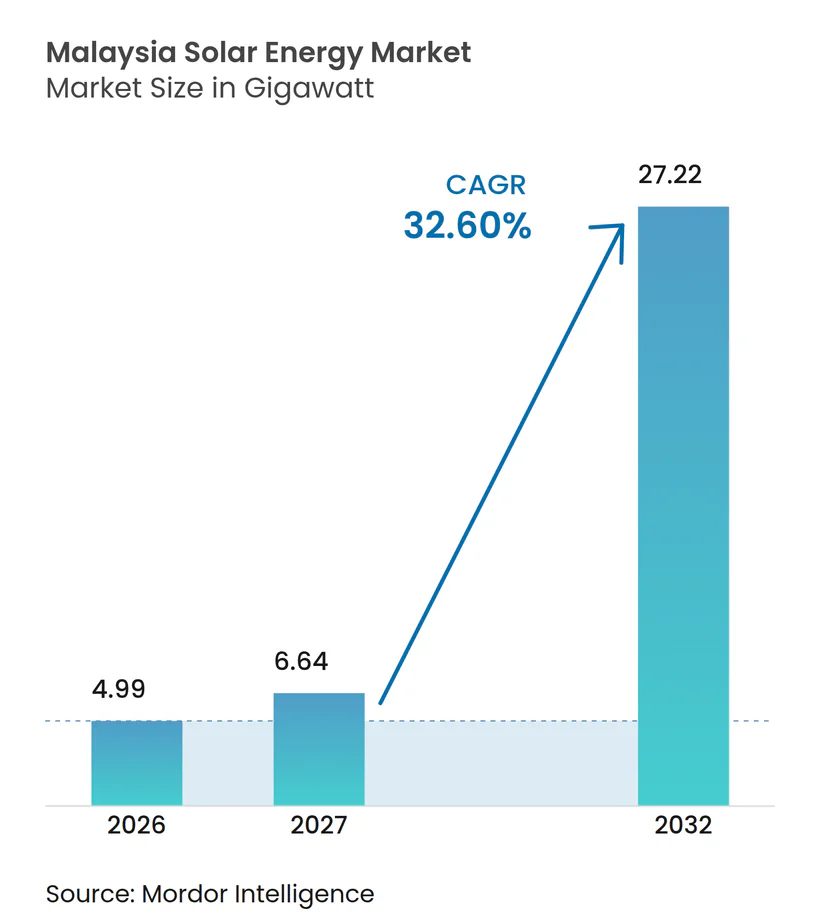
The Malaysia solar energy market size is projected to expand from 4.99 gigawatt in 2026 and 6.64 gigawatt in 2027 to 27.22 gigawatt by 2032, registering a CAGR of 32.6% between 2027 and 2032.
Malaysia’s auction pipeline and corporate commitments create demand across new plants and rooftop installations. Johor’s rising data-center electricity demand adds large prospective electricity buyers that solar developers can pursue. Equipment price exposure, connection liabilities and financing preparation make execution a separate commercial test from securing demand. Suppliers can secure module prices before delivery, reducing their exposure to later equipment-price changes. Auction allocations reach delivery through competitive selection, while rooftop orders depend on each applicant’s connection assessment and financing approval.
Key Report Takeaways
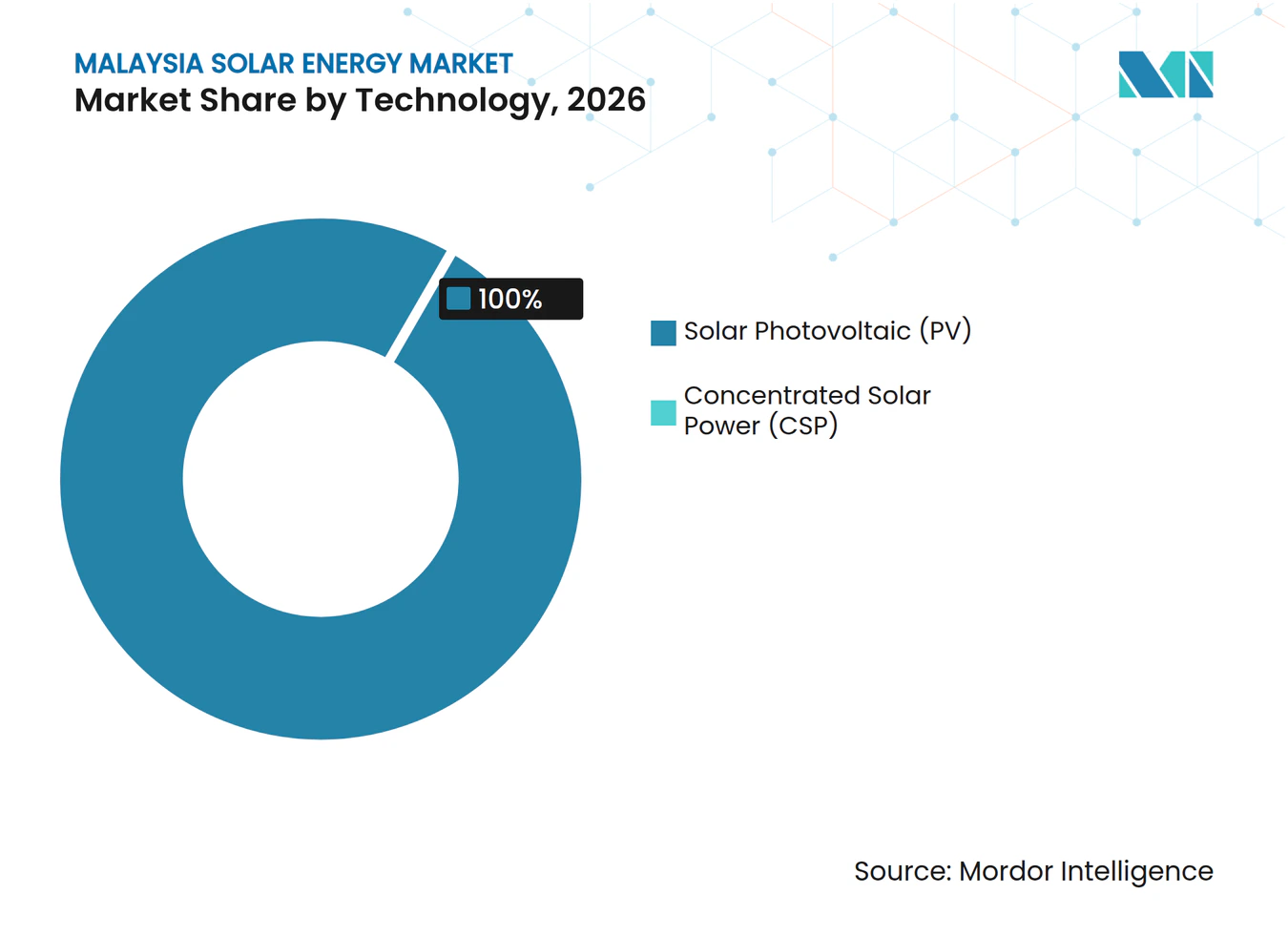
- Technology leadership sits with solar photovoltaic (PV), which held a 100% Malaysia solar energy market share in 2026 and is the fastest-growing segment, at a 32.6% CAGR between 2027 and 2032.
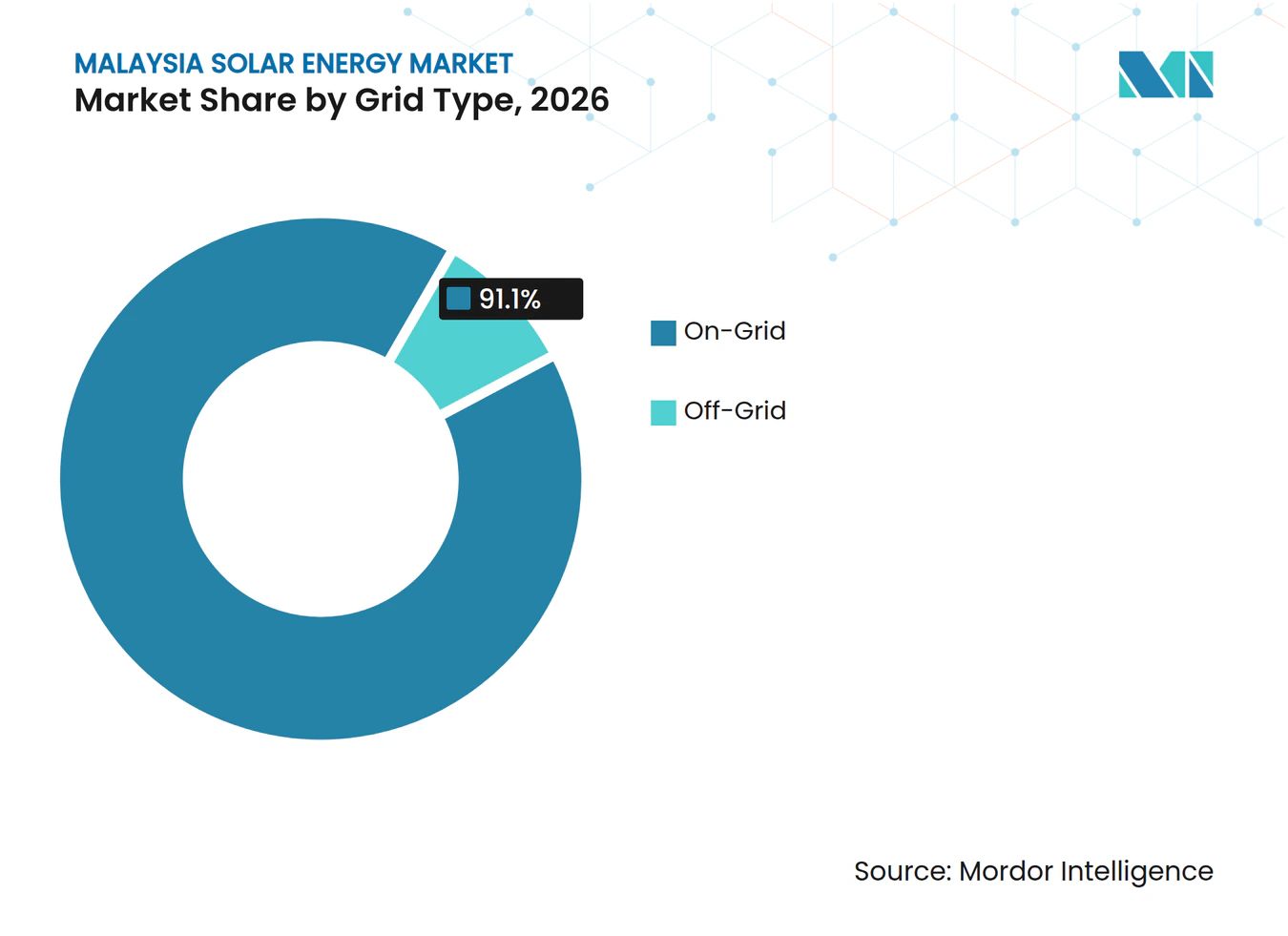
- By grid type, on-grid installations held a 91.1% share of the Malaysia solar energy market size in 2026, while off-grid solar is forecast to grow fastest at a 37.5% CAGR between 2027 and 2032.
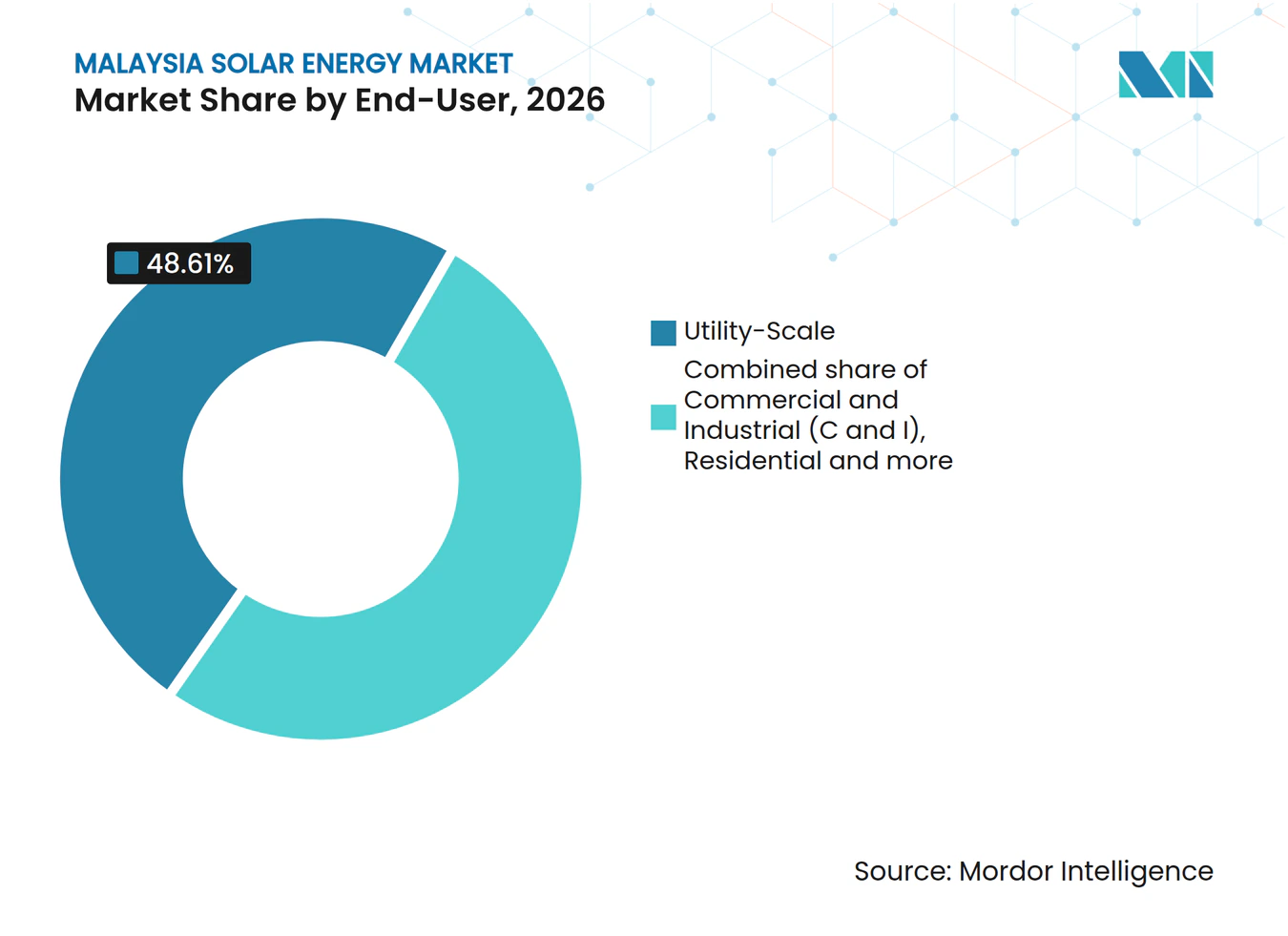
- Among end users, utility-scale facilities led with 48.61% of solar capacity in 2026, whereas residential solar is projected to grow fastest at a 36.1% CAGR between 2027 and 2032.
- Component demand links panels, inverters, mounting and tracking, balance-of-system electricals, and storage integration through distinct generation, connection and system-configuration roles.
Note: Market numbers in this report are based on Mordor Intelligence's proprietary estimation framework, which combines nine months of actuals with Q4 projections for base year 2026.
Market Trends and Insights
Drivers Impact Analysis of Malaysia Solar Energy Market*
| Driver | (~) % Impact on CAGR Forecast | Geographic Relevance | Impact Timeline |
|---|---|---|---|
| Government LSS auction expansions | +14% | Across Peninsular Malaysia | Medium term (2-4 years) |
| Declining PV module costs | +5% | Nationwide | Short term (≤ 2 years) |
| Rising corporate-PPA/RE100 demand | +8% | Cyberjaya, Mersing, Melaka, Iskandar Puteri and Gurun | Medium term (2-4 years) |
| Data-center power demand spike (Johor & Selangor) | +7% | Johor data-center campus | Medium term (2-4 years) |
| Virtual NEM (NOVA) policy implementation under existing contracts | +4% | Across Peninsular Malaysia | Short term (≤ 2 years) |
| Reservoir-based floating-solar push | +3% | Kenyir reservoir, Terengganu | Long term (≥ 4 years) |
| Source: Mordor Intelligence | |||
Government LSS auction expansions
Government procurement creates a defined development pipeline that can sustain solar orders beyond individual corporate purchasing decisions. PETRA approved 13 large-scale solar projects totaling 1,975 MWac under LSS PETRA 5+ on September 2, 2025. That tender received 37 applications offering 4,073 MW against a 2,000 MWac quota, showing participation beyond the available allocation. In July 2026, PETRA announced LSS6 with 2,500 MW of solar, 1,250 MW of battery storage and a separate 150 MW solar quota for Bumiputera companies in Peninsular Malaysia. [1] Oversubscribed bidding makes access to an allocation selective before the delivery stage begins. The announced pairing makes storage delivery part of the LSS6 offer, extending the procurement opportunity beyond generation alone.
Declining PV module costs
Low equipment costs improve solar affordability, although the commercial benefit depends on when projects secure their supply. IEA PVPS reported that Malaysian solar PV prices remained low through most of 2025, with gradual increases emerging toward year-end. It attributed the low prices to Chinese oversupply, continued domestic production and intense competition. Those conditions improve the equipment side of a project’s investment case, making the capacity proposition more financially accessible at the point of supply. The year-end increases make procurement timing a commercial variable, so the demand benefit is strongest for projects able to secure equipment during the low-price period.
Rising corporate-PPA/RE100 demand
Corporate solar demand spans facility electricity service and separately contracted energy attributes, creating different routes for suppliers to serve an identified buyer. On May 8, 2025, Gentari Renewables, Gentari’s wholly owned subsidiary, signed solar PPAs with Telekom Malaysia covering approximately 4.3 MWp across 6 facilities. [2] Gentari Renewables agreed to design, install and operate the systems, giving the buyer a contracted supply arrangement. In November 2025, SM 01 Sdn Bhd achieved financial close for its 29.99 MWac Gurun project and signed a Google PPA for energy attributes, with operation scheduled for 2027. Selling electricity service at corporate premises and selling energy attributes place different delivery obligations on solar suppliers.
Data-center power demand spike (Johor & Selangor)
Data-center growth in Johor expands the electricity-demand base that solar developers can seek to serve. Wood Mackenzie reported that data-center load in Johor more than doubled from 2024 to 2025. In June 2026, it estimated Johor data-center maximum demand at approximately 3.8 GW, nearly 1.5 times the state's current electricity demand. Yondr Group, the developer, owner and operator, handed over the first 25 MW of IT capacity at its Johor data center to a client on June 5, 2025, within a 98 MW IT project. A load of that scale makes Johor a location where solar developers can pursue large electricity buyers, and the initial handover shows a campus entering client use in stages.
Restraints Impact Analysis of Malaysia Solar Energy Market*
| Restraint | (~) % Impact on CAGR Forecast | Geographic Relevance | Impact Timeline |
|---|---|---|---|
| Grid congestion in Peninsular grid | -4% | Across Peninsular Malaysia | Medium term (2-4 years) |
| High financing cost for rooftop SME projects | -2.5% | Nationwide | Medium term (2-4 years) |
| Land-use conflicts with agriculture | -1.5% | Johor designated food-security zones | Long term (≥ 4 years) |
| Import-supply volatility for PV modules | -0.5% | Nationwide | Short term (≤ 2 years) |
| Source: Mordor Intelligence | |||
Grid congestion in Peninsular grid
Grid access can constrain a solar investment even when generation equipment is affordable because connection may require additional network works. In July 2025, Aurora Energy Research identified greater congestion and curtailment exposure in solar-heavy areas of Perak, Kedah, Terengganu and Pahang served by lower-voltage lines. Under Solar ATAP in Peninsular Malaysia, effective January 1, 2026, applicants bear all utility or grid-owner modification costs when technical assessment finds those works necessary. TNB commissioned its 100 MW/400 MWh Santong battery storage project on April 17, 2026, to store excess electricity and support grid stability as solar generation increases. Any network modifications identified by the assessment add applicant-funded expenditure to a rooftop project before connection.
High financing cost for rooftop SME projects
For sole proprietorships, partnerships and limited liability partnerships applying to CIMB’s SME Renewable Energy Financing-i, a rooftop solar proposal must be accompanied by business financial records. CIMB requires these applicants to supply their latest 3 years of management accounts. They must also provide their latest 6 months of bank statements, 3 years of income tax returns, and a solar PV installation proposal, agreement or contract. A solar project agreement alone leaves the application incomplete because these applicants must also document their business financial history.
*Our forecasts treat driver/restraint impacts as directional, not additive. The impact forecasts reflect baseline growth, mix effects, and variable interactions.
Malaysia Solar Energy Market Segment Analysis
By Technology:
PV Expansion Builds On An Established Deployment BaseSolar photovoltaic (PV) accounted for a 100% share of the Malaysia solar energy market size in 2026 and is the largest and fastest-growing segment, with a 32.6% CAGR between 2027 and 2032. IEA PVPS reported that 60 MW of LSS capacity was commissioned in 2025 through the DTU 1 and DTU 2 floating solar plants in Pasir Mas, Kelantan. With no concentrated solar power capacity in the market, supplier differentiation shifts toward delivering projects within PV rather than persuading buyers to switch solar technologies. The completed floating plants provide a delivery reference for water-based installations, allowing contractors to demonstrate execution in a specific setting while competing within the same generating technology.
PV also reaches institutional buyers through projects that spread installation work across separate government premises. By February 24, 2025, the Works Ministry had completed 5 of its 11 grid-connected PV installation projects in Malaysian government buildings. The other projects were then under construction or in pre-procurement. This mix of stages illustrates how a government-building portfolio can distribute demand across procurement, construction and handover instead of delivering capacity in a single block. Separate site schedules turn institutional portfolio execution into a coordination task beyond the handover of any single plant.



By Grid Type:
Network Integration And Remote Service Create Different DemandOn-grid installations represented a 91.1% Malaysia solar energy market share in 2026, making this the largest segment. Single Buyer’s Corporate Green Power Programme (CGPP) participant list gives April 2, 2026 for Cenergi Solar Kuala Ketil Sdn Bhd’s 29.99 MW project connecting at 132 kV in Kuala Ketil, Kedah. This combination of generation capacity and a specified network connection illustrates the physical interface through which a solar project participates in grid supply. The specified 132 kV interface makes grid-connection engineering a concrete project task alongside supplying the solar array.
Off-grid solar is the fastest-growing segment, with a 37.5% CAGR between 2027 and 2032. In November 2025, the Ministry of Works completed and handed over hybrid solar systems at 15 rural Sarawak schools within its 121-school program. The program aimed to replace diesel generators that were costly and difficult to maintain in remote areas. This gives off-grid solar a distinct value proposition where electricity service and system maintainability form part of the same installation decision. Delivering a usable power arrangement across scattered premises makes site-level service capability an important complement to generating equipment.

By End-User:
Utility Capacity And Commissioned Household Systems Shape DemandUtility-scale solar was the largest segment, accounting for 48.61% of solar capacity in 2026. On June 3, 2026, TNB Power Generation Sdn Bhd and Cypark Resources Berhad exchanged an EPCC contract for a 785 MWp hybrid hydro floating-solar project and a 1,190 MWh battery system at Kenyir. The agreement brings generation and storage into the same delivery assignment, with each retaining a separate capacity basis. Coordinating the floating array’s delivery with the battery package extends the commercial scope beyond installation and creates a larger integration responsibility within one contracted project.
Residential solar is the fastest-growing segment, with a 36.1% CAGR between 2027 and 2032. PETRA launched SuRIA Home on May 22, 2026, a rebate for Malaysian individual domestic low-voltage Solar ATAP customers whose systems are successfully commissioned with TNB, excluding previous solar-assistance or rebate recipients. Claims were scheduled from June 1 through December 31, 2026, subject to earlier allocation exhaustion, first-come, first-served access and one claim per eligible individual. At launch, PETRA expected 45,000 to 50,000 homes and around 250 MW of cumulative residential rooftop capacity. Tying eligibility to commissioning makes completed household installation the commercially relevant milestone for suppliers pursuing this incentive, connecting the customer’s financial benefit to actual delivery.
By Component (Qualitative Analysis):
Equipment Roles Extend Into Grid And System IntegrationSolar modules/panels formed the generating array of the 680 kWp rooftop system that TotalEnergies ENEOS commissioned at TechnipFMC’s Johor Bahru facility in July 2025. The system used more than 1,100 modules, with TotalEnergies ENEOS funding and installing it. TechnipFMC agreed to buy electricity under an 18-year PPA without upfront investment, while TotalEnergies ENEOS undertook to operate and maintain the system. Inverters (string, central, micro) provide power conversion, while the July 2026 NOVA guidelines describe smart-inverter voltage and frequency support for non-domestic participants in Peninsular Malaysia. The component proposition thus combines generation hardware with electrical functions shaped by the installation’s connection arrangement.
Mounting and tracking systems at TNB Renewables’ Kulim farm, commissioned in September 2026 with 45 MWp DC capacity and 29.99 MWac AC export capacity, involved ERS Energy as EPCC contractor and Nextpower as single-axis tracker provider. Balance-of-system and electricals include plant-site switchgear, transformers and cables, which the 2025 NEDA form separates from outside-plant interconnection facilities. Energy storage and hybrid integration under the June 2026 SELCO guidelines require non-domestic self-consumption systems above 1 MWac in Peninsular Malaysia, outside NEM and Solar ATAP, to include at least one hour of battery storage at 1 MWh per MWac, with AC or DC coupling permitted. Registered higher education institutions are exempt, and the battery requirement applied only after June 30, 2026 where installation was completed, Form G and H requirements met and licensing applications submitted by that date. These differences make mechanical design, electrical connection and storage configuration separate integration decisions within a solar installation.
Geography Analysis
Peninsular Malaysia contains distinct public-building and state-facilitated solar channels, illustrated by Selangor and the northern states. By June 2026, 70 government buildings in Selangor, including local-authority premises, had registered under the Net Energy Metering program. Penang broke ground on the Byram LSS5 farm on April 3, 2026, led by Penang Development Corporation subsidiary Solar Voltech with Solarvest as contractor and 29.99 MWp expected by July 2027. Public-premise registrations distribute potential installation work across existing buildings, whereas the Penang project concentrates development and construction around a state-linked generating site.
Johor’s development direction connects the choice of solar sites with the network infrastructure needed to integrate large renewable projects. Johor’s 2025 policy for renewable-energy development through 2030 prioritized solar farms and floating solar at identified project locations. The policy also recommended a renewable-energy grid in eastern Johor, called the Southern Johor Renewable Energy Corridor, to support large-scale renewable integration. Pairing an identified solar site with the proposed eastern network brings connection planning into the location decision, allowing developers to assess generation and integration together before committing to a generating facility.
Sabah offers a different consumer route through SELCO-PV SABAH 2.0, which includes on-site self-consumption and an off-grid PV category. Project providers can therefore address both premise-based generation and off-grid service within a state-specific program route. On September 17, 2026, developer reNIKOLA Gedong Solar (Sarawak) Sdn Bhd, a reNIKOLA Holdings subsidiary, signed a 30-year PPA with Syarikat Sesco Berhad for a planned 250 MWac facility. Syarikat Sesco Berhad is wholly owned by Sarawak Energy Berhad. Sabah’s premise-based route and Sarawak’s utility PPA call for different commercial structures, linking system delivery to an individual consumer in one case and a contracted power purchaser in the other.
Regulatory Framework and Outlook
The selected jurisdictions compare Malaysia’s federal framework for Peninsular Malaysia with Sabah’s state rules from a rooftop solar developer’s perspective. Solar ATAP participants in Peninsular Malaysia operate under program terms lasting up to 10 years from commencement. The comparison weighs the value of exported generation against the eligibility, approval and technical duties that developers must incorporate into a solar offering.
Regulatory Table of Malaysia Solar Energy Market
| Decision factor | Malaysia | Sabah |
|---|---|---|
| Primary authority | Energy Commission, for Peninsular Malaysia | Energy Commission of Sabah |
| Key instruments or direction | Solar ATAP guidelines | SELCO-PV SABAH 2.0 and Solar Rakyat Sabah guidelines |
| Commercial effect | Consumer-category-specific surplus export credits, subject to eligibility and network-capacity requirements | SELCO self-consumption without grid exports and with contractor-managed applications; separate conditional residential export credits |
| Current policy attractiveness | High | Medium |
| Future direction of policy attractiveness | No change | No change |
| Source: Mordor Intelligence | ||
Malaysia’s High rating reflects eligible Peninsular Solar ATAP export credits based on the domestic energy charge or non-domestic average SMP. Sabah’s Medium rating reflects non-exporting SELCO economics and contractor-managed applications at all grid-connected capacities and above 5 kWp off-grid. Solar Rakyat Sabah permits bill credits for residential surplus unused because of operational constraints or monthly or seasonal demand variation during the first 12 contract years, with rollover up to 12 months. Malaysia’s No change direction rests on Solar ATAP’s terms set from January 1, 2026, while Sabah’s rests on SELCO-PV SABAH 2.0, issued March 1, 2026 to replace the 2024 guideline, and Solar Rakyat’s defined credit period, giving developers operative routes on which to base offerings.
Value Chain Stages
The value chain compares equipment manufacture, project integration and operating support by who supplies the work and how each stage earns revenue. MIDA describes Malaysia’s solar ecosystem as spanning upstream cells and modules alongside downstream electrical components and system integrators. Commercial value moves from equipment transactions to contracted project delivery and continuing service, with different capabilities and obligations at each handoff.
Value Chain Analysis Table of Malaysia Solar Energy Market
| Primary activity | Key participants | Value capture | Bottleneck | Resilience response |
|---|---|---|---|---|
| Cell and module manufacturing | Cell and module manufacturers such as LONGi Green Energy Technology Co Ltd. | Cell and module sales | Price and supplier-delivery exposure before installation | Use price protection and supplier-performance safeguards |
| Project integration and commissioning | Turnkey EPCC contractors such as Solarvest Holdings Berhad | EPCC project fees | Coordination of engineering, procurement and commissioning obligations | Assign equipment-delivery and commissioning responsibilities to defined milestones |
| Operations and maintenance | Solar O&M providers such as Powertrack | Maintenance, monitoring and replacement service fees | Sustaining field coverage across dispersed solar assets | Combine performance monitoring with regional service teams |
| Source: Mordor Intelligence | ||||
Solarvest said it signed a 2 GW blanket order at locked-in prices in the second half of 2025, protected by refundable deposits and bank guarantees against supplier non-performance. Such safeguards address exposure at the equipment-to-project handoff while leaving manufacturing and integration as distinct sources of supplier value. Recurring maintenance work extends the commercial relationship beyond commissioning, allowing providers that combine delivery and field support to pursue service income alongside project fees.
Competitive Landscape
Market Concentration
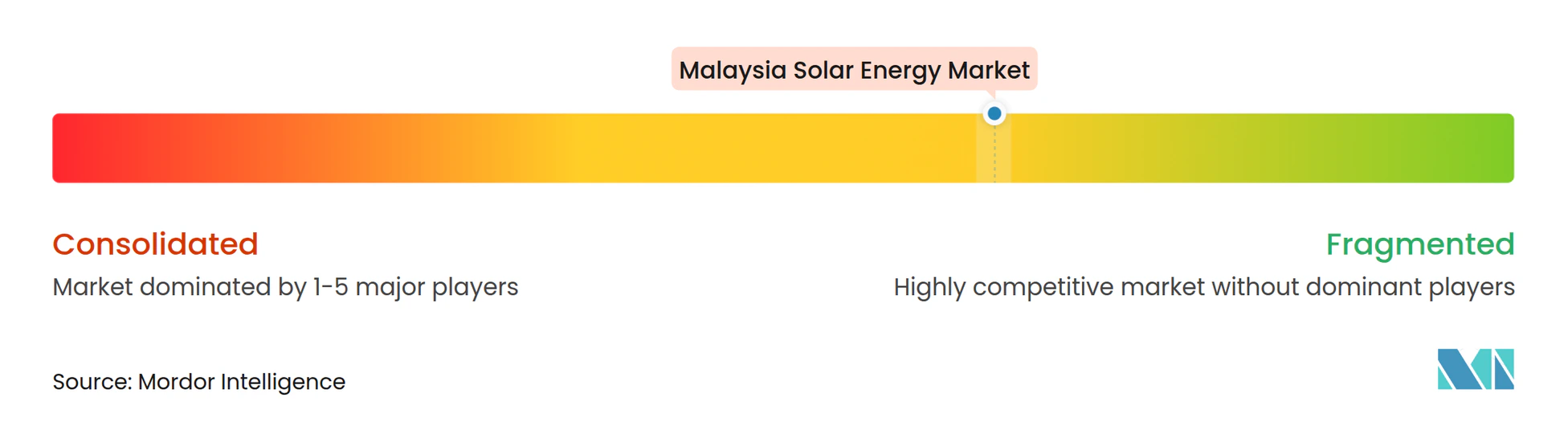
The competitive field is moderately fragmented across manufacturers, project contractors and service providers, whose roles expose them to different commercial pressures. IEA PVPS included JA Solar Technology Co. Ltd. in a group of Malaysian PV manufacturers that scaled back operations or ceased manufacturing in 2025. In October 2025, Solarvest Holdings Berhad’s 60%-owned joint venture signed a 30-year PPA with Sarawak Energy to develop a 100 MW solar plant in Mukah, Sarawak. This contrast separates factory exposure from downstream project opportunity, showing why competitive strength in solar delivery depends on different activities from maintaining a manufacturing footprint.
Other companies covered include TNB Engineering Corporation Sdn Bhd, Canadian Solar Inc. and Plus Xnergy Holding Sdn Bhd. In August 2025, BM GreenTech Berhad said its indirect wholly owned subsidiary Plus Xnergy Services Sdn Bhd signed contracts with NEFIN V Power Sdn Bhd to develop a 29.99 MWac solar PV plant in Malaysia. On July 6, 2026, BM GreenTech announced that its wholly owned subsidiary Plus Xnergy Holding acquired 100% of NEFIN V Power. The acquired company held rights to develop a 29.99 MWac farm under the Corporate Green Power Programme. Ownership of the development vehicle extends the group’s commercial exposure beyond construction work to the planned project’s development.
In June 2026, Plus Xnergy Services commissioned a 20 MWh self-consumption battery energy storage system at a food manufacturing facility in Perak. The deployment was developed in collaboration with HyperStrong, a specialist storage supplier. Plus Xnergy announced it as one of Malaysia’s largest single-deployment self-consumption battery systems to date. Separately, Sabah’s March 2026 Sabah Registered PV Investor rules require solar-leasing and PPA providers outside LSS to register, limiting non-Sabahan firms to non-residential projects above 72 kWac and requiring 80% local Sabahan staffing throughout registration. SaRPVI registration restricts non-Sabahan solar-leasing and PPA competitors outside LSS to non-residential projects above 72 kWac with at least 80% local staffing, so delivery references alone cannot secure entry.
Malaysia Solar Energy Industry Leaders
-
JA Solar Technology Co. Ltd.
-
Solarvest Holdings Berhad
-
TNB Engineering Corporation Sdn Bhd
-
Canadian Solar Inc.
-
Plus Xnergy Holding Sdn Bhd
- *Disclaimer: Major Players sorted in no particular order
Malaysia Solar Energy Market Companies Covered in this Report
- First Solar Inc.
- Canadian Solar Inc.
- Plus Xnergy Holding Sdn Bhd
- TNB Engineering Corporation Sdn Bhd
- Solarvest Holdings Berhad
- JA Solar Technology Co. Ltd.
- SunPower Corporation
- Hasilwan (M) Sdn Bhd
- TS Solartech Sdn Bhd
- Ditrolic Energy
- Cypark Resources Berhad
- Samaiden Group Berhad
- Gading Kencana Sdn Bhd
- Engie Services Malaysia
- Huawei Technologies Malaysia Sdn Bhd
- JinkoSolar Holding Co Ltd.
- LONGi Green Energy Technology Co Ltd.
- Hanwha Q CELLS
- Sunview Group Berhad
- Risen Energy Co Ltd.
Key Opportunities for Market Participants
The opportunities compare rooftop self-supply, corporate procurement and community supply by how each converts buyer demand into new solar projects. Solar ATAP began on January 1, 2026, offering eligible Peninsular Malaysia TNB consumers an application route through SEDA-registered PV service providers. [3] The commercial choice is which consumer relationship and connection arrangement a developer can serve within the applicable program conditions.
Market Opportunities Table of Malaysia Solar Energy Market
| Opportunity | Why now | Buyer / lead segment | Recommended play | Main barrier | Likely beneficiaries |
|---|---|---|---|---|---|
| Eligible host-rooftop solar | Solar ATAP provides a rooftop application route | Domestic and non-domestic TNB consumers | Combine rooftop design with registered-provider application support | Technical assessments and exclusion of consumers already registered under SelCo or NEM | Registered PV service providers |
| Corporate off-site solar supply | PETRA announced access-charge reductions of up to 40% against previous values in August 2025, expecting greater corporate demand | Corporate green-electricity consumers in Peninsular Malaysia | Structure solar supply around the applicable access charge and buyer commitment | Access charges remain part of supply economics | Solar developers such as Plus Xnergy Holding Sdn Bhd, a wholly owned BM GreenTech Berhad subsidiary |
| Nearby community rooftop supply | CREAM applications opened on June 1, 2025 | Nearby registered low- or medium-voltage consumers in Peninsular Malaysia | Aggregate a suitable buyer with a new rooftop plant owned and operated by the local generator | Approximately 5-kilometer range determined through connecting substations, power-system study, NEDA registration and required agreements | Local energy generators and aggregators |
| Source: Mordor Intelligence | |||||
Solar ATAP offers the clearest near-term opening for registered PV service providers serving eligible domestic and non-domestic TNB consumers in Peninsular Malaysia. Its application route places those providers directly between an interested rooftop host and the program’s submission and technical-assessment steps. Registered providers can turn an eligible host’s interest into an application for its own rooftop installation, avoiding the separate buyer-matching task required for nearby community supply.
Recent Industry Developments in Malaysia Solar Energy Market
- Sep 2026: reNIKOLA Gedong Solar (Sarawak) Sdn Bhd, a reNIKOLA Holdings subsidiary, signed a 30-year PPA with Syarikat Sesco Berhad for a planned 250 MWac solar facility in Sarawak. Syarikat Sesco Berhad is wholly owned by Sarawak Energy Berhad.
- Sep 2026: TNB Renewables commissioned its first solar farm using Nextpower single-axis tracking in Kulim, Kedah. ERS Energy was the EPCC contractor for the plant, with 45 MWp DC capacity and 29.99 MWac AC export capacity.
- Jul 2026: BM GreenTech Berhad’s wholly owned subsidiary Plus Xnergy Holding Sdn Bhd acquired NEFIN V Power Sdn Bhd. The acquired company held development rights for a 29.99 MWac solar PV farm under CGPP.
Malaysia Solar Energy Market Report Scope and Research Methodology
Market Definition and Coverage
Malaysia solar energy market measures the installed electricity-generating capacity of solar power systems in Malaysia. It covers capacity in service across grid connections and end-user classes, with system components classified within the capacity they support.
Scope exclusions: Solar heating and cooling systems, separately sold solar modules, inverters, mounting and tracking systems, balance-of-system equipment and storage equipment, standalone energy storage capacity, and solar system operation and maintenance services are excluded.
Segments Covered in This Report
- By Technology
- Solar Photovoltaic (PV)
- Concentrated Solar Power (CSP)
- By Grid Type
- On-Grid
- Off-Grid
- By End-User
- Utility-Scale
- Commercial and Industrial (C&I)
- Residential
- By Component (Qualitative Analysis)
- Solar Modules/Panels
- Inverters (String, Central, Micro)
- Mounting and Tracking Systems
- Balance-of-System and Electricals
- Energy Storage and Hybrid Integration
Data Sources, Market Sizing, and Validation
Desk Research
Official deployment and policy evidence can be drawn from sources such as the Energy Commission's operational renewable-capacity update, PETRA's LSS program statements, and SEDA Malaysia's Solar ATAP guidance to establish commissioned capacity, procurement timing, eligibility and connection requirements. IEA PVPS country updates provide program-level Malaysian PV installations, while the International Agency A's Malaysia outlook supplies scenario context for solar deployment and grid investment.
Company annual reports, Bursa Malaysia filings, investor materials, and reputable Malaysian business and energy press can clarify project commissioning, procurement, financing and operating developments for cross-checking. The named sources are illustrative and not exhaustive, and further sources inform collection, validation and clarification.
Primary Interviews and Surveys
Structured interviews and targeted questionnaires would cover Malaysian utility project developers, rooftop installers, equipment suppliers, corporate energy buyers, and grid or program specialists, with respondents selected across company sizes and operational and leadership roles. Analysts would use these discussions to test secondary evidence on project commissioning, tender conversion, rooftop adoption, connection constraints, and segment assignment, then investigate material contradictions with follow-up questions. Where direct evidence is unavailable, the model would retain a source-backed range or scenario and triangulate it against official capacity releases, project records, and company disclosures.
Distribution of primary research fieldwork respondents
| Company type | Respondent position | Region |
|---|---|---|
| Top tier: 30% | CXOs: 15% | |
| Mid tier: 50% | Functional/Unit leaders: 35% | |
| Smaller Players: 20% | Managers: 50% |
Market-Sizing & Forecasting
Because program releases and company disclosures can use different status dates, the model assigns each capacity item to the date and commissioning stage that its source documents. The model starts from Malaysia's total installed solar-generating capacity and builds a top-down estimate for capacity in service, using official program totals and commissioned project records as anchors. Core indicators include LSS awards reaching operation, rooftop program registrations and completions, reported installed capacity by grid and customer type, and module-cost and grid-connection conditions. These distinguish near-term additions from projects that remain in development. Analysts derive technology, grid-type, and end-user shares from program records, project attributes, and company disclosures, then check selective project and installer roll-ups against the national total. A scenario model carries expected commissioning and rooftop adoption forward through 2032, with slower and faster cases for tender delivery, connection timing, and distributed-system uptake, while sampled project capacity and commissioning evidence provide bottom-up checks and gaps remain as ranges until corroborated. Malaysian industry and program experts would review the contribution and timing of each driver, and material disagreements would trigger source checks or alternative scenario assumptions.
Data Validation & Update Cycle
Where commissioning dates remain unclear, the project-level check holds the addition outside the in-service total until a reliable operating date is documented. Analysts triangulate official capacity statistics, program awards, commissioning announcements, company filings, and primary responses, checking that each figure refers to installed generating capacity and a consistent measurement date. Independent capacity signals and segment roll-ups are compared with the national series, while duplicate projects, unit conversions, timing shifts, and unusual year-on-year changes receive anomaly review before sign-off. A second analyst reviews source traceability, calculations, boundary consistency, and explanations, and a first analyst resolves flagged differences. Re-contact is triggered when a respondent's account conflicts with documentary evidence or a material project status changes. The dataset is refreshed annually, updated between cycles after material policy, tender, grid, or project events, and given a fresh pre-delivery review.
Mordor Intelligence's Malaysia Solar Energy Market Size Versus Other Published Estimates
Published estimates can differ in the transactions and products they count and the inputs used to model demand. Malaysia solar energy market measures the installed electricity-generating capacity of solar power systems in Malaysia.
Key Gap Drivers include the study's defined coverage and market-specific modeling choices. Core indicators include LSS awards reaching operation, rooftop program registrations and completions, reported installed capacity by grid and customer type, and module-cost and grid-connection conditions.
Benchmark comparison
| Source | Market Size | Gaps in Research Methodology |
|---|---|---|
| Mordor Intelligence | 6.64 gigawatt (2027) | |
| International Agency A | 17.1 GW (2030) | The later measurement year captures additional installations, and the published total is a modeled 1.5-S RE90 pathway. |
| Global Consultancy A | 29.7 GW (2035) | The forecast horizon includes additional commissioning beyond the report's measurement year. |
For Mordor Intelligence, where commissioning dates remain unclear, the project-level check holds the addition outside the in-service total until a reliable operating date is documented.
Key Questions Answered in the Report
What is the Malaysia solar energy market size and growth outlook?
The market is projected to expand from 6.64 gigawatt in 2027 to 27.22 gigawatt by 2032, at a 32.6% CAGR between 2027 and 2032.
What is driving solar energy demand in Malaysia?
Government procurement and corporate PPAs are central drivers. PETRA announced LSS6 in July 2026 with 2,500 MW of solar, 1,250 MW of battery storage and a separate 150 MW solar quota for Bumiputera companies in Peninsular Malaysia.
Which solar technology leads installed capacity in Malaysia?
Solar photovoltaic (PV) held 100% of solar capacity in 2026 and is forecast to grow at a 32.6% CAGR between 2027 and 2032.
Which companies are prominent in Malaysia’s solar industry?
Companies covered include JA Solar Technology Co. Ltd., Solarvest Holdings Berhad, TNB Engineering Corporation Sdn Bhd, Canadian Solar Inc. and Plus Xnergy Holding Sdn Bhd.
What can slow rooftop solar project delivery in Malaysia?
Solar ATAP’s 2026 rules require Peninsular Malaysia applicants to pay all utility or grid-owner network modification costs if technical assessment finds the works necessary.
How do solar development routes differ across Malaysian states?
In Selangor, 70 government buildings had registered under Net Energy Metering by June 2026. In September 2026, reNIKOLA Gedong Solar signed a 30-year power purchase agreement with Syarikat Sesco Berhad for a planned 250 MWac facility in Sarawak.