
Market Overview
| Study Period | 2021 - 2031 |
|---|---|
| Forecast Data Period | 2026 - 2031 |
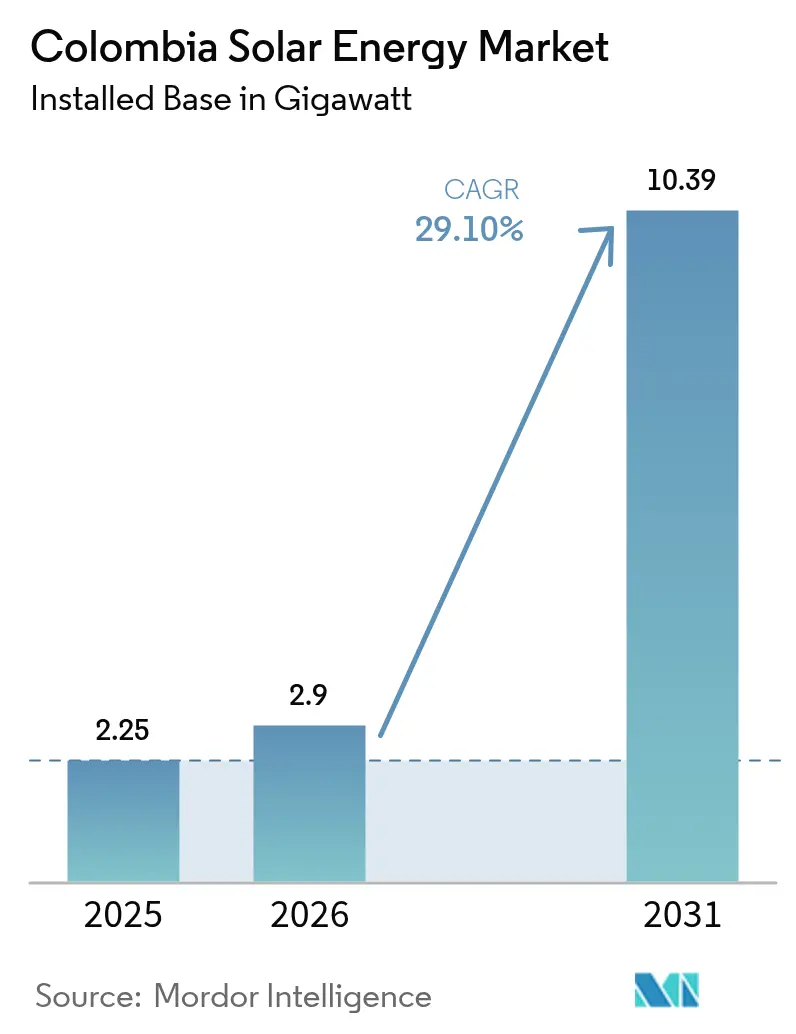
| Base Year Market Size (2025) | 2.25 gigawatt |
| Market Volume (2026) | 2.9 gigawatt |
| Market Volume (2031) | 10.39 gigawatt |
| Growth Rate (2026 - 2031) | 29.10 % |
| Market Concentration | Medium |
Major Players
*Disclaimer: Major Players sorted in no particular order Image © Mordor Intelligence. Reuse requires attribution under CC BY 4.0. |
|
Colombia Solar Energy Market Analysis by Mordor Intelligence
The Colombia Solar Energy Market size was valued at 2.25 gigawatt in 2025 and estimated to grow from 2.9 gigawatt in 2026 to reach 10.39 gigawatt by 2031, at a CAGR of 29.10% during the forecast period (2026-2031).
This forecast highlights the Colombia solar energy market size trajectory and underscores the country’s growing role within Latin American renewables. Growth reflects a deliberate pivot away from hydropower following a 23% price spike in April 2024, driven by El Niño, which exposed hydro variability risks and accelerated demand for new generation sources.[1]Daniela Morales Soler, “Alza de precios eléctricos tras El Niño,” portafolio.co Rapid deployment is evident, as installed solar capacity surpassed the 1 GW mark in 2024, with an additional 952 MW added since early 2023 across both grid-connected and off-grid systems. Declining levelised costs, VAT exemptions under Law 1715, and streamlined auctions continue to draw international developers to the Colombia solar energy market. Government support for green-hydrogen projects, which rely on abundant low-cost solar electricity, further widens long-term demand for the Colombia solar energy market.
Key Report Takeaways
- By grid type, on-grid installations held 71.80% of the Colombia solar energy market share in 2025, while off-grid capacity is forecast to expand at a 34.20% CAGR through 2031.
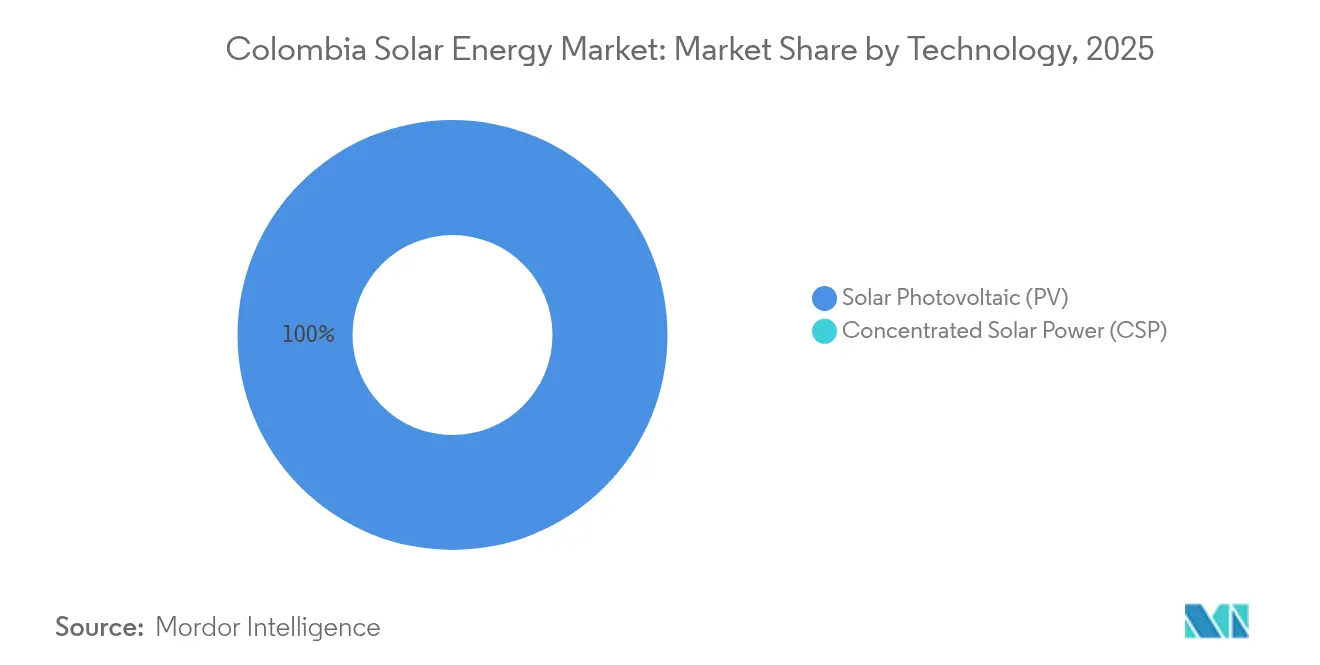
- By technology, Solar PV captured 100.00% of installed capacity in 2025 and is expected to maintain its lead with a 29.60% CAGR through 2031.
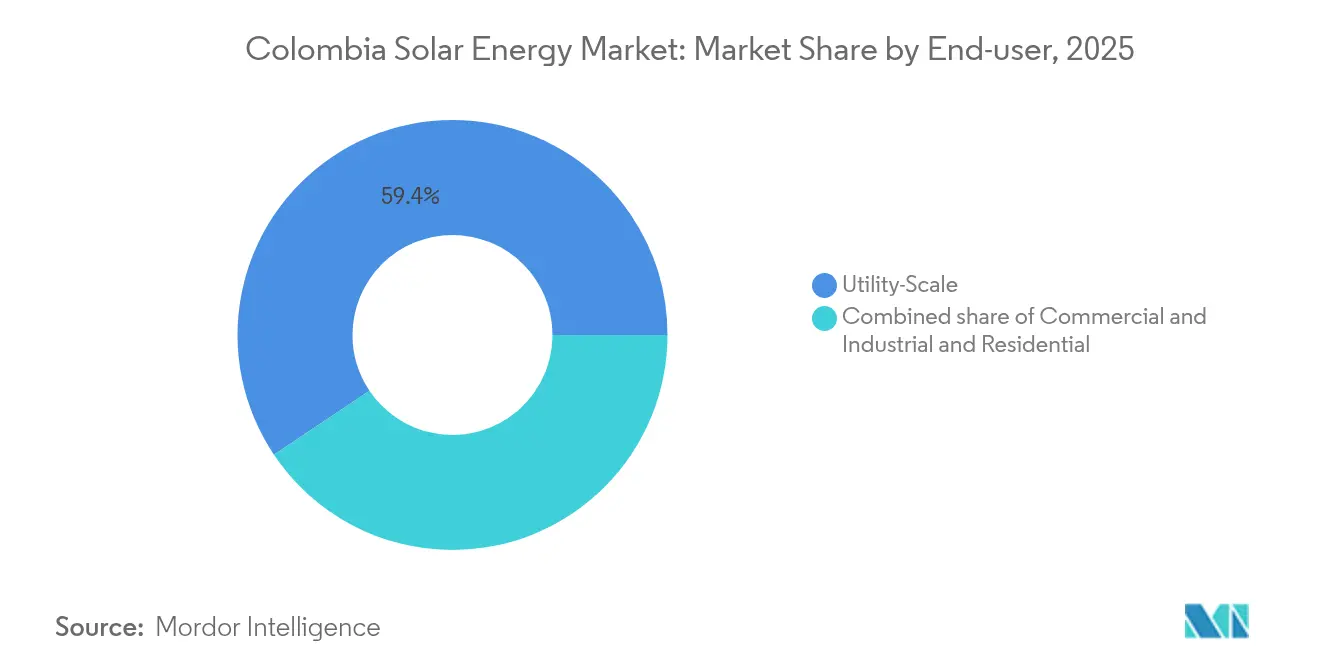
- By end user, utility-scale plants accounted for 59.40% of the Colombia solar energy market size in 2025, whereas residential capacity is projected to grow at a 32.10% CAGR to 2031.
- Atlántico, Cesar, and Córdoba contributed 54% of the 2024 additions, while Tolima and Cundinamarca, together, hold 73% of the capacity planned for 2025.
- Enel Colombia, Celsia, and Atlas Renewable Energy together controlled 35% of national solar output in 2024.
Note: Market size and forecast figures in this report are generated using Mordor Intelligence’s proprietary estimation framework, updated with the latest available data and insights as of 2026.
Colombia Solar Energy Market Trends and Insights
Drivers Impact Analysis*
| Driver | (~) % Impact on CAGR Forecast | Geographic Relevance | Impact Timeline |
|---|---|---|---|
| Falling levelised cost of PV electricity | 8.2% | National, with early gains in Caribbean coast | Medium term (2-4 years) |
| Net-metering incentives for small self-generators | 5.8% | Urban centers, particularly Bogotá, Medellín, Cali | Short term (≤ 2 years) |
| Corporate PPAs from mining & data-centre sectors | 6.4% | Mining regions (Cesar, La Guajira), urban data centers | Medium term (2-4 years) |
| Green-hydrogen linkage raising solar demand | 4.9% | La Guajira, Caribbean coast industrial zones | Long term (≥ 4 years) |
| Digitised O&M lowering operating risk | 2.7% | Large-scale utility projects nationwide | Medium term (2-4 years) |
| Accelerated grid-connection process for <5 MW | 3.5% | Distributed generation markets nationwide | Short term (≤ 2 years) |
| Source: Mordor Intelligence | |||
Falling Levelised Cost of PV Electricity
Utility projects now post LCOE below USD 0.10/kWh, undercutting diesel generation that dominates non-interconnected zones. Local distribution hubs established by global module vendors reduce logistics premiums, while the European Investment Bank's financing of Enel Colombia's 486 MW portfolio demonstrates investor confidence in continued cost declines.[2]European Investment Bank, “Loan to Enel Colombia,” eib.org Bifacial panels in La Loma raise annual yield and reinforce the cost advantage of the Colombia solar energy market.
Net-Metering Incentives for Small Self-Generators
Decree 348 streamlines interconnection and guarantees credit for exported surplus, shrinking rooftop payback periods to 11.3-13.8 years. Banco de Bogotá offers low-cost financing for residential arrays, and distribution utilities deploy smart meters to support bidirectional flows.[3]Comisión de Regulación de Energía y Gas, “Decreto 348,” creg.gov.co
Corporate PPAs from Mining & Data-Centre Sectors
After the 2024 price spike, mining operators have secured long-term solar PPAs to hedge against volatility, exemplified by PazdelRío’s 9.9 MW deal, which cuts 2,268 t of CO₂ annually. Hyperscale data centre operators demand renewable certificates, spurring the development of tailored contract structures permitted by Colombia’s open-access regulations.
Green-Hydrogen Linkage Raising Solar Demand
The national roadmap, targeting 1.9 million tonnes of annual hydrogen demand by 2050, requires gigawatts of new solar capacity. Ecopetrol pilots confirm technical viability at La Guajira, where high irradiation supports round-the-clock electrolyser operations. Export-oriented offtake agreements underpin large solar clusters dedicated to hydrogen production.
Restraints Impact Analysis*
| Restraint | (~) % Impact on CAGR Forecast | Geographic Relevance | Impact Timeline |
|---|---|---|---|
| Land-use conflicts in La Guajira | -4.2% | La Guajira department, indigenous territories | Medium term (2-4 years) |
| Transmission bottlenecks on Caribbean coast | -2.8% | Caribbean coastal departments | Short term (≤ 2 years) |
| Peso depreciation raising module import costs | -2.4% | National, affecting all import-dependent projects | Short term (≤ 2 years) |
| Community opposition driven by indigenous consultation gaps | -3.3% | Indigenous territories, primarily La Guajira | Long term (≥ 4 years) |
| Source: Mordor Intelligence | |||
Land-Use Conflicts in La Guajira
Wayuu communities have halted major wind projects and are extending scrutiny to large solar arrays that overlap grazing lands and sacred sites, causing Celsia and Enel to suspend developments and negotiate higher royalty frameworks. Cultural consultation gaps raise reputational risk and complicate timelines despite a new 6% royalty proposal designed to share economic benefits.[4]Alexander Iñigo, “Indigenous resistance in La Guajira,” theguardian.com
Transmission Bottlenecks on Caribbean Coast
The delayed Colectora line limits the evacuation of 6 GW of renewables slated for La Guajira, forcing developers to stagger commissioning schedules or fund costly grid upgrades. Concentrated build-out stress-tests legacy networks originally designed for dispersed thermal plants, pressing authorities to accelerate new 500 kV corridors.
*Our forecasts treat driver/restraint impacts as directional, not additive. The impact forecasts reflect baseline growth, mix effects, and variable interactions.
Segment Analysis
By Technology: Solar PV Sustains Total Market Leadership
Solar PV accounted for 100.00% of installed capacity in 2025. Crystalline-silicon modules dominate due to their high efficiency and extensive global supply chain. The Colombia solar energy market continues to adopt bifacial panels, single-axis trackers, and digital O&M systems that reduce downtime. Concentrated Solar Power remains absent due to higher costs and water requirements, despite irradiation levels exceeding 4.5 kWh/m² per day.
Utility developers integrate storage to improve capacity factors, while distributed systems incorporate smart inverters that manage bidirectional flows under net metering. Continuous cost compression supports a 29.60% CAGR for Solar PV through 2031 within the Colombia solar energy market.



By Grid Type: Off-Grid Growth Accelerates Rural Access
On-grid capacity commanded 71.80% of installations in 2025. Off-grid momentum rises with a 34.20% CAGR outlook, propelled by the Light for the Amazon program targeting 228,000 homes where diesel costs top USD 0.30/kWh. Hybrid mini-grid configurations combine solar, batteries, and backup generators to ensure reliability in remote areas such as Putumayo and Vichada.
International donors and government subsidies improve affordability, and new business models attract private capital to the Colombia solar energy market’s off-grid segment.
By End User: Residential Installations Lead Future Growth
Utility-scale assets held 59.40% of the Colombia solar energy market share in 2025, anchored by 4.4 GW of auction-backed PPAs. Commercial and industrial buyers sign bespoke PPAs to secure stable pricing. Residential capacity is expected to show the highest growth outlook at a 32.10% CAGR through 2031, driven by net-metering and the USD 10 billion Colombia Solar program, which subsidizes low-income households.
Solar-as-a-service models further lower barriers by spreading upfront costs over multi-year service contracts. Attractive payback periods of 11-14 years motivate middle-income adoption, adding depth to the Colombia solar energy market.
Geography Analysis
Solar build-out concentrates along the Caribbean coast, where Atlántico, Cesar, and Córdoba delivered 54% of added capacity in 2024, benefiting from irradiation above 4.5 kWh/m² day and proximity to existing 500 kV lines. La Guajira hosts marquee projects such as Enel’s 370 MW Guayepo complex, though indigenous land conflicts and grid bottlenecks have delayed 82% of regional pipelines.
Interior departments are gaining traction as developers diversify to mitigate coastal congestion. Tolima anchors Atlas Renewable Energy’s 201 MW Shangri-La plant, while Cundinamarca and Tolima, together, represent 73% of the capacity scheduled for 2025 commissioning, reflecting streamlined permitting and lower social conflict risk. The Colombia solar energy market size for interior regions is projected to rise at double-digit rates, underscoring the geographic broadening of investment flows.
Remote Amazonian and Orinoquia departments present high-margin opportunities for distributed solar, replacing diesel generation that costs above USD 0.30/kWh in non-interconnected zones. Bogotá, Medellín, and Cali continue to lead rooftop installations under net metering, confirming the critical mass of urban markets. Geographic diversification buffers systemic risk and aligns Colombia’s decarbonisation goals with inclusive regional development.
Regulatory Landscape
Colombia’s solar regulatory framework continues to focus on incentives for self-generation and on clearer pathways for project interconnection, with oversight by the Comisión de Regulación de Energía y Gas (CREG) and planning and connection processes managed through entities such as UPME. Decree 0972 of 2025 created the Programa Colombia Solar to promote residential self-generation for strata 1, 2, and 3, shifting part of the policy focus from electricity consumption subsidies to enabling rooftop and small-scale solar adoption.
In 2026, regulators moved to address grid congestion and compliance issues affecting project commissioning. UPME issued Resolution 000358 of 2026 to establish updated procedures for allocating transmission capacity to generation projects, aimed at speeding connections to the National Interconnected System (SIN). CREG Resolution 101-104 of 2026 set a normalization procedure for solar plants in local distribution systems (SDL) that had moved into testing status after missing prior technical requirements, tightening operational readiness expectations for developers and operators.
Competitive Landscape
Enel Colombia leads the Colombia solar energy market with a significant share of national output through its flagship projects, Guayepo (370 MW) and La Loma (187 MW). Celsia follows with 350 MW across 18 plants, leveraging existing customer relationships to lock in industrial PPAs. International module giants such as Trina Solar, Canadian Solar, and First Solar have established supply partnerships that guarantee bankable equipment pipelines.
Competition intensifies as Atlas Renewable Energy, Statkraft, and Verano Energy pursue buy-and-build strategies, drawn by a transparent auction regime and robust demand outlook. Traditional thermal players AES Colombia and Grupo Energía Bogotá are pivoting toward renewables to preserve relevance, creating a crowded field where operational expertise and local stakeholder management become decisive advantages. Developers are increasingly integrating storage, digital operations and maintenance (O&M), and community programs to differentiate their bids.
Capital allocation remains aggressive: Enel Américas earmarks USD 1.7 billion for Colombia between 2025 and 2027, while Ecopetrol’s acquisition of Enerfín Colombia signals state-backed scale-up ambitions. Vertical integration across development, EPC, and asset management enables margin capture along the value chain, suggesting that supply-chain control will shape future competitive hierarchies within the Colombia solar energy market.
Colombia Solar Energy Industry Leaders
-
Enel Green Power Colombia
-
Celsia S.A.
-
Grenergy Renovables S.A.
-
Canadian Solar Inc.
-
Ventus Ingeniería SRL
- *Disclaimer: Major Players sorted in no particular order


Market Opportunities and Future Outlook
Distributed generation and residential self-generation stand out as a near-term opportunity, supported by active policy and planning. Decree 0972 of 2025 established the Colombia Solar program targeting strata 1, 2, and 3 households, which creates a more defined channel for scaling rooftop systems beyond early-adopter segments. On the supply side, UPME’s Indicative Generation Expansion Plan 2025-2039 includes 6,088 MW of solar distributed generation incorporation through 2038, supporting a longer runway for rooftop and behind-the-meter deployments alongside utility-scale growth.
For utility-scale pipelines, permitting and financing mechanisms are being refined in ways that raise throughput for mid-sized projects and improve bankability. Decree 1033 of 2025 introduced the LASolar framework (Licencia Ambiental Solar con Diseno Optimizado), providing an optimized environmental licensing process for solar projects between 10 MW and 100 MW, which fits a broad range of portfolios rather than only mega-projects. Execution is also becoming more visible through commissioning and grid-delivery milestones, including Enel Colombia’s 180 MW Atlántico solar park beginning power supply to the SIN in March 2026 and the commissioning of a 360 MW solar plant reported in July 2026, pointing to sustained needs for interconnection capacity, EPC delivery, and O&M services.
Recent Industry Developments
- June 2026: Celsia S.A. signed a strategic alliance with Banco de Bogota to provide financing for corporate solar self-generation and distributed generation. The initiative targets 15 MW of new generation capacity, expanding access to structured credit for C&I solar deployments and supporting faster conversion of corporate demand into installed capacity.
- May 2026: Enel Colombia surpassed 1 GW (AC) of installed solar capacity across its six centrally dispatched solar parks. Reaching this scale milestone consolidates Enel’s role in Colombia’s utility-scale solar build-out and improves its ability to offer firmed renewable supply through a diversified fleet within the SIN.
- December 2024: Enel Colombia launched commercial operations at its 370 MW Guayepo solar project in Atlántico. Bringing a large-scale plant online strengthened near-term solar supply in the Caribbean corridor and set a reference point for subsequent financing and interconnection efforts tied to multi-hundred-megawatt developments.


Research Methodology Framework and Report Scope
Market Definition and Coverage
For this report, the Colombia solar energy market is measured as the country's installed solar power capacity (in GW), covering on-grid and off-grid systems that are commissioned and connected for generation use.
Scope exclusions: We do not count solar equipment manufacturing, EPC services, O&M services, financing, or power-trading revenues as part of the market size.
Segmentation Overview
-
By Technology
- Solar Photovoltaic (PV)
- Concentrated Solar Power (CSP)
-
By Grid Type
- On-Grid
- Off-Grid
-
By End-User
- Utility-Scale
- Commercial and Industrial (C&I)
- Residential
-
By Component (Qualitative Analysis)
- Solar Modules/Panels
- Inverters (String, Central, Micro)
- Mounting and Tracking Systems
- Balance-of-System and Electricals
- Energy Storage and Hybrid Integration
Data Sources, Market Sizing, and Validation
Desk Research
Desk research starts by building a clean fact base for Colombia's power system and solar additions, so the capacity math stays anchored to public records. We use non-paywalled sources that indicate what was installed, what is permitted, and what is queued, including Mining and Energy Planning Unit publications, national energy regulator resolutions, and statistics from the system operator and market administrator. We also use customs trade records to capture PV-related import signals.
To keep assumptions realistic, we review developer and utility presentations, public project announcements, and audited financial filings where commissioning timelines and capacity additions are described. When needed, we cross-check project status and company activity using paid subscriptions focused on company financial intelligence, news and financials, and shipment-level import and export screening. The sources mentioned above are illustrative only, and we also used other public references to compile data, validate findings, and clarify gaps.
Primary Interviews and Surveys
Primary work was used to pressure-test the desk view of Colombia's actual solar buildout and the timing of grid connections. We interviewed project developers, EPC and O&M teams, equipment channel participants, and power-sector stakeholders who track auctions, interconnection, and permitting, then used their input to confirm utilization, commissioning slippage, and the most plausible additions by end user.
Distribution of primary research fieldwork respondents
| Company type | Respondent position |
|---|---|
| Top tier: 33% | CXOs: 17% |
| Mid tier: 50% | Functional/Unit leaders: 36% |
| Smaller Players: 17% | Managers: 47% |
Market-Sizing & Forecasting
Sizing is built using a top-down reconstruction based on Colombia's installed capacity records and project-tracking signals, then mapped into yearly additions and the total operating base. We corroborate this with selective bottom-up checks, where sampled project lists are rolled up by technology and grid type, and then compared against plausible MW additions implied by import flows and typical module and inverter sizing.
A few practical inputs guide the model (illustrative): annual solar capacity additions in MW, grid connection and commissioning timelines, auction or contracting volumes, on-grid versus off-grid split, and typical project size by end user (utility-scale versus C&I and residential). Since project timing can move, slippage is adjusted explicitly using interview feedback and public connection-status updates, and missing sub-segment detail is filled using conservative shares that are rechecked during validation.
For forecasting, we use scenario analysis supported by trend smoothing on historical additions, and we adjust the trajectory using forward indicators like awarded capacity, announced pipelines, and expected interconnection readiness. The final forecast is locked only after assumptions match what market participants indicate is buildable within the forecast window.
Data Validation & Update Cycle
Validation is performed through multiple checks so the final output does not rely on any single signal. We compare the modeled total capacity against independent system statistics, project commissioning notes, and import and installation activity, then review any unusual jumps until a clear reason is documented.
Before sign-off, the model and assumptions go through internal review, followed by targeted re-contacts if a major variance is found in additions, commissioning timing, or policy direction. Reports are refreshed annually, with interim updates when material policy or project events occur, and a final pre-delivery pass is completed so clients receive the latest numbers and commentary.
Mordor Intelligence's Colombia Solar Energy Market Estimate Compared With Other Published Estimates
Published estimates for Colombia's solar market often do not match because they are not always measuring the same thing. Some sources report market value in USD, others report installed capacity in GW, and even when estimates are capacity-based, the treatment of pipeline projects versus commissioned assets can change the total.
Many external figures also expand the scope to include equipment sales, installation services, or battery components, which converts a solar capacity topic into a revenue pool that moves with pricing and currency choices. For Mordor Intelligence, the market is counted as installed capacity only after commissioning is evidenced through capacity statistics and project-status checks, and that narrower measurement can sit below USD-based totals for the same period.
Benchmark comparison
| Source | Market Size | Gaps in Research Methodology |
|---|---|---|
| Mordor Intelligence | USD 2.25 B (2025) | |
| Global Consultancy A | USD 2.80 B (2024) | Uses a revenue-value framing in USD and may include equipment and installation spending across the year, so pricing, currency timing, and cost curves can lift the total versus a commissioned-capacity view. |
| Industry Publisher B | USD 2.26 B (2023) | Presents a broader solar power value pool that can bundle components and related spend, and earlier capex cycles can be captured even when they do not translate one-to-one into operating capacity in that year. |
The spread in the table is mostly explained by unit choice and what is counted at the point of measurement. When the scope is held to commissioned capacity and cross-checked against system statistics and project-status evidence, the number becomes easier to track year to year and to update when new projects actually come online.


Key Questions Answered in the Report
What is the current installed capacity of the Colombia solar energy market?
Capacity will reach 2.9 GW in 2026.
How fast will Colombia add new solar capacity by 2031?
The Colombia solar energy market is forecast to expand at a 29.10% CAGR, reaching 10.39 GW by 2031.
Which technology leads Colombia’s solar sector?
Solar PV holds 100% of installations, driven by crystalline-silicon modules and falling equipment prices.
What drives off-grid solar growth in Colombia?
Rural electrification programs targeting 228,000 households and high diesel costs propel off-grid capacity at a 34.20% CAGR.
Who are the leading companies in the Colombia solar energy market?
Enel Colombia, Celsia, and Atlas Renewable Energy are the largest players, jointly controlling about 35% of output.
Why is residential solar adoption accelerating?
Net-metering, improved financing, and the USD 10 billion Colombia Solar initiative reduce costs and shorten payback periods for households.
Page last updated on:


 Your data is secure and never sold or shared.


