
Market Overview
| Study Period | 2021 - 2031 |
|---|---|
| Forecast Data Period | 2026 - 2031 |
| Base Year Market Size (2025) | 122.5 gigawatt |
| Market Volume (2026) | 145.83 gigawatt |
| Market Volume (2031) | 348.57 gigawatt |
| Growth Rate (2026 - 2031) | 19.05 % |
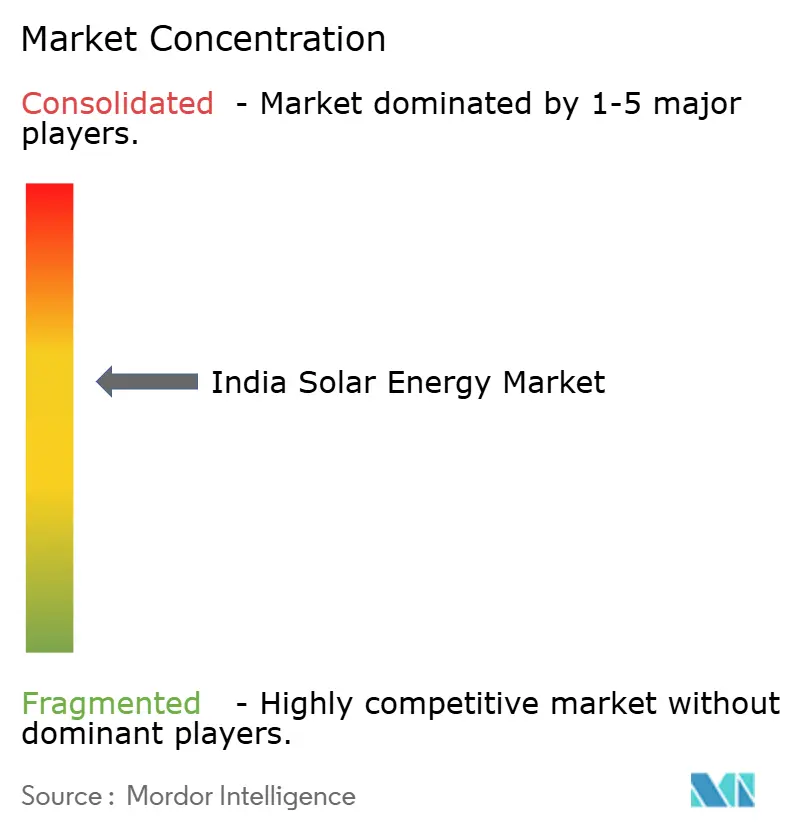
| Market Concentration | Medium |
Major Players *Disclaimer: Major Players sorted in no particular order Image © Mordor Intelligence. Reuse requires attribution under CC BY 4.0. | |
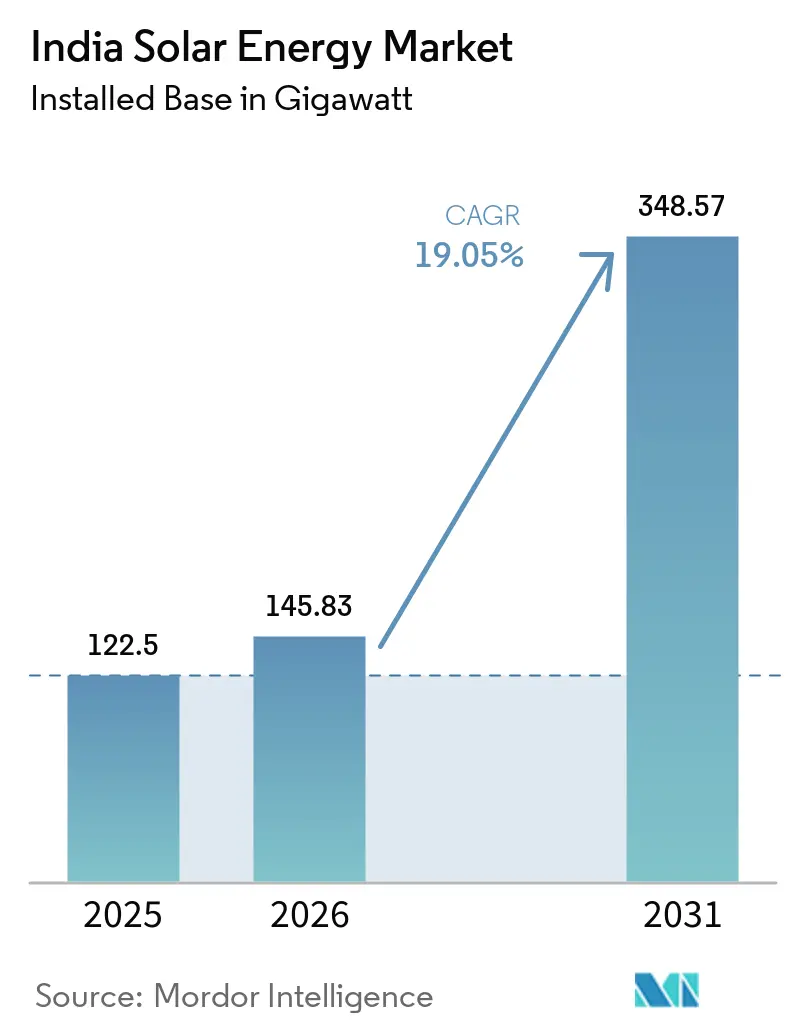
India Solar Energy Market Analysis by Mordor Intelligence
The India Solar Energy Market size was valued at 122.5 gigawatt in 2025 and estimated to grow from 145.83 gigawatt in 2026 to reach 348.57 gigawatt by 2031, at a CAGR of 19.05% during the forecast period (2026-2031).
Rising deployment momentum comes from the 500 GW national non-fossil target, PLI-backed manufacturing expansion, and stable auction tariffs that continue to undercut coal.[1]Ministry of New and Renewable Energy, “Solar Energy – Current Status,” mnre.gov.in Backward integration into cell, wafer, and polysilicon production is trimming import exposure that once exceeded 90%. At the same time, falling levelized costs, standardized rooftop subsidies, and open-access reforms are broadening demand beyond utility-scale plants. Developers are responding with hybrid solar-plus-storage bids that smooth evening demand curves, while states with canal-top and agrivoltaic programs are easing land bottlenecks.
Key Report Takeaways
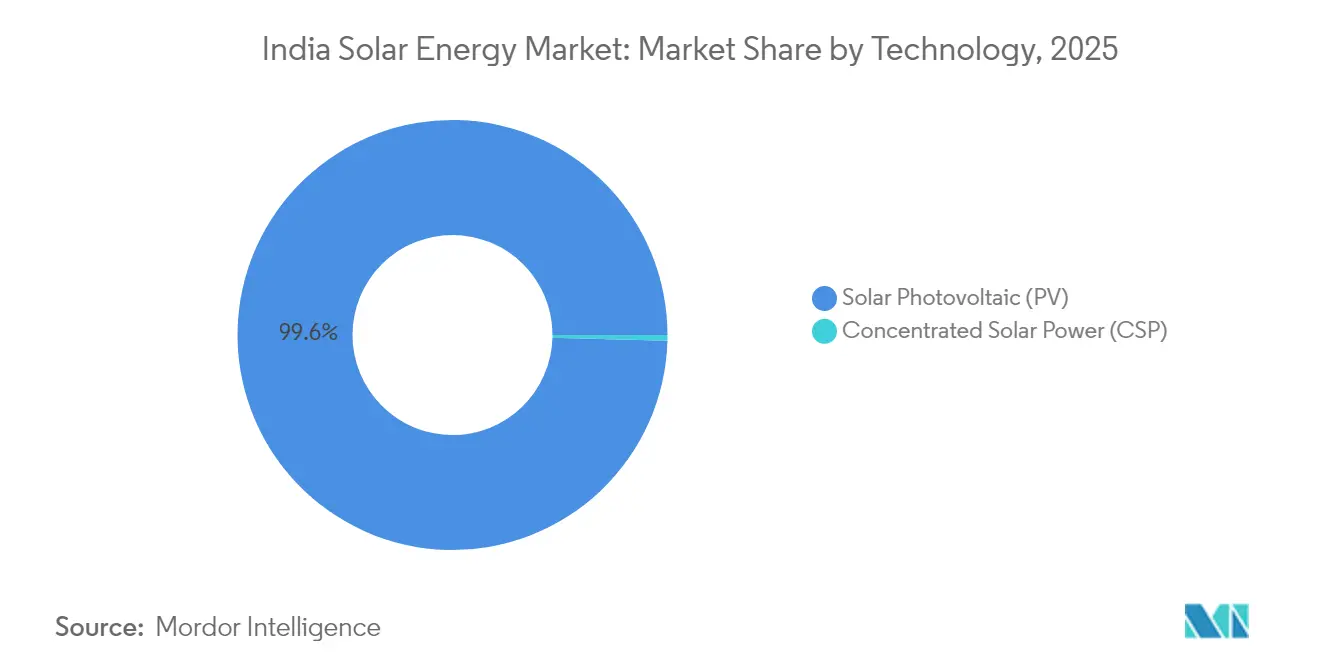
- By technology, solar photovoltaic commanded 99.58% of the India solar energy market share in 2025 and is advancing at a 19.08% CAGR to 2031.
- By grid type, on-grid systems held a 96.85% share in 2025, whereas off-grid installations are forecast to post the fastest 26.1% CAGR through 2031.
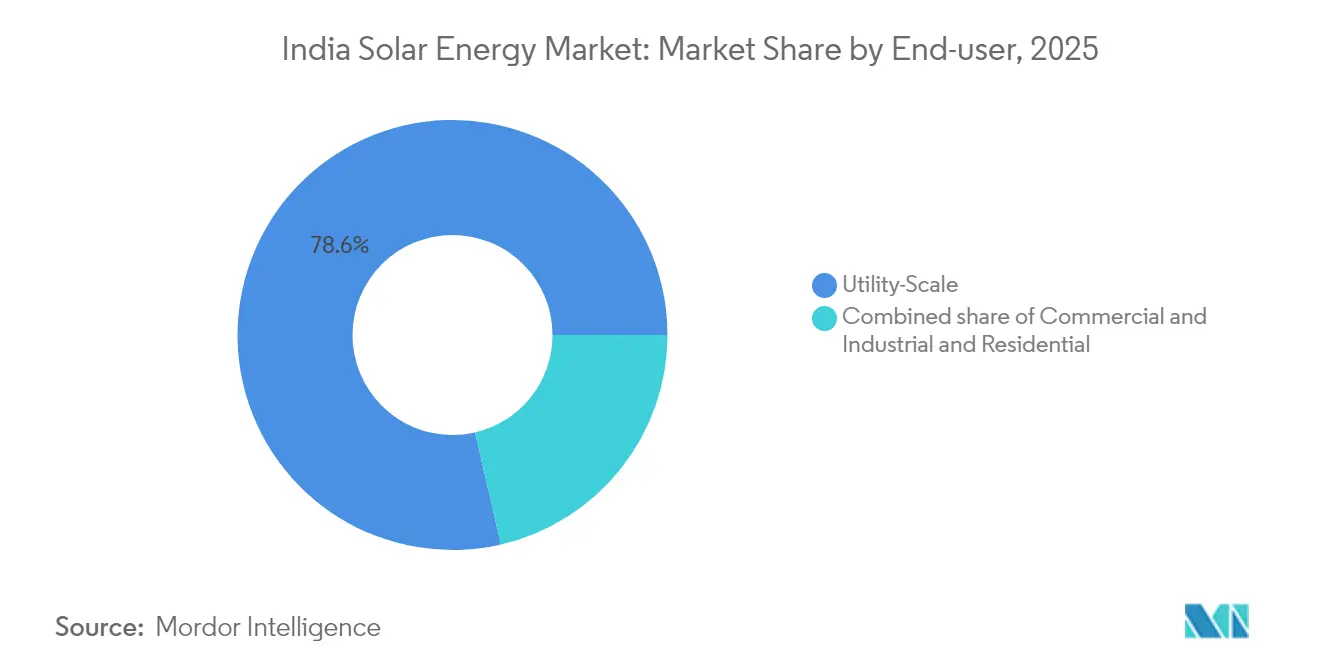
- By end-user, utility-scale projects accounted for 78.62% of the India solar energy market size in 2025, while the residential segment is set to expand at a 23.4% CAGR through 2031.
Note: Market size and forecast figures in this report are generated using Mordor Intelligence’s proprietary estimation framework, updated with the latest available data and insights as of 2026.
India Solar Energy Market Trends and Insights
Drivers Impact Analysis*
| Driver | (~) % Impact on CAGR Forecast | Geographic Relevance | Impact Timeline |
|---|---|---|---|
| Supportive federal and state incentives | +3.2% | National, led by Gujarat, Tamil Nadu, Rajasthan | Medium term (2-4 years) |
| Rapid decline in module LCOE | +4.1% | National, strongest in price-sensitive C&I and residential segments | Short term (≤ 2 years) |
| 500 GW national target sustaining tenders | +5.3% | National, with notable pipelines in Karnataka and Madhya Pradesh | Long term (≥ 4 years) |
| Green-hydrogen-linked solar demand | +1.8% | Coastal states such as Gujarat and Odisha | Long term (≥ 4 years) |
| Domestic polysilicon-to-module build-out | +2.4% | Clusters in Gujarat, Andhra Pradesh, Tamil Nadu | Medium term (2-4 years) |
| State-led agrivoltaic and canal-top programs | +1.5% | Punjab, Haryana, Uttar Pradesh, Gujarat | Medium term (2-4 years) |
| Source: Mordor Intelligence | |||
Supportive Federal and State Incentives Accelerate Localization
India's Solar Energy market expansion is underwritten by regulations that reward domestic value addition. The Approved List of Models and Manufacturers (ALMM) favors locally produced modules, while two PLI tranches are underwriting more than 48 GW of integrated cell-to-module capacity scheduled to go online by 2026.[2]Rachit Chawla, “PLI-II winners plan 48 GW of integrated capacity,” economictimes.indiatimes.com Tata Power, Waaree Energies, and Goldi Solar commissioned large plants in 2025, keeping domestic module margins in the 12-14% range despite import duties. Developers face 6-8% higher upfront costs in the short run, yet long-term supply security and potential tax credits offset the burden. Expansion of ALMM to cover cells from June 2026 is projected to triple exports to 8-9 GW in FY 2025, bolstering balance-of-payments resilience and deepening India's Solar Energy market competitiveness.
Rapid Decline in Module-Levelized Cost Unlocks Distributed Segments
Average utility-scale project capex fell 28% year-on-year in 2024, pushing discovered tariffs to INR 2/kWh, a new national floor. Cost compression stems from global oversupply, technology shifts toward TOPCon, and widening domestic supply chains. Intermittent spikes due to logistics bottlenecks and basic customs duties occasionally disrupt bids; still, most developers model energy at ≤ INR 2.4/kWh over project life. Sustaining that benchmark depends on continued efficiency gains, accelerated polysilicon-to-module build-out, and moderated freight rates. If manufacturers achieve advertised cell efficiencies above 25%, the India Solar Energy market could see sub-INR 2 tariffs by 2027, reinforcing demand across utility, C&I, and residential applications.[3] Uma Gupta, “Module prices hit INR 19/Wp amid global glut,” pv-magazine-india.com
500 GW National Target Sustains Utility-Scale Tender Pipeline
The national 500 GW renewables target anchors a predictable multiyear tender schedule. As of 2025, 163 GW of large-scale solar projects sit in various development stages, giving investors line-of-sight on offtake and policy stability. Central agencies have standardized auction timelines, while state utilities align feed-in tariffs and bankability standards. However, the spatial concentration of winning bids in Gujarat and Rajasthan strains transmission capacity, heightening curtailment risk. Flexible procurement clauses, hybrid wind-solar-storage bids, and impending market-based economic dispatch reforms are expected to spread installations to emerging states, enhancing diversity across the India Solar Energy market.
Green-Hydrogen–Linked Solar Demand Creates Dedicated Off-Take Channels
Industrial decarbonization strategies are driving new offtake clusters. ReNew aims to produce 1 million t of green hydrogen annually, powered by 25 GW of renewables, while NTPC and Adani target multi-GW electrolyzer facilities synchronized with utility-scale solar. Co-located solar, storage, and hydrogen plants enable higher capacity-utilization factors and diversified revenue. Project finance structures increasingly bundle merchant hydrogen sales with long-term power-purchase agreements, lowering the cost of capital. As India finalizes its National Hydrogen Mission incentives, demand from refineries, fertilizer plants, and steel mills will anchor larger projects, cementing the India Solar Energy market as a backbone of industrial competitiveness.
Restraints Impact Analysis*
| Restraint | (~) % Impact on CAGR Forecast | Geographic Relevance | Impact Timeline |
|---|---|---|---|
| Weak grid flexibility and curtailment risk | -2.8% | Tamil Nadu, Karnataka, Andhra Pradesh | Short term (≤ 2 years) |
| Land-acquisition bottlenecks | -1.9% | Rajasthan, Gujarat, Madhya Pradesh | Medium term (2-4 years) |
| Cell and wafer import dependency | -1.6% | National | Short term (≤ 2 years) |
| Limited credit for MSME rooftop projects | -1.2% | Tier-2 and Tier-3 cities | Medium term (2-4 years) |
| Source: Mordor Intelligence | |||
Weak Grid Flexibility and Curtailment Risk Threatens Project Returns
Solar penetration in leading states now exceeds 25% of peak demand, exposing grids to frequent curtailment events. Limited ancillary services, delayed battery-storage rollouts, and network congestion erode plant load factors by up to 4 percentage points. The Green Energy Corridor program and the commissioning of India’s largest BESS factory in Karnataka improve flexibility yet lag capacity-addition velocity. Developers incorporate generation forecasts, but unpredictable curtailment complicates financing, especially for medium-sized independent power producers. Faster adoption of market-based economic dispatch and real-time ancillary markets is essential to preserve investor confidence in the India Solar Energy market.
Land-Acquisition Bottlenecks in High-Irradiance States Delay Commissioning
Gujarat and Rajasthan’s solar parks highlight land-aggregation challenges. Competing land use, fragmented titles, and environmental clearances can delay projects by up to 12 months. Karnataka’s Pavagada Solar Park uses cooperative lease arrangements that provide farmers with annual rent indexed to inflation, offering a replicable model.[4]Lulu Raghavan, “Land acquisition hurdles in Rajasthan solar parks,” wri.org State-level digitization of land records and single-window clearances reduce transaction costs, but areas near wildlife sanctuaries and cultural sites remain contentious. The India Solar Energy industry increasingly explores floating, canal-top, and agrivoltaic installations to sidestep land constraints while supporting local economies.
*Our forecasts treat driver/restraint impacts as directional, not additive. The impact forecasts reflect baseline growth, mix effects, and variable interactions.
Segment Analysis
By Technology: PV Dominance Masks Niche CSP Revival
Solar photovoltaic accounted for 99.58% of the India solar energy market in 2025 and is on track for a 19.08% CAGR through 2031. Within PV, TOPCon modules already form 35% of domestic output after Waaree, Adani, and Premier ramped 18 GW combined capacity. BIS-mandated quality rules removed low-grade imports, nudging developers toward bifacial designs that raise yields 10-20%. Concentrated solar power, although below 1 GW, re-entered the tender pipeline via hybrid bids that bundle six-hour thermal storage. NTPC’s 50 MW Ladakh CSP plant logs a 42% capacity factor, showing dispatchable value in high-altitude sites.
Developers weigh CSP’s higher capital intensity against superior evening output when evaluating mixed portfolios. Meanwhile, Reliance’s planned 10 GW HJT line targets 25-26% cell efficiency by 2027, which could narrow LCOE differences with CSP. As cost spreads tighten, technology choice will hinge on project-specific land and storage constraints. The India solar energy market, therefore, remains PV-heavy yet technologically fluid, with niche CSP and next-gen PV formats carving differentiated roles over the decade.



By Grid Type: Off-Grid Surge Driven by Agricultural Electrification
On-grid capacity represented 96.85% of the India solar energy market size in 2025, supported by stable utility tariffs and bankable PPAs. Off-grid systems, however, are projected to grow at a 26.1% CAGR, catalyzed by PM KUSUM’s 3.5 million solar-pump mandate and Saubhagya village electrification. Stand-alone pumps cut diesel bills by INR 30,000-50,000 annually for a 5 HP unit, encouraging adoption in Bihar and Uttar Pradesh.
Financing divergence persists. Grid-tied projects secure 8-9% public-sector debt, whereas off-grid projects rely on 60-90% subsidy plus micro-finance rates of 12-15%. Recent pilots in Ladakh and Arunachal proved 35-40% diesel displacement for solar-plus-storage mini-grids. As battery costs fall and policy support widens, off-grid options could erode on-grid dominance, adding breadth to the solar industry in India.
By End-User: Residential Rooftop Outpaces Utility-Scale Growth
Utility-scale plants controlled 78.62% of the India solar energy market in 2025, underpinned by SECI’s robust auction flow and 25-year PPAs. Yet residential rooftops are predicted to advance ata 23.4% CAGR to 2031 as PM Surya Ghar targets 10 million homes. Subsidies lower simple paybacks to four to five years in high-tariff states such as Maharashtra.
Commercial and industrial buyers leverage group-captive rules to avoid wheeling charges, accelerating rooftop pipelines by 22-24% each year. Persistent subsidy delays of four to six months could temper momentum, but installers expect streamlined portals to cut approval times. As households recognize savings against INR 6-9 per kWh retail tariffs, distributed generation should capture incrementally larger slices of the solar industry in India.
Geography Analysis
Gujarat, Rajasthan, and Karnataka together contributed more than 60% of 2025 additions on the back of robust solar resources, streamlined land-leasing regimes, and strong state-utility creditworthiness. Gujarat’s 30 GW hybrid park at Khavda illustrates the state’s capacity to aggregate land, coordinate transmission, and de-risk offtake, while Rajasthan tops commissioning tables with multi-GW clusters linked to the Green Energy Corridor.
Maharashtra, Punjab, and Assam are now scaling distributed programs, leveraging agrivoltaic pilots and canal-top schemes to meet dual objectives of rural income and water conservation. Transmission upgrades under the Interstate Green Energy Corridor Phase-II enable surplus from western parks to flow eastward, easing regional imbalances. Nonetheless, curtailment incidence in Rajasthan and Gujarat signals the need for storage integration and flexible demand-side programs.
Union Territories such as Chandigarh and Lakshadweep test floating solar, while northeastern states deploy rooftop clusters under viability-gap funding. Harmonizing state regulations, standardizing banking periods, and accelerating digital approval portals remain prerequisites for balanced regional growth across the solar industry in India.
Regulatory Landscape
India's solar sector operates under a policy stack led by the Ministry of New and Renewable Energy (MNRE) and power-market oversight by the Central Electricity Regulatory Commission (CERC) for inter-state frameworks. A key compliance lever is the Approved List of Models and Manufacturers (ALMM), which is mandatory for specified government-supported and connected projects. From 01 June 2026, net-metering and open-access RE projects commissioned on or after that date must source PV modules from ALMM List-I and PV cells from ALMM List-II, tightening traceability and procurement planning.
Quality and domestic-content enforcement are reinforced through the Solar Systems, Devices and Components Goods Order, 2025 and verification mechanisms such as the National Institute of Solar Energy (NISE) DCR Verification Portal, used to track domestic content compliance. In May 2026, MNRE issued an official clarification focused on protecting investments already made under ALMM List-I, signaling continued fine-tuning of transition rules while keeping the compliance direction intact for developers, EPCs, and manufacturers.
Competitive Landscape
India's Solar Energy market competition is intensifying as conglomerates vertically integrate, and new domestic manufacturers enter with IPO-backed capital. Adani Green Energy crossed 12 GW of operational capacity in early 2025 and targets 45 GW by 2030; its Khavda cluster integrates PV, wind, and storage for 24/7 supply commitments. Tata Power commissioned a 4.3 GW cell-to-module plant in Tamil Nadu, underpinning ALMM compliance for its pipeline and external customers. ReNew’s INR 31,500 crore investment plan bundles 40 GW of projects with 6 GW of manufacturing, signaling a pivot toward integrated value chains.
Mid-tier manufacturers Waaree, Goldi Solar, Saatvik, and Jupiter International collectively announced >20 GW of new cell lines using TOPCon and HJT, carving export channels to the Middle East, Europe, and the United States. Foreign OEMs JinkoSolar and LONGi are forming joint ventures to navigate ALMM requirements and access PLI incentives. Storage integration is the new frontier: the inauguration of India’s largest BESS factory in Karnataka reveals synergies between module producers and storage OEMs, positioning diversified players for hybrid bids.
Tender bidding margins remain tight, often ≤ INR 0.15/kWh, propelling consolidation as smaller developers exit or pivot to rooftop niches. Access to low-cost capital, technological learning curves, and policy influence thus confer durable advantages to incumbents, indicating a moderately concentrated trajectory for the India Solar Energy market.
India Solar Energy Industry Leaders
Adani Green Energy Ltd.
Tata Power Solar Systems Ltd.
ReNew Power Pvt. Ltd.
Azure Power Global Ltd.
NTPC Renewable Energy Ltd.
- *Disclaimer: Major Players sorted in no particular order

Market Opportunities and Future Outlook
Opportunities are expanding across both generation and the domestic supply chain, as installed solar capacity moved beyond the 150 GW mark by 31 March 2026. MNRE also reported cumulative physical progress of 162.15 GW for solar power as of 30 May 2026. Utility-scale continues to absorb large blocks of capacity, supported by visible commissioning and projects such as the 1,000 MW Bikaner Solar Power Project in Rajasthan (inaugurated in July 2026, developed by SJVN Green Energy Limited). Procurement formats that bundle dispatchability are also creating an addressable market for hybrids and storage-backed renewables, illustrated by Serentica Renewables signing a 600 MW (2,400 MWh) FDRE PPA with SECI in July 2026.
Distributed and C&I rooftop adoption has additional whitespace where policy enables larger behind-the-meter systems and faster approvals. MNRE's June 2026 update to PM Surya Ghar Muft Bijli Yojana (including a higher net-metering cap up to 500 kW) widens the eligible consumer base for commercial rooftops and group facilities. On the supply side, manufacturing localization and product upgrades toward higher-efficiency technologies are being underwritten by new capacity and procurement pull-through, including Premier Energies commissioning a 5.6 GW module plant in Telangana in July 2026 and initiating construction of a 6 GWh BESS plant, alongside large module orders such as SAEL Industries supplying TOPCon modules for NTPC Renewable Energy Limited's 585.8 MWp Chitrakoot-1 project in Uttar Pradesh (July 2026).
Recent Industry Developments
- July 2026: Prime Minister Narendra Modi inaugurated SJVN Green Energy Limited's 1,000 MW Bikaner Solar Power Project in Rajasthan, a marquee utility-scale commissioning backed by a multi-thousand-crore investment. The project adds to the pool of large, grid-connected solar that anchors inter-state offtake and transmission planning. It also reinforces the role of public-sector backed developers in aggregating land, EPC execution, and financing for gigawatt-scale assets.
- June 2026: NTPC completed the 176 MW Ramagundam Solar PV Project after commissioning its final 41.6 MW unit. Full completion strengthens NTPC's renewable operating base and provides additional contracted solar supply from a central-sector counterparty. It also signals continued execution throughput on multi-unit projects where staged commissioning is used to synchronize grid readiness and evacuation.
- June 2024: Adani Green Energy commissioned 1 GW of solar capacity at the Khavda Renewable Energy Park in Gujarat, advancing the build-out of a 30 GW-scale renewable cluster. The milestone accelerated concentration of new solar supply in high-irradiance western India and raised the strategic premium on transmission build-out and grid flexibility in the region. Khavda's scale continues to influence tender design, hybridization, and supply-chain sourcing aligned with large, repeat orders.


Research Methodology Framework and Report Scope
Market Definition and Coverage
For this methodology, the India solar energy market is defined as solar electricity capacity within India, captured in gigawatts, and covering grid-connected and off-grid systems across major end users.
Scope exclusions: We exclude upstream polysilicon to module manufacturing revenues, EPC contract values, O&M service revenues, and battery storage unless it is inseparable from the solar system counted as capacity.
Segmentation Overview
- By Technology
- Solar Photovoltaic (PV)
- Concentrated Solar Power (CSP)
- By Grid Type
- On-Grid
- Off-Grid
- By End-User
- Utility-Scale
- Commercial and Industrial (C&I)
- Residential
- By Component (Qualitative Analysis)
- Solar Modules/Panels
- Inverters (String, Central, Micro)
- Mounting and Tracking Systems
- Balance-of-System and Electricals
- Energy Storage and Hybrid Integration
Data Sources, Market Sizing, and Validation
Desk Research
We started with public capacity and project-tracking signals to anchor the demand pool in physical units, and then used these signals to structure the market model year by year. Key reference points typically included sources such as MNRE releases, CEA power sector statistics, IEA and IRENA renewable dashboards, and DISCOM and regulator filings where capacity additions and commissioning timelines are discussed.
After the baseline was set, supportive context was added from company annual reports, investor presentations, and reputed press to understand tendering momentum, execution constraints, and price direction for modules and inverters. A paid subscription for company financials and intelligence was used selectively to cross-check developer scale, ownership changes, and project pipeline credibility, and an import-export shipment-level database was referenced where trade flows helped validate supply availability. The sources listed here are illustrative only, and many other public documents and datasets were also reviewed to collect, validate, and clarify data points.
Primary Interviews and Surveys
We validated the desk inputs through expert discussions and structured surveys with developers, EPC teams, component suppliers, lenders, and large C&I and utility off-takers. These conversations helped us confirm commissioning lags, typical DC to AC sizing practices, rooftop adoption barriers, and how policy and tender terms are translating into real project starts across major Indian states.
Distribution of primary research fieldwork respondents
| Company type | Respondent position |
|---|---|
| Top tier: 26% | CXOs: 13% |
| Mid tier: 60% | Functional/Unit leaders: 36% |
| Smaller Players: 14% | Managers: 51% |
Market-Sizing & Forecasting
Sizing was built mainly using a top-down approach where national capacity series, annual additions, and commissioning progress were reconstructed into an installed base and yearly net build, and then broken into meaningful demand drivers. We then used selective bottom-up approximations, like sampled project capacity by state and application, supplier and channel checks, and typical system sizing norms, to confirm that totals were not drifting away from what the market can practically deliver.
Inputs used in the model included annual solar additions, cumulative installed capacity, tender and auction award volumes, rooftop versus utility deployment mix, typical DC to AC ratios, and observed module and inverter price direction, which together explain why capacity grows faster in some years than others. For the forecast, scenario analysis was applied around policy execution, grid readiness, and financing conditions, with scenario weights adjusted based on what primary respondents described as the most likely path. Where bottom-up views had gaps, missing pockets were filled using state-level commissioning patterns and adoption rates already visible in the national datasets, and only then rolled back into the total.
Data Validation & Update Cycle
We checked consistency by comparing the modeled installed base and additions against independent signals like official power sector statistics, announced commissioning calendars, and trade and supply constraints, and then reviewed any unusual jumps before final sign-off. If a variance looked material, the assumptions were revisited and selected primary contacts were re-engaged to understand whether the change was timing, definition, or a genuine market shift.
Before release, the work goes through more than one analyst review so the inputs, math, and written logic align, and so the final story matches the observed market direction. Reports are refreshed annually, with interim updates triggered by material policy changes, major tender shifts, or significant revisions in official capacity reporting. Right before delivery, a fresh data pass is completed so clients receive the latest updated view.
Mordor Intelligence's India Solar Energy Market Size Measured Against Other Published Estimates
Published market sizes for India solar energy often do not line up because some studies measure capacity in gigawatts while others report revenue in USD, and the time framing can be fiscal year versus calendar year. Differences also come from what is counted as solar (for example, whether hybrid projects, storage-linked systems, or captive C&I setups are treated as part of the same pool).
Key gap drivers tend to be the unit of measurement, the treatment of pipeline versus commissioned capacity, the rooftop and off-grid counting rules, and how commissioning delays are handled in the forecast years. Currency conversion timing and whether prices are modeled explicitly can also move USD-based figures even when the underlying capacity path looks similar.
Benchmark comparison
| Source | Market Size | Gaps in Research Methodology |
|---|---|---|
| Mordor Intelligence | USD 122.50 B (2025) | |
| Trade Publisher A | USD 92.00 B (2024) | This figure is presented as capacity but is tied to a different base year, and it can also reflect calendar-year installed base without clearly separating commissioned systems from late-stage pipeline. |
| Industry Data Portal B | USD 33.09 B (2032) | The number is stated in USD for a fiscal-year forecast horizon, which implies price and revenue assumptions that are not directly comparable with capacity-based sizing unless the ASP and system scope are stated and validated. |
The table shows that unit choice and timing create most of the spread. In Mordor Intelligence's model, the market is measured as installed solar capacity in gigawatts, which avoids mixing equipment pricing and currency timing into what is fundamentally a build-out story. Once the same unit and year are aligned, the remaining differences are usually explained by whether off-grid and rooftop systems are counted consistently and how commissioning slippages are treated in the forecast.


Key Questions Answered in the Report
How large is the India solar energy market in 2026?
Installed capacity reached 145.83 GW in 2026 and is forecast to rise to 348.57 GW by 2031.
What is driving rooftop solar adoption among households?
PM Surya Ghar subsidies up to INR 78,000 per 3 kW system and rising retail tariffs cut paybacks to four-five years in many states.
Which technology dominates new capacity additions?
Solar photovoltaic holds 99.58% share and benefits from falling TOPCon and bifacial module costs.
Why are developers adding batteries to solar projects?
Round-the-clock tenders require four-hour storage to meet evening peaks, earning 15-20% tariff premiums over pure solar.
What challenges slow solar growth in high-irradiance states?
Land clearances and transmission congestion delay 8-10 GW of projects and trigger curtailment that erodes project returns.
Page last updated on:


 Your data is secure and never sold or shared.


