
Market Overview
| Study Period | 2021 - 2031 |
|---|---|
| Forecast Data Period | 2026 - 2031 |
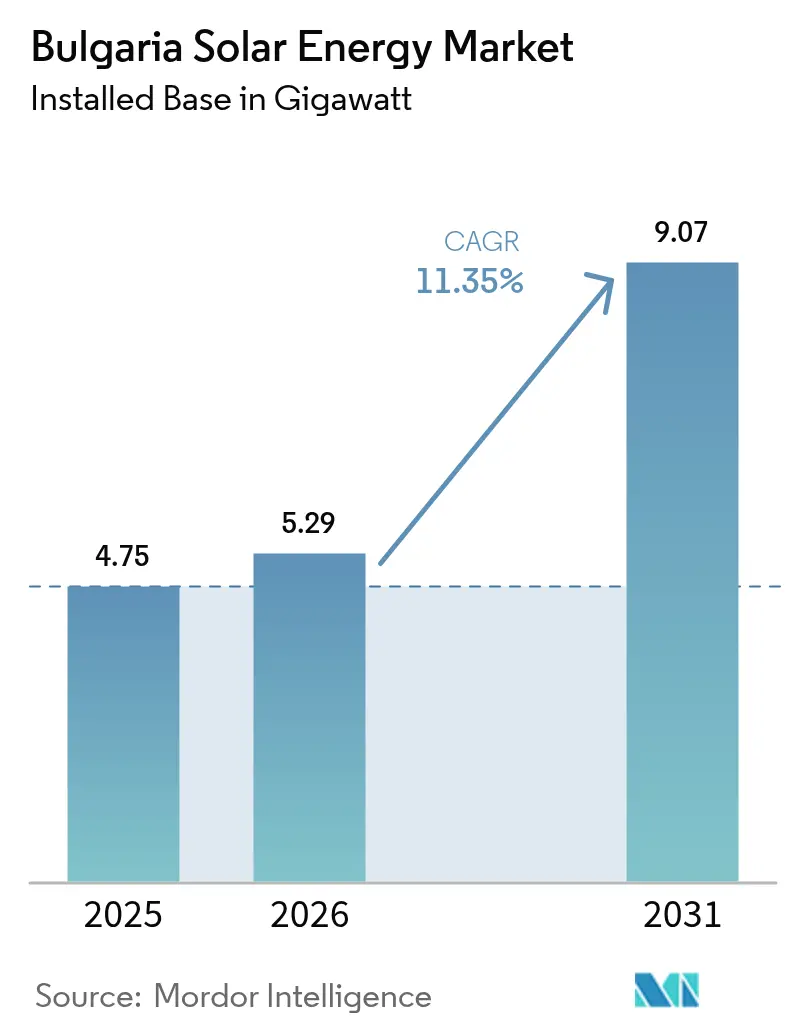
| Base Year Market Size (2025) | 4.75 gigawatt |
| Market Volume (2026) | 5.29 gigawatt |
| Market Volume (2031) | 9.07 gigawatt |
| Growth Rate (2026 - 2031) | 11.35 % |
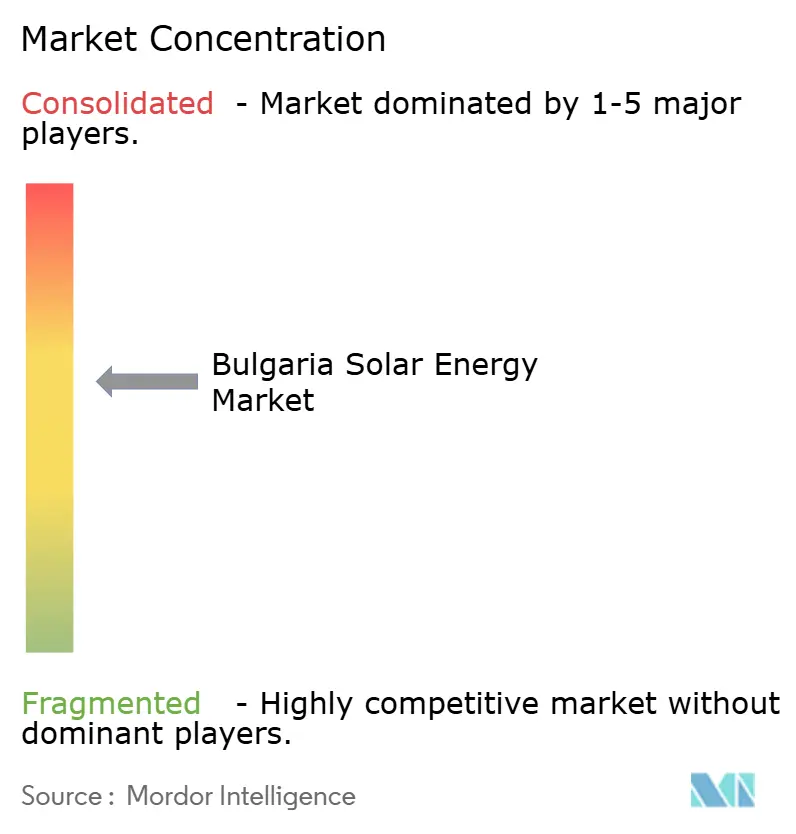
| Market Concentration | Medium |
Major Players
*Disclaimer: Major Players sorted in no particular order Image © Mordor Intelligence. Reuse requires attribution under CC BY 4.0. |
|
Bulgaria Solar Energy Market Analysis by Mordor Intelligence
Bulgaria Solar Energy Market size in 2026 is estimated at 5.29 gigawatt, growing from 2025 value of 4.75 gigawatt with 2031 projections showing 9.07 gigawatt, growing at 11.35% CAGR over 2026-2031.
Growth is anchored in the nation’s exit from coal, reinforced by the November 2024 auction that awarded 3 GW of new solar rights, nearly doubling the installed base in one round. Declining module prices, record-high household electricity tariffs, and the rise of corporate PPAs together push solar from a supplementary fuel to the backbone of Bulgaria’s post-coal grid.[1]Fraunhofer ISE, “PV Price Monitor Q4 2024,” fraunhofer.de Competition is sharpening as international suppliers fight on price while domestic EPC firms exploit local permitting know-how to secure construction mandates. Grid congestion and a shortage of certified installers remain headwinds, yet hybrid parks pairing PV with storage and a fast-growing rooftop segment temper these risks.
Key Report Takeaways
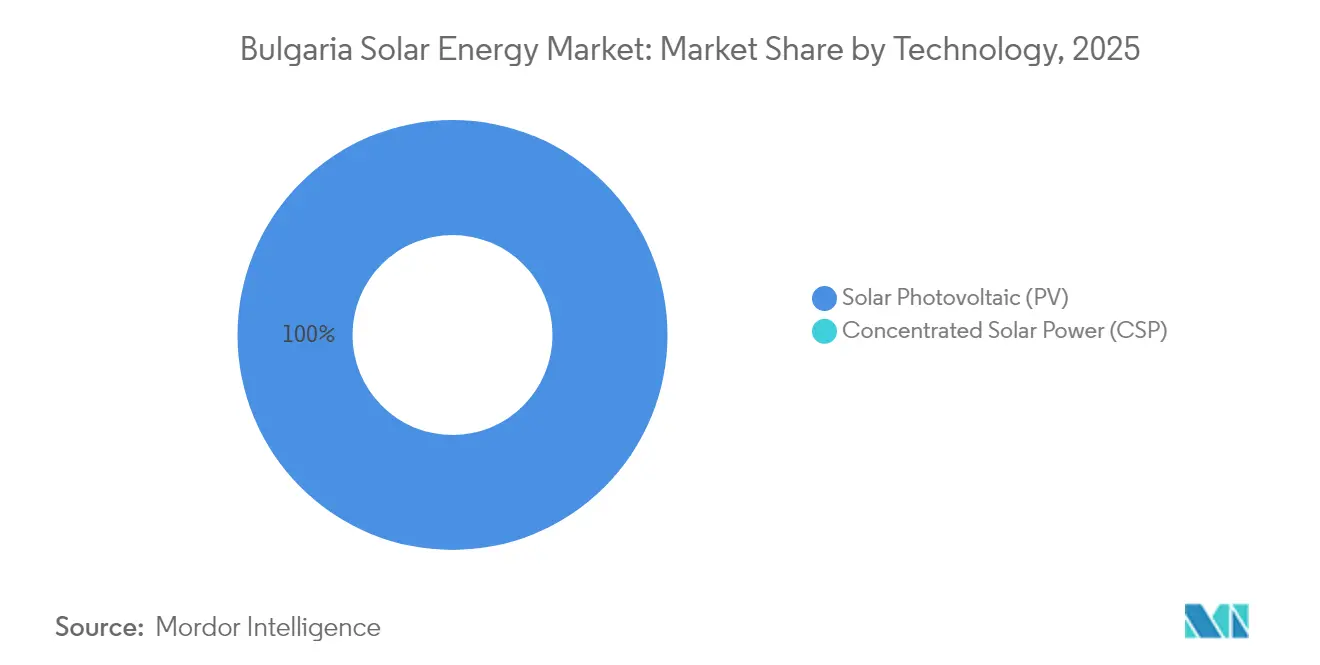
- By technology, solar PV captured 100.00% of the Bulgarian solar energy market share in 2025 and is set to advance at an 11.38% CAGR through 2031.
- By grid type, on-grid systems accounted for 94.65% of capacity in 2025, while the same segment is forecast to expand at a 11.76% CAGR to 2031.
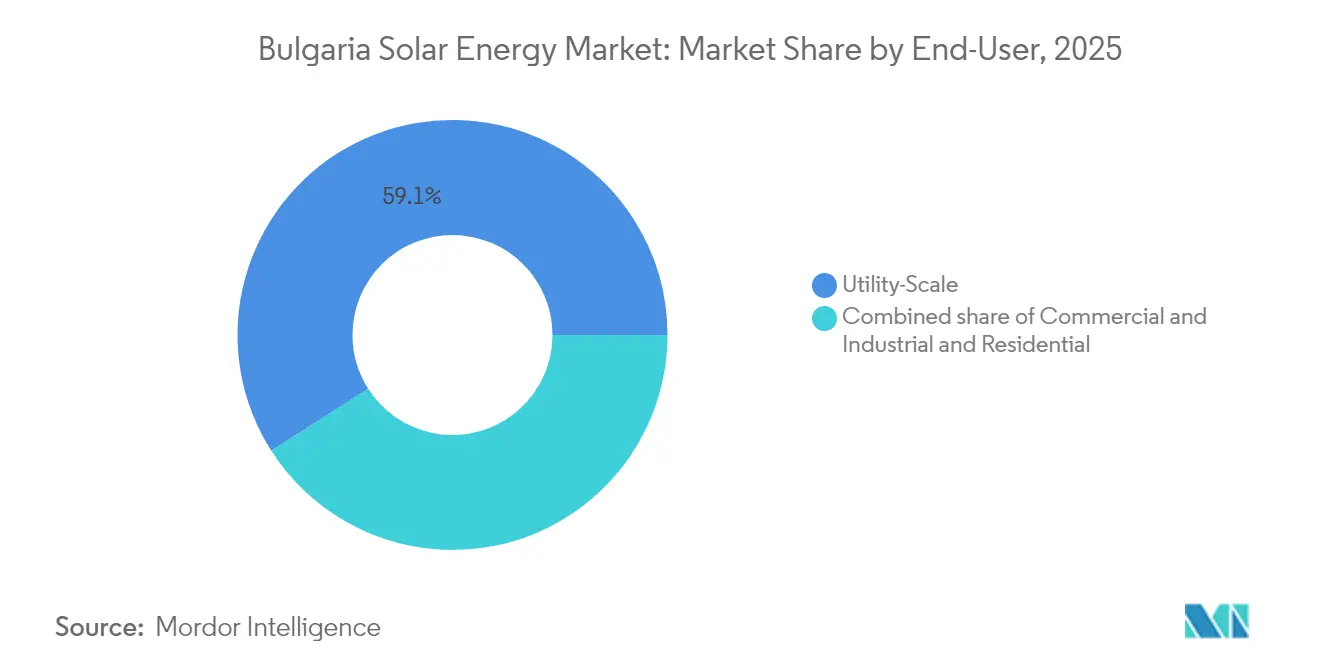
- By end user, utility-scale plants held 59.05% of installed capacity in 2025, whereas the residential segment is poised for the fastest growth at a 14.25% CAGR through 2031.
- By geography, the southern and eastern provinces—Burgas, Stara Zagora, Plovdiv, and Haskovo—contributed roughly 64.25% of installed capacity in 2025 and will maintain leadership with a double-digit CAGR to 2031.
Note: Market size and forecast figures in this report are generated using Mordor Intelligence’s proprietary estimation framework, updated with the latest available data and insights as of 2026.
Bulgaria Solar Energy Market Trends and Insights
Drivers Impact Analysis*
| Driver | (~) % Impact on CAGR Forecast | Geographic Relevance | Impact Timeline |
|---|---|---|---|
| EU Green Deal & NECP-linked procurement pipeline | +3.2% | National, south & east focus | Medium term (2-4 years) |
| Corporate PPAs from data centers & heavy industry | +1.8% | National, early in Sofia & Burgas | Medium term (2-4 years) |
| Declining LCOE of mono-PERC & TOPCon modules | +2.5% | National | Short term (≤ 2 years) |
| Grid-constrained hybrid parks pairing PV with batteries | +1.4% | Southern & eastern Bulgaria | Medium term (2-4 years) |
| Agro-PV pilots in the grain belt | +0.9% | Northern & central Bulgaria | Long term (≥ 4 years) |
| Surplus-power monetization via IBEX | +1.3% | National, cross-border to GR & RO | Short term (≤ 2 years) |
| Source: Mordor Intelligence | |||
EU Green Deal & NECP-linked procurement pipeline
Bulgaria’s National Energy and Climate Plan mandates 27% renewables by 2030, requiring about 5 GW of new solar beyond 2024 levels. The November 2024 auction issued 3 GW of solar rights at EUR 55/MWh, 30% below the former feed-in tariff, proving solar’s cost leadership and pivoting procurement from administratively set rates to competitive tenders. Multilateral lenders have responded: IFC and Raiffeisen Bank International closed EUR 90 million of non-recourse debt for the 225 MW St. George park in October 2024, underscoring confidence in tender-backed pipelines.[2]IFC, “IFC finances St. George Solar Park,” ifc.org Winners must now secure grid capacity within 18 months or forfeit bid bonds, favoring developers with integrated land and EPC teams ESO.BG. This framework compresses project timelines and accelerates commissioning, directly lifting the Bulgarian solar energy market.
Corporate PPAs from data-centres & heavy industry
Rezolv Energy signed Bulgaria’s first virtual PPA in 2024, covering 110 GWh per year for Ardagh Group over 12 years and locking prices around EUR 0.11/kWh, 20% below average industrial tariffs. High tariffs, averaging EUR 0.14/kWh in 2024, make PPAs an immediate hedge for energy-intensive firms. Aurubis Bulgaria earmarked BGN 800 million through 2027 to build 41 MWp of on-site PV, cutting grid purchases by 15%. Data-center operators planning Sofia and Burgas sites require hourly 100% renewable matching by 2025 under corporate mandates, and IBEX’s 15-minute settlement now supports granular certificate tracking IBEX.BG. These corporate deals inject long-term cash flows, lowering financing costs and deepening the Bulgarian solar energy market.
Declining LCOE of mono-PERC & TOPCon modules
Spot prices for PERC fell to EUR 0.10/W and TOPCon to EUR 0.115/W in late 2024, down more than 40% year on year, as Chinese n-type capacity surged to 70% of global output. TOPCon’s 24% efficiency trims balance-of-system costs by about 8% compared with PERC, a decisive advantage for land-constrained sites near substations. Rezolv Energy’s St. George park specified bifacial TOPCon panels, boosting yield 12% on reflective gravel. Lenders now apply a 15% technology-obsolescence haircut to PERC-based projects slated after 2026, nudging developers toward TOPCon and heterojunction. Smart Solar Technologies is building a BGN 240 million factory to supply 900 MW of TOPCon panels annually from 2026, localizing the value chain and underpinning the Bulgarian solar energy market.
Grid-constrained “hybrid parks” pairing PV with batteries
ESO’s April 2025 tender awarded 9.7 GWh of storage across 82 projects, quadruple the offered capacity, confirming storage as the preferred hedge against curtailment. Renalfa’s 25 MW/55 MWh Razlog system, commissioned in June 2024, earns roughly EUR 120,000 per MW annually from frequency regulation, double pure arbitrage revenue. SUNOTEC secured EUR 115 million in September 2025 for a 115 MW PV plus 763 MWh battery project, with a 6.6-hour duration aimed at both energy and capacity markets.[3]IFC, “IFC finances St. George Solar Park,” ifc.org EBRD is structuring a USD 200 million credit line for Bulgarian hybrid parks, which would normalize battery integration in utility solar EBRD.COM. Storage lifts capacity factors and unlocks new revenue streams, strengthening the Bulgarian solar energy market.
Restraints Impact Analysis*
| Restraint | (~) % Impact on CAGR Forecast | Geographic Relevance | Impact Timeline |
|---|---|---|---|
| Distribution-level grid congestion & curtailment risk | -2.1% | Southern & eastern Bulgaria | Short term (≤ 2 years) |
| Slow rooftop permitting for systems <30 kW | -1.3% | Urban areas | Medium term (2-4 years) |
| Scarce domestic workforce of certified PV installers | -0.8% | National | Medium term (2-4 years) |
| Rising land-lease prices near substations | -0.6% | Southern & eastern Bulgaria | Short term (≤ 2 years) |
| Source: Mordor Intelligence | |||
Distribution-level grid congestion & curtailment risk
The 110 kV grid can evacuate only 12 GW nationwide, yet 3.91 GW of solar is already concentrated in the south, forcing ESO to curtail up to 15% of peak PV output during summer 2024. Curtailment costs generators an estimated EUR 8 million and triggered force-majeure claims in several PPAs.[4]ESO, “Grid Curtailment Report 2024,” eso.bg ESO’s 2024-2030 plan budgets BGN 1.2 billion to upgrade 18 substations, but most work will finish only after 2027. Developers are self-funding interim reinforcements. Rezolv Energy built 6 km of 110 kV lines at EUR 4 million to meet commissioning deadlines. The asymmetry is stark: rooftop systems under 30 kW avoid curtailment via net-metering, whereas utility-scale parks bear uncompensated shutdowns, tempering growth in the Bulgarian solar energy market.
Slow rooftop permitting for systems < 30 kW
Amendments to the Energy Act in 2023 capped approval at 30 days for small rooftops, yet municipal offices still demand extra fire-safety and structural certificates, stretching actual timelines to 90-120 days. A 2024 survey found 42% of residential applications delayed by redundant document requests, with 18% abandoned outright.[5]Bulgarian Photovoltaic Association, “Residential PV Survey 2024,” bpva.bg The Energy Ministry began a six-month training program in early 2025 for 200 municipal officials, but coverage remains patchy. This gap slows deployment in the fast-growing residential segment, where subsidies of up to BGN 15,000 shorten payback periods to under six years. Unless local processes align with national law, the Bulgarian solar energy market will forfeit a key growth lever.
*Our forecasts treat driver/restraint impacts as directional, not additive. The impact forecasts reflect baseline growth, mix effects, and variable interactions.
Segment Analysis
By Technology: Crystalline Dominance Sustains Rapid Expansion
Solar PV retained a 100.00% hold on the Bulgarian solar energy market in 2025 and will grow at an 11.38% CAGR to 2031, driven by crystalline-silicon modules trading near EUR 0.10/W. CSP remains absent given Bulgaria’s 1,600 kWh/m² DNI, well below the 2,000 kWh/m² threshold for economic tower projects. TOPCon’s higher efficiency and lower temperature coefficient underpin its 60% share of 2024 additions, while bifacial designs delivered a 12% gain at the St. George brownfield site. Floating PV totals just 3 MW on irrigation ponds owing to regulatory ambiguity over water rights, yet Smart Solar’s local module factory will cut import dependence and may catalyze niche formats.
Aggressive price declines slash turnkey costs to EUR 500/kW for a 100 MW PV plant, one-fifth of an equivalently sized CSP project, locking in PV’s supremacy. Domestic manufacturing, led by Smart Solar Technologies, enhances supply security and creates spillovers for regional exports. These trends collectively enlarge the Bulgarian solar energy market size at both utility and rooftop scales.



By Grid Type: On-Grid Dominance Underpins Revenue Certainty
On-grid plants constituted 94.65% of installed capacity in 2025 and are forecast to expand at a 11.76% CAGR, buoyed by CfD contracts and IBEX liquidity. Net-metering credits below 200 kW at retail rates (EUR 0.14/kWh in 2024) create an EUR 0.08/kWh uplift over wholesale tariffs, compressing paybacks to under six years. The recent auction’s EUR 52-58/MWh clearing prices confirm grid parity. Off-grid systems, 5.35% of capacity, serve remote farms and telecom towers where grid extensions exceed EUR 50,000/km.
Hybrid on-grid plants blur traditional boundaries: Renalfa’s Razlog and SUNOTEC’s 763 MWh project operate grid-connected but can island during outages, fetching a 15% PPA premium from industrial buyers seeking resilience. These configurations diversify revenue and enhance the Bulgaria solar energy market size while alleviating curtailment pressure.
By End User: Residential Growth Outstrips Utility-Scale Additions
Utility-scale projects held 59.05% of installed capacity in 2025, yet residential rooftops will post the quickest ascent at a 14.25% CAGR to 2031, catalyzed by grants of up to BGN 15,000 per system and soaring power bills. Household applications jumped to 12,000 systems in 2024 from 4,500 in 2023. The Bulgarian solar energy market size for residential rooftops is set to more than triple by 2030, underscoring the subsidy’s pull and net-metering’s push.
C&I rooftops, roughly 27.85% of capacity, concentrate in metals, foods, and textiles, where daytime loads dovetail with generation. Aurubis Bulgaria’s 41 MWp roll-out trims grid purchases by 15% while monetizing surplus on IBEX’s intraday platform. Utility-scale parks keep adding sizable blocks. Rezolv Energy’s 225 MW St. George lifted national capacity 5.8 percentage points in 2024, but faces rising land-lease costs near substations, which climbed 40% since 2023. These mixed dynamics reinforce the Bulgaria solar energy market’s diversification and momentum.
Geography Analysis
Southern and eastern provinces, Burgas, Stara Zagora, Plovdiv, and Haskovo, host 64.25% of national solar capacity, aided by 1,550-1,600 kWh/m² irradiance and proximity to idle coal-plant substations. The 2024 auction steered 1.8 GW of the 3 GW award into these regions, locking in their dominance. Burgas is emerging as a hybrid hub; TERNA Energy’s 130 MW Vratitsa project will bolt on 50 MWh of storage, highlighting a shift from pure PV to integrated assets.
Northern and central Bulgaria, Pleven, Veliko Tarnovo, Ruse, hold about 20.15% of capacity but offer lower land rents and host agro-PV pilots like Qn-SOLAR’s 5 MW Svishtov site, which cut soil-moisture loss by 20%. Field trials in Strelcha in August 2025 showed an 8% wheat biomass lift under partial shading, suggesting crop-specific gains that could unlock CAP subsidies if Bulgaria adopts Germany’s 66% yield rule. The Ministry of Agriculture is drafting guidelines for 2026, potentially unleashing 1 GW of dual-use capacity on just 1% of the grain belt’s 2.1 million hectares.
Western Bulgaria, including Sofia and Pernik, supplied only 15.60% of capacity in 2025 but is rich in data centers and logistics roofs that now favor C&I solar due to high urban tariffs. Transmission bottlenecks exacerbate regional imbalance: southern lines can export only 2.5 GW at midday peaks, whereas northern circuits have 1.2 GW spare headroom. ESO’s north-south 400 kV link between Plovdiv and Pleven, scheduled for 2028, should cut southern curtailment by 60% and create a new corridor for cross-border sales to Romania. The 1,200 MW HVDC to Greece, online since 2023, already lets Bulgarian solar capture EUR 30/MWh price spreads, effectively using the regional grid as a virtual battery.
Regulatory Landscape
Bulgaria solar is primarily governed by the Renewable Energy Sources Act (ZEVI) and the Energy Act. The Energy and Water Regulatory Commission (EWRC) sets regulated prices, feed-in tariffs, and premiums on an annual cycle (with determinations typically published around mid-year). In practice, the framework supports smaller and legacy eligible projects, while a market-based buildout is increasingly driven by competitive tenders, corporate PPAs, and exchange trading via IBEX.
In 2026, the Council of Ministers advanced amendments to ZEVI to complete the transposition of EU Directive 2023/2413 (RED III). The stated priorities include faster administrative processing, clearer conditions for PPAs, and renewables acceleration areas designed to shorten project lead times. EU compliance pressure from earlier delays in RED II transposition also shapes the direction, pushing Bulgaria toward more standardized permitting timelines and clearer rules for connecting new solar and hybrid (solar plus storage) capacity to the grid.
Competitive Landscape
The EPC segment is moderately concentrated: the top five contractors command about a 55% share, led by Solarpro and Sunotec. Solarpro has delivered over 7 GW across 30 countries and offers 20-year performance guarantees, adding a service moat. Sunotec, with 8.2 GW built worldwide, holds 12% of the European industrial PV construction market and is extending its footprint to Africa and Asia. International module giants JinkoSolar, Trina Solar, Longi Green Energy, and Canadian Solar are bundling turnkey EPC packages, challenging domestic contractors for downstream margins.
Hybrid projects are the new battlefield. Solarpro Technology integrated Bulgaria’s first utility-scale BESS at Razlog, while Hithium supplied the lithium cells, carving an early-mover advantage. The oversubscribed 2025 storage tender will amplify demand for battery-capable EPC teams. Smart Solar Technologies’ upcoming 900 MW panel plant is a strategic play to secure module supply and edge out Chinese imports that covered 75% of 2024 demand. Producer-responsibility rules under the EU’s WEEE Directive increasingly sway RFP scoring, penalizing bidders lacking recycling pathways, and favoring players with established take-back programs, another lever of competitive differentiation. Together, these factors shape a dynamic yet consolidating Bulgarian solar energy market.
Bulgaria Solar Energy Industry Leaders
-
Solarpro Holding PLC
-
Jinko Solar Holdings Ltd.
-
Green Yellow
-
Skytech Energy Ltd
-
Elsol Ltd
- *Disclaimer: Major Players sorted in no particular order

Market Opportunities and Future Outlook
Hybridization is emerging as a key execution route across Bulgaria's solar buildout. ESO's April 2025 storage tender awarded 9.7 GWh across 82 projects, reflecting how developers are pairing PV with batteries to manage curtailment and access ancillary-services revenues. Long-term offtake also continues to support bankability, including Rezolv Energy's 2024 virtual PPA for Ardagh Group (110 GWh per year over 12 years) and Aurubis Bulgaria's plan to deploy 41 MWp of on-site PV through 2027, which aligns daytime industrial loads with solar generation and supports monetization via IBEX.
Grid enabling investments and EU-backed programs provide further room for new capacity. ESO's 2024-2030 plan includes BGN 1.2 billion to upgrade 18 substations, and the CARMEN project secured European grant co-financing for a grid investment of over EUR 59 million to support renewable electricity transmission. On the supply side, declining module prices and the shift toward higher-efficiency TOPCon modules support project economics, while Smart Solar Technologies' planned 900 MW TOPCon module factory from 2026 points to procurement localization, O&M spares availability, and compliance-linked requirements such as producer responsibility under EU WEEE rules.
Recent Industry Developments
- June 2026: OMV Petrom reached a final investment decision for the Gabare project in the Byala Slatina region, combining a 415 MWp solar plant with a 600 MWh battery energy storage system. The scale and co-located storage configuration highlight Bulgaria's move toward dispatchable solar assets that can better navigate grid constraints and support multiple revenue streams.
- May 2026: Rezolv Energy commissioned the 225 MW St. George solar park in Silistra, incorporating a 90 MW/240 MWh battery energy storage system. Commissioning of this utility-scale PV plus storage site further develops the template for curtailment mitigation and ancillary-services participation alongside merchant or PPA-backed energy sales.
- October 2024: IFC and Raiffeisen Bank International closed up to EUR 90 million of debt financing to support construction of Rezolv Energy's St. George solar park in Bulgaria. The non-recourse financing package reinforced lender appetite for large Bulgarian solar projects tied to bankable contracting structures and accelerated tender-led pipelines.


Research Methodology Framework and Report Scope
Market Definition and Coverage
For this methodology, the Bulgaria solar energy market is defined as the country's operational and newly added solar power installed capacity, tracked in gigawatts, across grid-connected and certified off-grid installations.
Scope exclusions: It does not count module manufacturing sales, EPC contract value, inverter sales, or retail electricity revenues as market size.
Segmentation Overview
-
By Technology
- Solar Photovoltaic (PV)
- Concentrated Solar Power (CSP)
-
By Grid Type
- On-Grid
- Off-Grid
-
By End-User
- Utility-Scale
- Commercial and Industrial (C&I)
- Residential
-
By Component (Qualitative Analysis)
- Solar Modules/Panels
- Inverters (String, Central, Micro)
- Mounting and Tracking Systems
- Balance-of-System and Electricals
- Energy Storage and Hybrid Integration
Data Sources, Market Sizing, and Validation
Desk Research
We start by building a clean factual base for Bulgaria's solar footprint using public datasets and policy documents that are easy to audit. Typical sources include Eurostat energy balances, ENTSO-E transparency data, the International Energy Agency's electricity and renewables indicators, IRENA renewable capacity statistics, and EU legal texts that set targets and describe permitting steps.
Next, the numbers are cross-checked with non-paywalled project and grid connection announcements, national regulator and transmission operator publications, and company filings or investor presentations when capacity additions are described. A subscription database focused on company financials and news is used selectively to confirm timelines for large projects and ownership changes. A patent database is referenced only when it helps explain technology shifts. The desk sources listed here are illustrative, and many other public sources were also used to fill gaps, validate figures, and clarify assumptions.
Primary Interviews and Surveys
We interview solar developers, EPC specialists, equipment distributors, financiers, grid experts, and large energy users active in Bulgaria. Their input helps clarify secondary capacity records, project commissioning timing, system costs, connection delays, and how storage should be treated. These discussions are used to fill data gaps and triangulate assumptions before final analysis.
Distribution of primary research fieldwork respondents
| Company type | Respondent position |
|---|---|
| Top tier: 27% | CXOs: 18% |
| Mid tier: 48% | Functional/Unit leaders: 32% |
| Smaller Players: 25% | Managers: 50% |
Market-Sizing & Forecasting
The core sizing logic is used top-down, where national installed-capacity time series and grid connection signals are used to reconstruct the active solar base in Bulgaria, and then yearly additions are layered in based on what is permitted and expected to reach commissioning. To keep the totals consistent, they are corroborated with selective bottom-up checks, such as sampling announced projects and applying typical commissioning slippage, and then comparing against observed grid injection and curtailment commentary.
Key inputs that shape the yearly build include the pace of new interconnection approvals, utility-scale pipeline maturity, typical lead times from notice to proceed to energization, and the practical split between C&I rooftops and residential installs. Where a project's status is unclear, it is held in the pipeline until a clear energization signal or credible update is confirmed, which helps avoid early counting.
Forecasting is done using scenario analysis supported by simple trend smoothing on historical capacity additions, with assumptions stress-tested through what interviewees expect for permitting pace, grid constraints, and financing appetite. The final output is a repeatable capacity pathway in GW that can be traced back to a small set of observable drivers.
Data Validation & Update Cycle
Before finalizing, we run consistency checks between modeled capacity, year-on-year additions, and independent system indicators, and we review any outliers for data-entry issues or one-off policy effects. When a variance looks material, experts are re-contacted to confirm whether it is a timing shift, a cancellation, or a re-scoping of project size.
The work goes through multi-step analyst review, including a second pass that tests whether assumptions still match the latest public signals. Reports are refreshed annually, and interim updates are made when major policy changes or large commissioning events meaningfully alter the outlook. Right before delivery, an analyst completes a fresh scan so clients receive an updated view rather than a stale snapshot.
Mordor Intelligence's Bulgaria Solar Energy Market Size Compared With Other Published Estimates
Published estimates for Bulgaria's solar market often diverge because not everyone measures the same thing, even when similar labels are used. Some sources size investment value or revenue flows, while others track installed capacity, and the chosen base year and update timing can also move the headline number.
The largest gap driver in this market is unit and scope selection, because a capacity-based view (GW) follows what is commissioned and operating, while value-based views can mix equipment spend, EPC services, and sometimes power sales. Another difference comes from pipeline timing, where some figures pull forward projects at announcement stage, while others wait for grid connection confirmation and then adjust for typical delays.
Benchmark comparison
| Source | Market Size | Gaps in Research Methodology |
|---|---|---|
| Mordor Intelligence | USD 5.29 B (2026) | |
| Trade Publisher A | USD 0.94 B (2024) | Uses a USD value lens that can blend project capex, equipment spend, and services, which is not directly comparable to an installed-capacity pathway. |
| Industry Portal B | USD 0.94 B (2022) | Reports a USD market value for an earlier year and may apply a different horizon and price escalation, which can shift the headline even if underlying build expectations are similar. |
What mainly explains the spread is that some published figures are value-based, while the capacity pathway relies on commissioning and verified grid connection signals, with delayed projects held back until energization is evidenced, which is how the sizing is treated by Mordor Intelligence.


Key Questions Answered in the Report
What capacity did Bulgaria install by the end of 2026?
The country will have 5.29 GW of solar online in 2026.
How fast is solar capacity expected to grow by 2031?
Forecasts point to 9.07 GW by 2031, an 11.35% CAGR.
Which segment is expanding the quickest?
Residential rooftops are projected to grow at 14.25% CAGR through 2031.
Why are hybrid solar-plus-storage parks gaining traction?
They mitigate curtailment, unlock frequency-regulation revenues, and improve project bankability.
What is the biggest regulatory hurdle for small rooftops?
Municipal delays still stretch the statutory 30-day permit to as much as 120 days.
How concentrated is the EPC market?
The top five contractors hold roughly 55% of utility-scale construction work.
Page last updated on:





