
Market Overview
| Study Period | 2021 - 2031 |
|---|---|
| Forecast Data Period | 2026 - 2031 |
| Base Year Market Size (2025) | 13.97 gigawatt |
| Market Volume (2026) | 15.94 gigawatt |
| Market Volume (2031) | 30.84 gigawatt |
| Growth Rate (2026 - 2031) | 14.12 % |
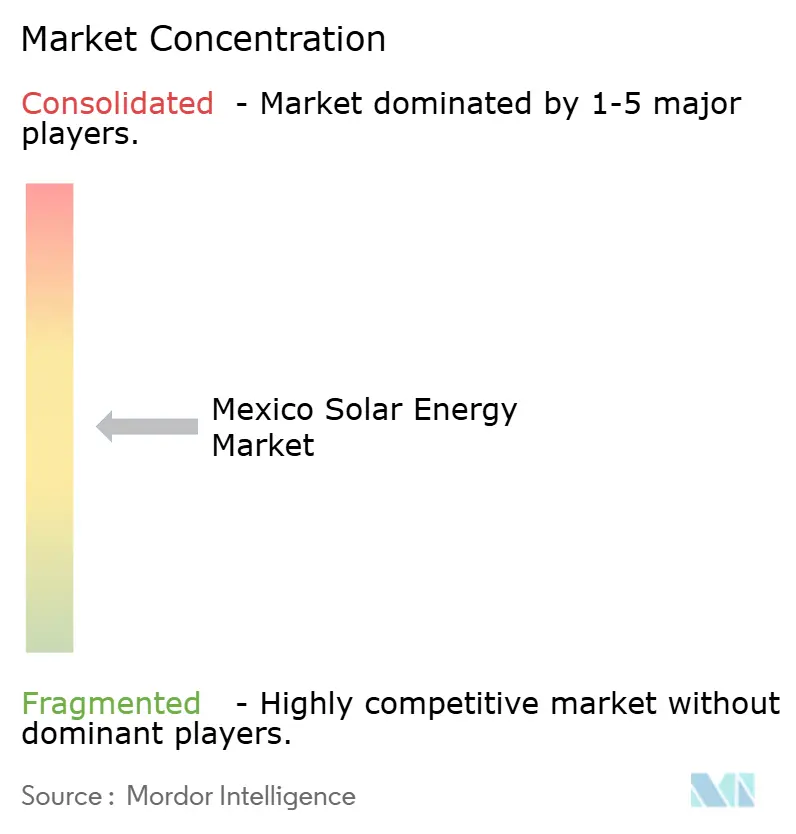
| Market Concentration | Medium |
Major Players *Disclaimer: Major Players sorted in no particular order Image © Mordor Intelligence. Reuse requires attribution under CC BY 4.0. | |
Mexico Solar Energy Market Analysis by Mordor Intelligence
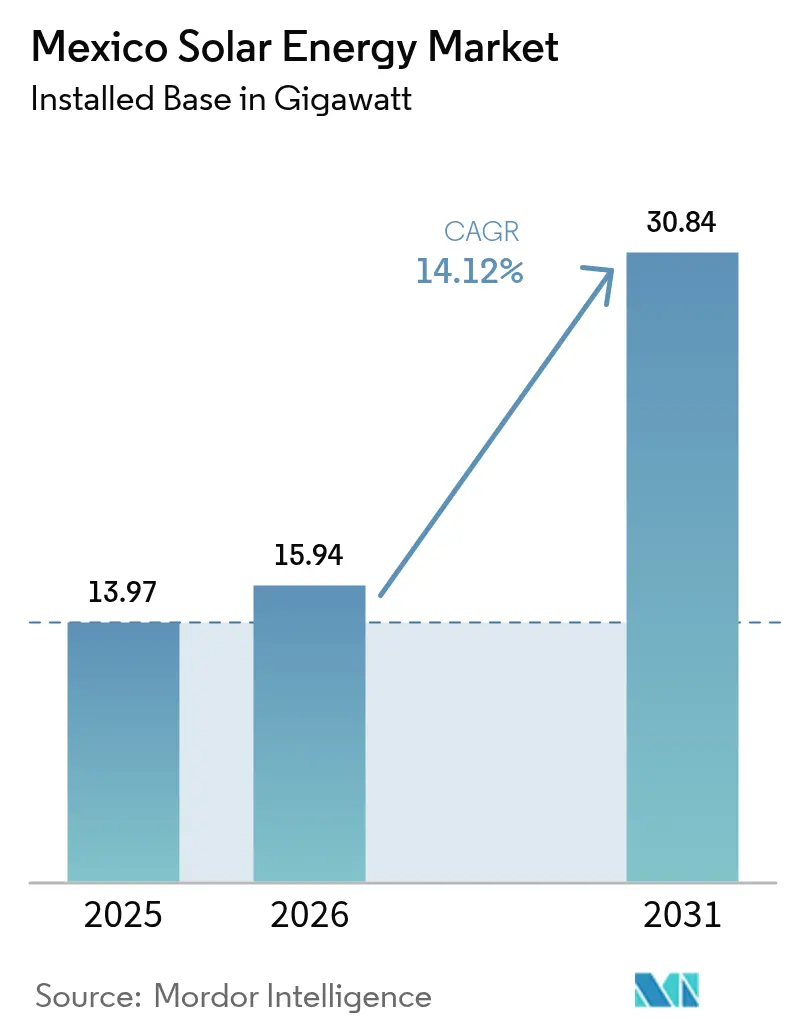
The Mexico Solar Energy Market size is expected to grow from 13.97 gigawatt in 2025 to 15.94 gigawatt in 2026 and is forecast to reach 30.84 gigawatt by 2031 at 14.12% CAGR over 2026-2031.
Rising deployment is anchored in President Claudia Sheinbaum’s 45% clean-power goal for 2030, abundant irradiance over 85% of national territory, and a regulatory regime that retains private-sector pathways even as Comisión Federal de Electricidad (CFE) safeguards a 54% generation quota. Utility-scale plants dominate capacity additions, yet residential and commercial distributed generation is accelerating as equipment prices fall and green financing scales up. Nearshoring pressures from United States manufacturers add new corporate-PPA demand, while a US-Mexico-Canada Agreement sustainability clause tightens the link between trade and renewable sourcing. Planned transmission upgrades, battery manufacturing incentives under the USD 7 billion Plan Sonora, and CFE’s USD 23.4 billion investment plan further support growth even as policy shifts and permitting bottlenecks inject near-term uncertainty.
Key Report Takeaways
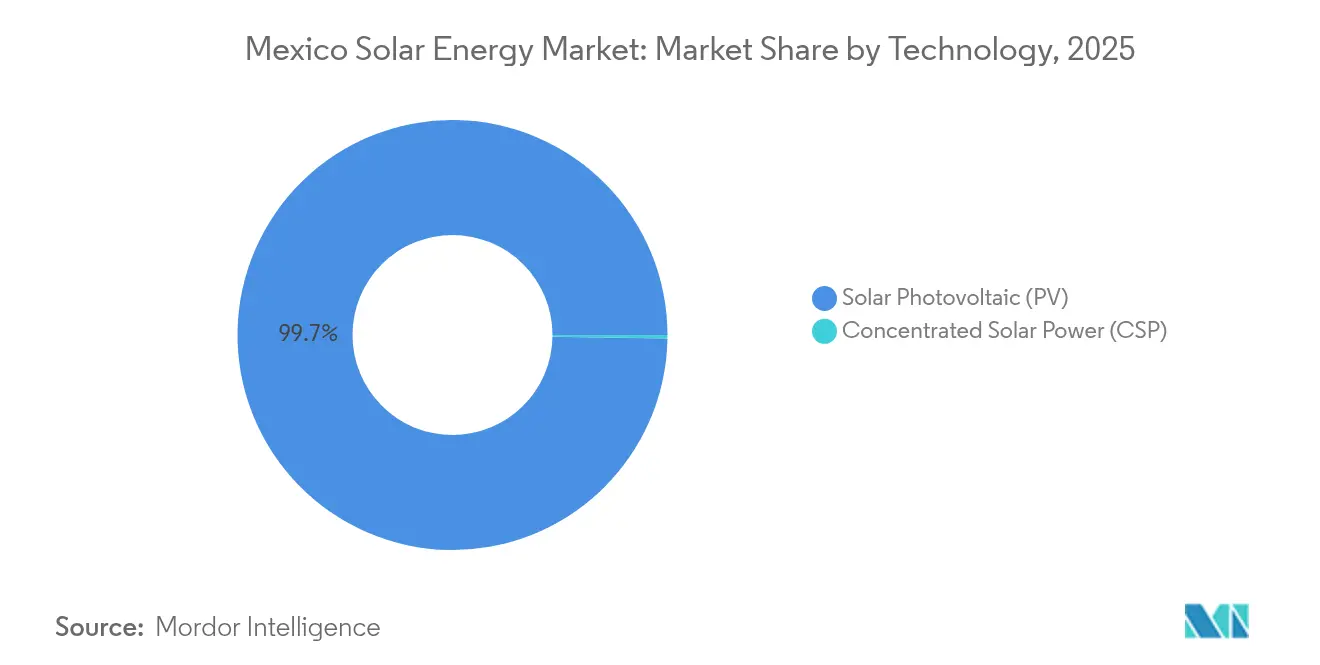
- By 2025, photovoltaic systems held 99.74% of the Mexican solar energy market share, while solar thermal systems for industrial heat are projected to rise at a 36.83% CAGR through 2031.
- By grid type, on-grid systems accounted for 94.85% of the Mexico solar energy market size in 2025, whereas off-grid solutions are forecast to progress at a 20.65% CAGR through 2031.
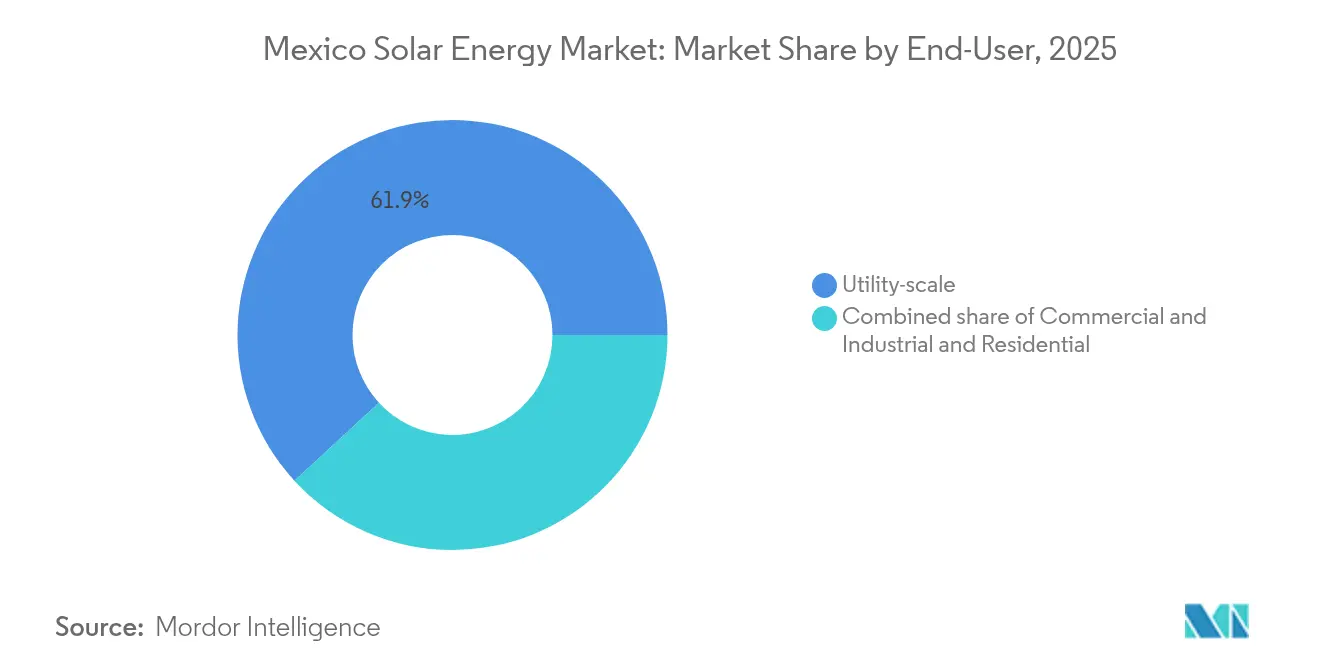
- By end-user, the utility-scale segment captured 61.85% of the Mexican solar energy market size in 2025, while the residential sector is set to grow at an 18.21% CAGR through 2031.
Note: Market size and forecast figures in this report are generated using Mordor Intelligence’s proprietary estimation framework, updated with the latest available data and insights as of 2026.
Mexico Solar Energy Market Trends and Insights
Drivers Impact Analysis*
| Driver | (~) % Impact on CAGR Forecast | Geographic Relevance | Impact Timeline |
|---|---|---|---|
| Abundant solar irradiance across 85% of the country | 3.20% | North and Central regions | Long term (≥ 4 years) |
| Government clean-energy targets to 45% by 2030 | 4.10% | National with focus on Sonora and Coahuila | Medium term (2-4 years) |
| Falling PV capex and new rooftop financing | 2.80% | Urban and peri-urban locations | Short term (≤ 2 years) |
| Powershoring demand for low-carbon supply chains | 3.50% | Border states and manufacturing corridors | Medium term (2-4 years) |
| Smart-grid and storage upgrades | 1.90% | Metropolitan and industrial zones | Long term (≥ 4 years) |
| Corporate-PPA momentum under USMCA clauses | 2.70% | Export-oriented hubs | Medium term (2-4 years) |
| Source: Mordor Intelligence | |||
Abundant Solar Irradiance Drives Geographic Advantage
Mexico achieves irradiation levels above 2,000 kWh/m²/year in its northern deserts and still exceeds 1,600 kWh/m²/year in the south, yielding capacity factors of 25-30% that outperform European benchmarks.[1] Seasonally consistent radiation enables developers to diversify their portfolios, smoothing output and reducing project risk. Studies estimate the technical potential at nearly 24,918 GW, which is many times the current installations, positioning the Mexican solar energy market as a future regional powerhouse.[2]
Government Clean-Energy Targets Reshape Investment Landscape
The National Strategy for the Electric Sector 2024-2030 allocates USD 12.3 billion to new generation, increasing the limits on distributed-generation projects to 0.7 MW and streamlining permit requirements to 20 MW. CFE issued USD 1.5 billion of sustainable bonds in 2024 to finance assets, including the 1,000 MW Puerto Peñasco project. Mixed public-private development models now balance state oversight with private capital, sustaining the Mexico solar energy market despite CFE dominance.
Falling PV Costs Enable Distributed Generation Boom
Auction clearing prices slid from USD 50/MWh to USD 20/MWh, outpacing rising retail tariffs that hit 151.60 USD/MWh in 2023.[3] More than 450,000 net-metered contracts, mainly residential, already total nearly 4 GW. Green mortgages and Fondo de Servicio Universal Eléctrico widen access, while lighter Comisión Reguladora de Energía rules lower soft costs. Analysts expect 600,000 solar rooftops by 2026, reshaping consumption profiles in the Mexico solar energy market.
Powershoring Amplifies Industrial Solar Demand
US manufacturers relocating facilities under near-shoring strategies insist on renewable energy. Microsoft’s USD 1.1 billion data center commitment in Querétaro illustrates the clean power pull that accelerates corporate PPAs. Border states Nuevo León and Chihuahua have seen manufacturers purchase dedicated plants to secure a solar supply, thereby embedding demand directly into industrial growth trajectories.
Restraints Impact Analysis*
| Restraint | (~) % Impact on CAGR Forecast | Geographic Relevance | Impact Timeline |
|---|---|---|---|
| Policy uncertainty & permitting delays under energy-sector reforms | -2.3% | National, particularly affecting private developers and foreign investors | Short term (≤ 2 years) |
| Dominance of CFE limiting private-grid access | -1.9% | National, concentrated in transmission-dependent regions and utility-scale projects | Medium term (2-4 years) |
| Land-use & social-license conflicts in desert utility-scale zones | -1.4% | North region desert areas, particularly Sonora and Chihuahua | Medium term (2-4 years) |
| Grid-congestion & curtailment risk in high-DG regions | -1.2% | North region and metropolitan areas with high solar penetration | Long term (≥ 4 years) |
| Source: Mordor Intelligence | |||
Policy Uncertainty Creates Investment Hesitation
The transfer of CRE and CNH duties to a new National Energy Commission resulted in a 75% decline in clean-energy investment, dropping to USD 302 million in 2023. Secondary legislation due by September 2025 lengthens the clarity gap, raising financiers’ risk perception and slowing project pipelines.[4]
CFE Market Dominance Constrains Grid Access
The statutory 54% generation share reserved for CFE grants the utility key control of transmission planning. Developers report curtailment in Sonora because surplus mid-day output cannot reach distant demand centers, and dispatch priority often favors CFE gas assets over lower-cost solar. These conditions temper the private sector's appetite, especially for large solar parks that rely on grid evacuation.
*Our forecasts treat driver/restraint impacts as directional, not additive. The impact forecasts reflect baseline growth, mix effects, and variable interactions.
Segment Analysis
By Technology: Photovoltaic Dominance Faces CSP Renaissance
Photovoltaic systems captured 99.74% of the Mexico solar energy market share in 2025, reflecting entrenched cost advantages and a mature supply chain that spans residential rooftops through multi-gigawatt parks. Concentrated Solar Power, however, is projected to expand at a 36.83% CAGR to 2031 as policymakers seek dispatchable renewable capacity that pairs thermal storage with Mexico’s world-class direct normal irradiance in desert states such as Sonora and Chihuahua.
The technology mix is evolving from pure cost optimization toward achieving grid stability and energy security goals. CFE’s hybrid geothermal–solar plan at Cerro Prieto and the Puerto Libertad steam project illustrate institutional support for thermal technologies beyond PV. Mexico’s leadership in industrial solar-thermal installations underpins a forecast 7.25 million m² of hybrid collectors by 2030, a build-out that could cut Food and Beverage sector emissions by 51.7%. As a result, the Mexico solar energy market size attributed to CSP and advanced thermal solutions is expected to expand steadily, even as PV remains the cornerstone of capacity.

By Grid Type: On-Grid Supremacy Meets Off-Grid Innovation
On-grid projects accounted for 94.85% of the Mexico solar energy market size in 2025, supported by net-metering rules and the reach of the National Electric System. Off-grid and hybrid systems, though smaller in absolute terms, are growing at a 20.65% CAGR through 2031 as remote mines, farms, and island communities adopt storage-backed arrays that bypass transmission bottlenecks.
Battery prices below USD 100/kWh and new market rules that let storage earn capacity payments now tilt project economics toward energy independence. Plan Sonora’s USD 7 billion battery cluster will shorten supply lines for domestic integrators, enabling off-grid solutions to deliver 24/7 reliability that rivals grid-connected service during peak-load curtailments. Agro-voltaic pilots in Yucatán and Chiapas confirm that stand-alone solar can power irrigation while shielding crops, a dual-benefit model expected to lift the off-grid slice of the Mexico solar energy market by decade-end
By End-User: Utility-Scale Leadership Challenged by Residential Surge
Utility-scale plants held 61.85% of the Mexico solar energy market share in 2025, anchored by projects such as the 1,089 MW Villanueva park and CFE’s 1,000 MW Puerto Peñasco venture. Residential arrays, however, are advancing at an 18.21% CAGR to 2031 as household economics improve; average retail tariffs reached 151.60 USD/MWh in 2023, while module prices slid to historical lows.
More than 450,000 interconnection contracts—75% of which are residential—already total nearly 4 GW, underscoring the consumer appetite for self-generation. Green mortgages and the Fondo de Servicio Universal Eléctrico extend financing to lower-income households, boosting inclusion without sacrificing technical standards. Corporates such as Grupo Bachoco demonstrate the middle-ground appeal of distributed portfolios, having installed 26 MW across 19 states to hedge tariff risk and accelerate ESG compliance. Looking forward, hybrid solar-plus-storage configurations are becoming standard at both residential and utility scales, positioning dispatchability—not just cost—as the decisive differentiator in the Mexico solar energy market.
Geography Analysis
The North region dominates the current capacity in the Mexican solar energy market due to its superior irradiance, industrial demand, and shorter routes to the United States' off-takers. Sonora’s Plan Sonora integrates lithium mining and battery cell production, fostering a localized value chain that informs project finance models and labor demand. However, congestion on the existing 400 kV lines curtails midday PV exports, prompting calls for HVDC links to central load hubs.
Central Mexico, encompassing Mexico City and the State of Mexico, balances high demand with rooftop potential. Steep retail tariffs and dense urban real estate encourage the installation of solar canopies and commercial warehouses. Municipal green-bond frameworks support schools and hospitals in adopting distributed arrays, establishing a replicable model for other metropolitan areas in the Mexico solar energy market.
The South & Peninsula exhibits the quickest installation pace as tourism and near-coastal manufacturing amplify load growth. Microgrids powered by hybrid solar-storage systems lower reliance on diesel and fortify resilience to tropical storm outages, particularly in Quintana Roo. Agro-voltaic pilots in Yucatán demonstrate the benefits of co-location, where shading improves crop yields and diversifies farmer income, underscoring the inclusivity potential of the Mexican solar energy market.
Regulatory Landscape
Mexico's solar regulatory framework is shifting toward a more centralized, state-led model while keeping defined pathways for private participation. Oversight has moved from the former Comisión Reguladora de Energía (CRE) to the National Energy Commission (CNE), which operates as a technical and operational body within the Secretariat of Energy (SENER), and policy planning for new generation has become binding. Within this structure, Comisión Federal de Electricidad (CFE) retains a statutory 54% generation share, shaping interconnection access and dispatch outcomes for utility-scale solar.
During 2025-2026, SENER and CNE rolled out new administrative instruments affecting project eligibility and timelines. SENER established the Ventanilla Unica de Autoconsumo (VUA) as a digital platform to consolidate self-consumption permitting, and the exempt (distributed) generation threshold increased from 0.5 MW to 0.7 MW, supporting larger behind-the-meter projects. On May 11, 2026, the government issued a Second Call for Priority Attention to generation permit and interconnection applications, and reliability policy signals tightened technical requirements, including the formal integration of storage into the legal and contractual framework for grid-connected and self-consumption schemes.
Competitive Landscape
International developers continue to dominate the utility-scale tier. Enel Green Power operates 2.98 GW across 19 Mexican plants, combining solar, wind, and hydro for portfolio hedging. Iberdrola, Acciona, Engie, and Sonnedix follow with multi-GW pipelines. Canadian Solar, Jinko, Trina, and LONGi supply modules, while First Solar’s thin-film technology finds niche demand in high-temperature desert operations.
Supply-chain localization gains momentum. A USD 198 million cell and module plant in Durango enhances regional content ratios, enabling developers to manage import tariffs introduced by the United States in 2025. Rafiqui’s recycling complex adds circular-economy credentials, and Chinese inverter firms expand assembly within Mexico to sidestep duties.
Strategic differentiation is increasingly centered on storage integration, hybrid plant optimization, and financial innovation, rather than headline-per-watt pricing. Players able to bundle software, asset management, and capital-market access will outpace pure-play EPCs. Market consolidation is expected as smaller installers face balance-sheet pressure, tilting the Mexico solar energy market toward mid- and large-cap firms proficient in policy navigation and risk management.
Mexico Solar Energy Industry Leaders
-
Enel Green Power México
-
Iberdrola México
-
Engie México
-
Canadian Solar
-
Acciona Energía
- *Disclaimer: Major Players sorted in no particular order
Market Opportunities and Future Outlook
Much of the near-term white space is concentrated in solar projects that fit the government's binding planning framework and address reliability and congestion constraints through storage. In May 2026, SENER launched a strategic tender for renewable power and energy storage that includes a 935 MW standalone storage target, which provides a direct route to hybridization and grid services beyond energy-only solar. The May 11, 2026 Second Call for Priority Attention also embeds storage more explicitly in permitting, supporting opportunities for EPCs, integrators, and developers that package PV with compliant battery configurations.
A second opportunity is the structured pipeline of permitted utility-scale projects and mixed development schemes that bring private capital into state-centered expansion. In December 2025, SENER approved 20 renewable projects totaling 3,320 MW (including 15 solar PV), and in June 2026, CFE awarded 37 projects to 31 private developers under the First Call for Mixed Development Schemes, expanding the addressable market for developers able to meet the updated technical and administrative requirements. Distributed generation continues to build via the VUA platform and the 0.7 MW exempt-generation ceiling, supporting commercial, industrial, and residential portfolios that hedge high retail tariffs and ease local feeder constraints when paired with storage and smart inverters.
Recent Industry Developments
- June 2026: CFE awarded 37 projects to 31 private-sector developers under the First Call for Mixed Development Schemes. The results operationalized the six-model participation structure under the state-centered market design, creating a clearer contracting pathway for private EPC and financing capacity alongside CFE-led planning.
- December 2025: SENER approved 20 renewable energy projects totaling 3,320 MW, including 15 solar PV projects, under a new binding planning scheme. The approvals showed that utility-scale solar permitting is moving through periodic government calls, and developers increasingly frame projects around compliance, interconnection readiness, and storage-enabled reliability.
- February 2024: ENGIE Mexico inaugurated the 100 MW Akin Solar Park in Puerto Libertad, Sonora, backed by a USD 112 million investment. The project strengthened Sonora's role as a utility-scale solar hub and reinforced the execution focus on high-irradiance northern sites, where grid integration and curtailment management are key constraints.
Research Methodology Framework and Report Scope
Market Definition and Coverage
For this report, the Mexico solar energy market is defined as the country level solar power capacity base and additions that supply electricity, tracked in gigawatts and aligned to how projects are developed, connected, and operated.
Scope exclusions: This sizing excludes off-grid solar used mainly for small standalone needs and also excludes downstream electricity retail prices and non-solar renewable generation.
Segmentation Overview
- By Technology
- Solar Photovoltaic (PV)
- Concentrated Solar Power (CSP)
- By Grid Type
- On-Grid
- Off-Grid
- By End-User
- Utility-Scale
- Commercial and Industrial
- Residential
- By Component (Qualitative Analysis)
- Solar Modules/Panels
- Inverters (String, Central, Micro)
- Mounting and Tracking Systems
- Balance-of-System and Electricals
- Energy Storage and Hybrid Integration
Data Sources, Market Sizing, and Validation
Desk Research
Desk research was used to build the starting dataset for Mexico solar capacity and to set assumptions that can be reviewed and rechecked later. We relied on public energy statistics and policy documentation, such as sources from SENER and CRE, along with grid and system planning publications from CENACE and other official bodies.
To keep the capacity series consistent year to year, global renewable datasets were also reviewed, such as IRENA and IEA publications, and trade and equipment signals were checked using sources like UN Comtrade where relevant. Company annual reports, investor presentations, project announcements, and reputed press were used to confirm commissioning timing and pipeline direction, and then a paid subscription for company financials and news intelligence was used to reconcile unclear ownership and project status. The sources listed here are illustrative and not exhaustive, and many other public references were also used for data collection, validation checks, and research clarification.
Primary Interviews and Surveys
Primary work focused on validating what is actually getting built and connected, and on pressure testing the key inputs that drive capacity forecasts. We spoke with a mix of developers, EPC and service firms, grid and policy experts, and large buyers, and then used respondent inputs to triangulate commissioning lags, permitting bottlenecks, and likely build rates across major demand centers in Mexico.
Distribution of primary research fieldwork respondents
| Company type | Respondent position |
|---|---|
| Top tier: 38% | CXOs: 14% |
| Mid tier: 46% | Functional/Unit leaders: 26% |
| Smaller Players: 16% | Managers: 60% |
Market-Sizing & Forecasting
Sizing starts with a top-down rebuild of Mexico solar capacity by tracking the installed base, annual additions, and grid connection milestones, which are then reconciled to the official reporting cadence and known project timelines. Once that structure is in place, selective bottom-up checks are used to keep the totals realistic, such as sampling announced projects by size, using typical MW blocks, and applying plausible build schedules when only partial status is available.
A few inputs do most of the work in the model, including historical installed capacity (GW), annual capacity additions, expected commissioning delays, share of utility-scale versus distributed systems, and the pace of interconnection approvals. Because the market is measured in GW, we also watch equipment availability signals and construction lead times as practical constraints. For forecasting, scenario analysis is used to reflect different permitting and grid readiness outcomes, and then the final path is aligned to what industry experts consider achievable under current conditions.
Data Validation & Update Cycle
Outputs are checked in several steps so outliers are caught early, and assumptions can be traced back to a documented source or an interview note. We compare modeled capacity additions against independent signals like announced commissioning dates, connection queues, and policy changes, and then investigate any large variance before sign-off.
The report is refreshed annually, and interim updates are made when a material event changes near-term build rates or commissioning schedules. Before delivery, a final review pass is completed so clients receive the latest view based on the most recent public releases and re-contacts where needed.
Mordor Intelligence's Mexico Solar Energy Market Estimate Compared With Other Published Estimates
Published market sizes for Mexico solar often do not match because some sources measure capacity in gigawatts, while others publish revenue in USD, and the line between solar-only and broader renewables is not always drawn the same way. Differences also come from how pipeline projects are treated, and from whether estimates lean on announced targets or only on commissioning evidence.
The table shows a clear split between a capacity-based view and value-based views, and in Mordor Intelligence's model the market is sized as installed solar capacity in GW (13.97 GW in 2025) rather than converting to USD using assumed capex and price paths. Some published figures also blend solar with other renewable technologies or count hybrid and off-grid activity more aggressively, which can shift the total even when the real build pace is unchanged.
Benchmark comparison
| Source | Market Size | Gaps in Research Methodology |
|---|---|---|
| Mordor Intelligence | USD 13.97 B (2025) | |
| Regional Consultancy A | USD 7.90 B (2024) | Uses a revenue valuation, which depends on assumed system prices and mix, and it may also bundle adjacent solar activities like thermal, hybrids, or services that are not treated as installed capacity. |
| Industry Data Publisher B | USD 7.40 B (2024) | Covers the broader renewable energy market and reports USD value, so solar is likely blended with wind and hydro, and currency timing plus price assumptions can materially change the stated total. |
Across the three figures, the main driver of the spread is what is being measured, which is either capacity in GW or revenue in USD, followed by what technologies are included in the scope. By keeping the model tied to observable capacity signals and then cross-checking them with project timing and expert inputs, the final estimate stays easier to reproduce and re-check over time.
Key Questions Answered in the Report
What is the current Mexico solar energy market size?
The installed base stands at 15.94 GW in 2026 and is set to rise to 30.84 GW by 2031.
How fast is the Mexico solar energy market growing?
Capacity is increasing at a 14.12% compound annual rate through 2031.
Which segment is expanding quickest?
Residential distributed generation leads with an 18.21% CAGR owing to lower module prices and green financing programs.
How will new Mexican energy laws affect investors?
The laws elevate CFE’s role but keep private participation open under six models, so bankable projects will rely on clear interconnection rights and long-term PPAs.
What role will storage play in future growth?
Hybrid solar-plus-battery systems are projected to grow at 21.55% CAGR as battery prices fall and new market rules allow revenue stacking.