
Market Overview
| Study Period | 2021 - 2031 |
|---|---|
| Forecast Data Period | 2026 - 2031 |
| Historical Data Period | 2021 - 2024 |
| Market Volume (2026) | 20.85 gigawatt |
| Market Volume (2031) | 32.5 gigawatt |
| Growth Rate (2026 - 2031) | 9.28 % |
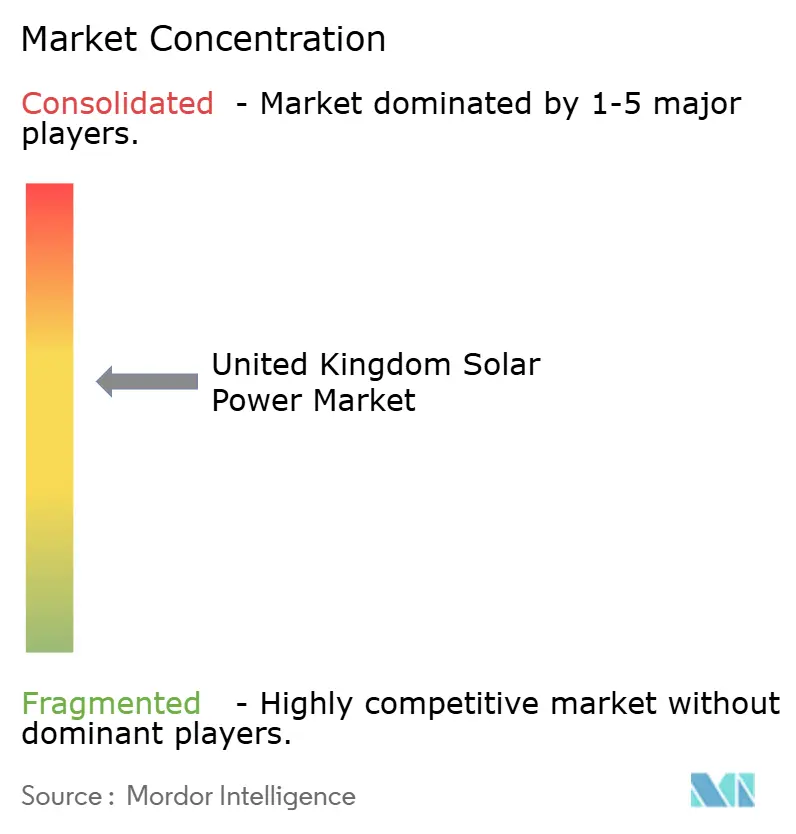
| Market Concentration | Medium |
Major Players *Disclaimer: Major Players sorted in no particular order Image © Mordor Intelligence. Reuse requires attribution under CC BY 4.0. | |

United Kingdom Solar Power Market Analysis by Mordor Intelligence
The United Kingdom Solar Power Market size in terms of installed base is expected to grow from 20.85 gigawatt in 2026 to 32.5 gigawatt by 2031, at a CAGR of 9.28% during the forecast period (2026-2031).
Grid-parity economics now favor merchant utility-scale projects, while rooftop demand is accelerating under supportive tariffs and building codes. Flexible connection rules, rising corporate power-purchase agreements, and cost-competitive storage are steering capacity toward regions with favorable irradiance and available distribution capacity. Policy commitments to a clean electricity system by 2030, paired with investment in public-sector rooftops, have broadened the opportunity set for developers across all scales. Supply-chain diversification, agrivoltaic pilots, and floating solar concepts are emerging as strategic growth avenues as land-use and grid constraints tighten.
Key Report Takeaways
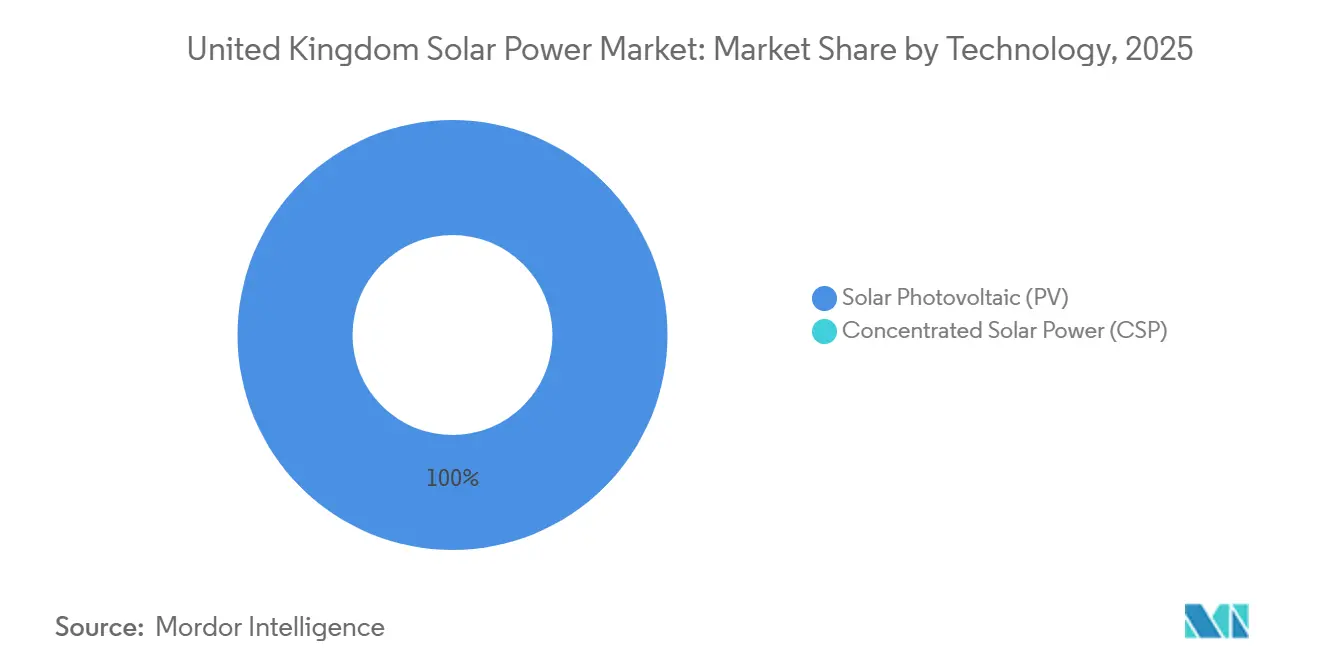
- By technology, photovoltaic modules maintained 100% of the United Kingdom solar power market share in 2025; photovoltaic products drive a 9.28% segment CAGR through 2031.
- By grid type, on-grid assets accounted for 97.1% of the United Kingdom solar power market size in 2025; off-grid systems are projected to grow at a 15.4% CAGR between 2026 and 2031.
- By end user, utility-scale plants captured 72.9% of the United Kingdom solar power market size in 2025, whereas residential installations are expected to grow at a 20.6% CAGR through 2031.
Note: Market size and forecast figures in this report are generated using Mordor Intelligence’s proprietary estimation framework, updated with the latest available data and insights as of January 2026.
United Kingdom Solar Power Market Trends and Insights
Drivers Impact Analysis*
| Driver | (~) % Impact on CAGR Forecast | Geographic Relevance | Impact Timeline |
|---|---|---|---|
| Renewable Energy Obligation Certificates (ROCs) Extension & Corporate PPAs | +1.8% | England, Scotland (industrial clusters) | Medium term (2-4 years) |
| Grid-Parity Achievement in Utility-scale Projects | +2.1% | England (South East, South West, East), Wales | Short term (≤ 2 years) |
| National Grid ESO Reform Favouring Distributed Solar | +1.4% | England (distribution-constrained regions), Scotland | Medium term (2-4 years) |
| Battery-Coupled Solar Economics Enhanced by Ofgem's Flexible Connection Code | +1.9% | England, Scotland, Wales | Short term (≤ 2 years) |
| Rising Demand for Agri-PV to Decarbonise UK Farming Sector | +0.7% | England (East, South West), Wales, Scotland | Long term (≥ 4 years) |
| OEM Supply-Chain Localisation Incentives Under UK Net-Zero Strategy | +0.5% | England (manufacturing hubs), Scotland | Long term (≥ 4 years) |
| Source: Mordor Intelligence | |||
Renewable Energy Obligation Certificates Extension Spurs Corporate PPAs
The ROC window through March 2027 underpins 10–15-year corporate PPAs, letting manufacturers and data centers hedge volatile wholesale prices while meeting disclosure mandates. Industrial demand clusters in Scotland and England absorb midday generation, lowering curtailment risks. The ROC floor de-risks early cash flows, unlocking bank finance for mid-scale developers, yet a commissioning rush is expected before the mechanism sunsets. Without larger CFD rounds, post-2027 activity could soften.[1]DESNZ, “Clean Power 2030 Action Plan,” DESNZ.gov.uk
Grid-Parity Achievement in Utility-Scale Projects Accelerates Merchant Solar
Levelized costs below GBP 0.045 per kWh in 2024 let southern English projects rely on wholesale, embedded-benefit, and ancillary-service revenues. Bifacial modules and single-axis trackers enhance yields, demonstrated by GRIDSERVE’s York site, which integrates 27 MW storage to capture multiple value streams.[2]Energy Storage News, “GRIDSERVE Completes Subsidy-Free Solar-Plus-Storage,” energystoragenews.com Merchant viability concentrates pipelines in high-irradiance counties, attracting institutional capital and reducing policy risk.
National Grid ESO Reform Favors Distributed Participation
Locational capacity auctions now prioritize distribution-connected solar, shortening queues and lowering charges for 10–50 MW arrays that relieve local demand. Developers are redrawing site plans to fit 11 kV or 33 kV thresholds and pairing storage to qualify for flexible agreements. The forthcoming Spatial Energy Plan may codify this tilt toward urban and peri-urban distributed solar.
Battery-Coupled Solar Economics Enhanced by Flexible Connection Code
Sharing export limits allows oversizing solar and storing surplus for evening peaks, when prices run 40–60% higher. Battery-paired solar capacity jumped 122% in the first nine months of 2025 as projects stack wholesale, frequency response, and capacity-market income. Sophisticated energy-management systems are now standard to comply with real-time export ceilings.
Restraints Impact Analysis*
| Restraint | (~) % Impact on CAGR Forecast | Geographic Relevance | Impact Timeline |
|---|---|---|---|
| Land-Use Planning Constraints in England's National Planning Policy Framework | -1.2% | England (agricultural counties) | Medium term (2-4 years) |
| Grid Congestion & Long Queue Times for Connections in Northern England | -1.5% | Northern England, Scotland | Short term (≤ 2 years) |
| Import Dependency Risk from Xinjiang Silicon Module Supply Chain | -0.6% | UK-wide | Medium term (2-4 years) |
| Volatile CFD Strike Prices Limiting Small-scale Project Bankability | -0.8% | England, Wales, Scotland | Short term (≤ 2 years) |
| Source: Mordor Intelligence | |||
Land-Use Planning Constraints Challenge Expansion
Agricultural land classifications hinder solar on Grade 1–3a soils, extending approvals to 18–24 months. Projects in Somerset and North Yorkshire face rejection unless dual-use or brownfield siting is proven. Elevated remediation costs on landfills further squeeze margins, shifting developers toward Wales and Scotland.[3]DESNZ, “National Planning Policy Framework 2024 Revision,” DESNZ.gov.uk
Import Dependency Risk from Xinjiang Silicon
Traceability rules under the U.S. Uyghur Act spill into European procurement, leading UK buyers to audit Tier 1 suppliers. Module costs could rise 3–5% if alternative polysilicon sources are mandated, squeezing fixed-price PPAs. Diversified sourcing or domestic assembly would mitigate exposure.[4]Ofgem, “Connections Reform Consultation Outcome,” Ofgem.gov.uk
*Our forecasts treat driver/restraint impacts as directional, not additive. The impact forecasts reflect baseline growth, mix effects, and variable interactions.
Segment Analysis
By Technology: Solar PV Dominates Temperate Climate
Solar photovoltaic technology captured 100% of the UK solar power market share in 2025 and is set to grow at a 9.3% CAGR through 2031, keeping the UK solar power market entirely PV-driven. Field tests in North Yorkshire show bifacial modules generating 15–17% more energy than monofacial references, validating rapid bifacial uptake. Half-cell and multi-busbar designs further boost low-light yields, aligning with the nation’s diffuse-irradiance profile.
Module innovations dovetail with inverter trends: string inverters dominate utility arrays for cost efficiency, whereas microinverters prosper on rooftops by mitigating chimney and tree shading. Tracking remains niche, yet University of Southampton trials could quantify dual-axis value at high latitudes over 2026–2028. Collectively, these advancements reinforce the technology’s lock-in across the UK solar power market.



By Grid Type: Off-Grid Gains in Remote Applications
On-grid assets held 97.1% of the UK solar power market size in 2025, underpinned by the Smart Export Guarantee, which paid GBP 56.97 million to prosumers that year. SEG tariffs, ranging from GBP 0.04-0.25 per kWh, spur battery adoption for export timing.
Off-grid systems, growing at a 15.4% CAGR, now underwrite microgrids on the Hebrides and Orkney, where subsea cables cost GBP 500,000 per kilometer. Lithium-ion storage below GBP 150 per kWh and portable solar for construction sites widen the addressable base. Off-grid’s share of the UK solar power market remains small yet strategic for resilience and rural electrification.
By End User: Residential Segment Surges on Policy Mandates
Utility-scale projects held 72.9% of 2025 capacity, benefiting from GBP 0.50-0.70 per-watt installed costs and 50 MW clustering for economies. Multiple merchant and CFD-backed farms, such as Larks Green, crossed financial close in 2024, reinforcing scale dominance.
The residential surge, advancing at 20.6% CAGR, reflects 206,682 rooftop certifications in 2025 and the Future Homes Standard mandate for new-build solar. Battery bundling and agile export tariffs heighten self-consumption. Commercial-and-industrial rooftops fill the middle ground, offsetting demand charges with 100-500 kW arrays. Together, these trends diversify end-user demand across the UK solar power market.

Geography Analysis
England commands 86% of installed capacity and added 1.8 GW in 2024, with the South East, South West, and East featuring the densest pipelines. South West irradiance over 1,100 kWh/m² attracts 50 MW farms such as Litchardon Cross. Cornwall leads rooftop uptake with 3,726 installations in 2025, evidencing favorable local policies. Yet NPPF land-use tests slow greenfield approvals, nudging developers toward brownfield plots and distribution-level connections.
Scotland trails in PV yet offers accommodating land-use rules and hybrid project potential. Islands reliant on diesel now pilot solar-storage microgrids, cutting generation costs from GBP 0.40 to GBP 0.20 per kWh. Transmission congestion to England constrains exports, prompting co-located batteries that time-shift excess power.
Wales posts the UK’s best 2025 load factor at 10%, aided by south-coast irradiance and community-benefit policies. Capacity is rising in Pembrokeshire, while smaller industrial demand caps rooftop potential. Northern Ireland remains niche, contributing under 2% capacity, though agrivoltaics could unlock farm diversification. Regional dynamics suggest England will still capture 80-85% of new capacity, with Scotland pursuing hybrids and Wales modest growth.
Regulatory Landscape
The UK regulatory framework for solar spans planning consent, grid access, and retail export rules. In June 2025, DESNZ published the Solar Roadmap with 70+ actions tied to Clean Power 2030 delivery, including grid-connection streamlining and community benefit approaches. Ofgem also advanced connection reform in April 2025 by approving TMO4+ changes that move the queue away from first-come-first-served toward a readiness-based regime administered by the National Energy System Operator (NESO), which increases the value of earlier-stage evidence on land, permitting, and deliverability.
Planning thresholds have also shifted in England. Two 2025 statutory instruments raised the key solar size threshold to 100 MW, reducing central-government consent requirements for projects in the 50-100 MW range and shifting more schemes to local planning authority processes, while keeping very large projects in the NSIP route under the Planning Act 2008. On the distributed side, DESNZ opened a June 2026 consultation on plug-in solar products, proposing an interim product specification (including reference to DIN VDE V 0126-95:2025-12) to enable safe, legal use via standard domestic sockets. If implemented, this would broaden pathways for small-scale PV adoption.
Value Chain Analysis
The UK solar PV value chain is anchored in imported core hardware (modules and many inverters), a domestic layer of distribution and logistics (for example, Segen UK), and a highly fragmented downstream delivery base of EPCs and 500+ MCS-certified residential installers. Upstream project origination and development is led by utility-scale developers and asset owners, supported by planning, grid, legal, and financing specialists. In operations, O&M providers and performance monitoring platforms support output, with battery integration and controls increasingly built into plant design to manage export constraints and support revenue stacking.
Bottlenecks are less tied to PV module availability and more tied to grid-enabling equipment and compliance. UK supply-chain readiness work highlights that long lead times for transformers and switchgear can delay commissioning, even when panels are readily purchasable, keeping DNO coordination and electrical balance-of-plant procurement critical. Policy and standards are also reshaping product flow: the June 2025 confirmation of the Future Homes Standard (solar PV by default for most new builds) reinforces steady rooftop demand for installers and distributors, while the June 2026 plug-in solar consultation and interim specification could create a new consumer-grade channel that moves part of the market toward standardized, safety-certified plug-in kits. At the same time, industry attention on traceability and ESG assurance for imported modules is increasing procurement complexity, and domestic capacity proposals such as ST Solar UK Limiteds gigafactory plan indicate interest in partial vertical integration to reduce import dependence.
Competitive Landscape
Market fragmentation is moderate. Lightsource bp, EDF Renewables, and Octopus Energy Generation lead utility-scale development, leveraging merchant financing and corporate PPAs. Foresight Solar Fund and NextEnergy Capital focus on operational acquisitions, optimizing yields via repowering. JinkoSolar, Canadian Solar, and Trina Solar collectively supply over 60% of utility modules, while First Solar services low-carbon procurement niches.
Residential installation is fragmented among 500+ MCS-certified firms, driving price competition and consolidation. Agrivoltaic pioneers such as Low Carbon Farming and Winch Energy test sheep-grazing designs, whereas floating solar specialists explore reservoir deployment at water-utility sites. Great British Energy’s GBP 180 million public-estate rooftop program offers steady EPC awards. Battery retrofit and hybrid solar-wind plays represent white-space for nimble entrants. Compliance with MIS 3002 and G98/G99 remains a gating barrier, favoring incumbents with certification and DNO ties.
United Kingdom Solar Power Industry Leaders
Lightsource bp Renewable Energy Investments Ltd
EDF Renewables UK (Electricité de France SA)
Octopus Energy Generation
Foresight Solar Fund Ltd
ScottishPower Renewables (Iberdrola SA)
- *Disclaimer: Major Players sorted in no particular order

Market Opportunities and Future Outlook
The policy and approvals pipeline creates whitespace across utility-scale projects, distributed rooftops, and emerging consumer formats. DESNZ's Clean Power 2030 Action Plan sets a 45-47 GW solar target by 2030, versus provisional May 2025 levels cited at 22.6 GW. The planning system has also been moving projects forward: in April 2026, the UK government approved the 800 MW Springwell Solar Farm, followed by approvals totaling 1.2 GW in one week in July 2026, including the 740 MW One Earth Solar Farm, the 320 MW Peartree Hill Solar Farm, and the 150 MW Dean Moor Solar Farm. Together, these actions expand the near-term addressable market for developers, owners, and grid and balance-of-system suppliers, with co-located BESS increasingly part of delivery plans to manage curtailment and connection limits.
On the distributed side, record installation momentum and targeted programs support multiple go-to-market routes. DESNZ reported 2025 as the strongest year on record with about 269,000 installations and over 2 million cumulative installations. The Warm Homes Plan (January 2026) frames a home-upgrade pathway that includes solar and batteries alongside heat pumps. A separate June 2026 DESNZ consultation on plug-in solar, supported by an interim product specification and proposed updates to plug and socket safety rules, opens a potential new product segment for compliant, socket-connected microgeneration that could complement conventional rooftop systems where installer availability, scaffolding, or landlord permissions slow adoption. Across segments, grid-access reforms (Ofgem TMO4+ and ongoing connections work) and the shift of some 50-100 MW projects into local planning in England together create additional openings for specialist developers, aggregators, and supply-chain players focused on faster-to-build, distribution-connected and hybrid solar-plus-storage configurations.
Recent Industry Developments
- July 2026: The UK government approved solar projects totaling 1.2 GW in one week, including the 740 MW One Earth Solar Farm, the 320 MW Peartree Hill Solar Farm, and the 150 MW Dean Moor Solar Farm. The cluster of approvals expands the utility-scale construction pipeline and underlines the role of large projects in meeting Clean Power 2030 goals.
- June 2025: DESNZ published the Solar Roadmap, setting out more than 70 actions to accelerate solar deployment toward 2030 objectives. The roadmap formalized priorities such as grid-connection streamlining and supply-chain diversity, giving developers and investors clearer signals on implementation focus areas.
- December 2024: Lightsource bp reported reaching 1.3 GW of solar and energy storage assets under its UK operations and maintenance management. The milestone highlights the scale-up of professional O&M and battery-integrated operations as more UK solar capacity moves into long-term, performance-driven ownership.


Research Methodology Framework and Report Scope
Market Definition and Coverage
This market covers solar power in the United Kingdom, measured through installed solar photovoltaic capacity that is deployed and operational in the country, including both on-grid and off-grid systems. The focus is on the physical buildout of solar power assets rather than electricity retailing.
Scope exclusions: Solar thermal applications, offshore floating hybrid concepts, and component exports are excluded from this market sizing.
Segmentation Overview
- By Technology
- Solar Photovoltaic (PV)
- Concentrated Solar Power (CSP)
- By Grid Type
- On-Grid
- Off-Grid
- By End User
- Utility-Scale
- Commercial and Industrial (C&I)
- Residential
- By Component (Qualitative Analysis)
- Solar Modules/Panels
- Inverters (String, Central, Micro)
- Mounting and Tracking Systems
- Balance-of-System and Electricals
- Energy Storage and Hybrid Integration
Data Sources, Market Sizing, and Validation
Desk Research
Desk research was used to build the base structure of the UK solar demand and supply picture, and then to set guardrails for what looks reasonable each year. We mainly relied on public energy statistics and policy documents to understand installed capacity history, annual additions, grid connections, and the incentive environment that shapes deployment timelines.
Common source types included UK government energy and climate statistics and publications (such as DESNZ releases), regulator and grid connection materials (such as Ofgem and National Grid data), and international energy datasets (such as IEA and IRENA). We also referred to peer-reviewed papers for performance and degradation assumptions, customs or trade releases where helpful for context, and public company reports like annual reports and investor presentations to cross-check project pipelines and commissioning timing. Select paid subscriptions were used only for company financials and intelligence, news and financials, and patent databases where they helped validate technology direction. The sources listed here are illustrative, and other public documents were also used for data collection, validation, and clarification.
Primary Interviews and Surveys
Primary work focused on validating what gets built in practice, how quickly projects move from consent to grid connection, and where cost and supply constraints are easing or tightening. We spoke with a mix of developers, EPC and service firms, equipment suppliers, utilities and offtakers, and sector advisors, which helped us confirm assumptions and close gaps that public datasets do not fully explain.
Distribution of primary research fieldwork respondents
| Company type | Respondent position |
|---|---|
| Top tier: 28% | CXOs: 15% |
| Mid tier: 51% | Functional/Unit leaders: 39% |
| Smaller Players: 21% | Managers: 46% |
Market-Sizing & Forecasting
Sizing starts from a top-down capacity ledger where the historical installed base and yearly additions are reconstructed using official time series and grid-related signals, then carried forward with realistic commissioning profiles. To keep totals grounded, we corroborate them with selective bottom-up checks such as sampled project pipelines, channel feedback on shipment momentum, and spot checks of typical system sizes by end user.
Key inputs used in the model include annual capacity additions, connection and commissioning timelines, the utility-scale versus rooftop mix, the on-grid versus off-grid split, module technology trends that affect yield, and the capex direction that changes build economics. Because public data can lag, we treat late-year additions carefully and use primary feedback to allocate additions into the correct year when commissioning is delayed. Forecasts are built using scenario analysis, varying policy support, grid availability, and financing conditions, then aligning to the most consistent path suggested by expert inputs.
Data Validation & Update Cycle
Model outputs are checked against independent signals such as national installed capacity series, reported commissioning activity, and grid connection commentary, then reviewed for year-over-year jumps that do not match real deployment constraints. Where variances appear, we revisit the underlying drivers, re-check the source trail, and re-contact relevant experts if the mismatch is material.
Each report is refreshed on an annual cycle, and interim updates are made when policy changes, major project movements, or macro events meaningfully shift the outlook. Before delivery, a final review pass is completed so clients receive the latest updated view based on the most recent data releases.
Mordor Intelligence's United Kingdom Solar Power Market Market Sizing Compared With Other Published Estimates
It is common to see different published market sizes for UK solar because the unit of measurement is not consistent, and because some studies mix capacity buildout with revenue pools that depend on pricing and value chain coverage. Differences also show up when one source uses an earlier base year, applies a faster price escalation, or updates assumptions less frequently.
Inverter and module sales revenue often gets counted inside the market by some publishers, but it sits outside Mordor Intelligence's scope because the core model tracks installed capacity in gigawatts within the United Kingdom. The spread also grows when CSP is bundled with PV, when regional definitions differ, or when currency conversion timing changes the reported USD value even if deployment levels are similar.
Benchmark comparison
| Source | Market Size | Gaps in Research Methodology |
|---|---|---|
| Mordor Intelligence | USD 20.85 B (2026) | |
| Industry Research House A | USD 8.24 B (2024) | Uses revenue-based valuation rather than installed capacity, which pulls in pricing assumptions and may include broader value chain revenues beyond operational capacity in-country. |
| Industry Research House B | USD 10.09 B (2025) | Reports market size in USD revenue and can bundle PV and CSP with regional revenue allocation, making results sensitive to price progression, exchange rates, and end-user spend definitions. |
The table shows that the gap is mainly driven by capacity versus revenue measurement, and by what parts of the value chain are counted. By keeping the sizing traceable to installed base, yearly additions, and commissioning timing, the estimate stays easier to replicate and simpler to reconcile with public energy statistics.


Key Questions Answered in the Report
How large is the UK solar power market in 2026?
The installed capacity reaches 20.85 GW in 2026, growing toward 32.50 GW by 2031.
What is driving rooftop adoption among homeowners?
The Future Homes Standard mandate, Smart Export Guarantee payments, and falling battery costs fuel a 20.6% CAGR in residential installations.
Which UK regions add the most new solar capacity?
England’s South East, South West, and East regions together account for about 86% of recent additions, thanks to higher irradiance and grid availability.
Why are bifacial panels gaining share?
Field data show 15–17% higher output versus monofacial panels under UK conditions, improving project economics even with slightly higher degradation rates.
How is grid congestion being addressed?
National Grid ESO’s distributed-solar reforms and Ofgem’s flexible connection code prioritize ready projects and allow solar-plus-storage sites to share export limits.
Page last updated on:


 Your data is secure and never sold or shared.


