
South America Home Appliances Market Size and Share
Market Overview
| Study Period | 2021 - 2031 |
|---|---|
| Forecast Data Period | 2026 - 2031 |
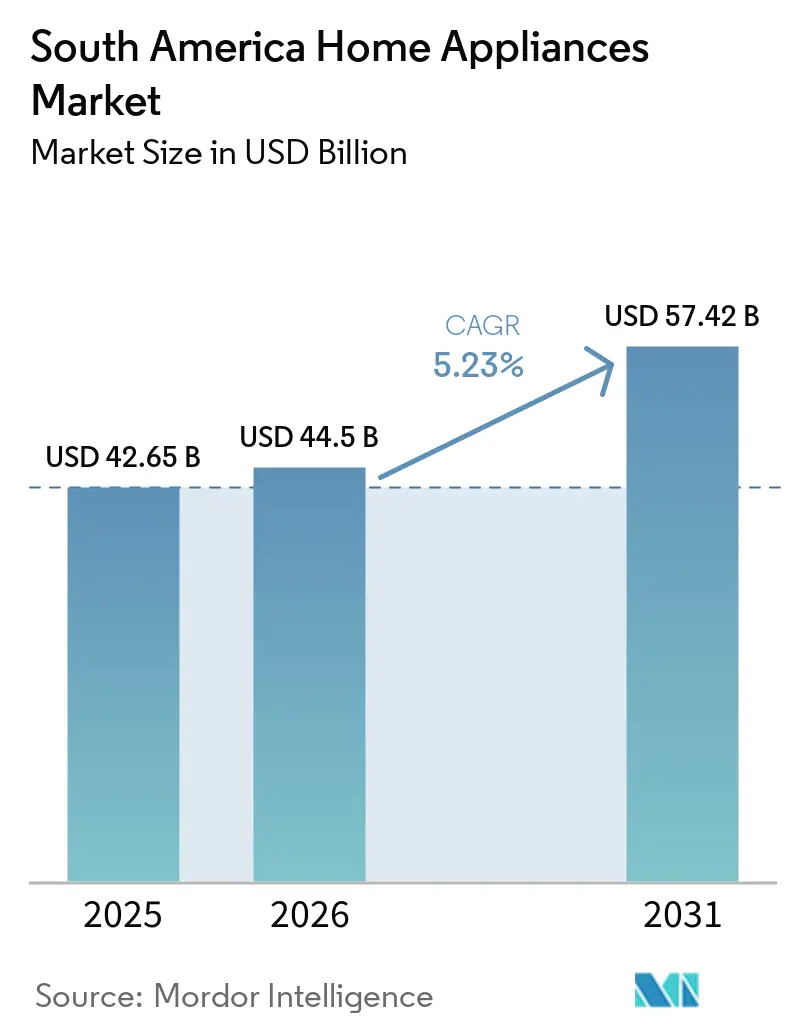
| Base Year Market Size (2025) | USD 42.65 Billion |
| Market Size (2026) | USD 44.5 Billion |
| Market Size (2031) | USD 57.42 Billion |
| Growth Rate (2026 - 2031) | 5.23 % |
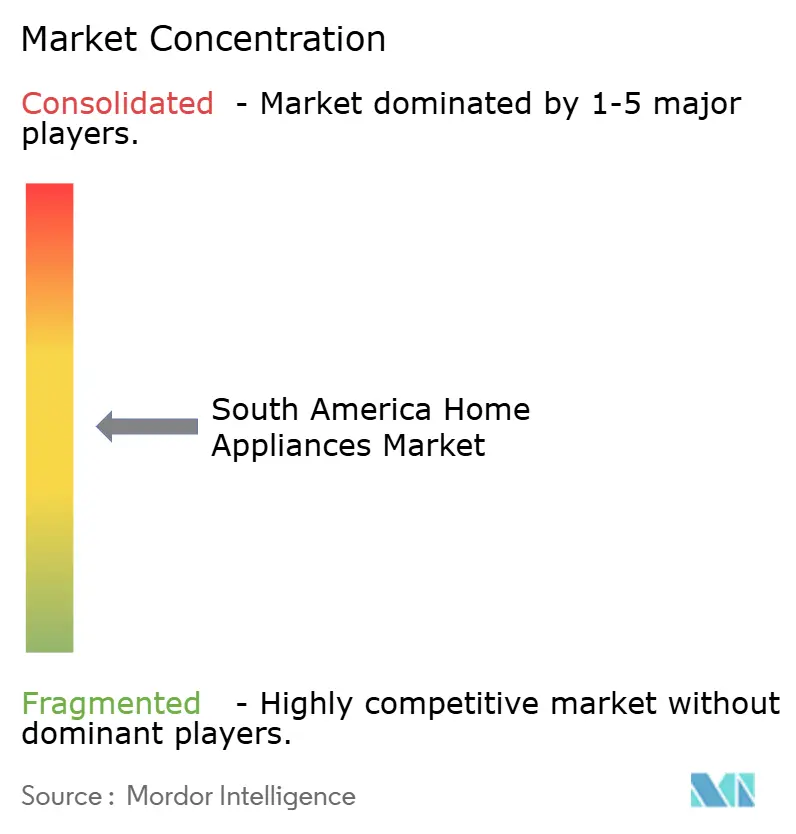
| Market Concentration | Medium |
Major Players *Disclaimer: Major Players sorted in no particular order Image © Mordor Intelligence. Reuse requires attribution under CC BY 4.0. | |
South America Home Appliances Market Analysis by Mordor Intelligence
The South America home appliances market size was valued at USD 42.65 billion in 2025 and is estimated to grow from USD 44.5 billion in 2026 to reach USD 57.42 billion by 2031, at a CAGR of 5.2% during the forecast period (2026-2031). The outlook reflects broader access to consumer credit, wider use of digital payments, and household formation across the region. Brazil remains the central demand and production base, while Peru gains importance as new port capacity widens access to imported products. Manufacturers are balancing local production investments against competition from lower-cost imported products. Currency movements and high borrowing costs can delay purchases of major appliances, even when replacement needs remain steady. The South America home appliances market, therefore, rewards companies that can support affordable financing, reliable delivery, and locally compliant product lines.
Key Report Takeaways
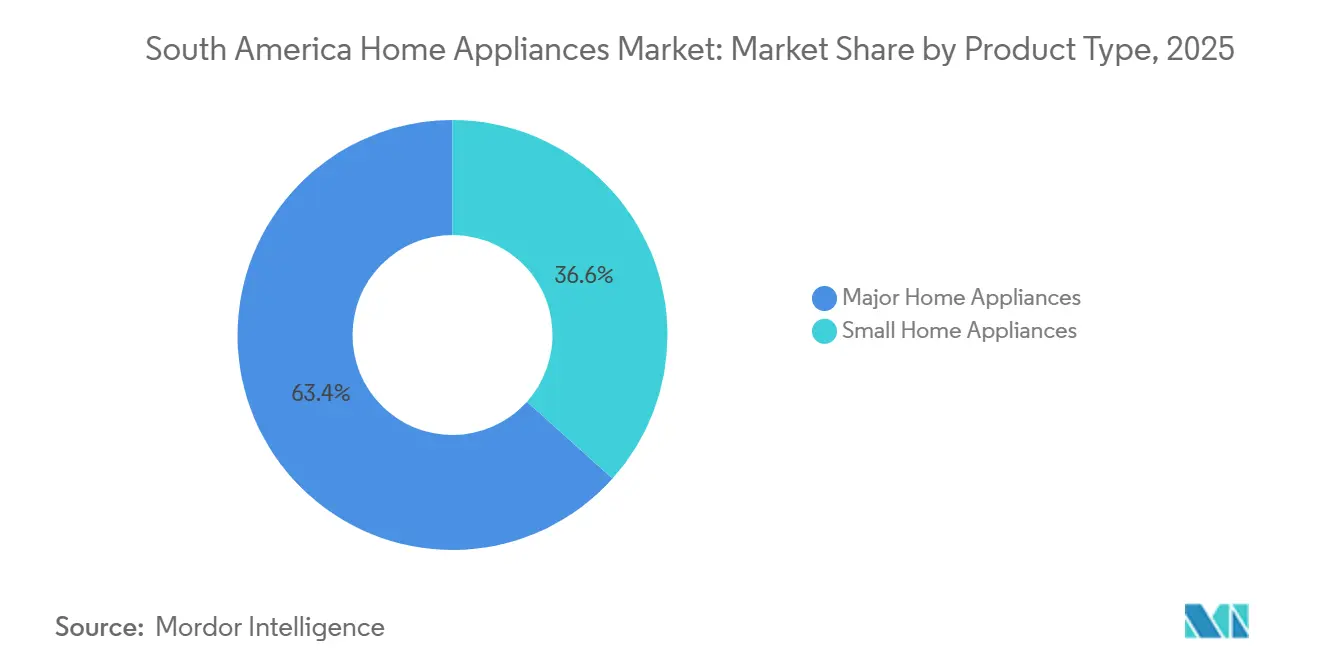
- By product type, Major Home Appliances held 63.36% of the South America home appliances market share in 2025, while Small Home Appliances is forecast to grow at a 6.25% CAGR through 2031.
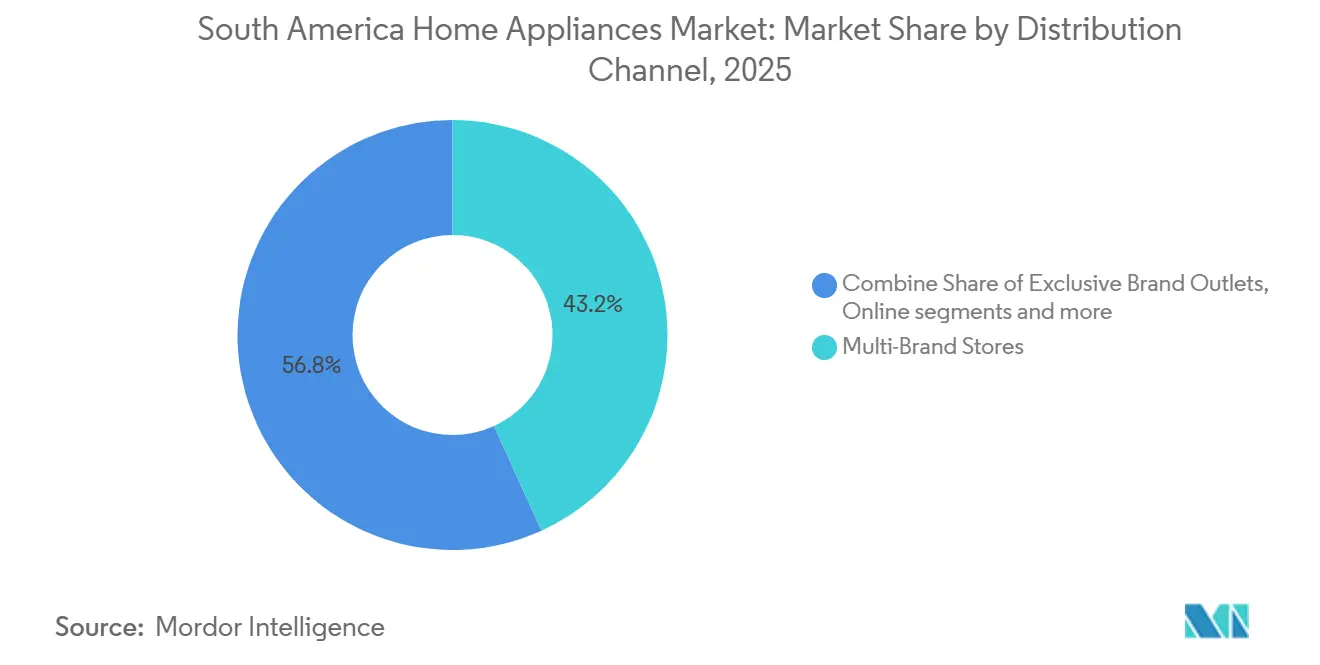
- By distribution channel, Multi-Brand Stores held 43.21% of the South America home appliances market share in 2025, while Online is forecast to grow at a 6.84% CAGR through 2031.
- By geography, Brazil held 48.25% of the regional total in 2025, while Peru is forecast to grow at a 6.54% CAGR through 2031.
Note: Market size and forecast figures in this report are generated using Mordor Intelligence’s proprietary estimation framework, updated with the latest available data and insights as of January 2026.
South America Home Appliances Market Trends and Insights
Drivers Impact Analysis*
| Driver | (~) % Impact on CAGR Forecast | Geographic Relevance | Impact Timeline |
|---|---|---|---|
| Rising Disposable Income and Consumer Credit Access | +1.4% | Brazil, Argentina, Chile, Peru | Medium term (2–4 years) |
| E-Commerce, Instant Payments and Embedded Financing | +0.9% | Brazil (core), spill-over to Argentina, Chile | Short term (≤ 2 years) |
| Smart-Connected Appliance Adoption | +0.7% | Brazil, Chile (early adopters), with supply-side reach across all markets | Long term (≥ 4 years) |
| Urban Housing Formation and Replacement Demand | +0.8% | Brazil (dominant), secondary gains in Peru and Colombia | Medium term (2–4 years) |
| Chancay Port-Led Import and Assortment Expansion | +0.4% | Peru (origin), spill-over to Chile, Ecuador, Colombia | Short term (≤ 2 years) |
| Energy and Water Stress Accelerating Efficient Appliances | +0.5% | Brazil, Chile, Peru; national, with early gains in São Paulo, Santiago, Lima | Long term (≥ 4 years) |
| Source: Mordor Intelligence | |||
Rising Disposable Income and Consumer Credit Access
Consumer credit functions as an important route to purchase for the South America home appliances market, particularly for higher-priced durable goods. In Argentina, credit cards accounted for 55.1% of appliance purchases in the fourth quarter of 2025[1]Instituto Nacional de Estadística y Censos, “Encuesta de Comercios de Electrodomésticos y Artículos para el Hogar, Cuarto Trimestre de 2025,” INDEC, indec.gob.ar.. IDB Invest documented more than 131 million retail store cards in Brazil, with annual transactions of USD 9 billion, alongside formal bank credit[2]Inter-American Development Bank Invest, “Home Durables and Access to Credit Among the Low-Income in Latin America and the Caribbean,” IDB Invest, idbinvest.org.. This combination expands access beyond households that rely only on conventional bank lending. Argentina recorded 23% growth in appliance unit sales in 2025, supported by lower import prices, broader product availability, and stronger consumer credit conditions. When interest rates increase, the cost of installment plans can rise quickly and postpone replacement purchases.
E-Commerce, Instant Payments and Embedded Financing
Brazil's Pix became the leading online payment method in 2025, accounting for 42% of e-commerce payment value, compared with 41% for credit cards. Pix Automático launched in June 2025 and can extend recurring debit payments to as many as 60 million Brazilians without credit cards. Embedded lending can use Open Finance data during checkout, linking product research more directly with available credit. Mercado Libre reported foreign exchange-neutral gross merchandise value growth of 30% in Brazil and 126% in Argentina during the first quarter of 2025, with nearly 67 million unique buyers. The shift requires manufacturers and retailers to improve product content, financing choices, and delivery capabilities.
Smart-Connected Appliance Adoption
Smart appliances are becoming more common in the South America home appliances market, especially in Brazil and Chile. Samsung stated that 5.6 million smart appliances were sold in Latin America in 2025, representing 20% of regional appliance sales. The connected appliance segment tripled between 2020 and 2025, while sales of AI-integrated appliances increased 60% during 2025. Samsung also reported a 19% year-over-year increase in Wi-Fi connectivity across its Latin American appliance range and a 251.7% increase in AI product usage. Connected features are increasingly expected in mainstream refrigerators and washing machines, rather than being limited to premium products. Manufacturers without a credible mid-range connected range face greater pressure as imported AI-capable products reach wider price points.
Urban Housing Formation and Replacement Demand
Brazil's Minha Casa Minha Vida program contracted 349,000 residential units in the first half of 2026, 21% more than in the first half of 2025[3]Associação Brasileira de Incorporadoras Imobiliárias, “Contratações Minha Casa, Minha Vida, Análise Semestral 1S2026,” ABRAINC, cdn.abrainc.org.br.. Residential lending under the program reached BRL 79.4 billion, equivalent to USD 14.3 billion, and increased 29% year over year. The program accounts for more than 50% of new residential transactions in Brazil, supporting first purchases of refrigerators, washing machines, and cooking ranges. Appliances bought during the 2020 to 2022 pandemic period are also moving into a 5-7 year replacement cycle. Housing deliveries and replacement needs together provide a more stable base for major appliance demand during periods of high interest rates.
Restraints Impact Analysis*
| Restraint | (~) % Impact on CAGR Forecast | Geographic Relevance | Impact Timeline |
|---|---|---|---|
| Currency, Tariff, and Imported-Component Volatility | -1.1% | Brazil (core), Argentina, Chile, Peru | Short to medium term (≤ 4 years) |
| High Interest Rates and Durable-Goods Affordability | -0.8% | Brazil (dominant), secondary pressure in Argentina, Chile | Medium term (2–4 years) |
| Line-Drying Preferences Limiting Clothes-Dryer Penetration | -0.3% | Brazil, Argentina, Colombia (cultural penetration ceiling) | Long term (≥ 4 years) |
| Reverse-Logistics and End-of-Life Collection Gaps | -0.2% | Brazil (national), with early compliance pressure in São Paulo, Minas Gerais | Long term (≥ 4 years) |
| Source: Mordor Intelligence | |||
Currency, Tariff and Imported-Component Volatility
South American appliance supply chains remain exposed to changes in exchange rates, tariffs, and imported component costs. Brazil's real depreciated 8% against the United States dollar in 2025, increasing pressure on imported inputs. The announced 50% United States tariff on Brazilian exports in 2025 added uncertainty to pricing decisions and exchange-rate expectations[4]Reuters, “Brazil's Economy Ready to Ride Out Trump's 50% Tariff,” Reuters, reuters.com.. Brands that import compressors, inverter boards, and motor assemblies must manage higher input costs while serving price-sensitive households. Electrolux described its Latin American second quarter of 2025 as challenging because of weak demand, currency headwinds, and macroeconomic adjustment in Brazil. Localizing production can improve cost visibility, although it requires capital investment before the benefits are realized.
High Interest Rates and Durable-Goods Affordability
High interest rates remain a direct constraint on large household purchases in the South America home appliances market. Non-payroll-deductible personal loan rates in Brazil averaged 106.2% annually in April 2025. At that rate, financing a BRL 2,500 washing machine over 12 months can nearly double the final cost to the consumer. Eletros projected Brazilian electronics sector growth of 3% to 5% for 2026 and described the outlook as conservative amid high rates and uncertain consumer sentiment. Households that defer major appliance purchases can instead spend on repairs and service, supporting after-sales revenue. The constraint is most visible where installment credit is central to appliance purchasing.
*Our forecasts treat driver/restraint impacts as directional, not additive. The impact forecasts reflect baseline growth, mix effects, and variable interactions.
Segment Analysis
By Product Type: Major Appliances Anchor Revenue as Small Appliances Accelerate
Major Home Appliances accounted for 63.36% of the South America home appliances market size in 2025, led by refrigerators, washing machines, and air conditioning. These categories serve essential household needs and are supported by regular replacement cycles. Air conditioning recorded 16% volume growth in Brazil during 2025, although the broader white-goods category adjusted lower. Dishwashers are gaining interest in São Paulo, Buenos Aires, and Santiago as smaller urban households place greater value on time-saving kitchen products. Brazil's INMETRO Ordinance 223/2025 tightened energy-efficiency requirements for refrigerators and freezers from April 2025. The rules shape which products can enter the country and favor suppliers with established certification arrangements. Major appliances also benefit when new housing deliveries turn empty homes into first-time appliance purchases.
Small Home Appliances is forecast to grow at a 6.25% CAGR from 2026 to 2031, faster than the regional total. Demand is supported by air fryers, premium espresso machines, multifunctional food processors, and robot vacuum cleaners. Products purchased during the pandemic are aging, which supports trade-up replacements toward mid-premium models. The category's growth is linked to urban lifestyles and a larger number of dual-income households. The South America home appliances industry also includes companies with strong product refresh capabilities, such as Groupe SEB, SharkNinja, and Versuni. Their broad product ranges allow them to respond more quickly to changing kitchen and floor-care preferences. White-goods suppliers remain important competitors, but their portfolios are more concentrated in refrigeration and laundry.


By Distribution Channel: Multi-Brand Stores Dominant as Online Reorders the Purchase Journey
Multi-Brand Stores accounted for 43.21% of the South America home appliances market size in 2025. Their position reflects in-store product demonstrations, direct customer support, and installment credit discussions for expensive purchases. In Brazil, parcelamento remains deeply linked to multi-brand retail, with store staff often helping customers select payment plans. Exclusive Brand Outlets remain relevant for premium suppliers, including BSH Hausgeräte, Samsung, and LG, in major metropolitan areas. Hypermarkets, construction stores, and specialist chains also serve replacement purchases and lower-priced products. These formats provide consumers with additional places to compare appliances before buying. Their role remains durable because major appliances often require confidence in installation, delivery, and after-sales support. Multi-brand retailers, therefore, continue to provide a practical route to reach households that value personal assistance.
Online is forecast to grow at a 6.84% CAGR from 2026 to 2031 and is the fastest-growing distribution channel. Online channels represented 56% of appliance unit sales in Argentina during the first half of 2025, while mobile devices accounted for 63% of those purchases. Mercado Libre's foreign exchange-neutral GMV increased 30% in Brazil and 126% in Argentina during the first quarter of 2025. Digital retail requires clear product specifications, virtual product tools, and dependable delivery for large units. Large platforms can spread those investments over dense logistics networks more easily than smaller retail chains. The South America home appliances industry is therefore placing greater emphasis on checkout financing and last-mile delivery. Traditional retailers need online services that complement, rather than replace, their in-store credit and product support. This shift may increase pressure on mid-sized multi-brand operators over the forecast period.

Geography Analysis
Brazil held 48.25% of the regional total in 2025, supported by its manufacturing base, developed credit system, and housing demand. Brazil's electrical and electronics sector generated BRL 272 billion, equivalent to USD 46.3 billion, in revenue during 2025, increasing 9% from 2024. Household appliance exports increased 20% in the same year. Updated INMETRO rules raised energy-efficiency and labeling requirements for refrigerators and freezers from January 2026. These rules raise the compliance requirement for imported and domestic models. Minha Casa Minha Vida lending of BRL 79.4 billion, equivalent to USD 14.3 billion, in the first half of 2026, supports a continuing first-purchase pipeline.
Peru is forecast to grow at a 6.54% CAGR from 2026 to 2031, making it the fastest-growing geography in the South America home appliances market. Chancay Megaport handled USD 1.88 billion in trade from January to October 2025. China accounted for 68% of imports through the port, while electrical equipment made up 8% of the declared import value. The port had handled more than 502,000 TEUs and 2.4 million tonnes of cargo since opening in May 2026. Its feeder services also connect Ecuador, Chile, and Colombia. This trade route broadens product assortment in Peru and neighboring Andean markets. It also narrows price gaps that previously offered more protection to established brands.
Argentina recorded 36.3% cumulative growth in appliance and household goods sales during 2025. Refrigerator prices fell 39.5% and washing machine prices declined 45% in United States dollar terms between November 2024 and November 2025. The increase reflected trade liberalization, lower prices, and credit-led demand, rather than a fully established long-term pattern. Chile has steadier and more premium-oriented demand, helped by higher income levels and mature e-commerce infrastructure. Its energy policy supports efficient appliance categories, though no forecast figure is included in the supplied material. Colombia, Ecuador, Paraguay, and Uruguay benefit from Chancay transshipment routes and MERCOSUR supply links. Infrastructure limitations and fragmented retail networks continue to slow formal expansion across these countries.
Competitive Landscape
The South America home appliances market is moderately consolidated among premium suppliers and more fragmented below that level. Whirlpool, Electrolux, LG, and Samsung have established brands across Brazil, Chile, and Argentina. Midea, Haier, Hisense, and TCL are expanding through lower-cost supply chains linked to Chancay. Local production is a major competitive response because it reduces exposure to exchange-rate and tariff changes. Whirlpool committed BRL 300 million to its Rio Claro facility in May 2026, moving front-load washing machine production from Argentina and increasing domestic sourcing to 95%. The project is intended to make Rio Claro Whirlpool's most advanced Latin American operation and host a new laundry research and development center. The South America home appliances industry is using manufacturing localization to protect supply reliability and cost control.
LG opened its second Brazilian home appliance factory in Fazenda Rio Grande, Paraná, in August 2026, following a USD 310 million investment. The facility produces 600,000 refrigerators annually and is designed to reduce domestic delivery times by up to 80%. LG plans to develop the site into a Latin American export base using MERCOSUR provisions. Samsung's Bespoke AI SmartThings system and LG's ThinQ platform show how connected functions can support premium product positioning. Software capability and post-sale engagement are becoming more important in premium appliances. Chinese suppliers are increasing competitive pressure by offering connected products at mainstream price points. Established manufacturers must therefore pair product features with dependable local service and delivery.
South America Home Appliances Industry Leaders
Whirlpool Corporation
Electrolux AB
Samsung Electronics Co., Ltd.
LG Electronics Inc.
Midea Group Co., Ltd.
- *Disclaimer: Major Players sorted in no particular order

Recent Industry Developments
- August 2026: LG Electronics opens its second Brazilian home appliances factory in Fazenda Rio Grande, Paraná, following a USD 310 million, BRL 1.5 billion investment. The 770,000 sq. m. AI-enabled smart factory produces 600,000 refrigerators per year, or 1 unit every 14 seconds, using Vision AI inspection systems and industrial robotics.
- May 2026: Whirlpool commits BRL 300 million to its Rio Claro, São Paulo, factory, relocating front-load washing machine production from its recently closed Pilar, Argentina, plant.
- June 2025: Banco Central do Brasil launches Pix Automático, enabling recurring debit payments for up to 60 million Brazilians without credit cards, materially expanding the addressable base for digital appliance retail and embedded-finance purchase models
- November 2025: Samsung Electronics confirms that the Latin American smart appliance category reached 5.6 million units sold in 2025, or 20% of total regional appliance sales. The connected segment tripled since 2020, and AI-integrated appliances grew 60% year over year.


South America Home Appliances Market Report Scope
| Major Home Appliances | Refrigerators |
| Freezers | |
| Washing Machines | |
| Clothes Dryers | |
| Dishwashers | |
| Ovens, Cookers and Ranges | |
| Microwave Ovens | |
| Air Conditioners | |
| Range Hoods and Cooktops | |
| Other Major Home Appliances | |
| Small Home Appliances | Coffee Makers and Espresso Machines |
| Food Processors, Juicers and Blenders | |
| Grills and Roasters | |
| Electric Kettles | |
| Air Fryers | |
| Vacuum Cleaners and Robot Vacuums | |
| Irons and Garment Steamers | |
| Toasters, Rice Cookers and Countertop Ovens | |
| Other Small Home Appliances |
| Multi-Brand Stores |
| Exclusive Brand Outlets |
| Online |
| Other Distribution Channels |
| Brazil |
| Peru |
| Chile |
| Argentina |
| Rest of South America |
| By Product Type | Major Home Appliances | Refrigerators |
| Freezers | ||
| Washing Machines | ||
| Clothes Dryers | ||
| Dishwashers | ||
| Ovens, Cookers and Ranges | ||
| Microwave Ovens | ||
| Air Conditioners | ||
| Range Hoods and Cooktops | ||
| Other Major Home Appliances | ||
| Small Home Appliances | Coffee Makers and Espresso Machines | |
| Food Processors, Juicers and Blenders | ||
| Grills and Roasters | ||
| Electric Kettles | ||
| Air Fryers | ||
| Vacuum Cleaners and Robot Vacuums | ||
| Irons and Garment Steamers | ||
| Toasters, Rice Cookers and Countertop Ovens | ||
| Other Small Home Appliances | ||
| By Distribution Channel | Multi-Brand Stores | |
| Exclusive Brand Outlets | ||
| Online | ||
| Other Distribution Channels | ||
| By Geography | Brazil | |
| Peru | ||
| Chile | ||
| Argentina | ||
| Rest of South America | ||


Key Questions Answered in the Report
Which product category leads regional appliance sales?
Major Home Appliances led with 63.36% of the regional total in 2025, supported by refrigerators, washing machines, and air conditioning.
Which sales channel is growing fastest for appliances in South America?
Online is forecast to grow at a 6.84% CAGR through 2031, supported by digital payments, embedded finance, and mobile purchasing.
Which country is the largest regional appliance destination?
Brazil held 48.25% of the regional total in 2025 and benefits from local manufacturing, consumer credit, and housing programs.
Which country is expected to grow fastest through 2031?
Peru is forecast to grow at a 6.54% CAGR, supported by greater import access through Chancay Megaport.
What is limiting household appliance purchases in the region?
High interest rates, currency volatility, tariffs, and the cost of imported components can make installment purchases less affordable.
Page last updated on:





