
Market Overview
| Study Period | 2020 - 2031 |
|---|---|
| Forecast Data Period | 2026 - 2031 |
| Base Year Market Size (2025) | USD 1.79 Billion |
| Market Size (2026) | USD 1.87 Billion |
| Market Size (2031) | USD 2.34 Billion |
| Growth Rate (2026 - 2031) | 4.54 % |
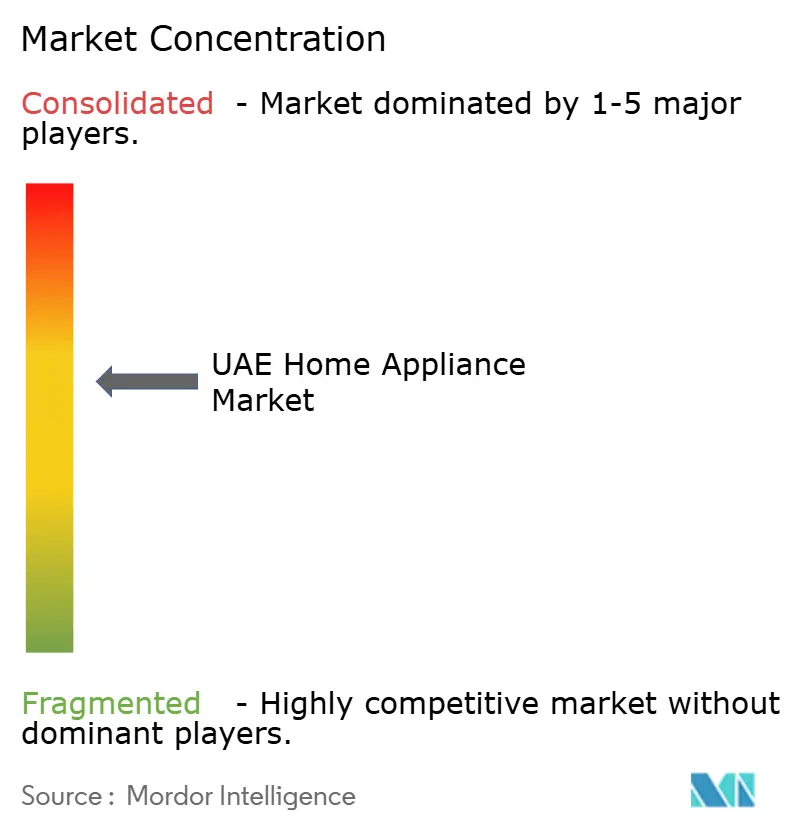
| Market Concentration | Medium |
Major Players *Disclaimer: Major Players sorted in no particular order Image © Mordor Intelligence. Reuse requires attribution under CC BY 4.0. | |
UAE Home Appliance Market Analysis by Mordor Intelligence
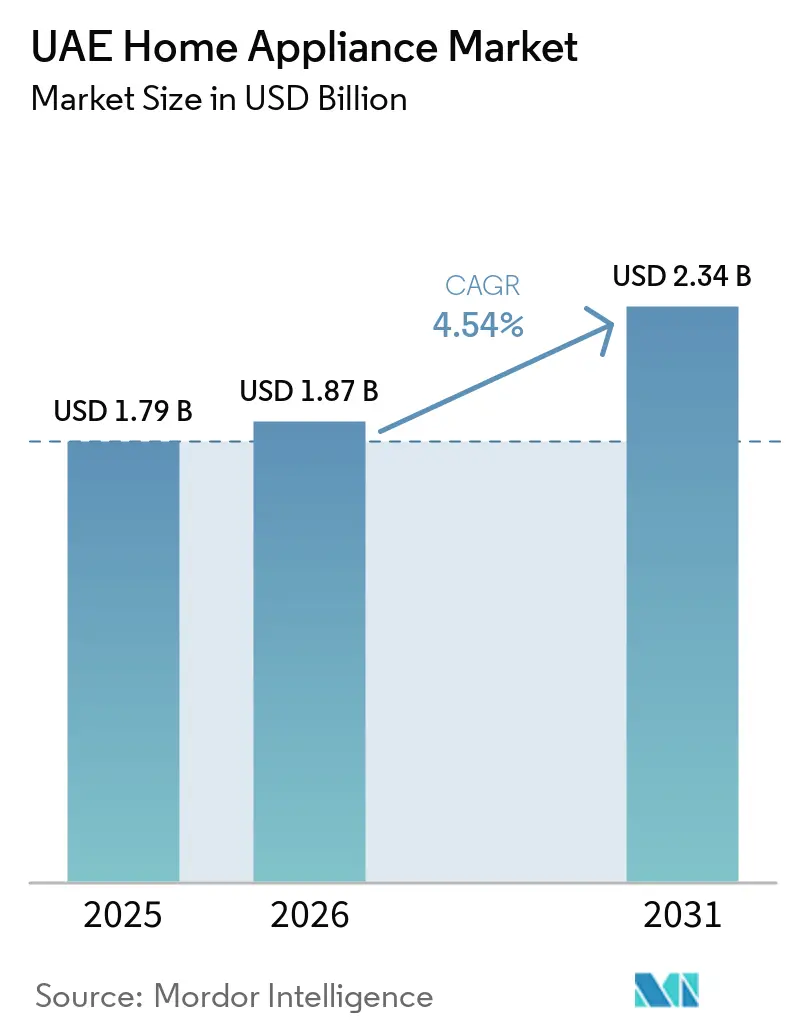
The UAE home appliance market size was valued at USD 1.79 billion in 2025 and estimated to grow from USD 1.87 billion in 2026 to reach USD 2.34 billion by 2031, at a CAGR of 4.54% during the forecast period (2026-2031). Demographic expansion, especially in fast-growing mixed-use developments, continues to unlock demand, while energy-efficiency mandates accelerate replacement cycles and steer purchasing toward 5-star-rated models that reduce household electricity bills by up to 75% compared with legacy units[1].
Infrastructure modernization linked to Dubai’s 10X strategy and Abu Dhabi’s digital transformation agenda is nurturing early adoption of connected appliances that communicate with smart-grid systems and demand-response programs. Retail channels are evolving in parallel; multi-branded stores hold scale advantages, yet rapidly maturing e-commerce networks supported by nationwide BNPL schemes and last-mile logistics upgrades are gaining share as consumers lean on AI shopping assistants for price discovery. Competitive intensity is tempered by moderate market concentration: the top five suppliers control 58.7% of sales, but smart-connectivity innovation and localization strategies are opening paths for challengers that can certify products under the Emirates Standards and Metrology Authority (ESMA) framework. Rising freight costs linked to Red Sea rerouting and classification complexity under the new 12-digit Integrated Customs Tariff system add supply-side friction, yet industry participants exhibiting agility in sourcing and inventory management continue to defend margins.
Key Report Takeaways
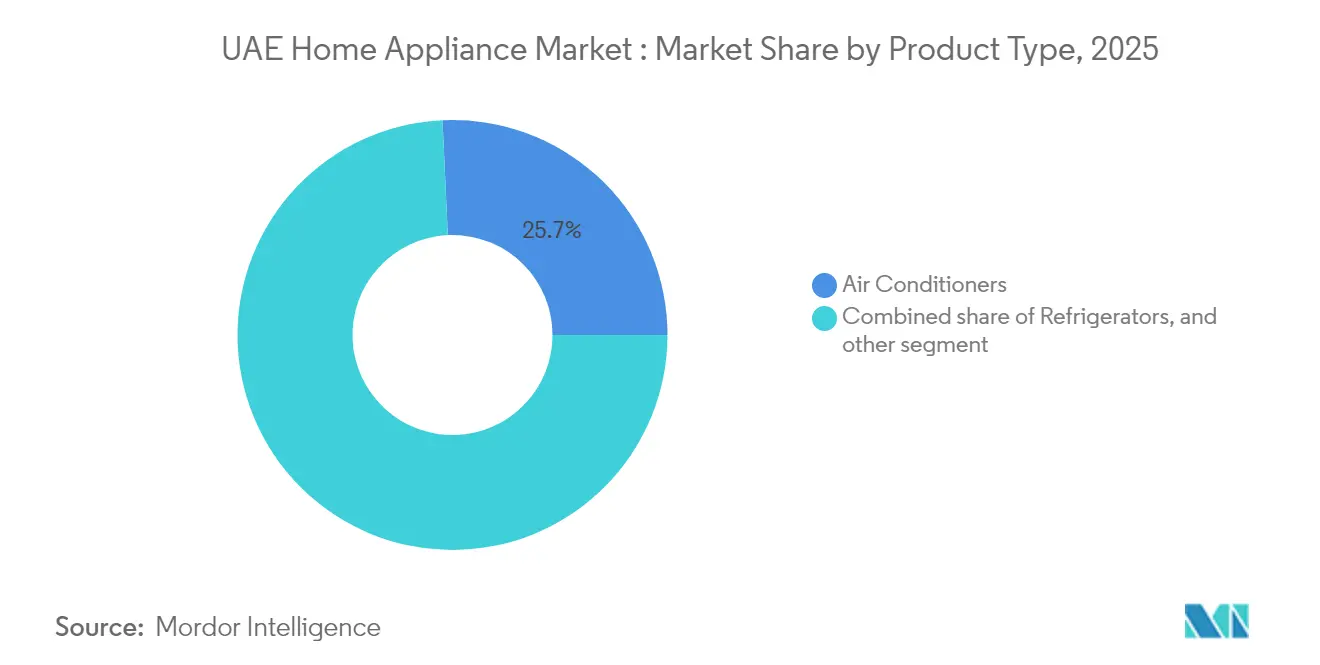
- By product type, air conditioners led with 25.74% revenue share in 2025, while smart refrigerators are projected to advance at a 13.00% CAGR to 2031.
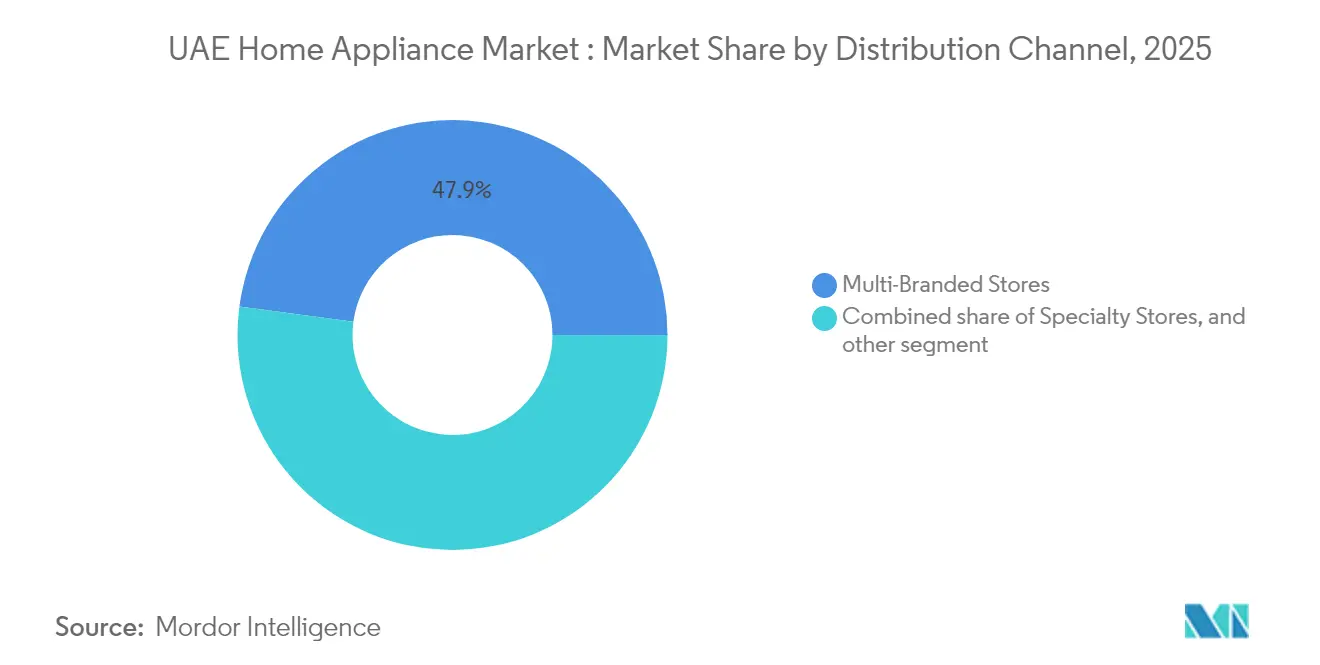
- By distribution channel, multi-branded stores held 47.88% of the UAE home appliance market share in 2025; e-commerce is poised for the fastest growth at a 15.95% CAGR through 2031.
- By technology, conventional appliances accounted for 63.95% of the UAE home appliance market size in 2025, yet smart/connected units are forecast to expand at 18.76% CAGR between 2026 and 2031.
- By geography, Dubai captured 39.85% of 2025 sales; Ras Al Khaimah and Fujairah are expected to record the highest CAGR at 10.63% over the same horizon.
Note: Market size and forecast figures in this report are generated using Mordor Intelligence’s proprietary estimation framework, updated with the latest available data and insights as of 2026.
Market Trends and Insights
Drivers Impact Analysis of UAE Home Appliance Market *
| Driver | (~) % Impact on CAGR Forecast | Geographic Relevance | Impact Timeline |
|---|---|---|---|
| Surge in residential construction & expatriate population | +1.2% | National, concentrated in Dubai, Abu Dhabi, Sharjah | Medium term (2-4 years) |
| Energy-efficiency mandates driving replacement sales | +0.8% | National, ESMA compliance requirements | Long term (≥ 4 years) |
| E-commerce flash-sale events boosting unit volumes | +0.6% | National, Dubai and Abu Dhabi leading adoption | Short term (≤ 2 years) |
| Government smart-city initiatives spurring smart-appliance adoption | +0.7% | Dubai, Abu Dhabi, emerging in Northern Emirates | Long term (≥ 4 years) |
| Installment-based BNPL & salary-card financing widening consumer access | +0.5% | National, particularly benefiting mid-income expatriates | Medium term (2-4 years) |
| Real-estate driven demand for built-in premium cooking ranges | +0.3% | Dubai, Abu Dhabi luxury developments | Medium term (2-4 years) |
| Source: Mordor Intelligence | |||
Surge in Residential Construction & Expatriate Population
Abu Dhabi’s population climbed 7.5% to 4.14 million in 2024, coinciding with 29,415 new housing completions that translate directly into first-time appliance purchases [2]. Developers are bundling fully-fitted kitchens and laundry spaces into lease packages to satisfy transient expatriate tenants, shifting buying power from individuals to bulk-procurement teams and amplifying volume orders for entry-level and mid-range models. Mixed-use megaprojects such as Al Dar’s Yas Bay integrate residential, commercial, and hospitality amenities, creating differentiated demand for compact dishwashers in serviced apartments and heavy-duty washers in hotel back-of-house facilities. Appliance specifications are increasingly codified at the blueprint stage to ensure compliance with ESMA’s 5-star energy benchmarks, thereby reducing post-handover retrofits and streamlining commissioning schedules. Government-backed smart-grid investments worth AED 7 billion mandate two-way data protocols, encouraging builders to pre-wire apartments for Wi-Fi–enabled cooling, cooking, and cleaning devices. This front-loaded specification approach cements pipeline visibility for suppliers and shrinks sales conversion cycles.
Energy-Efficiency Mandates Driving Replacement Sales
The ESMA labeling framework obliges retailers to phase out low-rated SKUs, funneling shoppers toward 4- and 5-star alternatives that carry higher ticket prices yet deliver a documented reduction of up to 30% in household electricity outlays [3]. Dubai Municipality’s Al Safat green-building code embeds appliance efficiency criteria into building audit checklists, compelling landlords to upgrade stock proactively to secure occupancy permits. Mortgage lenders have begun factoring projected utility savings into debt-service calculations, indirectly subsidizing premium appliance upgrades. Manufacturers now highlight “kilowatt-hour per cycle” metrics on point-of-sale materials and deploy augmented-reality apps that estimate lifetime energy expenses, reinforcing the payback narrative. The policy environment has shaved average replacement intervals for major white goods from eight years to roughly six, accelerating unit throughput for retailers.
E-Commerce Flash-Sale Events Boosting Unit Volumes
White-Friday, Ramadan-Weeks, and National-Day mega promotions compress seasonal demand into 48-hour digital windows that can equal a conventional retailer’s full-month turnover. Artificial-intelligence chatbots embedded on top-five platforms guide buyers through ESMA label interpretation and run personalized price-drop alerts, contributing to a 44% rise in AI-assisted purchases since 2024. Cross-border sellers capitalize on the UAE’s low 5% customs duty for fully-assembled appliances, but the duty-free threshold cut from AED 970 to AED 300 increased compliance costs and tilted the advantage toward domestic inventory positions. Warehousing operators in Dubai South free zone have responded by tripling last-mile capacity, enabling next-day delivery on bulky goods—a differentiator that brick-and-mortar rivals struggle to match. Flash-sale-driven spikes necessitate predictive demand-planning algorithms, prompting brands to collocate buffer stock within fulfillment centers.
Government Smart-City Initiatives Spurring Smart-Appliance Adoption
Dubai’s 10X strategy and the Mohammed bin Rashid Solar Park expansion require demand-side management that only grid-interactive devices can perform, turning connected refrigerators and HVAC systems from luxury accessories into functional infrastructure nodes. Abu Dhabi’s planned AI cognitive city, Aion Sentia, embeds appliance interoperability protocols at a district level, catalyzing OEM investment in Zigbee and Matter compliance modules. The National Policy for IoT Security, enforced since 2023, relieves cybersecurity anxiety by standardizing encryption baselines and incident-response workflows. Utilities offer time-of-use tariffs that reward smart-enabled washers capable of deferring cycles to off-peak windows, translating technology adoption into tangible bill savings. Appliance brands partner with telecom operators to bundle 24-month data plans, lowering barriers for renters to adopt smart features.
Restraints Impact Analysis of UAE Home Appliance Market *
| Restraint | (~) % Impact on CAGR Forecast | Geographic Relevance | Impact Timeline |
|---|---|---|---|
| Expats' high churn leading to second-hand market cannibalisation | -0.4% | National, particularly Dubai and Abu Dhabi | Medium term (2-4 years) |
| Import tariff volatility on steel & electronic components | -0.3% | National, affecting all price segments | Short term (≤ 2 years) |
| Rising logistics costs due to Red-Sea rerouting increasing retail prices | -0.2% | National, supply chain dependent | Short term (≤ 2 years) |
| Limited after-sales service network outside Dubai/Abu Dhabi | -0.3% | Northern Emirates, rural areas | Long term (≥ 4 years) |
| Source: Mordor Intelligence | |||
Expats’ High Churn Leading to Second-Hand Market Cannibalisation
Employment contracts averaging 2-4 years prompt frequent relocations, generating a steady flow of lightly-used refrigerators, washers, and air conditioners into classifieds platforms that undercut new-product entry-level pricing. Peer-to-peer resale groups advertise appliances at 30-50% of original cost, appealing to tenants wary of long-term capital outlays. The informal secondary channel is further legitimized by third-party refurbishers offering twelve-month warranties, eroding value propositions of budget OEMs. Regulatory proposals to license refurbishment centers could formalize the segment, potentially creating trade-in programs but also deepening cannibalization.
Import Tariff Volatility on Steel & Electronic Components
The UAE's appliance market faces ongoing cost pressure from import tariff fluctuations affecting core manufacturing inputs, particularly steel and electronic components that comprise 60-70% of appliance production costs. The implementation of a new 12-digit Integrated Customs Tariff system starting August 2025, expanding from 7,800 to over 13,400 tariff codes, introduces classification complexity that could affect duty determination for appliance components. While the UAE maintains a standard 5% customs duty rate on most appliances, component-level tariffs can vary significantly, creating cost volatility for manufacturers who assemble products locally or import partially-assembled units. The reduction of Dubai's duty-free threshold from AED 970 to AED 300 in 2023 has increased compliance costs for smaller shipments, affecting spare parts and component imports that support local assembly operations. Global steel price volatility, exacerbated by geopolitical tensions and trade policy changes, creates challenges for appliance manufacturers who cannot easily pass through cost increases in the UAE's price-sensitive market segments.
*Our forecasts treat driver/restraint impacts as directional, not additive. The impact forecasts reflect baseline growth, mix effects, and variable interactions.
UAE Home Appliance Market Segment Analysis
By Product Type:
Cooling Solutions Drive Market LeadershipAir conditioners accounted for 25.74% of the UAE home appliance market in 2025, cementing their role as the backbone of household comfort in a climate where average summer temperatures exceed 42 °C. Energy Strategy 2050 goals and urban decarbonization roadmaps incentivize inverter-compressor adoption, allowing OEMs to differentiate through variable-speed efficiency gains. Hyperganic, Strata, and EOS unveiled a prototype unit targeting 10-fold efficiency improvement, signalling an impending leap rather than incremental progress. Refrigerators and washing machines sustain mid-20% combined share, benefiting from shorter replacement timelines catalyzed by ESMA’s labeling mandate. Smart refrigerators, projected to expand at 13.00% CAGR, leverage touchscreen interfaces and AI food-management apps to reduce waste, a feature that resonates with sustainability-minded millennials. Dishwashers and ovens remain niche but gain traction in premium developments where built-in aesthetics complement high-spec cabinetry. Small appliances flourish on e-commerce promotions, especially air fryers that echo healthy-eating narratives and coffee makers that ride the specialty-coffee boom among urban professionals. Commercial demand from the USD 7.63 billion domestic food-processing sector adds incremental volume for heavy-duty freezers and industrial mixers .
Convergence of product categories around connectivity is compressing innovation cycles. Air conditioners now integrate sensors to coordinate with smart blinds and thermostats, raising expectations for cross-product ecosystem harmony. Appliance makers are therefore bundling SDKs that allow third-party developers to plug devices into home-automation dashboards, boosting stickiness among tech-savvy buyers. After-sales monetization via subscription filters and cloud analytics for predictive maintenance is gaining traction, opening recurring-revenue avenues beyond one-off unit sales. This shift also drives warranty-extension uptake as consumers value manufacturer-certified firmware updates that guard cybersecurity integrity under the national IoT policy.

By Distribution Channel:
Multi-Brand Dominance Faces Digital DisruptionMulti-branded showrooms maintained 47.88% share in 2025 thanks to floor-space scale, experiential displays, and bundled after-sales packages that remain persuasive for big-ticket purchases exceeding AED 2,000. In-store financing desks facilitate BNPL enrollment, capturing footfall that originates online but converts offline when buyers seek tactile reassurance on build quality. Nevertheless, e-commerce is set to outpace all other channels at 15.95% CAGR as platforms extend white-glove delivery, free installation, and hassle-free haul-away of old units. AI-powered configurators let shoppers visualize appliances inside virtual replicas of their apartment layouts, diminishing the need to visit physical outlets. Specialty boutiques that once thrived on niche Italian cooking appliances reposition as experience centers offering chef-led demonstrations to justify premium markups. Direct-to-consumer microbrands leverage social commerce to bypass retailers altogether, but logistics scale remains a barrier for bulky goods.
Institutional procurement—hotels, hospitals, and schools—forms a small yet stable slice, often serviced via project tenders where turnkey suppliers such as Whirlpool Middle East marshal broad portfolios. Stadium builds ahead of major sporting events funnel orders for industrial-grade refrigeration and laundry systems, adding counter-cyclical revenue streams that insulate distributors from household demand softness. Omnichannel integration is becoming non-negotiable: click-and-collect lockers inside hypermarkets extend pickup flexibility, and unified SKU identifiers across channels ensure real-time inventory accuracy, mitigating stock-out risk during flash sales.
By Technology:
Smart Transformation Accelerates Despite Conventional DominanceConventional formats still represent 63.95% of the UAE home appliance market size in 2025 because resident segments prioritize reliability and user-friendly operation. However, the smart-connected subset, expanding at 18.76% CAGR, is siphoning share by coupling energy savings with lifestyle convenience. The National Policy for IoT Security alleviates hacking fears, while utility-backed demand-response rebates make the cost premium easier to justify. Over-the-air firmware updates prolong product relevance, nudging households toward a subscription mindset where appliances evolve post-purchase.
Energy-efficient appliances form a bridge between legacy and full smart capabilities. ESMA 5-star rated machines integrate advanced compressors and DC motors but may omit Wi-Fi modules, offering a mid-price steppingstone. Manufacturers employ modular design so owners can retrofit connectivity later, mitigating obsolescence anxiety. Component miniaturization unlocks slimmer form factors suited to tighter urban kitchens, a selling point in high-rise apartments where space optimization commands a premium. Marketing narratives have pivoted from horsepower and drum size to kilowatt savings and app ecosystem compatibility. In-app dashboards aggregate real-time energy metrics across devices, transforming appliances into data-generating nodes that inform household energy budgeting. This positioning reframes the purchase as an investment in utility-bill management rather than a discretionary upgrade.
Geography Analysis
Dubai’s 39.85% revenue leadership in 2025 owes much to its status as the UAE’s commercial hub, where expatriate professionals with disposable incomes gravitate toward premium, connected appliances that harmonize with smart-home ecosystems. Retail density along Sheikh Zayed Road ensures competitive pricing transparency, while free-zone incentives enable distributors to maintain hub-and-spoke logistics for regional re-exports. The emirate’s 10X smart-city blueprint mandates grid-interactive devices in new developments, fast-tracking adoption of dynamic-pricing compatible washers and HVAC systems. Tourism-driven hospitality pipelines inject incremental demand for commercial refrigeration, cooking, and laundry equipment, reinforcing Dubai’s centrality to supplier order books. Utility-administered time-of-use tariffs reward appliances capable of load-shifting, embedding a financial incentive into the upgrade narrative.
Abu Dhabi, the second-largest sub-market, leverages oil-sector wealth and public-sector employment stability to support a steady appliance revenue base. The emirate’s population uptick and 29,415 new housing deliveries in 2024 foster first-time purchase demand, while its USD 2.5 billion Aion Sentia AI-city project codifies appliance interoperability requirements at district scale. Government housing programs for Emirati nationals prefer 5-star-rated models, giving compliant brands a predictable tender pipeline. Abu Dhabi Distribution Company’s smart-meter rollout provides real-time consumption feedback to residents, reinforcing the merits of energy-efficient replacements.
Northern Emirates Sharjah, Ajman, Ras Al Khaimah, Fujairah, and Umm Al Quwain—collectively trail on absolute size yet post the fastest growth, driven by rising affordability of housing and industrial diversification efforts. Ras Al Khaimah and Fujairah together are set to advance at 10.63% CAGR, buoyed by free-zone manufacturing clusters that attract a fresh expatriate labor pool requiring new living quarters and the associated appliance purchases. Logistics corridors improved by a USD 20.03 billion nationwide freight network expansion facilitate faster restocking cycles and lower last-mile costs, inching retail price parity toward Dubai levels. Limited after-sales footprints remain a bottleneck, prompting OEMs to pilot mobile-service vans equipped for on-site repairs.
Regulatory Landscape
The UAE home appliance market is governed by mandatory conformity and energy-labeling requirements administered by the Ministry of Industry and Advanced Technology (MoIAT) through the Emirates Conformity Assessment Scheme (ECAS) and the Energy Efficiency Standards and Labeling (EESL) program (1 to 5 stars). MoIAT also runs the national conformity marks framework used by regulated electrical appliances to demonstrate compliance before products can be placed on the market.
In April 2025, MoIAT announced updates to 12 national conformity marks and efficiency labels, with transition windows differentiated for local versus imported products. This increases the execution burden on importers, distributors, and retailers to refresh labeling, documentation, and certification files. Appliance-specific technical requirements continue to tighten as well, including updated refrigerator energy labeling under UAE.S 5010-3:2024 and UAE Cabinet Resolution No. 157 of 2025 for energy-efficiency requirements covering small and large capacity air conditioners, reinforcing the shift toward higher-rated models across core categories.
Value Chain Analysis
The value chain remains largely import-led, with global OEMs and regional brand subsidiaries supplying finished appliances into the UAE via importers and master distributors, then moving downstream to multi-branded retailers, specialty stores, and e-commerce operators that bundle delivery, installation, and haul-away. Market access shapes upstream flow because ECAS certification and EESL star labeling, overseen by MoIAT (and historically linked to ESMA frameworks), require test reports and conformity documentation prior to customs clearance and retail sale. As a result, SKU selection and replacement cycles are strongly influenced by compliance readiness.
Inbound consolidation and warehousing concentrate around Jebel Ali Free Zone for inbound intake and re-exports, with alternative routes and nodes such as Sharjah airport-linked industrial zones used for time-sensitive replenishment. Downstream value capture increasingly depends on last-mile capability for bulky goods, installation readiness for high-rise projects, and after-sales service coverage outside Dubai and Abu Dhabi, where gaps can limit brand preference and repeat purchases. Distributors and service enablers, including General Enterprises Co. LLC and MVP Appliances, coordinate channel inventory and service networks, while platforms offering trade and logistics services support working capital and cross-border movement for both appliances and spare parts.
Competitive Landscape
The market remains moderately concentrated, dominated by a handful of key players holding the significant share of the market. LG Electronics Gulf leads the pack, driven by its wide range of inverter air conditioners and the strength of its ThinQ app ecosystem. Samsung Gulf Electronics closely follows, leveraging its SmartThings platform to enhance user experience and appliance integration. This competitive dynamic reflects a growing focus on intelligent features and ecosystem compatibility. Regional players continue to carve out space by aligning with evolving consumer expectations for connected, energy-efficient solutions. Bosch-Siemens and Whirlpool Middle East secure mid-double-digit shares by leveraging European-quality positioning and localized after-sales centers. Haier Middle East rounds out the top tier with aggressive pricing on smart refrigerators tailored to ESMA 5-star benchmarks.
Localization initiatives have emerged as a differentiator. Rheem’s Dubai factory sources 70% of components locally, shaving lead times and buffering currency volatility. Partnerships such as Softlogic and Daikin’s joint pursuit of the USD 650 million commercial HVAC segment demonstrate the value of combining project-management expertise with tech leadership. Appliance makers are also experimenting with rental models aimed at expatriates wary of ownership friction, bundling service, upgrades, and removal into monthly fees. Solar-powered refrigerator pilots for remote worker camps indicate exploration of off-grid opportunities that align with national clean-energy ambitions. Compliance rigor remains a gatekeeper; ESMA certification costs deter opportunistic imports and encourage established players to deepen testing infrastructure, raising entry barriers.
Price wars occasionally flare during flash-sale seasons, but differentiation is increasingly anchored in software update cadence, AI-powered fault diagnostics, and interoperability with third-party platforms such as Amazon Alexa and Google Home. Brands that secure early integration within property-developer specifications tend to lock-in multiyear refresh cycles, granting a durable revenue moat.
UAE Home Appliance Industry Leaders
-
LG Electronics Gulf
-
Samsung Gulf Electronics
-
Bosch-Siemens Home Appliances
-
Whirlpool Middle East
-
Haier Middle East
- *Disclaimer: Major Players sorted in no particular order
UAE Home Appliance Market Companies Covered in this Report
- LG Electronics Gulf
- Samsung Gulf Electronics
- Whirlpool Middle East
- Bosch-Siemens Home Appliances
- Haier Middle East
- Panasonic Marketing MEA
- Midea Middle East
- Electrolux Middle East
- Ariston (Indesit Company)
- Hisense Middle East
- Nikai Group
- Super General Company
- Gree Electric Appliances
- Daikin Middle East
- TCL Electronics
- Siemens Home Appliances
- Philips Domestic Appliances
- Kenwood (Delonghi Group)
- Tefal (SEB Group)
- Black+Decker (Stanley B&D)
Market Opportunities and Future Outlook
Government-led procurement and housing programs are creating clearer demand anchors for high-efficiency and connected appliances. In January 2026, the Abu Dhabi Department of Energy launched an Efficient Appliances Procurement Policy for Government Entities under the Abu Dhabi Energy and Water Efficiency Strategy 2030, targeting 22% electricity reduction and 32% water reduction by 2030. The policy formalizes purchasing pull-through for compliant, higher-rated appliances in public buildings and facilities, and it strengthens supplier incentives to prioritize certified, measurable-efficiency SKUs.
Smart-home readiness is also shifting from individual device adoption to community-level integration. In July 2026, the Sheikh Zayed Housing Programme partnered with e& to integrate smart home automation and connected devices, including the Hassantuk early fire detection system, within residential communities. This creates room for appliance brands that offer interoperable ecosystems and secure onboarding aligned with national IoT security requirements. Alongside these programs, the April 2025 MoIAT update to conformity marks and efficiency labels creates near-term opportunity for manufacturers and distributors that can rapidly re-label, re-certify, and optimize assortments around ECAS/EESL compliance, while expanding after-sales and installation capacity into the Northern Emirates to reduce service-related purchase friction.
Recent Industry Developments in UAE Home Appliance Market
- May 2026: LG Electronics and Al Yousuf Electronics opened a new LG AI Home showroom on Sheikh Zayed Road, Dubai, featuring a dedicated AI home experience zone. The move expands experiential retail for connected appliances in the UAE and supports ecosystem-led selling across categories such as kitchen, laundry, and air care. It also strengthens LGs channel positioning in a market where multi-brand retail still dominates high-ticket purchases.
- April 2026: Gorenje accelerated its premium built-in appliances push in the Middle East with a sharpened focus on expansion, including the UAE. The emphasis on built-in formats aligns with developer-specified kitchens in premium villa communities and integrated living projects, raising competitive intensity in ovens, hobs, and other built-in categories. This approach also elevates the role of project-linked distribution and installation capability as differentiators.
- June 2024: Havells entered the UAE kitchen appliances segment through a distribution partnership with Jumbo Group, leveraging the Jumbo Serve network for after-sales support. The tie-up broadened branded choice in small kitchen appliances across mass retail and strengthened service-backed positioning for a new entrant. It also reinforced the strategic importance of distributor-led market access and service coverage in the UAE appliance ecosystem.
UAE Home Appliance Market Report Scope and Research Methodology
Market Definition and Coverage
For this methodology, the United Arab Emirates home appliances market is defined as the value of household appliances sold for residential use across the UAE, covering both major and small appliances through offline and online channels.
Scope exclusions: This sizing excludes commercial and industrial equipment, along with non-appliance consumer electronics and furniture.
Segments Covered in This Report
- By Product Type
- Major Home Appliances
- Refrigerators
- Freezers
- Dishwashing Machines
- Washing Machines
- Ovens
- Air Conditioners
- Other Major Products (Electric Hobs, Ranges, etc.)
- Small Home Appliances
- Coffee Makers
- Food Processors
- Grills & Toasters
- Vacuum Cleaners
- Juicers & Blenders
- Other Small Appliances (Waffle Makers, Air Fryers, etc.)
- Major Home Appliances
- By Distribution Channel
- Multi-Branded Stores
- Specialty Stores
- E-Commerce
- Other Distribution Channels
- By Technology
- Smart / Connected Appliances
- Energy-Efficient (?5-Star, Inverter) Appliances
- Conventional Appliances
- By Geography
- Dubai
- Abu Dhabi
- Sharjah & Ajman
- Ras Al Khaimah & Fujairah
- Umm Al Quwain
Data Sources, Market Sizing, and Validation
Desk Research
We start by building the UAE demand context and retail environment using public, trackable datasets, which helps keep later assumptions realistic. Common reference points include UAE Federal Competitiveness and Statistics Centre releases, UN Comtrade trade statistics, UAE customs and port disclosures, and IMF or World Bank macro series such as inflation and FX trends.
To understand category direction and seasonality signals, we also review sources such as UAE energy-efficiency and product compliance updates, retailer promotions and price ladders published online, and company filings and investor presentations from listed appliance makers and distributors that discuss regional sales mix. Where helpful, a paid subscription is used for company financials and to cross-check import and export shipment patterns at a high level. The sources noted above are illustrative, and many other public references were also used for data collection, validation, and clarification.
Primary Interviews and Surveys
Next, we validate what the numbers mean in real selling terms by speaking with a mix of manufacturers, distributors, large-format retailers, online sellers, and service partners who track pricing and volumes across categories in the UAE. These interviews focus on current ASP movement, promo intensity, inventory cycles, and the UAE mix shift between replacement buying and first-time purchases tied to housing turnover.
Because this is a single-country market, the outreach is centered on UAE-wide operators. At the same time, we account for demand differences typically seen between Dubai and Abu Dhabi, as well as channel coverage variation across the rest of the emirates.
Distribution of primary research fieldwork respondents
| Company type | Respondent position |
|---|---|
| Top tier: 37% | CXOs: 13% |
| Mid tier: 49% | Functional/Unit leaders: 37% |
| Smaller Players: 14% | Managers: 50% |
Market-Sizing & Forecasting
Sizing is built using a top-down approach where UAE demand is reconstructed from appliance category splits and spend capacity indicators, and then shaped by trade flow direction and channel structure for the country. Once the first cut is created, selective bottom-up checks are used, such as sampled price ladders by category, retailer assortment counts, and a limited roll up of supplier and distributor revenue signals to correct any overstatement.
Key inputs we track include household formation and housing completions (which influence new appliance sets), replacement cycles for cooling and laundry products, import dependency and the timing of inbound shipments, promotion-driven price erosion versus premiumization in smart models, and inflation and exchange-rate timing that can quickly change landed pricing. Forecasts are developed using scenario analysis supported by expert views on how pricing, promotions, and mix will evolve, and then the category outlook is aggregated back to the total market. When a bottom-up signal is missing for a smaller category, we bridge the gap using stable relationships like category share ranges and observed ASP bands from channel checks.
Data Validation & Update Cycle
Outputs are checked in more than one way before sign-off, so the totals align with independent signals like trade trends, reported category momentum, and channel-level price movement. If a category grows too fast or pricing moves against known inflation and FX patterns, the model is reopened and assumptions are re-tested with follow-up calls.
Each report is refreshed on an annual cycle, and interim updates are made when large shifts occur, such as a sharp currency move, a change in major promotion intensity, or a new regulatory requirement that affects product availability. Before delivery, a final review pass is completed so clients receive the most current view based on the latest accessible data.
Mordor Intelligence's United Arab Emirates Home Appliances Market Size Compared With Other Published Estimates
Published market sizes for UAE home appliances do not always match, even when the topic label looks the same, because the timing and rules used inside the models can be different. The most common reasons are the base year chosen, how retail prices are converted into USD, and whether values reflect transaction pricing after promotions or a more list-price view.
In a refresh-led approach, the spread often comes from when currency conversion is applied and how fast ASPs are allowed to move during heavy discount periods, which is then followed by differences in whether categories like split AC and smart add-on pricing are treated consistently across channels. Using monthly FX timing checks and spot validation of promo-adjusted ASP bands helps keep the USD total anchored to what shoppers actually pay, a discipline applied by Mordor Intelligence.
Benchmark comparison
| Source | Market Size | Gaps in Research Methodology |
|---|---|---|
| Mordor Intelligence | USD 1.79 B (2025) | |
| Global Consultancy A | USD 3.45 B (2024) | Uses an earlier base year and a broader household appliances definition, and the USD conversion and pricing basis are less transparent around promo periods, which can inflate the value when list prices are used. |
| Industry Publisher B | USD 3.43 B (2024) | Counts a wide product basket and reports a 2024 revenue base, which can differ if category boundaries include adjacent heating and air-treatment items and if ASP updates are applied annually rather than in-period. |
Overall, the comparison shows that year choice, USD timing, and price-setting rules create most of the gap, not a single data point. By keeping scope boundaries explicit and tying pricing to observable channel signals, the resulting market size stays easier to reproduce and explain in client discussions.
Key Questions Answered in the Report
How large is the UAE home appliance market in 2025?
The UAE home appliance market was valued at USD 1.79 billion in 2025.
What is the expected CAGR for UAE appliance sales to 2031?
Revenue is forecast to grow at a 4.54% CAGR through 2031.
Which product type leads in UAE household appliance demand?
Air conditioners dominate with 25.74% share thanks to the country’s extreme climate.
How fast is e-commerce growing as an appliance sales channel?
Online sales are projected to expand at 15.95% CAGR between 2026 and 2031.
Why are smart appliances gaining traction in the Emirates?
Smart-city initiatives, utility rebates, and the National Policy for IoT Security are driving adoption of connected, energy-efficient devices.