
Market Overview
| Study Period | 2020 - 2031 |
|---|---|
| Forecast Data Period | 2026 - 2031 |
| Base Year Market Size (2025) | USD 107.83 Billion |
| Market Size (2026) | USD 110.35 Billion |
| Market Size (2031) | USD 123.88 Billion |
| Growth Rate (2026 - 2031) | 2.34 % |
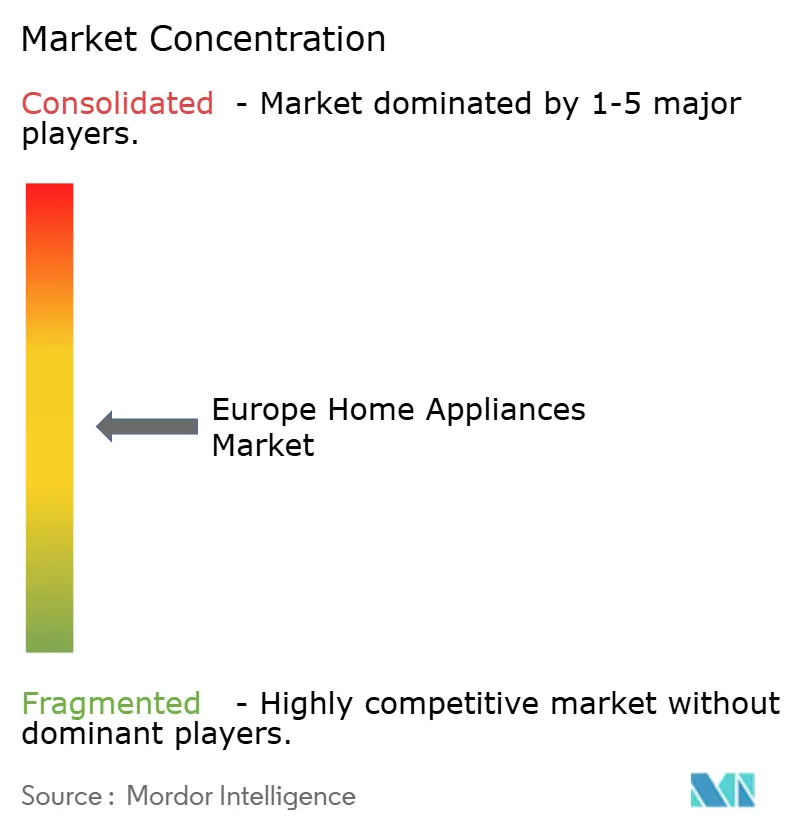
| Market Concentration | Medium |
Major Players *Disclaimer: Major Players sorted in no particular order Image © Mordor Intelligence. Reuse requires attribution under CC BY 4.0. | |
Europe Home Appliances Market Analysis by Mordor Intelligence
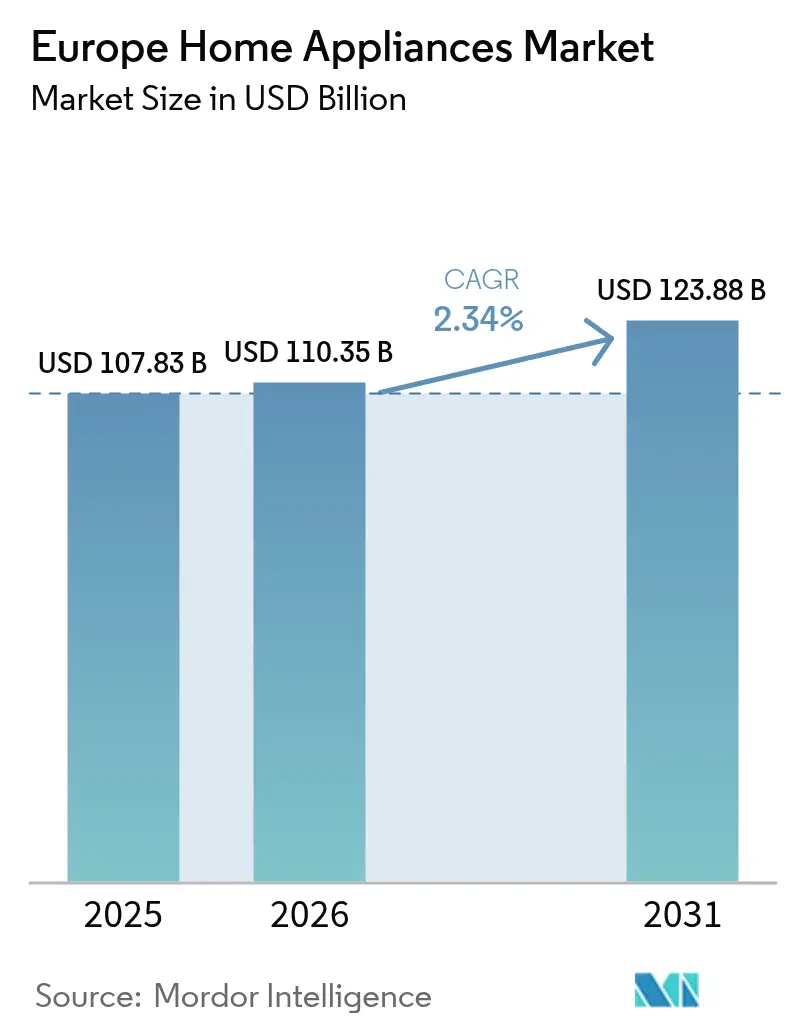
The Europe home appliances market size was valued at USD 107.83 billion in 2025 and estimated to grow from USD 110.35 billion in 2026 to reach USD 123.88 billion by 2031, at a CAGR of 2.34% during the forecast period (2026-2031). Manufacturers are shifting from volume-driven tactics toward value enhancement, emphasizing smart connectivity, embedded software, and higher energy-efficiency ratings that comply with the EU’s evolving eco-design legislation [1]. Regulatory alignment, particularly the Energy Performance of Buildings Directive (EPBD) revision and the forthcoming Ecodesign for Sustainable Products Regulation (ESPR), accelerates demand for products carrying better repairability scores and lower lifetime energy costs. Competitive intensity remains moderate, yet the entrance of Beko Europe following the Whirlpool-Arçelik deal increases the pressure on incumbents to invest in R&D and digital platforms. Against a backdrop of raw-material inflation and fragile supply chains, utilities’ demand-response rebates and an expanding base of single-person households continue to create tangible pockets of opportunity across Western and Central Europe.
Key Report Takeaways
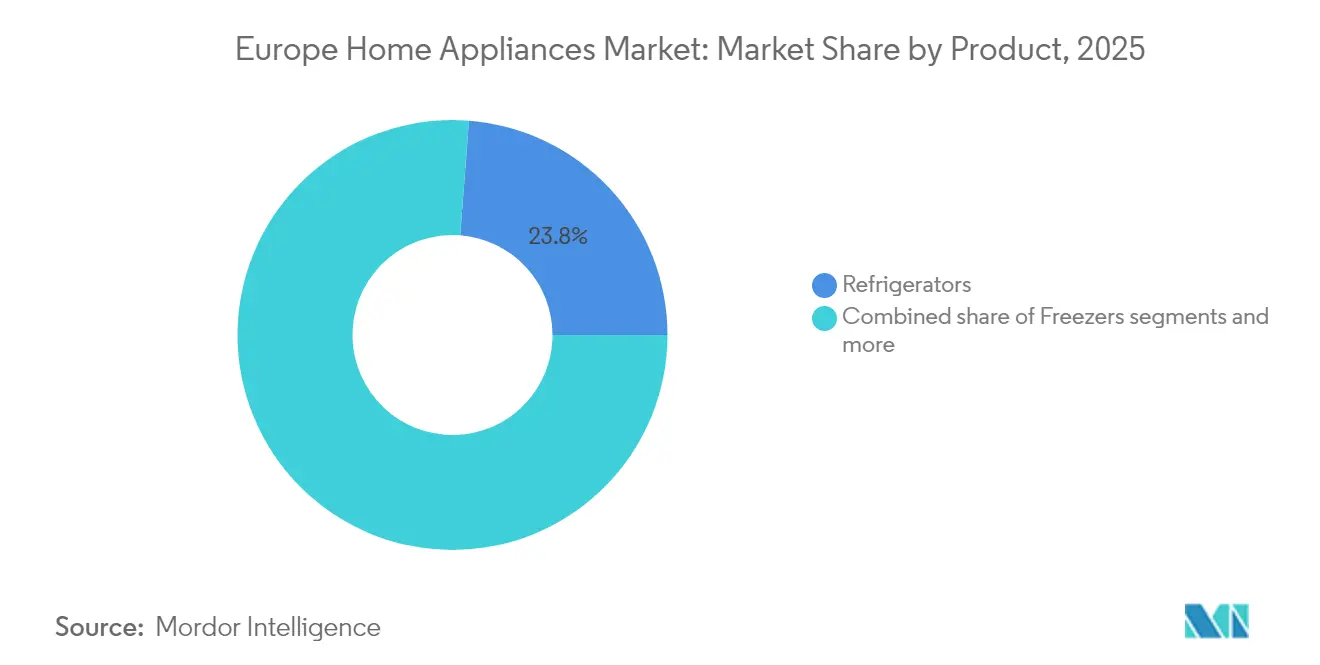
- By product type, refrigerators led with 23.78% of the Europe home appliances market share in 2025, while air fryers are projected to grow at a 4.05% CAGR through 2031.
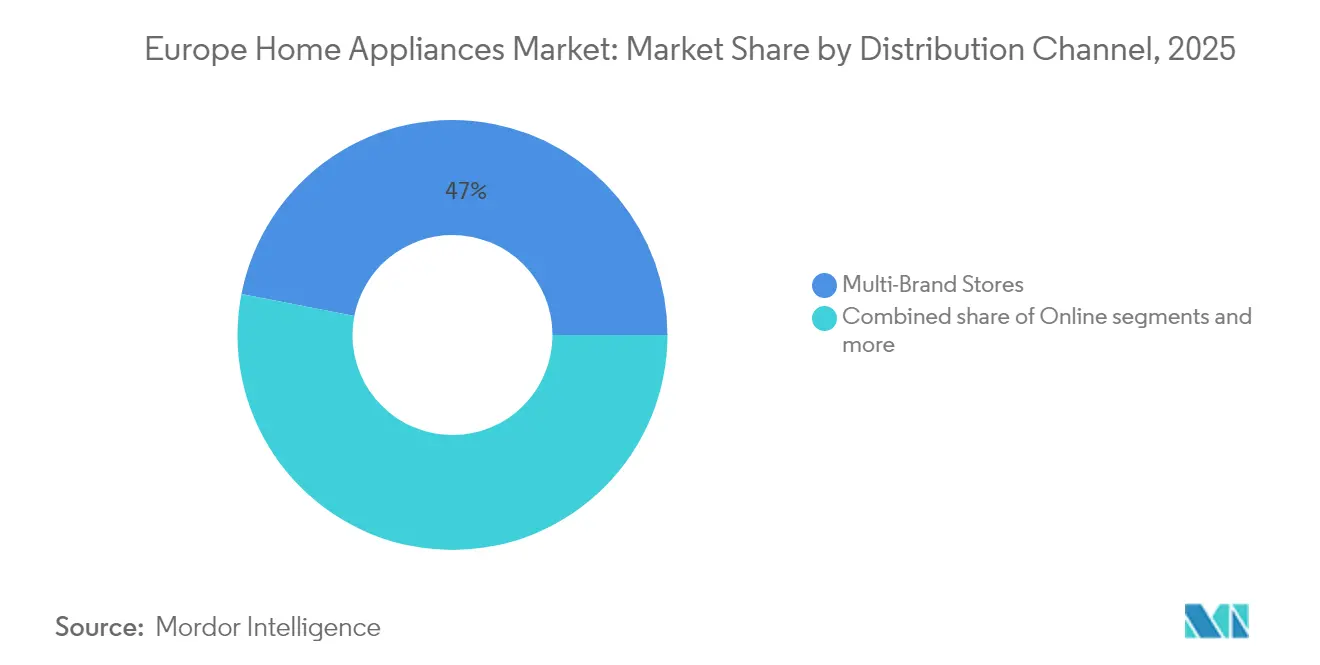
- By distribution channel, multi-brand stores held 46.95% of the Europe home appliances market size in 2025; online channels record the highest forecast growth at 4.62% CAGR to 2031.
- By geography, Germany accounted for 13.65% of the Europe home appliances market share in 2025, whereas Italy is advancing at a 3.02% CAGR between 2026 and 2031.
Note: Market size and forecast figures in this report are generated using Mordor Intelligence’s proprietary estimation framework, updated with the latest available data and insights as of 2026.
Market Trends and Insights
Drivers Impact Analysis of Europe Home Appliances Market*
| Driver | (~) % Impact on CAGR Forecast | Geographic Relevance | Impact Timeline |
|---|---|---|---|
| Energy-efficiency labeling & eco-design laws | +0.8% | EU27, UK, Switzerland | Medium term (2-4 years) |
| Smart-home integration accelerating upgrades | +0.6% | Western Europe, Nordics | Short term (≤ 2 years) |
| Growth in single-person households | +0.4% | Germany, France, Nordics, urban centers | Long term (≥ 4 years) |
| Rising disposable income in CEE | +0.3% | Poland, Czech Republic, Hungary, Romania | Medium term (2-4 years) |
| Heat-pump dryer subsidies | +0.2% | Germany, Netherlands, France | Short term (≤ 2 years) |
| Utilities’ demand-response rebates | +0.2% | Germany, Netherlands, Belgium | Medium term (2-4 years) |
| Source: Mordor Intelligence | |||
Energy-Efficiency Labeling & EU Eco-Design Mandates
The ESPR, scheduled for full enforcement in 2026, introduces digital product passports that log energy consumption, material composition, and repairability metrics throughout an appliance’s life cycle [2]. Compliance costs raise entry barriers for import-dependent brands, favoring regional manufacturers with embedded sustainability processes. Spare-parts obligations and mandated firmware updates make total cost of ownership a decisive purchase factor. ISO 14006 alignment becomes a core procurement requirement among European retailers, further reinforcing the premium that consumers attach to low-carbon footprints. Brands able to launch A-rated models ahead of statutory deadlines command price premiums and strengthen retailer partnerships.
Rapid Replacement Cycle Driven by Smart-Home Integration
Matter protocol adoption and Thread networking permit appliances to join whole-home energy-management systems, making non-connected units a bottleneck in demand-response programs offered by utilities [3]. Functional obsolescence now arrives sooner than mechanical failure, encouraging 5- to 7-year upgrade cycles. LG’s 2024 takeover of Athom, maker of Homey hubs, illustrates a pivot from one-off sales to subscription-based energy-optimization services. Connected models deliver usage data that utilities convert into off-peak rebates, trimming payback periods for premium appliances. Northern Europe, where electricity prices remain high, leads adoption.
Rising Disposable Income in Central & Eastern Europe
Economic convergence in Central and Eastern Europe creates a distinct growth corridor where appliance penetration rates remain below Western European levels while purchasing power steadily increases. Poland's GDP per capita growth of 3.20% in 2024 and similar trajectories in Czech Republic and Hungary drive appliance market expansion as consumers upgrade from basic functionality to premium features [4]. This income growth particularly benefits built-in appliance segments where kitchen renovations accompany rising living standards, creating opportunities for premium brands to establish market presence before local competitors can respond. The region's integration with EU supply chains and energy efficiency standards accelerates the adoption of Western European appliance technologies, while lower labor costs attract manufacturing investments that strengthen local market presence.
Surge in Heat-Pump Dryer Retrofits Supported by Subsidies
Government incentives across Europe specifically target heat-pump dryer adoption as part of broader electrification strategies, creating a distinct growth vector within the laundry appliance segment. Germany's BEG (Bundesförderung für effiziente Gebäude) program provides up to EUR 2,100 (USD 2,250) subsidies for heat-pump dryer installations, while France's MaPrimeRénov scheme offers similar incentives as part of whole-home energy efficiency upgrades. These programs specifically target heat-pump technology because it delivers 50% energy savings compared to conventional vented dryers while enabling integration with home heat recovery systems. The subsidy structure creates artificial demand acceleration that manufacturers leverage to build market share and achieve production scale economies before incentives phase out.
Restraints Impact Analysis of Europe Home Appliances Market*
| Restraint | (~) % Impact on CAGR Forecast | Geographic Relevance | Impact Timeline |
|---|---|---|---|
| Supply-chain volatility & component gaps | -0.5% | Global, EU assembly facilities | Short term (≤ 2 years) |
| Inflation-driven consumer down-trading | -0.4% | Southern & Eastern Europe | Short term (≤ 2 years) |
| EU Right-to-Repair rules | -0.3% | EU27 | Long term (≥ 4 years) |
| Grid-capacity fees penalizing peak loads | -0.2% | Germany, Belgium, Netherlands | Medium term (2-4 years) |
| Source: Mordor Intelligence | |||
Supply-Chain Volatility and Component Shortages
Persistent semiconductor shortages and raw material price volatility continue to disrupt European appliance manufacturing, with plastic resin costs rising 15-20% year-over-year in 2024 while metal prices remain elevated compared to pre-pandemic levels. This cost pressure forces manufacturers to implement selective price increases while absorbing margin compression, particularly affecting mid-market segments where price sensitivity limits pass-through capability. Supply chain resilience becomes a competitive differentiator as companies with diversified sourcing and vertical integration maintain better availability and cost control compared to those dependent on single-source suppliers.
EU "Right-to-Repair" Rules Extending Product Lifetimes
The EU's Right-to-Repair directive, fully implemented across member states in 2024, mandates 10-year spare parts availability for major appliances and introduces repairability scoring that influences consumer purchasing decisions. This regulation extends average appliance lifespans by 2-3 years, reducing replacement demand while increasing aftermarket service revenue opportunities. Manufacturers adapt by designing modular architectures that facilitate component replacement and developing service networks that can monetize extended product lifecycles through maintenance contracts and upgrade services.
*Our forecasts treat driver/restraint impacts as directional, not additive. The impact forecasts reflect baseline growth, mix effects, and variable interactions.
Europe Home Appliances Market Segment Analysis
By Product:
Air Fryers Drive Small Appliance RenaissanceRefrigerators preserved their 23.78% portion of the Europe home appliances market in 2025 as top-mounted freezer models shifted to A-class efficiency ratings that align with upcoming eco-design thresholds. In value terms, refrigerators accounted for USD 25.64 billion of the Europe home appliances market size during 2025, and the segment is tracking a 1.84% CAGR through 2031 as incremental gains from compressor and insulation advances taper. At the opposite end of the growth spectrum, air fryers are scaling from USD 2.38 billion in 2025 to an expected USD 3.02 billion by 2031, reflecting a 4.05% CAGR that outpaces every other small-appliance line. Compact form factors, oil-free cooking, and app-based recipe libraries resonate with single-person and health-conscious households, creating premium sub-segments featuring dual-zone baskets and smart-heat algorithms.
Beyond these headline categories, washing machines and dishwashers integrate turbidity and fabric-sensing technology that adjusts cycle length and resource consumption in real time. Sensor-driven models claim water savings of up to 35% versus legacy machines, an advantage reflected in higher average selling prices. Combination microwave-steam-convection ovens underscore the push toward multi-functionality, capturing space-constrained urban buyers while raising cross-category cannibalization risks. Manufacturers deploy modular platform architectures, enabling rapid SKU proliferation without duplicating engineering expense. Over the forecast horizon, premiumization remains the principal value lever, offsetting the deceleration of pure replacement demand triggered by Right-to-Repair regulations.

By Distribution Channel:
Online Acceleration Reshapes Retail LandscapeMulti-brand stores retained 46.95% of the Europe home appliances market share in 2025, yet channel fundamentals are tilting online as digitally native retailers deploy virtual-demo tools and flexible delivery windows. The Europe home appliances market size generated through e-commerce touched USD 18.28 billion in 2025 and is positioned to exceed USD 23.98 billion by 2031 at a 4.62% CAGR. Direct-to-consumer storefronts amplify manufacturer control over pricing, product launches, and customer data, enabling tailored after-sales services such as subscription detergents for auto-dose washers.
Physical showrooms pivot toward experiential selling, integrating augmented-reality kitchen planners and on-site installation services. Exclusive brand outlets gain momentum for built-in portfolios, where appliance-cabinet alignment requires professional guidance. Warehouse clubs and regional specialty chains differentiate via financing bundles and extended warranties. The emergent omnichannel model hinges on unified inventory visibility across touchpoints, pushing retailers to overhaul legacy ERP architectures. Order-fulfillment optimization, including micro-fulfillment centers inside city limits, trims last-mile costs and supports same-day delivery promises on large-format goods.
Geography Analysis
Western Europe Home Appliances Market
Western Europe contributed more than 69% of the Europe home appliances market in 2025, with Germany alone capturing 13.65% share on the strength of its manufacturing base and high household incomes. Smart-home penetration surpasses 50% in German urban centers, leading to elevated attach rates for voice-enabled refrigerators and AI-driven laundry pairs. The United Kingdom shows resilient spend on premium built-ins as post-Brexit logistics bottlenecks ease and housing-renovation activity normalizes.
Southern Europe Home Appliances Market
Italy is the standout growth engine, advancing at a 3.02% CAGR through 2031 amid generous Superbonus tax credits that subsidize energy-efficient appliance purchases as part of home retrofits. Italian consumers favor design-oriented finishes and customizable hardware, giving premium brands pricing power. France and Spain leverage building-renovation incentives to sustain mid-single-digit value growth despite cautious consumer sentiment.
Central and Eastern Europe Home Appliances Market
Central and Eastern Europe offer the most compelling volume upside. Poland’s appliance shipments climbed 6.90% in 2025 as rising wages converged with EU energy-efficiency mandates. Czech Republic and Hungary exhibit similar trajectories, underpinned by automotive-sector wage gains that lift discretionary spending. Cross-border e-commerce accelerates feature adoption as consumers tap Western inventory assortments. These markets double as near-shoring locations, cushioning Western supply chains against Asia-Pacific risks.
Regulatory Landscape
The European Commission anchors appliance compliance through the EU energy labelling framework (Regulation (EU) 2017/1369), which mandates A-G labels and model registration in the European Product Registry for Energy Labelling (EPREL) before covered products can be placed on the EU market. At the same time, the EU is tightening product-specific ecodesign rules, including Commission Regulation (EU) 2023/2533 for household tumble dryers, which applies from 1 July 2025 and adds resource-efficiency provisions alongside energy-performance parameters.
The regulatory pipeline also includes work under the EU ecodesign and energy labelling governance calendar, with Commission obligations to adopt updated delegated acts for certain product groups by 2 August 2026 following scheduled reviews of earlier delegated regulations. For suppliers and retailers, compliance is shifting toward more structured documentation, label provisioning across physical and online channels, and lifecycle information readiness as the EU expands circularity priorities under its 2025-2030 planning for energy-related products.
Value Chain Analysis
Europe's home appliance value chain runs from upstream materials (steel, iron, plastics, glass) and electronics, through design and assembly, to omnichannel distribution, installation, and after-sales service supported by spare parts logistics. APPLiA describes the regional ecosystem as extensive, with 3,214 manufacturing sites and a broad network of enterprises, while component availability and input-cost volatility keep procurement and supplier diversification central to operational performance.
Regulation is becoming embedded across the chain, shaping product engineering, traceability, and end-of-life processes. The Ecodesign for Sustainable Products Regulation (ESPR, Regulation (EU) 2024/1781) sets the framework for ecodesign requirements and, through its working-plan prioritization of household categories such as dishwashers, washing machines, and refrigerating appliances, pushes manufacturers and tier suppliers toward circular design, serviceability, and compliance data management. Downstream, online growth and direct-to-consumer models increase the reliance on last-mile delivery partners, reverse logistics for returns, and authorized repair networks that align with spare parts obligations and repairability expectations.
Competitive Landscape
In 2024, the Europe home appliances market was moderately consolidated, with the top five vendors collectively holding a significant share of the market. BSH Hausgeräte led the field, supported by its strong engineering capabilities and vertically integrated component supply chain, which helped mitigate the impact of global chipset shortages. Whirlpool transferred its EMEA operations to Beko Europe in April 2024, creating a EUR 5.5 billion (USD 5.90–5.95 billion) revenue company that combines Turkish manufacturing efficiencies with Western design and distribution strengths. Electrolux focused its investments on higher-margin built-in appliances to enhance profitability. Meanwhile, SMEG and Miele maintained their positions in the premium segment, emphasizing distinctive design and dedicated in-house service networks.
Strategic focus tilts toward software-defined appliances that harvest usage data, unlocking predictive-maintenance services and utility partnerships. LG’s acquisition of Athom positions the Korean brand as a software-centric challenger that monetizes AI-enabled routines beyond hardware margin. Incumbents intensify R&D around heat-pump compression, leveraging patent portfolios to sustain efficiency leadership in anticipation of stricter eco-design tiers. M&A momentum is likely to persist as tier-two vendors seek scale to fund compliance and digital-platform investments.
Emerging disruptors exploit direct-to-consumer logistics and subscription models that bundle small appliances with consumables. Though their revenue remains low in absolute terms, they influence channel standards around unboxing, delivery speed, and return convenience. Incumbents respond with white-label fulfillment arms and last-mile partnerships to match customer expectations built by e-commerce pure-plays.
Europe Home Appliances Industry Leaders
-
Whirlpool Corp.
-
BSH Hausgeräte GmbH
-
Electrolux AB
-
Haier Smart Home (Candy/Hoover)
-
Dyson Ltd.
- *Disclaimer: Major Players sorted in no particular order
Europe Home Appliances Market Companies Covered in this Report
- Whirlpool Corp.
- BSH Hausgeräte GmbH
- Electrolux AB
- Haier Smart Home (Candy/Hoover)
- Dyson Ltd.
- LG Electronics Inc.
- Samsung Electronics Co. Ltd.
- Miele and Cie. KG
- Arçelik A.Ş. (Beko)
- Gorenje Group
- SharkNinja Operating LLC
- De'Longhi Group
- Kenwood Ltd.
- Russell Hobbs
- Morphy Richards
- Smeg SpA
- Seb Group (Tefal)
- Groupe SEB (Rowenta, Krups)
- Hisense UK
- Liebherr-Hausgeräte GmbH
Market Opportunities and Future Outlook
Compliance-led product renewal and premiumization are creating monetizable whitespace in high-efficiency and repair-forward appliances, especially where consumers and retailers can quantify lifetime energy costs and serviceability. APPLiA's 9th annual statistical reporting pointed to long-run improvements in appliance energy efficiency since 2000 and reported 92 Mtoe of household energy savings from appliances in 2023, reinforcing the value of efficiency-led upgrades across Europe. This supports opportunities for manufacturers and retailers to bundle higher-rated appliances with installation, take-back, and extended service offerings that fit spare parts availability and repairability scoring.
On the supply side, industry actions highlight investment and localization themes that affect product availability and price tiers across Europe. APPLiA's 2026 call for an EU Action Plan for the home appliance industry, along with its 2026 positions on simplifying overlapping environmental requirements and expanding CBAM scope to relevant home appliance CN codes, indicate ongoing efforts to improve regulatory predictability and competitive conditions for European manufacturing. For market participants, this translates into opportunity in compliance tooling (EPREL-ready data workflows and label delivery for e-commerce), circular services (repair, refurbishment, parts), and differentiated smart and connected portfolios that can support pricing under tighter ecodesign and energy labelling regimes.
Recent Industry Developments in Europe Home Appliances Market
- March 2026: Haier Europe announced a refreshed Candy brand identity and an updated product range positioned around intuitive and connected solutions. The focus is on differentiated mass-market offerings where software features and usability can support value recovery amid cost pressure and tighter EU product requirements.
- September 2025: BSH Home Appliances Group and ECOVACS Group entered a global strategic partnership to jointly develop intelligent floor-cleaning solutions. The collaboration increases competitive pressure in robotic vacuum cleaners by combining appliance brand distribution with robotics capabilities and connected features.
- April 2024: Whirlpool finalized the creation of Beko Europe in partnership with Arcelik A.S., with Whirlpool retaining a 25% stake while transferring its EMEA operations. The transaction reshaped the regional competitive landscape by creating a scaled player with combined manufacturing, design, and distribution footprints across Europe.
Europe Home Appliances Market Report Scope and Research Methodology
Market Definition and Coverage
For this report, the Europe home appliances market is counted as the value of household appliance sales across Europe, covering major appliances and small appliances that are primarily used in homes and sold through offline and online retail channels.
Scope exclusions: We exclude non-household industrial equipment, stand-alone spare parts, and most repair and installation labor that is billed separately from the appliance sale.
Segments Covered in This Report
- By Product
- Major Home Appliances
- Refrigerators
- Freezers
- Washing Machines
- Dishwashers
- Ovens (Incl. Combi and Microwave)
- Air Conditioners
- Other Major Home Appliances
- Small Home Appliances
- Coffee Makers
- Food Processors
- Grills and Roasters
- Electric Kettles
- Juicers and Blenders
- Air Fryers
- Vacuum Cleaners
- Electric Rice Cookers
- Other Small Home Appliances
- Major Home Appliances
- By Distribution Channel
- Multi-Brand Stores
- Exclusive Brand Outlets
- Online
- Other Distribution Channels
- By Region
- England
- Scotland
- Wales
- Northern Ireland
Data Sources, Market Sizing, and Validation
Desk Research
Desk research is used to set the market boundaries, understand demand signals, and build defensible assumptions for volumes and pricing before we speak with industry participants. We leaned on public statistics and reference sources such as Eurostat (household spending and trade), European Commission energy labeling and Ecodesign rules, national statistical offices in key countries, and customs datasets that indicate appliance import and export flows.
We also reviewed company annual reports, investor presentations, and public retail pricing patterns to see how ASPs move by category and country. Where helpful, we used a paid subscription for company financials and news screening, and a separate patent database to track feature shifts that can influence replacement cycles and price tiers. The examples listed above are not exhaustive, and many other public sources were also used for data collection, validation, and clarification.
Primary Interviews and Surveys
Primary work was used to confirm which appliance categories are driving value, how replacement demand differs by country, and how pricing changes are landing at retail. We spoke with manufacturers, distributors, large-format retailers, e-commerce focused sellers, and category specialists across Europe to validate the desk research signals and close information gaps.
To keep responses balanced, we included viewpoints from leadership and from managers who track sell-through, promotions, and availability across major and small appliance lines.
Distribution of primary research fieldwork respondents
| Company type | Respondent position |
|---|---|
| Top tier: 37% | CXOs: 17% |
| Mid tier: 43% | Functional/Unit leaders: 40% |
| Smaller Players: 20% | Managers: 43% |
Market-Sizing & Forecasting
The sizing starts with a top-down build where consumption and replacement demand are reconstructed from country-level indicators and then rolled up to Europe. In practice, we map the demand pool using household counts, replacement cadence for key categories, new household formation, and the share of purchases occurring through organized retail and online. We translate this into value using category-level ASP bands.
After the first cut is built, we use selective bottom-up approximations to keep totals realistic, including sampled category revenue roll-ups from public disclosures, channel checks on sell-through momentum, and ASP x unit sanity tests for higher value appliances. When direct unit signals are limited for a country or category, we handle the gaps through proxies such as import trends, energy label mix shifts, and retail price indices, and then refine the outputs through expert feedback.
For forecasting, we rely mainly on scenario analysis supported by light multivariate regression on stable drivers such as real disposable income, housing turnover, energy cost sensitivity, and efficiency-led replacement timing linked to policy updates. We then tune the forecast using what primary participants expect for promotion intensity, premiumization, and the pace of smart feature adoption.
Data Validation & Update Cycle
Model outputs are compared with independent market signals, and we also recheck the results for unusual jumps at the country and category level. When a variance is seen, we recheck the inputs behind it, such as ASP steps, trade spikes, or short-term demand effects, then follow up with targeted re-contacts if the reason is not clearly supported.
Before sign-off, the work goes through multi-step analyst review so assumptions, conversions, and roll-ups remain consistent across countries and channels. Reports are refreshed annually, with interim updates for material events that can shift demand, pricing, or trade flows. Right before delivery, a final pass is completed so clients receive the latest updated view.
Mordor Intelligence's Europe Home Appliances Market Size Versus Other Published Estimates
Published market sizes for Europe home appliances do not always match because the scope line is drawn differently, and because value is translated from demand signals using different pricing and timing assumptions. The gaps tend to widen when one source blends in adjacent connected-home spending or counts appliance-related services in the same value line.
Key gap drivers in this market usually include whether air conditioners are treated consistently across countries, how online promotions are reflected in ASP building, and what currency conversion timing is used for cross-country aggregation. Refresh cadence also matters here, since energy rule updates and rapid price tier shifts can change the value outcome even when unit demand changes only modestly.
Benchmark comparison
| Source | Market Size | Gaps in Research Methodology |
|---|---|---|
| Mordor Intelligence | USD 107.83 B (2025) | |
| Global Consultancy A | USD 98.15 B (2024) | Uses a 2024 base year and a shorter outlook window, and the value capture can run lower when promotional pricing is averaged too aggressively across offline and online sales. |
| Industry Publisher B | USD 237.05 B (2025) | Uses a broader basket that appears to add smart-home categories as a separate value pool, which can pull in connected-home device spending beyond core major and small appliances. |
The table points to a scope-and-pricing spread, and under Mordor Intelligence's model, smart features are counted only when they are part of a defined major or small appliance sale. Category ASPs are normalized by country and checked against retail signals, and these steps are kept consistent and revalidated through interviews. As a result, the number remains traceable to clear demand and pricing inputs rather than a widened product basket.
Key Questions Answered in the Report
How large is the Europe home appliances market in 2026?
The Europe home appliances market size reached USD 110.35 billion in 2026 and is projected to rise to USD 123.88 billion by 2031.
Which product segment holds the largest market share across Europe?
Refrigerators led with a 23.78% share of the Europe home appliances market in 2025, reflecting strong replacement demand for energy-efficient models.
Why are air fryers growing faster than other categories?
Air fryers combine oil-free cooking with compact form factors that appeal to single-person and health-focused households, resulting in a 4.05% CAGR outlook through 2031.
Which distribution channel is expanding the fastest?
Online sales are increasing at a 4.62% CAGR as manufacturers push direct-to-consumer storefronts and retailers deploy virtual demos and flexible delivery options.
What factors make Italy the fastest-growing European market?
Superbonus tax credits for energy-efficient renovations and a rebound in household spending drive Italy’s 3.02% CAGR, outpacing other geographies through 2031.
How will EU eco-design rules influence appliance innovation?
From 2026, digital product passports and stricter repairability scores will push manufacturers toward modular, software-defined designs that meet tougher sustainability benchmarks.