
Market Overview
| Study Period | 2020 - 2031 |
|---|---|
| Forecast Data Period | 2026 - 2031 |
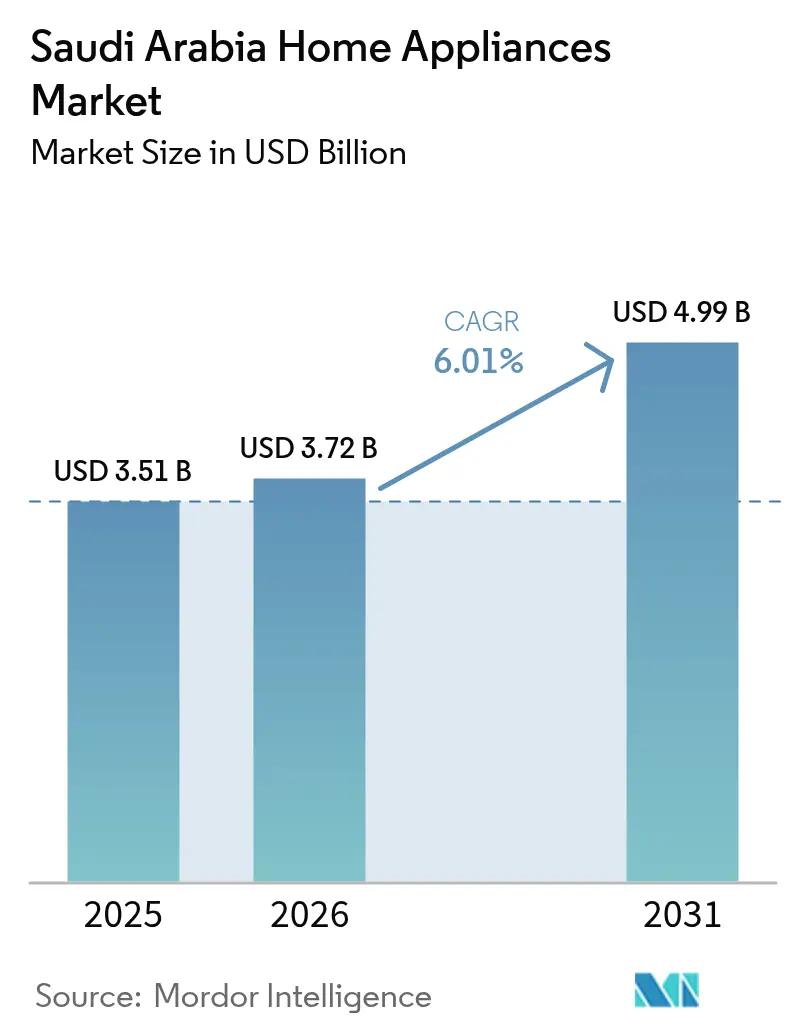
| Base Year Market Size (2025) | USD 3.51 Billion |
| Market Size (2026) | USD 3.72 Billion |
| Market Size (2031) | USD 4.99 Billion |
| Growth Rate (2026 - 2031) | 6.01 % |
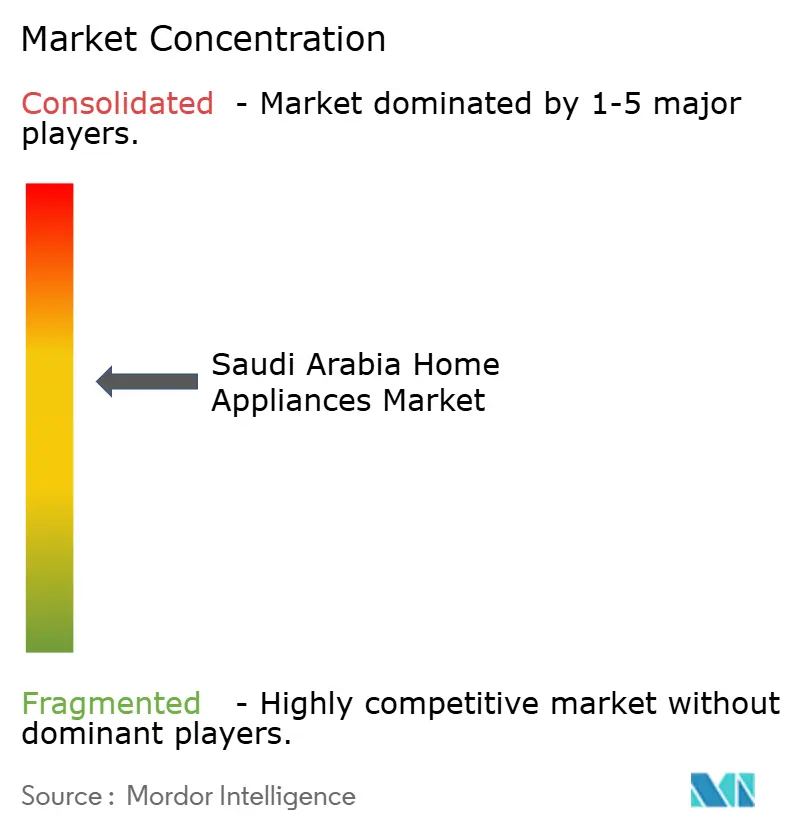
| Market Concentration | Medium |
Major Players *Disclaimer: Major Players sorted in no particular order Image © Mordor Intelligence. Reuse requires attribution under CC BY 4.0. | |
Saudi Arabia Home Appliances Market Analysis by Mordor Intelligence
The Saudi Arabia home appliances market size is expected to grow from USD 3.51 billion in 2025 to USD 3.72 billion in 2026 and is forecast to reach USD 4.99 billion by 2031 at 6.01% CAGR over 2026-2031. This momentum mirrors Vision 2030’s economic diversification agenda, which accelerates residential construction, smart-city roll-outs, and infrastructure upgrades across the Kingdom. The surge in giga-projects such as NEOM, Diriyah, and ROSHN developments feeds sustained demand for premium, connected appliances, while stricter Saudi Standards, Metrology, and Quality Organization (SASO) efficiency rules hasten replacement cycles and boost sales of inverter-grade air conditioners and A-rated refrigerators. Disposable-income gains, reflected in national homeownership rising to 65.4% in 2024, encourage premiumization across built-in kitchen suites and smart washing machines. Omnichannel retailing reshapes the competitive field as e-commerce captures incremental share on the back of 32% annual growth in Saudi online spending. Meanwhile, localized production—backed by Alat, MODON, and private-sector joint ventures—reduces import exposure and fosters technology transfer, yet leaves manufacturers exposed to near-term input-cost volatility and logistics hurdles.
Key Report Takeaways
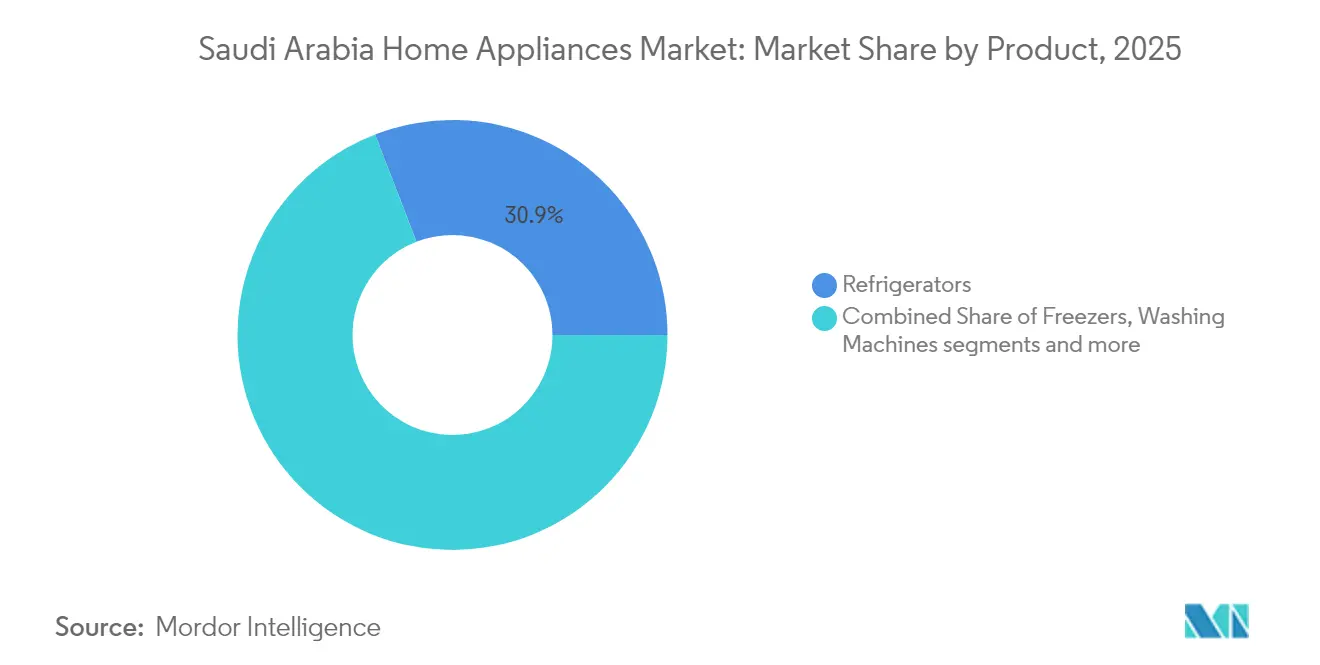
- By product type, refrigerators led with 30.86% of the Saudi Arabia home appliances market share in 2025; air fryers are advancing at a 6.80% CAGR through 2031.
- By distribution channel, multi-brand stores held 44.78% of the Saudi Arabia home appliances market size in 2025, while online retail is expanding at a 7.05% CAGR to 2031.
- By geography, Riyadh Province commanded 31.10% of the Saudi Arabian home appliances market share in 2025; Makkah & Jeddah Provinces are projected to grow at a 6.45% CAGR during the forecast period.
Note: Market size and forecast figures in this report are generated using Mordor Intelligence’s proprietary estimation framework, updated with the latest available data and insights as of 2026.
Saudi Arabia Home Appliances Market Trends and Insights
Drivers Impact Analysis*
| Driver | (~) % Impact on CAGR Forecast | Geographic Relevance | Impact Timeline |
|---|---|---|---|
| Vision 2030 giga-projects accelerating smart-home adoption | +2.1% | National, early gains in NEOM, Riyadh, Diriyah | Long term (≥ 4 years) |
| Rising disposable income & premiumization | +1.8% | National, strongest in Riyadh & Eastern Province | Medium term (2-4 years) |
| Energy-efficiency regulations spurring replacement sales | +1.4% | National, stricter in major cities | Short term (≤ 2 years) |
| E-commerce & omnichannel retail growth | +0.9% | National, the highest in urban centers | Short term (≤ 2 years) |
| Urbanisation & housing expansion | +1.2% | National, Vision 2030 zones | Medium term (2-4 years) |
| Residential solar rollout driving inverter-grade demand | +0.8% | National, focus on NEOM & green cities | Long term (≥ 4 years) |
| Source: Mordor Intelligence | |||
Vision 2030 giga-projects accelerating smart-home adoption
Giga-projects are embedding smart-infrastructure blueprints that require connected refrigerators, dishwashers, and HVAC systems able to interface with energy-management platforms. NEOM’s ENOWA-operated grid already pilots appliance-level demand response that trims peak loads by remote adjustment[1]“2025 Vision: NEOM’s High-Voltage Smart Grid Blueprint,” saudienergyconsulting.com. The USD 5 billion AI data-center venture between NEOM and DataVolt, slated for 2028, underpins ultra-low-latency services for appliance voice control and predictive maintenance. Six Saudi cities now rank in the IMD Smart-City index, reinforcing the nationwide backbone for IoT-appliance deployment. The state-backed Alat initiative adds a dedicated “Smart Appliances” business unit forecasting 39,000 direct jobs by 2030, catalyzing local design of Matter-enabled devices. Manufacturers that certify appliances for these platforms secure preferred-supplier status in giga-project residential clusters and hospitality zones.
Energy-efficiency regulations spurring replacement sales
SASO broadens minimum-performance thresholds and stand-by power limits across televisions, dryers, and microwaves, referencing EU ErP standards EN 50564 and EN 50643[2]Nemko, “Saudi Arabia introducing Off/Stand-by energy requirements,” nemko.com. Draft SASO 2874 for large-capacity air conditioners introduces 10% tolerance windows between rated and tested performance to smooth compliance pathways while tightening real-world energy use. A national window-A/C swap program launched in April 2025 targets the removal of legacy R-22 units, redirecting demand to inverter-driven R-410A systems that command higher price points. Enforcement success—91% compliance in 2024—has made energy labels a core purchase criterion and nudged households toward premium models with smart energy dashboards.
Rising disposable income & premiumization
Saudi Arabia’s real-estate transaction value escalated from SAR 170 billion to SAR 850 billion in 2024, mirroring wage gains that underpin higher per-home appliance outlays. ROSHN sold out all phase-1 villas at SEDRA and approaches 7,000 cumulative sales across flagship communities, each furnished with built-in cooker suites and side-by-side refrigerators. Foreign investment flows to construction now exceed 16% of inbound capital, elevating demand for imported premium brands. Knight Frank estimates 305,000 new Riyadh homes are required this decade, ensuring a long reflux of replacement and new-install volumes. Premiumization gathers pace in smart refrigerators with steel-alloy internal linings, turbo cooling, and Wi-Fi recipe applications that match evolving dietary trends.
E-commerce & omnichannel retail growth
Online channels leverage fulfillment networks and flexible payment schemes to capture mid-single-digit share gains annually. The washing machine segment alone should log USD 282.8 million in online revenue by 2029 as penetration rises to 72.1%. Retailer Extra integrates app-based order tracking, installation scheduling, and Shariah-compliant installment plans, reducing the perceived risk of large-ticket e-purchases. Multi-brand chains push click-and-collect services, while brands like Samsung augment their Saudi web stores with AI chatbots for model selection. Data analytics from omnichannel traffic feed inventory optimization and predictive promotion calendars, compressing stock-turn cycles and lowering carrying costs.
Restraints Impact Analysis*
| Restraint | (~) % Impact on CAGR Forecast | Geographic Relevance | Impact Timeline |
|---|---|---|---|
| Supply-chain price volatility | -1.2% | National, higher on import-dependent segments | Short term (≤ 2 years) |
| Water-scarcity rules limiting high-water washers | -0.7% | National, stricter in water-stressed regions | Medium term (2-4 years) |
| Category saturation in tier-1 cities | -0.5% | Riyadh, Jeddah, Dammam metros | Medium term (2-4 years) |
| Domestic-helper culture is dampening certain SDAs | -0.3% | National, higher in affluent areas | Long term (≥ 4 years) |
| Source: Mordor Intelligence | |||
Supply-chain price volatility
Ocean-freight swings and commodity shocks compress margins as the Kingdom imports most finished goods and sub-assemblies. Additional compliance layers—such as mandatory USB-C chargers from January 2025—raise certification costs and complicate production planning. Chinese OEM overcapacity triggers unpredictable export pricing, demonstrated by lithium-carbonate declines that cut storage-module quotes below 0.5 CNY/Wh, unsettling appliance battery suppliers. While MODON’s USD 14.9 billion in localization deals aims to shorten supply lines, greenfield factories will not contribute meaningful volumes until later in the decade. Brands hedge risk via multi-origin sourcing and currency-hedging programs; however, near-term retail pricing stays sensitive to global cost spikes, tempering volume growth.
Water scarcity rules limiting high-water washers
Per-capita water use near 360 liters daily pressures regulators to tighten water-efficiency scores for laundry appliances[3]U.S. Department of Commerce, “Saudi Arabia – Water,” trade.gov. Labels already cap flow rates for sanitary fixtures, signaling that washer drum capacities above 12 kg may soon face stricter benchmarks. The Ministry of Environment, Water, and Agriculture’s USD 80 billion infrastructure plan underscores urgency, while academic studies reveal 135 million m³ annual residential water consumed for power and cooling alone. Manufacturers innovate with recirculation pumps and sensor-based load detection to satisfy cultural preferences for large-volume abaya washing without breaching forthcoming thresholds.
*Our forecasts treat driver/restraint impacts as directional, not additive. The impact forecasts reflect baseline growth, mix effects, and variable interactions.
Segment Analysis
By Product Type: Dominance of refrigerators amid rapid air-fryer uptake
Refrigerators retained a 30.86% Saudi Arabia home appliances market share in 2025, thanks to indispensability and rising floor-area standards in new housing. Energy-rating upgrades and demand for larger French-door formats sustain value growth. Air fryers, posting a 6.80% forecast CAGR, epitomize health-conscious meal-prep trends and benefit from promotional pricing—Midea units retail between SAR 279 and SAR 439 after discounts. The Saudi Arabia home appliances market size for small-appliance categories advances fastest as consumers replace legacy cooking methods. Washing machines command a stable share, driven by cultural preferences for high-capacity front loaders with abaya cycles. Regulatory pushes toward eco-detergent compatibility and lower stand-by power spur premium launches such as TCL’s P680 washer-dryer with Wi-Fi diagnostics. Dishwashers, once niche, gain traction in newly built apartments where space-saving built-ins complement modern cabinetry.
Manufacturers differentiate via refrigerant transitions, vitality-cool zones, and AI freshness algorithms. Samsung’s R-410A line achieves higher SEER values than legacy R-22 systems, responding to SASO mandates and enabling premium price positioning. Meanwhile, fast-cycle innovation in kettles, blenders, and food processors captures casual cooks and expatriate professionals seeking time-saving gadgets.



By Distribution Channel: Online gains reshape retail hierarchies
Multi-brand stores contributed 44.78% of the Saudi Arabian home appliances market size in 2025, leveraging nationwide footprints, live demos, and bundled after-sales service. These outlets use aggressive festival promotions, warranty extensions, and installation support to retain foot traffic even as digital options proliferate. Their physical presence also anchors click-and-collect functions for retailers’ mobile apps, giving shoppers same-day pickup and real-time inventory visibility. Extra, for instance, integrates loyalty rewards across its 47 outlets and online storefront to deepen customer retention while field technicians handle on-site set-up and maintenance. Exclusive brand boutiques remain important in high-income districts but face margin pressure from the broader assortments and frequent discounting available at multi-brand rivals.
Online channels forecast to grow at 7.05% CAGR, disrupt price discovery, and expand reach into tier-2 and tier-3 cities where brick-and-mortar coverage is thin. E-commerce penetration in washing machines is set to rise from 55.4% to 72.1% by 2029, signaling consumer confidence in transacting big-ticket goods over digital platforms. Platforms such as Tamkeen Stores offer 30-day returns, zero-interest installments, and nationwide delivery, narrowing service-quality gaps with physical stores. Jarir’s pivot from books to electronics shows how trusted brands can migrate customer loyalty into appliance categories, while brand-owned Saudi web shops push bundled accessories and extended warranties. Improved logistics hubs in Riyadh and Jeddah shorten delivery windows to under 48 hours, and last-mile partners provide optional installation, eroding traditional stores’ historic service advantage. As a result, future share shifts hinge on each retailer’s ability to synchronize inventory, pricing, and promotion strategies across both physical and digital channels.

Geography Analysis
Riyadh Province, holding 31.10% of the Saudi Arabian home appliances market share in 2025, benefits from Vision 2030 budgets, corporate relocation mandates, and higher disposable incomes. Diriyah alone adds 20,000 luxury units, and Wadi Safar financing injects USD 1.6 billion into premium villas that favor built-in cookers and smart refrigerators. JLL’s Q3 2024 retail audit shows Riyadh outperforming Jeddah across occupancy and rent metrics, strengthening retailer balance sheets. Oracle’s USD 1.5 billion cloud campus furnishes a digital infrastructure backbone supporting IoT-appliance data flows.
Makkah & Jeddah Province posts the highest growth at 6.45% CAGR, propelled by religious-tourism hospitality and Red Sea coastal resorts. Residential sales skyrocketed 53% in 2024 to 28,072 transactions, with apartment prices stable at SAR 4,215/m²—maintaining affordability for first-time apartment buyers. ROSHN’s ALAROUS megaproject spans 4 million m², channeling concentrated appliance demand. Johnson Controls Arabia’s KAEC plant supplies 80% of domestic HVAC demand, illustrating how local manufacture feeds both residential and commercial markets.
The Eastern Province leverages petrochemical wealth and industrial clusters in Dammam and Jubail. Basic Electronics’ 70,000 m² HVAC smart factory employs 2,000 staff, amplifying demand for industrial refrigerators and staff housing appliances. Export corridors via the King Fahd Causeway enable re-export of finished goods to Bahrain and Kuwait, boosting factory utilization.
Madinah Province and the Rest of Saudi Arabia represent emerging opportunities as government initiatives develop secondary cities and rural areas, though growth depends on infrastructure investments and income development that may lag behind major urban centers.
Regulatory Landscape
Saudi Arabia regulates home appliances primarily through the Saudi Standards, Metrology and Quality Organization (SASO), which sets technical regulations and runs conformity assessment for regulated electrical products. Market access for in-scope appliances is channeled through the mandatory Saudi Product Safety Program (SALEEM) using the SABER platform, where suppliers must secure the applicable Certificate of Conformity before placing products on the market, with requirements tied to Gulf low-voltage electrical equipment rules and SASO technical regulations.
Energy labeling and minimum energy performance requirements are a core compliance driver for major appliances, particularly air conditioners, refrigerators/freezers, washing machines, and dishwashers, and retailer label visibility increasingly shapes purchase decisions. Appliance makers and importers also manage ongoing updates such as the stand-by and sleep mode power-consumption technical requirements effective from July 1, 2024, which tightened documentation and supplier declaration obligations and supported a replacement shift toward higher-efficiency, connected models that can substantiate measured savings and compliant labeling.
Value Chain Analysis
The value chain begins with upstream components and materials (compressors, motors, control boards, and refrigerants), which are still largely imported for both finished appliances and locally assembled units, making landed cost sensitive to freight and commodity swings. Local manufacturing and assembly in HVAC is expanding through joint-venture footprints (for example, the LG-Shaker facility), while higher-complexity parts remain a key import dependency, shaping pricing and model-mix decisions for air conditioners and other large appliances.
Midstream, regulatory and testing steps (SASO technical regulations, energy-efficiency labels, and SABER certification) sit between manufacturing/import and commercialization, affecting time-to-market and SKU rationalization. Downstream distribution is concentrated around Riyadh and Jeddah, with multi-brand stores and omnichannel players bundling delivery, installation, and after-sales service, plus developer-direct procurement for large housing communities that creates a parallel B2B route. Strategic moves such as Shaker Strategy 2027, which targets higher localization levels in HVAC manufacturing, also aim to shorten supply lines, improve service responsiveness, and reduce exposure to import logistics constraints.
Competitive Landscape
Competition remains moderate—with the top five brands controlling roughly half of retail revenue—yet intensifying as localization mandates spur new entrants. LG, Samsung, Whirlpool, and Haier defend share via R&D in AI fault-diagnostics and adaptive cooling. LG and Shaker Group celebrated 30 years of collaboration, marking local production of MULTI V 5 HVAC systems that feed integrated home-comfort bundles. Chinese challengers—Hisense, TCL, Midea—capitalize on aggressive pricing and fast model rotations; Hisense claims over 70% domestic solar-compatible A/C share. Local firms such as Basic Electronics and Al Essa Industries scale assembly lines through joint ventures with Gree and Panasonic, using MODON incentives to secure land and utilities.
Product connectivity sets the next competitive frontier. BSH debuted the Matter-ready Bosch 100 Series French-door fridge, enabling cross-brand home-network integration and seamless voice control via Alexa. TCL’s FreshIN 3.0 air conditioners feature self-cleaning heat-exchangers and VOC-sensor algorithms to differentiate indoor air quality. Compliance with SASO energy tiers offers marketing clout; brands exceeding minimum SEER by 15% highlight lifetime operating-cost savings to justify premiums. Price wars loom in entry-level segments as supply-chain fluctuations trickle through, yet localization buffers foreign-exchange exposure and strengthens after-sales networks.
Service quality and financing flexibility are becoming critical factors influencing brand perception, driving strategic partnerships with leading retailers and fintech platforms. Panasonic’s collaboration with Al Essa Industries in 2025 is expected to enhance its nationwide service network while introducing zero-interest installment plans to attract mid-income consumers. This initiative aligns with the growing demand for affordable financing options in the market. Similarly, Johnson Controls Arabia has partnered with ROSHN to integrate VRF cooling systems into master-planned communities. This collaboration is anticipated to secure long-term replacement cycles and generate consistent aftermarket parts revenue. Such strategic moves highlight the increasing focus on value-added services and customer-centric solutions to strengthen market positioning.
Saudi Arabia Home Appliances Industry Leaders
Haier
LG Electronics
Samsung Electronics
Whirlpool Corporation
Panasonic Corporation
- *Disclaimer: Major Players sorted in no particular order

Market Opportunities and Future Outlook
The clearest opportunity is at the intersection of Vision 2030 housing delivery and higher-specification kitchens and laundry rooms in master-planned communities, where developers and retailers increasingly want bundled installation, extended warranties, and connectivity-ready appliances. Current market momentum includes ROSHN community sales and large residential pipelines in Riyadh and Western provinces, which support demand for built-in cooker suites, larger-format refrigerators, and space-efficient dishwashers, and favor suppliers that can deliver coordinated packages (product plus installation plus service) at scale.
A second opportunity is compliance-led premiumization in high-load categories, especially cooling, where tighter SASO energy-performance and labeling enforcement accelerates replacement and supports higher-SEER inverter systems designed for hot-climate operation and smart energy management. The regulatory push on stand-by power, effective from July 1, 2024, and the Saudi Energy Efficiency Program's focus on MEPS for major appliances also raise the value of local compliance capability and faster certification turnaround, creating headroom for manufacturers and importers to keep compliant SKUs available across omnichannel routes and to support B2B requirements in giga-project and community developments with localized supply and service coverage.
Recent Industry Developments
- June 2026: LG Electronics expanded local HVAC manufacturing capacity in Riyadh at the LG-Shaker facility by launching a new production line for its MULTI V S (VRF) system. This expansion supports local availability of higher-efficiency cooling equipment aligned with SASO-driven upgrade cycles and Vision 2030 construction demand, while also improving lead times and after-sales support versus import-reliant supply.
- September 2025: LG Electronics signed an MOU with DataVolt to supply thermal management and cooling solutions for a planned AI data center in the Oxagon industrial hub of the NEOM project. This ties HVAC demand to data-center buildouts and supports LG's B2B procurement position in giga-project infrastructure, where energy performance and reliability requirements are high.
- February 2024: Al Hassan Ghazi Ibrahim Shaker Co. (Shaker), LG Electronics, and the Ministry of Investment of Saudi Arabia signed a non-binding memorandum of understanding to explore localization of AC compressor manufacturing in the Kingdom. The memorandum points to deeper component localization beyond final assembly, a lever for cost stability and local-content compliance in major appliance categories.


Research Methodology Framework and Report Scope
Market Definition and Coverage
This market is defined as revenues generated from the sale of home appliances used in Saudi households, covering major appliances and small appliances sold through offline and online channels, measured in USD at the country level.
Scope exclusions: We exclude consumer electronics that are not primarily household appliances, along with installation-only services, extended warranties, and most spare parts sold separately.
Segmentation Overview
- By Product
- Major Home Appliances
- Refrigerators
- Freezers
- Washing Machines
- Dishwashers
- Ovens (Incl. Combi & Microwave)
- Air Conditioners
- Other Major Home Appliances
- Small Home Appliances
- Coffee Makers
- Food Processors
- Grills & Roasters
- Electric Kettles
- Juicers & Blenders
- Air Fryers
- Vacuum Cleaners
- Electric Rice Cookers
- Toasters
- Countertop Ovens
- Other Small Home Appliances
- Major Home Appliances
- By Distribution Channel
- Multi-Brand Stores
- Exclusive Brand Outlets
- Online
- Other Distribution Channels
- By Geography
- Riyadh Province
- Makkah & Jeddah Province
- Eastern Province
- Madinah Province
- Rest of Saudi Arabia
Data Sources, Market Sizing, and Validation
Desk Research
Desk research was used to build the factual base for the model, and to make sure our definitions match what is actually sold in the Saudi market. We referred to public and official sources such as the General Authority for Statistics (Saudi Arabia), Saudi Customs trade statistics, SAMA macro indicators, UN Comtrade, and World Bank time series to understand import flows, household formation, and price pressure.
We also used company annual reports, investor presentations, and press coverage to map category focus and distribution mix, especially for major appliances like refrigerators, washing machines, ovens, and air conditioners. For certain cross-checks, we relied on paid subscriptions that help with company financials and intelligence, shipment-level import and export data, and news and financials. The sources listed here are illustrative and not exhaustive, and many other public references were used for data collection, clarification, and validation.
Primary Interviews and Surveys
Primary work focused on validating how volumes and prices move by appliance type and channel, and then testing the assumptions that sit behind the final model. We spoke with a mix of manufacturers, distributors, retailers, service ecosystem participants, and informed buyers across Saudi Arabia, and we used their inputs to confirm category splits, promo intensity, imported versus locally assembled mix, and realistic ASP progression by year.
Distribution of primary research fieldwork respondents
| Company type | Respondent position |
|---|---|
| Top tier: 27% | CXOs: 18% |
| Mid tier: 54% | Functional/Unit leaders: 27% |
| Smaller Players: 19% | Managers: 55% |
Market-Sizing & Forecasting
The sizing model starts with a top-down demand pool build that is reconstructed from Saudi appliance consumption signals, and then it is reconciled with supply-side checks so the totals stay realistic. To do this, we connect category-level demand to a few practical indicators such as household count growth, housing completions and handovers, replacement cycles for core appliances, penetration of air conditioners by climate zone, and import value and volume patterns by key HS codes.
Once the top-down totals are formed, they are corroborated with selective bottom-up approximations, such as sampled price points across channels, mix shifts between entry and premium products, and distributor feedback on sell-through ranges. Forecasts are built using scenario analysis, where variables like real income expectations, promo depth, housing pipeline, and currency conversion timing are stress-tested with expert feedback, and the most consistent path is used as the base case. Where direct volume signals are missing for smaller categories, gaps are handled through proportional splits anchored to interview-based mix and then checked against trade and retail signals.
Data Validation & Update Cycle
Validation is done in steps so the model does not depend on a single data stream. We check for outliers by comparing implied unit volumes, implied ASPs, and category shares against independent signals like import statistics, housing activity, and channel-level pricing behavior, and then we review any large variances before sign-off.
A second analyst review is used to challenge assumptions, and respondents are re-contacted when price moves, channel shifts, or trade trends do not line up with the draft outputs. The report is refreshed annually, and interim updates are triggered when material events occur that can change demand or pricing. Before delivery, a final pass is completed so clients receive the latest updated view.
Mordor Intelligence's Saudi Arabia Home Appliances Market Market Size Compared With Other Published Estimates
Published market sizes for Saudi Arabia home appliances often differ, even when they sound like they are talking about the same thing. In our work, the biggest reasons usually come down to what is counted as an appliance, how prices are converted into USD in the base year, and whether updates reflect the most recent price and promo cycles.
When refresh timing is tighter, annual average exchange rates and category-level ASP paths can be re-checked against current retail pricing and trade signals, and that is where the spread typically narrows, which is a practical choice applied by Mordor Intelligence.
Benchmark comparison
| Source | Market Size | Gaps in Research Methodology |
|---|---|---|
| Mordor Intelligence | USD 3.51 B (2025) | |
| Global Consultancy A | USD 4.32 B (2024) | Uses a household-appliances scope that can widen category boundaries and may apply a different USD conversion and price baseline, which can lift the reported value versus a tighter home-appliance mapping. |
| Regional Consultancy B | USD 3.45 B (2025) | Relies on a category set that appears to include adjacent device groupings and a different channel and price-mix build, which can shift ASP assumptions and slightly change the total for the same year. |
Taken together, the gap is mainly explained by scope edges and by how pricing and currency timing are handled in the base year. By keeping the variables traceable to trade, housing, and price signals, and by re-checking assumptions during reviews, the final number stays balanced and repeatable for planning.


Key Questions Answered in the Report
How large is the Saudi Arabia home appliances market in 2026?
The market is valued at USD 3.72 billion in 2026 and is projected to reach USD 4.99 billion by 2031 at a 6.01% CAGR.
Which product category leads sales?
Refrigerators hold the top spot with 30.86% share of 2025 revenue, supported by housing expansion and premium-feature upgrades.
What is the fastest-growing product?
Air fryers show the highest growth, advancing at a 6.80% CAGR through 2031 as health-focused cooking gains popularity.
Which region will expand quickest?
Makkah & Jeddah Province is forecast to grow at a 6.45% CAGR, benefiting from tourism infrastructure and Red Sea Project developments.
How are energy regulations affecting demand?
Tightened SASO standards accelerate replacement of older units with inverter-grade, A-rated models, boosting premium appliance sales.
What role does e-commerce play?
Online channels are projected to grow at a 7.05% CAGR, pushing washing machine online penetration to 72.1% by 2029 and reshaping retail strategies.
Page last updated on:


 Your data is secure and never sold or shared.


