
Market Overview
| Study Period | 2020 - 2031 |
|---|---|
| Forecast Data Period | 2026 - 2031 |
| Base Year Market Size (2025) | USD 16.39 Billion |
| Market Size (2026) | USD 17.17 Billion |
| Market Size (2031) | USD 21.66 Billion |
| Growth Rate (2026 - 2031) | 4.76 % |
| Market Concentration | Medium |
Major Players *Disclaimer: Major Players sorted in no particular order Image © Mordor Intelligence. Reuse requires attribution under CC BY 4.0. | |
Mexico Home Appliances Market Analysis by Mordor Intelligence
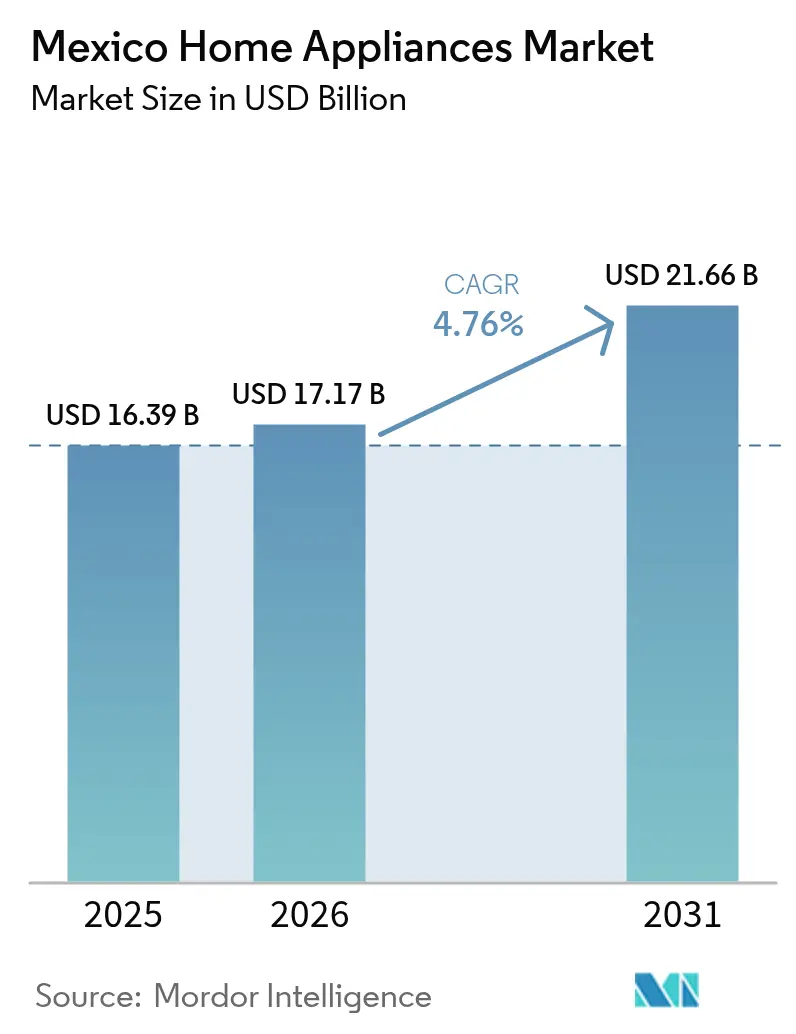
Mexico home appliances market size in 2026 is estimated at USD 17.17 billion, growing from 2025 value of USD 16.39 billion with 2031 projections showing USD 21.66 billion, growing at 4.76% CAGR over 2026-2031. Rising remittances that exceed 3% of GDP, stricter NOM-015 efficiency labeling, and resilient consumer sentiment create a sturdy demand floor despite periodic peso volatility[1]. Nearshoring policies motivate global brands to expand Mexican production lines, shortening delivery lead-times and supporting localized component sourcing. Retailers accelerate Buy-Now-Pay-Later rollouts that pull aspirational households into mid-tier price brackets, while e-commerce firms refine last-mile networks to reach semi-urban buyers. Energy-conscious urban dwellers, especially in Mexico City and Monterrey, increasingly favor inverter-grade refrigerators and laundry systems that promote long-term utility-bill savings, reinforcing premiumization inside the Mexico home appliances market.
Key Report Takeaways
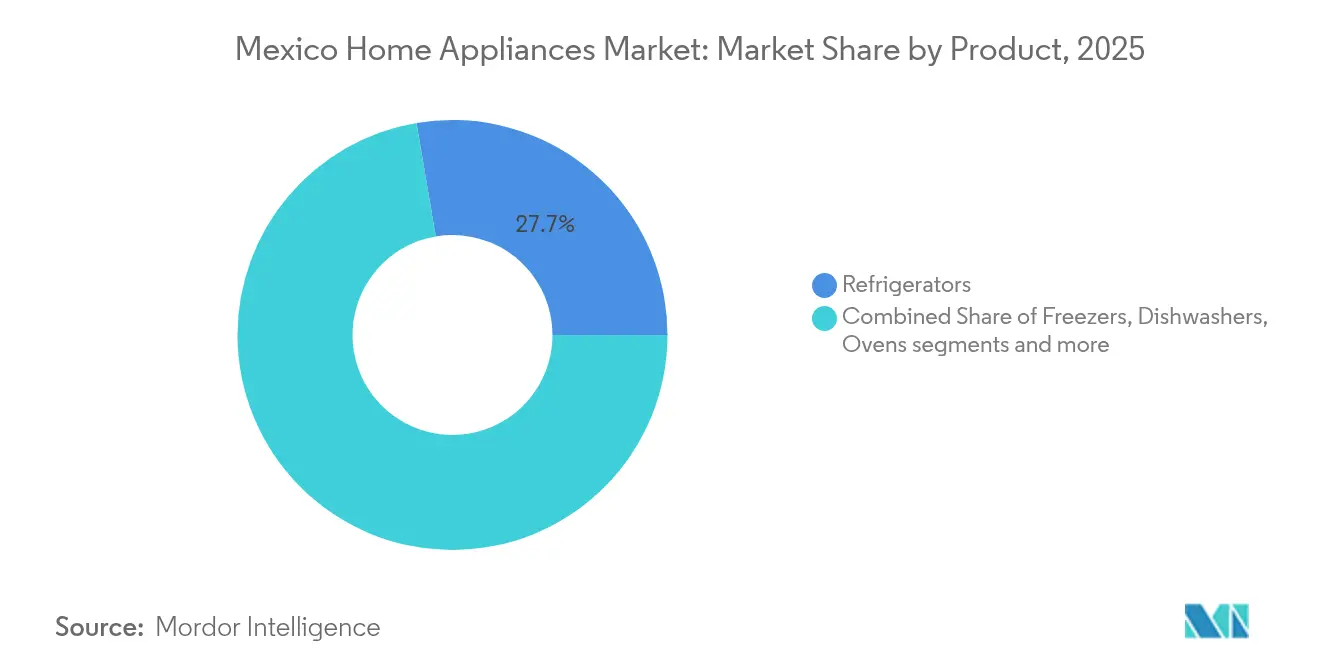
- By product category, refrigerators held 27.68% of the Mexico home appliances market share in 2025, whereas air fryers are projected to post the fastest 4.97% CAGR through 2031.
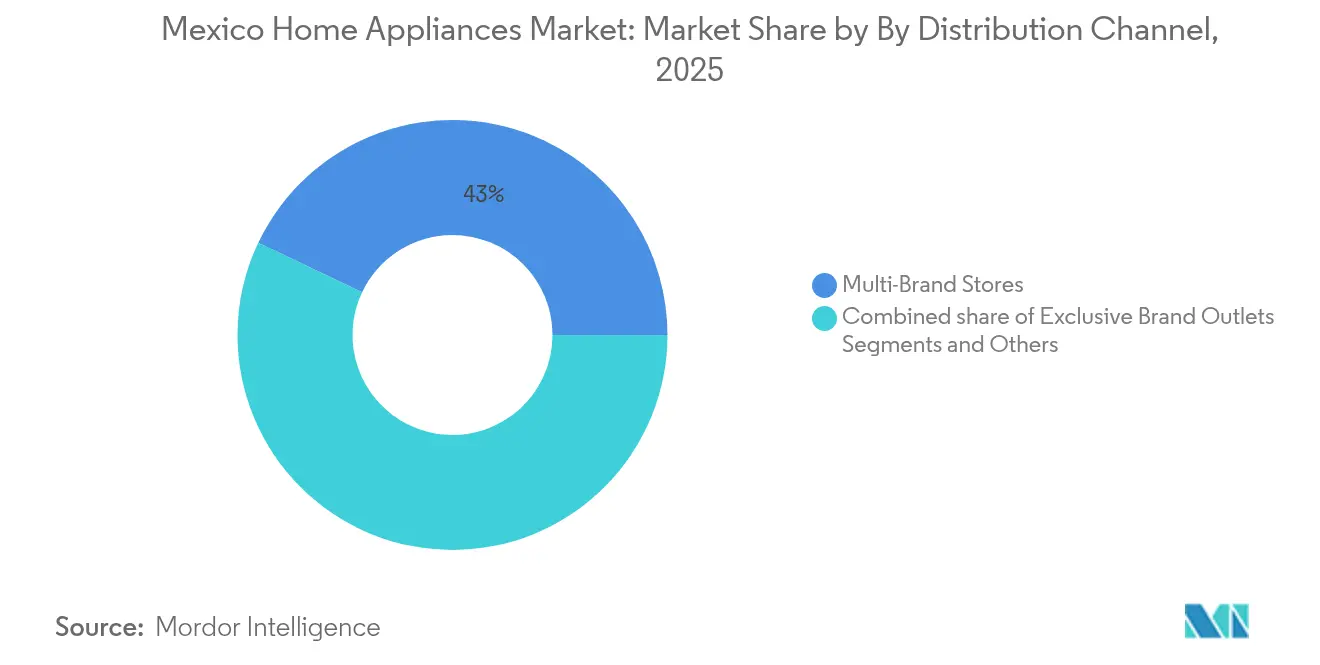
- By distribution channel, multi-brand stores accounted for 42.95% of the Mexico home appliances market size in 2025, while online retail is advancing at a 5.63% CAGR through 2031.
- By geography, Central Mexico captured a 40.82% revenue share in 2025; Southern Mexico is forecast to expand at a 5.09% CAGR to 2031.
Note: Market size and forecast figures in this report are generated using Mordor Intelligence’s proprietary estimation framework, updated with the latest available data and insights as of 2026.
Market Trends and Insights
Drivers Impact Analysis of Mexico Home Appliances Market*
| Driver | (~) % Impact on CAGR Forecast | Geographic Relevance | Impact Timeline |
|---|---|---|---|
| Rising disposable income & middle-class expansion | +1.2% | National: strongest in Central Mexico | Medium term (2-4 years) |
| Accelerated urban housing construction | +0.8% | Central and Northern corridors | Short term (≤ 2 years) |
| Mandatory NOM-015 energy-efficiency labeling | +0.6% | National | Long term (≥ 4 years) |
| Remittance-fueled home upgrades | +0.9% | Central and Southern Mexico | Medium term (2-4 years) |
| Buy-Now-Pay-Later retail financing | +0.7% | Urban clusters nationwide | Short term (≤ 2 years) |
| Cross-border e-commerce inflows from the United States | +0.5% | Northern Mexico; spillover to Central | Medium term (2-4 years) |
| Source: Mordor Intelligence | |||
Rising Disposable Income & Middle-Class Expansion
Consumer confidence touched 46.3 points in February 2025, and the likelihood of purchasing household appliances and furniture edged higher by 0.6 points, suggesting selective optimism among newly affluent families. Durable goods imports soared 21.7% in August 2024, while domestic production climbed 11.6%, confirming a healthy appetite even amid mixed macro signals. Consumer credit stood at MXN 2.1 trillion by Q4 2024, enabling access to energy-efficient refrigerators, smart ovens, and split-type air conditioners. Remittances boost liquidity in rural municipalities, bridging purchasing-power gaps and broadening the customer base for premium appliances. Elevated electricity tariffs reinforce the cost-saving narrative around A-rated units, deepening the Mexico home appliances market’s shift toward high-efficiency SKUs.
Accelerated Urban Housing Construction
Urban housing starts in Mexico City, Monterrey, and Guadalajara quicken replacement cycles because new units require full appliance bundles. INFONAVIT and FOVISSSTE mortgages allow first-time owners to allocate residual credit to up-market washers or side-by-side refrigerators. Builders increasingly mandate NOM-compliant appliances to meet municipal green-building codes, embedding higher technical standards into project specifications. Proximity to assembly plants in Guanajuato and Nuevo León lowers freight outlays, allowing manufacturers to guarantee one-week delivery to construction sites. Predictable tranche ordering smooths production scheduling, reducing inventory risk and elevating gross-margin visibility inside the Mexico home appliances market.
Mandatory NOM-015 Energy-Efficiency Labeling
NOM-015-ENER-2012 caps annual energy consumption for refrigerators and freezers and obliges manufacturers to display kWh/year data plus relative savings on a front-of-pack label. Models that beat the ceiling by 10% qualify for an “EFICIENCIA SUPERIOR” seal that retailers highlight in both showrooms and digital catalogs. Accredited labs conduct annual conformity tests unless firms hold certified quality systems that extend validity to three years, forcing continuous R&D investment. Parallel standards such as NOM-021-ENER raise performance thresholds for air conditioners, effectively blocking low-efficiency imports. Over time, mandatory labeling bolsters consumer trust and rewards innovators, anchoring long-run value capture across the Mexico home appliances market.
Remittance-Fueled Home Upgrades
Remittances equal roughly 3% of national GDP and proved counter-cyclical during recent downturns, supplying households with steady cash that cushions disposable income. Guanajuato, Michoacán, and Oaxaca record above-average flows, and retailers serving those states report heightened sales of frost-free refrigerators and multi-program washers. Lenders have introduced remittance-backed instalment plans pegged to expected monthly inflows, letting buyers move into the mid-tier price band without straining liquidity. Premium finishes and advanced cooling features signal socioeconomic progress, making appliances a favored investment among recipients. This income stream stabilizes baseline demand, sheltering the Mexico home appliances market from domestic macro shocks.
Restraints Impact Analysis of Mexico Home Appliances Market*
| Restraint | (~) % Impact on CAGR Forecast | Geographic Relevance | Impact Timeline |
|---|---|---|---|
| Peso volatility & consumer-credit tightening | -1.4% | National: hardest on import-intensive lines | Short term (≤ 2 years) |
| High domestic logistics & last-mile costs | -0.9% | Nationwide, the steepest in Southern Mexico | Medium term (2-4 years) |
| Informal second-hand appliance market growth | -0.6% | Urban centers | Medium term (2-4 years) |
| Water scarcity concerns for water-intensive units | -0.4% | Northern and Central arid belts | Long term (≥ 4 years) |
| Source: Mordor Intelligence | |||
Peso Volatility & Consumer-Credit Tightening
Peso swings amplify the landed cost of compressors and electronic boards sourced from Asia, squeezing gross margins or forcing retail mark-ups that deter entry-level shoppers. Commercial banks curbed unsecured lending in late 2024, increasing approval thresholds and limiting credit-card limits, which dampens installment-based purchases. Budget-constrained buyers either delay replacement cycles or migrate to used-goods marketplaces, trimming unit shipments in segments like frost-free freezers. Import-dependent brands remain most vulnerable, as they lack peso-denominated cost buffers inside the Mexico home appliances market.
High Domestic Logistics & Last-Mile Costs
Large appliances traverse mountainous terrain and urban congestion, pushing transport fees to more than half of the delivered unit cost. In low-density states such as Chiapas and Guerrero, average final-mile distance exceeds 120 kilometers, inflating vehicle wear, fuel consumption, and driver labor. E-commerce players wrestle with double-handling needs—warehouse to micro-hub to doorstep—while also absorbing high reverse-logistics rates for returns. Elevated shipping outlays compress margins and discourage free-delivery promotions, slowing digital conversion in the Mexico home appliances market’s hardest-to-reach districts.
*Our forecasts treat driver/restraint impacts as directional, not additive. The impact forecasts reflect baseline growth, mix effects, and variable interactions.
Mexico Home Appliances Market Segment Analysis
By Product:
Major Appliances Anchor Revenue, Small Appliances Accelerate InnovationRefrigerators maintained a 27.68% share of the Mexico home appliances market in 2025, strengthened by mandatory replacement cycles and energy-label compliance that phase out power-hungry imports. Nominal utility rates have risen, spurring demand for inverter compressors, multi-door formats, and smart-thaw functionality. Washing machines trail closely, aided by dual-tub units popular in semi-urban homes, while room air conditioners gain ground as average summer temperatures climb. Dishwashers face mixed adoption because of water-scarcity worries, whereas microwave-convection hybrids thrive in compact kitchens where space efficiency rules. Collectively, large appliances supply the economies of scale that keep factory utilization high in the Mexico home appliances market.
Air fryers headline the small-appliance story with a projected 4.97% CAGR to 2031, buoyed by fast-cooking convenience and health-oriented meal prep trends. Coffee machines and electric kettles ride Mexico’s expanding specialty-beverage culture, while juicers and blenders suit rising demand for fresh produce diets. Vacuum cleaners, including robotic variants, grow steadily as two-income households seek labor-saving tools. Accelerated design cycles and lower price points let brands introduce Wi-Fi connectivity, voice controls, and modular components without disturbing household budgets. The small-appliance category, therefore, acts as the innovation sandbox within the Mexico home appliances market.

By Distribution Channel:
Store Formats Rebalance as E-Commerce ClimbsMulti-brand stores controlled 42.95% of the Mexico home appliances market in 2025 by leveraging broad assortments, same-day pickup, and on-site credit desks that clear loans in minutes. Showrooms allow shoppers to test door hinges, assess noise levels, and gauge real-world capacity—attributes still hard to replicate via online thumbnails. Chains deploy regional warehouses adjacent to highway junctions, shaving transport time and enabling weekend flash sales coordinated across hundreds of outlets.
Online platforms post the sharpest 5.63% CAGR, fueled by smartphone penetration, digital-wallet incentives, and nationwide expansion of fiber networks. Partnerships with Kueski Pay and other Buy-Now-Pay-Later providers deliver zero-interest schemes that rival legacy in-store credit. Exclusive brand stores, both brick-and-mortar and digital, craft curated environments that justify premium pricing on smart-enabled SKUs. Click-and-collect, augmented-reality product demos, and 360-degree video consultations blur channel boundaries, pushing the Mexico home appliances market toward omnichannel parity.
Geography Analysis
Central Mexico dominated the Mexico home appliances market with a 40.82% share in 2025, thanks to the Mexico City megalopolis, denser retail footprints, and higher discretionary income. Same-day delivery services flourish within ring highways, while condo living favors slimline, energy-rated appliances that minimize utility costs and fit compact layouts. Corporate headquarters demand commercial refrigeration and laundry solutions, further raising throughput.
Northern Mexico benefits from maquiladora clusters and cross-border buying behaviors. Consumers in Baja California and Sonora often compare U.S. and domestic prices before purchasing, leading retailers to sharpen promotions to hold local share. Per-capita electricity use in Mexicali runs 3.5 times the national mean, elevating adoption of split-inverter air conditioners and reinforcing the Mexico home appliances market’s focus on climate control. Nearshoring drives component producers to establish hubs in Coahuila and Nuevo León, enhancing supply resilience.
Southern Mexico emerges as the fastest-growing territory, targeting a 5.09% CAGR via remittance-backed spending and public infrastructure upgrades that include road expansions and improved grid stability. Retailers deploy micro-fulfillment centers to overcome rugged terrain and poor road density. Water-efficient washers and eco-wash dishwashers resonate in Chiapas and Oaxaca, where periodic shortages make conservation a top priority. Although freight costs remain steep, localized assembly partnerships help contain end-user pricing, broadening reach inside the Mexico home appliances market.
Value Chain Analysis
Mexico's home appliances value chain spans upstream metals, resins, and electronics, midstream component fabrication (stamping, plastics injection, wiring harnesses, compressors, and control boards), and downstream assembly into major and small appliances concentrated in industrial corridors such as Nuevo Leon, Coahuila, and Guanajuato. A recurring bottleneck is the import intensity of select inputs, especially steel grades and electronic components, which exposes OEMs to landed-cost swings when the peso weakens and when global freight rates change; manufacturers respond by expanding local supplier qualification and by locating production close to border logistics to shorten replenishment cycles.
Downstream, products flow through multi-brand retailers, exclusive brand outlets, and online channels, with last-mile delivery and reverse logistics remaining cost-heavy for bulky appliances, particularly into Southern Mexico. Industry bodies such as ANFAD (representing a large share of domestic production) sit alongside conformity assessment organizations and testing labs that support NOM compliance, which in practice influences design decisions, labeling, and go-to-market timing. Government manufacturing frameworks used by export-oriented plants, including IMMEX and PROSEC, also shape sourcing by enabling duty-managed import of inputs tied to export production, reinforcing Mexico's role as a North American supply base for major appliances.
Competitive Landscape
The competitive field is moderately concentrated. Home-grown Mabe leverages factories in Guanajuato and Nuevo León to remain a category leader in refrigerators and cooking ranges. Whirlpool’s USD 65 million Celaya expansion, finished in December 2024, equips the firm to supply premium French-door units nationally while hedging currency exposure through peso-denominated costs. Samsung and LG tap both domestic plants and cross-border distribution nodes to shorten lead times within Northern Mexico, deploying periodic promotional blitzes whenever the peso weakens.
China-based Jiaxipera opened a USD 60 million compressor facility in Coahuila, boosting regional self-sufficiency for refrigeration systems. Arçelik, operating the Beko brand, integrated Whirlpool’s European assets to acquire procurement heft that extends to its Mexican sourcing operations. Retail financing alliances matter: Kueski Pay’s embedded-checkout APIs help smaller brands compete head-to-head with entrenched giants by smoothing high-ticket transactions. NOM certifications, audited by JJR Laboratory, function as gatekeepers that block low-quality imports, compelling entrants to invest in robust testing and QA processes[3]. Technology differentiation, after-sales servicing, and localized production strategies therefore outweigh mere unit-price tactics across the Mexico home appliances market.
Mexico Home Appliances Industry Leaders
-
Whirlpool Corporation
-
Mabe
-
Electrolux AB
-
LG Electronics
-
Samsung Electronics Co., Ltd.
- *Disclaimer: Major Players sorted in no particular order

Mexico Home Appliances Market Companies Covered in this Report
- Whirlpool Corp.
- Mabe, S.A. de C.V.
- LG Electronics Inc.
- Samsung Electronics Co., Ltd.
- Electrolux AB
- Bosch-Siemens Hausgeräte (BSH)
- Haier Group Corp.
- Hisense Co., Ltd.
- Panasonic Corp.
- Black+Decker (Stanley Black & Decker)
- De’Longhi Appliances S.r.l.
- Groupe SEB (Tefal, Moulinex)
- Hamilton Beach Brands
- SharkNinja Operating LLC
- Conair Corporation
- Oster (Newell Brands)
- General Electric Appliances (Haier)
- Arcelik A.Ş. (Beko)
- SMEG S.p.A.
- Winia Electronics
Market Opportunities and Future Outlook
Large, named manufacturing commitments and network moves create clear whitespace for suppliers and service providers around localization, productivity upgrades, and faster product refresh. Mabe's announced USD 668 million program (2025-2027) to refurbish and expand 15 facilities, BSH's refrigeration factory start-up in Monterrey (opened July 2024, EUR 220-240 million), and the Electrolux-Midea plan to form a food-preservation manufacturing joint venture in Juarez (announced April 2026) underline active capital formation in core categories where Mexico already has scale. These initiatives increase demand for Mexico-based component ecosystems (plastics, stamped parts, wiring, insulation, electronics integration) and for industrial services such as tooling, automation integration, and quality systems that support NOM-driven efficiency and labeling requirements.
On the demand and route-to-market side, opportunities center on energy-efficient and connected SKUs and on reducing the friction of purchase and delivery outside the main urban cores. NOM energy labeling and heightened consumer sensitivity to electricity costs keep attention on inverter-driven refrigeration and laundry platforms, while omnichannel tactics and embedded financing expand the addressable base for higher-ticket products. There is additional room for third-party logistics and installation networks that can cut damage, returns, and delivery lead times into harder-to-serve regions, where high last-mile costs still constrain online conversion for large appliances.
Recent Industry Developments in Mexico Home Appliances Market
- July 2026: Whirlpool announced a manufacturing restructuring plan in Mexico that includes closing its Supsa facility in Apodaca, Nuevo Leon by Q2 2027 and shifting production to Ramos Arizpe, Coahuila and other sites. The move consolidates output into fewer, higher-utilization hubs and reshapes local supplier allocation for refrigeration-related components and services. It also signals continued optimization of Mexico within Whirlpool's North American footprint rather than a retreat from regional production.
- March 2025: Mabe announced an investment program of about USD 668 million for 2025-2027 to refurbish and expand 15 manufacturing facilities in Mexico. The modernization cycle supports higher-efficiency product lines and tighter compliance execution around NOM-driven performance and labeling. It also broadens the addressable market for domestic tooling, automation, and component suppliers tied to scaled OEM platforms.
- July 2024: BSH Hausgeraete opened its first refrigeration factory in Mexico, located in Monterrey, Nuevo Leon, with an investment reported at roughly EUR 220-240 million. The facility adds local capacity in a core major-appliance category and strengthens Mexico's role as a production base serving North America. The expansion increases competitive intensity in mid-to-premium refrigeration and supports further localization of adjacent component supply chains in Northern Mexico.
Mexico Home Appliances Market Report Scope and Research Methodology
Market Definition and Coverage
For this study, the Mexico home appliances market is defined as the value of household appliance sales in Mexico across major and small appliances, counted at the point where the product is sold into the market through recognized retail and online channels.
Scope exclusions: We exclude commercial and industrial appliances used mainly in restaurants, factories, hospitals, and other non-household settings.
Segments Covered in This Report
- By Product
- Major Home Appliances
- Refrigerators
- Freezers
- Washing Machines
- Dishwashers
- Ovens (Incl. Combi & Microwave)
- Air Conditioners
- Other Major Home Appliances
- Small Home Appliances
- Coffee Makers
- Food Processors
- Grills & Roasters
- Electric Kettles
- Juicers & Blenders
- Air Fryers
- Vacuum Cleaners
- Electric Rice Cookers
- Toasters
- Countertop Ovens
- Other Small Home Appliances
- Major Home Appliances
- By Distribution Channel
- Multi-Brand Stores
- Exclusive Brand Outlets
- Online
- Other Distribution Channels
- By Geography
- Northern Mexico
- Central Mexico (incl. Mexico City)
- Southern Mexico
Data Sources, Market Sizing, and Validation
Desk Research
Desk research was first used to build the country context and to anchor the demand pool for appliances in Mexico. We referenced public sources such as Mexico national statistics releases, customs trade statistics, central bank inflation and FX series, energy efficiency and labeling rules from official regulators, and housing and household formation indicators from government portals.
To convert those signals into a practical model, we also reviewed brand and retailer press releases, company annual reports and investor presentations, and trusted business news for pricing moves and channel shifts. In addition, a paid subscription database was used selectively for company financials and news screening, and another paid subscription was used for patent lookups where product cycles or efficiency changes mattered. The specific desk sources listed here are illustrative only, and many other public and paid references were used to collect, cross-check, and clarify data points.
Primary Interviews and Surveys
Primary work was then done to pressure-test the sizing logic with people who see volumes, pricing, and channel mix in real time, including manufacturers, distributors, retailers, installers, and after-sales teams. For Mexico, inputs were validated across key demand pockets (northern industrial states, central urban areas including Mexico City, and the south) so regional mix and affordability shifts were captured. Where secondary numbers were missing or looked inconsistent, we re-checked assumptions through short follow-ups, and then used the feedback to finalize the market build.
Distribution of primary research fieldwork respondents
| Company type | Respondent position |
|---|---|
| Top tier: 37% | CXOs: 14% |
| Mid tier: 49% | Functional/Unit leaders: 29% |
| Smaller Players: 14% | Managers: 57% |
Market-Sizing & Forecasting
Sizing was built using a top-down and bottom-up combination, where household and housing indicators were used to reconstruct the demand pool, and then mapped to appliance replacement cycles and first-time purchases. The totals were cross-checked with selective bottom-up approximations, such as sampling average selling prices by channel, validating unit movement patterns from trade and retail feedback, and checking whether supplier roll-ups fit the expected category mix.
Key inputs used in the model included appliance category splits between major and small appliances, channel mix between multi-brand stores, exclusive outlets, and online, price movement signals (including inflation effects), import reliance for certain categories, and regional demand differences inside Mexico. Forecasts were developed using scenario analysis, where macro conditions and affordability assumptions were adjusted based on expert views, followed by smoothing the year-on-year path so the outlook stays consistent with observed replacement behavior and channel expansion. When bottom-up checks were incomplete for a category or region, the gap was handled through ratio-based allocation using the most defensible proxies (such as household counts and category penetration), and then validated again through interviews.
Data Validation & Update Cycle
Outputs were validated through multiple checks so the final number stays tied to real market signals. Analysts compare category totals against independent indicators such as trade flows, pricing trends, and reported channel expansion, and then investigate any sharp jumps before sign-off.
A second analyst review is performed to re-check assumptions, unit economics logic, and year-to-year movements, and any variance that cannot be explained triggers a re-contact with primary respondents. Reports are refreshed annually, and interim updates are made when material events occur that can shift pricing, demand, or supply. Before delivery, a final pass is completed so clients receive the latest updated view based on the most recent available information.
Mordor Intelligence's Mexico Home Appliances Market Sizing Compared With Other Published Estimates
Published market sizes for Mexico home appliances often do not line up because the scope choices and counting points differ, even when the category names look similar. Differences usually come from whether figures are retail value or factory level, how online sales are treated, and which appliance sets are grouped together.
The main gap comes from what gets counted as a home appliance sale, where Mordor Intelligence includes both major and small household appliances sold through recognized retail and online channels in Mexico, while some figures appear to narrow the basket or mix in adjacent electronics, which shifts the total in either direction.
Benchmark comparison
| Source | Market Size | Gaps in Research Methodology |
|---|---|---|
| Mordor Intelligence | USD 16.39 B (2025) | |
| Global Consultancy A | USD 10.41 B (2024) | This estimate is materially lower because the scope is presented at a higher level and may rely on a narrower definition split mainly into major versus small appliances, which can undercount the long tail of small appliance categories and some retail channels. |
| Industry Publisher B | USD 15.34 B (2024) | The value is closer, but the time base differs and the treatment of currency timing and inflation effects is not transparent, so the carry-forward to a 2025 level can vary depending on the FX month used and how price progression is applied. |
Overall, the spread is mainly explained by scope inclusion, the year used for the headline number, and how price and currency timing are handled. By keeping the category basket explicit, validating channel mix through field inputs, and applying repeatable pricing logic, the resulting market size stays easier to trace back to real demand drivers.
Key Questions Answered in the Report
How large is the Mexico home appliances market today?
It is valued at USD 17.17 billion in 2026 and is projected to reach USD 21.66 billion by 2031.
Which channel is expanding fastest for major appliance sales?
Online retail is growing at a 5.63% CAGR as smartphones, digital wallets, and BNPL tools gain traction.
What is driving the popularity of air fryers across Mexico?
Health-focused cooking, compact countertop needs, and quick meal prep underpin a 4.97% CAGR outlook.
Why does Central Mexico hold the biggest regional share?
High urban density, superior logistics, and elevated disposable incomes secure a 40.82% 2025 share.
How do NOM standards influence purchasing decisions?
Mandatory energy labels steer shoppers toward efficient models and force manufacturers to innovate to remain compliant.
What risks could slow near-term appliance demand?
Peso volatility, tighter consumer credit, and rising logistics costs are the chief near-term brakes on growth.