
Market Overview
| Study Period | 2020 - 2031 |
|---|---|
| Forecast Data Period | 2026 - 2031 |
| Base Year Market Size (2025) | USD 3.48 Billion |
| Market Size (2026) | USD 3.67 Billion |
| Market Size (2031) | USD 4.77 Billion |
| Growth Rate (2026 - 2031) | 5.39 % |
| Market Concentration | Medium |
Major Players *Disclaimer: Major Players sorted in no particular order Image © Mordor Intelligence. Reuse requires attribution under CC BY 4.0. | |
South Africa Home Appliances Market Analysis by Mordor Intelligence
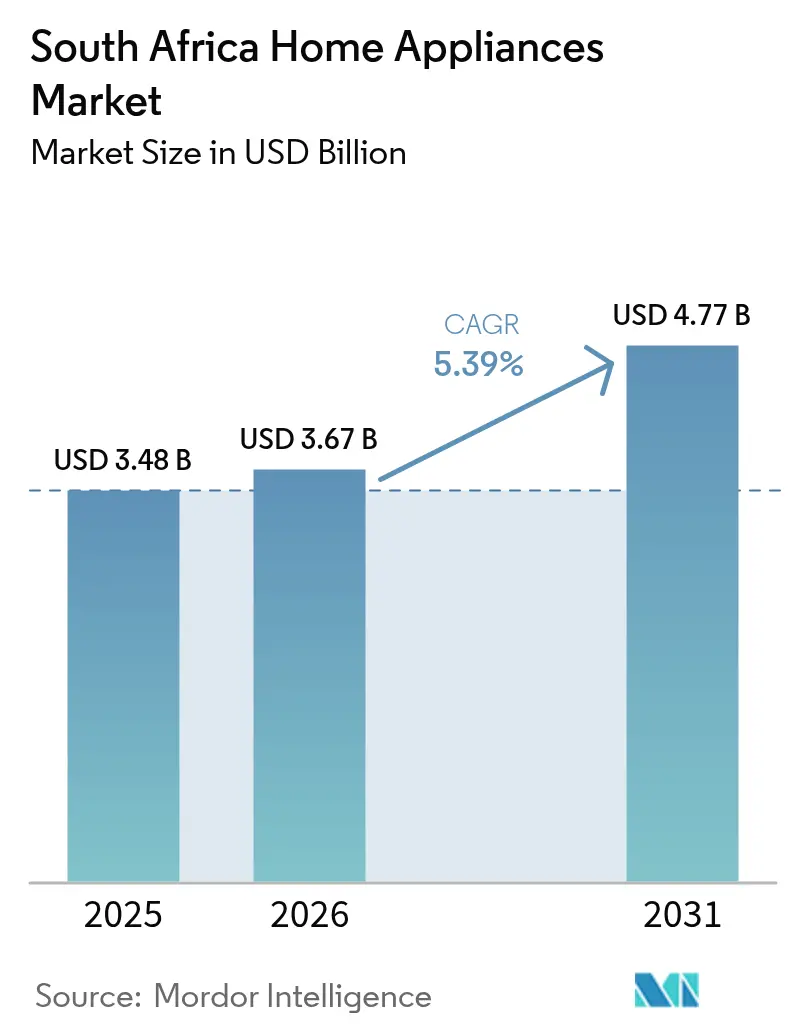
The South Africa home appliances market size is expected to grow from USD 3.48 billion in 2025 to USD 3.67 billion in 2026 and is forecast to reach USD 4.77 billion by 2031 at 5.39% CAGR over 2026-2031. This healthy trajectory persists despite inflationary pressure because households are compelled to replace load-shedding-damaged units and are simultaneously attracted to energy-efficient models that curb electricity bills [1]. Essential categories such as refrigerators, freezers, and washing machines continue to anchor overall volume sales, yet a growing middle class is steadily shifting discretionary spend toward convenience-oriented small appliances that work on battery or solar backup systems. Retailers report that inverter-compatible products now move faster than legacy models as consumers future-proof against chronic power cuts, and manufacturers are responding by localizing component assembly to offset rand volatility. Multi-brand chains still dominate brick-and-mortar sales, but digital channels are scaling quickly on the back of nationwide fulfilment networks and expanded payment choices, helping brands penetrate peri-urban townships without heavy fixed-store investment. Competitive intensity is moderate: the top five vendors control 65% of revenue, enabling scale efficiencies, yet leaving room for niche entrants that differentiate on price, after-sales service, or off-grid compatibility.
Key Report Takeaways
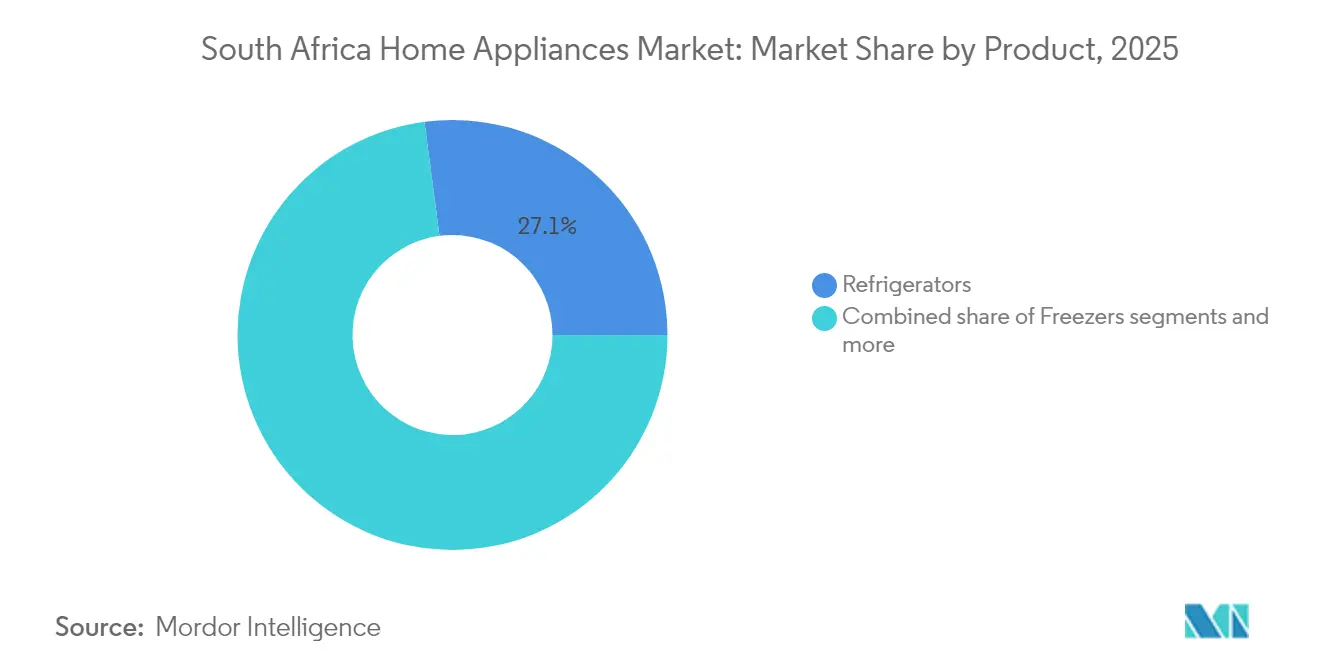
- By product type, refrigerators accounted for 27.08% of the South Africa home appliances market share in 2025, while the South Africa home appliances market size for air fryers is forecast to grow at the fastest CAGR of 5.84% between 2026 and 2031.
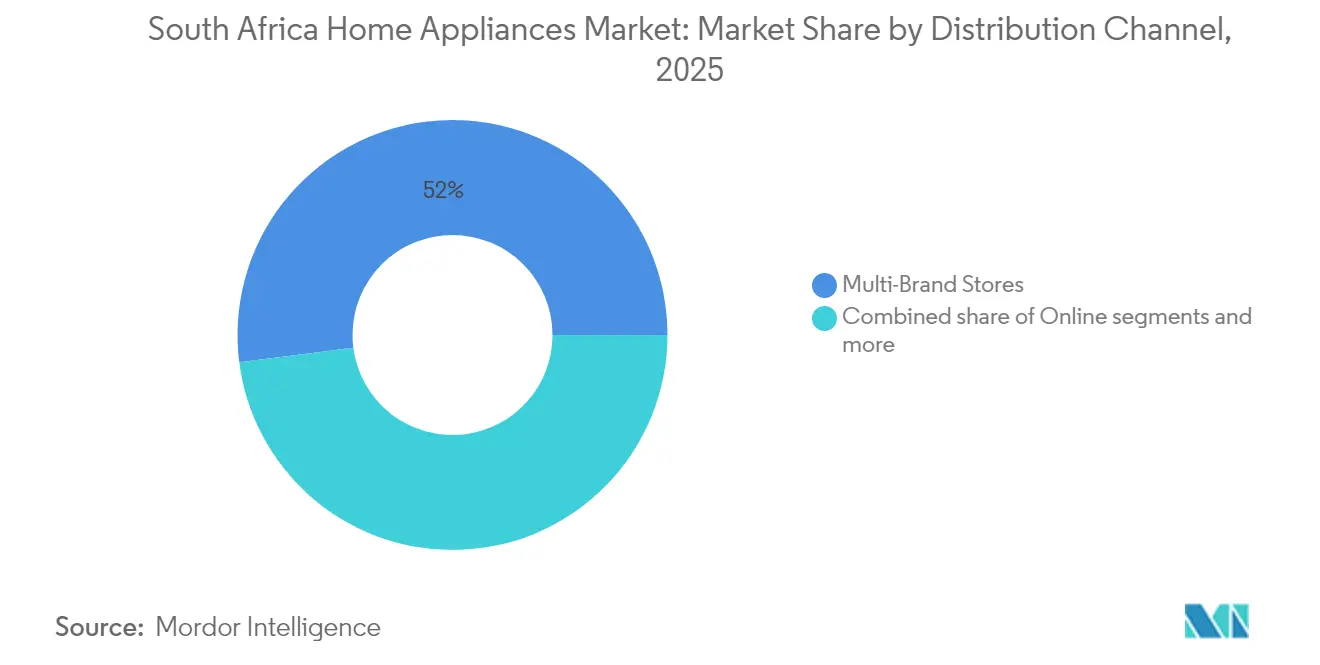
- By distribution channel, multi-brand stores captured 52.03% of the South Africa home appliances market share in 2025, whereas the South Africa home appliances market size for online channels is projected to expand fastest at a CAGR of 6.26% over 2026-2031.
- By geography, Gauteng led with 31.86% of the South Africa home appliances market share in 2025, while the South Africa home appliances market size in KwaZulu-Natal is anticipated to grow at the highest CAGR of 5.74% between 2026 and 2031.
Note: Market size and forecast figures in this report are generated using Mordor Intelligence’s proprietary estimation framework, updated with the latest available data and insights as of 2026.
Market Trends and Insights
Drivers Impact Analysis of South Africa Home Appliances Market*
| Driver | (~) % Impact on CAGR Forecast | Geographic Relevance | Impact Timeline |
|---|---|---|---|
| Rising middle-class disposable income & urbanisation | +1.2% | Gauteng, Western Cape, KwaZulu-Natal | Medium term (2-4 years) |
| Energy-efficiency regulations & rebate programmes | +0.8% | National, with early gains in Western Cape, Gauteng | Long term (≥ 4 years) |
| Replacement demand from ageing & load-shedding-damaged stock | +1.5% | National, concentrated in urban areas | Short term (≤ 2 years) |
| Expansion of e-commerce & omnichannel retail | +0.7% | Urban centers, spill-over to secondary cities | Medium term (2-4 years) |
| Surge in solar-powered & battery-integrated appliances | +0.9% | Western Cape, Gauteng, Free State | Medium term (2-4 years) |
| Township micro-finance schemes enabling appliance purchases | +0.4% | Gauteng townships, KwaZulu-Natal, Eastern Cape | Long term (≥ 4 years) |
| Source: Mordor Intelligence | |||
Rising Middle-Class Disposable Income & Urbanization
Urban migration into Johannesburg, Pretoria, Cape Town, and Durban is enlarging the addressable consumer base for durable goods. New homeowners routinely prioritize refrigeration and laundry equipment, while mid-income upgrades toward larger-capacity or smart-enabled models boost average selling prices. Retail chains have broadened consumer-finance programs, offering up to 36-month instalments that permit buyers to trade up without heavy upfront cash outlay[2]. This financing, coupled with stable formal-sector employment in key provinces, underpins sustained demand even when overall GDP growth lags. The demographic bulge of younger, tech-savvy consumers further accelerates the uptake of app-controlled appliances that mesh with lifestyle aspirations. Manufacturers position energy-saving attributes as cost-containment tools, resonating with price-sensitive households facing rising power tariffs. Consequently, the driver is expected to contribute a net positive 1.2 percentage points to forecast CAGR through 2030.
Energy-Efficiency Regulations & Rebate Programs
South Africa enforces Minimum Energy Performance Standards that bar sub-optimal washers, refrigerators, and air-conditioners from entering the formal channel. Retailers must therefore stock only appliances rated Class A or better, forcing a technology refresh that lifts average unit prices. Complementary fiscal incentives—such as the 25% solar tax credit for households and 125% accelerated depreciation for businesses—encourage pairing of efficient appliances with rooftop photovoltaic systems. Compliance audits by the South African Bureau of Standards push importers toward local testing and, in turn, stimulate domestic component sourcing. Provincial initiatives in the Western Cape and Gauteng further sweeten rebates for low-consumption units, catalyzing faster turnover of the installed base. Rising Eskom tariffs amplify the cost-saving narrative, making the regulatory driver a structural tailwind that adds roughly 0.8 percentage points to long-term CAGR.
Replacement Demand from Ageing & Load-Shedding-Damaged Stock
Frequent voltage dips and sudden outages degrade compressors, electronic control boards, and sealed-system components, shortening appliance life cycles well below global norms. Insurance claims rarely cover repeated power-surge damage, pushing households to self-fund replacements every five to seven years rather than the historical ten-year window. Vendors offering inverter compressors, surge-protected power supplies, and lithium-ion battery modules gain share because they lessen downtime during rolling blackouts. Parallel growth in residential energy-storage capacity—in facilities such as Freedom Won’s recently expanded assembly plant—ensures ample demand for appliances optimized for DC-AC inverters. The resulting accelerated swap-out cycle injects an additional 1.5 percentage points into short-term market growth, cushioning revenue against macro downturns.
Expansion of E-Commerce & Omnichannel Retail
Mobile-first consumers increasingly finalize big-ticket purchases online after showroom research, a trend aided by nationwide courier networks that promise three-to-five-day delivery even to secondary towns. Leading physical retailers have launched click-and-collect programs that marry store footprints with digital catalogs, mitigating last-mile logistics costs. Payment-service upgrades, such as instant EFT and buy-now-pay-later wallets, widen affordability for first-time buyers. Online-only entrants frequently bundle installation or old-appliance haul-away to overcome customer hesitancy around complex goods. Transparent pricing and aggregated customer reviews erode legacy brand moats, compelling incumbents to sharpen loyalty schemes. The omnichannel surge is expected to lift overall market CAGR by 0.7 percentage points during the forecast window.
Restraints Impact Analysis of South Africa Home Appliances Market*
| Restraint | (~) % Impact on CAGR Forecast | Geographic Relevance | Impact Timeline |
|---|---|---|---|
| High unemployment & weak consumer spending power | -1.8% | National, concentrated in rural areas and townships | Short term (≤ 2 years) |
| Rand volatility inflating import costs | -0.9% | National, affecting all import-dependent segments | Medium term (2-4 years) |
| Chronic load-shedding delaying big-ticket purchases | -0.7% | National, urban areas most affected | Short term (≤ 2 years) |
| Grey-market cross-border imports eroding formal sales | -0.5% | Border provinces, informal retail channels | Medium term (2-4 years) |
| Source: Mordor Intelligence | |||
High Unemployment & Weak Consumer Spending Power
National joblessness near 32% constrains discretionary budgets, particularly in rural districts and informal settlements where under-employment is pervasive. Households give precedence to urgent necessities such as refrigeration over aspirational devices like dishwashers, limiting category breadth. Inflation in food, fuel and transport absorbs wallet share, delaying non-essential upgrades even when credit is available. Township economies, though estimated at ZAR 300 billion annually, remain under-served by formal retailers due to credit-risk concerns. Micro-lending initiatives often carry double-digit interest rates, discouraging uptake among cash-constrained consumers. Consequently, the spending-power drag subtracts an estimated 1.8 percentage points from near-term growth.
Rand Volatility Inflating Import Costs
More than half of the finished units or critical subsystems originate from East Asian factories denominated in USD or CNY. Each episode of rand depreciation forces immediate wholesale price adjustments, raising retail tags and prompting buyers to postpone purchases in anticipation of currency rebounds. Hedging instruments partly shield large importers, yet smaller distributors struggle to absorb swings, squeezing margins and marketing budgets. Grey-channel traders exploit currency gaps by moving parallel-import stock through border provinces, undermining authorized dealer pricing and warranty perceptions. Local assembly efforts—exemplified by Hisense’s Atlantis plant—soften but do not eliminate component-cost exposure because compressors, motors, and chips are still sourced offshore. The net effect trims the forecast CAGR by roughly 0.9 percentage points.
*Our forecasts treat driver/restraint impacts as directional, not additive. The impact forecasts reflect baseline growth, mix effects, and variable interactions.
South Africa Home Appliances Market Segment Analysis
By Product:
Essential Cooling Dominates, Small-Appliance Uptake ClimbsRefrigerators retained 27.08% of South Africa's home appliances market share in 2025, highlighting their non-discretionary role in food security, especially amid erratic power supply. Load-shedding has elevated inverter-compressor fridges, which draw 40% less power when switched to battery back-up, reinforcing their replacement appeal. The South Africa home appliances market size for refrigeration equipment is projected to expand in tandem with cold-chain urban grocery retailing, which raises consumer expectations for fresh-food storage longevity. Air fryers headline the small-appliance growth chart with a 5.84% CAGR because they cut cooking times and electricity use versus conventional ovens. Manufacturers promote dual-zone baskets and integrated recipe apps, encouraging second-time upgrades despite the category’s relative infancy. Parallel growth is visible in countertop induction stoves and programmable pressure cookers, as urban renters favor compact solutions compatible with limited power budgets.
Second-tier categories such as dishwashers, tumble dryers, and air conditioners show mixed fortunes. Dishwashers lag because plumbing retrofits are costly in older housing stock, yet premium developers in Gauteng’s northern suburbs are pre-fitting kitchens with cavity space and water lines, seeding future demand. Tumble-dryer sales rise during winter months in KwaZulu-Natal and Western Cape coastal zones where humidity prolongs drying times, but off-peak electricity-tariff programs partly mitigate operating-cost concerns. Split-unit air-conditioners gain traction in hotter northern provinces, though sales remain seasonal and heavily tied to disposable income elasticity. Ovens, particularly electric convection models, experience incremental demand from baking entrepreneurs operating home-based micro-bakeries, a trend catalyzed by pandemic-era side hustles.

By Distribution Channel:
Multibrand Chains Hold Volume While Digital Gathers PaceMultibrand retailers accounted for 52.03% of 2025 value, leveraging portfolio breadth, in-store credit desks and warehouse-level bargain events to pull foot traffic. Store assistants provide live demos and financing paperwork, anchoring loyalty among older shoppers less comfortable with online carts. The South Africa home appliances market size realized through physical multibrand outlets remains buoyant because installation services and immediate product handover reduce perceived risk for high-value goods. Nevertheless, online platforms are climbing at a 6.26% CAGR, capturing digitally fluent millennials who prioritize price comparison and doorstep delivery.
Exclusive brand stores cater to premium buyers seeking curated in-store experiences: signature kitchens, coffee bars and live chef demonstrations create halo effects that justify higher margins. Yet expansion of these monobrand boutiques is cautious because shopping-center rents escalate faster than appliance margins. Direct-to-consumer dropship arrangements from overseas factories appeal to niche importers but face customs-duty unpredictability. Informal channels—street vendors or cross-border traders—continue to offload low-spec or refurbished appliances at deep discounts, posing compliance challenges for regulators.
Geography Analysis
Gauteng contributed 31.86% of 2025 revenues, anchored by Johannesburg-Pretoria’s dense middle-income suburbs, sprawling shopping centers and proximity to logistics hubs that compress last-mile costs for bulky items. The province’s higher per-capita electricity consumption intensifies interest in inverter-ready refrigerators and lithium-battery back-up packages, making energy efficiency a decisive purchase criterion. Premium real-estate developments adopt smart-home wiring standards, paving the way for Wi-Fi-enabled ovens and washers connected through manufacturer cloud dashboards. Retailer clustering along the N1 and N3 transport corridors eases same-day delivery promises, reinforcing consumer expectations for rapid fulfilment.
KwaZulu-Natal is poised for the fastest provincial growth at a 5.74% CAGR thanks to Durban’s port-centric industrial revival and infrastructure upgrades along the N2 north-south artery. Importers benefit from direct container landings at the Port of Durban, shaving transit costs that can otherwise add 4%-6% to appliance landed prices. Secondary hubs such as Pietermaritzburg, Newcastle and Richards Bay witness retail square-meter expansion as property developers target rising urbanization. The coastal climate heightens demand for dehumidifying appliances, while a thriving hospitality segment orders commercial-grade refrigerators and dishwashers for guesthouses along the Dolphin Coast. Township micro-finance pilots in Umlazi and KwaMashu demonstrate proof of concept for extending structured credit into informal settlements, signaling untapped volume upside if replicated across other wards.
Western Cape sustains a sizable share, undergirded by Cape Town’s diversified economy, technology start-ups and strong municipal support for rooftop solar installations. Energy-conscious households actively seek appliances bearing the municipal GreenBuilding Council of South Africa endorsement, reinforcing brand messaging around low kilowatt-hour consumption. Coastal weather swings drive interest in heat-pump tumble dryers that operate efficiently in damp winter months. Tourism rebound pushes holiday-rental hosts to furnish properties with mid-to-high-end microwaves, bar fridges and smart TVs, adding seasonal demand spikes. Yet property-price inflation pressures disposable income, prompting middle-class consumers to stretch repayment horizons on new appliance finance contracts.
Regulatory Landscape
South Africa regulates household appliances through the National Regulator for Compulsory Specifications (NRCS) Electro-technical business unit, which enforces mandatory compliance via Letters of Authority (LoA) before regulated models can be placed on the market. Key compulsory specifications include VC 8055 for electrical safety (aligned to the SANS 60335 series) and VC 9008 for energy efficiency and labeling across major categories such as refrigerators, freezers, dishwashers, washing machines, and air conditioners, making testing and documentation readiness a gating factor for importers and local assemblers.
Trade remedies and import controls also shape category economics. Definitive anti-dumping duties on fully automatic top-load washing machines from China and Thailand took effect on 23 April 2026, shifting landed-cost benchmarks and influencing sourcing and pricing strategies in laundry appliances. ITAC import-control rules generally exempt new goods in the formal channel from permits, while second-hand or used appliance imports face stricter controls, reinforcing the compliance advantage of authorized, NRCS-cleared product flows versus informal and grey-market supply.
Value Chain Analysis
The value chain runs from (i) component and finished-goods sourcing (with meaningful exposure to offshore compressors, motors, and electronics), to (ii) local manufacturing and assembly of selected lines, (iii) conformity assessment and market-entry approvals (NRCS LoA tied to SANS/VC requirements), and (iv) distribution through multi-brand chains, brand outlets, and e-commerce backed by national fulfillment plus installation and after-sales networks. Local production anchors include Defy manufacturing operations in KwaZulu-Natal (Jacobs, Durban and Ezakheni, Ladysmith), Hisense manufacturing at Atlantis, and KIC manufacturing in Isithebe, which helps shorten lead times for high-volume categories even as imported subsystems remain part of the supply base.
Policy and industry coordination influence localization economics and supplier development. A key value-chain lever is customs rebate and tariff administration for inputs: on 02 September 2025, ITAC, SARS, and Defy resolved to proceed with requested amendments under Schedule 3 of the Customs and Excise Act, 1964, related to rebate structures for cooking and cooling appliance components. This directly affects the cost base for local assembly versus importing finished units. Industry-government platforms such as the dtic-convened White Goods Manufacturers Forum, alongside sector bodies including EDMASA and SAEEC initiatives, support supplier development and export-readiness workstreams that can expand the domestic parts ecosystem over the study period.
Competitive Landscape
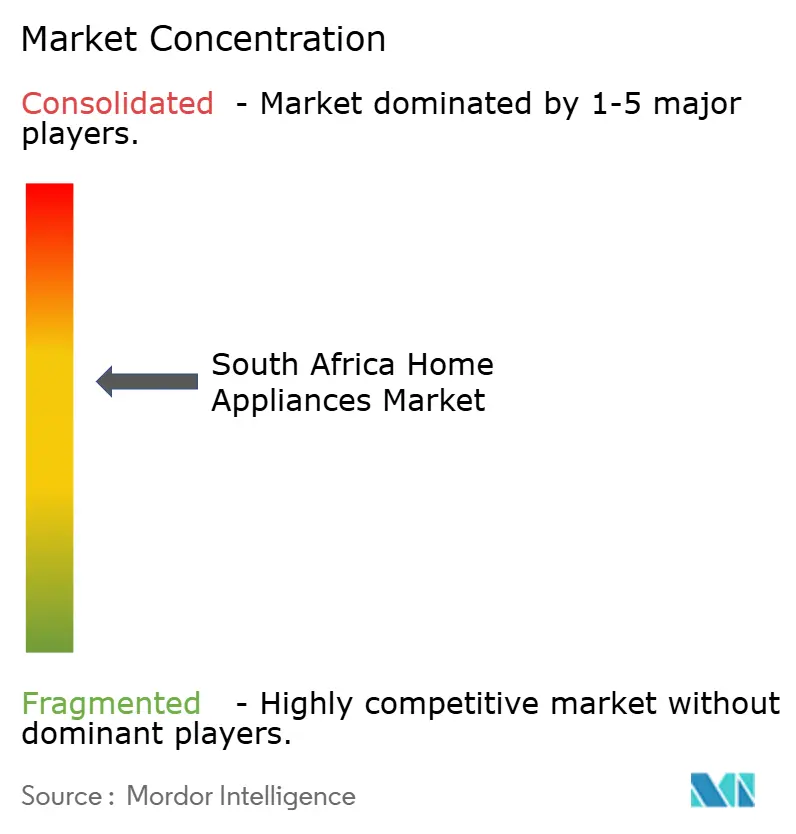
The market shows moderate concentration, with the five largest vendors collectively holding a significant portion of total turnover. Their nationwide service networks reinforce this position, substantial advertising spend, and cost efficiencies from local assembly. Defy leads the market, leveraging its production facilities in KwaDukuza and Durban to supply refrigerators, chest freezers, and cooking ranges tailored to South Africa’s voltage fluctuations. Hisense expands its Atlantis site to furnish LED-lighting lines and automated foam-injection refrigerators, shortening lead times and mitigating currency exposure[4]. Samsung and LG court affluent buyers through smart-home ecosystems that integrate washing-machines, TVs and smartphones within a single mobile app, reinforcing brand stickiness. Whirlpool positions on quiet-drive motors and antimicrobial gasket linings but faces channel-stuffing risks if currency shocks raise inventory-carrying costs.
Local challengers concentrate on price-value propositions in the mid-range and small-appliance space; brands such as Russell Hobbs exploit licensing models to flood shelves with kettles, toasters, and blenders sporting fashionable finishes at attainable prices. Import-only boutique labels capture design enthusiasts through direct online campaigns, though volumes remain niche. Service quality is a battlefield: vendors now advertise 48-hour repair pledges in metros and 72-hour commitments in secondary cities, differentiating against grey-import competitors lacking local parts. Supply-chain resilience strategies include dual-sourcing compressors and heating elements to shield against port congestion. Strategic partnerships with solar-panel installers and battery suppliers amplify cross-selling; for example, washing-machine bundles with 3 kWh lithium packs are marketed during load-shedding peaks.
Online marketplaces intensify price transparency, forcing manufacturers to implement unilateral minimum advertised price policies to steady margins. Brick-and-mortar retailers retaliate with experiential showrooms where customers test decibel levels, steam functions and app controls in real time. Advertising budgets tilt toward social-media influencers who demonstrate power-draw measurements under real-world outage simulations, validating manufacturer efficiency claims. Sustainability credentials gain prominence: brands publicize ISO 14001-certified factories and refrigerants with lower global-warming potential to align with evolving consumer values. Overall, technology refresh cycles, regulatory pressure and shifting retail models sustain dynamic yet disciplined competition within the South Africa home appliances market.
South Africa Home Appliances Industry Leaders
-
Defy (Arçelik)
-
Whirlpool Corp. (incl. KIC)
-
Hisense
-
Samsung Electronics
-
LG Electronics
- *Disclaimer: Major Players sorted in no particular order
South Africa Home Appliances Market Companies Covered in this Report
- Defy (Arçelik)
- Whirlpool Corporation
- Samsung Electronics Co. Ltd
- LG Electronics Inc.
- Hisense Co. Ltd
- Midea Group
- BSH Hausgeräte GmbH (Bosch)
- Electrolux AB
- SMEG S.p.A.
- Panasonic Corporation
- Haier Group Corporation
- Russell Hobbs (Spectrum Brands)
- Sunbeam Products Inc.
- Philips Domestic Appliances (Versuni)
- Kenwood Ltd (Delonghi Group)
- De'Longhi S.p.A.
- Xiaomi Corporation
- TCL Technology
- KIC (Pty) Ltd
- Salton Appliances (Amalgamated Appliances)
Market Opportunities and Future Outlook
Energy-efficiency compliance and label evolution create product and service whitespace in major categories, especially refrigeration and laundry. SABS approval of SANS 62552-3:2024 (March 2024) for household refrigerating appliances tightens the technical backbone for measured energy consumption and volume performance, while the NRCS ran an amendment process for VC 9008 with a public comment deadline closing on 01 June 2024. This standards and compulsory-specification pathway raises the premium on models engineered to meet updated test methods and labeling rules, creating room for manufacturers and importers to shorten redesign-to-approval cycles and for local test, certification, and pre-compliance services to reduce LoA bottlenecks.
Load-shedding-driven household behavior also supports differentiated offerings that combine efficiency, surge tolerance, and compatibility with inverters or solar-battery systems, aligning with retailer observations that inverter-compatible products move faster. Evidence of adjacent ecosystem capacity build-out includes Freedom Won completing a 48,000 m2 expansion of its Edenvale battery assembly complex in January 2025 (150 MWh monthly capacity), which increases the availability of residential storage to pair with appliances. On the access side, payments and merchant acceptance continue to broaden appliance affordability and conversion across formal retail and emerging township networks; for example, Lesaka Technologies closed the acquisition of Adumo in August 2024, raising its merchant-services footprint to 119,000 outlets, which supports wider digital payment acceptance for appliance purchases.
Recent Industry Developments in South Africa Home Appliances Market
- July 2026: KIC South Africa (Whirlpool) launched the KFL 812 GR 8 kg front-loader washing machine with Steam+ and an A+++ energy rating. The introduction adds a fresh, efficiency-led option in laundry appliances at a time when electricity costs and performance-per-kWh are key purchase filters. It also reinforces the role of established local brands in using new feature sets to defend share against imported alternatives.
- July 2025: Defy (Arcelik) announced a pledge to invest an additional R500 million in its South African operations over the next five years. The commitment supports ongoing localization and capacity positioning around core categories such as cooling and cooking, where lead times and serviceability matter for replacement-driven demand. The investment signal also strengthens supplier and channel confidence amid currency volatility affecting imported finished goods and components.
- May 2024: Hisense committed to investing R1 billion in its Atlantis plant over five years. The plan underlines continued expansion of domestic manufacturing footprint for major appliances, supporting shorter replenishment cycles and improved responsiveness to local demand patterns such as inverter-ready refrigeration. It also aligns with broader efforts to deepen local value add and reduce exposure to import logistics and exchange-rate swings.
South Africa Home Appliances Market Report Scope and Research Methodology
Market Definition and Coverage
This market tracks the value of home appliances sold in South Africa, covering large and small household appliances across offline and online channels, measured in revenue terms in USD for the study period.
Scope exclusions: We exclude non-home utility equipment and products outside household appliance use, and we do not count service-only revenue like repairs or extended warranties.
Segments Covered in This Report
- By Product
- Major Home Appliances
- Refrigerators
- Freezers
- Washing Machines
- Dishwashers
- Ovens (Incl. Combi & Microwave)
- Air Conditioners
- Other Major Home Appliances
- Small Home Appliances
- Coffee Makers
- Food Processors
- Grills & Roasters
- Electric Kettles
- Juicers & Blenders
- Air Fryers
- Vacuum Cleaners
- Electric Rice Cookers
- Toasters
- Countertop Ovens
- Other Small Home Appliances
- Major Home Appliances
- By Distribution Channel
- Multi-Brand Stores
- Exclusive Brand Outlets
- Online
- Other Distribution Channels
- By Geography
- Gauteng
- Western Cape
- KwaZulu-Natal
- Eastern Cape
- Free State
- Limpopo
- Mpumalanga
- North West
- Northern Cape
Data Sources, Market Sizing, and Validation
Desk Research
Desk research was used to build the starting structure of the market and to anchor the model to real-world demand signals in South Africa. We relied on public macro and consumer indicators that explain appliance replacement and first-time purchases, followed by import and retail signals that show how supply is flowing into the country.
Sources reviewed included, as examples, Statistics South Africa releases on households, income, and CPI, the South African Reserve Bank for macro trends and currency context, South African Revenue Service trade statistics for import patterns, and standards and energy-efficiency references from South African Bureau of Standards. We also cross-checked listed-company filings and investor presentations, retailer and distributor announcements, and a paid subscription used for company financials and news context, plus a paid patent database to understand feature direction (such as inverter-ready designs). The desk sources cited here are illustrative, and many other public and paid references were also used for collection, cross-checking, and clarification.
Primary Interviews and Surveys
Primary work was used to pressure-test the model assumptions that are hard to verify from public data alone, especially around pricing, channel mix shifts, and category-level demand swings. We spoke with a spread of manufacturers, importers, distributors, large-format retailers, and specialist dealers, and we also covered service ecosystem viewpoints that often reveal replacement cycles and product reliability trends. For a South Africa-only scope, respondents were selected to reflect different operating footprints and customer profiles across the country.
Distribution of primary research fieldwork respondents
| Company type | Respondent position |
|---|---|
| Top tier: 30% | CXOs: 17% |
| Mid tier: 48% | Functional/Unit leaders: 27% |
| Smaller Players: 22% | Managers: 56% |
Market-Sizing & Forecasting
The market was sized using a top-down build that starts from South Africa demand and trade-linked supply signals, and then it is shaped into appliance revenue by applying category shares and channel splits. In practice, we reconstruct the demand pool from indicators like household formation and electrification, replacement behavior, and import intensity for key appliance groups, which is then converted into value using observed price bands.
To keep the total realistic, selective bottom-up checks were used, such as sampling typical retail price points by category, validating online versus store-led sales mix, and sanity-checking the scale of revenues implied by major importers and distributors that are visible through public filings and interviews. Key inputs used in the model include inflation-adjusted price movement for durable goods, exchange-rate driven landed-cost shifts, appliance penetration and replacement timelines, online share changes, and retailer promotion seasonality that affects unit volumes. Forecasting was done using scenario analysis supported by short-run smoothing on the strongest drivers, where expert feedback was used to confirm which variables were likely to move together over the next few years. When bottom-up visibility was weaker for small appliances sold through fragmented outlets, we handled the gap by using category-level price and volume ranges that were validated through channel checks.
Data Validation & Update Cycle
Outputs were validated through triangulation across independent signals, and then checked for internal consistency across categories and channels. If an assumption created an unusual jump in market value, it was flagged and reworked, followed by a second-pass review so the driver and the result still matched.
Before sign-off, the model was compared against external indicators like trade direction, consumer spending pressure, and pricing movement to make sure the totals remained plausible. Reports are refreshed annually, and interim updates are triggered when there are material events such as sharp currency moves, import disruptions, or meaningful channel shifts. Right before delivery, an analyst performs a fresh pass on key inputs so clients receive the most current view available.
Mordor Intelligence's South Africa Home Appliances Market Estimate Compared With Other Published Estimates
Published values for South Africa home appliances can differ because the boundaries around what counts as an appliance, the year used for currency conversion, and the treatment of price inflation are not consistent across sources. Differences also appear when some studies lean more on modeled consumer spend, while others tie totals more closely to trade and channel evidence.
Import direction from customs statistics, retailer channel mix checks, and price-band validation are the evidence points that keep Mordor Intelligence's estimate tied to appliance revenue actually flowing through South Africa, instead of broader household electrical spend. Gaps often come from including adjacent categories like air conditioners and space heaters, using an older base year with higher nominal values, or applying a single aggressive price growth factor without validating it against observed shelf-price movement.
Benchmark comparison
| Source | Market Size | Gaps in Research Methodology |
|---|---|---|
| Mordor Intelligence | USD 3.67 B (2026) | |
| Global Consultancy A | USD 5.16 B (2025) | Uses a broader household appliances scope and a different base year, which can pull in more categories and lift nominal totals through currency timing and inflation treatment. |
| Industry Publisher B | USD 12.54 B (2021) | Anchors sizing to an older base year and includes adjacent appliance groups (such as cooling and heating), and the definition can overlap with wider household electrical equipment. |
The spread across the three values is mainly explained by scope boundaries, base-year choice, and how prices are projected forward in a high-inflation, currency-sensitive market. By keeping the model traceable to observable trade and channel signals, and then applying repeatable pricing and mix steps, the estimate stays practical to reproduce and easier to reconcile when inputs change.
Key Questions Answered in the Report
What is the projected value of South Africa’s home appliances space by 2031?
The segment is expected to reach USD 4.77 billion by 2031, up from USD 3.67 billion in 2026.
Which product type currently commands the largest revenue share?
Refrigerators lead with 27.08% of 2025 value because they are indispensable for food preservation.
Why are air fryers expanding faster than other categories?
They cook quickly, use less electricity and align with healthier eating trends, driving a 5.84% CAGR through 2031.
How significant is e-commerce in appliance sales?
Online channels are growing at a 6.26% CAGR as nationwide fulfilment and flexible payments entice digital-native buyers.
Which province offers the quickest growth outlook?
KwaZulu-Natal is forecast to post a 5.74% CAGR thanks to industrial expansion and improved retail penetration.