
India Data Center Cooling Market Size and Share
India Data Center Cooling Market Analysis by Mordor Intelligence
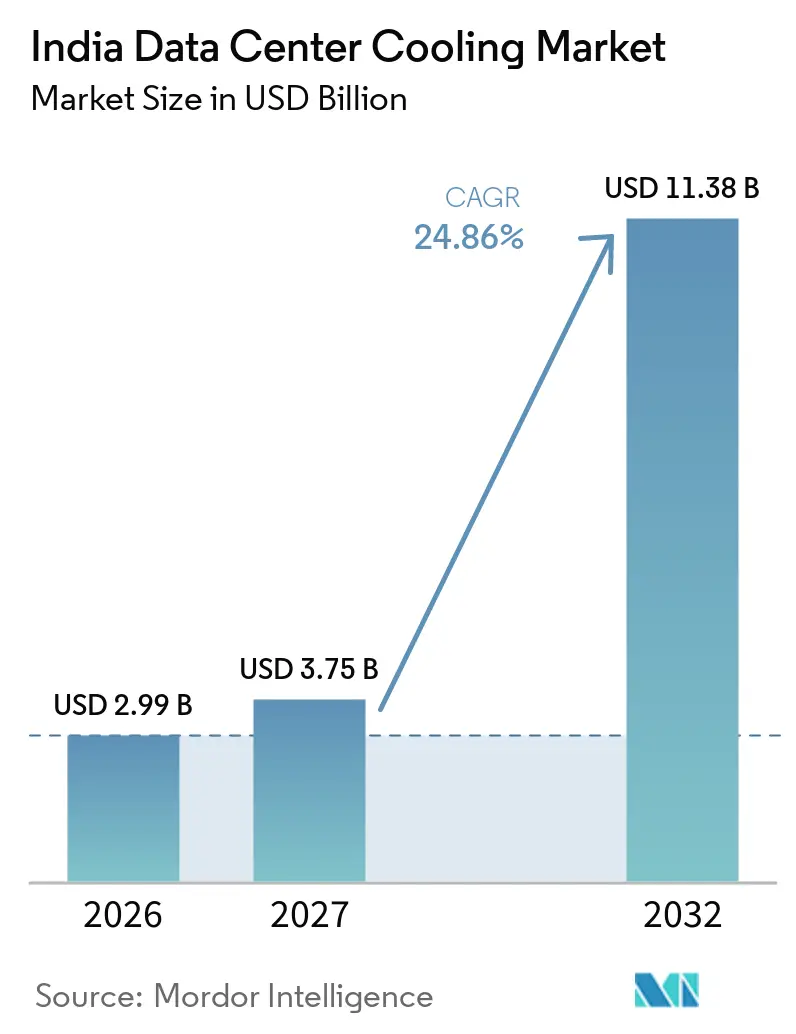
The India data center cooling market size is expected to increase from USD 2.99 billion in 2026 to USD 3.75 billion in 2027 and reach USD 11.38 billion by 2032, growing at a CAGR of 24.86% over 2027-2032.
In India, digital-service activity and high-density computing create both new-facility demand and thermal-upgrade opportunities for cooling providers. Air-based systems connect hall and plant equipment, while liquid cooling can extend the vendor’s scope into computing-side thermal networks. Upfront investment and power economics can make deployment timing as commercially significant as the technology chosen. Local manufacturing and service reach support delivery proposals because an installed plant must be commissioned and serviced on site. Rising rack densities sustain the case for liquid cooling in India, while capital and power constraints temper the pace of adoption without reversing the growth outlook.
Key Report Takeaways
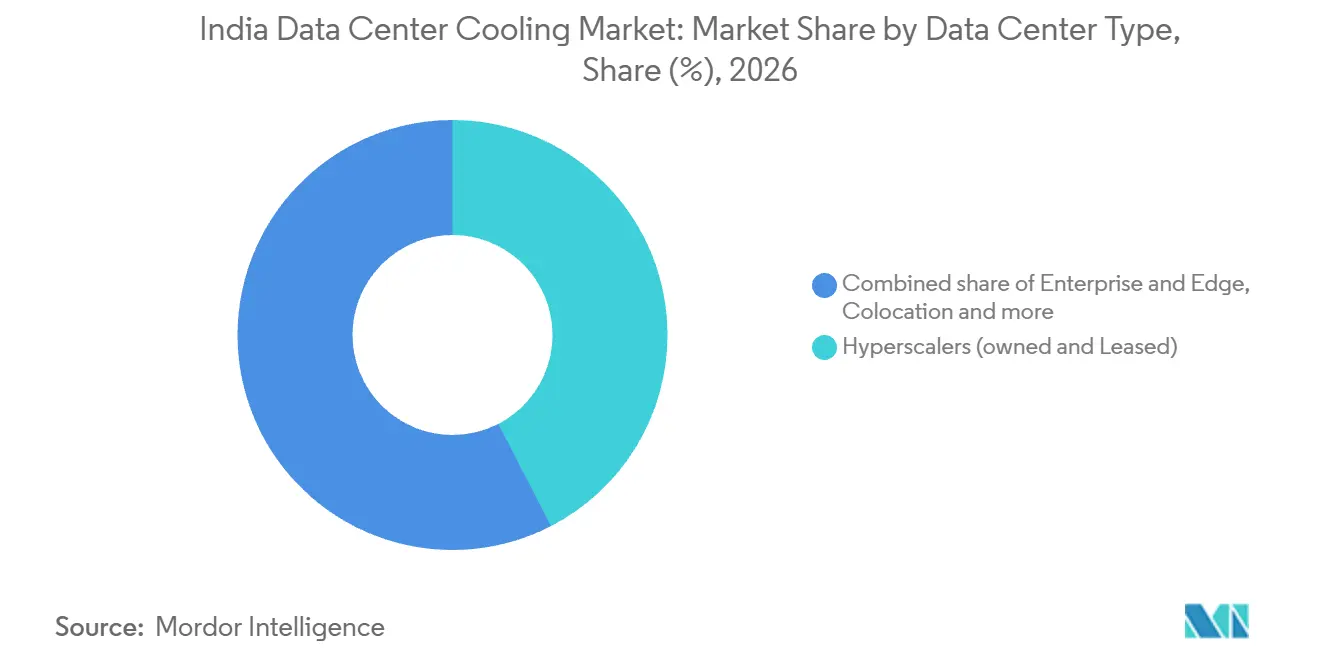
- By data center type, hyperscalers (owned and leased) held a 42.42% India data center cooling market share in 2026 and are forecast to grow fastest at a 25.6% CAGR over 2027-2032.
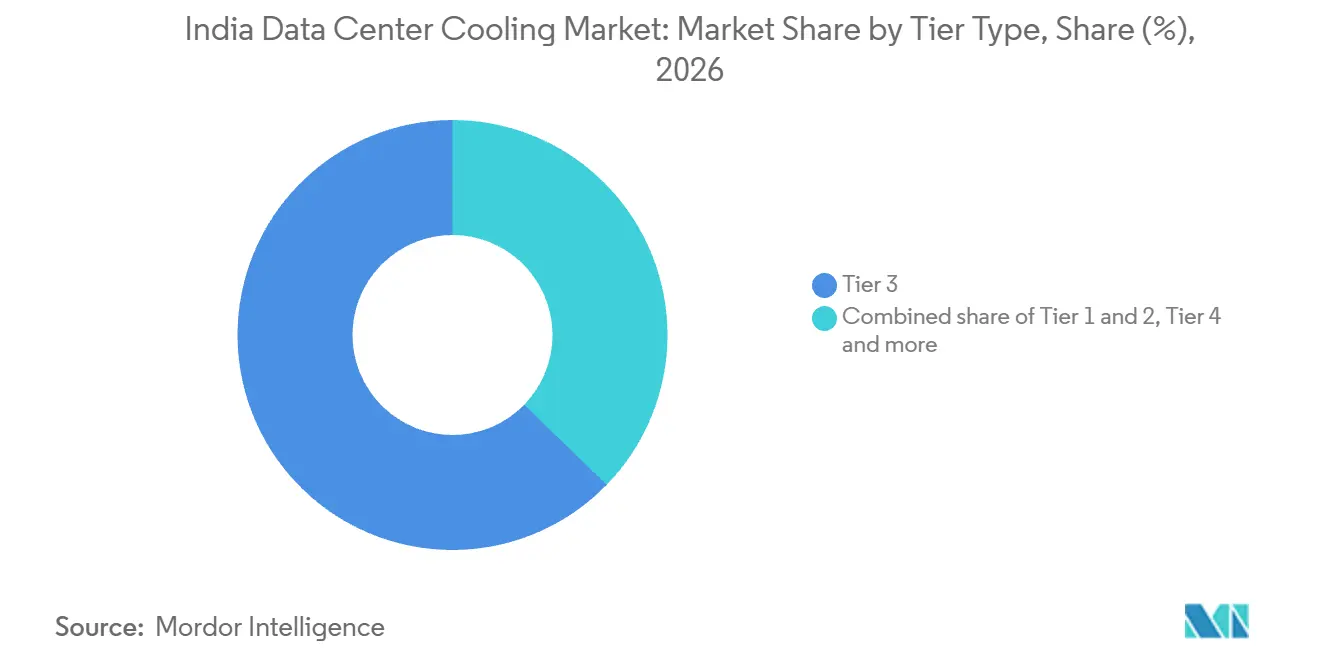
- Across tier types, Tier 3 held a 62.73% share of the India data center cooling market size in 2026, while Tier 4 is forecast to grow fastest at a 26.35% CAGR over 2027-2032.
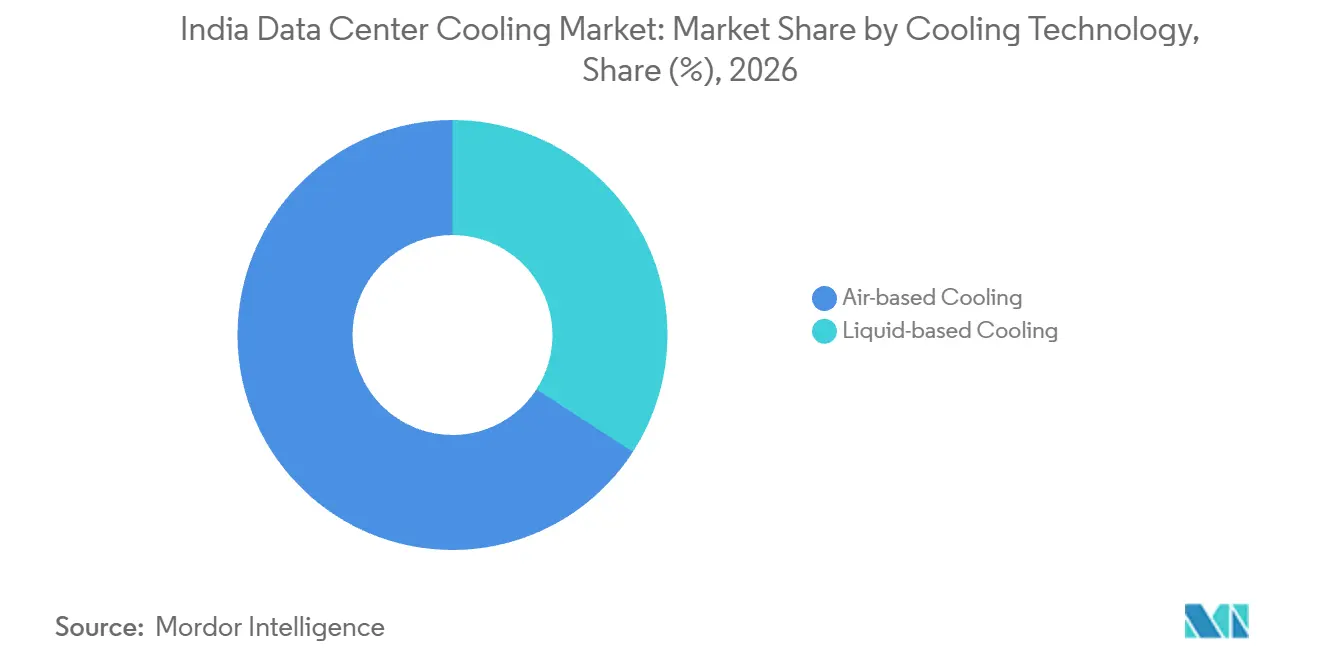
- Air-based cooling led the technology mix with a 65.85% share in 2026, while liquid-based cooling is forecast to grow fastest at a 26.7% CAGR over 2027-2032.
- Among components, equipment accounted for 80.44% of Indian data-center cooling spending in 2026, with services forecast to grow fastest at a 25.6% CAGR over 2027-2032.
- Geographically, Chennai stands out as the fastest-growing metro, where phased AI-ready campus development can create cooling-equipment and operating-support opportunities.
Note: Market numbers in this report are based on Mordor Intelligence's proprietary estimation framework, which combines nine months of actuals with Q4 projections for base year 2026.
Market Trends and Insights
Drivers Impact Analysis of India Data Center Cooling Market*
| Driver | (~) % Impact on CAGR Forecast | Geographic Relevance | Impact Timeline |
|---|---|---|---|
| Hyperscale cloud build-outs accelerating capacity additions | +12% | Visakhapatnam, Hyderabad and Mumbai | Medium term (2-4 years) |
| Government-backed digital initiatives (Digital India, Aadhaar, ONDC) expanding data generation | +7% | Nationwide | Long term (≥ 4 years) |
| Rising rack power densities (greater than 15 kW) heightening cooling intensity requirements | +9% | Nationwide | Short term (≤ 2 years) |
| Edge data-center roll-outs in tier-2/3 cities creating niche, high-ambient cooling demand | +4% | Chandigarh and Lucknow | Medium term (2-4 years) |
| Carbon-credit market development / ESG reporting requirements prompting evaluation of liquid and free-air cooling | +2% | Chennai and Rabale | Medium term (2-4 years) |
| Rapid decrease in on-site renewable power (solar-plus-storage) LCOE enabling energy-hungry cooling retrofits | +1% | Nationwide | Long term (≥ 4 years) |
| Source: Mordor Intelligence | |||
Hyperscale cloud build-outs accelerating capacity additions
Hyperscale construction creates cooling demand through the coordinated delivery of multiple facilities, extending the opportunity beyond individual rack additions. Google broke ground on its Visakhapatnam AI hub on April 28, 2026, for a project comprising 3 data center campuses. AdaniConneX and Nxtra by Airtel were identified to lead construction of the data center buildings and connecting infrastructure. A development at that scale can require suppliers to align thermal installations with the delivery of distinct buildings and shared infrastructure. For providers in the India data center cooling market, the resulting commercial opening combines equipment supply with the ability to support staged campus delivery across several construction interfaces.
Government-backed digital initiatives (Digital India, Aadhaar, ONDC) expanding data generation
Government-backed digital services support substantial transaction activity in India. The Unique Identification Authority of India (UIDAI) recorded 2.31 billion Aadhaar authentication transactions in India in November 2025, up 8.47% from November 2024.[1] The Open Network for Digital Commerce (ONDC) reported that its network enabled 218 million transactions in India in FY2025-26. Rising authentication activity suggests expanding processing needs, which could increase the thermal load at facilities hosting these services. Where that growth is accommodated in operating halls, cooling upgrades and servicing offer a route to demand beyond equipment for new buildings.
Rising rack power densities (greater than 15 kW) heightening cooling intensity requirements
Heat concentration makes rack density part of the cooling specification for dense computing installations. In 2026, the Ministry of Electronics and Information Technology (MeitY) reported that India’s data-center industry was deploying high-density racks for high-performance computing and AI workloads. Deloitte India’s May 2025 report said rising rack density intensifies cooling demand in Indian data centers and is driving adoption of liquid cooling and rear-door heat exchangers. These changes link the cooling proposition to the type of computation housed at each rack, reflecting India data center cooling market trends toward liquid cooling and rear-door heat exchangers. That creates a path for thermal upgrades within facilities as their computing configurations change. Because rising density favors liquid cooling and rear-door heat exchangers, upgrades in existing halls can require different equipment rather than additional air capacity.
Edge data-center roll-outs in tier-2/3 cities creating niche, high-ambient cooling demand
Regional edge facilities can create cooling demand through separate thermal installations in different cities. Sify operates AI Edge Data Centers in Chandigarh and Lucknow. In October 2026, CtrlS said it plans to establish more than 20 edge data centers across Tier 2 and Tier 3 cities in India over the coming years. If implemented, that rollout would spread cooling work across a wider network of installations. The commercial advantage would lie in reproducing commissioning and support across the network, so regional coverage could influence which suppliers can serve the complete program.
Restraints Impact Analysis of India Data Center Cooling Market*
| Restraint | (~) % Impact on CAGR Forecast | Geographic Relevance | Impact Timeline |
|---|---|---|---|
| Large upfront capex for advanced liquid and immersion systems | -4.5% | Nationwide | Short term (≤ 2 years) |
| Elevated power tariffs and intermittent grid reliability increasing OPEX volatility | -3.5% | Nationwide | Short term (≤ 2 years) |
| Shallow domestic supply-chain for specialized cold-plate / dielectric fluids | -1.4% | Nationwide | Medium term (2-4 years) |
| Water-use restrictions in drought-prone states limiting evaporative technologies | -0.7% | Data-center locations in Maharashtra | Short term (≤ 2 years) |
| Source: Mordor Intelligence | |||
Large upfront capex for advanced liquid and immersion systems
Operators adopting advanced liquid cooling face an installation funding decision that can be material even when the technology fits the intended workload. Sify Technologies’ executive director and group CFO said in 2026 that liquid cooling adds approximately USD 1.3 million per MW. Depending on the contract, Sify may incur the cost and add it to capacity charges, or the customer may invest in the system. India data center cooling market analysis must account for how the added investment is supported by the economics of the computing capacity that uses it, raising the commitment required before operations generate returns.
Elevated power tariffs and intermittent grid reliability increasing OPEX volatility
Power economics can limit the cooling load an operator can commercially sustain, even where demand for computing is strong. A 2026 report by the Council on Energy, Environment and Water and SYSTEMIQ found that electricity costs and reliability outweighed land costs, fiscal incentives and labor availability in stakeholders’ assessment of Indian data-center viability. Stakeholders identified grid evacuation and capacity limitations on renewable procurement in major data-center clusters, constraints also shared by other large electricity consumers. For cooling projects, this makes India data center cooling market growth dependent in part on affordable, dependable electricity arrangements.
*Our forecasts treat driver/restraint impacts as directional, not additive. The impact forecasts reflect baseline growth, mix effects, and variable interactions.
India Data Center Cooling Market Segment Analysis
By Data Center Type:
Hyperscale Projects and Colocation ChannelsHyperscalers (owned and leased) accounted for 42.42% of the India data center cooling market size in 2026 and are forecast to be the fastest-growing segment at a 25.6% CAGR over 2027-2032. On July 15, 2026, Amazon Web Services broke ground on a data center at Bharat Future City in Ranga Reddy District, Telangana. Construction of a hyperscale site places cooling within a dedicated infrastructure program, giving suppliers a project-level route to demand. The India data center cooling market overview highlights the opportunity for vendors to secure a defined thermal package within hyperscale programs, covering the relevant equipment and delivery responsibilities.
Colocation broadens the route to cooling demand by separating computing customers from the facility-service provider. Sify Infinit Spaces, a Sify Technologies subsidiary, focuses on colocation demand from hyperscalers, enterprises and neo-cloud prospects in India. That customer mix gives cooling providers a route to several computing buyer groups through the operator responsible for the facility, with the offer organized around its thermal installation. The commercial distinction is the facility relationship, which can connect a supplier to different workload categories without requiring a separate infrastructure sales channel for every category of computing customer.



By Tier Type:
Portfolio Scale and AI CommitmentsTier 3 represented a 62.73% India data center cooling market share in 2026. In July 2025, Software Technology Parks of India (STPI) reported 5 Tier III-compliant data centers across Bengaluru, Bhubaneswar, Chennai, Mohali and Vijayawada. STPI identified government, public-sector, institutional and industry organizations as intended clients for these centers. That buyer profile positions its portfolio to address institutional computing requirements alongside commercial workloads. For cooling suppliers, STPI’s intended institutional reach makes public-sector and industry hosting a separate potential source of facility demand from hyperscale construction.
Tier 4 is the fastest-growing segment, with a forecast CAGR of 26.35% over 2027-2032. On March 16, 2026, Gorilla Technology signed binding agreements with Yotta Data Services to deploy AI compute infrastructure at Yotta’s Uptime Tier IV NM1 center in Navi Mumbai. The agreements covered approximately 640 NVIDIA HGX B200 servers with more than 5,000 GPUs, with Yotta assigned implementation and operation. For cooling suppliers, this places a potential thermal requirement around committed computing equipment at an identified Tier 4 facility.

By Cooling Technology:
Rack Density Shapes Thermal ArchitectureAir-based cooling accounted for a 65.85% share of the India data center cooling market size in 2026. STT GDC India’s Chennai 7 center, operational since January 2026, uses air-cooled chillers paired with air-handling units across its data halls. The cooling design supports 4 kW per rack, providing a specified density basis for that installation. Within the largest segment, air-distribution units and the chiller plant form different parts of this thermal architecture, linking data-hall equipment with facility-scale heat removal. The 4 kW air-based design illustrates why lower-density halls can sustain air-cooling equipment demand even as denser computing shifts attention toward liquid cooling.
Liquid-based cooling is the fastest-growing segment, with a forecast CAGR of 26.7% over 2027-2032. On October 16, 2026, Vertiv completed a direct-to-chip high-density liquid-cooling deployment with CapitaLand India Trust at CLDC Mumbai 01 in Airoli, Navi Mumbai.[2] The system supports 30 MW of a hyperscale customer’s AI workloads. The project used a secondary fluid network, making liquid distribution part of the delivered cooling installation. That network delivery creates a commercial role at the interface between facility thermal infrastructure and computing equipment, allowing liquid-cooling vendors to compete on an integrated installation scope.
By Component:
Equipment Awards and Lifecycle ServicesEquipment accounted for 80.44% of the India data center cooling market share in 2026, making it the largest segment. In September 2026, Swegon was selected to supply cooling and air-treatment equipment for a major data-center project in India. The order illustrates how cooling demand can enter the supplier pipeline as a defined hardware package before it becomes a completed installation. Equipment revenue is consequently tied to executing the awarded supply scope within the wider data-center project. Converting that selection into accepted delivery is what turns commercial award activity into an installed equipment base around which future cooling support can be offered.
Services are the fastest-growing segment, with a forecast CAGR of 25.6% over 2027-2032. By October 16, 2026, Vertiv had completed installation and commissioning procedures, technology-loop balancing and Level 4 testing for direct-to-chip liquid cooling at CLDC Mumbai 01 in Airoli, Navi Mumbai. Installation and deployment bring cooling equipment into use, while maintenance and support address thermal conditions through its operating life. Consulting and training provide a separate scope for operators deciding how air-based or liquid-based equipment will be implemented and managed. Service providers can build contracts around commissioning and later operation, extending the revenue horizon beyond the equipment delivery itself.
Geography Analysis
Chennai Data Center Cooling Market
Chennai stands out as the fastest-growing metro, with phased data-center development providing a route to cooling demand. In February 2026, STT GDC India reported that the first 7.2 MW phase of its AI-ready Siruseri campus was operational, with the campus designed for 45 MW. Phased development can separate cooling support at delivered capacity from equipment opportunities associated with potential later build-out. Suppliers serving this campus model can align thermal packages with the capacity of each phase as it enters use. Maintaining the operating 7.2 MW phase could give a supplier a customer relationship from which to compete for expansion toward the campus’s 45 MW design.
Outside the Siruseri campus, the project channel differs by location, from financed campus development in Navi Mumbai to a regulated power arrangement at a Greater Noida data-center park. In June 2026, the International Finance Corporation (IFC) announced support for Sify Infinit Spaces to develop AI-ready centers in Navi Mumbai and Chennai with a combined capacity of 103 MW. In July 2026, the Uttar Pradesh Electricity Regulatory Commission approved NIDP Developers’ FY2026-27 tariff for its licensed distribution area at the Knowledge Park V data-center park in Greater Noida. These channels give vendors different project interfaces, linking cooling delivery to the financed development’s building program and to the power framework of a specific data-center park.
On April 8, 2026, Equinix opened MB3, its 4th International Business Exchange data center in Mumbai, with liquid-cooling capability for enterprise workloads across India. The retail facility was designed to support high-performance workloads and hybrid multicloud deployments. Its offering targeted enterprises across India, giving the Mumbai-hosted facility a geographically broader intended buyer base. For cooling providers, this separates the location of the thermal installation from the geography of the enterprise customer using it. A Mumbai cooling provider could serve nationally targeted enterprise demand through this installation without extending field-service coverage to each tenant’s location.
Regulatory Framework and Outlook
This comparison covers selected jurisdictions from the perspective of operators installing cooling systems, with the Uttar Pradesh case limited to the Greater Noida Data Centre Park. India requires prior environmental clearance when data centers form part of qualifying building or township projects. Coverage includes building projects above 20,000 square meters of built-up area and township projects covering at least 50 hectares or with at least 150,000 square meters of built-up area, or both. Energy-efficiency and efficient-water-use conditions attach to projects receiving clearance, making the framework relevant to cooling design.
Regulatory Table of India Data Center Cooling Market
| Decision factor | India | Uttar Pradesh |
|---|---|---|
| Primary authority | State Environment Impact Assessment Authorities | Uttar Pradesh Electricity Regulatory Commission for tariffs; Uttar Pradesh Power Transmission Corporation Limited for the transmission exemption |
| Key instruments or direction | Environmental Impact Assessment (EIA) Notification, 2006, Items 8(a) and 8(b); conditional project clearance | FY2026-27 NIDP tariff order; transmission provider’s June 13, 2025 exemption letter |
| Commercial effect | Prior clearance and energy/water conditions for qualifying construction projects | 50% transmission-charge exemption from April 2025 onward for the Greater Noida Data Centre Park |
| Current policy attractiveness | Medium | High |
| Future direction of policy attractiveness | No change | No change |
| Source: Mordor Intelligence | ||
India’s EIA Notification, 2006, Items 8(a) and 8(b), continues to link clearance and energy/water design duties to qualifying construction, supporting Medium and No change for operators installing cooling systems. Uttar Pradesh Power Transmission Corporation Limited (UPPTCL) granted NIDP Developers a 50% transmission-charge exemption on intra-state procurement from April 2025, reported for FY2026-27 and supporting High and near-term No change for the selected Greater Noida park. Uttar Pradesh’s 2026 policy repeals the amended 2021 policy but preserves admissible benefits for old-policy Letter of Comfort holders who partly or fully used incentives or concessions, subject to prevailing government orders. The park-specific outlook rests on the FY2026-27 tariff treatment, while continuation under the replacement policy depends on those legacy eligibility conditions.
Value Chain Stages
The cooling value chain compares how design, equipment supply and site integration create different supplier earnings and delivery risks. Trane Technologies plc undertakes cooling-system engineering, while Blue Star Ltd. supplies data-center chillers in India. Site integration brings together chillers, chilled-water piping, air-handling units and controls. This division makes responsibility for the finished thermal system commercially significant, because equipment supply alone does not resolve every installation interface.
Value Chain Analysis Table of India Data Center Cooling Market
| Primary activity | Key participants | Value capture | Bottleneck | Resilience response |
|---|---|---|---|---|
| Cooling design and system configuration | Cooling-system designers such as Trane Technologies plc | Engineering and configuration fees | Unresolved thermal and hydraulic specifications | Agree system operating conditions before equipment configuration |
| Equipment manufacture and supply | Cooling-equipment suppliers such as Blue Star Ltd. and STULZ India | Chiller and cooling-equipment sales | Configuration changes at the factory-to-site handoff | Confirm equipment and control interfaces before manufacture |
| Site installation and commissioning | Cooling installation contractors and cooling-system deployers such as Tech India Electrosolutions and Vertiv Co., respectively | Installation, integration and commissioning fees | Risk of incomplete piping and control integration | Test the integrated installation against agreed operating conditions |
| Source: Mordor Intelligence | ||||
Manufacturers capture equipment revenue, while designers and installers earn from converting separate components into a functioning thermal installation. Assigning responsibility at each handoff can reduce the risk that an interface problem falls between supplier scopes. For the October 2026 CLDC Mumbai 01 deployment, Vertiv and CapitaLand Investment designed installation and commissioning procedures to minimize dust ingress into the technology loop. This places contamination control at the installation handoff, where delivery capability must extend beyond supplying equipment.
Competitive Landscape
Market Concentration
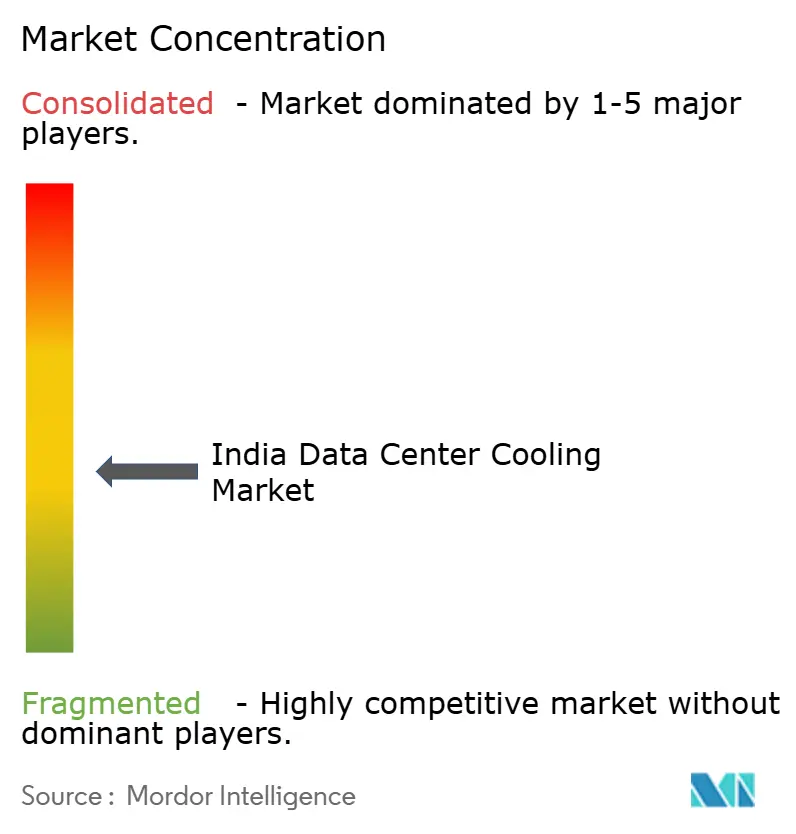
Competition spans system providers and thermal-component specialists, with Vertiv Co., Stulz GmbH, Schneider Electric SE, Alfa Laval AB and Rittal GmbH & Co. KG among its major participants. In June 2026, STULZ India inaugurated a 352,000-square-foot production facility near Sriperumbudur, Chennai, its 7th production facility in India.[3] The group’s Indian operating entity, STULZ-CHSPL (India) Pvt. Ltd., reported in June 2026 that it manufactured mission-critical cooling solutions and operated a nationwide 24-hour service network. That supply and service footprint creates a barrier beyond product design, since an entrant must support equipment delivery and field service to address operators seeking local execution capability.
On February 18, 2026, Schneider Electric launched its Motivair liquid-cooling factory in Bengaluru, its first Motivair production site in India and 3rd globally. Alfa Laval India manufactures brazed plate heat exchangers for high-load data-center cooling and liquid-cooling loops. Rittal’s India-facing offering spans data-center cooling systems from room-level units to rack-level climate control. Local manufacturing, component supply and room-to-rack product breadth give buyers different options for assigning thermal-system responsibility. Vendor differentiation consequently depends on the portion of a facility’s thermal architecture that each company can supply directly, with system integration left as a separate competitive task.
Regulatory positioning offers suppliers another way to differentiate their technical proposals to data-center project teams. In August 2026, Schneider Electric described data-center standards from the Bureau of Indian Standards (BIS) as voluntary and explained their use in comparing thermal architectures. That guidance addressed operators, consultants, specifiers and contractors, extending the performance discussion beyond the equipment manufacturer. For challengers, the opening is to demonstrate cooling and resource efficiency using common measures, making the quality of performance documentation a potential competitive advantage. A specialist can use those common measures to make a performance-based proposal comparable with an incumbent’s broader equipment offering.
India Data Center Cooling Industry Leaders
-
Vertiv Co.
-
Stulz GmbH
-
Schneider Electric SE
-
Alfa Laval AB
-
Rittal GmbH & Co. KG
- *Disclaimer: Major Players sorted in no particular order
India Data Center Cooling Market Companies Covered in this Report
- Vertiv Co.
- Stulz GmbH
- Schneider Electric SE
- Rittal GmbH & Co. KG
- Alfa Laval AB
- Kirloskar Chillers Pvt. Ltd.
- Johnson Controls Inc.
- Mitsubishi Electric Corp.
- Munters Group
- Eaton Corp. plc
- Prasa Infocom and Power Solutions Pvt. Ltd.
- Hitachi Energy Ltd.
- Blue Star Ltd.
- Delta Electronics (Delta Power Solutions India)
- Daikin Industries Ltd.
- Trane Technologies plc
- Asetek A/S
- Submer Technologies
- CoolTera Ltd.
- Climaveneta (Mitsubishi Electric Hydronics & IT Cooling Systems)
- Kaltra GmbH
- Green Revolution Cooling (GRC)
- Tark Thermal Solutions
Key Opportunities for Market Participants
This comparison separates opportunities in AI cooling equipment, performance verification and infrastructure partnerships. On August 7, 2026, MeitY reported that Indian data centers were adopting direct-to-chip liquid, adiabatic, immersion and closed-loop liquid cooling as AI infrastructure advanced. That range creates different entry points for vendors supplying thermal hardware and specialists helping operators implement and evaluate their chosen cooling architecture.
Market Opportunities Table of India Data Center Cooling Market
| Opportunity | Why now | Buyer / lead segment | Recommended play | Main barrier | Likely beneficiaries |
|---|---|---|---|---|---|
| Advanced cooling packages for AI installations | AI-led adoption of multiple cooling technologies in India | Operators deploying high-density AI computing | Offer liquid-cooling packages with defined facility and computing interfaces | Coordinating facility and technology loops | Advanced cooling-equipment suppliers |
| Cooling-performance verification | Technology adoption broadens evaluation needs; BIS cooling-efficiency and water-use standards provide reference measures | Operators comparing advanced cooling architectures | Document cooling-efficiency and water-use performance on defined measurement boundaries | Consistent measurement across different architectures | Testing, commissioning and cooling-service providers |
| Cooling integration within energy-infrastructure programs | Tata Power reported active infrastructure workstreams and a cooling offering in October 2026 | Hyperscale and advanced data-center developers | Establish a defined thermal scope with an energy-infrastructure partner | Coordinating power, utility and cooling responsibilities | Tata Power and specialist thermal-integration partners |
| Source: Mordor Intelligence | |||||
The central opening is to pair advanced cooling installations with documentation of their installed resource performance. Cooling-efficiency and water-use standards provide a specific reference for verification work alongside an equipment offering. Testing, commissioning and cooling-service providers can anchor that documentation, so the opening extends beyond equipment sellers to the specialists who verify installed performance.
Recent Industry Developments in India Data Center Cooling Market
- Oct 2026: Vertiv completed a direct-to-chip high-density liquid-cooling deployment with CapitaLand India Trust at CLDC Mumbai 01 in Airoli, Navi Mumbai, supporting 30 MW of a hyperscale customer’s AI workloads.
- Sep 2026: Swegon was selected to supply cooling and air-treatment equipment for a major data-center project in India.
- Jun 2026: STULZ India inaugurated a 352,000-square-foot production facility near Sriperumbudur, Chennai, its 7th production facility in India.
India Data Center Cooling Market Report Scope and Research Methodology
Market Definition and Coverage
India data center cooling market measures annual spending on cooling equipment, systems, and related services used to remove heat and maintain thermal conditions at data centers. It covers transactions for data centers located in India, with value reported in USD.
Scope exclusions: General building HVAC used mainly for offices or non-data-center spaces and cooling assets installed outside India, even if procured by India headquartered operators, are excluded.
Segments Covered in This Report
- By Data Center Type
- Hyperscalers (owned and Leased)
- Enterprise and Edge
- Colocation
- By Tier Type
- Tier 1 and 2
- Tier 3
- Tier 4
- By Cooling Technology
- Air-based Cooling
- Chiller and Economizer (DX Systems)
- CRAH
- Cooling Tower (covers direct, indirect and two-stage cooling)
- Others
- Liquid-based Cooling
- Immersion Cooling
- Direct-to-Chip Cooling
- Rear-Door Heat Exchanger
- Air-based Cooling
- By Component
- By Service
- Consulting and Training
- Installation and Deployment
- Maintenance and Support
- By Equipment
- By Service
Data Sources, Market Sizing, and Validation
Desk Research
Public sources such as the Press Information Bureau, Software Technology Parks of India, the Unique Identification Authority of India, and the Ministry of Electronics and Information Technology provide India-specific evidence for the market. The Press Information Bureau reports installed capacity, high-density racks, and adoption of direct-to-chip, adiabatic, immersion, and closed-loop cooling, while Software Technology Parks of India describes Tier III facilities and their rack capacity across Indian cities. Unique Identification Authority of India transaction statistics and the Ministry of Electronics and Information Technology's State Data Centre guidance help characterize digital-service activity and the thermal requirements of public-sector facilities, such as precision air conditioning for server rooms.
Company annual reports, investor materials, project announcements, and reputable Indian business and technology press can supplement public-sector data with supplier activity, facility commissioning, equipment awards, and service reach. These sources support cross-checks rather than direct substitution for market revenue. The named sources are illustrative and not exhaustive, and further sources inform collection, validation and clarification.
Primary Interviews and Surveys
Structured interviews and surveys would include Indian data-center operators and developers, cooling equipment and system suppliers, installation and maintenance providers, and industry specialists in procurement and facility engineering. Respondents would be selected across company sizes and seniority, with questions testing secondary-source findings on project timing, rack density, technology mix, equipment and service scope, and realized or quoted pricing. Conflicting responses would be checked against project and company evidence, with unresolved gaps recorded and triangulated using separate demand, supplier, and channel indicators.
Distribution of primary research fieldwork respondents
| Company type | Respondent position | Region |
|---|---|---|
| Top tier: 32% | CXOs: 20% | |
| Mid tier: 46% | Functional/Unit leaders: 35% | |
| Smaller Players: 22% | Managers: 45% |
Market-Sizing & Forecasting
The estimate starts with a top-down view of annual Indian spending on data-center cooling equipment, systems, and services, then checks selected totals against supplier roll-ups and sampled project estimates built from cooling-system contract values. The model tracks data-center capacity additions and commissioned IT load to size new installation demand, rack counts and rack power density to reflect thermal intensity, the mix of air and liquid systems to estimate technology shares, equipment and service contract values to distinguish revenue streams, and project schedules to place spending in the correct year. Segment shares are built from observed project and supplier mix by data-center type, facility tier, cooling technology, and component, with value assigned to the relevant end-user cooling contract and embedded components counted once. Scenario analysis carries alternative capacity, density, and technology-adoption paths through 2032, while primary respondents would test the direction and practical range of variable-level forecasts. Gaps in project value or timing are handled with documented ranges and checked against independent capacity and supplier indicators.
Data Validation & Update Cycle
Analysts triangulate operator capacity and project announcements with supplier disclosures, public-sector facility data, and market indicators, then investigate outliers and year-to-year or source-to-source variances against project timing, system mix, and contract scope. A second review checks source traceability, unit consistency, segment totals, and the treatment of bundled equipment and services. Material conflicts trigger targeted re-contact of relevant respondent types and review of the underlying source evidence before sign-off. The model is refreshed annually, updated between cycles when material Indian capacity, policy, technology, or supply events change assumptions, and given a fresh source and calculation review immediately before delivery.
Mordor Intelligence's India Data Center Cooling Market Size Compared With Other Published Estimates
Published estimates can differ in the transactions and products they count and the inputs used to model demand. India data center cooling market measures annual spending on cooling equipment, systems, and related services used to remove heat and maintain thermal conditions at data centers.
Key Gap Drivers include the study's defined coverage and market-specific modeling choices. The model tracks data-center capacity additions and commissioned IT load to size new installation demand, rack counts and rack power density to reflect thermal intensity, the mix of air and liquid systems to estimate technology shares, equipment and service contract values to distinguish revenue streams, and project schedules to place spending in the correct year.
Benchmark comparison
| Source | Market Size | Gaps in Research Methodology |
|---|---|---|
| Mordor Intelligence | USD 3.75 B (2027) | |
| Regional Consultancy A | USD 2.05 B (2025) | At its 2025 base, this estimate is 45.3% below this report's 2027 value of USD 3.75 B, 2 years later. Its earlier measurement year places it below the later comparison year. |
| Global Consultancy B | USD 1.24 B (2025) | At its 2025 base, this estimate is 66.9% below this report's 2027 value of USD 3.75 B, 2 years later. Its earlier measurement year places it below the later comparison year. |
Mordor Intelligence's analysts triangulate operator capacity and project announcements with supplier disclosures, public-sector facility data, and market indicators, then investigate outliers and year-to-year or source-to-source variances against project timing, system mix, and contract scope.
Key Questions Answered in the Report
What is the India data center cooling market size and growth outlook?
The market is expected to increase from USD 2.99 billion in 2026 to USD 3.75 billion in 2027 and reach USD 11.38 billion by 2032, with a 24.86% CAGR over 2027-2032.
What is driving cooling demand at Indian data centers?
Hyperscale build-outs and denser computing support demand. Google broke ground on its Visakhapatnam AI hub in April 2026 for a project comprising 3 data center campuses.
Which technology leads cooling spending in Indian data centers?
Air-based cooling held 65.85% of Indian data-center cooling spending in 2026. Liquid-based cooling is forecast to grow fastest at a 26.7% CAGR over 2027-2032.
Which companies compete in data-center cooling in India?
Major participants include Vertiv Co., Stulz GmbH, Schneider Electric SE, Alfa Laval AB and Rittal GmbH & Co. KG.
What is the capital-cost challenge for liquid cooling in Indian data centers?
Sify’s group CFO said in 2026 that liquid cooling adds approximately USD 1.3 million per MW. Depending on the contract, Sify may pay and add the cost to capacity charges, or the customer may invest.
Which Indian metro has the fastest-growing data-center cooling outlook?
Chennai stands out as the fastest-growing metro. STT GDC India reported an operational 7.2 MW first phase at its Siruseri campus in February 2026, with 45 MW of campus design capacity.
- Data Center Construction Market Construction across the global market, covering tier, facility size and facility type.
- Data Center Server Market Global servers demand, split by tier, facility size and facility type.
- Data Center Immersion Cooling Market Immersion cooling across the global market, covering type, cooling fluid and application.
- India Artificial Intelligence (AI) Optimised Data Center Market AI facilities demand across India, covering facility type, component and tier.
- United States Data Center Construction Market The US construction, split by tier, facility size and facility type.