
Market Overview
| Study Period | 2020 - 2031 |
|---|---|
| Forecast Data Period | 2026 - 2031 |
| Base Year Market Size (2025) | USD 8.74 Billion |
| Market Size (2026) | USD 10.16 Billion |
| Market Size (2031) | USD 21.56 Billion |
| Growth Rate (2026 - 2031) | 16.23 % |
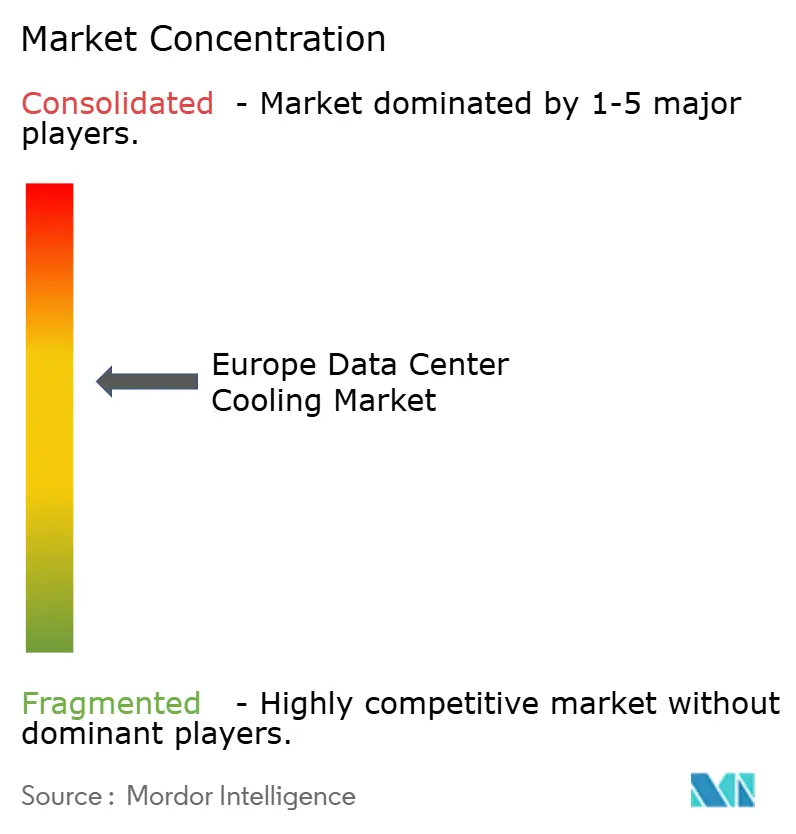
| Market Concentration | Medium |
Major Players *Disclaimer: Major Players sorted in no particular order Image © Mordor Intelligence. Reuse requires attribution under CC BY 4.0. | |
Europe Data Center Cooling Market Analysis by Mordor Intelligence
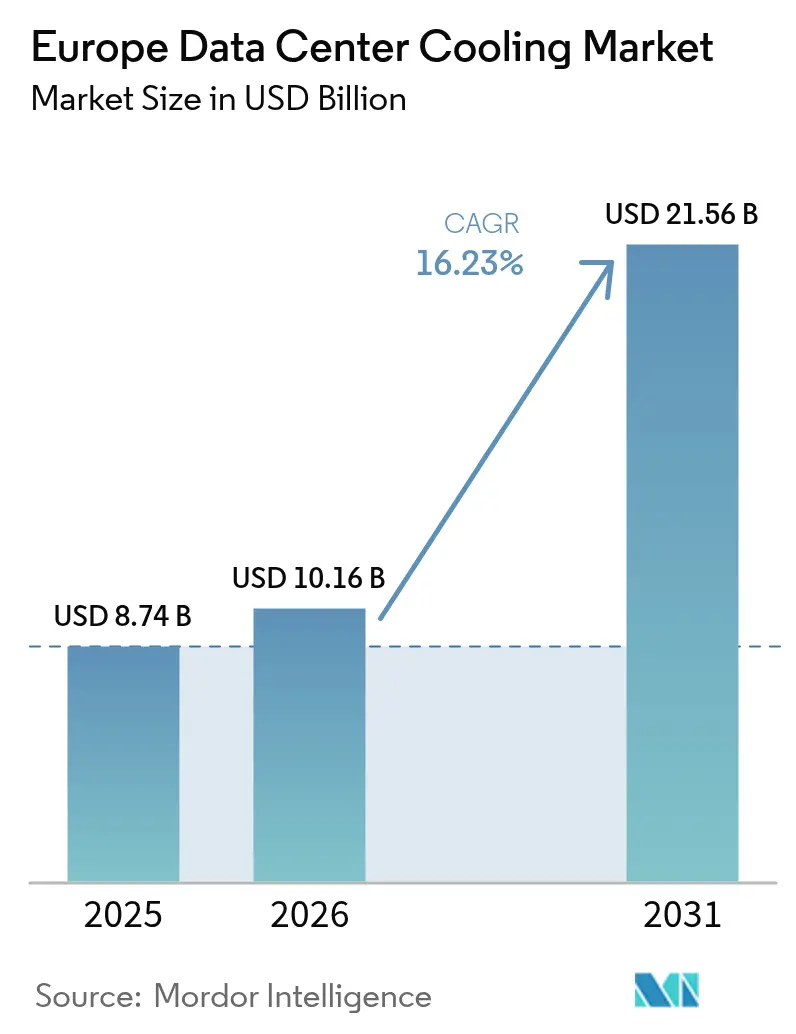
Europe data center cooling market size in 2026 is estimated at USD 10.16 billion, growing from 2025 value of USD 8.74 billion with 2031 projections showing USD 21.56 billion, growing at 16.23% CAGR over 2026-2031. Demand for AI-ready capacity, tougher energy-efficiency rules, and persistent supply constraints in the FLAP-D corridor have combined to accelerate investment in advanced thermal management. Natural free-cooling conditions across the Nordic region, together with mandatory waste-heat reuse for sites above 1 MW, are reshaping technology choices toward liquid systems and district-heating integration. Vendor consolidation is intensifying as incumbent HVAC suppliers purchase liquid-cooling specialists to secure the competencies needed for high-density racks. Component shortages and grid-connection delays remain near-term brakes, yet operators with capital headroom are using liquid cooling to unlock higher rack densities and premium AI margins, reinforcing the region’s lead in sustainable digital infrastructure.
Key Report Takeaways
- By data center type, hyperscalers held 46.78% of the European data center cooling market share in 2025 while recording the fastest expansion at a 16.62% CAGR through 2031.
- By tier classification, Tier 3 sites led with 64.92% revenue share in 2025; Tier 4 facilities are projected to grow at 17.05% CAGR over 2026-2031.
- By cooling technology, air-based solutions retained 66.55% share in 2025 whereas liquid systems are forecast to climb at an 17.76% CAGR to 2031.
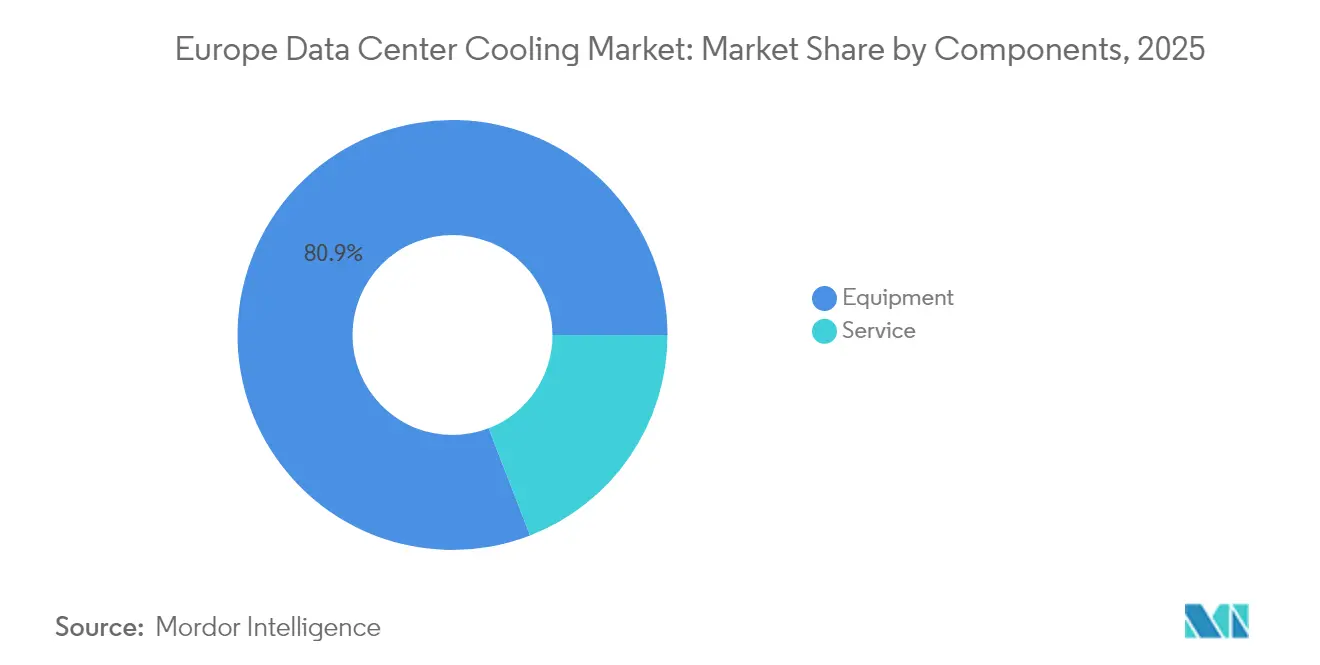
- By component, equipment commanded 80.88% share of the Europe data center cooling market size in 2025; services are set to rise at a 17.01% CAGR through 2031.
- By country, the United Kingdom accounted for 33.88% of the Europe data center cooling market size in 2025; Poland represents the fastest-growing national market at 16.39% CAGR to 2031.
Note: Market size and forecast figures in this report are generated using Mordor Intelligence’s proprietary estimation framework, updated with the latest available data and insights as of 2026.
600+
data center reports by Mordor Intelligence
covering security, AI facilities, energy efficiency and more - global, regional or country-level, right down to individual data center components
Market Trends and Insights
Drivers Impact Analysis of Europe Data Center Cooling Market*
| Driver | (~)% Impact on CAGR Forecast | Geographic Relevance | Impact Timeline |
|---|---|---|---|
| Surging AI-led rack power densities | +4.2% | Global, with concentration in FLAP-D corridor | Short term (≤ 2 years) |
| EU Green Deal and related energy-efficiency mandates | +3.8% | EU-wide, strongest in Germany and Netherlands | Medium term (2-4 years) |
| Hyperscale and colocation build-outs in FLAP-D corridor | +3.1% | Frankfurt, London, Amsterdam, Paris, Dublin | Medium term (2-4 years) |
| Northern Europe's free-cooling climate advantage | +2.4% | Nordic countries, extending to Northern Germany | Long term (≥ 4 years) |
| District-heating revenue from waste-heat re-use | +1.8% | Nordic countries, Germany, Netherlands | Long term (≥ 4 years) |
| Sovereign AI clusters adopting micro-modular liquid cooling | +1.3% | National initiatives across major EU economies | Medium term (2-4 years) |
| Source: Mordor Intelligence | |||
Surging AI-led Rack Power Densities
AI training clusters are pushing rack loads from 10-15 kW toward 40-60 kW, a shift that renders conventional CRAH units inadequate. Vertiv cited a 37% year-on-year rise in liquid-cooling orders during Q3 2024 as GPU-intensive builds accelerated. Sovereign AI programs amplify the trend: Beyond.pl’s new Sovereign AI Factory in Poland uses micro-modular liquid pods to condense national compute into secure footprints.[1]Higher fluid-cooling content is driving copper demand, adding further strain to supply chains already coping with long lead times.
EU Green Deal and Related Energy-Efficiency Mandates
The Energy Efficiency Directive obliges sites above 1 MW to recover waste heat unless technically infeasible, steering designs toward low-exergy cooling loops linked to municipal networks. Retelit’s Avalon 3 centre in Milan already diverts 2.5 MWt into district heating, cutting 3,300 t of annual CO₂.[2] In parallel, the F-gas phase-down accelerates migration to low-GWP refrigerants or non-refrigerant liquid technologies.
Hyperscale and Colocation Build-outs in FLAP-D Corridor
Vacancy in FLAP-D declined in 2024 and is projected to rise in 2025, prompting hyperscalers to pre-lease capacity 16 months before go-live. Colt’s Frankfurt West campus was fully committed before shell completion. Cooling systems are now a key differentiator; Digital Realty’s Frankfurt expansion markets AI-optimized liquid systems as a premium feature.[3]
Northern Europe’s Free-Cooling Climate Advantage
Nordic temperatures let operators deliver PUE figures near 1.1 while shaving energy bills up to 40%. XTX Markets committed EUR 1 billion to a Kajaani campus that will rely on ambient air and heat export to the local grid. Norway’s fjord-water cooling at Green Mountain removes chiller loads entirely and underpins the government’s digital-export strategy.
Restraints Impact Analysis of Europe Data Center Cooling Market*
| Restraint | (~)% Impact on CAGR Forecast | Geographic Relevance | Impact Timeline |
|---|---|---|---|
| High CAPEX for liquid-cooling retrofits | -2.8% | Global, particularly affecting legacy facilities | Short term (≤ 2 years) |
| EU-wide F-gas / refrigerant phase-down complexity | -1.9% | EU-wide, strongest impact in Southern Europe | Medium term (2-4 years) |
| Shortage of certified water-treatment skills | -1.4% | Global, acute in Eastern and Southern Europe | Medium term (2-4 years) |
| Grid-connection moratoria in power-tight metros | -1.1% | Amsterdam, Dublin, London metropolitan areas | Short term (≤ 2 years) |
| Source: Mordor Intelligence | |||
High CAPEX for Liquid-Cooling Retrofits
Upgrading an existing hall to direct-to-chip loops can cost beyond USD 1,000 per kW, a figure that drives operators to weigh greenfield builds against retrofits. Component lead times of 12-16 months for pumps, CDU valves, and high-capacity chillers extend project paybacks. Skills scarcity adds opex, as water-chemistry expertise commands premium rates.
EU-wide F-gas / Refrigerant Phase-Down Complexity
The 2030 F-gas cap compresses the availability of high-GWP blends, sending prices upward and complicating maintenance scheduling. Rittal’s Blue e+ S launch, cutting GWP 56%, illustrates design revision costs but also the pathway toward compliance. Divergent enforcement calendars across member states increase legal workload for multi-country operators.
*Our forecasts treat driver/restraint impacts as directional, not additive. The impact forecasts reflect baseline growth, mix effects, and variable interactions.
Europe Data Center Cooling Market Segment Analysis
By Data Center Type:
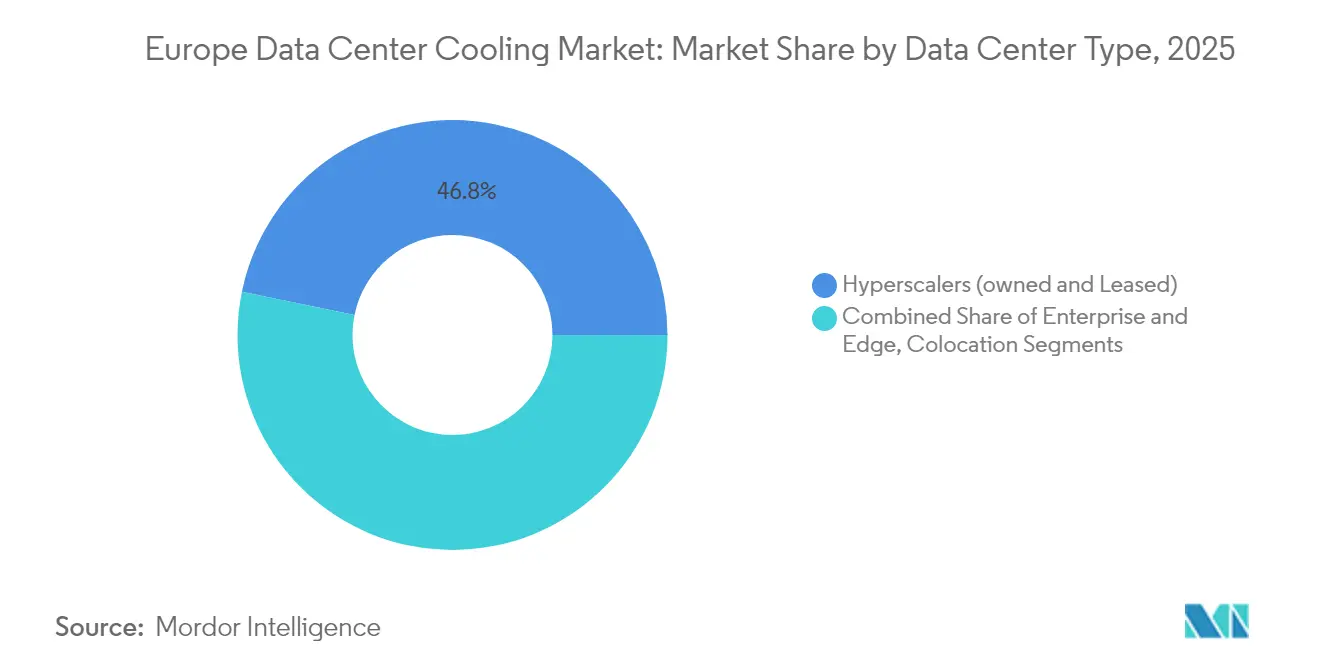
Hyperscalers Drive Market TransformationHyperscaler facilities captured 46.78% of the European data center cooling market share in 2025 and are projected to rise at a 16.62% CAGR, confirming their outsized influence on technology migration. Their extensive capital budgets absorb the higher upfront costs of immersion tanks and rear-door heat exchangers, accelerating ecosystem learning curves. Enterprise and edge sites lag in adoption but are piloting modular coolant distribution to meet localized AI inference. Colocation operators are carving a middle path by offering “liquid-cooling suites” that de-risk client transformation, an approach that underpins rising service revenue.
Sovereign AI mandates intensify hyperscaler momentum. Microsoft’s newest European builds dedicate entire halls to liquid-ready racks, enabling compute footprints that conventional air layouts cannot host. Colocation landlords respond by marketing liquid cooling as a service, a premium they recover via higher-density fees. Edge operators, pressured by latency requirements, are embracing compact dielectric-fluid pods, illustrating how scale dynamics filter through the entire ecosystem.

By Tier Type:
Tier 4 Emerges as Liquid-Cooling PioneerTier 3 remains the mainstream choice with 64.92% share of the Europe data center cooling market size in 2025, favored for balanced resilience and cost. Yet Tier 4 footprints expand at 17.05% CAGR as sovereign clouds and regulated sectors require simultaneous maintainability. Tier 4 blueprints frequently integrate dual coolant loops with N+N pumps, setting new reliability norms.
Tier 3 managers are adopting selective liquid retrofits, rear-door exchangers for AI tenants, CRAH rows for general-purpose racks, creating hybrid environments that prolong asset life. Tier 1/2 facilities hold niche relevance for content distribution and backup; their simplified cooling often leverages indirect free cooling to minimize spend. Standards bodies are reviewing whether current Tier definitions sufficiently account for liquid system redundancy, suggesting future design codifications.
By Cooling Technology:
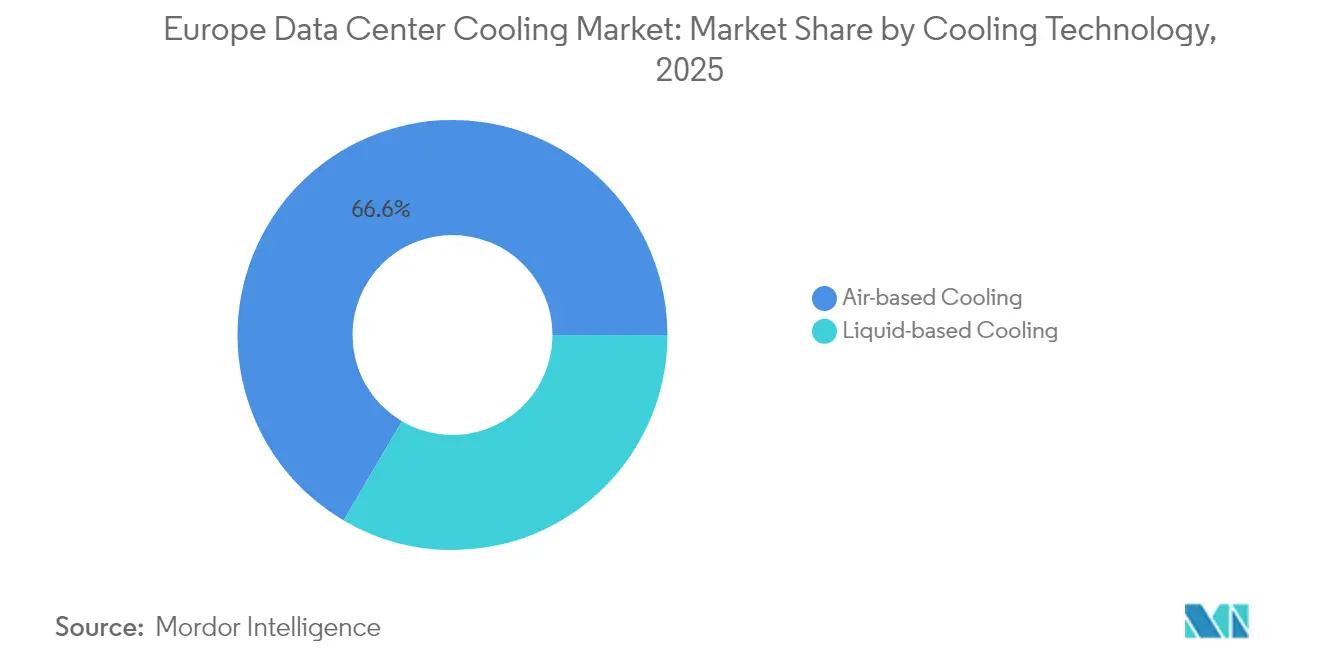
Liquid Systems Gain Strategic MomentumAir methods still account for 66.55% of 2025 revenue. Economizer chillers and CRAH units dominate brown-field estates, and indirect evaporative towers remain cost-effective in moderate climates. Pressure, however, is mounting from 17.76% CAGR liquid-cooling growth led by direct-to-chip plates and single-phase immersion. Immersion vendors demonstrate chip thermal design power beyond 1,000 W, allowing AI racks to breach historical density ceilings.
Retrofit-friendly rear-door heat exchangers bridge the gap for legacy halls, delivering cooling of 30 kW per rack without floor-level plumbing changes. The technology race fuels M&A: Baltimore Aircoil licensed DUG’s immersion patents to secure a presence in high-density niches. Traditional air-cooling specialists are forming partnerships to safeguard share, reflecting a recognition that the performance ceiling of air alone has been reached for next-generation compute.
By Component:
Services Growth Reflects Implementation ComplexityEquipment retained 80.88% share in 2025, a ratio supported by hardware-intensive build cycles. Yet the services segment is projected to grow 17.01% CAGR as operators outsource design, commissioning, and predictive maintenance. Liquid-cooling start-ups are bundling fluid-quality monitoring, leak-detection analytics, and training into recurring contracts, expanding lifetime revenue per MW.
Installation services capture the largest slice, reflecting the specialized pipe-fit, welding, and containment skills needed for coolant loops. Maintenance demand is likewise elevated because pump reliability directly affects uptime SLA metrics. Consultancy around waste-heat valorization and EU regulation compliance is emerging as a lucrative niche, with engineering firms modeling thermodynamic and financial returns of district-heating tie-ins.
Geography Analysis
United Kingdom Data Center Cooling Market
The United Kingdom led with 33.88% of Europe data center cooling market size in 2025, propelled by London’s finance-centric cloud demand and favorable depreciation allowances. Power-grid constraints around the M25 ring have nudged designs toward sub-1.2 PUE solutions. Green Mountain’s 30 MW East London build targets high-performance workloads and leverages advanced liquid loops to stay within power-allocation caps. Government projections valuing the sector at GBP 44 billion contribution by 2035 sustain policy support.
Poland Data Center Cooling Market
Poland is the standout growth frontier with 16.39% CAGR. Hyperscalers, lured by mid-tier power costs and EU proximity, committed multibillion-euro spends; Google alone earmarked EUR 3 billion for regional cloud zones Atman’s USD 344 million Warsaw campus adds 14.4 MW with liquid-cooling loops that support 50 kW racks.
Regulatory Landscape
EU policy is tightening around data-center energy performance disclosure and heat recovery, which is filtering through to cooling system choices. The Energy Efficiency Directive (Directive (EU) 2023/1791) expands reporting obligations for data centres at or above 500 kW IT power demand into a European database, and it links larger sites (above 1 MW) to waste-heat utilization unless technical infeasibility is demonstrated. From July 1, 2026, additional operational requirements apply for new data centres, including minimum shares of reused energy, raising the priority of low-exergy liquid loops and district-heating tie-ins in permitting and design.
The European Commission has also moved common measurement and transparency tools forward via the EU-wide rating scheme for data centres under Commission Delegated Regulation (EU) 2024/1364. It requires operators to report standardized indicators that include energy consumption for cooling and aspects of cooling infrastructure. Technical standards from CEN and CENELEC, including EN 50600-4-7 (Cooling Efficiency Ratio as a KPI), underpin consistent KPI reporting, while the Ecodesign for Sustainable Products Regulation (EU) 2024/1781 provides a framework for future sustainability requirements that can translate into equipment and system specifications for cooling.
Competitive Landscape
Europe data center cooling market competition is tightening as scale and technology breadth become decisive. Schneider Electric’s USD 850 million Motivair acquisition secured immersion IP and high-capacity CDU manufacturing. Vertiv leverages a global service franchise to lock multiyear support deals and posted 19.2% organic net sales growth in Q3 2024.
Strategic alliances complement M&A. Munters and ZutaCore combine adiabatic air handling with direct-on-chip dielectric loops, bridging mixed-density halls. Carrier’s QuantumLeap platform bundles chillers, CDU racks, and AI controls, signaling a pivot from discrete hardware to integrated ecosystems.
Disruptors such as Submer, Iceotope, and Asperitas target immersion niches, prompting incumbents to license or acquire. The white-space opportunity lies in hybrid architectures: vendors that unify airside economization with close-coupled liquid loops position themselves to win refresh cycles across brown-field estates. Services capability is emerging as a moat; vendors offering design-build-operate packages lock operators into decade-long revenue streams.
Europe Data Center Cooling Industry Leaders
-
Vertiv Group Corp.
-
Stulz GmbH
-
Schneider Electric SE
-
Rittal GmbH & Co. KG
-
Asetek A/S
- *Disclaimer: Major Players sorted in no particular order
Europe Data Center Cooling Market Companies Covered in this Report
- Vertiv Group Corp.
- Stulz GmbH
- Schneider Electric SE
- Rittal GmbH and Co. KG
- Asetek A/S
- Alfa Laval AB
- Iceotope Technologies Ltd.
- Green Revolution Cooling Inc.
- Chilldyne Inc.
- Airedale International Air Conditioning Ltd.
- Johnson Controls International plc
- Daikin Europe NV
- Munters Group AB
- Submer Technologies SL
- CoolIT Systems Inc.
- Danfoss A/S
- Parker Hannifin Corp.
- Trane Technologies plc
- Sensata Technologies Inc.
- Asperitas BV
Market Opportunities and Future Outlook
Compliance-led instrumentation and verification are emerging as a near-term whitespace across brownfield and greenfield sites as EU reporting expands for data centres at or above 500 kW and as waste-heat utilization expectations harden for facilities above 1 MW. Operators are shifting toward solutions that can be measured and evidenced in audits, including metered cooling loops and controls that make cooling energy and water metrics visible. This is also increasing demand for packaged services for data capture, commissioning, and continuous optimization aligned to CEN-CENELEC KPIs such as EN 50600-4-7.
Heat-reuse enablement is moving beyond a sustainability feature toward a commercial design lever where district heating access exists, particularly in Northern and Central Europe. Retelit has already implemented heat export at its Avalon 3 site in Milan (2.5 MWt to district heating), showing a practical pathway for cooling architectures that deliver usable temperature lift. Program and deployment activity supports this direction, including the CoolHeatDC project using two-phase immersion cooling with heat pumps for district heating integration, and DCX Liquid Cooling Systems being selected (March 2025) to supply liquid cooling infrastructure for the DataOne project in Grenoble, France. Together, these examples point to procurement of facility-side liquid distribution (FDUs, facility water systems) alongside other liquid-cooling deployments.
Recent Industry Developments in Europe Data Center Cooling Market
- June 2026: Vertiv completed the acquisition of ThermoKey S.p.A., adding heat rejection and heat-exchange manufacturing capability to its thermal management portfolio. It expands Vertiv's ability to supply cooling-critical components for high-density AI data centers in EMEA and supports shorter lead times for regional deployments.
- May 2026: Vertiv expanded its liquid cooling portfolio in EMEA with the launch of CoolChip CDU 2300 and Fluid Network Row Manifolds aimed at high-density AI infrastructure. This broadened portfolio supports more standardized liquid-ready hall designs and increases the share of close-coupled liquid systems available from a single vendor.
- October 2024: Schneider Electric agreed to acquire Motivair Corporation for USD 850 million to deepen its liquid cooling capabilities for data centers. The acquisition strengthens Schneider Electric's push into high-density thermal management, including CDUs and related offerings needed for AI and HPC deployments.
Europe Data Center Cooling Market Report Scope and Research Methodology
Market Definition and Coverage
This market is defined as the revenue generated from cooling equipment and cooling related services used to remove heat from data center white space across Europe, covering air-based and liquid-based approaches used in hyperscale, colocation, enterprise, and edge sites.
Scope exclusions: Building HVAC for offices and other non-white-space areas, power conversion rooms, and telecom shelters are excluded from this sizing.
Segments Covered in This Report
- By Data Center Type
- Hyperscalers (owned and Leased)
- Enterprise and Edge
- Colocation
- By Tier Type
- Tier 1 and 2
- Tier 3
- Tier 4
- By Cooling Technology
- Air-based Cooling
- Chiller and Economizer (DX Systems)
- CRAH
- Cooling Tower (covers direct, indirect and two-stage cooling)
- Others
- Liquid-based Cooling
- Immersion Cooling
- Direct-to-Chip Cooling
- Rear-Door Heat Exchanger
- Air-based Cooling
- By Component
- By Service
- Consulting and Training
- Installation and Deployment
- Maintenance and Support
- By Equipment
- By Service
- By Country
- United Kingdom
- Germany
- Netherlands
- Spain
- Poland
- Switzerland
- Austria
- Rest of Europe
Data Sources, Market Sizing, and Validation
Desk Research
To structure the model, we started with desk research to map where capacity is being added and which cooling choices are practical across Europe. We reviewed public sources such as Eurostat energy statistics, national energy agencies, and European Commission policy pages to understand electricity pricing, efficiency programs, and heat reuse rules that affect cooling design.
We also checked guidance and data points from ASHRAE and The Green Grid, plus open technical papers from IEEE and other peer reviewed journals, to ground assumptions like typical PUE ranges and cooling technology adoption patterns. Company annual reports, investor presentations, and press releases were used to sanity check demand signals like new build announcements, retrofit activity, and service mix. Where needed, we used a paid subscription for company financials and news selectively to confirm revenue direction and timing. These are illustrative sources only, and other public documents were also referenced for data collection, cross checks, and clarifications.
Primary Interviews and Surveys
Primary work was used to close gaps that desk sources cannot answer cleanly, especially the equipment versus services split and the pace of liquid cooling adoption in high density halls. Interviews were conducted with cooling OEMs, integrators, facility operators, and engineering consultants across major European build-out markets. Surveys then helped confirm typical pricing logic, replacement cycles, and how projects are contracted (new build versus retrofit).
Distribution of primary research fieldwork respondents
| Company type | Respondent position |
|---|---|
| Top tier: 34% | CXOs: 14% |
| Mid tier: 46% | Functional/Unit leaders: 31% |
| Smaller Players: 20% | Managers: 55% |
Market-Sizing & Forecasting
Sizing was built using a top-down demand pool approach, where data center IT load additions and installed capacity signals are translated into cooling system value by applying cooling architecture shares and typical cost intensity by site type. We then corroborated totals with selective bottom-up checks, including sampling typical project quotes and mapping supplier revenue exposure to Europe. This helped adjust for timing lags between capacity commissioning and cooling spend.
Key inputs used in the model include new data center capacity additions, IT rack density shifts (including AI-driven high density deployments), the mix of air-based versus liquid-based systems, service attachment rates for installation and maintenance, and energy price and efficiency trends that change technology selection. Because adoption moves in steps rather than in a straight line, scenario analysis was used for the forecast. Scenario weights were refined using expert views on liquid cooling penetration, retrofit intensity, and constraints such as permitting and grid connection delays. Where bottom-up visibility was limited for smaller countries, we used proxy indicators like colocation pipeline activity and country level capacity growth to fill gaps, then rechecked the implied cooling spend per MW for reasonableness.
Data Validation & Update Cycle
Outputs were checked through triangulation across independent signals, including the implied cooling spend per MW, the equipment versus services split, and the direction of technology mix versus observed deployment trends. Outliers were flagged, reviewed by another analyst, and then reworked by revisiting the specific assumption that caused the variance. If the gap could not be explained from available evidence, we followed up with targeted re-contact.
The report is refreshed annually, and interim updates are made when material events occur, such as major policy shifts affecting heat reuse or sudden changes in expansion plans. Before delivery, a final pass is completed to ensure the latest public announcements and validated assumptions are reflected in the model.
Mordor Intelligence's Europe Data Center Cooling Market Market Size Versus Other Published Estimates
Different published numbers for Europe data center cooling can look far apart because the underlying scope is not always the same, even when the titles sound similar. The main differences usually come from what is counted as cooling, how services are treated, and whether the estimate is anchored to installed capacity signals or to broader facility spending.
In practice, gaps are often driven by whether the model includes only cooling equipment or also includes installation, maintenance, and consulting, and by how quickly liquid cooling is assumed to scale in high density deployments. Currency timing and the refresh cadence also matter, since project pipelines and energy conditions can shift across countries, which then changes the near-term spend profile.
Benchmark comparison
| Source | Market Size | Gaps in Research Methodology |
|---|---|---|
| Mordor Intelligence | USD 8.74 B (2025) | |
| Industry Publisher A | USD 3.79 B (2024) | The estimate appears to lean toward a narrower equipment-only view and an earlier base year, which can understate spend when services and commissioning-linked project timing are not fully captured. |
| Global Consultancy B | USD 5.53 B (2025) | The published split is stated only at a high level (solutions versus services), and the inclusions for installation, maintenance, and liquid-cooling-specific services are not clearly detailed, which can shift totals depending on what is grouped into cooling. |
The spread across the three figures mainly comes from what gets counted beyond core cooling hardware and how the timing of new capacity rollouts is converted into annual revenue. By explicitly including equipment plus cooling related services that occur inside data halls, and by checking implied spend per MW against operator feedback, the 2025 value stays traceable to repeatable inputs, a choice applied by Mordor Intelligence.
Key Questions Answered in the Report
What is the current size of the Europe data center cooling market?
The Europe data center cooling market is valued at USD 10.16 billion in 2026 and is projected to hit USD 21.56 billion by 2031.
Which segment holds the largest share of Europe data center cooling market?
Hyperscale data centers lead with 46.78% market share in 2025, driven by large AI and cloud deployments.
Why are liquid-cooling technologies gaining traction in Europe?
AI racks now exceed 40 kW, surpassing air-cooling limits, and EU energy-efficiency rules favor liquid systems that support waste-heat reuse and low PUE.
How does EU regulation influence cooling choices?
The Energy Efficiency Directive requires heat-recovery for large sites, and the F-gas phase-down limits high-GWP refrigerants, pushing operators toward efficient liquid or low-GWP solutions.
More reports on data centers
- Data Center Security Market Security across all regions, split by security type, offering and facility type.
- Artificial Intelligence (AI) Data Center Market AI facilities across all regions, split by facility type, component and tier.
- Europe Green Data Center Market Europe energy efficiency, split by component, facility type and tier.
- Europe Hyperscale Data Center Market Europe hyperscale sites, split by facility type, component and tier.
- China Data Center Construction Market China's construction, split by facility size and tier.
- United Kingdom Data Center Construction Market Construction demand across the UK, covering tier, facility size and facility type.