
Market Overview
| Study Period | 2020 - 2031 |
|---|---|
| Forecast Data Period | 2026 - 2031 |
| Historical Data Period | 2020 - 2024 |
| Growth Rate | 4.43 % |
| Market Concentration | High |
Major Players *Disclaimer: Major Players sorted in no particular order Image © Mordor Intelligence. Reuse requires attribution under CC BY 4.0. | |
Bahrain Paints And Coatings Market Analysis by Mordor Intelligence
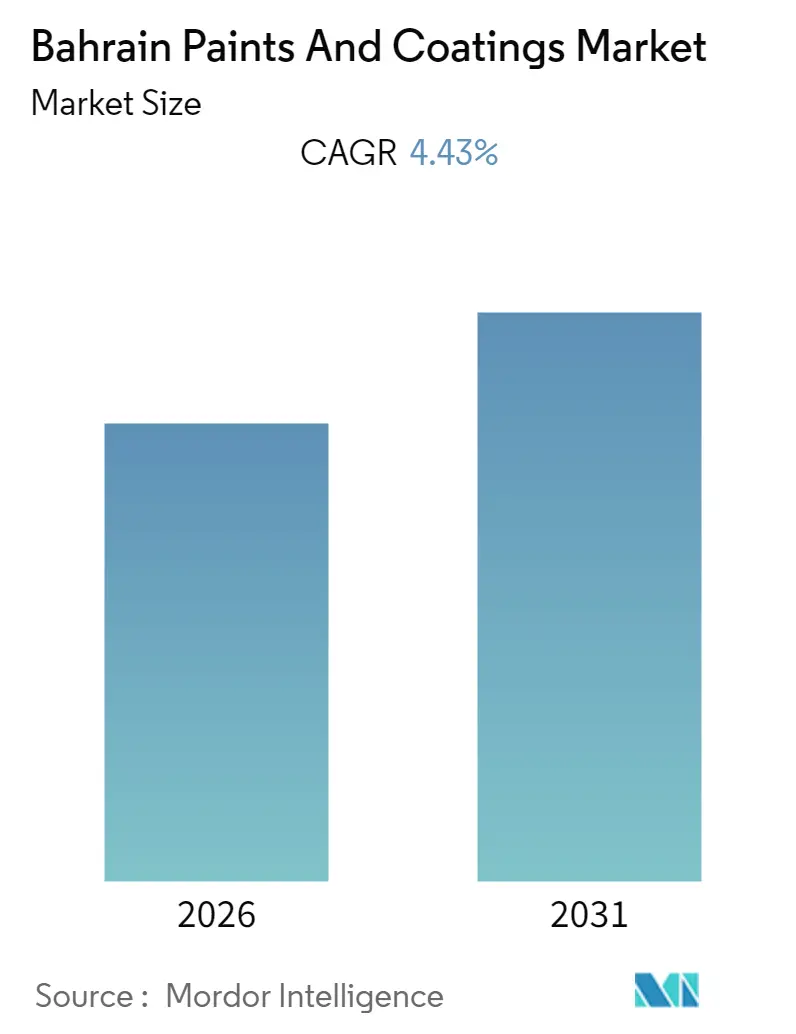
The Bahrain Paints and Coatings Market size is expected to register a CAGR of 4.43% during the forecast period.
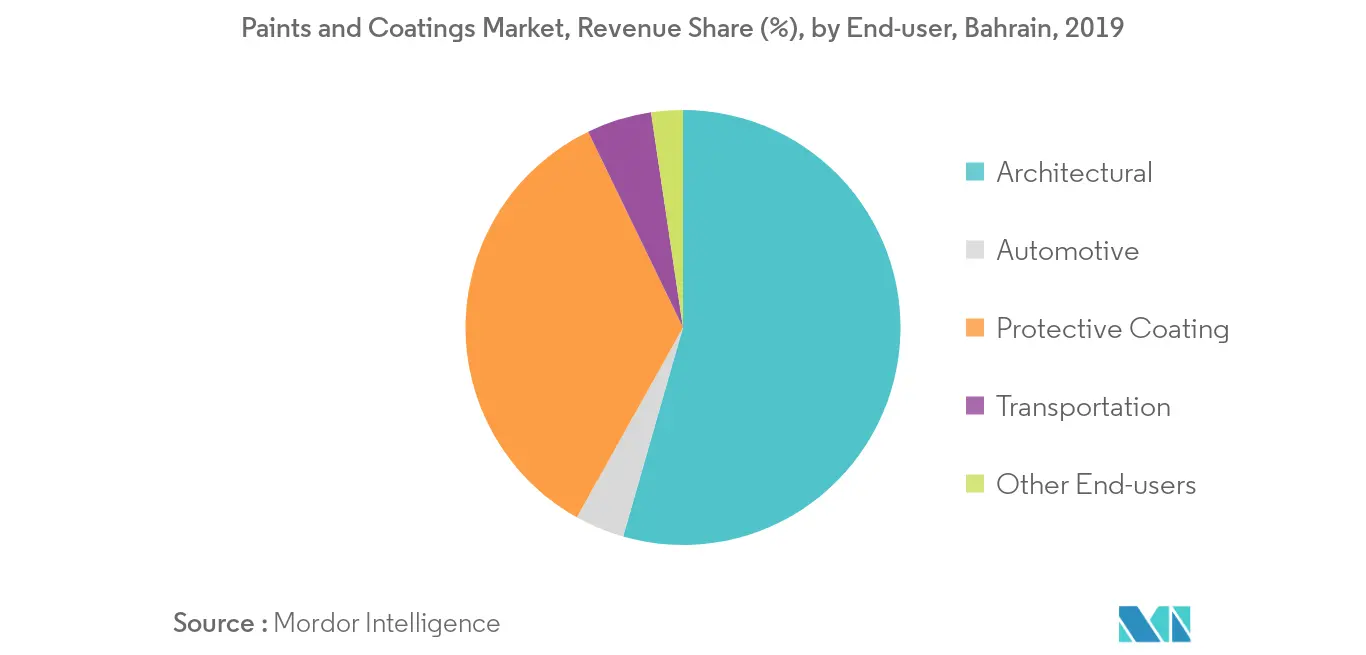
- Architectural coatings dominated the market, and it is expected to grow during the forecast period due to the increasing construction activities.
- Growing oil & gas exploration and production activities in Bahrain are likely to act as an opportunity in the future.
Note: Market size and forecast figures in this report are generated using Mordor Intelligence’s proprietary estimation framework, updated with the latest available data and insights as of 2026.
Bahrain Paints And Coatings Market Trends and Insights
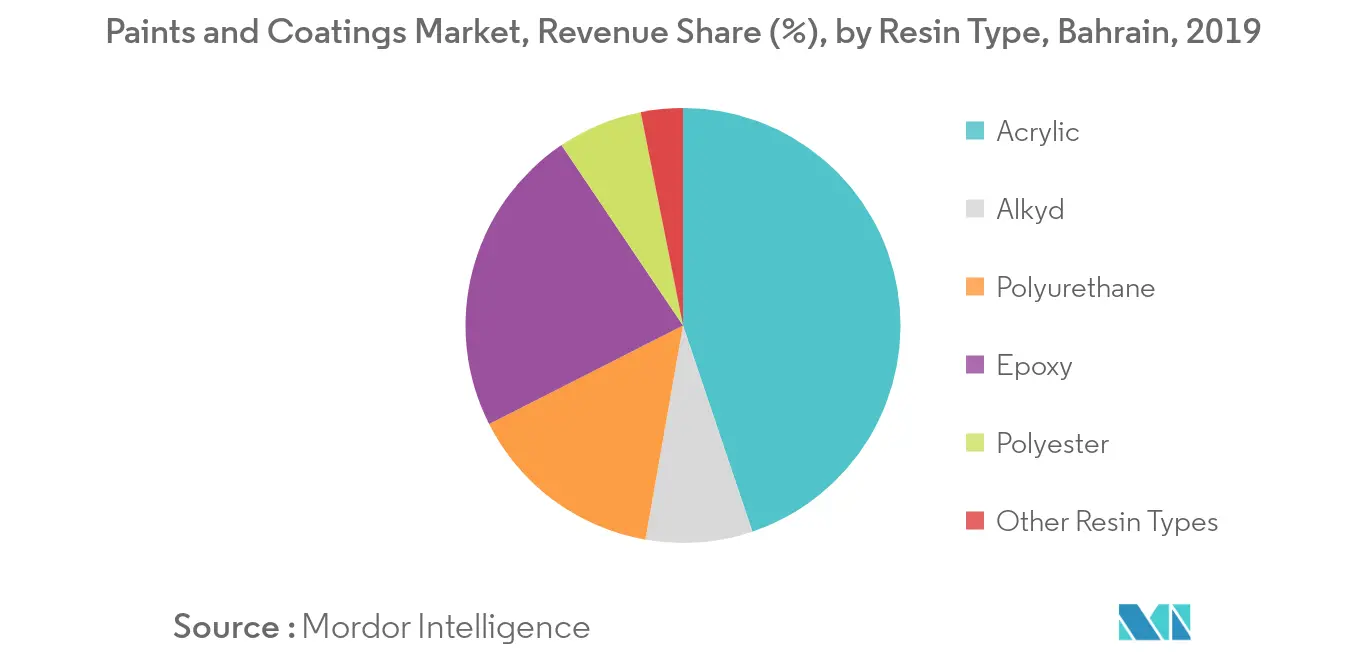
Acrylic Resin Dominating the Market
- Acrylic resins are the most widely used polymers in the paint and coatings industry. Most of the acrylic paints are water-based or solvent-based and are available as emulsions (latices), lacquers (lower volume solids), enamels (higher volume solids), and powders (100% solids).
- The common acrylic polymers come in a wide variety of types and combinations, such as methyl and butyl methacrylate. In the case of inexpensive paints, polyvinyl acetate is used primarily.
- The two principal forms of acrylic used are thermoplastic and thermoset. Thermoplastics acrylic resins are synthetic resins achieved by polymerization of different acrylic monomers. Thermosets are cured at elevated temperatures by reacting them with other polymers. Thermoplastic acrylic resins are of two types, namely solution acrylics and acrylic latex coatings.
- Furthermore, the acrylic resins develop properties, such as transparency, high colorability, and UV resistance in coating solutions. They are used in waterborne systems very often, which result in low VOC emission. The application of acrylic coatings leads to high surface hardness. In certain applications, such as walls, decks, and roofing, the acrylic coatings provide elastomeric finishes to improve the UV resistance of the surface, if employed with some fluids.
- The application of acrylic coatings is primarily found in the construction industry for high-end finishing in roofs, decks, bridges, floors, and other applications. The water-based acrylic coatings are high in demand, owing to the environmental concerns, as the negative impact of VOCs affecting the air quality in the environment.
- The primary binder type in the Bahrain paints and coatings market is acrylic, with a total share of more than 70% of all the waterborne coatings. Acrylic is widely used in architectural coatings.
- Such positive factors are likely to increase demand for Bahrain Paints and Coatings Market over the forecast period.


Protective Coatings Demand to Expand at a Fastest Rate
- The oil and gas industry use protective coatings for both upstream and downstream segments, for the transportation of oil and gas toward refineries.
- The industry has been trying to find ways to cut capital charges. This, along with the need to adhere to strict environmental regulations, has led to the demand for a coating system (with a long life), which may be effective in the protection of the assets.
- The oil and gas industry use various types of protective coatings, such as anti-corrosion, heat-resistant, abrasion-resistance, fire-resistance, and others.
- The offshore oil and gas production have some of the most demanding conditions. Therefore, the coating systems used must be equipped likewise.
- Apart from oil and gas, infrastructure has been the major backbone for the country’s growth.
- Roads, bridges, public parks, etc., are all subjected to continuously extreme conditions. Paints and coatings in infrastructure can be used as varnishes and inorganic binders that provide protection against harsh environmental conditions. The key drivers of this growth are a USD 32 billion infrastructure investment, a pipeline comprised of USD 10 billion in government funding, USD 7.5 billion from the GCC Development Fund, and USD 15 billion from the private sector.
- With the substantial growth, especially in the oil and gas and infrastructural projects, the Bahrain Paints and Coatings Market is expected to witness rapid growth during the forecast period.
Value Chain Analysis
The Bahrain paints and coatings value chain typically starts with imported feedstocks and regionally sourced petrochemical derivatives for resins, solvents, pigments, and additives. These inputs are then processed through local compounding and batch manufacturing (mixing, dispersion, let-down, and tinting), followed by QC and packaging.
Local manufacturing participants include firms such as Legend Paints, which operates a 4,400 square meter manufacturing facility. This supports in-country supply for architectural and selected industrial/protective products, alongside imports from multinational producers active in the market. Downstream, products move through distributors, contractor channels, and branded retail/tinting outlets that serve the dominant architectural segment, while protective coatings demand is tied to industrial maintenance and oil and gas users. Compliance with GCC technical requirements can influence formulations and procurement, including the GSO 2764:2024 standard for pigmented nitrocellulose topcoats used in automotive refinishing. Industrial operations also interface with Bahrain licensing and environmental review processes, which can affect time-to-market for new capacity or product lines.
Competitive Landscape
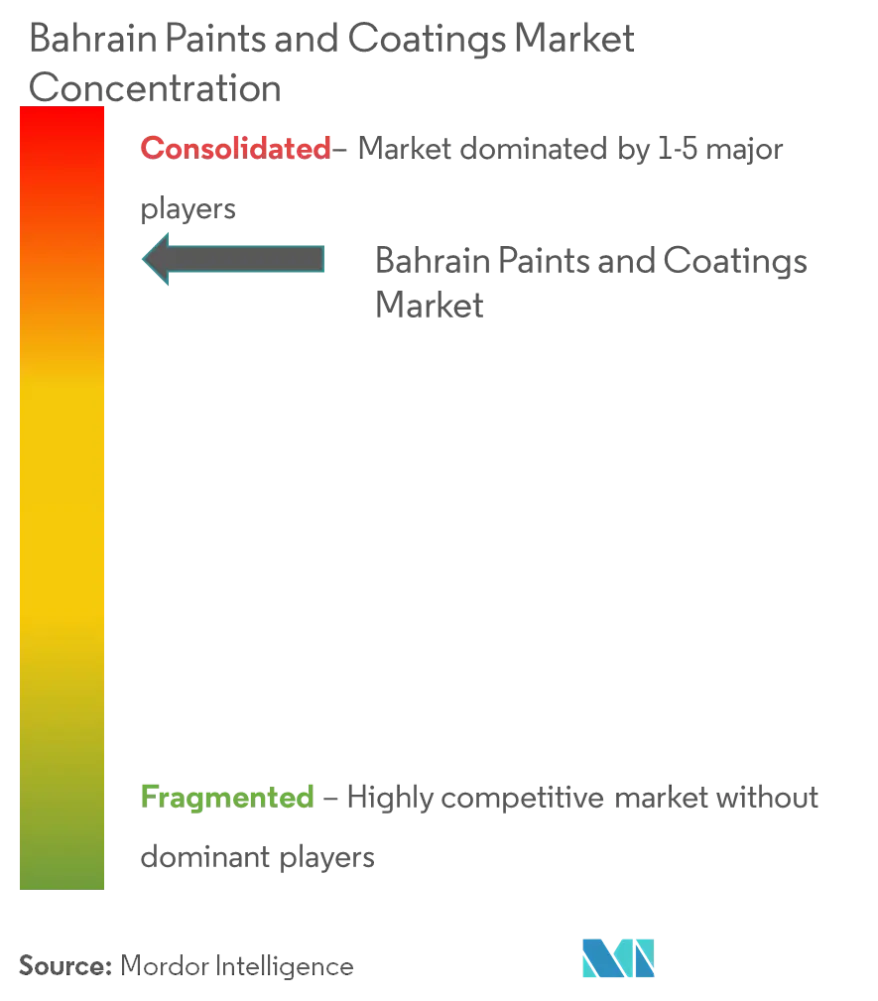
The Bahrain Paints and Coatings Market is consolidated and the top five players account for more than 65% of the market share. The major companies include Jotun, Asian Paints Berger, Hempel A/S, Omega Paints & Chemical Industries, and PPG Industries, Inc. among others.
Bahrain Paints And Coatings Industry Leaders
Jotun
Asian Paints Berger
Hempel A/S
Omega Paints & Chemical Industries
PPG Industries, Inc.
- *Disclaimer: Major Players sorted in no particular order

Market Opportunities and Future Outlook
Opportunities center on deeper localization of raw materials, intermediates, and performance additives for architectural and protective coatings. Bahrain’s ability to align with downstream petrochemical priorities under the Industrial Sector Strategy (2022-2026) is relevant here, and GPICs Sitra operations show an existing platform spanning polymer and plastic additives and paints and coatings additives. This creates a practical opening for local formulators and toll manufacturers to qualify additive packages and resin systems aligned to GCC demand, while reducing reliance on imported specialty inputs.
An in-country value (ICV) approach being implemented in Bahrain also supports opportunities across paint and coating manufacturing, packaging, and contractor supply chains that can meet local content preferences in industrial and infrastructure procurement. Given that protective coatings are linked to oil and gas and infrastructure maintenance cycles, suppliers that can provide compliant systems, faster local service, and application support have room to expand wallet share across industrial end users and contractor networks, not only by competing on commodity architectural volumes.
Recent Industry Developments
- February 2026: Jotun Paints Bahrain and its partner Al Karar Trading opened a new exclusive shop concept in Manama, featuring dedicated product finish stations and advanced color displays. The opening strengthens branded retail and tinting capability in-country, supporting faster fulfillment and more specification-driven sales in the architectural segment.
- February 2025: Jotun reported 2025 as a record year for sales and earnings, alongside volume growth across business segments and most geographical regions. The stronger financial capacity supports continued investment in product development, manufacturing footprint, and service capabilities that influence competitive intensity in markets such as Bahrain.
- February 2024: Bahrain continued executing the Industrial Sector Strategy (2022-2026), which prioritizes downstream petrochemicals as a core pillar for industrial growth. This policy direction supports local supply-chain initiatives for coatings-related intermediates and additives, improving the business case for in-country production and qualification with industrial buyers.


Research Methodology Framework and Report Scope
Market Definition and Coverage
This market covers the value of paints and coatings sold for use within Bahrain, including decorative and functional coating materials applied on buildings, vehicles, equipment, and transport assets. The sizing reflects local demand and supply movement for coating products used across common Bahraini end uses.
Scope exclusions: Excludes application services, tools and accessories, and adjacent chemicals like adhesives, sealants, and construction additives.
Segmentation Overview
- Resin Type
- Acrylic
- Alkyd
- Polyurethane
- Epoxy
- Polyester
- Other Resin Types
- End-user
- Architectural
- Automotive
- Protective Coating
- Transportation
- Marine
- Other Transportation Types
- Other End-users
Data Sources, Market Sizing, and Validation
Desk Research
Desk research starts with public Bahrain and international statistics so we can anchor the model with consistent macro and trade signals. Sources used include official publications such as Bahrain Customs Affairs import data, the Information and eGovernment Authority (IGA) releases, the Ministry of Industry and Commerce updates, and the UN Comtrade database for paints and varnishes related trade codes, along with World Bank indicators for construction and investment context.
We then review company materials such as annual reports, investor presentations, and product brochures to understand how demand is split across decorative and industrial uses and how pricing moves across resin systems. To fill gaps, a paid subscription for company financials and intelligence is used selectively, and an import and export shipment-level database is referenced for cross-checking directional flows where public trade tables are not granular enough. These desk sources are illustrative, and many other public and paid references were also used for data collection, validation, and clarification.
Primary Interviews and Surveys
Primary work is used to pressure-test the desk assumptions on demand drivers, pricing, and the on-ground mix between architectural repainting, new builds, and industrial maintenance. We spoke with a spread of raw material and coating value chain participants, distributors, applicator networks, and large end-user buyers across Bahrain, and then used follow-up questions to reconcile any major differences seen in trade, construction activity, and reported consumption patterns.
Distribution of primary research fieldwork respondents
| Company type | Respondent position |
|---|---|
| Top tier: 30% | CXOs: 16% |
| Mid tier: 52% | Functional/Unit leaders: 29% |
| Smaller Players: 18% | Managers: 55% |
Market-Sizing & Forecasting
Sizing is built with a top-down structure where construction and maintenance activity, paint intensity by end use, and import dependence are used to reconstruct the addressable demand pool in Bahrain. Once the first total is obtained, it is cross-checked with selective bottom-up approximations, such as distributor channel checks and sampled average selling price by volume, and then adjusted when mismatches persist.
Inputs that typically move the Bahrain model include building permits and project pipeline direction, renovation and repaint cycles for residential and commercial stock, import volumes and unit values for key paint and varnish trade categories, resin and solvent cost trends that pass through into pricing, and the mix shift toward protective coatings for industrial assets and marine exposure. For forecasting, scenario analysis is used so the base case can be built around expected construction starts, infrastructure spend timing, and plausible price progression, and then reviewed with what interviewees consider realistic for the next few years. Where bottom-up checks are incomplete, gaps are handled by applying conservative penetration and mix assumptions that are later re-tested through follow-up calls and sensitivity runs.
Data Validation & Update Cycle
Validation is done by comparing the modeled totals against independent signals such as import trends, construction activity direction, and expected repaint cycles, which helps us catch outliers early. Any large variance is investigated, and the assumptions behind pricing, mix, and demand indicators are revisited before sign-off. A multi-step internal review is completed so the final model is consistent across historical years and the forecast logic remains traceable.
The report is refreshed annually, and interim updates are triggered when material events occur, such as major policy changes, sharp raw material price movements, or sudden construction slowdowns. Before delivery, an analyst performs a fresh pass to ensure the latest public data points and interview learnings are reflected in the final numbers.
Mordor Intelligence's Bahrain Paints and Coatings Market Size Compared With Other Published Estimates
Published market sizes for Bahrain paints and coatings can look different because studies often use different product boundaries, time windows, and price assumptions. The year chosen for the starting point, how imports are treated, and whether the numbers represent shipments or real demand also create visible gaps.
Coating application labor is one common inclusion that changes the total, and in Mordor Intelligence's scope it sits outside the market value so product revenues are not mixed with service spend. Another driver is how pricing is projected, where some estimates apply a single inflation factor across the whole market, even though architectural and protective coatings can move differently in Bahrain. Differences also show up when trade codes are mapped broadly and solvent, thinner, or adjacent chemical categories are counted along with paints, which can lift the value beyond what end users actually consume as coatings.
Benchmark comparison
| Source | Market Size | Gaps in Research Methodology |
|---|---|---|
| Mordor Intelligence | USD 0.45 B (2026) | |
| Regional Consultancy A | USD 0.42 B (2024) | Uses an earlier base year and appears to rely on reported market value without clearly separating paint product sales from project-driven service spend and mix shifts between decorative and protective uses. |
| Industry Publisher B | USD 0.48 B (2026) | Leans on a broad category definition that can pull in adjacent coating-related chemicals and assumes uniform price progression, which can overstate value when import unit values soften or the resin mix changes. |
The spread in the table is mainly explained by what is counted as a coating sale in Bahrain and how prices are carried forward year to year. By keeping the demand pool tied to trade signals, construction activity, and interview-based mix checks, our estimate stays transparent and can be repeated with the same set of practical inputs.


Key Questions Answered in the Report
What is the current Bahrain Paints and Coatings Market size?
The Bahrain Paints and Coatings Market is projected to register a CAGR of 4.43% during the forecast period (2026-2031)
Who are the key players in Bahrain Paints and Coatings Market?
Jotun, Asian Paints Berger, Hempel A/S, Omega Paints & Chemical Industries and PPG Industries, Inc. are the major companies operating in the Bahrain Paints and Coatings Market.
What years does this Bahrain Paints and Coatings Market cover?
The report covers the Bahrain Paints and Coatings Market historical market size for years: 2019, 2020, 2021, 2022, 2023, 2024 and 2025. The report also forecasts the Bahrain Paints and Coatings Market size for years: 2026, 2027, 2028, 2029, 2030 and 2031.
Page last updated on:


 Your data is secure and never sold or shared.


