
Market Overview
| Study Period | 2020 - 2031 |
|---|---|
| Forecast Data Period | 2026 - 2031 |
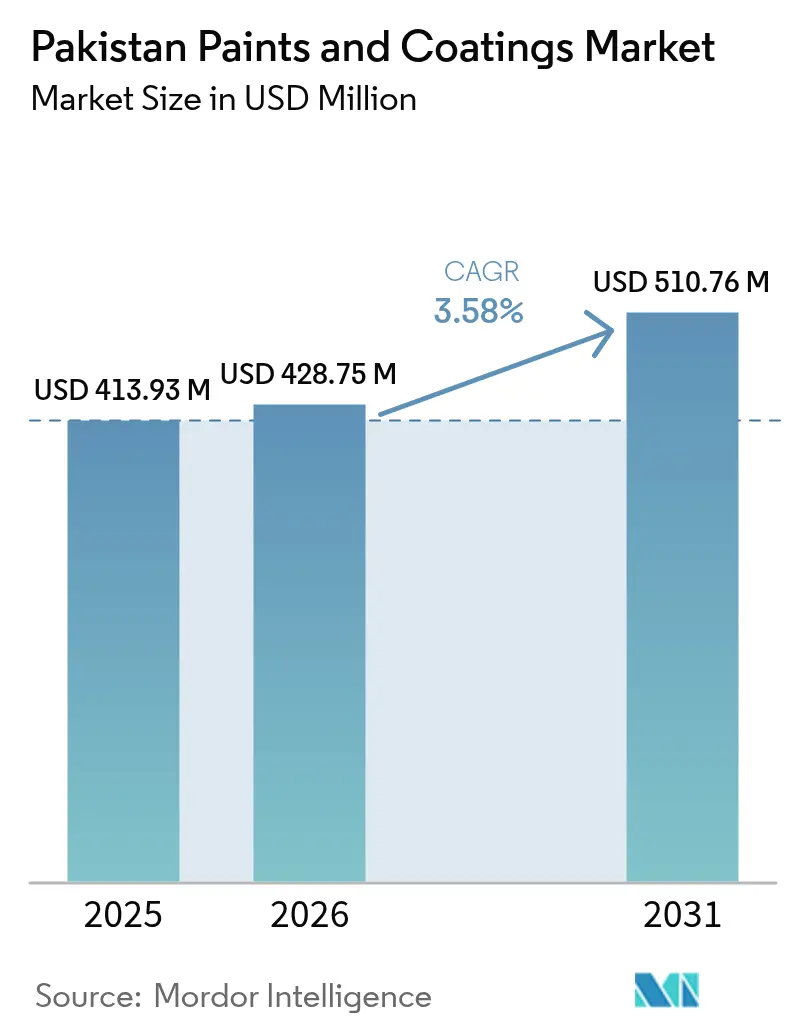
| Base Year Market Size (2025) | USD 413.93 Million |
| Market Size (2026) | USD 428.75 Million |
| Market Size (2031) | USD 510.76 Million |
| Growth Rate (2026 - 2031) | 3.58 % |
| Market Concentration | High |
Major Players *Disclaimer: Major Players sorted in no particular order Image © Mordor Intelligence. Reuse requires attribution under CC BY 4.0. | |
Pakistan Paints And Coatings Market Analysis by Mordor Intelligence
Pakistan Paints And Coatings Market size in 2026 is estimated at USD 428.75 million, growing from 2025 value of USD 413.93 million with 2031 projections showing USD 510.76 million, growing at 3.58% CAGR over 2026-2031. Moderate yet steady growth reflects the country’s return to macro-economic stability, supported by a 4.2% GDP growth outlook and a contained inflation target of 7.5% that preserves consumer purchasing power. CPEC Phase 2 investments, accelerated Special Economic Zone roll-outs, and a Rs 1,000 billion Federal PSDP allocation are widening the opportunity set for protective, road-marking, and maintenance coatings. Simultaneously, the import duty structure that favors water-borne inputs—such as 0% on ethylene glycol—reinforces a long-term technological shift toward environmentally compliant, low-VOC systems.
Key Report Takeaways
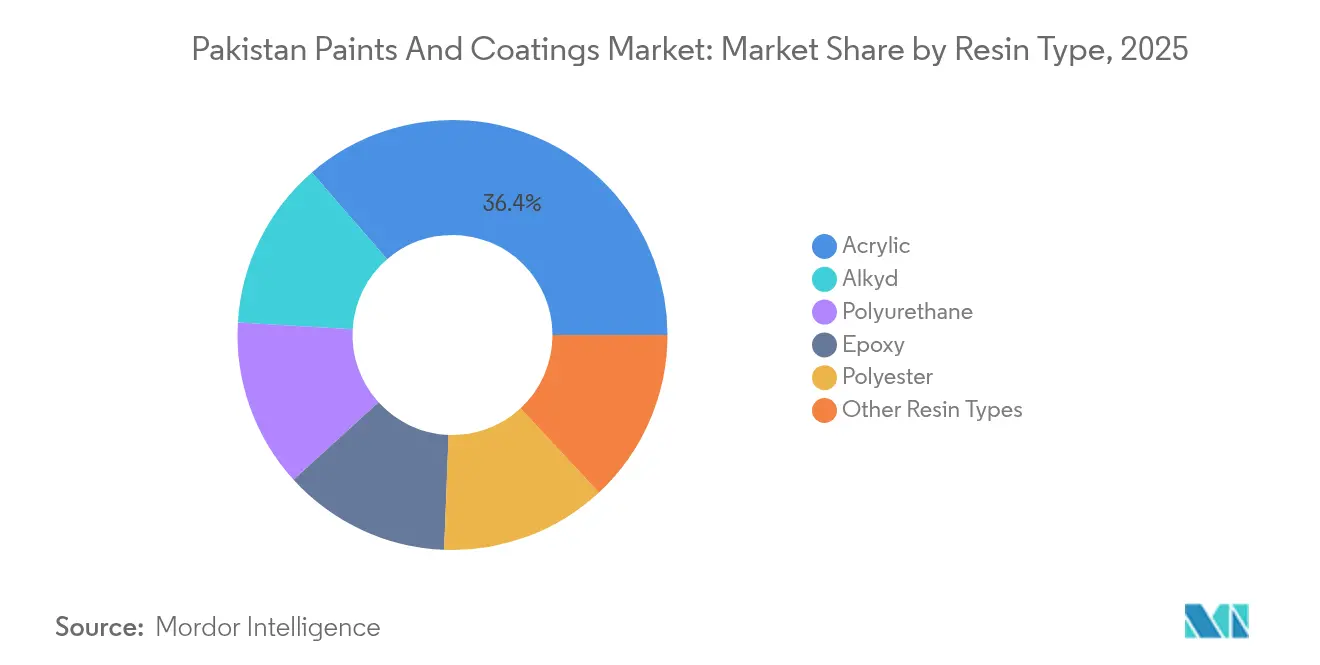
- By resin type, acrylic products captured 36.35% of Pakistan paints and coatings market share in 2025 and is forecasted to grow at a CAGR of 4.93% through 2031.
- By technology, water-borne systems accounted for 49.58% of the Pakistan paints and coatings market size in 2025 and are forecast to grow at a 4.81% CAGR through 2031.
- By end-user, architectural coatings commanded 64.42% of the Pakistan paints and coatings market size in 2025 and are projected to register the fastest 5-year CAGR at 3.92%.
Note: Market size and forecast figures in this report are generated using Mordor Intelligence’s proprietary estimation framework, updated with the latest available data and insights as of 2026.
Pakistan Paints And Coatings Market Trends and Insights
Drivers Impact Analysis*
| Drivers | (~) % Impact on CAGR Forecast | Geographic Relevance | Impact Timeline |
|---|---|---|---|
| Govt-backed affordable housing and infra boom | +1.2% | National, Punjab and Sindh urban centers | Medium term (2-4 years) |
| Rapid urbanization spurring decorative demand | +0.8% | National; Karachi, Lahore, Islamabad | Long term (≥ 4 years) |
| Shift toward low-VOC water-borne coatings | +0.6% | National; regulated industrial zones | Medium term (2-4 years) |
| Appliance and 2/3-wheeler boom lifts powders | +0.4% | National; manufacturing hubs | Short term (≤ 2 years) |
| E-commerce and onsite tinting widen reach | +0.3% | Urban centers with strong digital networks | Short term (≤ 2 years) |
| Source: Mordor Intelligence | |||
Government-Backed Affordable Housing and Infrastructure Boom
Federal support for subsidized housing and the PKR 328 billion earmarked for transport infrastructure in the 2025-26 PSDP are expanding coating demand across residential, road, and public‐works projects[1]. CPEC Phase 2, which now features five industrial corridors and an operational Rashakai SEZ, is translating into sizable protective-coating opportunities for bridges, power plants, and heavy equipment. Steel capacity expansion from 4 million t to 9 million t, negotiated under Sino-Pak agreements, further raises consumption of high-performance anti-corrosion systems. Budgeted fiscal surpluses and USD 14.3 billion in foreign-exchange reserves strengthen public-investment execution, cushioning demand from cyclical setbacks. Amid these programs, Pakistan paints and coatings market participants that align supply chains, tinting services, and credit terms with large contractors are positioned to outpace sector averages.
Rapid Urbanization Spurring Decorative Demand
A 40.1% urbanization rate and a 3.8% rise in construction GDP in FY 2025 sustain city-center residential starts and renovation spending. Karachi, Lahore, and Islamabad record increased remittance inflows—USD 32 billion in 2025—that lift discretionary incomes for home improvement and premium finishes. While national cement output contracted 7.2%, selective demand in high-density neighborhoods preserved order books for decorative producers focused on mid- to high-end emulsions. Diamond Paints’ expansion of integrated manufacturing at Sunder Industrial Estate illustrates how local champions capture this trend through responsive lead-time and color-matching capabilities. The push toward healthier indoor environments is also nudging buyers toward low-VOC, odor-free options, advancing the long-run transition to water-borne chemistries.
Shift Toward Low-VOC Water-Borne Coatings
Punjab Environmental Quality Standards enforce strict emission ceilings that are raising compliance costs for solvent-based manufacturers and accelerating water-borne adoption. Independent testing in Karachi found 40% of solvent paints exceeding the 100 ppm lead limit, intensifying regulatory scrutiny and consumer distrust. Scientific work on styrene-acrylic façade coatings demonstrated dirt-resistant performance that matches or outperforms traditional alkyds, validating broader market acceptance. As petrochemical volatility still inflates solvent-raw-material costs, the relative total-cost advantage of water-borne lines is improving, particularly for export-oriented textile and appliance plants subject to international audits. Producers that invest in modular dispersion units and automated tinting for water-borne SKUs are therefore expected to gain share within the Pakistan paints and coatings market.
E-Commerce and Onsite Tinting Widen Reach
Mobile-first consumers in Pakistan’s urban corridors now benefit from 82 million broadband SIMs and a maturing branchless-banking ecosystem that enable direct-to-home paint retailing. Brighto Paints’ automatic tinting kiosks and “model shops” illustrate how local brands replicate multinational retail standards at lower cost while extending into GCC export markets that delivered Rs 400 million in sales in 2024. Portable tinting units further minimize waste by in-situ color matching, reducing returns and boosting contractor loyalty. Online platforms also bypass fragmented wholesalers, improving margin capture and order visibility for capacity planning. Manufacturers that integrate ERP-linked e-stores and live inventory feeds are therefore winning shelf space in the Pakistan paints and coatings market’s long-tail geographies.
Restraints Impact Analysis*
| Restraints | (~) % Impact on CAGR Forecast | Geographic Relevance | Impact Timeline |
|---|---|---|---|
| Volatile TiO₂ and petro-chemical prices | -0.9% | Global supply chain; all Pakistani regions | Short term (≤ 2 years) |
| Energy shortages and high tariffs | -0.7% | Punjab and Sindh industrial belts | Medium term (2-4 years) |
| Large informal sector undercutting prices | -0.5% | Urban and peri-urban retail clusters | Long term (≥ 4 years) |
| Source: Mordor Intelligence | |||
Energy Shortages and High Tariffs
Capacity payments of PKR 2.8 trillion to idle plants keep industrial tariffs between 13 and 17.5 US cents/kWh, double some regional peers, eroding cost competitiveness for local resin and dispersion lines[2]. Gas revisions and frequent load shedding drive smaller firms toward diesel gensets that raise unit costs and emissions. Textile exporters losing regionally competitive energy tariffs offer a cautionary parallel for paint formulators dependent on consistent heat for batch reactors and curing ovens. Government proposals to privatize loss-making Discos and to retire furnace-oil capacity promise relief beyond 2027, yet near-term uncertainty is delaying capex in high-efficiency roasting or recovery systems. Larger integrated players that deploy solar or waste-heat recovery retain a structural margin edge within the Pakistan paints and coatings market.
Large Informal Sector Undercutting Prices
The informal economy’s USD 457 billion gross value and 72.5% share of non-farm employment enable sub-scale paint shops to bypass taxes, environmental audits, and labor compliance, allowing price points up to 25% below organized brands. Occupational-safety studies reveal inadequate personal-protective equipment and unregulated solvent use in informal spray-painting, underscoring public-health concerns and reputational risk for the sector. As formal producers spend on wastewater treatment, lead-free pigments, and ISO certifications, price wars compress margins and disincentivize research and development. Digitized invoicing and tax amnesties may eventually entice small operators into the formal fold, yet enforcement resources remain thin, prolonging competitive distortions in the Pakistan paints and coatings market.
*Our forecasts treat driver/restraint impacts as directional, not additive. The impact forecasts reflect baseline growth, mix effects, and variable interactions.
Segment Analysis
By Resin Type: Acrylic Dominance Drives Innovation
Acrylic resins held a 36.35% of overall revenue, and is projected to rise at a 4.93% CAGR through 2031, reflecting their versatility across both decorative and industrial categories. The segment’s strength lies in superior UV resistance, color retention, and ease of formulation into water-borne dispersions that satisfy emerging environmental rules. Domestic research and devlopment has already delivered styrene-acrylic façade emulsions with proven dirt resistance on par with European benchmarks. Alkyd offerings remain relevant for metal maintenance but face gradual share loss as regulators tighten VOC and lead limits. Imports of polymeric MDI for polyurethane systems draw only 5% duty, facilitating niche growth in high-durability floor and oil-and-gas coatings that capture rising industrial capex.
Second-tier resin families—epoxies and polyesters—address protective and powder applications, respectively, and benefit from tariff preferences that encourage local blending. Polyester uptake is synchronized with powder-coating capacity aimed at appliances and two-wheelers, while epoxy primers protect critical infrastructure such as pipelines and bridges being delivered under CPEC. As multinational and domestic formulators increasingly publicize product EPDs (Environmental Product Declarations), acrylic adoption will deepen, reinforcing its leadership within the Pakistan paints and coatings market.

By Technology: Water-Borne Systems Lead Environmental Transition
In 2025, water-borne lines generated 49.58% of sector revenue, outpacing solvent systems as Pakistan Environmental Protection Act audits gain momentum. The sub-segment is forecast at a 4.81% CAGR to 2031, supported by 0% import duty on ethylene glycol and institutional buyers’ preference for low-odor top-coats in schools and hospitals. Solvent-borne demand endures in heavy-duty marine and automotive refinishes but slips as supply chains improve for high-flash water-reducible alkyds.
UV-cured and solvent-free hybrids remain embryonic yet garner pilot projects among furniture exporters targeting European compliance. Pakistan’s customs framework incentivizes early adopters through IOCO quotas and duty drawbacks, encouraging incremental capex in UV lines. As regulatory enforcement tightens, the commercial case for water-borne and powder formats strengthens, positioning them as twin growth engines.
By End-User Industry: Architectural Segment Drives Market Growth
Architectural coatings earned 64.42% of sector revenue in 2025 and are projected to grow at a 3.92% CAGR through 2031 on the back of Rs 5 billion in subsidized housing loans and rising urban renovation cycles. Decorative emulsions and exterior textures dominate volume, with premium sheens gaining traction as disposable incomes rise.
Wood-finish demand correlates with the furniture cluster in Chiniot and Gujrat, while industrial formulations protect machinery in emerging SEZs along CPEC routes. Transportation and packaging sub-segments remain specialized but benefit from railway modernization and food-and-beverage capacity additions such as Murree Brewery’s ongoing PET bottle investments. Overall, diversified demand anchors resilience in the Pakistan paints and coatings market.

Geography Analysis
Punjab is driven by Lahore’s manufacturing belt and the presence of integrated plants like the 13-acre Diamond Paints complex in Sunder Industrial Estate. Karachi’s port logistics make Sindh the import gateway for titanium dioxide and specialized additives, and its vast urban housing stock underpins decorative volumes despite slower industrial expansion. Local formulators exploit proximity to container terminals to minimize demurrage and offer faster delivery into Baluchistan and KPK.
Khyber Pakhtunkhwa emerges as a high-growth node after the Rashakai SEZ became operational on 247 acres, hosting textiles, packaging, and light-engineering tenants that source protective and floor coatings. . Rail and road upgrades on the Western Route further lower freight costs for paint distributors extending north-west. Baluchistan contributes modest revenue today but holds potential in marine and oil-storage coatings tied to Gwadar’s master plan, which includes 300 MW of new generation capacity and expanded berths. Northern urban clusters, Islamabad-Rawalpindi and Faisalabad, benefit from civil-service housing allowances and export-oriented textile mills, respectively, creating steady mid-grade decorative demand. In aggregate, regional dynamics confirm a dual core of Punjab and Sindh with emerging peripheries under CPEC, shaping supply-chain footprints in the Pakistan paints and coatings market.
Value Chain Analysis
The Pakistan paints and coatings value chain starts with upstream petrochemical derivatives (including acrylic, alkyd, epoxy, and polyurethane resins) and pigments such as titanium dioxide, with high import dependence for specialty resins and additives. Local suppliers such as Engro Polymer and Chemicals and Ittehad Chemicals cover parts of basic chemical needs, but formulators still have to manage foreign exchange availability, PKR volatility, and port-clearance lead times for critical inputs. These frictions flow through to working-capital cycles and pricing decisions.
Midstream production covers resin blending and dispersion, grinding, tint-base making, and packaging. Energy intensity makes plants sensitive to industrial power tariffs (13 to 17.5 US cents/kWh in the market context), and any reliability gaps can constrain output planning. In the downstream layer, large organized players run hub-and-spoke distribution through depots, dealers, and contractor networks, with tinting points and a growing direct-to-consumer layer in major cities. Logistics remains road-led and is often outsourced to third-party providers. With a smaller documented formal segment competing against a sizable informal base, compliance and taxation carry outsized influence on operating models, even as public procurement and contractor-led infrastructure work under the Federal PSDP and CPEC-linked nodes, including the operational Rashakai SEZ, concentrates demand for protective, maintenance, and project-spec coatings for suppliers that can deliver technical support and assured replenishment.
Competitive Landscape
Pakistan paints and coatings market features consolidation amongst major players. Multinationals AkzoNobel, Nippon Paint, and Berger Paints leverage proprietary resins and branded tinting systems, while domestic leaders Diamond Paints and Brighto Paints compete on localized formulations and agile distribution. AkzoNobel’s 25-acre Faisalabad hub integrates decorative, coil, and protective lines and signals a pivot toward capacity consolidation in South Asia following its announced divestment of Indian decorative assets to JSW Group. Strategic investments in digital color tools, ERP-linked inventory, and training academies for painters improve brand stickiness, while ESG disclosures and ISO-14001 certifications unlock procurement from multinational construction firms. Over the forecast period, analysts expect selective consolidation as energy and compliance costs favor scale, thereby raising entry barriers in the Pakistan paints and coatings market.
Pakistan Paints And Coatings Industry Leaders
-
AkzoNobel N.V.
-
Berger Paints Private Limited
-
Brighto Paints
-
Diamond Paints
-
Nippon Paint Pakistan
- *Disclaimer: Major Players sorted in no particular order

Market Opportunities and Future Outlook
Capability scaling and consolidation remain actionable opportunity themes in Pakistan paints and coatings. The April 2026 agreement for IGI Investments to acquire a controlling stake in Akzo Nobel Pakistan Limited (enterprise value of about PKR 16.22 billion) creates space for portfolio repositioning, distributor and tinting-network expansion, and plant-level efficiency programs that can better absorb high energy and compliance costs in a market where organized players face competition from a large informal segment.
Technology migration also points to specification-led whitespace. Water-borne and other lower-VOC systems are gaining commercial momentum where enforcement and institutional procurement matter, supported by the import duty structure for some water-borne inputs (including 0% duty on ethylene glycol in the market context) and by buyer scrutiny on lead and emissions. That environment supports differentiation through documented low-lead, low-odor lines, contractor training, and standardized shade and tint systems. On the industrial side, CPEC Phase 2 activity and SEZ rollout keep protective coatings relevant for bridges, plants, and heavy equipment, while export-adjacent routes add another pathway: Brighto Paints securing inclusion in Qatar’s Ashghal vendor ecosystem (reported in May 2026) provides evidence of GCC-linked specifications and approvals that Pakistani manufacturers can target. Upstream localization further supports industrial coating input security, with Engro Polymer and Chemicals commissioning a hydrogen peroxide plant in February 2025 (Rs 11.7 billion), reinforcing a broader import-substitution effort for select chemical intermediates used across industrial value chains.
Recent Industry Developments
- May 2026: Brighto Paints was reported to have secured approval and inclusion in Qatar’s Ashghal (Public Works Authority) vendor ecosystem. The listing expands addressable demand tied to government and infrastructure specifications in Qatar, strengthening an export channel beyond Pakistan’s price-competitive retail market.
- July 2025: AkzoNobel expanded its Karachi footprint through a strategic alliance with Premier Distributors. The arrangement reinforced last-mile availability and contractor servicing in the country’s largest consumption hub, where speed of replenishment and tinting support influence brand pull-through.
- September 2024: AkzoNobel hosted the Punjab Minister for Industries at its new Faisalabad plant. The engagement reflected commissioning progress and stakeholder alignment around domestic manufacturing capacity, supporting shorter lead times and greater supply reliability for decorative and protective lines.
Research Methodology Framework and Report Scope
Market Definition and Coverage
This market covers the value of paints and coatings sold in Pakistan, counted in revenue terms at the first point of sale for the product. We treat the market as coatings used for protection and appearance across buildings, vehicles, equipment, and other common applications.
Scope exclusions: We exclude painting tools and accessories, construction services and labor, and raw material feedstocks sold as standalone chemicals rather than as formulated paint or coating products.
Segmentation Overview
- By Resin Type
- Acrylic
- Alkyd
- Polyurethane
- Epoxy
- Polyester
- Other Resin Types
- By Technology
- Water-borne
- Solvent-borne
- Powder
- Others (UV cured and Solvent free)
- By End-user Industry
- Architectural
- Automotive
- Wood
- Industrial Coatings
- Transportation
- Packaging
Data Sources, Market Sizing, and Validation
Desk Research
Desk research was used to map demand anchors and supply signals that explain paint consumption in Pakistan, and then to build practical checks before we spoke with industry participants. Public sources, such as Pakistan Bureau of Statistics series on manufacturing and construction related indicators, State Bank of Pakistan releases, Pakistan Customs import and export statistics, and the Federal Board of Revenue tax and duty structure, were reviewed to understand macro pull and price pressures.
We also used technical and trade references, such as Pakistan Coating Association updates, engineering standards and safety guidance where available, and peer reviewed papers on coatings performance in hot and humid climates. This helps when we set assumptions for technology mix (for example, where performance needs drive product choice). Company annual reports and investor presentations were scanned for revenue split hints, capacity additions, and price increase commentary. Where public filings were limited, we used a paid subscription for company financials and intelligence to fill those gaps. The sources listed here are not exhaustive, and many other public documents and data releases were reviewed for collection, cross-checking, and clarification.
Primary Interviews and Surveys
Interviews and surveys with manufacturers, distributors, retailers, contractors, and procurement managers across Pakistan are used to test secondary data and clarify informal demand, pricing, channel shares, product use, and changes in construction or industrial activity. Respondents also help identify where reported trade or company data may not capture local sales patterns. Conflicting views are rechecked before assumptions and final estimates are set.
Distribution of primary research fieldwork respondents
| Company type | Respondent position |
|---|---|
| Top tier: 28% | CXOs: 18% |
| Mid tier: 47% | Functional/Unit leaders: 32% |
| Smaller Players: 25% | Managers: 50% |
Market-Sizing & Forecasting
For sizing, a top-down build was first created by reconstructing Pakistan demand pools from construction activity and repaint intensity, industrial output signals, and trade flows for finished paints and coatings, which are then translated into value using realistic price bands. We then cross-checked totals using selective bottom-up approximations, such as rolling up a sample of supplier revenues, channel checks on distributor throughput, and simple volume times average selling price tests where volume cues were available.
A few practical inputs carried most of the model weight, including housing starts and renovation cadence in major cities, public infrastructure and roads activity that affects protective and road-marking demand, the relative split of water-borne versus solvent-borne products driven by regulation and consumer preference, and import reliance when local capacity tightens. Price movement was handled carefully because the market is sensitive to currency swings and resin cost inflation, so we used interview-based bands and then stress tested them against observed price actions in public disclosures.
Forecasts were built using scenario analysis, where construction momentum, industrial maintenance spend, and inflation and FX assumptions were adjusted into base, softer, and stronger paths and then normalized back to what most interviewees described as realistic. Where direct bottom-up revenue coverage was incomplete, we applied conservative expansion factors that were tied to channel structure and informal share indicators, and then rechecked the result against the macro demand anchors.
Data Validation & Update Cycle
Validation was done through a few layers of checks, so the final number did not depend on a single input. We compared the model outputs against independent signals, such as import intensity for finished coatings, construction and manufacturing trend direction, and the implied per capita consumption level for Pakistan, and then flagged any variance that looked too high to be realistic.
When anomalies showed up, assumptions were reopened and the relevant interview pool was re-contacted to confirm what changed, such as a sharp pricing reset, a supply disruption, or a policy shift affecting duties. Before sign-off, another analyst reviews the logic and the math, and the story is tested to ensure it matches how decisions are made in this market. Reports are refreshed annually, with interim updates triggered by material events, and a final pre-delivery pass is completed so clients receive the latest updated view.
Mordor Intelligence's Pakistan Paints and Coatings Market Size Compared Against Other Published Estimates
Published market values for Pakistan paints and coatings can differ even when the topic sounds identical, because the included products and the pricing basis are not always consistent. Differences also come from how informal sales are treated, whether imports are counted at landed cost or selling price, and how quickly assumptions are refreshed when inflation and FX move.
The spread usually traces back to a few specific choices, such as whether decorative paints are blended with specialized industrial coatings, and whether road-marking and protective maintenance are counted inside the total. Another common gap is the year and currency timing used for conversion, since Pakistan has seen material volatility that can shift a USD total without any real volume change. In our model, sales are counted only for formulated paints and coatings sold into Pakistan (not application labor or tools), and that narrower inclusion is what keeps the 2025 value aligned to demand signals and channel realities, a scope choice applied by Mordor Intelligence.
Benchmark comparison
| Source | Market Size | Gaps in Research Methodology |
|---|---|---|
| Mordor Intelligence | USD 413.93 M (2025) | |
| Industry Brief A | USD 400.00 M (2023) | Often shared as a rounded directional figure with an unclear base year and limited detail on whether totals are ex-factory, retail, or import-value based, which can understate or overstate USD values during high inflation years. |
| Credit Rating Note B | USD 175.00 M (2020) | Covers mainly the organized paint segment in local currency terms and does not fully represent the full paints and coatings market, especially informal volumes and some industrial coating categories, which naturally produces a smaller total. |
The table shows that differences are mostly explained by scope and valuation point, not by a disagreement that demand exists. When the market is restricted to the organized segment or shared as a rounded figure without consistent pricing logic, the USD value can move a lot. By keeping the product definition tight and then checking it against construction activity, industrial maintenance cues, and trade signals, our estimate stays traceable to a repeatable set of assumptions.
Key Questions Answered in the Report
What is the current value of Pakistan's paints and coatings sector?
The Pakistan paints and coatings market size stands at USD 428.75 million as of 2026.
How fast is the sector expected to grow?
Mordor Intelligence forecasts a 3.58% CAGR, lifting value to USD 510.76 million by 2031.
Which resin family leads volume sales?
Acrylic resins hold 36.35% share owing to versatility and compatibility with water-borne systems.
Why are water-borne formulations gaining ground?
Stricter VOC limits under PEPA and lower import duties on key inputs favor water-borne chemistry.
Which end-use category dominates demand?
Architectural coatings represent 64.42% of total revenue, supported by subsidized housing and urban renovation.
What key challenge could slow sector growth?
Volatile titanium-dioxide and energy costs pose the largest near-term margin risks.