
Paints and Coatings Market Analysis by Mordor Intelligence
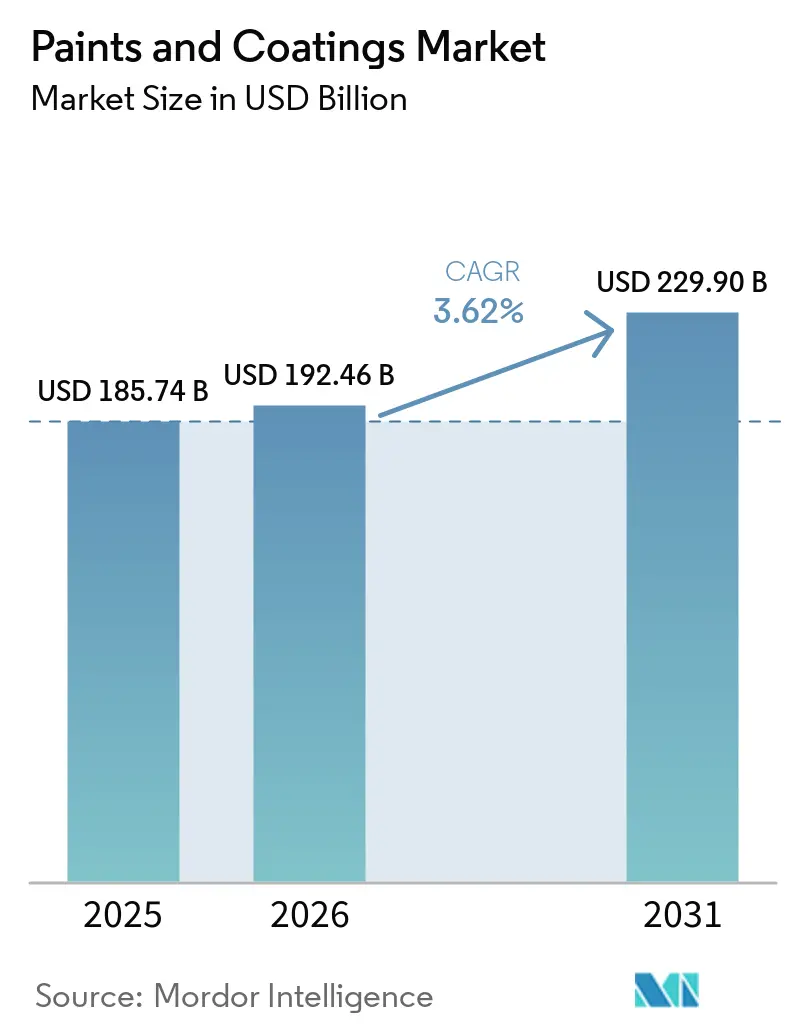
The paints and coatings market size is projected to expand from USD 192.5 billion in 2026 and USD 199.4 billion in 2027 to USD 240.8 billion by 2032, registering a CAGR of 3.84% between 2027 and 2032.
Construction-linked finishing demand in India can support growth, while vehicle manufacturing adds a separate source of coating applications. Production of water-borne automotive coatings in Southeast Asia and faster vehicle-repair basecoats connect supplier investment with specific manufacturing and application needs. Singapore's rating-linked green-building incentives can also encourage qualifying paints with low volatile organic compound (VOC) emissions for building upgrades. VOC limits on scheduled architectural coatings and EU duties on Chinese-origin titanium dioxide add formulation requirements and sourcing costs. Serving this demand therefore requires product and sourcing choices together, since replacing specialized pigment grades can add testing and reformulation work.
Key Report Takeaways
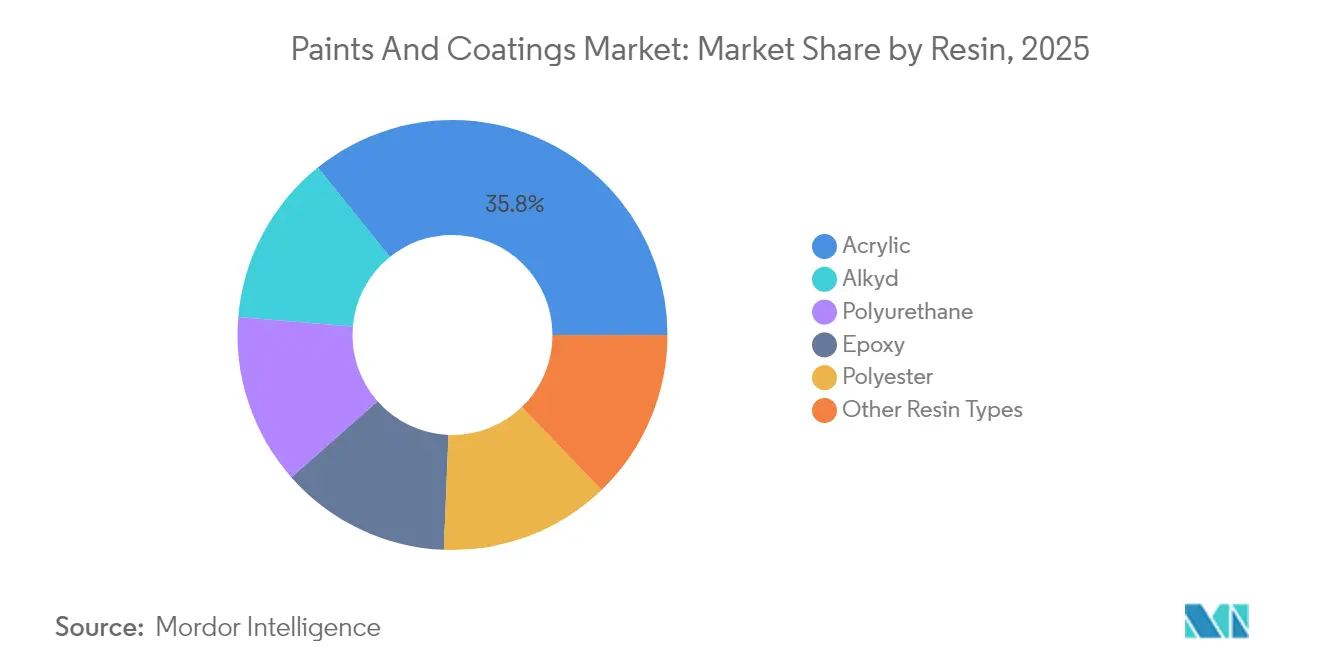
- By resin, acrylic led with a 35.88% paints and coatings market share in 2026 and is forecast to be the fastest-growing segment, with a 4.16% CAGR between 2027 and 2032.
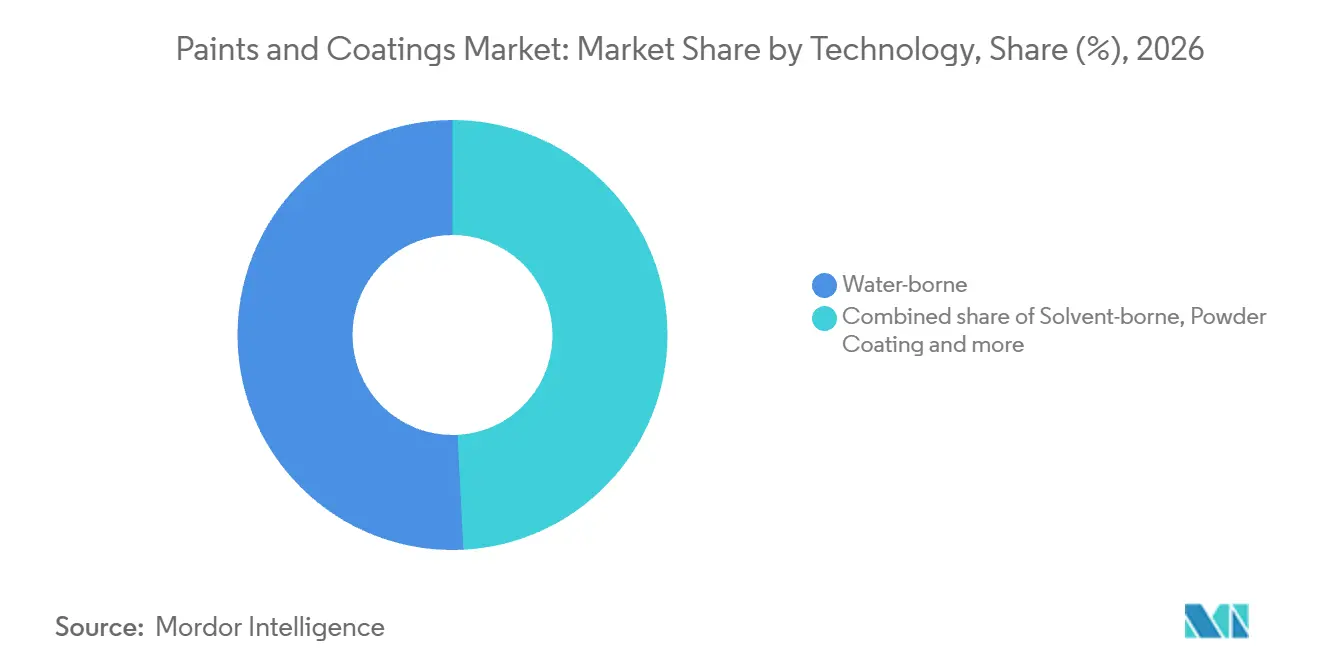
- Water-borne coatings led the technology categories with a 50.81% share of the paints and coatings market size in 2026 and are projected to be the fastest-growing segment at a 4.22% CAGR between 2027 and 2032.
- Among end-user industries, architectural coatings held the largest share, 48.56% of the market in 2026, and are forecast to be the fastest-growing segment with a 4.51% CAGR between 2027 and 2032.
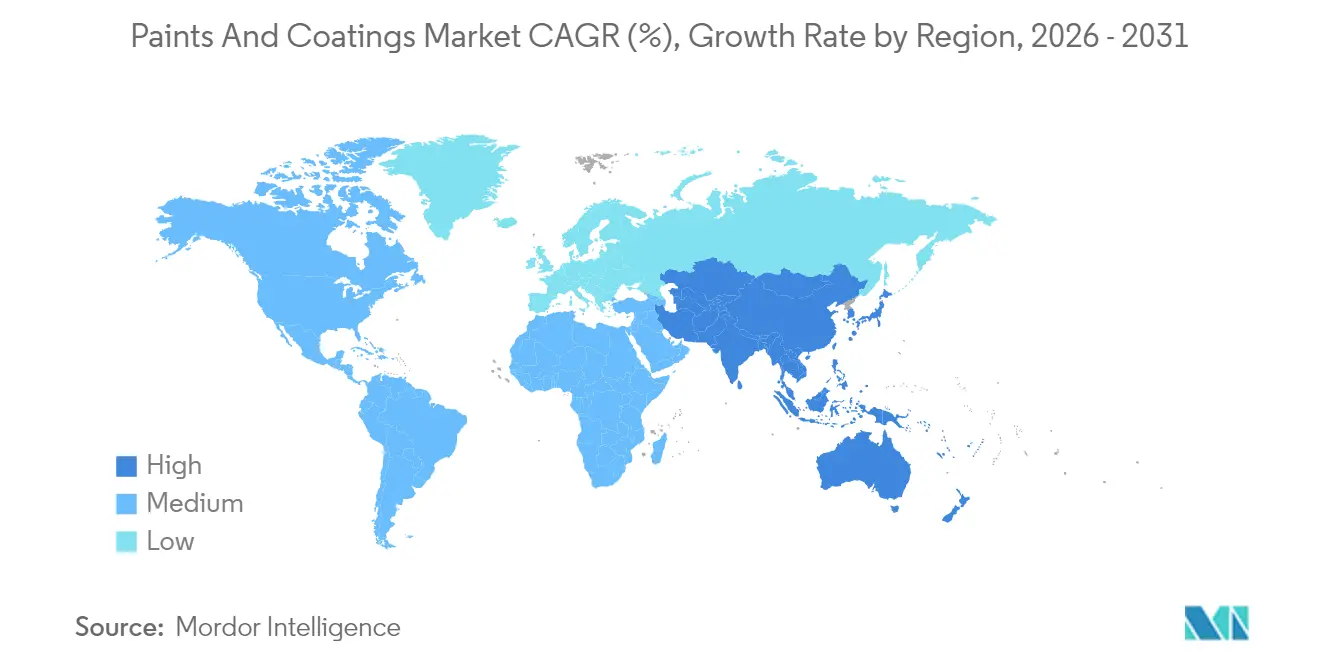
- Across geographies, Asia-Pacific led with a 46.79% share of the market in 2026 and is projected to be the fastest-growing region at a 5.13% CAGR between 2027 and 2032.
Note: Market numbers in this report are based on Mordor Intelligence's proprietary estimation framework, which combines nine months of actuals with Q4 projections for base year 2026.
Market Trends and Insights
Drivers Impact Analysis of Paints and Coatings Market*
| Driver | (~) % Impact on CAGR Forecast | Geographic Relevance | Impact Timeline |
|---|---|---|---|
| Surge in Global Residential Construction Activity | +1.65% | Commonwealth of Australia | Short term (≤ 2 years) |
| Expanding Automotive Production Volumes | +1.15% | United States and other vehicle-producing countries | Short term (≤ 2 years) |
| Rapid Urban Population Growth in APAC | +1.05% | India, Eastern and South-Eastern Asia | Long term (≥ 4 years) |
| Government Incentives for Green Building (Low-VOC) | +0.75% | Republic of Singapore | Short term (≤ 2 years) |
| Emergence of AI-Driven Color-Matching Platforms | +0.24% | Republic of Korea | Medium term (2-4 years) |
| Source: Mordor Intelligence | |||
Surge in Global Residential Construction Activity
Residential construction supports coating demand through both new project starts and the workload progressing toward delivery. Australia recorded 52,201 dwelling commencements in the June quarter of 2026, up 14.4% from the June quarter of 2025 on a seasonally adjusted basis. Seasonally adjusted completions in Australia's new private sector other residential category reached 19,018 in the June 2026 quarter, up 58.6% from the June 2025 quarter. For architectural-paint suppliers, the distinction matters because starts establish a future finishing pipeline while completions reflect projects further through construction.
Expanding Automotive Production Volumes
Higher vehicle output creates an additional production-linked route to demand for automotive finishes. Global vehicle production rose from 92.7 million units in 2024 to 96.4 million in 2025, an increase of 3.9%.[1] In July 2026, General Motors announced a USD 157 million investment in paint and modernization work at Wentzville Assembly, including processing equipment and an estimated 28,000-square-foot paint-shop expansion. General Motors' announcement commits capital to the in-house process stage where automotive coatings are applied. The 3.9% rise in global output carries the demand case for automotive finishes, while the Wentzville project shows an assembler's paint-shop capital spending rather than a measured increase in vehicle volume.
Rapid Urban Population Growth in APAC
Urban demand in Eastern and South-Eastern Asia and in India links a large city population with urban housing programs. In 2025, city dwellers totaled 1.1 billion in the UN grouping of Eastern and South-Eastern Asia with Oceania excluding Australia and New Zealand. India's Ministry of Housing and Urban Affairs sanctioned 141,000 additional houses under its PMAY-U 2.0 urban housing program on October 15, 2025. For architectural-coating suppliers, the sanctioned housing provides a specific route through which urban accommodation needs can become a future finishing workload. The commercial opportunity depends on approved homes progressing into construction.
Government Incentives for Green Building (Low-VOC)
Singapore's green-building incentive can encourage qualifying low-VOC paint specifications through its rating system. Singapore's Building and Construction Authority tiers Green Mark Incentive Scheme for Existing Buildings 2.0 funding for verified energy-work carbon savings by achieved Green Mark rating. Eligible privately owned existing buildings need at least 5,000 square meters of gross floor area, with availability ending when funds are committed or on March 31, 2027, whichever comes first. Green Mark 2021 awards one point for qualifying low-VOC interior materials, including paints, when at least 80% of common areas comply or at least 3 finishes hold Singapore Green Building Product 4-tick certification. Materials qualify through that certification or specified emission limits. Owners pursuing a higher rating therefore have a near-term reason to specify qualifying paints that can contribute to the rating determining their funding tier.
Restraints Impact Analysis of Paints and Coatings Market*
| Restraint | (~) % Impact on CAGR Forecast | Geographic Relevance | Impact Timeline |
|---|---|---|---|
| Stringent Global VOC Regulations | -0.45% | United States and Canada | Short term (≤ 2 years) |
| Volatility in Titanium-Dioxide Feedstock Prices | -0.35% | European Union and China | Short term (≤ 2 years) |
| Longer Drying/Curing Times for Water-Borne Systems | -0.2% | United States of America | Medium term (2-4 years) |
| Source: Mordor Intelligence | |||
Stringent Global VOC Regulations
For architectural-coating suppliers in Canada, VOC compliance limits which formulations can enter ordinary commercial channels. The regulations bar making, importing, or selling scheduled coatings above category-specific VOC limits, with prescribed dilution and permit exceptions. Qualifying dilution must follow written instructions that bring the coating within its limit, and labeling and bilingual-instruction conditions also apply. Specified coating uses and certain small-container products are excluded, making the applicable product category central to the compliance decision. A supplier must therefore resolve formulation, labeling and any applicable dilution or permit requirements before selling a covered coating in Canada, adding development and paperwork time ahead of a sale.
Volatility in Titanium-Dioxide Feedstock Prices
Trade measures can change titanium-dioxide sourcing economics independently of movements in the underlying pigment price. The European Commission imposed definitive anti-dumping duties on Chinese-origin titanium dioxide in January 2025, affecting a raw material used in European paints and coatings. The measure applies producer-specific rates, with individual treatment dependent on the prescribed valid commercial-invoice declaration. For EU coating producers, this means source selection involves a trade-related cost difference as well as the quoted material price. In June 2025, Teknos CEO Paula Salastie reported that European titanium-dioxide site closures after tariff implementation had reduced specialized-grade availability and supplier options, requiring additional testing and reformulation. For affected EU formulators, the remaining burden includes testing and reformulation costs as well as the import duty.
*Our forecasts treat driver/restraint impacts as directional, not additive. The impact forecasts reflect baseline growth, mix effects, and variable interactions.
Paints and Coatings Market Segment Analysis
By Resin:
Acrylic Differentiation Extends Into Binder SourcingAcrylic accounted for a 35.88% share of the paints and coatings market size in 2026 and is forecast to be the fastest-growing segment at a CAGR of 4.16% between 2027 and 2032. In May 2026, BASF and Cromology announced that Cromology would source BASF's Acronal Ccycled acrylic binder for Tollens Maxiline+ interior wall paint, described as available in France from March 2026.[2] Chemically recycled feedstock is attributed to selected products through a mass-balance approach. For manufacturers in the largest segment, this offers a route to differentiating the binder input within an established resin family.
Regional ingredient capacity creates a different commercial consideration for acrylic formulators serving African customers. BASF's Durban site supplies acrylic dispersions for paint formulation. In March 2026, BASF expanded the site's broader dispersion production capacity to supply architectural coatings, construction materials, and paper customers. For acrylic formulators in Africa, the Durban expansion adds capacity at a nearby dispersion source for architectural coatings, a supply option separate from selecting a binder for a given paint.

By Technology:
Water-Borne Growth Connects Capacity With Application ProductivityWater-borne coatings represented a 50.81% paints and coatings market share in 2026 and are forecast to be the fastest-growing segment at a CAGR of 4.22% between 2027 and 2032. Akzo Nobel N.V. launched a water-borne wood coating with 20% bio-based content in 2025, increasing the use of renewable raw materials in that product. The launch gives Akzo Nobel N.V. a renewable-content attribute to offer in wood coatings within its water-borne range.
Application productivity gives water-borne coatings a separate competitive lever within vehicle repair. Akzo Nobel N.V. launched Sikkens Autowave Optima, a water-borne vehicle-repair basecoat, in 2025. It requires one spray-booth visit and, according to the producer, enables up to 50% faster process times than conventional basecoat application methods. When a spray booth limits completed repair work, a shorter basecoat process could support more work from the same installation.
By End-user Industry:
Architectural Demand Rewards Clear Performance ChoicesArchitectural coatings were the largest segment, with a 48.56% share of the market in 2026, and are forecast to be the fastest-growing segment at a CAGR of 4.51% between 2027 and 2032. Asian Paints reported 8.7% volume growth in its India Decorative business in FY 2025-26. Across its overall coatings business in FY 2025-26, volume grew 9% while value grew 5.3%, so added volume carried a smaller revenue gain for the company.
Architectural suppliers can encounter different demand conditions across project and retail channels within the same business. PPG's Global Architectural Coatings segment recorded 2% organic sales growth in the fourth quarter of 2025. Project-related sales in Mexico recovered sequentially and retail sales were strong, while demand in Europe remained mixed. The segment's 2% organic growth therefore rested on recovering project sales in Mexico and strong retail sales, while mixed demand in Europe kept the quarter from showing a broader recovery.
Geography Analysis
Asia-Pacific Paints and Coatings Market
Asia-Pacific accounted for a 46.79% share of the paints and coatings market size in 2026 and is forecast to be the fastest-growing region at a CAGR of 5.13% between 2027 and 2032. The China National Coatings Industry Association reported that China's coatings industry produced 34.6 million metric tons in 2025, down 7.1% from 2024. By contrast, PPG commissioned a water-borne automotive coatings plant in Samut Prakan, Thailand, on March 20, 2025, with annual capacity of 2,000 metric tons for basecoats and primers serving growing Southeast Asian demand. Local basecoat and primer capacity gives Southeast Asian automotive buyers an additional supply route within the region.
North America and Europe show why a global supplier's volume trajectory cannot be applied uniformly across regions. PPG reported higher sales volume in the United States and Canada in 2025, while its European sales volume decreased. South America offers a different pattern in Brazil, where 2025 paint sales rose 0.4% in real estate paints and at least 3% in the other segments compared with 2024. Brazil's slower real estate-paint expansion means a supplier focused on that application would face a different sales-growth environment from a more diversified domestic paint business.
Middle Eastern production investment and African export expansion illustrate 2 different ways to reach additional coating buyers. Makkah Paint Company launched an architectural coatings production line in Saudi Arabia in December 2025 for interior and exterior finishes serving residential, commercial, and project-based applications. Kansai Paint Co. Ltd reported in the first half of FY2025 that exports to Ghana and Angola had commenced. The Saudi example links local production to several building applications, while the African example shows a supplier extending its reach through distinct national export destinations.
Regulatory Framework and Outlook
The comparison covers selected jurisdictions whose paint-composition and market-access rules create different compliance tasks. Policy attractiveness is assessed for manufacturers and importers supplying the covered finished paints and coatings. These products face different combinations of formulation limits, testing, and labels, making the precise product category central to compliance effort. Brazil's exceptions cover qualifying industrial or marine copper-oxide-biocide antifouling and zinc-powder anticorrosive paints up to 600 ppm, alongside products manufactured, imported, or entering import processes before commencement.
Regulatory Table of Paints and Coatings Market
| Decision factor | India | United States | United Kingdom | Brazil | Saudi Arabia | South Africa |
|---|---|---|---|---|---|---|
| Primary authority | Central Pollution Control Board | U.S. Environmental Protection Agency | Local authorities in England, Scotland, and Wales; Northern Ireland district councils; Scottish Environment Protection Agency for specified already-regulated processes | Competent executive authority under Law 15,441 | Saudi Standards, Metrology and Quality Organization (SASO) | National Department of Health and provincial/port-of-entry Environmental Health Practitioners |
| Key instruments or direction | Household and decorative paint lead rules | 40 CFR part 59, subpart E aerosol-coating standards | 2012 Paints Regulations for specified paint, varnish, and vehicle-refinishing products | Law 11,762/2008 and adopted Law 15,441/2026 | Paints-and-varnishes technical regulation; environmental label mandatory from October 1, 2026 | GNR 4832 of May 17, 2024, lead-in-paint regulations |
| Commercial effect | Annual product lead testing by an authorized agency before marketing household/decorative paints | Reactivity-compliance testing and electronic reporting | Category VOC limits and VOC labels for covered marketed products | Laboratory-tested lead below 90 ppm by weight on dry/nonvolatile basis after the scheduled transition, subject to statutory exceptions | Accredited-body conformity certificate and SASO environmental-label license for covered products | Lead-limit compliance labels and imports through designated ports |
| Current policy attractiveness | Medium | Medium | Medium | Medium | Low | Medium |
| Future direction of policy attractiveness | No change | Hardening | No change | Hardening | No change | No change |
| Source: Mordor Intelligence | ||||||
India's recurring testing duty supports a continuing compliance workload, while updated United States aerosol testing and reporting become fully mandatory on January 17, 2027. The UK review recommended retaining core VOC provisions alongside narrower exemption and reporting changes, supporting continuity for ordinary covered paint products. Brazil's overlapping residential and children's-use products face a lead-prohibition threshold scheduled to fall from 600 ppm to 90 ppm 12 months after the new law's June 29, 2026, publication. Saudi Arabia's conformity certification and mandatory environmental-label license create a more burdensome entry path, while South Africa's established lead-labeling and import-port duties support a continuing compliance requirement.
Value Chain Stages
The value chain compares how ingredient supply, coating production, customer access, and application services generate supplier revenue. BASF supplies dispersions, resins, and additives for architectural, vehicle, and industrial coating formulations. PPG combines manufacturing and distribution with coating-application services, illustrating how a producer can participate beyond the sale of finished material.
Value Chain Analysis Table of Paints and Coatings Market
| Primary activity | Key participants | Value capture | Bottleneck | Resilience response |
|---|---|---|---|---|
| Ingredient supply | Coating ingredient suppliers such as BASF | Dispersions, resin, and additive sales | Matching ingredients to different formulation requirements | Develop qualified alternatives for specific applications |
| Coating manufacture | Integrated coating producers such as PPG Industries, Inc. | Finished-coating sales | Raw materials are the largest production cost component at PPG | Contract with multiple sources and identify alternative materials or technology where possible |
| Retail and contractor access | Company-operated paint retailers such as The Sherwin-Williams Company | Controlled-brand coating and related-product sales | Maintaining local service coverage for contractors and homeowners | Align store service capacity with local customer needs |
| Application and technical service | Producer-operated coating service providers such as PPG Industries, Inc. | Coating-application and support-service revenue | Coordinating coating work with customer production | Link application scheduling to customer production milestones |
| Source: Mordor Intelligence | ||||
Sherwin-Williams' Paint Stores Group operated 4,853 specialty paint stores in the United States, Canada, and the Caribbean at December 31, 2025.[3] This scale shows why control of customer access can distinguish producers alongside formulation capability. PPG's application services add another earnings route, but also link delivery to work performed on customers' parts and assembled products. Sherwin-Williams' company-operated stores and PPG's application work on customers' parts both make uninterrupted coating supply a condition for capturing downstream earnings.
Competitive Landscape
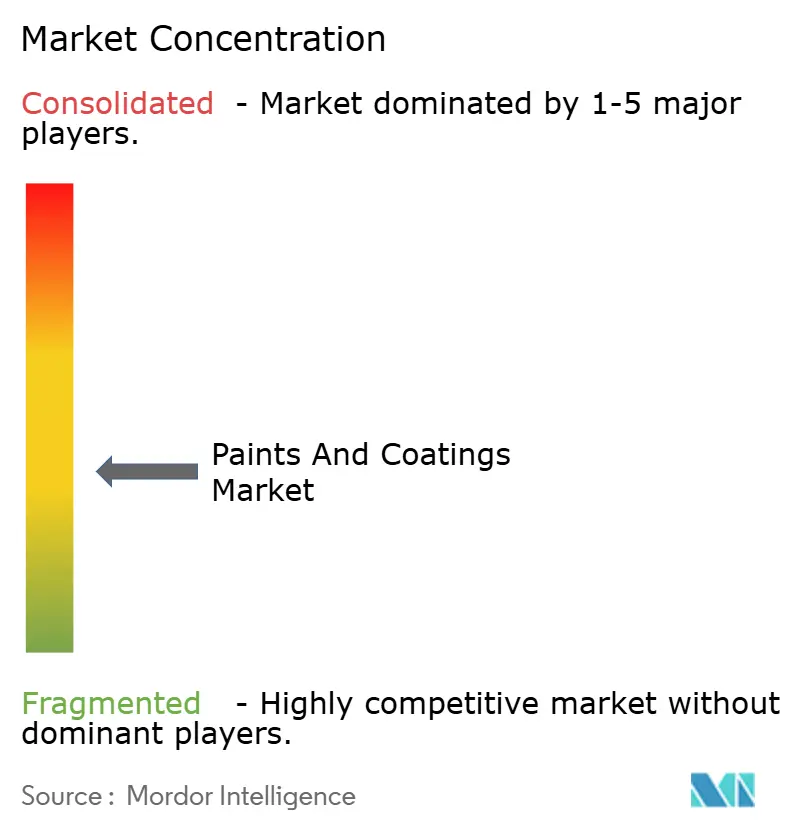
Multinational suppliers combine broad operations with regional brands, as The Sherwin-Williams Company's Consumer Brands Group demonstrated by completing its acquisition of Brazilian architectural coatings leader Suvinil in 2025. Nippon Paint Holdings Co., Ltd. reported consolidated, whole-company revenue growth of 11% and adjusted operating profit growth of 38% in FY2025 compared with FY2024. PPG Industries, Inc. manufactures and distributes paints and coatings, while Surventis (formerly BASF Coatings) supplies coatings and surface treatments. Akzo Nobel N.V. is a global paints and coatings producer, placing another broad supplier alongside businesses with distinct distribution and surface-treatment roles.
On July 1, 2026, Surventis completed its carve-out from BASF, backed by Carlyle and Qatar Investment Authority, with BASF retaining a 40% stake. Funds managed by Carlyle, in partnership with Qatar Investment Authority, majority-own the business, placing majority ownership outside its former chemicals parent. Akzo Nobel N.V.'s FY2025 revenue fell 5% year over year, while organic sales were flat as higher price and mix offset lower volumes. On October 15, 2026, Akzo Nobel N.V. and Axalta reported independent operations pending their proposed merger's closing, expected in early 2027 subject to regulatory approvals and customary closing conditions. Akzo Nobel N.V.'s volume pressure makes sales retention a separate competitive challenge while the proposed combination follows its conditional path to closing.
Technology can shape competition by solving a specific application problem while matching buyers' formulation requirements. In April 2026, PPG launched NUTRISHIELD MAX PPG7590, the first U.S. PVC-NI, one-component coil coating for aluminum draw-redraw cans and easy-open ends containing wet pet food. PVC-NI means polyvinyl chloride non-intent, and the system is designed to eliminate mixing and changeovers. Pet-food brands, coil coaters, and can manufacturers approved the product, showing acceptance across several roles in the packaging chain. PPG's food-packaging coatings manager presented the product as offering compliance in a fast-moving regulatory landscape, which ties the one-component design to regulatory positioning as well as plant simplicity.
Paints and Coatings Industry Leaders
-
The Sherwin-Williams Company
-
Nippon Paint Holdings Co., Ltd.
-
PPG Industries, Inc.
-
Surventis
-
Akzo Nobel N.V.
- *Disclaimer: Major Players sorted in no particular order
Paints and Coatings Market Companies Covered in this Report
- Akzo Nobel N.V.
- Asian Paints
- Axalta Coating Systems Ltd.
- Surventis
- Beckers Group
- Benjamin Moore & Co.
- Berger Paints India
- Chugoku Marine Paints, Ltd.
- DAW SE
- Hempel A/S
- Jazeera Paints
- Jotun
- Kansai Paint Co. Ltd
- Masco Corporation
- NATIONAL PAINTS FACTORIES CO. LTD.
- Nippon Paint Holdings Co., Ltd.
- NOROO Paint & Coatings Co., Ltd.
- PPG Industries, Inc.
- RPM International Inc.
- Russian Paints Company
- SK Kaken Co. Ltd
- The Sherwin-Williams Company
Key Opportunities for Market Participants
The comparison separates 3 voluntary certification opportunities by intended coating use and the evidence needed to qualify. On December 17, 2025, the European Commission established EU Ecolabel criteria for decorative paints, performance coatings, and water-based aerosol spray paints, valid through December 31, 2032. Applicants must meet every applicable requirement and complete assessment and verification to obtain recognition for an eligible product.
Market Opportunities Table of Paints and Coatings Market
| Opportunity | Why now | Buyer / lead segment | Recommended play | Main barrier | Likely beneficiaries |
|---|---|---|---|---|---|
| Certification of eligible pigmented decorative building paints | Defined decorative-product route under the new framework | Architectural paints for buildings, trim, and fittings | Assemble applicable performance tests and supplier declarations for selected paint lines | Applicable spreading-rate and wet-scrub tests plus pigment-content documentation | Decorative-paint manufacturers able to provide required test evidence |
| Certification of eligible building-performance coatings | Separate group for certain one-pack and multi-pack products | Building coatings within Directive 2004/42/EC subcategories 1.1(i) and 1.1(j) | Select qualifying applications and build a product-specific compliance dossier | Product verification, including documentation for any non-film-forming synthetic polymer microparticle use | Eligible building-performance coating formulators with documented products |
| Certified water-based aerosols for targeted building decoration | Dedicated aerosol product group within the framework | Consumer and professional users of ready-to-use spray paints | Develop eligible valved metal-pack products for building trim and fittings | Product verification covering the eligible formulation and packaged spray product | Water-based aerosol-paint manufacturers with verifiable eligible products |
| Source: Mordor Intelligence | |||||
These openings place different formulation and documentation tasks behind a shared certification route, making product selection central to execution. Aerosol eligibility excludes solvent-based products, specified flammable aerosols and biocidal products, road-marking aerosols, and substitutes for conventional paints on large wall and ceiling surfaces. Applicants using synthetic polymer microparticles for non-film-forming purposes must declare their nature, quantity, and purpose and justify improved overall environmental performance, generally through a comparison with the product without them. With Decision 2025/2607 replacing the 2014 criteria, decorative-paint applicants have a concrete preparation route because the Commission's January 2026 checklist identifies applicable spreading-rate and wet-scrub test reports and high-refractive-index white pigment declarations.
Recent Industry Developments in Paints and Coatings Market
- Oct 2026: Dörken acquired German paints and coatings manufacturer J.W. Ostendorf from Fidelium Partners on October 15. The companies will operate independently with their own management teams and organizational structures.
- Oct 2026: Henkel completed its acquisition of Netherlands-based Stahl on October 1, adding specialty coatings for flexible materials after closing conditions, including regulatory approvals, were fulfilled.
- Sep 2026: Sherwin-Williams opened its expanded paint plant in Statesville, North Carolina, on September 30. Improvements covered nearly 50,000 square feet, including additional production space, automation, and 4 new rail spurs.
Paints and Coatings Market Report Scope and Research Methodology
Market Definition and Coverage
The global paints and coatings market measures annual spending on pigmented paints and coatings sold for application to substrates worldwide. It values finished coating products by sales revenue, with resin and application technology describing product types and end-user industries and regions classifying those sales.
Scope exclusions: Unpigmented clear coatings and varnishes sold without pigment, separately sold coating inputs including pigments, binders or resins, solvents and additives, and paint and coating application labor or contractor fees are excluded.
Segments Covered in This Report
- By Resin
- Acrylic
- Alkyd
- Polyurethane
- Epoxy
- Polyester
- Other Resin Types
- By Technology
- Water-borne
- Solvent-borne
- Powder Coating
- UV-cured Coating
- By End-user Industry
- Architectural
- Automotive
- Wood
- Protective Coating
- General Industrial
- Transportation
- Packaging
- By Geography
- Asia-Pacific
- China (Including Taiwan)
- India
- Japan
- Indonesia
- Australia and New Zealand
- South Korea
- Thailand
- Malaysia
- Philippines
- Bangladesh
- Vietnam
- Singapore
- Sri Lanka
- Rest of Asia-Pacific
- North America
- United States
- Canada
- Mexico
- Europe
- Germany
- United Kingdom
- France
- Italy
- Benelux
- Russia
- Turkey
- Switzerland
- Scandinavian Countries
- Poland
- Portugal
- Spain
- Rest of Europe
- South America
- Brazil
- Argentina
- Colombia
- Chile
- Rest of South America
- Middle-East
- Saudi Arabia
- Qatar
- United Arab Emirates
- Kuwait
- Egypt
- Rest of Middle East
- Africa
- South Africa
- Nigeria
- Algeria
- Morocco
- Rest of Africa
- Asia-Pacific
Data Sources, Market Sizing, and Validation
Desk Research
Desk research uses sources such as the American Coatings Association and World Coatings Council to frame global coating categories, regional coverage, end-use markets, and links between customer production and coating demand. The International Organization of Motor Vehicle Manufacturers provides vehicle output indicators for automotive coatings, while the European Commission's paints and varnishes criteria describe regulatory product groups and formulation requirements.
Company annual reports, investor materials, reputable business press, and public statistical releases can supplement these sources by clarifying producer sales, capacity changes, raw-material exposure, construction activity, and vehicle production trends. These sources are illustrative rather than exhaustive, and further sources inform collection, validation and clarification.
Primary Interviews and Surveys
Interviews and structured surveys can include coatings producers, distributors, formulators, and purchasing or technical leaders from architectural, automotive, and industrial end uses across APAC, EMEA, and the Americas. Questions test secondary findings on sales definitions, channel coverage, resin and technology mix, realized selling prices, regional demand, and forecast drivers. Analysts reconcile conflicting answers with public evidence, document unresolved gaps, and triangulate estimates across producer, channel, and end-use perspectives.
Distribution of primary research fieldwork respondents
| Company type | Respondent position | Region |
|---|---|---|
| Top tier: 35% | CXOs: 20% | APAC: 40% |
| Mid tier: 40% | Functional/Unit leaders: 35% | EMEA: 30% |
| Smaller Players: 25% | Managers: 45% | Americas: 30% |
Market-Sizing & Forecasting
The estimate starts with a top-down view of worldwide producer sales for finished pigmented coatings, then checks selected totals through supplier revenue roll-ups, distributor channel checks, and sampled average selling price times volume. Resin, technology, end-use, and regional shares are built from published category splits, producer product and application disclosures, regional sales patterns, and end-market demand indicators, with overlapping categories checked to avoid double counting. Key indicators include housing starts and renovation activity for architectural paints, vehicle production for automotive coatings, industrial production for manufacturing uses, infrastructure investment for protective coatings, and resin and pigment input prices for selling-price and mix changes. Forecasts apply scenario analysis to expected end-market activity, technology adoption, regulatory changes, and pricing, with regional and segment assumptions reviewed separately. Interviews can test whether each variable's direction and timing fit industry conditions. Where supplier or channel evidence is incomplete, analysts use available public revenue and trade indicators, retain uncertainty in working assumptions, and compare selective bottom-up checks with the top-down total.
Data Validation & Update Cycle
Analysts triangulate producer disclosures, association and government indicators, trade data, and channel evidence, then investigate large variances against prior periods and independent demand signals before sign-off. A second review checks market boundaries, currency and unit consistency, segment shares, regional totals, and forecast assumptions. A material contradiction or unexplained outlier triggers source review or respondent re-contact. The dataset is refreshed annually, reviewed between cycles when material acquisitions, regulatory changes, or production disruptions alter market conditions, and given a fresh pre-delivery review.
Mordor Intelligence's Paints and Coatings Market Size Compared Against Other Published Estimates
Published estimates can differ in the transactions and products they count and the inputs used to model demand. The global paints and coatings market measures annual spending on pigmented paints and coatings sold for application to substrates worldwide.
Key Gap Drivers include the study's defined coverage and market-specific modeling choices. Resin, technology, end-use, and regional shares are built from published category splits, producer product and application disclosures, regional sales patterns, and end-market demand indicators, with overlapping categories checked to avoid double counting.
Benchmark comparison
| Source | Market Size | Gaps in Research Methodology |
|---|---|---|
| Mordor Intelligence | USD 199.4 B (2027) | |
| Global Consultancy A | USD 279.58 B (2025) | At its 2025 base, this estimate is 40.2% above this report's 2027 value of USD 199.4 B, 2 years later. Its stated application coverage includes aerospace, marine, and consumer-goods uses alongside construction and automotive applications, which can add sales beyond narrower end-use groupings. |
| Global Consultancy B | USD 185.7 B (2025) | At its 2025 base, this estimate is 6.9% below this report's 2027 value of USD 199.4 B, 2 years later. The published series rises from its 2025 base through 2027, so the earlier measurement year precedes additional forecast growth. |
Mordor Intelligence's analysts triangulate producer disclosures, association and government indicators, trade data, and channel evidence, then investigate large variances against prior periods and independent demand signals before sign-off.
Key Questions Answered in the Report
What is the projected paints and coatings market size by 2032?
The market is projected to reach USD 240.8 billion by 2032, with a CAGR of 3.84% between 2027 and 2032.
What is driving demand for paints and coatings?
Residential construction, vehicle production, and urban housing programs support demand. India sanctioned 141,000 additional urban houses under PMAY-U 2.0 on October 15, 2025.
Which coating technology leads the industry?
Water-borne coatings led with a 50.81% share of the market in 2026 and are forecast to grow at a CAGR of 4.22% between 2027 and 2032.
Which companies are major paint and coating suppliers?
Major suppliers include The Sherwin-Williams Company, Nippon Paint Holdings Co., Ltd., PPG Industries, Inc., Surventis, and Akzo Nobel N.V.
What is a key compliance challenge for architectural paint suppliers?
Canada restricts scheduled architectural coatings above category-specific VOC limits, with prescribed dilution and permit exceptions.
Which region has the largest share of the paint and coating sector?
Asia-Pacific held a 46.79% share of the market in 2026 and is forecast to be the fastest-growing region, with a CAGR of 5.13% between 2027 and 2032.