
Market Overview
| Study Period | 2020 - 2031 |
|---|---|
| Forecast Data Period | 2026 - 2031 |
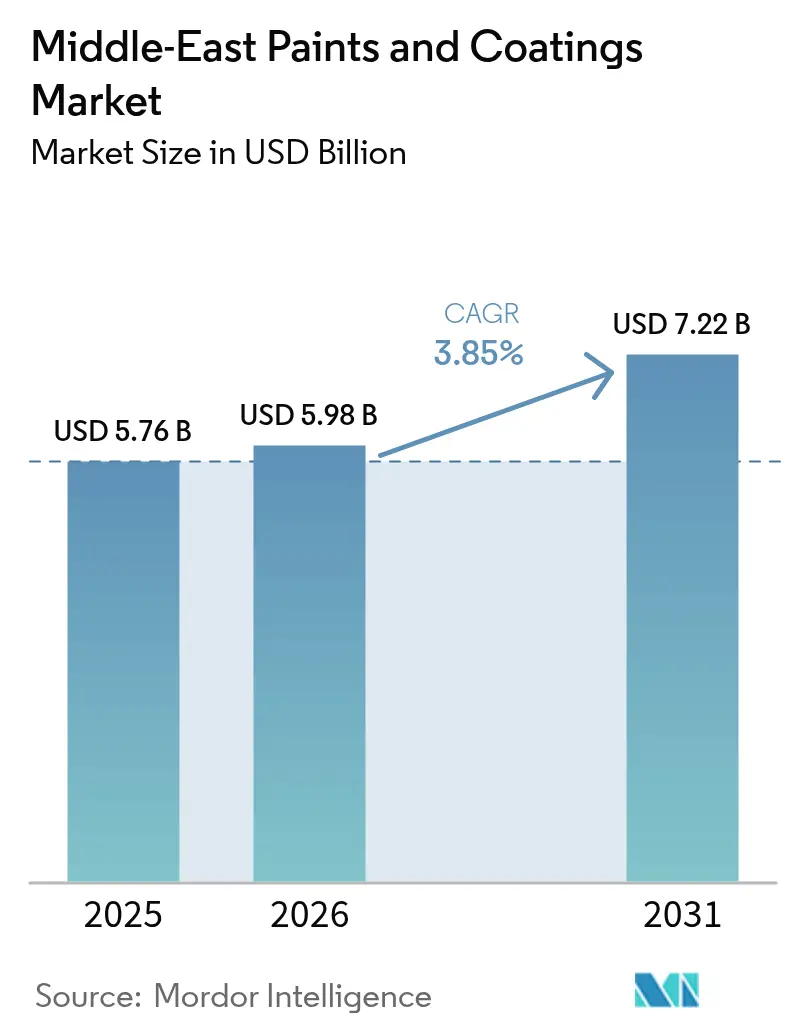
| Base Year Market Size (2025) | USD 5.76 Billion |
| Market Size (2026) | USD 5.98 Billion |
| Market Size (2031) | USD 7.22 Billion |
| Growth Rate (2026 - 2031) | 3.85 % |
| Market Concentration | Medium |
Major Players *Disclaimer: Major Players sorted in no particular order Image © Mordor Intelligence. Reuse requires attribution under CC BY 4.0. | |
Middle-East Paints And Coatings Market Analysis by Mordor Intelligence
The Middle East Paints and Coatings Market size in 2026 is estimated at USD 5.98 billion, growing from 2025 value of USD 5.76 billion with 2031 projections showing USD 7.22 billion, growing at 3.85% CAGR over 2026-2031. Solid demand visibility comes from tourism-led giga-projects, strict low-VOC rules, and localization incentives that enlarge both volume and value pools. Firms able to supply water-borne, self-cleaning, or highly durable polyurethane systems secure pricing leverage, while those tied to solvent-borne chemistries face the costs of reformulation. Local manufacturing expansion in Saudi Arabia and the UAE shortens lead times and limits currency risk. Price volatility in titanium dioxide and logistics disruptions in the Red Sea compress short-term margins, yet they also accelerate forward-buying and vertical-integration strategies. Intensifying competition raises the bar on technical service, with certified applicators now pivotal in winning large façade or pipeline jobs.
Key Report Takeaways
- By resin type, acrylics held a 34.00% share of the Middle East paints and coatings market size in 2025, and polyurethane grades are projected to grow at a 4.18% CAGR between 2026 and 2031.
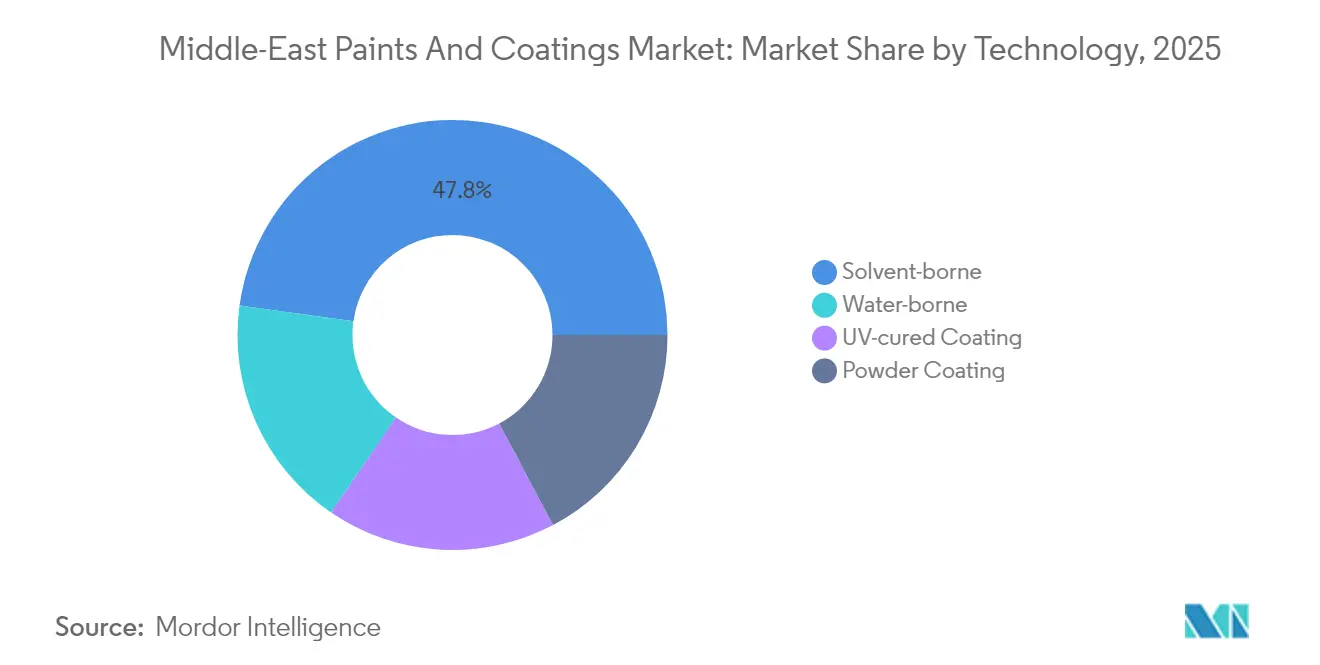
- By 2025, solvent-borne systems accounted for 47.80% of the Middle East paints and coatings market share, while water-based chemistries registered the fastest growth rate of 4.26% through 2031.
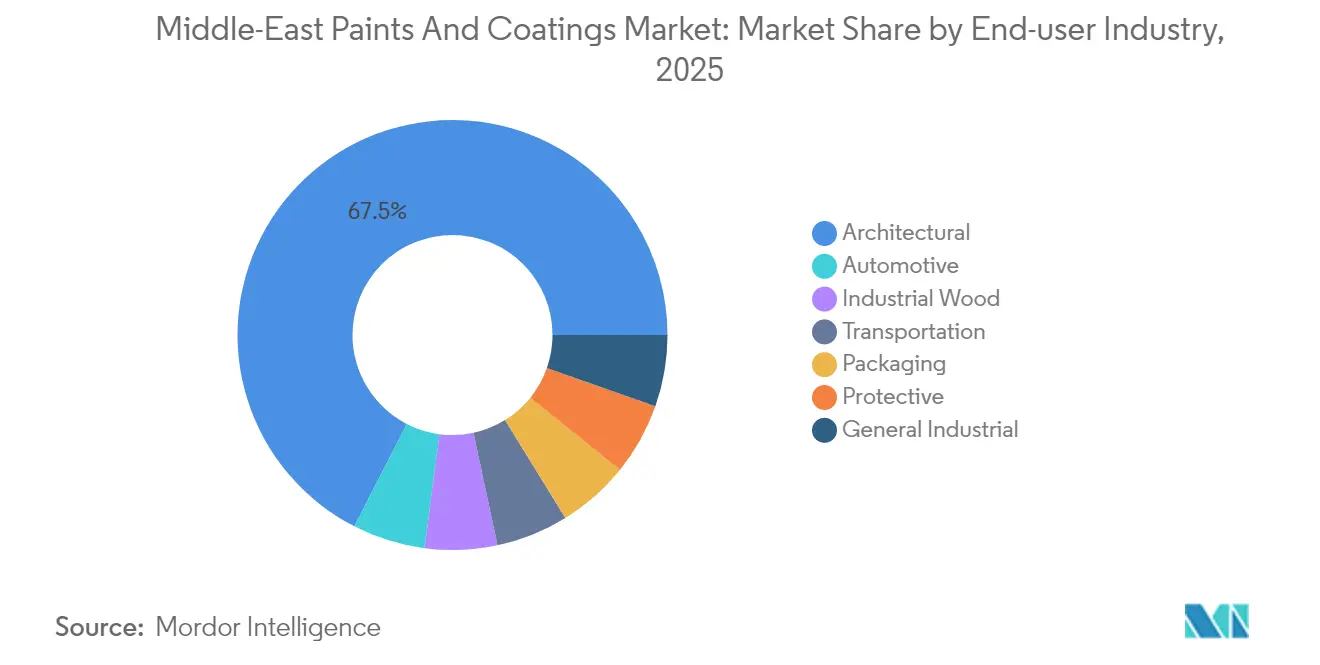
- By end-user industry, architectural coatings led with a 67.45% revenue share in 2025; the segment is expected to advance at a 4.10% CAGR through 2031.
- By geography, Saudi Arabia captured 31.05% of the Middle East paints and coatings market size in 2025 and is set to expand at a 4.55% CAGR to 2031.
Note: Market size and forecast figures in this report are generated using Mordor Intelligence’s proprietary estimation framework, updated with the latest available data and insights as of 2026.
Market Trends and Insights
Drivers Impact Analysis of Middle-East Paints And Coatings Market*
| Driver | (~) % Impact on CAGR Forecast | Geographic Relevance | Impact Timeline |
|---|---|---|---|
| Focus on tourism-led giga-projects (Saudi NEOM, Expo City Dubai) | +1.2% | Saudi Arabia, UAE core with spillover to Qatar, Oman | Long term (≥ 4 years) |
| Booming commercial and residential construction pipeline | +1.0% | Global Middle East, concentrated in GCC | Medium term (2-4 years) |
| Regulatory shift to low-VOC water-borne systems | +0.8% | GCC countries with Dubai Municipality leading | Medium term (2-4 years) |
| Localization incentives for regional paint production | +0.6% | Saudi Arabia, UAE primary with Oman emerging | Long term (≥ 4 years) |
| Rapid uptake of self-cleaning facade coatings for high-rise maintenance | +0.4% | UAE, Qatar, Kuwait urban centers | Short term (≤ 2 years) |
| Source: Mordor Intelligence | |||
Focus on tourism-led giga-projects (Saudi NEOM, Expo City Dubai)
Saudi Arabia’s USD 500 billion NEOM development and Dubai’s USD 2.7 billion Expo City extension project shift spending from cyclical construction toward permanent infrastructure that demands premium, climate-adapted coatings. NEOM’s 200,000-strong workforce creates secondary residential and commercial builds that multiply coating volumes, while the focus on architectural icons shifts preferences toward polyurethane and self-cleaning products. These projects, therefore, convert temporary exhibition or hospitality structures into long-term asset classes that require higher-value maintenance cycles[1].
Booming commercial and residential construction pipeline
A USD 3.9 trillion MENA project pipeline ensures a predictable pull for the Middle East paints and coatings market across the decade. The UAE’s USD 590 billion commitments and Saudi Arabia’s USD 1.5 trillion backlog include high-value mixed-use towers, downstream energy plants, and logistics hubs that require both corrosion-resistant and decorative systems. Energy–linked contracts, such as ADNOC’s AED 720 million local procurement award, increase protective-coating volume in harsh, salt-laden environments.
Regulatory transformation toward low-VOC systems
More than 27,000 unified Gulf standards now govern coating chemistry, while Dubai Municipality VOC thresholds, bilingual safety data sheets, and SABER certification in Saudi Arabia move compliance close to European norms. The rulebook rewards firms that already conduct water-borne R&D, thereby accelerating the 4.41% CAGR for compliant systems. Initial formulation spending tightens margins, yet the medium-term prize is preferred-supplier status in public contracts.
Localization incentives for regional paint production
Saudi Vision 2030 and the UAE’s “Make it in the Emirates” program anchor tariff breaks, grant funding, and domestic-content rules. SIPCO’s January 2025 purchase of Premium Paints and Oman’s USD 300 million polymer plant demonstrate how regional value chains are transitioning from import models to integrated hubs, reducing freight exposure and driving scale benefits for early movers.
Restraints Impact Analysis of Middle-East Paints And Coatings Market*
| Restraint | (~) % Impact on CAGR Forecast | Geographic Relevance | Impact Timeline |
|---|---|---|---|
| Volatility in petro-derived raw-material prices | -0.7% | GCC, especially UAE and Saudi Arabia | Short term (≤ 2 years) |
| Stricter VOC and indoor-air-quality compliance costs | -0.4% | GCC early adopters | Medium term (2-4 years) |
| Shortage of certified spray-application labour | -0.3% | UAE, Qatar, Kuwait | Short term (≤ 2 years) |
| Source: Mordor Intelligence | |||
Raw-material price volatility pressures margins
Titanium dioxide hovering near USD 1,974 per metric ton and Red Sea shipping delays force producers to boost safety stocks, stretch working capital, and hedge feedstocks. While GCC petrochemical expansion is expected to ease long-term resin supply, short-term price swings still closely mirror global energy markets. Smaller regional firms, lacking integration or procurement scale, feel the squeeze hardest, hastening them as takeover targets for well-capitalized rivals.
Compliance costs challenge solvent-based incumbents
Water-borne conversions demand new dispersion equipment, employee training, and parallel inventory during the transition. Dubai Municipality’s label-traceability rules and SABER digital audits mean non-compliant batches risk border rejections. Large multinationals spread their R&D outlays across global portfolios, while niche regional players either partner for technology or exit low-margin lines[2].
*Our forecasts treat driver/restraint impacts as directional, not additive. The impact forecasts reflect baseline growth, mix effects, and variable interactions.
Middle-East Paints And Coatings Market Segment Analysis
By Resin Type:
Polyurethane narrows the gap with acrylicAcrylics controlled 34.00% of the market in 2025, thanks to their affordability; however, polyurethanes posted the fastest 4.18% CAGR through 2031, as specifiers seek UV resistance and a long lifecycle in desert sun. Epoxy and alkyd grades hold niche roles in oil-and-gas and heritage restoration work. Investment in hybrid chemistries, led by research from the Technology Innovation Institute on soft-material composites, hints at next-generation blends that merge the cost efficiency of acrylic with the robustness of polyurethane. Manufacturing footprints expand accordingly, with National Paints' lifting capacity to 264 million liters to serve premium growth pockets.
Deadline-driven giga-projects reward suppliers able to scale polyurethanes without sacrificing color consistency or cure time. As plant numbers increase, regional buyers negotiate shorter lead times and in-country technical service support, embedding local labs within Saudi and Emirati industrial zones. This dynamic raises the floor for quality across the Middle East paints and coatings market and deepens barriers to low-spec imports.
By Technology:
Water-borne chemistries outpace yet do not displace solvent-borneSolvent-borne systems still represent 47.80% in 2025, but water-borne grades advance at 4.26% CAGR on the back of VOC limits and welfare concerns for applicators laboring in enclosed, climate-controlled spaces. Powder and UV-cure segments accelerate in specialty equipment casings, fixtures, and high-speed furniture lines, aided by Qemtex’s 10,000-tonne UAE plant. DELTA Coatings’ new Dubai site, which runs partly on solar power, increases polyurea output for fast-return pipeline and tank linings.
During the next five years, regulators and end-users will converge on a performance-plus-compliance mindset, transforming water-borne from a cost-premium option into the baseline for public tenders. Vendors wielding on-site tinting hubs and digital color-matching win contracts by guaranteeing exact shade replication despite quick-dry constraints. The mix shift therefore builds volume for dispersant, neutralizing amine, and rheology-modifier suppliers inside the Middle East paints and coatings market.

By End-User Industry:
Architectural segment remains the growth engineArchitectural projects commanded a 67.45% share in 2025 and are expected to continue growing at a 4.10% CAGR through 2031. Towers, resorts, and smart-city districts pivot away from basic whitewash toward textured, fade-resistant, and dirt-shedding solutions. Automotive coatings are expected to follow as Saudi and Emirati vehicle-assembly corridors mature, while pipeline corrosion programs increase protective-coating demand in Abu Dhabi and the Eastern Province.
Interior designers and real estate investors now issue tender documents stipulating solar-reflective index values and antimicrobial ratings. These add-ons boost average selling prices and reward firms that bundle paint, warranty, and applicator training. As product SKUs proliferate, distributors are adopting e-catalogs, stock-optimization software, and same-day tint delivery to builders, thereby strengthening their ties to leading brands in the Middle East paints and coatings market.
Geography Analysis
Saudi Arabia Paints and Coatings Market
Saudi Arabia’s robust 4.55% CAGR springs from public-sector capital flows into diversified industry parks, leisure islands, and green energy platforms. Contract models emphasize domestic labor and on-shore suppliers, prompting multinationals to co-invest in Jubail or Yanbu facilities. The shift accelerates innovation centers focused on testing and training for arid-climate products.
United Arab Emirates Paints and Coatings Market
The UAE remains a leading market for product launches, thanks to Dubai’s design-centric real estate landscape and Abu Dhabi’s energy megaprojects. Government purchasing rules that grant preference to VOC-compliant portfolios accelerate waterborne penetration. Logistics services improve as the Khalifa Port Free Zone offers bonded warehousing and re-export incentives to the wider GCC.
GCC Paints and Coatings Market
Qatar, Kuwait, and Oman form the next tier. Qatar targets façade makeovers in economic zone expansions around Hamad Port. Kuwait revitalizes petrochemical assets, demanding high-build epoxy novolacs. Oman’s Sohar and Duqm corridors position the sultanate as both a raw-material and finished-goods node, cushioning freight risk for the wider Middle East paints and coatings market.
Regulatory Landscape
Across the Middle East, paints and coatings compliance is anchored by GCC Standardization Organization (GSO) standards and country-level enforcement, with Saudi Arabia and the UAE setting the pace on VOC control and product documentation. In Saudi Arabia, market entry hinges on conformity requirements under SASO and digital verification through the SABER platform, while GSO standards such as GSO 1914 define VOC limits for decorative and architectural coatings (with category limits specified for interior and exterior finishes). The GSO catalogue has also continued to broaden coverage for specific coating classes, including GSO 2753:2024 for automotive refinishing oven-dry topcoats and GSO 2801:2025 for one-component solvent-based acrylic intumescent fireproofing paint for steelworks.
In 2026, Saudi Arabia tightened compliance signals further through SASO actions tied to the Technical Regulation for paints and varnishes, including a voluntary period starting in April 2026 for an Environmental Performance Efficiency Label for paints and varnishes, with mandatory implementation following in October 2026. Separately, SASO issued Technical Regulation TR-IND-2026-04 in May 2026 to revoke a VOC-limit exemption for water-based industrial coatings and expand testing requirements, raising the bar for lab validation, documentation, and batch traceability. In the UAE, a layered framework combines federal oversight (MOCCAE), Dubai Municipality VOC limits (commonly referenced via DMS requirements), and green building programs such as Estidama Pearl in Abu Dhabi and LEED-driven tender specifications, which together push formulators toward low-VOC and water-borne systems and place greater weight on compliant labels and safety data sheet readiness.
Value Chain Analysis
The Middle East paints and coatings value chain starts with upstream petrochemical and minerals inputs (resins, solvents, additives, pigments such as titanium dioxide), then moves through regional formulation, tinting, packaging, and quality-control labs located in industrial zones across the GCC. Formulators sell through a mix of direct-to-project channels (architectural and protective jobs tied to mega-projects and energy assets), specification-driven distributors, and retail branches, with technical service and certified applicator networks influencing conversion in large facade, pipeline, and tank-lining work. Free zones and logistics hubs in the UAE and Saudi Arabia support re-export across the GCC, while conformity processes (including Saudi SABER) add an additional compliance step that affects lead time and inventory planning.
Operationally, the chain faces two key pressure points: import exposure for critical intermediates and periodic logistics disruption that affects inbound feedstocks and pigments. In early 2026, long-route shipping and higher insurance costs tied to regional tensions and chokepoint risk increased landed costs and stretched lead times, particularly for specialty pigments and effect materials where lead times can extend into multi-week windows. Producers have responded by localizing blending and manufacturing in dedicated industrial zones, including January 2026 actions in Abu Dhabi when Jotun Abu Dhabi signed a 50-year land lease with KEZAD Group for an AED 450 million manufacturing facility in KEZAD Musaffah, and by Asian Paints in November 2025 plans (via Berger Paints Emirates) for a 55,800 KL per year manufacturing plant in KEZAD. These moves shift the value chain toward more in-region production and buffering capacity, improving service levels for project-driven demand while increasing the importance of local raw-material sourcing strategies and working-capital discipline.
Competitive Landscape
The Middle East Paints and Coatings Market is moderately fragmented. Capital outlays are shifting toward plant automation, energy-efficient reactors, and on-site solar arrays, helping to keep unit costs in check even as electricity subsidies decline. Technology collaborations emerge, with Axalta partnering with Gulf universities on thermal-reflective topcoats and Hempel forming a partnership with ADNOC for in-service hull performance tracking. Training centers in Dubai and Dammam fill certified applicator gaps and create lock-in for preferred spray equipment and consumables. White space lies in smart or functional coatings—anti-carbonation concretes, anti-viral interiors, and roof membranes that reduce HVAC load. Smaller innovators team up with Emirates-based venture funds to scale niche chemistries, eyeing exit routes via trade sale to the large formulators once pilot adoption hits breakeven. As MEPCA harmonizes testing protocols, product approvals accelerate, reducing market entry lead times.
Middle-East Paints And Coatings Industry Leaders
-
Akzo Nobel N.V.
-
Jotun
-
Jazeera Paints
-
Hempel A/S
-
NATIONAL PAINTS FACTORIES CO. LTD.
- *Disclaimer: Major Players sorted in no particular order

Middle-East Paints And Coatings Market Companies Covered in this Report
- Akzo Nobel N.V.
- Asian Paints Berger
- Axalta Coating Systems
- Beckers Group
- Caparol Paints
- Hempel A/S
- Henkel AG & Co. KGaA
- Jazeera Paints
- Jotun
- Kaizen Paint Middle East FZCO
- National Paints Factories Co. Ltd
- Nippon Paint Factories Co. Ltd
- PPG Industries Inc.
- Ritver Paints & Coatings
- RPM International Inc.
- Sigma Paints
- Tambour
- Terraco UAE Ltd
- The Sherwin-Williams Company
- Thermalite Middle East
Market Opportunities and Future Outlook
A central opportunity area is the build-out of localized feedstock and intermediates supply that improves availability and cost stability for coating binders and related inputs, reducing reliance on long-haul imports during periods of shipping disruption. Concrete evidence includes Ta'ziz and Alpha Dhabi signing a partnership agreement in May 2026 targeting USD 10 billion of capital investment to expand the industrial chemicals ecosystem in Al Ruwais Industrial City, and Ta'ziz confirming in May 2026 that its first phase (including ammonia, methanol, and PVC plants) remains on track for completion in 2028, following the November 2025 award of a USD 1.99 billion EPC contract for a large-scale PVC complex in the UAE. On the Saudi side, Tasnee completed a USD 500 million expansion of the SEPC ethylene cracker in Al Jubail Industrial City in July 2026, increasing olefins capacity, which supports broader availability of petrochemical building blocks used across coatings and packaging value chains.
On the demand side, whitespace continues to open in performance-plus-compliance coating systems that align with low-VOC and green-building procurement while addressing hot-climate durability needs in architectural and protective applications. Regulatory tightening in 2026 in Saudi Arabia, including labeling and expanded testing scope under SASO technical requirements, reinforces demand for water-borne and documented, traceable product portfolios across public and large-project tenders. This creates room for suppliers that can pair compliant formulations with local lab support, fast color-matching, and applicator training. Recurring logistics stress around regional shipping routes has also elevated the business case for in-country blending hubs, bonded warehousing, and dual-sourcing of pigments and additives, particularly for higher-value systems where project schedules penalize stockouts.
Recent Industry Developments in Middle-East Paints And Coatings Market
- May 2026: Jazeera Paints opened its first branch in Doha, Qatar, on Salwa Road through an arrangement with Al Hattab Trading Company as its exclusive distributor in Qatar. The move expands the companys physical retail and service footprint beyond its core Gulf markets and supports closer access to architectural and maintenance demand in Qatar.
- February 2026: Hempel partnered with AlKarar to introduce a customer-focused paint retail concept store in Bahrain. The new format strengthens last-mile availability and specification support, helping Hempel compete more effectively in decorative and light industrial segments where service and shade accuracy influence repeat purchases.
- January 2026: Jotun Abu Dhabi signed a 50-year land lease with KEZAD Group to establish an AED 450 million manufacturing facility in KEZAD Musaffah, Abu Dhabi, covering 83,177 square meters. The long-tenor commitment signals deeper localization of manufacturing and supply resilience for the UAE and wider GCC, improving lead times for project-driven architectural and protective coatings.
Middle-East Paints And Coatings Market Report Scope and Research Methodology
Market Definition and Coverage
This market is measured as the value of paints and coatings sold for decorative and protective use across buildings and industrial applications within the Middle East, counted at the point where products are supplied into the market in USD.
Scope exclusions: This sizing does not count adjacent chemicals like printing inks, adhesives, sealants, or construction chemicals that are not sold and specified as paints or coatings.
Segments Covered in This Report
- By Resin Type
- Acrylic
- Alkyd
- Polyurethane
- Epoxy
- Polyester
- Others (Silicone, Vinly, Fluoropolymer)
- By Technology
- Water-borne
- Solvent-borne
- Powder Coating
- UV-cured Coating
- By End-user Industry
- Architectural
- Automotive
- Industrial Wood
- Protective
- Transportation
- General Industrial
- Packaging
- By Geography
- Saudi Arabia
- United Arab Emirates
- Qatar
- Kuwait
- Oman
- Bahrain
- Iran
- Iraq
- Rest of Middle East
Data Sources, Market Sizing, and Validation
Desk Research
Desk research was used to set the market boundary, identify demand drivers, and ground the model with public data points that can be checked by readers. Sources reviewed included official construction and macro releases such as national statistics offices in the region, central bank indicators, and government infrastructure and housing updates, followed by trade flows and unit values from UN Comtrade and national customs portals.
To keep the coating demand story realistic, we also referenced sources such as industry and standards bodies (for example, ISO and regional standards agencies), peer reviewed papers that discuss resin and technology shifts, and trade association publications related to coatings and surface protection. Company annual reports, investor presentations, and press releases were used to understand capacity moves, product mix, and country exposure, and then selected paid subscriptions for company financials and for shipment level import and export checks were used to validate directionally. These examples are not exhaustive, and many other public sources were reviewed for data collection, cross-checking, and clarification.
Primary Interviews and Surveys
Interviews and surveys with manufacturers, distributors, applicators, raw-material specialists, and project buyers across the Middle East are used to test secondary data and fill gaps in country coverage. Respondents help clarify demand timing, pricing, product mix, and construction activity, particularly where published trade or production data are incomplete. Responses are compared before the final model is adjusted.
Distribution of primary research fieldwork respondents
| Company type | Respondent position |
|---|---|
| Top tier: 28% | CXOs: 18% |
| Mid tier: 47% | Functional/Unit leaders: 31% |
| Smaller Players: 25% | Managers: 51% |
Market-Sizing & Forecasting
The model starts with a top-down build where country-level construction activity and industrial output indicators are used to reconstruct the coatings demand pool, and then the total is converted into value using price and mix assumptions by technology and application. Once that initial total is formed, it is corroborated with selective bottom-up approximations, such as sampled supplier and distributor revenue splits, channel checks on decorative paint throughput, and volume times average selling price sanity tests for key coating categories.
Inputs were chosen because they move paint consumption in a visible way and can be tracked each year. Examples include building permit and new project pipelines, infrastructure spending announcements and award trends, housing completions and refurbishment intensity, industrial production and PMI direction, and solvent versus water-borne shift signals tied to regulation and customer preference. Because pricing changes can swing value sizing, we also track resin and solvent cost direction, mix movement toward higher performance systems, and currency conversion timing for local reporting.
Forecasting is done using scenario analysis supported by a simple multivariate regression check. Demand drivers like construction output and industrial activity shape the base case, and expert feedback is used to adjust inflection years. When bottom-up checkpoints are incomplete for smaller countries, gap handling is done through per capita consumption ranges and import intensity logic, then reviewed again before locking the totals.
Data Validation & Update Cycle
Validation is done in multiple steps so that outliers do not silently pass through the model. We compare totals against independent signals such as paint and varnish trade values, construction output trends, and visible project cycles, then trace any large variance back to pricing, mix, or country allocation.
Before sign-off, the numbers are reviewed by another analyst, and we re-contact select respondents when a major assumption changes or a new event materially shifts supply or demand. Reports are refreshed annually, and interim updates are made when a material event occurs, followed by a final pre-delivery check so clients receive the latest view available at the time of purchase.
Mordor Intelligence's Middle East Paints and Coatings Market Size Versus Other Published Estimates
Published market values for this space can look far apart even when everyone is talking about paints and coatings, because the boundary and the timing choices are not the same. Differences usually come from what is counted as the market, which year is treated as the current value, and how pricing and country coverage are handled.
The table highlights that some sources land higher mainly when they assume a broader country set or apply a faster price and mix uplift through the forecast, while others stay closer to trade linked value signals and more moderate repaint assumptions. Currency conversion timing and whether the estimate leans on producer revenues versus apparent consumption (production plus imports minus exports) also create visible gaps, especially when import intensity differs by country.
Benchmark comparison
| Source | Market Size | Gaps in Research Methodology |
|---|---|---|
| Mordor Intelligence | USD 5.98 B (2026) | |
| Global Consultancy A | USD 7.96 B (2024) | Uses a different current year and can reflect a broader country inclusion list plus a higher implied price and mix level, which lifts the value baseline versus a consumption-anchored check. |
| Industry Publisher B | USD 5.14 B (2024) | Appears closer to a sales value view that can undercount smaller industrial coating streams and may rely on conservative repaint and project conversion assumptions for near-term demand. |
The table shows a spread that is largely explained by base year choice and what gets counted as paint and coating demand. In Mordor Intelligence's model, the market is tied to Middle East country consumption signals and technology mix checks rather than only producer revenue claims. With that structure, the final value can be rechecked through clear inputs like construction activity, industrial output, and trade consistency, which keeps the sizing steps repeatable year to year.
Key Questions Answered in the Report
What is the current value of the Middle East paints and coatings market?
It is valued at USD 5.98 billion in 2026, with a forecast to hit USD 7.22 billion by 2031.
Which segment contributes most to coating demand in the region?
Architectural applications lead with 67.45% share in 2025 and retain the fastest growth at 4.10% CAGR.
How fast are water-borne coatings growing in the Gulf?
Water-borne chemistries register a 4.26% CAGR from 2026 to 2031, outpacing the overall market.
Why is Saudi Arabia so important for suppliers?
The kingdom holds 31.05% of regional demand and posts a 4.55% CAGR, supported by Vision 2030 mega-projects.
What risks affect producers’ margins?
Feedstock price swings, shipping delays in the Red Sea, and compliance expenses tied to low-VOC rules squeeze profitability.