
Market Overview
| Study Period | 2020 - 2031 |
|---|---|
| Forecast Data Period | 2026 - 2031 |
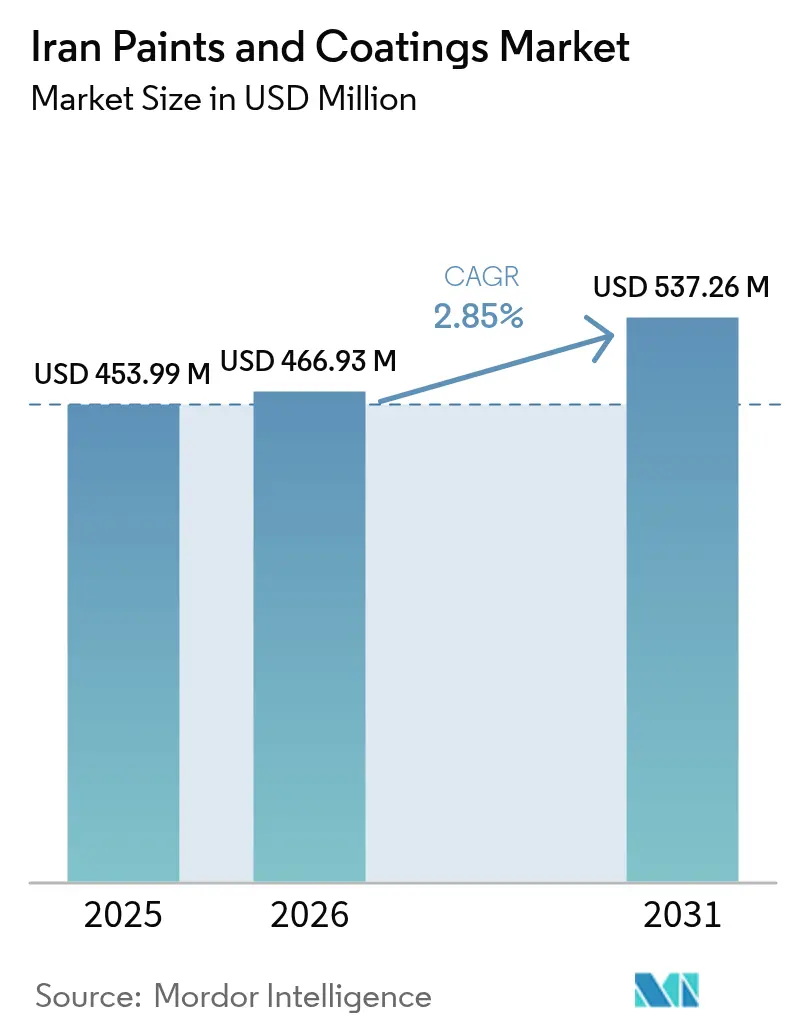
| Base Year Market Size (2025) | USD 453.99 Million |
| Market Size (2026) | USD 466.93 Million |
| Market Size (2031) | USD 537.26 Million |
| Growth Rate (2026 - 2031) | 2.85 % |
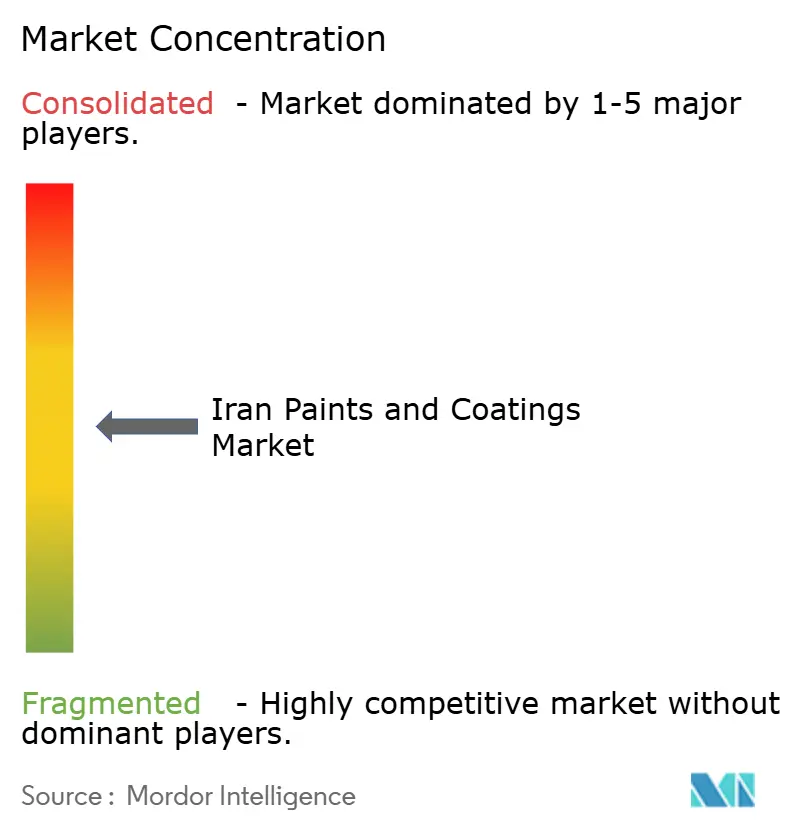
| Market Concentration | Medium |
Major Players *Disclaimer: Major Players sorted in no particular order Image © Mordor Intelligence. Reuse requires attribution under CC BY 4.0. | |
Iran Paints And Coatings Market Analysis by Mordor Intelligence
The Iran Paints And Coatings Market size was valued at USD 453.99 million in 2025 and estimated to grow from USD 466.93 million in 2026 to reach USD 537.26 million by 2031, at a CAGR of 2.85% during the forecast period (2026-2031). Demand resilience reflects a mix of state-led housing initiatives, feedstock cost advantages from the domestic petrochemical chain, and rising technical specifications in heritage and industrial maintenance coatings. Foreign investors committed USD 900 million to Iran’s chemicals and polymers sector in 2024-2025, signaling confidence in downstream processing despite sanctions-related headwinds. The market continues to benefit from acrylic and polyurethane resin integration, while compliance with Iran’s National Clean-Air Law accelerates a gradual shift toward water-borne technologies. Energy supply vulnerabilities that surfaced during the December 2024 nationwide industrial shutdown underscore the importance of operational diversification and efficiency upgrades.
Key Report Takeaways
- By resin type, acrylic resins accounted for 34.85% of Iran paints and coatings market size in 2025, while polyurethane resins represent the fastest-growing category with a 2.91% CAGR to 2031.
- By technology, solvent-borne formulations retained 64.40% revenue share in 2025; water-borne technologies are expanding at a 3.09% CAGR to 2031.
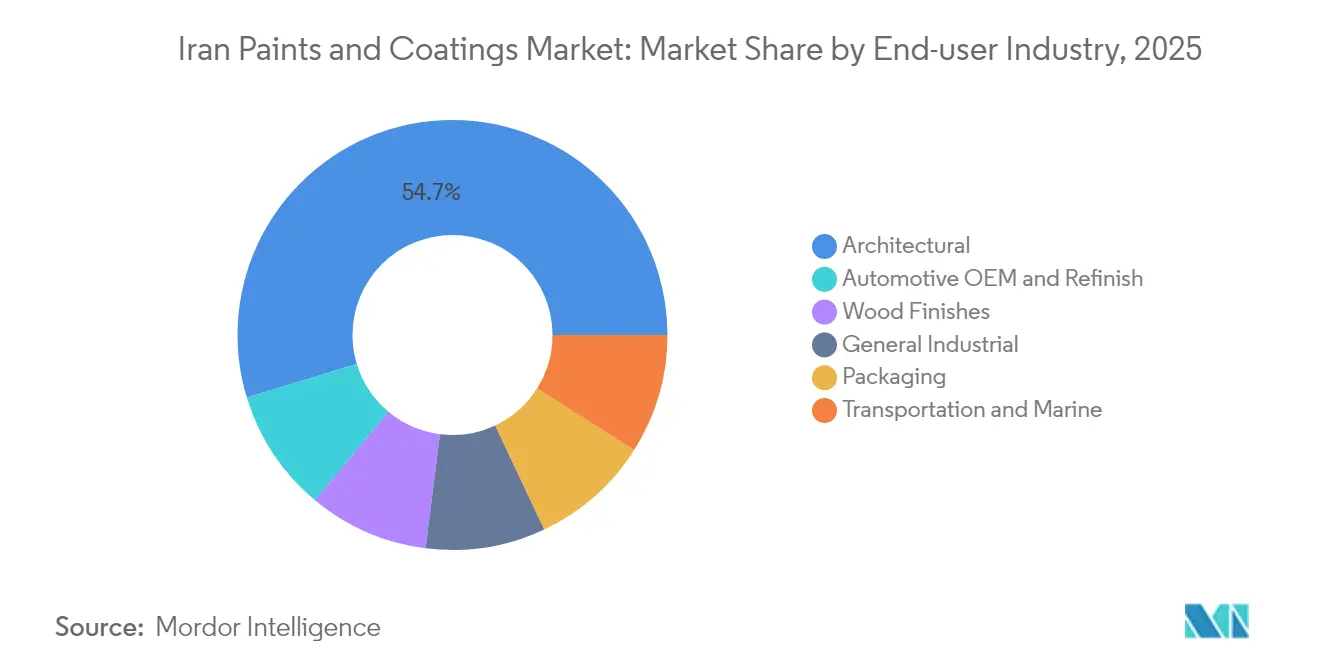
- By end-user industry, architectural applications held 54.70% of Iran paints and coatings market share in 2025, whereas automotive OEM and refinish coatings are forecast to advance at a 3.00% CAGR through 2031.
Note: Market size and forecast figures in this report are generated using Mordor Intelligence’s proprietary estimation framework, updated with the latest available data and insights as of 2026.
Iran Paints And Coatings Market Trends and Insights
Drivers Impact Analysis*
| Drivers | (~) % Impact on CAGR Forecast | Geographic Relevance | Impact Timeline |
|---|---|---|---|
| Government housing-led construction boom | +0.8% | National; Tehran, Isfahan, Shiraz | Medium term (2-4 years) |
| Surge in furniture exports to Iraq and Turkey | +0.3% | Border provinces, export zones | Short term (≤ 2 years) |
| Petrochemical feedstock cost advantage | +0.5% | Khuzestan, Fars petrochemical hubs | Long term (≥ 4 years) |
| Domestic nano-coating research and development for conservation | +0.2% | Tehran, Isfahan, Shiraz heritage sites | Long term (≥ 4 years) |
| Energy-efficiency upgrades for public assets | +0.4% | Nationwide government facilities | Medium term (2-4 years) |
| Source: Mordor Intelligence | |||
Government Housing-Led Construction Boom
State policy aims to deliver 1 million new housing units annually, sustaining baseline demand for architectural coatings across Iran’s largest cities. The 25th International Building Industry Exhibition attracted over 490 domestic exhibitors in August 2025, reflecting robust engagement between material suppliers and developers. Urbanization pressures combined with inflation-hedging behavior have elevated residential renovation activity, bolstering repaint cycles. While traditional masonry techniques prevail, interest in drywall systems and specialized interior finishes is gradually rising, creating educational opportunities for paint formulators and applicators. Continuation of the program hinges on controlling inflation and managing raw-material import costs denominated in foreign currency.
Surge in Furniture Exports to Iraq and Turkey
Greater furniture shipments are stimulating demand for performance wood coatings. Historic trade corridors facilitate outbound logistics, while localized research and development has enhanced adhesion and durability of beech, poplar, and fir substrates via nanosilver-assisted heat treatments. Compliance with importing countries’ emission standards is a prerequisite for sustained export growth. Opportunities center on low-formaldehyde clear coats and traditional decorative finishes aligned with Middle Eastern consumer preferences. Export obstacles include sanctions-related payment restrictions and limited domestic access to certain high-grade additives.
Petrochemical Feedstock Cost Advantage
Iran’s abundant ethane and condensate streams allow ethylene production costs near USD 110 per ton, roughly half European levels, underpinning competitive pricing for acrylic and polyethylene-based resins. Commissioning of the Setare Khalij Fars refinery is expected to raise naphtha and LPG supply for downstream units, further lowering variable costs for domestic coatings producers. However, allocation priorities occasionally shift toward export-oriented petrochemicals, pressuring local formulators during tight supply windows. Sanctions that curtail overseas sales can conversely redirect feedstock inward, temporarily easing pricing but limiting access to new equipment and catalysts.
Growth of Domestic Nano-Coating Research and Development for Heritage Conservation
Iranian universities and start-ups have produced hydrophobic titania–silica and bio-based nanocrystalline coatings suited to preserving historic tile and stone façades. Laboratory success has translated into pilot-scale commercialization with institutional backing from the Iran Nanotechnology Initiative Council, which supports 130+ companies nationwide. Successful heritage projects establish credibility for broader industrial applications such as anti-corrosive or self-cleaning façade paints. The niche nature of conservation limits immediate volume but yields premium margins and technology spillovers into mainstream product lines.
Restraints Impact Analysis*
| Restraints | (~) % Impact on CAGR Forecast | Geographic Relevance | Impact Timeline |
|---|---|---|---|
| Escalating U.S./EU sanctions on petrochemicals | -0.6% | Country-wide, import-dependent producers | Short term (≤ 2 years) |
| Stringent VOC and HAP limits under National Clean-Air Law | -0.4% | Major urban and industrial zones | Medium term (2-4 years) |
| Shortage of high-purity pigments and additives | -0.3% | Premium formulation facilities nationwide | Short term (≤ 2 years) |
| Source: Mordor Intelligence | |||
Escalating U.S./EU Sanctions on Petrochemicals
Renewed sanctions restrict the import of titanium dioxide, specialty additives, and modern dispersion equipment, complicating high-performance formulation work. Secondary sanctions deter European suppliers from even non-restricted transactions, forcing Iranian manufacturers toward alternative Asian sources that may entail longer lead times and variable quality[1]. Banking hurdles elevate transaction costs, while limited access to state-of-the-art QC instrumentation hampers process optimization. Larger firms are partially insulated via diversified sourcing strategies, but small and medium producers face margin compression.
Stringent VOC and HAP Limits Under National Clean-Air Law
Iran monitors air quality at more than 200 stations, and PM2.5 readings exceeding WHO guidelines are driving regulators to tighten solvent-usage thresholds. Compliance necessitates water-borne or high-solids alternatives, demanding capital investment in resin synthesis, emulsification, and bake-oven modifications. Enforcement varies by province, creating uneven competitive pressure. International brands operating local plants must often meet dual standards, complicating supply chain planning. Smaller domestic players risk fines or market exclusion if they cannot upgrade in time.
*Our forecasts treat driver/restraint impacts as directional, not additive. The impact forecasts reflect baseline growth, mix effects, and variable interactions.
Segment Analysis
By Resin Type: Acrylic Dominance Reflects Feedstock Integration
Acrylic resins commanded 34.85% of Iran paints and coatings market share in 2025 thanks to low-cost ethylene feedstock derived from national gas resources. Polyurethane resins, while a smaller slice, are expanding at a 2.91% CAGR on the strength of oil-and-gas pipeline protection systems that exploit quick-cure polyurea chemistries. Pricing volatility in titanium dioxide and other pigments has pressured all resin categories, but acrylic formulations benefit from in-house monomer access that cushions cost spikes. The Iran paints and coatings market size accruing to polyurethane is poised to rise as local research institutes refine continuous water-borne polyurethane processes that meet both performance and VOC criteria.
Domestic producers are investing in alkyd upgrades to serve mid-tier architectural clients, while epoxy and polyester systems cater to marine, powder-coating, and industrial metal finishing lines. Emerging silicone and fluoropolymer blends serve aerospace and chemical-resistant niches, although uptake is limited by equipment constraints and premium raw-material costs. Certification under ISO 9001:2015 is becoming standard for resin suppliers targeting export- oriented OEMs.


By Technology: Water-Borne Transition Accelerates Despite Solvent-Borne Dominance
Solvent-borne coatings retained 64.40% value share in 2025, reflecting entrenched production lines and applicator familiarity. Nonetheless, water-borne systems are advancing at a 3.09% CAGR, propelled by Clean-Air compliance deadlines and rising consumer awareness of indoor air quality. Domestic surfactant and coalescent manufacture supports the cost-structure shift, reducing dependence on imported solvent packages. The Iran paints and coatings market size allocated to water-borne chemistries will broaden as urban enforcement tightens and as government procurement favors low-VOC products.
High-solids and powder coatings remain niche, partly due to capital expenditure requirements for electrostatic spray booths and curing ovens. Technical guidance from the Association of Paint and Resin Manufacturers of Iran is helping smaller producers navigate formulation hurdles. Collaborative research and development agreements with Asian technology licensors are further easing performance gaps between water-borne and conventional solvent-based products.
By End-User Industry: Architectural Leadership Meets Automotive Growth
Architectural uses generated 54.70% of segment revenue in 2025, driven by the national housing program and ongoing renovation work. Automotive OEM and refinish demand is projected to post a 3.00% CAGR to 2031 as domestic vehicle assembly plants ramp up protective and decorative finish lines. Furniture-related wood coatings benefit from export-led production clusters along border provinces, while general industrial and marine applications draw on Iran’s expanding steel, petrochemical, and port infrastructure.
Nano-enhanced traffic marking paints have entered service at Isfahan Airport, demonstrating local ability to commercialize research outputs. Packaging coatings remain modest but could scale alongside Iran’s food-processing expansion. Across all end users, ISO certification and documented VOC performance are rising procurement prerequisites.
Geography Analysis
Tehran, Isfahan, and Shiraz dominate consumption due to housing activity, industrial clusters, and heritage conservation needs. Khuzestan and Fars host petrochemical hubs that supply critical resins and solvents at competitive transfer prices. Coastal provinces specialize in marine and protective maintenance coatings for port and shipyard infrastructure, while interior regions focus on architectural and wood-finishing lines aligned with furniture export processing. Border provinces leverage overland corridors into Iraq and Turkey, creating demand pockets for export-grade finishes. The Iran Nanotechnology Initiative Council’s decentralized funding has stimulated nano-coating start-ups across multiple provinces, spreading technical capacity beyond traditional industrial centers. Energy-related factory shutdowns in late 2024 exposed logistical vulnerabilities, incentivizing producers to adopt captive power or dual-fuel solutions to mitigate future disruptions.
Value Chain Analysis
Upstream supply is anchored by Iran's petrochemical chain, which provides inputs such as acrylic-oriented monomers and resins, solvents, and aromatics, supporting local cost competitiveness for mainstream architectural and industrial formulations. The value chain is still exposed to imported specialty pigments and additives, including higher-purity grades such as titanium dioxide and performance additives. Sanctions and sourcing constraints can extend lead times and introduce quality variability. Feedstock and energy reliability also affect conversion costs, consistent with the energy disruption risk highlighted in the broader market context.
Midstream conversion covers resin manufacture and paint or coating compounding by domestic producers (including Alvan Paint, Pars Pamchal, Pars Eshen, Yashm, Rangsazi Iran, and Saba Shimi Arya), followed by packaging and quality control for compliance-driven segments such as low-VOC and industrial maintenance coatings. Downstream channels include project and contractor supply for architectural coatings, OEM and industrial accounts for protective systems, and marine-linked protective logistics that draw on port-connected corridors, with Bandar Abbas often cited as a congestion-sensitive gateway for imported raw materials. Export flows into nearby markets add another layer of complexity due to payment frictions and documentation requirements under sanctions.
Competitive Landscape
The market remains moderately fragmented, with international brands such as Jotun, AkzoNobel, and Hempel competing alongside domestic leaders Alvan Paint, Rangsazi Iran, Pars Pamchal, and Daryarnag. Global players command premium industrial and marine niches, leveraging advanced corrosion-resistant and fire-protective technologies. Domestic firms rely on cost advantages, petrochemical integration, and familiarity with regulatory protocols.
Strategic focus areas include ISO 9001 certifications, product differentiation through nano-enabled functionalities, and partnerships with Iranian universities to commercialize proprietary resin and additive systems. Sanctions deter some European and North American entrants, effectively protecting local share but also limiting technology inflow. The emergence of 200 plus knowledge-based nano-technology companies is catalyzing a shift toward higher-margin specialty coatings, particularly in conservation, solar energy, and pipeline protection lines. Consolidation is expected among smaller producers lacking access to diversified energy supplies or export channels.
Iran Paints And Coatings Industry Leaders
-
Jotun
-
Alvan Paint Co.
-
Pars Pamchal Company
-
Peka Chemie
-
Rangsazi Iran Company
- *Disclaimer: Major Players sorted in no particular order
Market Opportunities and Future Outlook
Opportunities cluster where domestic feedstock additions and tightening performance requirements create a practical pull for reformulation and localization. On the supply side, the National Petrochemical Company is bringing major capacity online, including the February 2026 start-up of Phase 2 of the Bushehr Petrochemical Plant (olefin and monoethylene glycol units) as part of a broader program of projects tied to expanded output by March 2026. This supports local availability of intermediates that matter for resin and solvent chains, strengthening deeper integration for acrylic and polyurethane-related systems and creating room for suppliers to convert incremental petrochemical output into coatings-grade inputs.
On the demand side, export and specification-led niches extend beyond standard architectural emulsions, especially in higher-performance wood coatings linked to regional furniture trade and in protective systems where compliance and durability act as procurement filters. Tehran Times reported paint and resin exports reaching USD 80 million in the first eight months of the Iranian year ending November 2025, which indicates ongoing cross-border pull despite currency and payment constraints. Standardization and quality infrastructure are also becoming a commercialization lever, with INSO-managed mandatory standards and certification coverage (reported as expanding through 2025) favoring producers that can document VOC performance, consistency, and application suitability. This aligns with the market shift toward water-borne, high-solids, and specialty coatings, where imported additive dependence remains a key bottleneck.
Recent Industry Developments
- May 2026: Jotun reported improved sales and earnings for the first four months of 2026, while highlighting uncertainty tied to regional conflict conditions. The update points to how large multinationals with established supply chains and R&D backing can sustain operations and maintain pricing discipline even when Middle East market conditions are volatile.
- March 2025: Technologihay-e Bartar Farma, a subsidiary linked to Alvan Paint and Resin, announced production of specialized coatings including fireproof, antibacterial, and underwater-application paints. This signals continued product upgrading by domestic groups toward higher-spec niches that differentiate beyond commodity architectural volumes.
- May 2024: Coatings industry commentary noted that Iranian manufacturers targeting foreign markets face constraints from sanctions, high inflation, and foreign-currency rationing mechanisms affecting export proceeds. These frictions have increased the importance of compliant formulations, reliable logistics, and partner or distributor networks for any sustained export strategy.
Research Methodology Framework and Report Scope
Market Definition and Coverage
This market covers the value of paints and coatings sold for use in Iran. In this context, the product forms a thin film after drying, curing, or polymerization, and it is used to protect or decorate building and industrial surfaces.
Scope exclusions: We exclude adjacent construction chemicals and surface prep items such as sealants, adhesives, fillers, and standalone primers when they are sold as non-coating treatments.
Segmentation Overview
- By Resin Type
- Acrylic
- Alkyd
- Polyurethane
- Epoxy
- Polyester
- Other Resin Types
- By Technology
- Water-borne
- Solvent-borne
- By End-user Industry
- Architectural
- Automotive OEM and Refinish
- Wood Finishes
- General Industrial
- Transportation and Marine
- Packaging
Data Sources, Market Sizing, and Validation
Desk Research
To set a clean starting point, we first mapped Iran demand drivers using public sources that report construction activity, industrial output, and trade signals. Helpful references included the Statistical Center of Iran for production and construction indicators, Ministry of Industry, Mine and Trade releases for sector direction, Iranian Customs and UN Comtrade for paint-related import and export patterns, and the International Energy Agency for energy cost context that affects manufacturing economics.
We then reviewed supporting material such as listed company disclosures where available, importer and distributor catalogs, and reputable press coverage tied to building renovation and industrial maintenance cycles. A patent database was used selectively to check formulation and resin direction (for example, water-borne and low-VOC work), and an import-export shipment-level database was used to sense-check trade movements when public codes were too broad. The desk sources named here are illustrative only, and other public references were also used to collect, validate, and clarify data points.
Primary Interviews and Surveys
Expert interviews and surveys within Iran cover producers, distributors, raw material specialists, applicators, and end-user purchasing managers. Their feedback is used to check secondary data, clarify utilization and selling-price gaps, and triangulate the final market model.
Distribution of primary research fieldwork respondents
| Company type | Respondent position |
|---|---|
| Top tier: 30% | CXOs: 15% |
| Mid tier: 50% | Functional/Unit leaders: 30% |
| Smaller Players: 20% | Managers: 55% |
Market-Sizing & Forecasting
Sizing starts from a top-down demand pool built from Iran-specific construction and industrial activity, which is then converted into coatings demand using penetration and usage-rate assumptions by major application areas. To keep the result practical, we corroborate it with selective bottom-up checks, such as sampled average selling price ranges by technology and resin family, distributor channel checks, and volume sanity checks tied to trade flows for paint-related product codes.
A few market fingerprints are tracked closely because they move the value outcome in a visible way. These include the split between architectural and industrial use, the adoption rate of water-borne systems versus solvent-borne systems, resin mix shifts toward acrylic and polyurethane, and price movement tied to petrochemical feedstock and energy availability. When information is missing for smaller applications, we treat it through conservative proxy ratios based on similar use cases and then validate those proxies through follow-up calls.
Forecasts are built using scenario analysis, since Iran demand is sensitive to construction starts, renovation intensity, industrial maintenance cycles, and pricing pass-through. The scenario ranges are narrowed using expert views on policy direction, supply constraints, and realistic technology switching speed, and then one base case is selected for the final forecast path.
Data Validation & Update Cycle
Model outputs are cross-checked against independent signals, such as trade direction, construction indicators, and stated capacity or production commentary, and then inconsistencies are investigated before results are accepted. When an assumption creates an unexpected swing, we re-check the driver logic, revisit the input series, and re-contact sources if the gap cannot be explained by seasonality or a one-time event.
Before sign-off, the work goes through multi-step reviews so calculation errors and scope mismatches can be caught early. Reports are refreshed annually, and interim updates are triggered if material events affect feedstock pricing, building activity, or import availability. Right before delivery, an analyst performs a final pass so clients receive the most current view available at that time.
Mordor Intelligence's Iran Paints and Coatings Market Size Compared With Other Published Estimates
Published numbers for Iran paints and coatings often vary because the scope is not identical, and the pricing logic and currency timing are handled differently across studies. Differences also show up when one estimate is anchored to trade-only signals and another is anchored to domestic consumption, which changes the implied demand pool.
Some external estimates fold in broader chemicals buckets or include extra distribution-led markups that are not consistently observable. In Mordor Intelligence, the value is counted only for paints and coatings used in Iran across clear end-use demand pools, and adjacent construction chemicals are kept out, so the total stays traceable to resin and technology mixes and to validated price bands.
Benchmark comparison
| Source | Market Size | Gaps in Research Methodology |
|---|---|---|
| Mordor Intelligence | USD 453.99 M (2025) | |
| Trade Journal A | USD 460.30 M (2023) | Uses a different base year and often reports a single headline number without making resin mix, technology split, and price update steps explicit, which can shift the value when inflation and currency conversion timing change. |
| Industry Journal B | USD 560.00 M (2020) | Older point-in-time estimate that can reflect a different pricing environment and may rely on industry commentary and capacity narratives without a transparent conversion from demand indicators into a consistent value model. |
The table shows that the spread is mainly explained by timing, scope clarity, and how pricing is refreshed in local conditions. By keeping the demand pool tied to end uses and then checking it through practical price and mix assumptions, the resulting market value stays easier to replicate and update when conditions change.
Key Questions Answered in the Report
What is the current value of the Iran paints and coatings market?
The Iran paints and coatings market size stands at USD 466.93 million in 2026.
How fast is demand for water-borne technologies growing?
Water-borne coatings are registering a 3.09% CAGR in response to Clean-Air compliance rules.
Which resin segment is expanding the quickest?
Polyurethane resins exhibit the highest growth at a 2.91% CAGR due to pipeline protection and specialty uses.
Why do international sanctions matter to Iranian paint producers?
Sanctions restrict access to high-purity pigments, additives, and advanced equipment, raising procurement costs and tightening quality control.
Where is demand most concentrated geographically?
Tehran, Isfahan, and Shiraz dominate volume, while Khuzestan supplies key petrochemical inputs.