
Saudi Arabia Plastic Components Market Size and Share
Market Overview
| Study Period | 2020 - 2031 |
|---|---|
| Forecast Data Period | 2026 - 2031 |
| Historical Data Period | 2020 - 2024 |
| Growth Rate | 3.46 % |
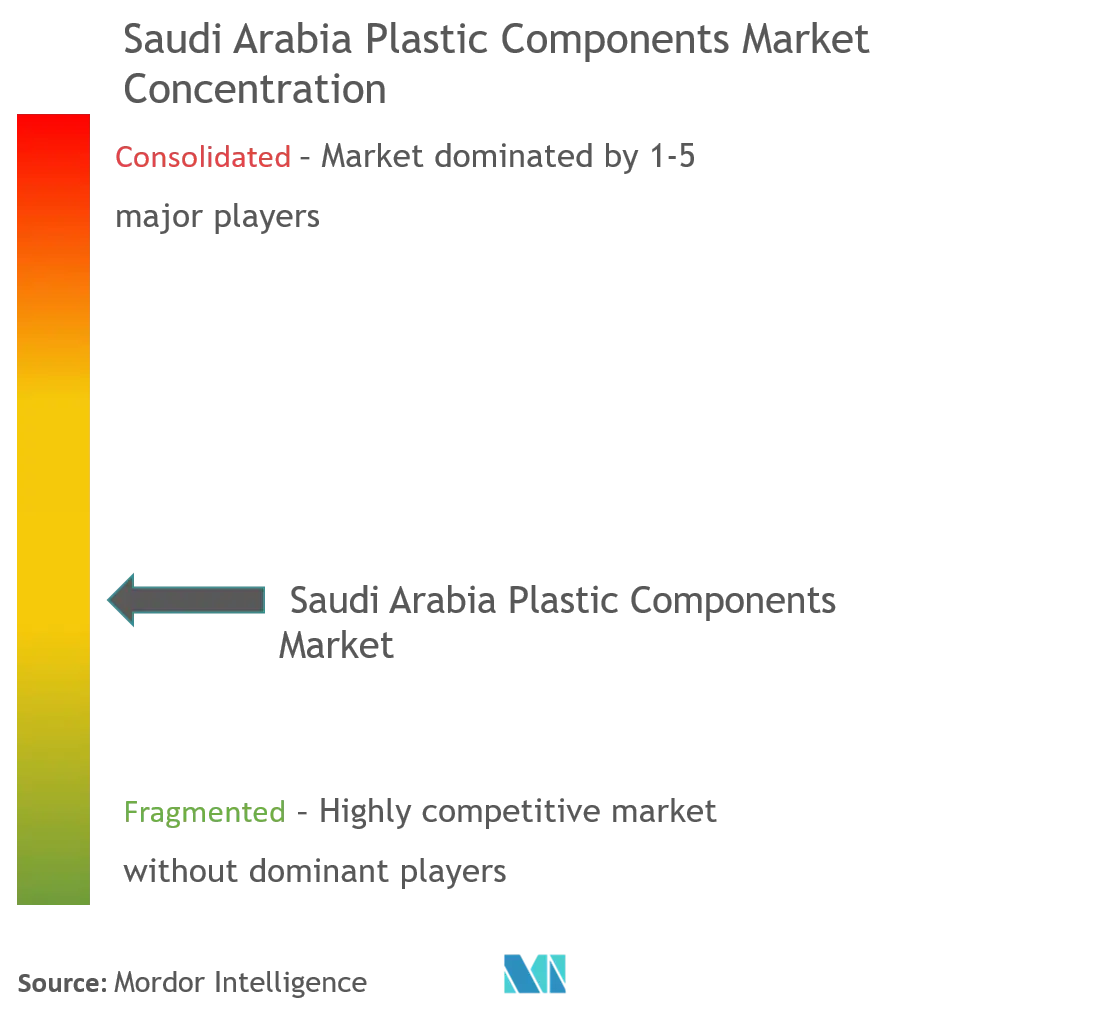
| Market Concentration | Low |
Major Players *Disclaimer: Major Players sorted in no particular order Image © Mordor Intelligence. Reuse requires attribution under CC BY 4.0. | |
Saudi Arabia Plastic Components Market Analysis by Mordor Intelligence
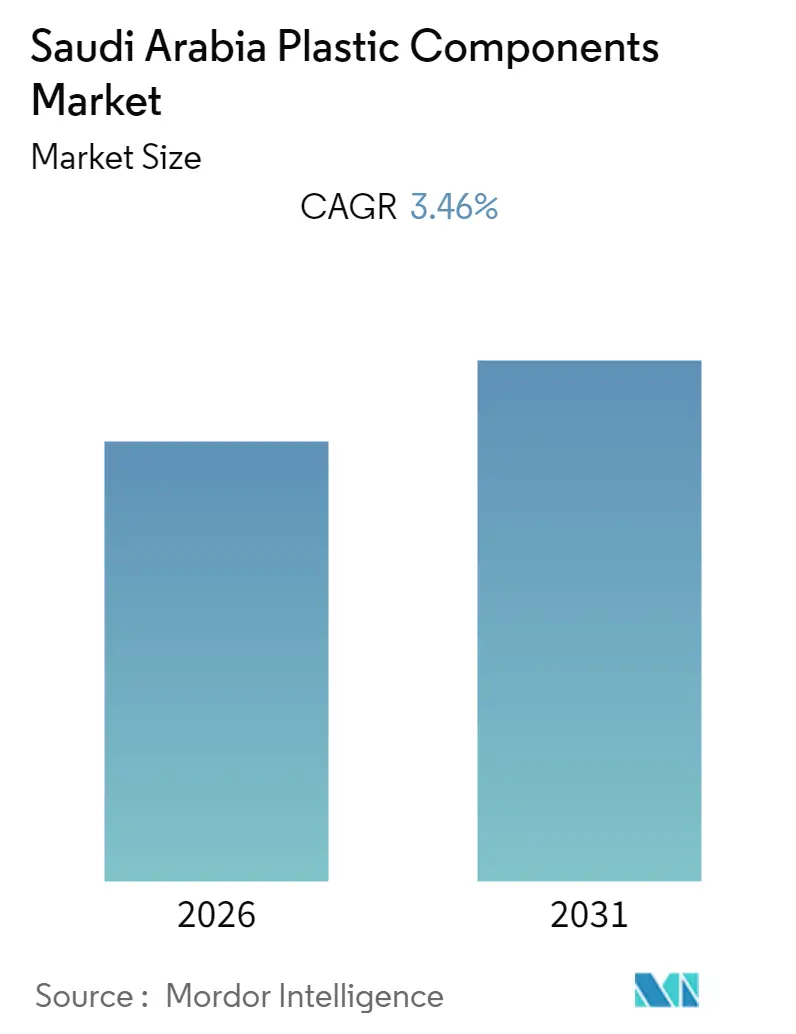
The Saudi Arabia Plastic Components Market size is expected to register a CAGR of 3.46% during the forecast period.
- However, the slowdown in the automotive industry and the outbreak of COVID-19 disease across the globe are likely to hinder the growth of the studied market.
- Growing awareness for electric vehicles is expected to drive the demand for the market during the forecast period is likely to provide opportunities for the Saudi Arabia plastic components market over the next five years.
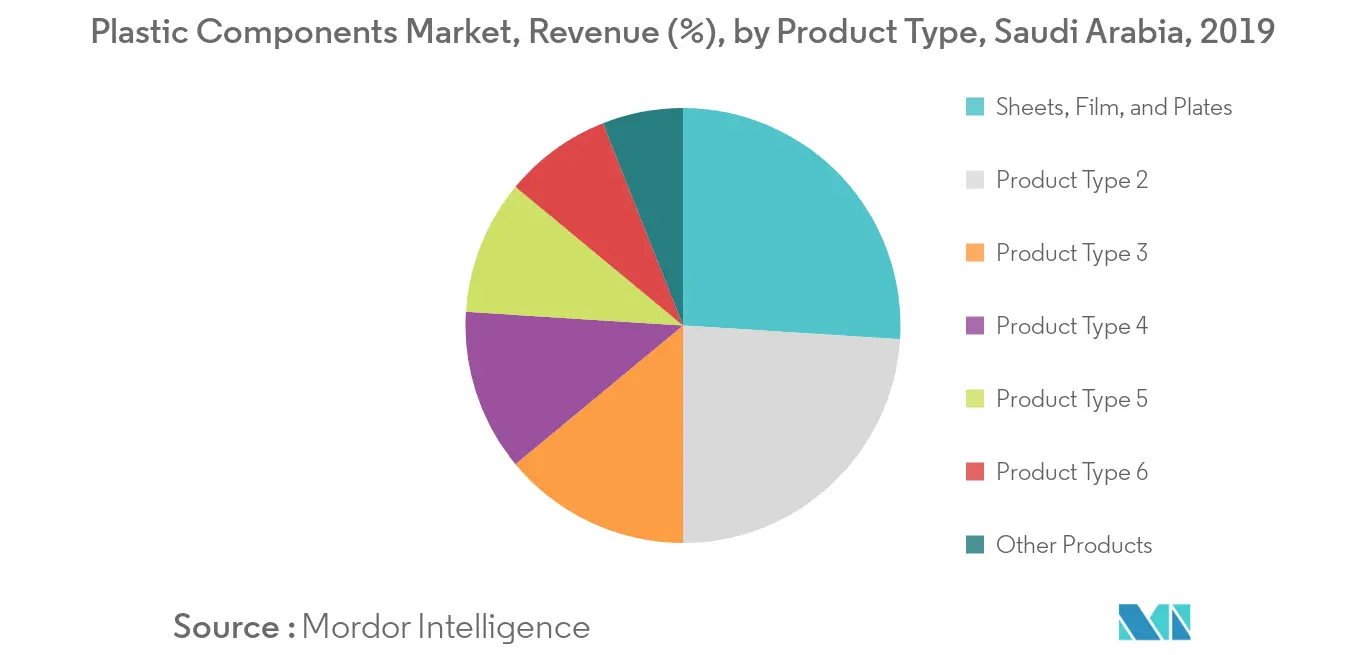
- Sheets, films, and plates segment is the most dominating product segment of the market studied.
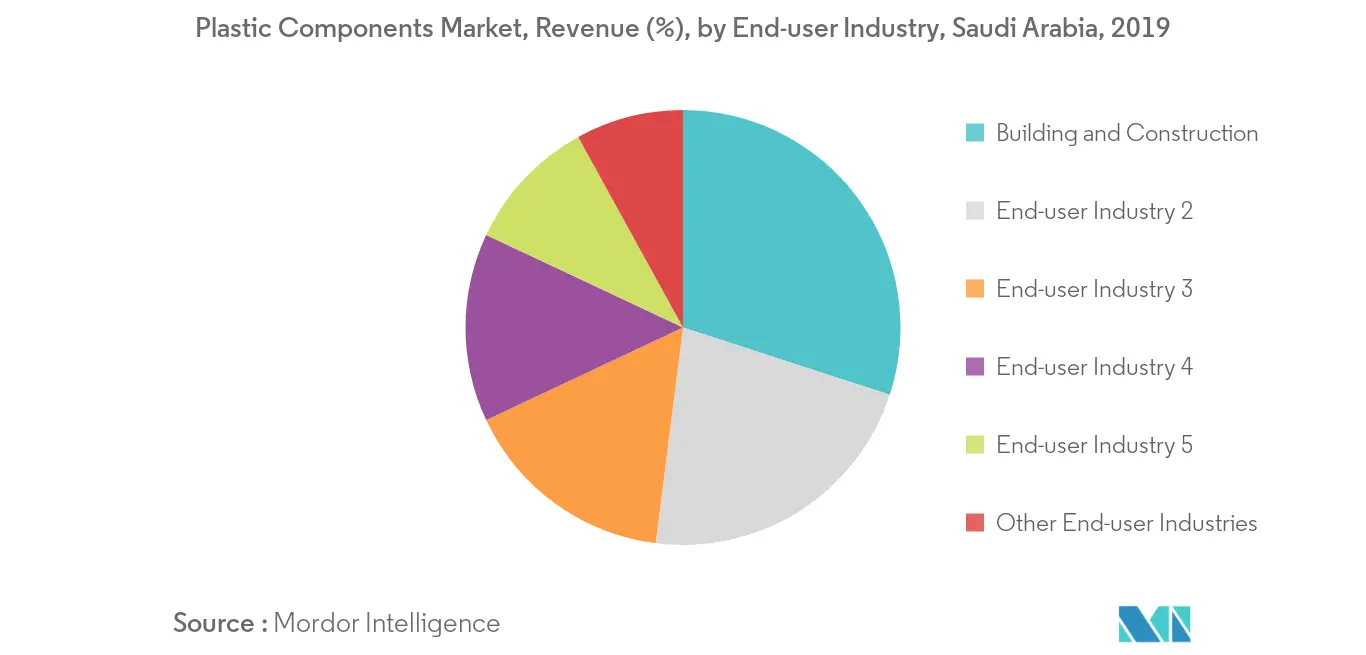
- Building and construction is the most dominating end-user industry of the market studied.
Note: Market size and forecast figures in this report are generated using Mordor Intelligence’s proprietary estimation framework, updated with the latest available data and insights as of 2026.
Saudi Arabia Plastic Components Market Trends and Insights
Sheets, Film, and Plates to Dominate the market
- Plastic films and sheets are lightweight, economical, and have many safety advantages and important properties, such as chemical resistance, and are available in a wide variety of colors and thicknesses. The product has applications in industries, including the food and beverage, pharmaceuticals, electronic, medical, construction, home remodeling, decorating, repair, and aerospace industry.
- Surface protection film helps protect surfaces against dust, dirt, fingerprints, scratching, contamination, and abrasion that are common in various industries like aerospace, automotive, electronics, and construction during production, shipping, and storage.
- According to GCC plastic industry indicators, Saudi Arabia accounted for more than two-thirds of GCC polymer resins production.
- Government schemes such as Vision 2030 to emphasize developing sectors such as health care, defense, transport and, logistics will increase the investment in the construction of hospitals, factories, and other infrastructure, which further propel the demand of sheets and film during the forecast period.
- The above-mentioned factors are anticipated to drive the demand for Saudi Arabia Plastic Components Market during the forecast period.
Building and Construction to Dominate the Market
- The Vision 2030 plan of the country to reduce its dependency on oil, diversify its economy, and develop public service sectors is anticipated to drive investment toward the construction industry. The country is seeking USD 425 billion by 2030 for infrastructure, energy, mining, and other industrial projects, as part of an effort to cut its reliance on oil.
- Furthermore, Saudi Arabia is supporting its 2030 goals by allocating an expenditure budget of SAR 1.1 trillion in 2019, out of which SAR 246 billion are allotted for Capex to back up its infrastructure projects.
- The plastics used in the building and construction industry are polyvinyl chloride (PVC), polystyrene, formaldehyde, phenol-formaldehyde, polyethylene, polypropylene, nylon, polyurethane, acrylic and phenolic resins, and melamine.
- Under the National Transformation Program (NTP) 2020 and the Saudi Arabia Vision 2030, the government has a plan to develop seaports, railway lines, airports, and manufacturing facilities. Under NTP 2020, the government plans to invest around USD 72 billion to develop the country's transport and tourism infrastructure.
- Hence, all such market trends are expected to drive the demand for Saudi Arabia Plastic Components Market market during the forecast period.
Value Chain Analysis
The value chain in Saudi Arabia plastic components begins with upstream feedstock and polymer resin production, supported by the Kingdom's petrochemical base and large producers such as SABIC and TASNEE. The supply base includes polyethylene, polypropylene, and polystyrene, which feed into midstream compounding and specialty material preparation, including recycled and compounded resins.
Downstream activities then focus on converting processes such as extrusion, thermoforming, injection and blow molding, and film orientation into components including sheets, films, and plates, containers, household articles, and construction-related profiles. Manufacturing and distribution are anchored by local converters and packaging and component producers such as Napco National, Rowad Global Packaging, National Plastic Factory Co., Saudi Plastic Packaging Systems, and Petrochemical Conversion Company Ltd., with industrial clustering around PlasChem Park in Jubail to support co-location near feedstock. Supply chain localization programs, including the Ministry of Industry and Mineral Resources Local Supply Chain Development Initiative (LSCDI) database covering 15+ sectors, also underpin supplier development and local sourcing across chemicals-related inputs and conversion capabilities.
Competitive Landscape
The Saudi Arabia Plastic Components Market is partially fragmented in nature. Some of the major companies are Arabian Plastics Industrial Company Limited, Zamil Plastic, Rowad National Plastic Company Ltd, Tamam Plastic Factory, and Takween Advanced Industries amongst others.
Saudi Arabia Plastic Components Industry Leaders
-
Arabian Plastics Industrial Company Limited
-
Zamil Plastic
-
Rowad National Plastic Company Ltd
-
Takween Advanced Industries
-
Tamam Plastic Factory
- *Disclaimer: Major Players sorted in no particular order
Market Opportunities and Future Outlook
Industrial localization and investment incentives create room for higher value-added plastic components beyond commodity conversion, especially in construction-related systems, packaging formats, and engineered parts for industrial customers. A clear enabler is the Standard Incentives Program launched on January 11, 2025, with SAR 10 billion allocated to incentivize targeted industrial sectors, supported by financing and subsidies via the Saudi Industrial Development Fund (SIDF) (with investment subsidies capped at SAR 50 million per project). Taken together with Vision 2030 manufacturing priorities, these instruments can support new or expanded conversion lines, automation upgrades, and supplier development for components that are currently sourced as semi-finished imports.
There is also scope in higher-performance resins and electronics-linked applications backed by domestic petrochemical players and capacity actions. SABIC's December 2025 announcement to expand PPE oligomers (NORYL SA9000) for high-performance PCBs and 5G infrastructure, with completion scheduled for the second half of 2026, points to greater availability of specialty materials that can translate into local demand for downstream converting into precision components. In parallel, ongoing upstream integration and project pipelines, including the Ministry of Energy's February 2025 feedstock allocation for a Sipchem and LyondellBasell mixed-feed cracker feasibility effort, further reinforce the feedstock-and-derivatives platform that downstream component makers can use for local sourcing and product diversification.
Recent Industry Developments
- March 2026: National Industrialization Co. (Tasnee) signed a share purchase agreement to sell 100% of Al-Rowad Industrial Transformation Company, including Al-Rowad National Plastic Company Ltd, to Tahweel Holding for SAR 700 million. The transaction indicates portfolio restructuring and may change the competitive position of downstream plastic conversion assets within Saudi Arabia.
- February 2026: Arabian Plastic Industrial Company Limited (APICO) signed a non-binding memorandum of understanding with Air International Thermal Systems to explore localization of ventilation and air-conditioning product manufacturing. The tie-up aligns with local-content objectives and expands the component set that Saudi converters can target for HVAC-related applications.
- May 2024: GROHE announced cooperation with Zamil Plastic Industries, centered on local manufacturing capabilities for sanitary-related product requirements in the Kingdom. Partnerships like this can support technology transfer and improve the quality and specification compliance of plastic components supplied for building and construction end uses.
Research Methodology Framework and Report Scope
Market Definition and Coverage
For this methodology, the market covers revenues generated from plastic components sold in Saudi Arabia across common converted plastic forms used by industrial and consumer end users. The value reflects domestic sales into key applications where plastic parts are purchased as inputs or finished items.
Scope exclusions: We exclude primary polymer/resin production and traded raw pellets, along with non-plastic component substitutes such as metals, glass, and wood.
Segmentation Overview
- Product Type
- Sheets, Film, and Plates
- Tubes
- Containers
- Household Articles
- Floor Cover and Wall Cover
- Textile Fabrics
- Other Products
- End-user Industry
- Building and Construction
- Consumer Goods
- Life Sciences
- Aerospace
- Food and Beverage
- Other Applications
Data Sources, Market Sizing, and Validation
Desk Research
To build the base dataset, we start with public production, trade, and industry indicators that can be checked year over year. Sources used include, such as Saudi General Authority for Statistics releases, Saudi Customs trade statistics (when published), UN Comtrade for import and export flows, World Bank macro series, and UNIDO industrial indicators. Standards and technical context are also reviewed through sources such as ISO documentation and peer reviewed polymer processing literature.
We also review company annual reports, investor presentations, and local association websites to understand product mix changes, capacity additions, and end market demand. In a few cases, we refer to paid subscriptions that aggregate company financials, shipment level import export data, and patent filings, which helps cross check the timing of expansions and technology shifts. This desk research source list is illustrative, and many other public references were used to validate data points and clarify assumptions.
Primary Interviews and Surveys
Primary work is used to confirm what is actually being sold as plastic components in Saudi Arabia and how pricing moves with resin costs and conversion complexity. We speak with converters, distributors, large buyers, and industry specialists across the main demand centers in Saudi Arabia, so assumptions on utilization, product mix, and import dependence can be stress tested before totals are finalized.
Distribution of primary research fieldwork respondents
| Company type | Respondent position |
|---|---|
| Top tier: 39% | CXOs: 17% |
| Mid tier: 44% | Functional/Unit leaders: 27% |
| Smaller Players: 17% | Managers: 56% |
Market-Sizing & Forecasting
Sizing starts from a top-down build where national demand is reconstructed using trade flows for relevant plastic component categories, domestic conversion output signals, and end use activity levels in Saudi Arabia. That total is then checked through selective bottom-up approximations, such as sampled average selling price ranges by product family multiplied by estimated volumes, plus channel checks with distributors and large buyers, and then adjusted if the two views drift too far apart.
Key inputs used in the model include import penetration by component type, direction of resin prices and pass-through timing into component pricing, construction and infrastructure activity indicators, packaging and food consumption trends that move container and film demand, and capacity expansion or utilization changes reported by local converters. For forecasting, scenario analysis is applied around these drivers, and then the preferred case is selected based on what industry respondents expect for new projects, pricing discipline, and demand stability over the next few years. When a clean bottom-up volume is not available for smaller product niches, we use proxy shares from similar components and validate them through follow-up calls.
Data Validation & Update Cycle
Each major step is checked using more than one angle, so totals are compared against import trends, industrial output direction, and large end market indicators before sign-off. Outliers are flagged when growth or pricing moves too far from the underlying resin and demand signals, and then assumptions are revisited and recalculated. A second analyst review is completed to confirm that definitions, currency treatment, and year mapping are consistent.
Reports are refreshed annually, and interim updates are made if there is a material event such as a new plant start-up, a large policy change, or a sudden trade shift. Before delivery, the latest public releases are scanned again and any major variance triggers a quick re-check with contacts, so clients receive an updated view.
Mordor Intelligence's Saudi Arabia Plastic Components Market Estimate Compared With Other Published Estimates
Published market size values for Saudi Arabia plastic components often do not line up because the counted products are not always the same, and the pricing basis can shift by year and currency timing. Differences also come from whether estimates lean on trade-only views, domestic production views, or a blended approach that attempts to reflect actual local consumption.
Some external estimates bundle in broader plastics packaging and semi-finished plastic materials, which inflates totals when resin-linked products are included. In Mordor Intelligence, plastic components are counted only when they are sold as converted parts or articles into end users in Saudi Arabia, and resin and basic polymer volumes are kept outside the market value.
Benchmark comparison
| Source | Market Size | Gaps in Research Methodology |
|---|---|---|
| Mordor Intelligence | USD 0.00 B (2025) | |
| Industry Association A | USD 0.00 B (2025) | Often aligns plastics packaging materials and some semi-finished plastic forms with components, and then applies an average price that follows resin movements more than conversion complexity. |
| Trade Journal B | USD 0.00 B (2025) | May infer market value mainly from import statistics and broad HS groupings, which can miss domestic conversion output and can double count items that are re-exported or sold through distributors. |
The spread in the table is mainly explained by scope and pricing construction, not by arithmetic errors. By keeping the counted items limited to converted plastic components and by cross checking trade signals with local demand and price discussions, the final number stays traceable to a clear demand pool and repeatable steps.
Key Questions Answered in the Report
What is the current Saudi Arabia Plastic Components Market size?
The Saudi Arabia Plastic Components Market is projected to register a CAGR of 3.46% during the forecast period (2026-2031)
Who are the key players in Saudi Arabia Plastic Components Market?
Arabian Plastics Industrial Company Limited, Zamil Plastic, Rowad National Plastic Company Ltd, Takween Advanced Industries and Tamam Plastic Factory are the major companies operating in the Saudi Arabia Plastic Components Market.
What years does this Saudi Arabia Plastic Components Market cover?
The report covers the Saudi Arabia Plastic Components Market historical market size for years: 2019, 2020, 2021, 2022, 2023, 2024 and 2025. The report also forecasts the Saudi Arabia Plastic Components Market size for years: 2026, 2027, 2028, 2029, 2030 and 2031.