
Market Overview
| Study Period | 2020 - 2031 |
|---|---|
| Forecast Data Period | 2026 - 2031 |
| Base Year Market Size (2025) | USD 1.30 Billion |
| Market Size (2026) | USD 1.36 Billion |
| Market Size (2031) | USD 1.73 Billion |
| Growth Rate (2026 - 2031) | 4.85 % |
| Market Concentration | Medium |
Major Players *Disclaimer: Major Players sorted in no particular order Image © Mordor Intelligence. Reuse requires attribution under CC BY 4.0. | |
Egypt Paints And Coatings Market Analysis by Mordor Intelligence
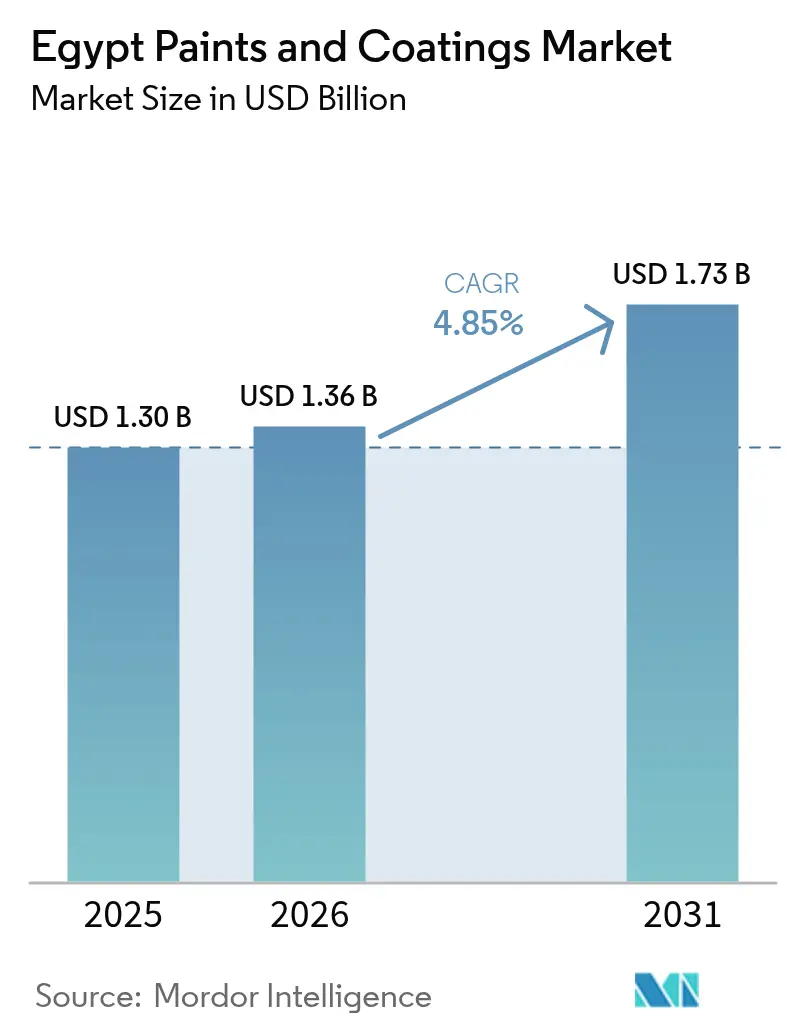
The Egypt paints and coatings market size is expected to grow from USD 1.30 billion in 2025 to USD 1.36 billion in 2026 and is forecast to reach USD 1.73 billion by 2031 at 4.85% CAGR over 2026-2031. Robust public-sector spending on housing, transport corridors, and petrochemical complexes anchors demand even as foreign-exchange volatility challenges input costs. Continued rollout of green building rules accelerates the shift toward water-borne technologies, while the petrochemical build-out in the Suez Canal Economic Zone strengthens domestic feedstock supply and underpins industrial coatings uptake. Automotive localization initiatives add incremental volume for OEM refinishing, and research advances using locally sourced silica-fume signal future innovation pathways. Intensifying competition among global multinationals and nimble regional players is spurring capacity expansions, product differentiation, and selective mergers, all reshaping competitive dynamics.
Key Report Takeaways
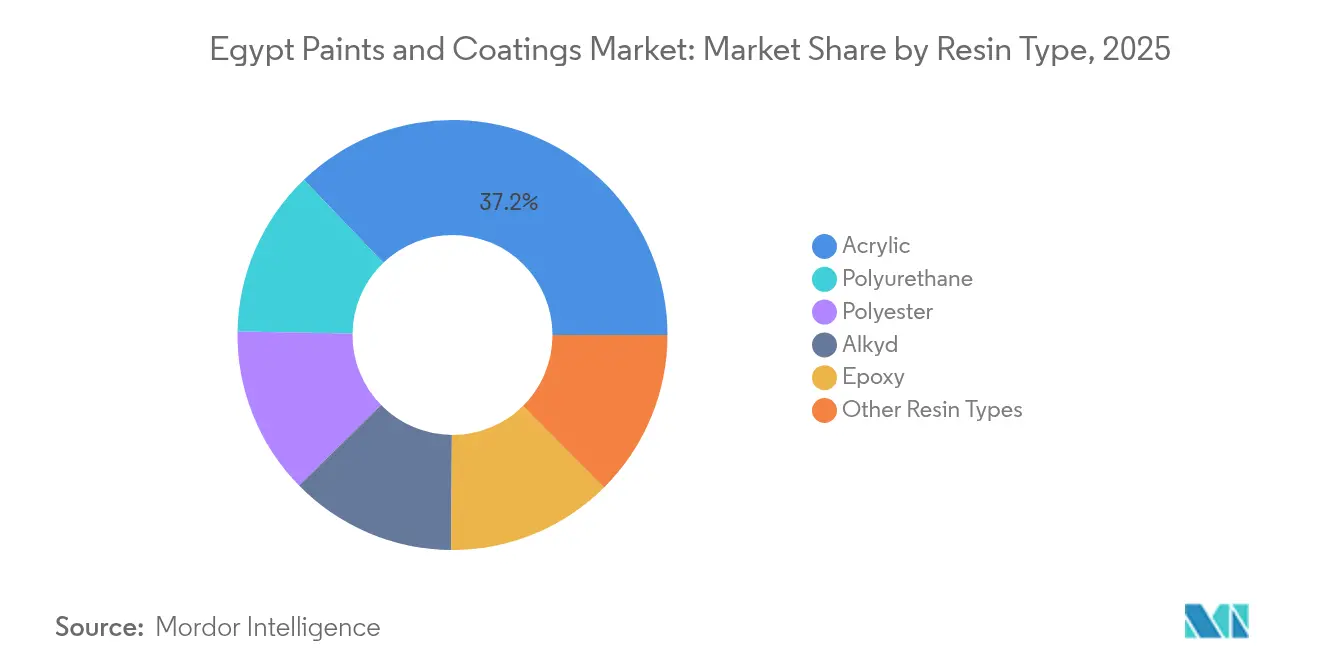
- By resin type, acrylic captured 37.15% of Egypt paints and coatings market share in 2025, and is registering the fastest growth at a 6.15% CAGR through 2031.
- By technology, water-borne systems held 49.55% share of the Egypt paints and coatings market size in 2025, and the segment is projected to expand at a 6.05% CAGR during 2026-2031.
- By end-user industry, architectural applications led with 64.80% revenue share in 2025; protective coatings are forecast to post the highest 5.12% CAGR to 2031.
Note: Market size and forecast figures in this report are generated using Mordor Intelligence’s proprietary estimation framework, updated with the latest available data and insights as of 2026.
Egypt Paints And Coatings Market Trends and Insights
Drivers Impact Analysis*
| Drivers | (~) % Impact on CAGR Forecast | Geographic Relevance | Impact Timeline |
|---|---|---|---|
| Residential mega-housing boom under New Urban Communities Authority | +1.8% | National, concentrated in New Administrative Capital, New Alamein, New Mansoura | Medium term (2-4 years) |
| Expansion of oil and gas downstream (Midor, Red Sea Petrochem) | +1.2% | Suez Canal Economic Zone, Alexandria, Red Sea governorates | Long term (≥ 4 years) |
| VOC-curbing environmental rules spur water-borne adoption | +0.9% | National, with stricter enforcement in Cairo, Alexandria metropolitan areas | Short term (≤ 2 years) |
| OEM refinishing demand from local-content automotive push | +0.7% | Industrial zones in Giza, Badr, 6th of October City | Medium term (2-4 years) |
| Nano-enhanced antimicrobial coatings using Egyptian silica-fume | +0.4% | National, with research concentration in Cairo universities | Long term (≥ 4 years) |
| Source: Mordor Intelligence | |||


Residential Mega-Housing Boom Under New Urban Communities Authority
Government-backed cities such as the New Administrative Capital, New Alamein, and New Mansoura are reshaping Egypt’s urban footprint and fueling a continuous flow of architectural coatings demand. The New Administrative Capital alone encompasses landmark structures—including the Parliament Building and Al-Fatah Al-Aleem Mosque—that require high-performance finishes tailored to desert heat and sand abrasion. Construction schedules spanning 2025-2028 assure steady volumes for interior and exterior paints, primers, and sealers. Demand for heat-reflective and self-cleaning formulations is rising as developers seek energy-efficient building envelopes. Suppliers able to certify low-VOC and high-solar-reflectance products gain procurement preference under Egypt Vision 2030’s sustainability criteria. Parallel housing programs in satellite cities extend the opportunity beyond Cairo, anchoring long-term growth for the Egypt paints and coatings market.
Expansion of Oil and Gas Downstream Operations
A USD 10.9 billion petrochemical complex inside the Suez Canal Economic Zone will host 11 factories that supply key monomers, solvents, and additives used in coatings, reducing import reliance and improving input cost visibility. At the same time, these facilities, along with existing Midor and Red Sea Petrochem projects, need high-build, chemically resistant coatings to safeguard tanks, pipelines, and jetties. Employment creation for 48,000 workers prompts ancillary housing and commercial developments, broadening architectural demand. Egypt’s LNG export hubs at Damietta and Idku generate a fresh need for marine and maintenance coatings that withstand saline environments[1]“Country Analysis Brief: Egypt,” U.S. Energy Information Administration, eia.gov . Combined, these investments create a self-reinforcing cycle of raw-material supply growth and downstream consumption, strengthening the Egypt paints and coatings market.
VOC-Curbing Environmental Rules Spur Water-Borne Adoption
The Egyptian Environmental Affairs Agency enforces stringent VOC ceilings, and the August 2024 launch of Africa’s first carbon market adds a monetary incentive for low-emission products. Public agencies now tender projects that mandate water-borne or other green technologies, accelerating conversion from solvent-borne lines. With half of government capital expenditure earmarked for green projects by 2025, coating suppliers that certify compliance capture priority status. New formulation work integrates locally sourced silica-fume nanoparticles to deliver antimicrobial and heat-reflective benefits, further differentiating water-borne offerings. Rapid regulatory enforcement in Cairo and Alexandria compresses transition timelines and cements water-borne dominance inside the Egypt paints and coatings market.
OEM Refinishing Demand from Local-Content Automotive Push
Geely’s CKD plant in Giza and Stellantis’ Jeep Grand Cherokee L assembly line in Cairo underscore Egypt’s pivot from vehicle importation to local manufacturing. Each unit rolling off these lines consumes multiple coating layers, such as e-coat, primer, base coat, and clear coat, driving factory throughput for high-gloss, scratch-resistant systems. The national automotive strategy favors electric vehicle output, prompting the development of coatings with electromagnetic shielding and battery-thermal-management properties. Component suppliers such as Leoni’s new wiring-harness plant in Badr expand industrial-coating requirements for machinery and building infrastructure. As automotive volumes climb, authorized body shops invest in fast-curing refinishing products, adding depth to the Egyptian paints and coatings market.
Restraints Impact Analysis*
| Restraints | (~) % Impact on CAGR Forecast | Geographic Relevance | Impact Timeline |
|---|---|---|---|
| Automotive production slump and import curbs | -0.8% | Industrial zones in Greater Cairo, Alexandria | Short term (≤ 2 years) |
| FX-driven raw-material price volatility | -1.1% | National, with higher impact on import-dependent manufacturers | Medium term (2-4 years) |
| Water-scarcity risks for water-borne lines | -0.6% | Upper Egypt, desert industrial zones | Long term (≥ 4 years) |
| Source: Mordor Intelligence | |||
FX-Driven Raw-Material Price Volatility
The Egyptian pound’s March 2024 float triggered sharp cost spikes for imported pigments, solvents, and specialty additives that account for most formulation expenses. Electricity tariff hikes following the removal of industrial discounts compound operating costs, forcing manufacturers to either absorb margin compression or raise prices, which can delay construction and industrial maintenance schedules. Shorter procurement cycles, hedging challenges, and greater working-capital needs elevate credit risk, particularly for small and mid-size firms that collectively serve a sizable slice of the Egypt paints and coatings market.
Water-Scarcity Risks for Water-Borne Lines
Egypt ranks among the world’s most water-stressed nations, and intermittent shortages in Upper Egypt and arid industrial estates threaten the continuous operation of water-intensive coating lines. Academic studies show escalating water-quality deterioration in certain clusters, raising treatment costs and complicating discharge compliance[2]“Utilization of affordable nanocomposites,” Nature, nature.com . While powder or high-solids alternatives can mitigate usage, capital retrofits are expensive, potentially delaying technology upgrades and moderating the otherwise strong trajectory of the Egypt paints and coatings market.
*Our forecasts treat driver/restraint impacts as directional, not additive. The impact forecasts reflect baseline growth, mix effects, and variable interactions.
Segment Analysis
By Resin Type: Acrylic Dominance Driven by Climate Adaptability
Acrylic systems commanded 37.15% of Egypt paints and coatings market share in 2025, underpinned by excellent color retention and adhesion in environments where surface temperatures top 60 °C. The Egypt paints and coatings market size for acrylic resins is projected to grow at a 6.15% CAGR as residential, commercial, and infrastructure projects demand durable yet environmentally compliant finishes.
Polyurethane enjoys premium uptake in petrochemical and automotive lines thanks to superior chemical resistance, while epoxy remains the go-to for secondary containment and floorings in harsh industrial sites. Alkyd retains a foothold in cost-sensitive masonry but faces tightening VOC caps. Polyester-based powder systems gain momentum in appliance and metal-fabrication niches that value solvent-free curing, and nano-enhanced water-borne formulations incorporating Egyptian silica-fume position local producers for future specialty growth.


By Technology: Water-Borne Solutions Lead Environmental Transition
Water-borne coatings held 49.55% of the Egypt paints and coatings market size in 2025, benefiting from rapid public-sector uptake and consumer awareness. Regulatory mandates on VOC ceilings and the carbon-credit system solidify their lead, with segment volume forecast to rise at 6.05% CAGR through 2031. Solvent-borne lines persist in heavy-duty marine and industrial applications, though new high-solids chemistries aim to retain performance while lowering emissions.
Powder coatings gain foothold in appliances, furniture, and automotive metal parts, rising in tandem with Egypt’s export-oriented manufacturing drive. Digital finishing lines at new factories in 10th of Ramadan City and Badr illustrate capital investment in cleaner technologies as firms future-proof production against forthcoming stricter regulations. Yet, persistent water scarcity forces producers to optimize rinse cycles and recycle process water, spurring research into ultra-low-water formulations and closed-loop systems.
By End-User Industry: Architectural Anchors Growth While Protective Accelerates
Architectural uses absorbed 64.80% of the Egypt paints and coatings market share in 2025, mirroring surging residential and mixed-use construction under the New Urban Communities Authority. General industrial and industrial wood segments take advantage of the rise in textile and furniture exports, sustaining a steady consumption baseline.
Protective coatings lead growth at a 5.12% CAGR, fueled by ongoing refinery upgrades, LNG terminals, and the large-scale petrochemical complex near Ain Sokhna. Automotive volumes remain uneven given import restrictions and supply-chain kinks, yet localized assembly lines and after-sales refinishing invest in higher-spec coatings to meet OEM warranty and color-match expectations. As multinational manufacturers adopt ISO 12944 and ISO 9001 standards across Egyptian plants, demand tilts toward certified, high-durability coating systems, further professionalizing the Egypt paints and coatings market.

Geography Analysis
Cairo and its satellite cities concentrate most of the Egypt paints and coatings market demand, energized by the New Administrative Capital’s mixed-use clusters, metro extensions, and social-housing projects. Architectural contractors operating here specify large volumes of acrylic emulsions, primers, and interior finishes that withstand desert dust and ultraviolet exposure. Alexandria and the Mediterranean coastal belt's consumption is driven by port expansions and a shipyard maintenance drive, marine-grade and anti-fouling paint uptake.
Meanwhile, the Suez Canal Economic Zone evolves into an industrial coating hotspot; the petrochemical complex at Ain Sokhna alone requires tank linings, pipeline wraps, and intumescent fireproofing across 11 integrated plants. Diversification initiatives such as New Alamein’s silicon complex and Upper Egypt’s Kom Ombo solar farm introduce new industrial activity clusters that recalibrate geographic demand patterns. Coupled with anticipated recovery in global trade flows, these projects foster a balanced distribution of consumption, reducing Cairo’s historic dominance and enlarging the total addressable Egypt paints and coatings market size nationwide.
Value Chain Analysis
Upstream supply for Egyptian paint and coatings producers is a mix of locally available inputs (such as fillers and select solvents) and import-dependent raw materials, particularly specialty additives, pigments, and selected monomers. This structure leaves manufacturers sensitive to foreign-exchange volatility in both cost and lead times. The petrochemical build-out centered on the Suez Canal Economic Zone, alongside the announced USD 11 billion ECHEM program (2026-2030), supports deeper domestic feedstock availability for industrial and protective coatings. Product compliance requirements, including registration and VOC thresholds that are monitored by bodies such as the Egyptian Organization for Standardization and Quality, also shape formulation choices and supplier qualification.
Midstream manufacturing relies on a blend of multinational and local plants (including Jotun in 10th of Ramadan City and MIDO in Alexandria). Investment is directed toward capacity utilization, quality systems, and higher-performance categories. In April 2026, MIDO secured a USD 45 million facility from Vantage Capital to refinance and increase liquidity, while unlocking idle capacity across its two Alexandria sites, illustrating how structured finance can stabilize operations and expand output. Downstream channels include contractor and government tenders tied to megaprojects, wholesale and retail networks serving decorative paints, and direct industrial accounts for protective, marine, and OEM-related systems. In these segments, documented standards adoption (for example, ISO-aligned specifications referenced in industrial procurement) increases the value of technical service, certification, and longer-term supply agreements.
Competitive Landscape
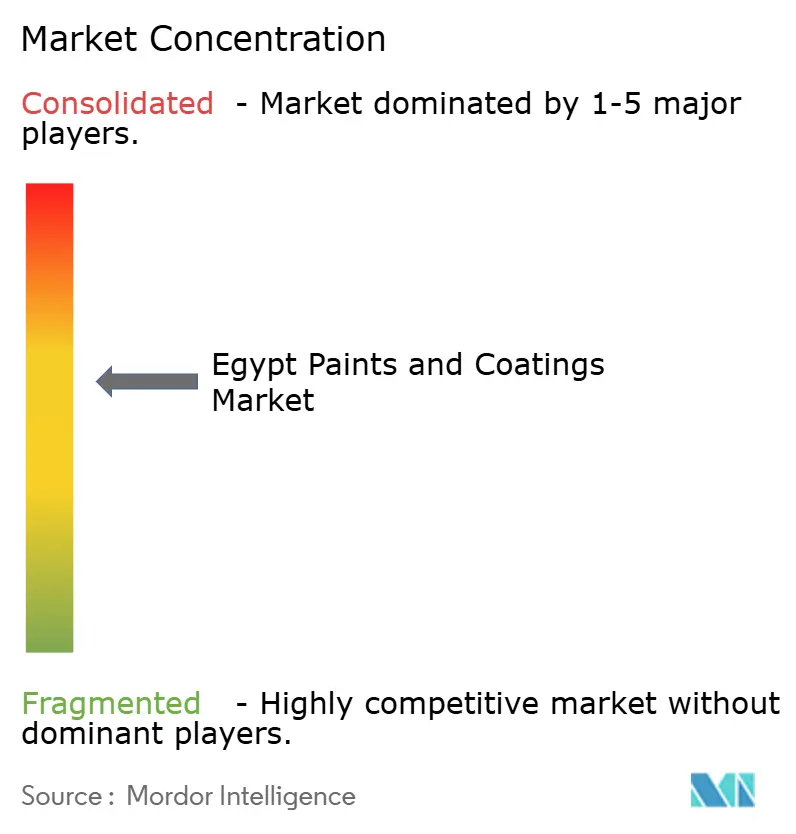
The Egypt paints and coatings market hosts a mix of global majors and agile local firms, yielding moderate fragmentation. Competitive advantage hinges on product customization for Egypt’s climatic extremes and regulatory specifics. Jotun’s “Jotashield Extreme” employs heat-reflective pigments that minimize interior cooling loads, gaining traction in social-housing tenders. Start-ups collaborating with Cairo universities exploit silica-fume nanotechnology to deliver antimicrobial, self-cleaning exterior paints that lower maintenance cycles. Meanwhile, domestic producers such as Pachin, now 81% owned by UAE-based National Paints, leverage regional distribution and price flexibility to defend share in mass-market emulsions.
Egypt Paints And Coatings Industry Leaders
Asian Paints
Jotun
KAPCI Coatings
NATIONAL PAINTS FACTORIES CO. LTD.
UBMC Group
- *Disclaimer: Major Players sorted in no particular order

Market Opportunities and Future Outlook
Near-term whitespace is most visible in localized production of higher-specification coatings that are frequently imported or supplied through limited domestic capacity. Demand is particularly tied to fire protection, heavy-duty protective systems for petrochemical and energy assets, and low-VOC water-borne solutions that meet tighter procurement requirements in Cairo and Alexandria. This direction showed up in June 2026, when Jotun Egypt announced the start of local production for Passive Fire Protection products (including the SteelMaster line) at its 10th of Ramadan City facility, mapping industrial safety needs to shorter lead times and more localized technical support. In the same period, Jotun also reported more than 50% year-on-year export growth from Egypt, reinforcing the role of Egyptian plants as regional supply points for nearby African and Middle Eastern markets.
On supply and integration, import substitution opportunities sit in resins, solvents, and additives tied to the petrochemical investment cycle. The ECHEM five-year plan (2026-2030) targets USD 11 billion across 10 major projects and 7.5 mtpa of capacity, while Industry Strategy 2030 places emphasis on deepening local manufacturing. Financing-led capacity unlocking is also emerging as a practical lever to raise throughput faster than greenfield builds; in April 2026, MIDO secured a USD 45 million facility from Vantage Capital to strengthen liquidity and bring idle lines back into use across its Alexandria plants, improving availability for specialty and industrial-grade coatings. Across these opportunities, compliance with evolving VOC requirements and tender specifications continues to distinguish suppliers with validated low-emission portfolios and credible on-site application support for large housing and infrastructure programs.
Recent Industry Developments
- June 2026: Jotun Egypt announced the start of local manufacturing of Passive Fire Protection products (including the SteelMaster line) at its 10th of Ramadan City facility. The move localizes a higher-value industrial coatings category used in petrochemical and infrastructure assets, reducing reliance on imported supply and strengthening technical-service delivery for complex projects.
- April 2026: Vantage Capital announced a USD 45 million mezzanine debt facility for International Group for Modern Coatings (MIDO). The funding supports refinancing and working capital and is positioned to unlock idle capacity at MIDO’s two Alexandria manufacturing sites, improving domestic supply responsiveness for specialty coatings.
- May 2024: Asian Paints International Private Limited entered a share purchase agreement to acquire an additional 24.3% stake in SCIB Chemicals S.A.E., increasing its total ownership to 85.6%. The transaction deepened strategic control over an Egyptian producer, supporting portfolio localization and route-to-market coordination in decorative and contractor segments.


Research Methodology Framework and Report Scope
Market Definition and Coverage
This market covers the value of paints and coatings sold for use in Egypt, including architectural and industrial uses, and it is measured in USD revenue at the point where products are sold into the market.
Scope exclusions: We exclude adjacent construction chemicals and surface prep materials (such as sealants, adhesives, and plaster additives) unless they are sold as paints or coatings.
Segmentation Overview
- By Resin Type
- Acrylic
- Alkyd
- Polyurethane
- Epoxy
- Polyester
- Other Resin Types
- By Technology
- Water-borne
- Solvent-borne
- Other Technologies
- By End-User Industry
- Architectural
- Automotive
- Industrial Wood
- Protective Coatings
- General Industrial
- Other End-user Industries
Data Sources, Market Sizing, and Validation
Desk Research
Desk research was used to set the demand context and the market boundaries before the model was built. We leaned on public indicators that explain coatings consumption, such as construction output trends, housing and infrastructure programs, and manufacturing activity that pulls industrial coatings.
For Egypt-specific direction, we reviewed non-paywalled sources such as CAPMAS releases, the Central Bank of Egypt publications for macro signals and exchange rate context, UN Comtrade trade statistics for coatings-related HS codes, UNIDO industrial statistics, and standards and regulatory references published through organizations such as ISO. We also used company filings, investor presentations, trade press coverage, and a paid subscription database for company financials and patent lookups when formulation shifts mattered. These desk sources are not exhaustive, and other references were used for data collection, validation, and research clarification.
Primary Interviews and Surveys
Primary work was used to turn broad indicators into Egypt-realistic assumptions on mix, pricing, and near-term demand. We spoke with a spread of manufacturers, distributors, contractors, and large end users across major demand centers, then cross-checked inputs across cohorts so one viewpoint did not dominate.
To reduce guesswork, we validated items such as waterborne versus solvent-borne shifts, project timing in construction, and purchasing behavior in refinish and general industrial use, then reconciled these back to what desk sources can support.
Distribution of primary research fieldwork respondents
| Company type | Respondent position |
|---|---|
| Top tier: 34% | CXOs: 13% |
| Mid tier: 52% | Functional/Unit leaders: 29% |
| Smaller Players: 14% | Managers: 58% |
Market-Sizing & Forecasting
Sizing starts from a demand pool view where construction activity and renovation intensity are used to reconstruct architectural coatings consumption, then industrial demand signals are added to complete the national total. A top-down approach is applied by translating Egypt building activity and industrial output into coatings demand, followed by price and mix assumptions anchored to interview feedback.
Selective bottom-up checks were then used to keep totals realistic, using supplier and channel sense checks, sampled average selling prices by key resin and technology families, and volume proxies tied to import trends where relevant. Inputs that matter in this market include building permits and housing delivery pace, infrastructure spend timing, manufacturing output trends, the share shift toward waterborne systems, resin price direction that affects pass-through, and currency movement that impacts imported raw material cost and selling prices. For forecasting, scenario analysis is used, with base, conservative, and upside paths shaped around construction pipeline timing and pricing pass-through, then narrowed using what experts expect for the next few years. Where bottom-up signals are incomplete, gaps are handled by using conservative ranges and re-checking them with multiple interview groups before finalizing.
Data Validation & Update Cycle
Model outputs are checked against independent signals so totals do not drift away from what the market can absorb. We run variance checks across growth rates, pricing movement, and mix assumptions, then review outliers in a second analyst pass before sign-off.
When a number looks inconsistent with trade flows, construction indicators, or interview consensus, respondents are re-contacted and assumptions are revised with clear notes on what changed and why. Reports are refreshed annually, with interim updates when material events occur, and a final pre-delivery review is completed so clients receive the latest updated view.
Mordor Intelligence's Egypt Paints and Coatings Market Estimate Compared With Other Published Estimates
Published market values for Egypt paints and coatings can look far apart because the boundaries and pricing logic are not always the same. Differences usually come from what gets counted as coatings, whether the numbers are at ex-factory or retail value, and how currency timing is handled.
The table shows a wide spread. In Mordor Intelligence's model, the estimate is built as product revenue for paints and coatings used in Egypt, using a defined resin, technology, and end-use structure, then checked with project activity and price pass-through rather than assuming a single blanket sales figure.
Benchmark comparison
| Source | Market Size | Gaps in Research Methodology |
|---|---|---|
| Mordor Intelligence | USD 1.30 B (2025) | |
| Industry Event Portal A | USD 3.60 B (2027) | Uses a single national sales figure that may reflect a broader value layer or a wider product boundary, and the year is different, which can overstate comparability versus a structured demand and price build. |
| Trade Journal B | USD 0.98 B (2033) | Appears to emphasize a narrower definition or different end-use coverage, and longer-range projections can swing based on assumed construction growth and price escalation without frequent re-validation. |
The spread mainly comes from scope and valuation points, followed by how pricing and currency are carried through the forecast years. By keeping inputs tied to visible demand drivers and re-checking assumptions with market participants, the final number stays traceable and easier to reproduce.


Key Questions Answered in the Report
What factors are driving near-term demand for decorative paints in Egypt?
Accelerated housing projects under the New Urban Communities Authority and stringent green-building mandates are lifting volumes for low-VOC decorative paints, particularly in Cairo-area megacities.
How big is the opportunity for protective coatings linked to petrochemicals?
The downstream oil and gas expansion, led by the USD 10.9 billion complex in the Suez Canal Zone, is propelling protective-coating demand at a 5.12% CAGR through 2031.
Which technology segment is gaining the most share?
Water-borne systems already hold 49.55% share and continue to outpace the overall market thanks to VOC rules and carbon-credit incentives.
How are currency swings affecting raw-material costs?
The March 2024 pound float raised prices for imported pigments and resins, shaving an estimated 1.1% from forecast CAGR as firms juggle margin protection with price sensitivity.
Are water-scarcity concerns reshaping technology choices?
Yes, producers are investing in powder and high-solids lines and recycling systems to mitigate long-term water-risk exposure in arid zones.
Page last updated on:




