
Market Overview
| Study Period | 2020 - 2031 |
|---|---|
| Forecast Data Period | 2026 - 2031 |
| Base Year Market Size (2025) | USD 1.65 Billion |
| Market Size (2026) | USD 1.73 Billion |
| Market Size (2031) | USD 2.19 Billion |
| Growth Rate (2026 - 2031) | 4.84 % |
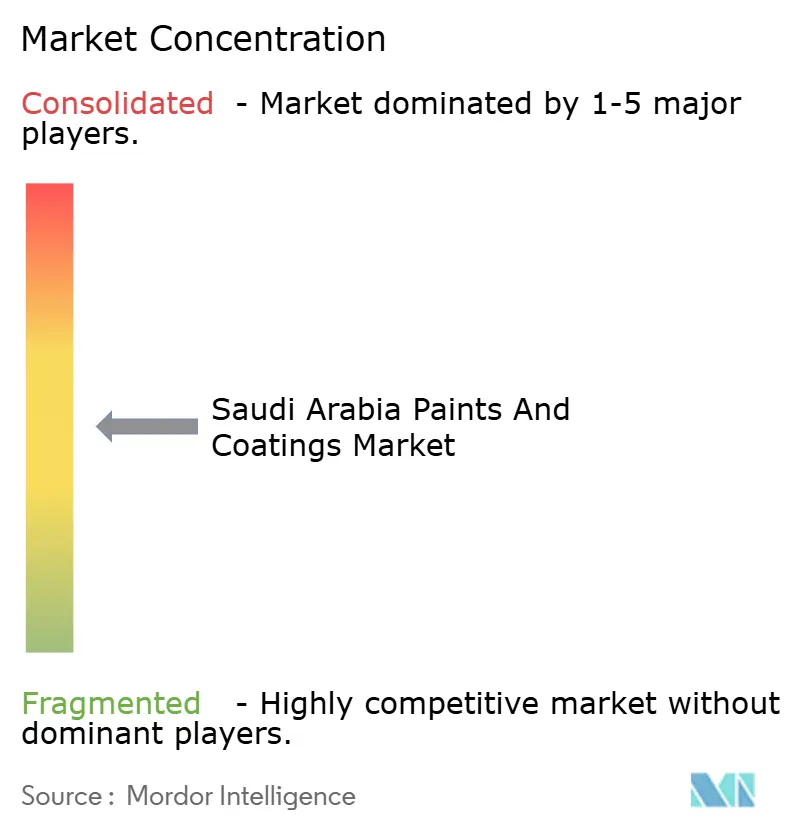
| Market Concentration | Medium |
Major Players *Disclaimer: Major Players sorted in no particular order Image © Mordor Intelligence. Reuse requires attribution under CC BY 4.0. | |
Saudi Arabia Paints And Coatings Market Analysis by Mordor Intelligence
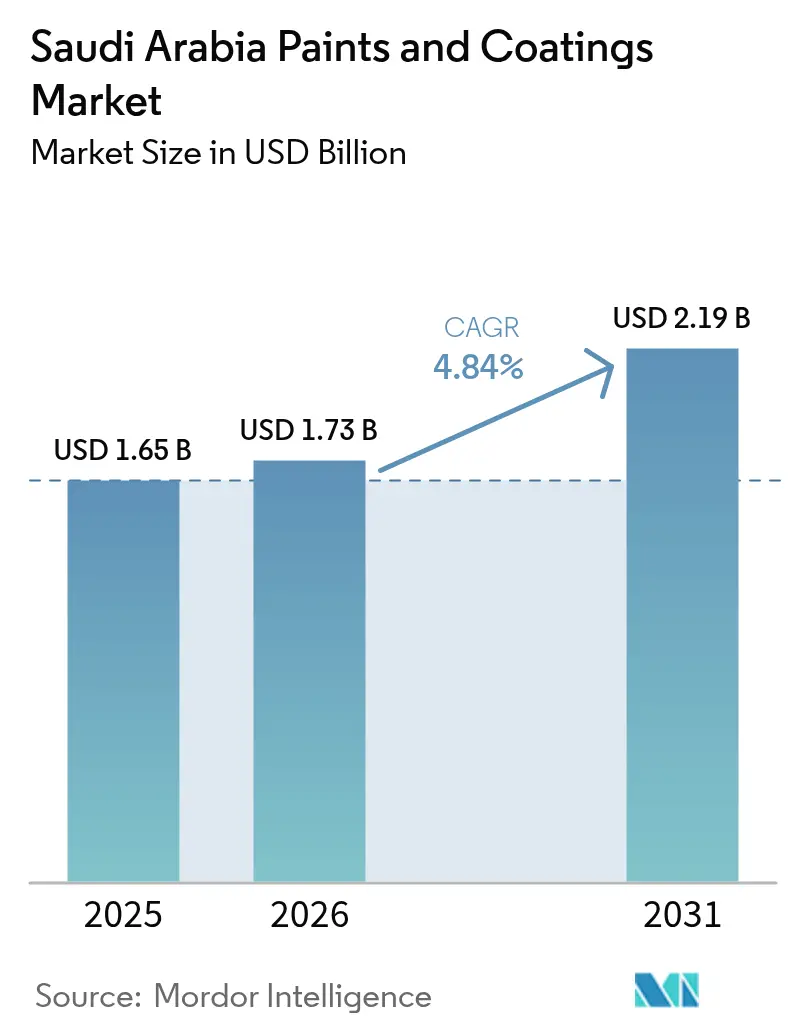
The Saudi Arabia Paints and Coatings Market size was valued at USD 1.65 billion in 2025 and estimated to grow from USD 1.73 billion in 2026 to reach USD 2.19 billion by 2031, at a CAGR of 4.84% during the forecast period (2026-2031). Robust public-sector spending under Vision 2030, tighter environmental rules, and rising localization levels are the main forces behind this increase. Landmark projects such as NEOM, King Salman International Airport, and Diriyah are generating sustained demand for high-performance architectural finishes, while the fast switch to low-VOC systems strengthens the position of water-borne and powder technologies. Strategic joint ventures led by Saudi Aramco and the Public Investment Fund are anchoring international know-how inside the Kingdom, creating fresh capacity for specialty resins and advanced protective chemistries. At the same time, volatile petrochemical feedstock costs and the rise of modular building methods are reshaping cost structures and application practices, compelling suppliers to tighten production efficiency and diversify raw-material sources.
Key Report Takeaways
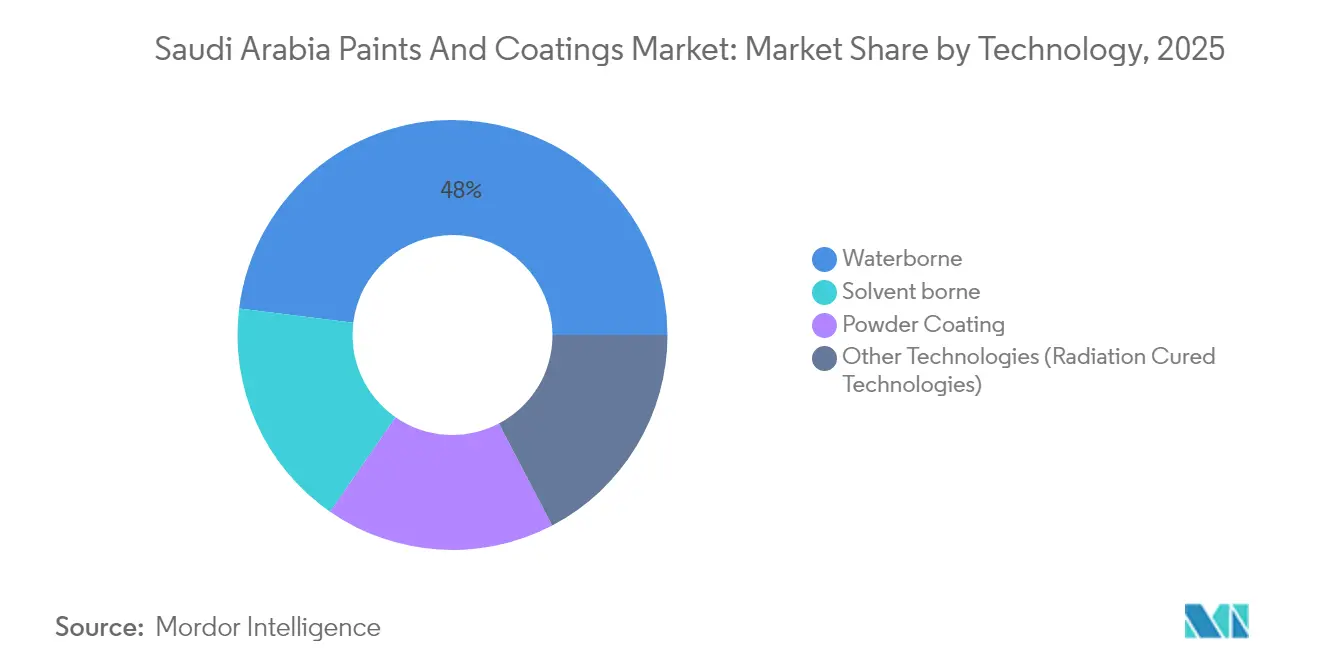
- By technology, water-borne products held 48.02% of the Saudi Arabia paints and coatings market share in 2025 and are forecast to deliver the highest 5.21% CAGR through 2031.
- By resin type, acrylic systems captured 48.43% of the Saudi Arabia paints and coatings market size in 2025 and are projected to grow at a 5.18% CAGR to 2031.
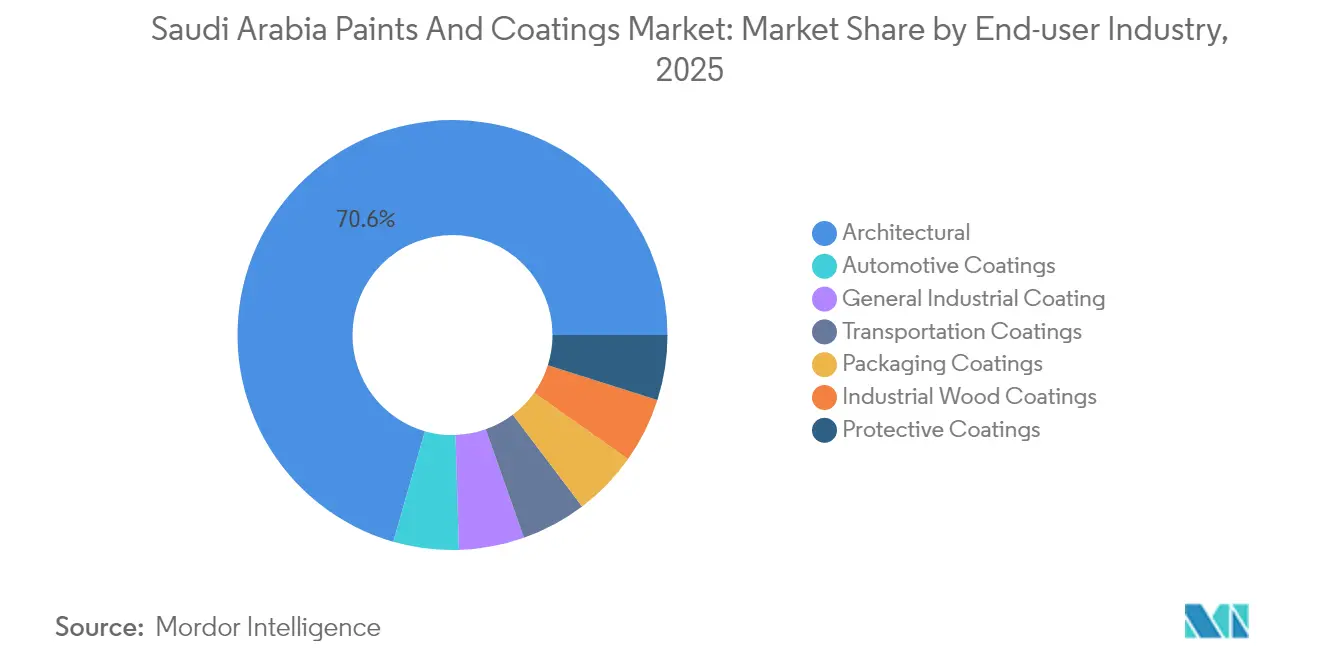
- By end-user industry, architectural applications led with 70.56% revenue share in 2025 and represent the fastest-growing category and are slated for a 5.10% CAGR to 2031.
Note: Market size and forecast figures in this report are generated using Mordor Intelligence’s proprietary estimation framework, updated with the latest available data and insights as of 2026.
Market Trends and Insights
Drivers Impact Analysis of Saudi Arabia Paints And Coatings Market*
| Drivers | (~) % Impact on CAGR Forecast | Geographic Relevance | Impact Timeline |
|---|---|---|---|
| Vision-2030 infrastructure boom | +1.2% | National, with concentration in NEOM, Riyadh, and Eastern Province | Long term (≥ 4 years) |
| Mandatory local-content rules for coatings in oil and gas assets | +0.8% | Eastern Province and industrial cities (Jubail, Yanbu) | Medium term (2-4 years) |
| Rapid switch to water-borne and powder technologies to meet VOC caps | +1.0% | National, with stricter enforcement in industrial zones | Short term (≤ 2 years) |
| Giga-projects (NEOM, Red Sea) specifying solar-reflective façades | +0.6% | Northwestern regions (NEOM, Red Sea coastline) | Long term (≥ 4 years) |
| Localisation of pipeline and hydrogen-ready anti-corrosion coatings | +0.5% | Eastern Province and hydrogen corridor developments | Medium term (2-4 years) |
| Source: Mordor Intelligence | |||
Vision-2030 Infrastructure Boom
The Kingdom’s pipeline of 18,000 projects under Vision 2030 is the single largest demand catalyst, pushing the architectural share of the Saudi Arabia paints and coatings market to 71.12% in 2024[1]. Projects such as the USD 147 billion King Salman International Airport require multi-layer coating systems able to endure dust abrasion, intense UV radiation, and thermal shock for 30-year design lives. Mixed-use developments alone add over 555,000 residential units and 275,000 hotel keys, translating into unprecedented volumes of primers, sealers, and high-solids decorative finishes. Underground civil assets like the Riyadh Metro drive uptake of abrasion-resistant epoxy linings that can withstand cyclic humidity and heavy passenger traffic[2]. This surge is reverberating across the Saudi Arabia paints and coatings market through stronger pull for alkali-resistant acrylics, zinc-rich anti-corrosion primers, and antimicrobial interior emulsions.
Mandatory Local-Content Rules for Coatings in Oil and Gas Assets
Saudi Aramco’s In-Kingdom Total Value Add program reached 43% localization in 2024 and targets 70% by 2030, rewarding suppliers that move resin synthesis, pigment dispersion, and canning inside Saudi Arabia. The shift is especially evident in fusion-bonded epoxy pipe coatings for the world’s largest seawater injection network, where domestic plants now fabricate internal linings that previously had to be imported. New hydrogen transmission lines mandate specialty polyamide-cured epoxies and thermally sprayed aluminum barriers, opening white-space for local SME formulators and multinationals willing to build Saudi production hubs. Technology-transfer clauses embedded in long-term framework agreements are turning the Eastern Province into a regional center of excellence for high-build anti-corrosion chemistries.
Rapid Switch to Water-Borne and Powder Technologies to Meet VOC Caps
The Environmental Law (Royal Decree M/165), effective January 2025, bans products exceeding strict VOC limits, prompting water-borne paints to seize 48.41% share of the Saudi Arabia paints and coatings market in 2024. Industrial estates in Jubail and Yanbu apply even tighter caps, accelerating the move to powder coatings whose 100% solids formulation eliminates solvent emissions. Factory applicators favor these powders for window frames, cladding, and data-center racks because faster curing reduces line energy use and boosts throughput. Nanocomposite powder technologies now incorporate silica-modified acrylics that improve scratch resistance and UV retention, making them suitable for premium façades exposed to sandstorms and 50 °C summer peaks.
Giga-Projects Specifying Solar-Reflective Façades
Climate-adaptive designs in NEOM and the Red Sea Project stipulate solar-reflective coatings that cut roof temperatures by 20 °C and slash annual cooling loads by up to 48.6%. These coatings combine high-albedo pigments with infrared-transparent binders, and some variants embed self-cleaning titania nanoparticles to counter dust deposition. Marine-grade polyurethane topcoats meeting ISO 12944 C5-M standards protect coastal resort assets against salt spray, while hydrogen-ready epoxy phenolic systems safeguard underground storage caverns. Successful qualification on giga-projects is quickly cascading to mainstream commercial builds, lifting overall specification standards across the Saudi Arabia paints and coatings market.
Restraints Impact Analysis of Saudi Arabia Paints And Coatings Market*
| Restraints | (~) % Impact on CAGR Forecast | Geographic Relevance | Impact Timeline |
|---|---|---|---|
| Volatile petrochemical feedstock pricing | -0.7% | National, with concentration in petrochemical hubs (Jubail, Yanbu) | Short term (≤ 2 years) |
| Tightening VOC and hazardous-solvent regulation | -0.4% | National, with stricter enforcement in industrial and urban zones | Short term (≤ 2 years) |
| Emerging prefab-construction methods cutting paint consumption | -0.3% | Urban centers (Riyadh, Jeddah, Dammam) with modular construction adoption | Medium term (2-4 years) |
| Source: Mordor Intelligence | |||
Volatile Petrochemical Feedstock Pricing
Crude-to-chemicals integration is lowering Saudi naphtha exports, curbing solvent availability, and inflating input costs for alkyd and polyurethane producers. The Satorp and Yasref expansions will divert larger crude volumes into aromatics and olefins, magnifying cost swings for resin monomers such as styrene and butyl acrylate. Suppliers are therefore diversifying toward water-borne polyurethane dispersions and bio-based polyols that mitigate reliance on petrochemical streams. Risk hedging, through multi-month feedstock contracts with Aramco Trading, and lean inventory management have become critical to protect margins in the Saudi Arabia paints and coatings market.
Emerging Prefab-Construction Methods Cutting Paint Consumption
Modular builders like Prefabex assemble full wall panels in controlled factories, complete with primer and topcoat, reducing field painting work scopes by 20–30% on high-rise projects. These plants apply robot-sprayed, oven-cured powder systems that deliver uniform film builds and reduced rework. While total square-meter output of coatings declines on a per-unit basis, higher-value factory-grade formulations partially offset volume losses. Traditional distributors that rely on job-site deliveries are adapting by supplying specialized touch-up kits and color-matched repair aerosols compatible with off-site finishes.
*Our forecasts treat driver/restraint impacts as directional, not additive. The impact forecasts reflect baseline growth, mix effects, and variable interactions.
Saudi Arabia Paints And Coatings Market Segment Analysis
By Technology:
Water-Borne Dominance Accelerates Environmental ComplianceWater-borne products controlled 48.02% of the Saudi Arabia paints and coatings market share in 2025, advancing at a 5.21% CAGR through 2031 as specifiers pivot toward zero-to-low-odor work sites. Solvent-borne alkyds still prevail in high-temperature pipelines where fast drying and moisture tolerance are essential, but replacements are emerging via water-reducible alkyd emulsions. Powder coatings are expanding into façades, electrical enclosures, and stadium seating, aided by new super-durable polyester-acrylic hybrids that deliver 3,000-hour QUV resistance. Radiation-cured systems play a small yet growing role in furniture lines and plastic automobile parts needing tack-free handling in seconds.
Longer term, the Saudi Arabia paints and coatings market size linked to water-borne technology will rise as government ministries roll out public procurement policies mandating VOC-free interiors for schools and hospitals. Multilingual labeling and easy-clean attributes appeal to contractors responsible for maintaining the 120 million passenger-per-year King Salman Airport. Powder suppliers are preparing capacity expansions near Riyadh’s new dry port to capture architectural cladding demand, reinforcing the Kingdom’s ambition to act as an export node to the wider GCC.

By Resin Type:
Acrylic Leadership Drives Versatility and PerformanceAcrylic chemistries amassed 48.43% of the Saudi Arabia paints and coatings market size in 2025 on the back of exceptional UV durability and color fastness, and are advancing at a CAGR of 5.18%. Fast-drying styrene-acrylic emulsions today coat school halls and hospital corridors that must return to service overnight. Polyurethane systems dominate high-build roof membranes exposed to temperature cycling and occasional acid rain events generated by industrial clusters. Epoxy novolacs protect tank linings and offshore platforms, while polyester resins underpin the surge in TGIC-free powder exports to Africa.
Next-generation silicone-modified acrylics promise dirt-shedding exteriors for skyscrapers exceeding 400 m in Riyadh’s new CBD. Frontier research and development is focusing on graphene-enhanced acrylic binders that double tensile strength without sacrificing gloss, aligning with Vision 2030 initiatives to industrialize advanced carbon materials.
By End-User Industry:
Architectural Segment Captures Infrastructure Boom BenefitsThe architectural segment held a commanding 70.56% share of 2025 revenues, mirroring unprecedented new-build volumes across residential, hospitality, and mixed-use assets, and is advancing at a CAGR of 5.10%. Interior emulsions with formaldehyde-scavenging additives meet SASO indoor-air guidelines, while elastomeric exterior paints bridge façade hairline cracks caused by thermal cycling. Specialty solar-reflective roof membranes that lower heat-island effects are standard on LEED-certified hotels lining the Red Sea coast. Automotive coatings rank second in growth priority, supported by Hyundai’s 50,000-unit plant that will consume e-coat, basecoat, and clearcoat systems engineered for desert sand abrasion.
Protective coatings flourish around Aramco’s gas compression projects, where novolac epoxies and thermal-spray aluminum protect assets designed for a 50-year life. Industrial wood and packaging coatings ride the e-commerce wave, as Saudi furniture exporters and food processors raise product-appearance standards. Transportation coatings benefit from Riyadh Metro’s railcar refurbishments, requiring anti-graffiti clearcoats and low-smoke interior finishes compliant with EN45545.
Geography Analysis
The Eastern Province is seeing a growth in consumption owing to Jubail and Yanbu industrial cities, where heavy-duty primers, tank linings, and marine topcoats account for almost one-third of the Saudi Arabia paints and coatings market. Riyadh, boosted by mega-airport and metro works, represents the most dynamic pocket, fueling demand for low-odor, quick-turnaround interior systems suited to tight build schedules. Western Province tourism assets, notably the Red Sea luxury resorts, mandate ISO-12944 C5-M coatings capable of resisting chloride and sulfate attack, sustaining robust volumes of polyaspartic polyurethanes.
In the Northwest, NEOM’s USD 500 billion vision is rewriting specification books with net-zero embodied-carbon targets, positioning solar-reflective acrylics and hydrogen-compatible epoxies as default choices. The Southern mining belt, anchored by Maaden, spurs protective paint demand for phosphoric-acid tank farms and conveyor galleries. Central Province agriculture and solar PV push adoption of ultra-weatherable powder coatings on mounting structures. Each region’s distinct industrial mix underpins localized product portfolios, yet the overall Saudi Arabia paints and coatings market remains unified through national SASO standards and centralized raw-material supply chains.
Regulatory Landscape
Saudi Standards, Metrology and Quality Organization (SASO) governs market access for paints and varnishes through its Technical Regulation for Paints (Dyes) and Varnishes. The regulation sets product safety, quality, and environmental requirements and links conformity assessment to the SABER platform. Regulated products typically require a Product Conformity Certificate (PCC) before import and sale, which makes certification readiness and test documentation central to market entry and helps avoid customs delays.
Environmental compliance has tightened alongside product safety oversight. The Environmental Law (Royal Decree M/165) took effect in January 2025 and supports stricter control of VOCs and hazardous substances, reinforcing the shift toward water-borne and powder technologies already visible in industrial zones such as Jubail and Yanbu. SASO also introduced Environmental Performance Efficiency Labeling requirements under the paints and varnishes technical regulation framework, with voluntary application from April 2026 and mandatory labeling from October 2026. This increases the value of early testing and label compliance planning for manufacturers and importers.
Value Chain Analysis
Saudi Arabia's paints and coatings value chain combines local production of high-volume architectural products with continued reliance on imports for specialized resins, pigments, and additives. Upstream inputs such as titanium dioxide and specialty epoxy intermediates remain largely internationally sourced, while domestic manufacturing is concentrated in industrial hubs such as Dammam and the Eastern Province corridor. Industrial cities overseen by MODON, including Jubail and Yanbu, support blending, dispersion, and the finishing of coatings for national distribution through producers and toll manufacturers.
Downstream, the channel is bifurcating between traditional retail and stockist distribution for decorative paints, and direct-to-project technical selling for giga-projects. Large buyers such as NEOM and the Red Sea Project consolidate procurement and increasingly require contractor-facing service models, including on-site technical support, specification assistance, and rapid color matching. This favors suppliers with local laboratories and short lead times. Localization programs, including Saudi Aramco's IKTVA and the Made in Saudi initiative, also shape sourcing decisions by encouraging resin synthesis, pigment dispersion, and packaging activities inside the Kingdom, which reshapes supplier selection around in-country production and qualification of local sub-suppliers.
Competitive Landscape
The market is moderately fragmented. Major players' research and development centers in Dammam and Jeddah fine-tune color spaces for desert illumination and sandstorm exposure. Jazeera Paints, National Paints, and Al-Jazeera Factory exhibit strong brand recognition in retail emulsion channels and benefit from Arabic label familiarity. Innovation races now orbit around hydrogen-ready coatings, super-durable powders, and AI-assisted color-matching applications. PPG’s SPEEDHIDE MAX zero-VOC range expanded to seven sheens, offering contractors higher tint strength with reduced odor. Localization depth, proven sand-storm durability, and digital color-spec support will separate winners from laggards over the next five years.
Saudi Arabia Paints And Coatings Industry Leaders
-
Jotun
-
Akzo Nobel N.V.
-
Hempel A/S
-
Jazeera Paints
-
Sigma Paints (PPG Industries Inc.)
- *Disclaimer: Major Players sorted in no particular order
Saudi Arabia Paints And Coatings Market Companies Covered in this Report
- Akzo Nobel N.V.
- Axalta Coating Systems, LLC
- BBC Paints
- Caparol Paints
- Hempel A/S
- Jazeera Paints
- Jotun
- Kansai Paint Co. Ltd
- NATIONAL PAINTS FACTORIES CO. LTD.
- Protech Group
- SAAD H. ABUKHADRA & Co. Inc.
- Sigma Paints (PPG Industries Inc.)
- The Sherwin-Williams Company
- United Coating Industries
Market Opportunities and Future Outlook
Regulatory tightening and certification requirements are creating whitespace for suppliers that can industrialize compliant low-VOC portfolios and demonstrate conformity through SASO and SABER processes. In May 2026, SASO issued Technical Regulation TR-IND-2026-04, revoking the VOC exemption for water-based industrial coatings and requiring full-scope testing under the applicable SASO standard. This increases the premium placed on local testing capability, stable formulations, and documentation discipline for both domestic producers and importers. The change also points to opportunities in reformulation services, compliant industrial maintenance systems, and water-borne protective solutions that align with enforcement in industrial zones.
Localization initiatives and upstream petrochemical investments are broadening the scope for downstream coating raw materials and additive systems produced inside Saudi Arabia. Songwon Industrial announced an investment in a greenfield One Pack Systems (OPS) facility in Saudi Arabia (October 2025) to supply additive systems used across plastics and coatings, while Tasnee completed a USD 500 million ethylene expansion in Jubail (July 2026), strengthening the local olefins base for downstream polymers and intermediates relevant to coatings. Parallel moves by local and regional players, including VIP Coatings partnering with CIC Construction Chemicals to localize production (April 2026) and SIPCO acquiring Premium Paints to expand local capacity (February 2025), indicate opportunities in in-Kingdom manufacturing for project supply, specialty protective chemistries aligned to oil and gas and new-energy assets, and direct-to-giga-project service models such as on-site labs, fast-turn color, and specification engineering.
Recent Industry Developments in Saudi Arabia Paints And Coatings Market
- July 2026: Tasnee completed a USD 500 million expansion of the Saudi Ethylene and Polyethylene Company ethylene cracker in Al Jubail Industrial City, lifting olefins capacity by 18%. The added upstream output strengthens local availability of polymer and chemical intermediates used across coatings-related value chains, supporting domestic supply resilience for downstream formulators.
- May 2026: SASO issued Technical Regulation TR-IND-2026-04, revoking the VOC exemption for water-based industrial coatings and mandating full-scope testing in line with the updated SASO standard. The change raises compliance and documentation requirements for suppliers and can shift purchasing toward manufacturers with in-Kingdom testing, stable formulations, and faster certification cycles.
- February 2025: SIPCO completed the acquisition of Premium Paints Company to expand local production capacity and deepen its presence in the Saudi market. The deal supports faster response to large construction programs and adds scale in locally manufactured decorative and project-oriented coatings.
Saudi Arabia Paints And Coatings Market Report Scope and Research Methodology
Market Definition and Coverage
For this study, the market is defined as the value of paints and coatings sold for use in Saudi Arabia, covering decorative and functional coating layers applied on buildings, infrastructure, equipment, vehicles, and packaged goods.
Scope exclusions: Excludes adjacent construction chemicals (such as adhesives, sealants, and waterproofing membranes) and non-coating surface materials that do not form a paint or coating film.
Segments Covered in This Report
- By Technology
- Water-borne
- Solvent-borne
- Powder Coating
- Other Technologies (Radiation Cured Technologies)
- By Resin Type
- Acrylic
- Alkyd
- Polyurethane
- Epoxy
- Polyester
- Other Resin Types ?(Vinyl, Nitrocellulose, Latex)
- By End-user Industry
- Architectural
- Automotive Coatings
- Industrial Wood Coatings
- Protective Coatings
- General Industrial Coating
- Transportation Coatings
- Packaging Coatings
Data Sources, Market Sizing, and Validation
Desk Research
Desk research starts with building a clean demand backdrop for Saudi Arabia, then mapping how coatings are consumed across construction and industrial activity. For this, we relied on public sources such as the General Authority for Statistics (construction and manufacturing indicators), Saudi Central Bank (macroeconomic series and inflation signals), Saudi Customs releases (imports and exports), and UN Comtrade (trade direction and unit-pattern cross-checks).
Supportive context was also reviewed from sources such as SASO publications for standards and compliance signals, government portals that publish tender and project announcements, and peer reviewed journals to understand technology shifts (for example, waterborne adoption and VOC-related changes). Company annual reports, investor presentations, and reputable press were used to validate capacity moves and distribution reach. Where public datasets had gaps, we used paid subscriptions for company financials and for shipment-level trade intelligence, but only selectively. The sources listed here are illustrative and not exhaustive, and many other references were also used to collect data, validate assumptions, and clarify open questions.
Primary Interviews and Surveys
Primary work was used to pressure-test desk assumptions and convert activity indicators into realistic coatings demand. We spoke with a balanced mix of manufacturers, distributors, applicators, and large buyers to confirm pricing logic, technology mix, and demand swings across residential, commercial, and industrial projects.
Because this is a country market, respondents were selected to reflect the main demand pockets, and follow-ups were conducted when desk and interview signals did not align on volumes, project timing, or price direction.
Distribution of primary research fieldwork respondents
| Company type | Respondent position |
|---|---|
| Top tier: 34% | CXOs: 17% |
| Mid tier: 48% | Functional/Unit leaders: 37% |
| Smaller Players: 18% | Managers: 46% |
Market-Sizing & Forecasting
Sizing was built using top-down and bottom-up logic, where national demand is first reconstructed from construction and industrial activity and then cross-checked against supply-side realities. On the top-down side, indicators such as building and infrastructure spend, housing completions, non-oil manufacturing output, and large project pipelines were converted into coatings demand using observed consumption intensities, then split by technology and major end uses so totals stay consistent.
To corroborate the totals, selective bottom-up approximations were used such as sampled volume-by-application checks, distributor feedback on throughput, and average selling price ranges by technology, followed by adjustments when implied price progression did not match market feedback. Key inputs tracked include the share shift toward waterborne systems, raw material driven pricing movement, protective coatings pull from maintenance cycles in energy and industry, and the pace of new build versus refurbishment work. For forecasting, scenario analysis was applied around construction execution pace and industrial capex timing, then refined with expert consensus so the forward curve stays realistic when projects are delayed or accelerated. Where bottom-up signals were weaker for smaller end uses, conservative penetration assumptions were applied and then revalidated through interviews before finalizing.
Data Validation & Update Cycle
Model outputs were checked against independent signals such as trade trends, construction activity direction, and observed price ranges, and then variances were reviewed by a second analyst before sign-off. If a segment moved in a way that did not match the demand indicators, inputs were revisited and respondents were re-contacted to confirm whether the shift was structural or temporary.
The report is refreshed annually, and interim updates are triggered when material events occur, such as a major regulatory change, meaningful capacity addition, or a sharp cost swing that shifts pricing. Before delivery, a final pass is completed so the most recent data points and interview learnings are reflected in the market size and forecast.
Mordor Intelligence's Saudi Arabia Paints and Coatings Market Size Compared Against Other Published Estimates
Published market sizes for Saudi Arabia paints and coatings often do not match because different studies draw the boundaries around what is included, and they also use different price and timing assumptions. The chosen base year, how currency timing is handled, and the assumed speed at which technology mix shifts can change the final value by a noticeable amount.
In our review, the main gap drivers were whether industrial maintenance and protective use are fully counted alongside decorative demand, how import values are normalized against local price levels, and whether forecasts assume a steady project execution pace or build in delays. When protective maintenance demand is only counted where recurring asset upkeep is evidenced through industrial activity checks and import normalization, the spread to other figures narrows, which is a defining difference in the way Mordor Intelligence builds the Saudi Arabia paints and coatings total.
Benchmark comparison
| Source | Market Size | Gaps in Research Methodology |
|---|---|---|
| Mordor Intelligence | USD 1.65 B (2025) | |
| Regional Consultancy A | USD 1.55 B (2025) | Often emphasizes decorative demand and applies a tighter end-use accounting, which can undercount protective maintenance and some industrial applications that still consume meaningful volumes. |
| Industry Research Publisher B | USD 2.10 B (2025) | Typically uses higher blended pricing and may apply broader inclusion of coating demand categories, which can inflate value when price progression is not reconciled with trade and end-use intensity checks. |
Looking across the three figures, the lower estimate aligns with narrower end-use coverage, while the higher estimate is consistent with higher implied pricing or added demand categories. By keeping inclusions explicit, tying demand to activity indicators, and checking implied volumes and prices against market feedback, the final number stays easier to replicate and explain.
Key Questions Answered in the Report
How large is the Saudi Arabia paints and coatings market in 2026?
The Saudi Arabia paints and coatings market size is USD 1.73 billion in 2026, with projections indicating USD 2.19 billion by 2031 at a 4.84% CAGR.
Which coating technology is growing fastest in Saudi Arabia?
Water-borne products are expected to post the fastest 5.21% CAGR through 2031, driven by zero-VOC mandates and energy-efficient curing advantages.
What segment dominates paint demand in Saudi Arabia?
Architectural applications account for 70.56% of total 2025 revenues owing to the Vision 2030 construction boom.
How are local-content rules impacting suppliers?
Saudi Aramco’s IKTVA program rewards companies manufacturing inside the Kingdom, already enabling 43% localization and targeting 70% by 2030.
What environmental laws shape product formulation?
Royal Decree M/165 imposes strict VOC caps effective 2025, accelerating the shift to water-borne and powder systems throughout the supply chain.