
Market Overview
| Study Period | 2020 - 2031 |
|---|---|
| Forecast Data Period | 2026 - 2031 |
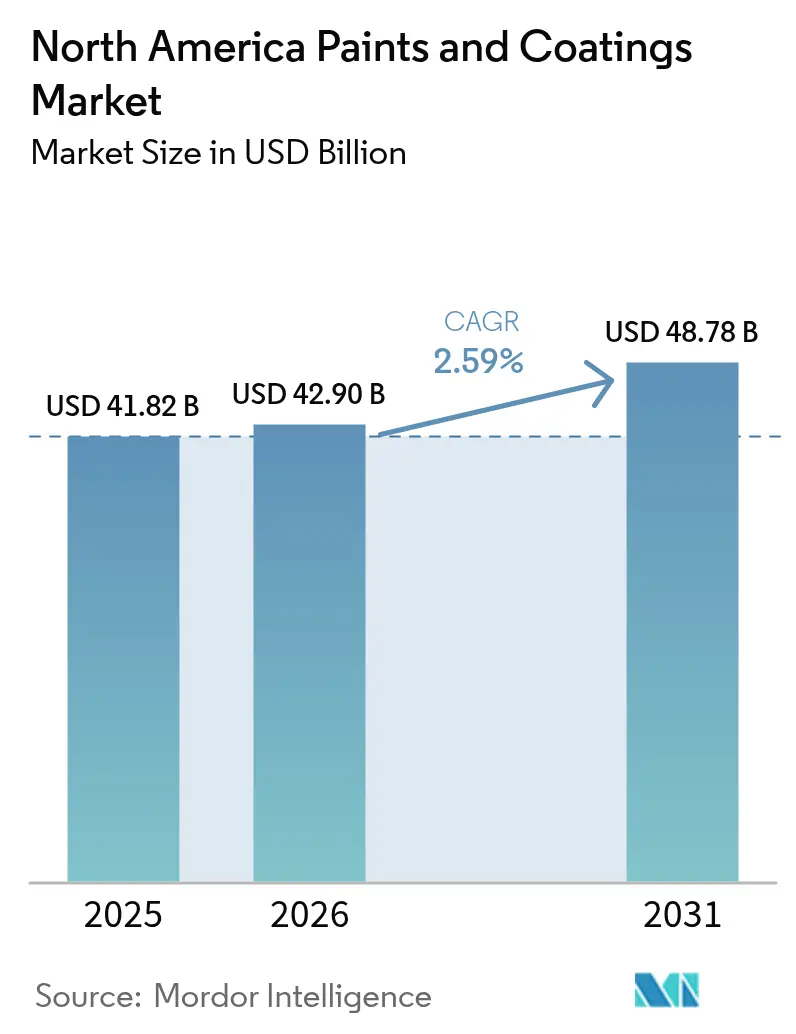
| Base Year Market Size (2025) | USD 41.82 Billion |
| Market Size (2026) | USD 42.9 Billion |
| Market Size (2031) | USD 48.78 Billion |
| Growth Rate (2026 - 2031) | 2.59 % |
| Market Concentration | Medium |
Major Players *Disclaimer: Major Players sorted in no particular order Image © Mordor Intelligence. Reuse requires attribution under CC BY 4.0. | |
North America Paints And Coatings Market Analysis by Mordor Intelligence
The North America Paints and Coatings Market size in 2026 is estimated at USD 42.9 billion, growing from 2025 value of USD 41.82 billion with 2031 projections showing USD 48.78 billion, growing at 2.59% CAGR over 2026-2031. Steady gains stem from deeper penetration of water-borne technologies, which command a 57.23% share, and resilient architectural renovation alongside commercial construction outlays. The United States generates 85.64% of all regional demand based on extensive building stock and reshoring-led industrial activity. Acrylic resins remain the volume cornerstone at 37.67% share, yet polyurethane lines expand quickest as OEMs (original equipment manufacturers) prioritize toughness and weather resistance. Margin discipline hinges on mitigating 15-25% quarterly swings in petrochemical feedstocks while automating production and color-matching workflows to offset skilled-labor deficits.
Key Report Takeaways
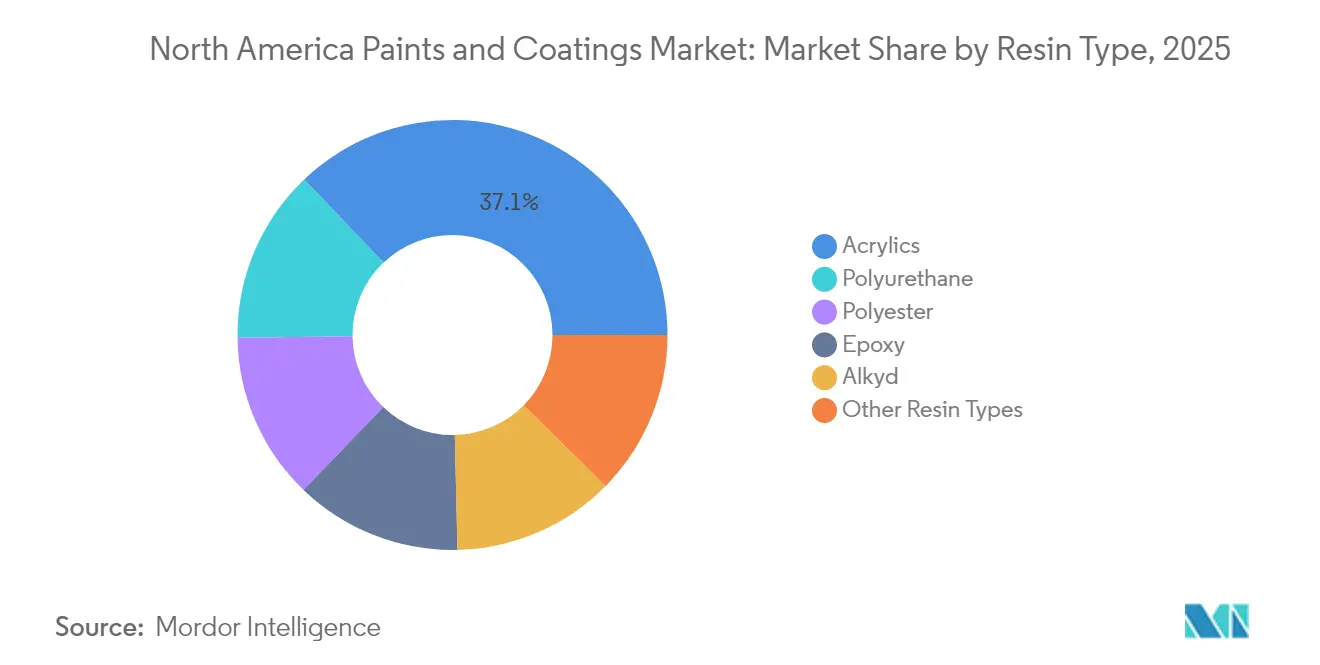
- By resin type, acrylics led with 37.12% of the North American Paints and Coatings market share in 2025, while polyurethanes posted the highest projected CAGR at 2.95% through 2031.
- By technology, water-borne systems accounted for a 57.05% share of the North American Paints and Coatings market size in 2025; powder coatings are set to advance at a 3.18% CAGR between 2026-2031.
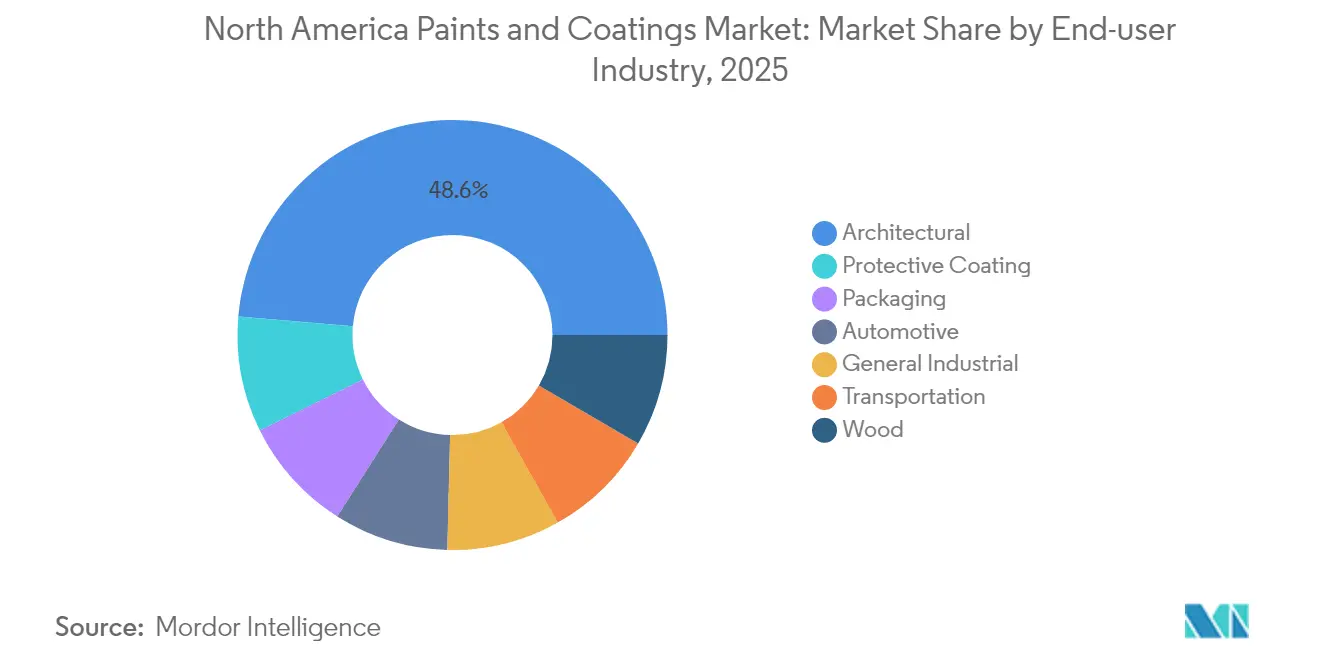
- By end-user industry, architectural applications captured 48.62% of the North American Paints and Coatings market size in 2025 and are tracking a 3.22% CAGR to 2031.
- By geography, the United States held 85.18% revenue share in 2025, reflecting scale advantages in manufacturing, construction, and distribution networks.
Note: Market size and forecast figures in this report are generated using Mordor Intelligence’s proprietary estimation framework, updated with the latest available data and insights as of 2026.
North America Paints And Coatings Market Trends and Insights
Drivers Impact Analysis*
| Driver | (~) % Impact on CAGR Forecast | Geographic Relevance | Impact Timeline |
|---|---|---|---|
| Surge in Commercial and Institutional Construction | +0.8% | United States core; spillover to Canadian cities | Medium term (2-4 years) |
| Rapid Shift to Low-VOC Water-borne Technologies | +0.6% | Region-wide, led by California and Northeast | Long term (≥ 4 years) |
| OEM Demand for High-performance Powder Coatings | +0.5% | U.S. manufacturing belt; Mexico maquiladora zones | Medium term (2-4 years) |
| AI-driven Color-matching Platforms Accelerating Repaint Cycles | +0.4% | United States and Canada metros | Short term (≤ 2 years) |
| Reshoring of US Manufacturing Boosting Anti-corrosion Demand | +0.3% | Rust Belt and Southeast corridors | Long term (≥ 4 years) |
| Source: Mordor Intelligence | |||
Surge in Commercial and Institutional Construction
Commercial outlays reached USD 180 billion in 2024, translating directly into greater demand for premium architectural coatings that meet strict indoor-air requirements[1]U.S. Census Bureau, “Value of Construction Put in Place,” census.gov. Healthcare builds alone represented USD 12 billion in coating-intensive projects as antimicrobial finishes became baseline specifications. Renovation cycles across logistics hubs, data centers, and educational facilities sustain high-margin orders for fire-retardant and static-dissipative paints. Low-emission mandates such as the South Coast Air Quality Management District cap of 50 g/L VOC further shift preference toward advanced water-borne lines. The driver, therefore, locks in steady architectural pull for the North American paints and coatings market.
Rapid Shift to Low-VOC Water-borne Technologies
Eighteen U.S. states now enforce VOC limits below federal thresholds, accelerating water-borne adoption across all usage classes. Architectural variants fetch 15–20% price premiums, cushioning margin pressure even as solvent inputs spike. Hybrid chemistries marry water clean-up with solvent-level endurance in protective segments, helping suppliers capture long-cycle industrial contracts. The regulatory tide effectively institutionalizes higher specification, lifting average selling prices within the North American paints and coatings market.
OEM Demand for High-performance Powder Coatings
Automotive and appliance OEMs favor powder lines for near-zero emissions and 98% transfer efficiency, a tangible cost advantage over liquid finishes. Electric-vehicle battery housings, thermal shields, and appliance panels add functional parameters such as dielectric strength and heat dissipation, moving powder beyond aesthetics. Mexico’s maquiladora clusters rely on these coatings to meet US import standards, reinforcing demand integration across the North American paints and coatings market.
AI-driven Color-matching Platforms Accelerating Repaint Cycles
Sherwin-Williams’ ColorSnap processed more than 2 million digital matches monthly in 2024, cutting color selection cycles from weeks to hours[2]Sherwin-Williams, “ColorSnap Usage Statistics,” sherwin-williams.com. BASF’s Refinity brings similar speed to body-shop refinishing, slashing booth downtime and material waste. Contractors report 25% productivity gains, turning rapid repaint into a volume lever for the North American paints and coatings market. The technology particularly impacts architectural repaint markets, where color uncertainty traditionally delayed project initiation by 2-4 weeks while customers evaluated options.
Restraints Impact Analysis*
| Restraint | (~) % Impact on CAGR Forecast | Geographic Relevance | Impact Timeline |
|---|---|---|---|
| Volatile Petrochemical Raw-material Prices | -0.4% | Region-wide; acute in Gulf Coast | Short term (≤ 2 years) |
| Stringent and Diverging VOC Regulations Across US/Canada/Mexico | -0.3% | Most rigorous in California and Northeast | Medium term (2-4 years) |
| Skilled-applicator Labor Shortage in Industrial Coatings | -0.2% | U.S. industrial hubs; Canadian manufacturing centers | Long term (≥ 4 years) |
| Source: Mordor Intelligence | |||
Volatile Petrochemical Raw-material Prices
Titanium dioxide swings of 25% per quarter and acrylic-monomer spikes of 30% keep procurement budgets unstable, eroding contractual margins for smaller players. Supply chain disruptions from Gulf Coast weather events and refinery maintenance cycles amplify price volatility, with Hurricane Beryl's 2024 impact on Texas petrochemical facilities demonstrating the sector's vulnerability to operational disruptions. Manufacturers with hedging programs and integrated resin capacity can shield profitability, hastening consolidation within the North American paints and coatings market.
Stringent and Diverging VOC Regulations Across North America
Rule 1113 in California limits architectural paints to 50 g/L VOC, whereas Texas permits 380 g/L, forcing multi-formula inventories that fragment scale economics. Mexico’s draft limits mirror California thresholds but rely on different testing protocols, adding another compliance tier. Regulatory inconsistency increases cost-to-serve and slows time to market. The regulatory constraint particularly impacts industrial coatings, where performance requirements often conflict with emission limitations, forcing manufacturers to invest in advanced polymer chemistry research to achieve compliance without sacrificing durability characteristics
*Our forecasts treat driver/restraint impacts as directional, not additive. The impact forecasts reflect baseline growth, mix effects, and variable interactions.
Segment Analysis
By Resin Type: Acrylic Dominance with Polyurethane Momentum
Acrylic systems occupied 37.12% of the North American paints and coatings market share in 2025, benefiting from balanced cost, weatherability, and color retention across architectural and automotive finishes. The sub-segment also captures early wins from bio-based feedstock innovation, meeting sustainability mandates without sacrificing performance. While smaller in absolute terms, polyurethane grades log the fastest 2.95% CAGR through 2031 on demand for high-abrasion durability in OEM assemblies. Epoxies stay indispensable in marine and infrastructure applications where chemical resistance outweighs initial cost concerns. Alkyd displacement accelerates as VOC norms tighten, yet modified alkyd-water hybrids prolong relevance in niche trim and primer roles. Blended chemistries that marry acrylic elasticity with polyurethane hardness present fertile ground for differentiated offerings inside the North American paints and coatings market.
In industrial maintenance and asset-protection projects, silicone and fluoropolymer niches command premium pricing due to extreme heat or chemical exposures, although their aggregate revenue share remains modest. Polyester resins gain ground in powder lines, reinforcing the zero-VOC narrative while delivering 25-year façade warranties for aluminum extrusions. Resin choice therefore centers less on commodity cost and more on life-cycle value as facility owners calculate total operating expense. Suppliers with cross-technology R&D capacity enjoy a service moat that newcomers struggle to replicate, reinforcing competitive stratification throughout the North American paints and coatings industry.



By Technology: Water-borne Pre-eminence, Powder Acceleration
Water-borne platforms captured 57.05% of the total value in 2025, cementing their position as the baseline chemistry for interior and exterior architectural work. Transfer efficiency gains, odor reduction, and easier equipment cleanup help contractors save labor time, enhancing pull-through for distributors. Powder coatings, at a 3.18% CAGR to 2031, ride electrification and appliance output as zero-VOC policies converge with production-line automation. UV-cured segments diversify into flooring and packaging, where instant handling offsets higher resin cost, and solvent-borne grades retreat into specialist assignments demanding solvent-level outcomes. Digital viscosity monitoring enables painters to hit water-borne spray windows with repeatable results, tackling historical humidity sensitivity issues. The technology mix underscores how sustainability plus productivity jointly influence capital-purchase decisions inside the North American paints and coatings market.
Hybrid solutions bridge extreme-service gaps—for example, water-borne primers topped with solvent-free polysiloxane clears for coastal bridges—proving that innovation leans toward system thinking rather than single-product swaps. Equipment makers align by integrating electrostatic guns, curing ovens, and data analytics into turnkey cells, raising switching barriers and locking in powder-line growth. Such total-ecosystem orientation solidifies the future trajectory of the North American paints and coatings market.
By End-user Industry: Architectural Core with Emerging Industrial Diversity
Architectural work flowed through USD billions of commercial towers, warehouses, and multifamily renovations, capturing 48.62% of 2025 revenue and charting the fastest 3.22% CAGR through 2031. Sustainability certifications, including LEED (Leadership in Energy and Environmental Design) v4.1 low-emitting criteria, intensify demand for zero-solvent and antimicrobial lines. Automotive coatings confront drivetrain electrification: battery casings need electrostatic shielding, while lightweight substrates require flexible finishes, each commanding higher selling prices. Wood furniture and millwork benefit from reshored cabinetry plants and consumer interest in non-yellowing clearcoats. Protective coatings become mission-critical as bridge agencies and oil-and-gas operators replace legacy epoxy coal-tar with novolac hybrids that double service intervals, limiting downtime costs. Packaging evolves via BPA-free liners in food cans and UV-flexo overprints on metal tubes. Collectively, this industrial diversity insulates the North American paints and coatings market from single-sector cyclicality.
Contractors and OEMs alike now weigh coatings through a total-ownership lens that factors accelerated assembly, warranty risk, and disposal compliance. High-performance formulations win bids where maintenance shut-downs carry six-figure opportunity costs per day. Suppliers that outfit technical service teams and digital support portals secure preferred-vendor status, elevating service value alongside product volume across the North American paints and coatings industry.
Geography Analysis
The United States delivered 85.18% of 2025 turnover and is forecast for a 2.84% CAGR to 2031 as infrastructure renewal, commercial space builds, and semiconductor fabs broaden coating consumption. State-by-state VOC discrepancies complicate logistics, yet they also steer premium uptake where the lowest-emission benchmarks apply. Manufacturing credits under the Inflation Reduction Act channel investment toward battery, solar, and chip plants that require highly specified anti-corrosion and clean-room coatings, cementing the country’s central role within the North American paints and coatings market.
Canada positions itself as a specialized niche emphasizing resource extraction and harsh-climate durability. Protective systems for pipelines, mining equipment, and hydroelectric structures wield strong pricing power due to extreme service conditions. Regulatory harmonization with the US EPA (Environmental Protection Agency) simplifies cross-border approvals, letting producers leverage continental manufacturing footprints while tailoring for cold-weather cure windows. Urban housing upgrades in Toronto, Vancouver, and Calgary additionally feed architectural repaint demand, providing balanced volume continuity for the North American paints and coatings market.
Mexico offers the growth lever as OEMs realign supply chains under USMCA (United States-Mexico-Canada Agreement). Automotive, appliance, and electronics plants around Monterrey, Saltillo, and the Bajío corridor specify powder and low-VOC water-borne systems to comply with corporate sustainability pledges. SEMARNAT’s tightening draft rules heighten the need for compliant local supply. AkzoNobel’s USD 3.6 million powder-line expansion in Tlalnepantla signals broader multinational confidence in Mexican throughput potential. The tri-national dynamics underline the integrated yet varied geography of the North American paints and coatings market.
Regulatory Landscape
Regulation across North America is shaped by air-emissions and toxic-substance controls that influence coatings formulation, labeling, and product availability. In the United States, the EPA regulates VOC emissions for architectural coatings under 40 CFR Part 59 (Subpart D). State and regional product-category requirements can be tighter, which reinforces the shift toward low-VOC water-borne systems that account for 57.05% of 2025 value. On January 17, 2025, the EPA finalized amendments to the National Volatile Organic Compound Emission Standards for Aerosol Coatings, updating reactivity-based limits and compliance parameters that affect both manufacturers and private-label packagers supplying DIY and professional channels.
Canada complements VOC requirements with hazardous-substance limits under Health Canada, including the Surface Coating Materials Regulations (SOR/2016-193), which cap total lead at 90 mg/kg and total mercury at 10 mg/kg (current to May 26, 2026). Cross-border alignment and trade facilitation remain active policy themes ahead of the 2026 CUSMA/USMCA review, with the American Chemistry Council (ACC), Chemistry Industry Association of Canada (CIAC), and Mexico's ANIQ convening executive dialogues and launching joint workstreams during 2026 to support regulatory simplification and smoother continental chemical trade for coatings raw materials and finished products.
Value Chain Analysis
The regional value chain runs from upstream petrochemical and minerals inputs, including monomers, solvents, and intermediates for acrylic, alkyd, epoxy, and polyester chemistries, plus pigments such as titanium dioxide and specialty additives. It then moves into midstream resin and coatings manufacturing, followed by downstream distribution through company-owned stores, independent dealers, big-box retail, and industrial direct-to-OEM and contractor networks. A share of formulation cost typically tracks petroleum-linked inputs (commonly cited as 40-60% petroleum-derived content in typical coatings), which increases exposure to feedstock swings and logistics shocks and pushes large players toward multi-sourcing and contractual hedging.
Manufacturing and tinting are regionalized to reflect shipping and service-time requirements, with major production and distribution clusters across the United States and in Southern Ontario and Quebec in Canada. This is supported by technical service and color-matching infrastructure. 2026 reporting from industry sources pointed to renewed strain in global intermediates and shipping lanes, lengthening lead times for key resin and solvent building blocks and raising the value of integrated resin capacity, safety stocks, and rapid reformulation capability. Downstream, digital color platforms, including Sherwin-Williams ColorSnap with multi-million monthly matches in 2024, and OEM process innovation like powder application efficiency and automated lines, tighten the linkage between coatings suppliers, equipment providers, and end users around productivity and waste reduction.
Competitive Landscape
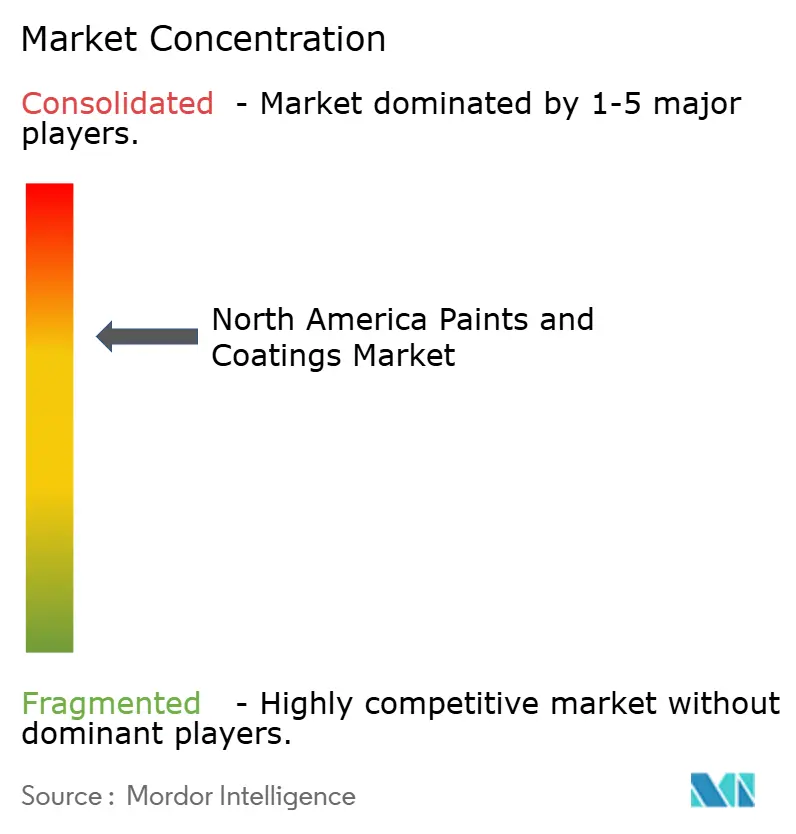
The North America Paints and Coatings market is consolidated. Market leadership rests with global brands such as PPG, Sherwin-Williams, AkzoNobel, BASF, and Axalta, each balancing scale with segment specialization. PPG divested its United States and Canadian commodity architectural arm for USD 550 million in September 2024 to refocus on higher-margin industrial lines. Simultaneously, sustainability initiatives—recycled-content powders, bio-based binders, and low-energy cure technologies—position incumbents for premium tiers. Competitive dynamics, therefore, hinge on balancing margin protection with transformative innovation across the North American paints and coatings industry.
North America Paints And Coatings Industry Leaders
The Sherwin-Williams Company
PPG Industries, Inc.
RPM International Inc.
Akzo Nobel N.V.
Axalta Coating Systems
- *Disclaimer: Major Players sorted in no particular order

Market Opportunities and Future Outlook
The strongest opportunities are concentrated where regulatory compliance, faster throughput, and standardized environmental reporting support clearer differentiation. Powder coatings and resinous floor systems benefit from near-zero VOC and high transfer efficiency, and from tighter, more comparable LCA disclosures enabled by American Coatings Association (ACA) Product Category Rules for powder and resinous floor coatings (February 2026), and for metal coil and extrusion coatings (July 2026). These PCR frameworks widen whitespace for suppliers that can provide verified environmental product declarations and cradle-to-grave impact data alongside performance, especially in coil, extrusion, and industrial maintenance specifications where documentation is increasingly part of bid qualification.
Capacity and capability investments are pointing to targeted growth pockets rather than broad-based expansion. Sherwin-Williams completed a major expansion at its Bowling Green, Kentucky coil coatings plant in March 2026, increasing capacity versus 2025 and supporting higher-volume, consistency-critical building products supply, including metal roofing and cladding components. In protective coatings, WEG inaugurated a new Heresite Protective Coatings manufacturing site in Manitowoc, Wisconsin, and a new distribution center in Duluth, Georgia in May 2026, improving service levels for corrosion-focused applications. In architectural demand, the 21st Century ROAD to Housing Act becoming law in July 2026 provides a policy-backed catalyst linked to housing supply and construction activity, supporting coatings pull-through across new build and renovation channels without relying on a single end market.
Recent Industry Developments
- July 2026: PPG introduced the PPG AEROVIEW virtual aircraft painter for business and general aviation. The tool digitalizes application planning and training for aerospace coatings, supporting higher first-pass quality and reducing rework risk for customers with constrained labor and tight MRO turnaround windows.
- June 2026: Sherwin-Williams entered a long-term strategic partnership with Do it Best Group to manufacture paint products for independent retailers and acquired the Majic and Shur-Line brands. The move strengthens supply assurance and portfolio breadth in the independent channel, while adding control over key private-label and accessory adjacencies tied to DIY repaint demand.
- May 2024: PPG announced plans to invest USD 300 million in advanced manufacturing across North America, including a new 250,000 sq. ft facility in Loudon County, Tennessee targeted for completion in 2026. The project expands the regional production footprint and supports faster delivery and customization for automotive and industrial coatings customers.


Research Methodology Framework and Report Scope
Market Definition and Coverage
This market covers the value of paints and coatings sold for use across North America, counted in USD, across common technologies and resin systems used for architectural and industrial end uses.
Scope exclusions: We exclude downstream application labor and equipment services, and we also exclude raw material sales that are not sold as finished paint or coating products.
Segmentation Overview
- By Resin Type
- Acrylics
- Alkyd
- Epoxy
- Polyester
- Polyurethane
- Other Resin Types
- By Technology
- Water-borne
- Solvent-borne
- Powder Coating
- UV-cured Coating
- By End-user Industry
- Architectural
- Automotive
- Wood
- Protective Coating
- General Industrial
- Transportation
- Packaging
- By Country
- United States
- Canada
- Mexico
Data Sources, Market Sizing, and Validation
Desk Research
Desk research was used to build the starting structure for the market model, especially around North America demand drivers and the product mix across major coating uses. We reviewed public construction and remodeling indicators, manufacturing output series, and trade flows for coating inputs and finished products to understand the direction of demand, and then aligned this to how coatings are commonly reported by technology and resin type.
Key public sources were used as anchors, such as US Census Bureau construction data, US Bureau of Economic Analysis and Federal Reserve industrial production releases, US International Trade Commission trade statistics, Environment and Climate Change Canada publications, and government supported building permit and housing-start series across the region. We also cross-checked company filings, investor presentations, association websites, and reputed press coverage, then filled a few company revenue gaps using paid subscriptions for company financials and news intelligence, and used import-export shipment-level views where needed. These desk research sources are illustrative only, and many other public and paid references were also used for data collection, validation, and clarification during the work.
Primary Interviews and Surveys
Primary work focused on interviews and short surveys with executives, functional leaders, and managers who track coatings demand, pricing movement, and channel shifts across the United States, Canada, and Mexico. The respondent input helped pressure-test the desk assumptions on technology mix (water-borne versus solvent-borne and powder), typical price bands by end use, and timing effects from construction cycles and industrial production changes.
Distribution of primary research fieldwork respondents
| Company type | Respondent position |
|---|---|
| Top tier: 28% | CXOs: 12% |
| Mid tier: 52% | Functional/Unit leaders: 39% |
| Smaller Players: 20% | Managers: 49% |
Market-Sizing & Forecasting
The core sizing starts from a top-down build where construction and remodeling activity, industrial output signals, and vehicle production context are translated into an addressable demand pool for coatings, and then allocated across major uses and technologies. Once this structure was in place, we used selective bottom-up approximations to sanity-check the total, including sampled price per unit movement multiplied by estimated consumption volumes in key end uses, plus distributor and channel checks that helped adjust for under-coverage.
Inputs that mattered most for North America included housing starts and building permits, non-residential construction spending, manufacturing output indices, the mix shift between water-borne and solvent-borne systems driven by VOC rules, and observed price progression linked to resin and solvent cost movement. For forecasting, we leaned on scenario analysis because the market is pushed by construction cycles and industrial momentum, and those drivers can move differently by country and by end use. When bottom-up signals were incomplete for smaller end uses, gaps were handled through conservative share-of-activity assumptions that were confirmed during expert calls, and then rebalanced so totals stayed consistent with the top-down demand pool.
Data Validation & Update Cycle
Validation is done in layers so the final numbers are not driven by one assumption. Model outputs are compared against independent signals like construction activity direction, manufacturing output movement, and trade and pricing cues, and then variances are reviewed before sign-off. If a value looks out of line, the input trail is revisited and follow-up outreach is triggered to confirm whether the change is real or caused by timing or definition differences.
Reports are refreshed annually, and interim updates are made when a material event changes demand or pricing expectations. Before delivery, a final analyst pass is completed so the market view reflects the latest public releases and the most recent primary feedback.
Mordor Intelligence's North America Paints and Coatings Market Estimate Compared With Other Published Estimates
Different published market sizes for North America paints and coatings can be far apart, even when the topic sounds identical. In most cases the gap comes from how each publisher sets the country coverage, what is counted as a coating versus adjacent chemical products, and how pricing is handled over the base year.
Some estimates narrow the geography to only the United States and Canada, and some also apply a different base year and price deck that shifts the reported value. For Mordor Intelligence, the count is limited to the North America region (United States, Canada, and Mexico) and to finished paints and coatings across key technologies, with the 2025 base-year value anchored to end-use demand checks and validated price progression.
Benchmark comparison
| Source | Market Size | Gaps in Research Methodology |
|---|---|---|
| Mordor Intelligence | USD 41.82 B (2025) | |
| Industry Research House A | USD 43.96 B (2025) | Uses a different country cut that emphasizes only the United States and Canada in its headline scope, which can raise the average realized pricing mix and shift totals compared to a full North America roll-up. |
| Global Consultancy B | USD 35.95 B (2025) | Base-year framing is influenced by a 2024 base and a shorter forecast window, and the scope language is broader around end uses, which can lead to different inclusion rules and currency timing for the 2025 value. |
The table shows that the spread is mainly explained by country coverage choices and base-year pricing treatment, followed by how tightly finished coatings are separated from adjacent categories. With clear scope rules, practical demand indicators, and repeatable checks, the sizing stays traceable and easier to reconcile when new public data and primary feedback comes in.


Key Questions Answered in the Report
How large will the North American paints and coatings market be by 2031?
Forecasts point to USD 48.78 billion by 2031, up from USD 42.9 billion in 2026.
Which technology segment is expanding fastest across North America?
Powder coatings are projected to grow at a 3.18% CAGR through 2031 thanks to zero-VOC credentials and high transfer efficiency.
What share do water-borne coatings command in 2025?
Water-borne formulations hold 57.05% of regional value, reflecting tightening VOC rules.
Why are polyurethanes gaining traction?
OEM buyers favor their superior abrasion resistance and durability, driving a 2.95% CAGR to 2031.
Which end-user category leads demand?
Architectural applications generate 48.62% of revenue due to steady new-build and renovation cycles.
Page last updated on:


 Your data is secure and never sold or shared.


