
Market Overview
| Study Period | 2021 - 2031 |
|---|---|
| Forecast Data Period | 2026 - 2031 |
| Historical Data Period | 2021 - 2024 |
| Growth Rate | 4.07 % |
| Market Concentration | Medium |
Major Players *Disclaimer: Major Players sorted in no particular order Image © Mordor Intelligence. Reuse requires attribution under CC BY 4.0. | |
West Africa Battery Market Analysis by Mordor Intelligence
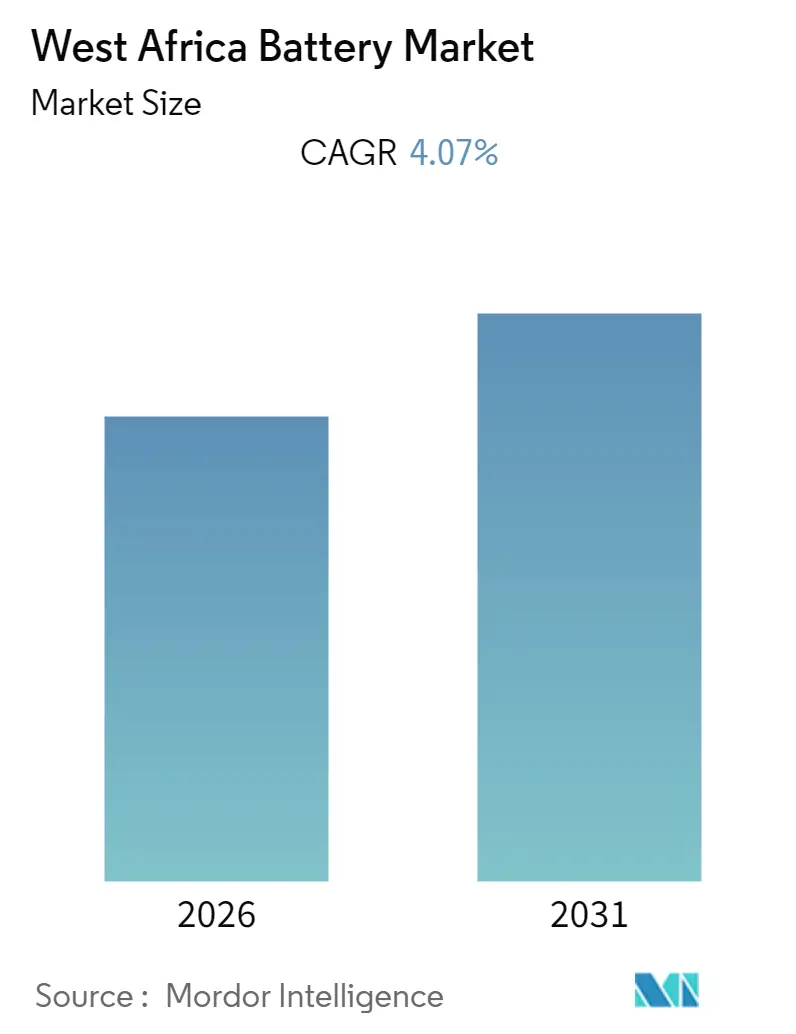
The West Africa Battery Market size is expected to register a CAGR of 4.07% during the forecast period (2026-2031).
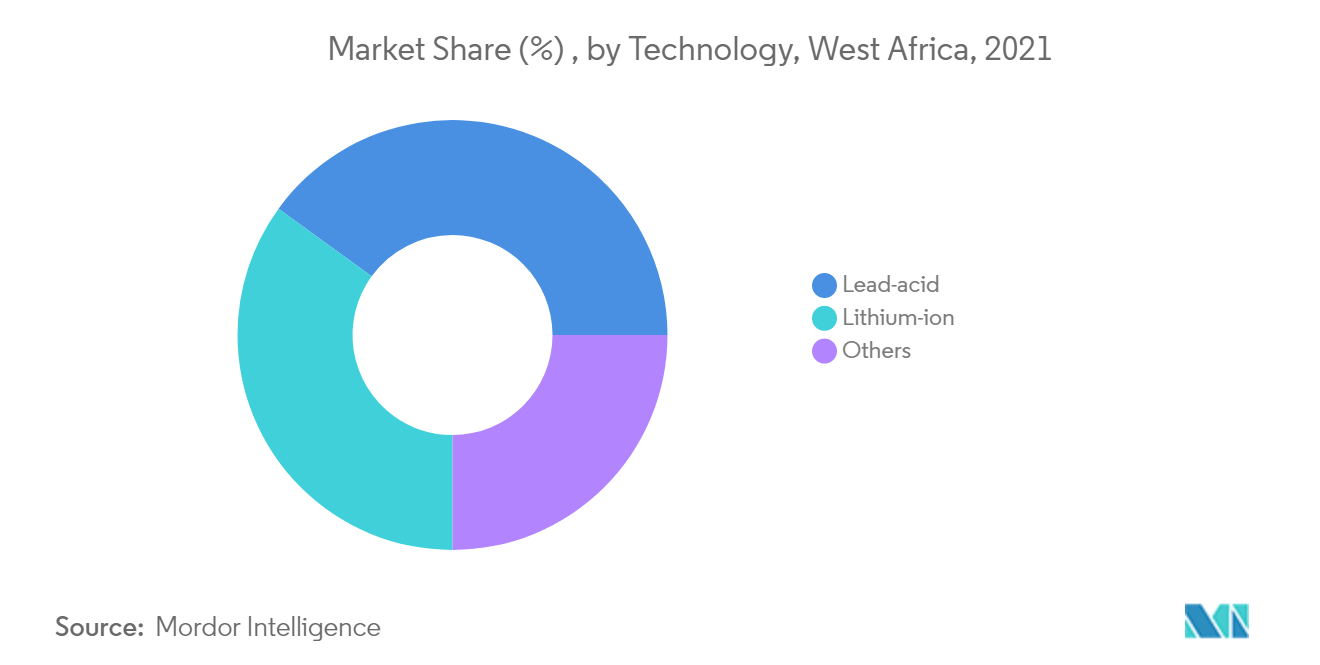
- The lead-acid battery technology is expected to dominate in the West African battery market due to the increased production of automobiles and motorcycles during the forecast period.
- The expansion of mini-grid systems for battery storage systems is expected to soon create immense opportunities for the West African battery market.
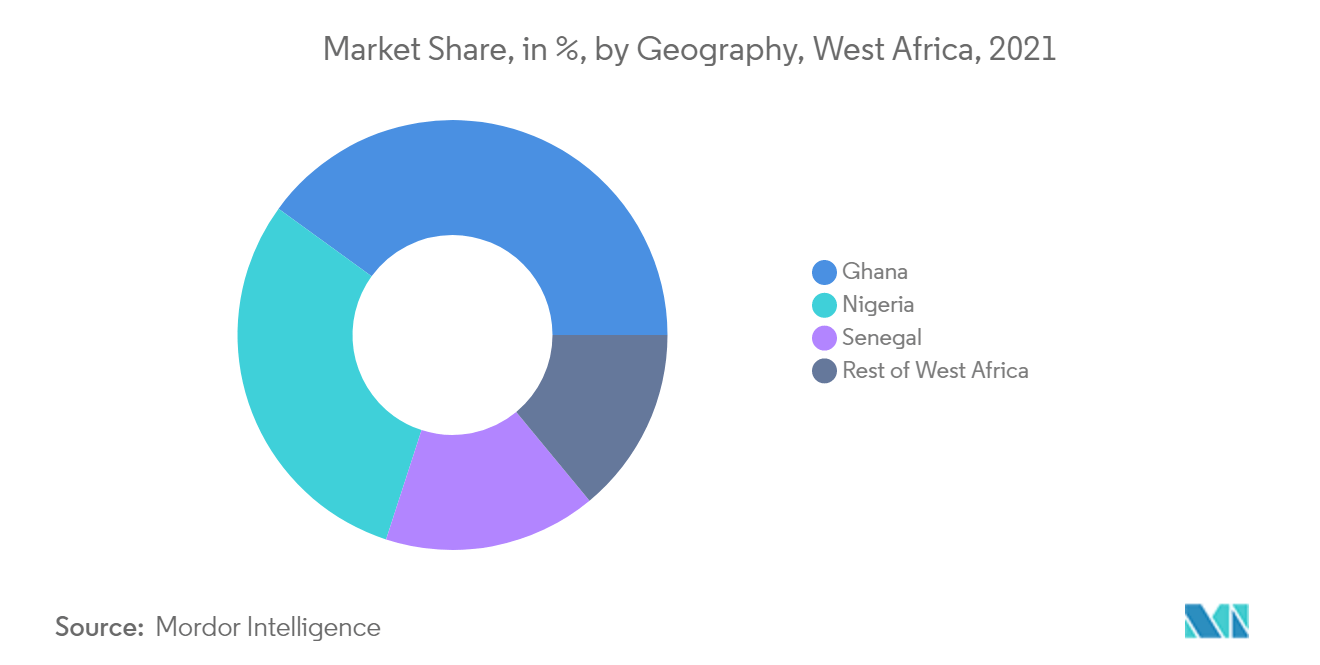
- Ghana is expected to dominate the battery market during the forecast period due to the increasing adoption of consumer electronic goods and renewable energy deployment.
Note: Market size and forecast figures in this report are generated using Mordor Intelligence’s proprietary estimation framework, updated with the latest available data and insights as of 2026.
West Africa Battery Market Trends and Insights
Lead Acid Battery Segment to Witness Significant Growth
- Lead-acid batteries remain the lowest-priced and most widely used rechargeable batteries in the automotive and industrial sectors across the West African region. Currently, these batteries are the only available mass-market technology for SLI applications in conventional vehicles, including those with basic micro-hybrid systems. Moreover, the usage of an increasing number of automobiles in the region is expected to drive the demand for lead-acid batteries in the coming years.
- Due to the trend of rapid globalization and industrialization in countries across the region, lead-acid batteries are increasingly finding application in numerous areas and devices. Increasing requirements for UPS systems in corporate offices, industries, research, educational institutes, and homes are driving the demand for lead-acid batteries.
- Gravita has begun commercial production of lead at its new plant in West Africa with a production capacity of 6,000 metric ton a year, and it has marked to increase the production capacity of 12,000 metric ton in the near future.
- Recycling lead-acid batteries is another main driving factor in West Africa, especially in Ghana. Ghana is known as the leading player in recycling lead-acid batteries in West Africa.
- In November 2020, Bosch announced the lead-acid battery recycling project in Ghana. As part of the project, Bosch has established reverse logistics in partnership with Ghanaian professional market players, City Waste Management Ghana, battery distributors, used battery collectors, and end consumers.
- Furthermore, in February 2021, Bosch introduced an eco-friendly battery recycling program. The program gives the opportunity to customers to return any lead-acid old car battery for a 5% discount on a new one they purchase or get a 5% value of the old battery returned.
- Due to factors like the declining cost of lead and lack of lithium-ion manufacturers, the lead-acid battery segment is expected to dominate the West African battery market during the forecast period.


Ghana to Witness Significant Growth
- Ghana is expected to grow at a significant phase in the battery market over the forecast period due to the increasing adoption of consumer electronic goods and increasing renewable energy deployment, which, in turn, is expected to boost the overall battery demand in the country.
- For instance, in December 2020, a 5 MW section was connected to the grid at a floating solar plant on the reservoir of the Bui hydroelectric dam in Ghana. With this, the plant makes a small step toward its eventual goal for a 250 MW plant. Hence, this will increase the demand for batteries used for solar PV storage purposes.
- Furthermore, the construction and building industry remains one of the fastest-growing sectors due to the increasing population in the country. Infrastructure development projects, booming industrialization, and construction activities are expected to be on the higher side in the country, which, in turn, is expected to supplement the demand for batteries for activities, such as backup, lighting, and power tools. Additionally, factors such as a rise in the demand for zero-emission vehicles have been driving the growth of lithium-ion batteries for electric vehicles application in the country.
- On the other side, Ghana, like many other African countries, is facing a power supply shortage, which has led to load shedding. To minimize the impact of the power crisis, battery energy storage devices have been used in residential and commercial sectors, which, in turn, is expected to boost the battery market in the country.
- For instance, in April 2021, Puma Energy announced the launch of 11 solar projects at its retail stations and an additional three at its terminals in Ghana, with the solar power generation at 11 of the 14 sites supported by battery storage. Through these projects, Puma Energy aims to deploy solar and/or battery storage in at least 75% of company-owned retail sites, depots, and terminals in the world by 2023.
- Ghana, like many other African countries, is facing a power supply shortage, which has led to load shedding. To minimize the impact of the power crisis, battery energy storage devices have been used in residential and non-residential sectors, which is expected to boost the battery market in the country.
Regulatory Landscape
Regional rules for grid-connected storage are increasingly routed through ECOWAS and West African Power Pool (WAPP) instruments. In 2024, ECOWAS introduced an Electricity Code that sets out the legal basis for cross-border power pooling rules relevant to battery energy storage systems (BESS), while WAPP issued regional regulatory and institutional frameworks for BESS. These frameworks reference established technical and safety standards, including UL 9540 (ESS), UL 1741 (inverters/interconnection), and NFPA 855 (stationary storage installation), which improves the compliance pathway for utility-scale deployments across member states.
Environmental and waste controls around batteries are also tightening at the national level. Nigeria issued National Environmental (Battery Control) Regulations in March 2024 through its environmental enforcement framework, covering licensing and life-cycle management of batteries, including aspects of import and export for new and used batteries. In Cote d'Ivoire, Decree 2025-181 introduced a suspension on the export of waste batteries and accumulators, strengthening local control over end-of-life flows and affecting recycling and secondary lead supply chains.
Value Chain Analysis
The West African battery value chain is still import-heavy for finished batteries and key components, while local activity is concentrated in distribution, installation, and aftersales for automotive SLI/UPS and solar-storage use cases. Downstream demand is supported by battery distributors and solar home system and C&I solar providers that bundle storage with inverters and PV, alongside local assemblers and manufacturers in Nigeria, including Ibeto Group in Nnewi and Forgo Battery Company in Ilorin, which serve automotive and backup-power demand. Recycling and used-battery collection also underpin lead-acid circularity in specific pockets of the region.
Upstream and midstream moves are beginning to influence regional sourcing over the study period. In July 2026, Nigeria inaugurated a lithium processing plant in Nasarawa State described as West Africa's largest, with reported capacity of 6,000 metric tonnes of lithium ore per day, signaling a push to shift from raw ore exports to processed feedstock. At the ECOWAS level, industrial coordination gained visibility in June 2026, when Ministers of Trade and Industry met in Accra on a value-addition agenda. Around the same time, Ghana's government reiterated plans in June 2026 for local lithium processing and a downstream battery-manufacturing ecosystem, indicating an intent to build midstream inputs and pack-level capabilities closer to demand centers.
Competitive Landscape
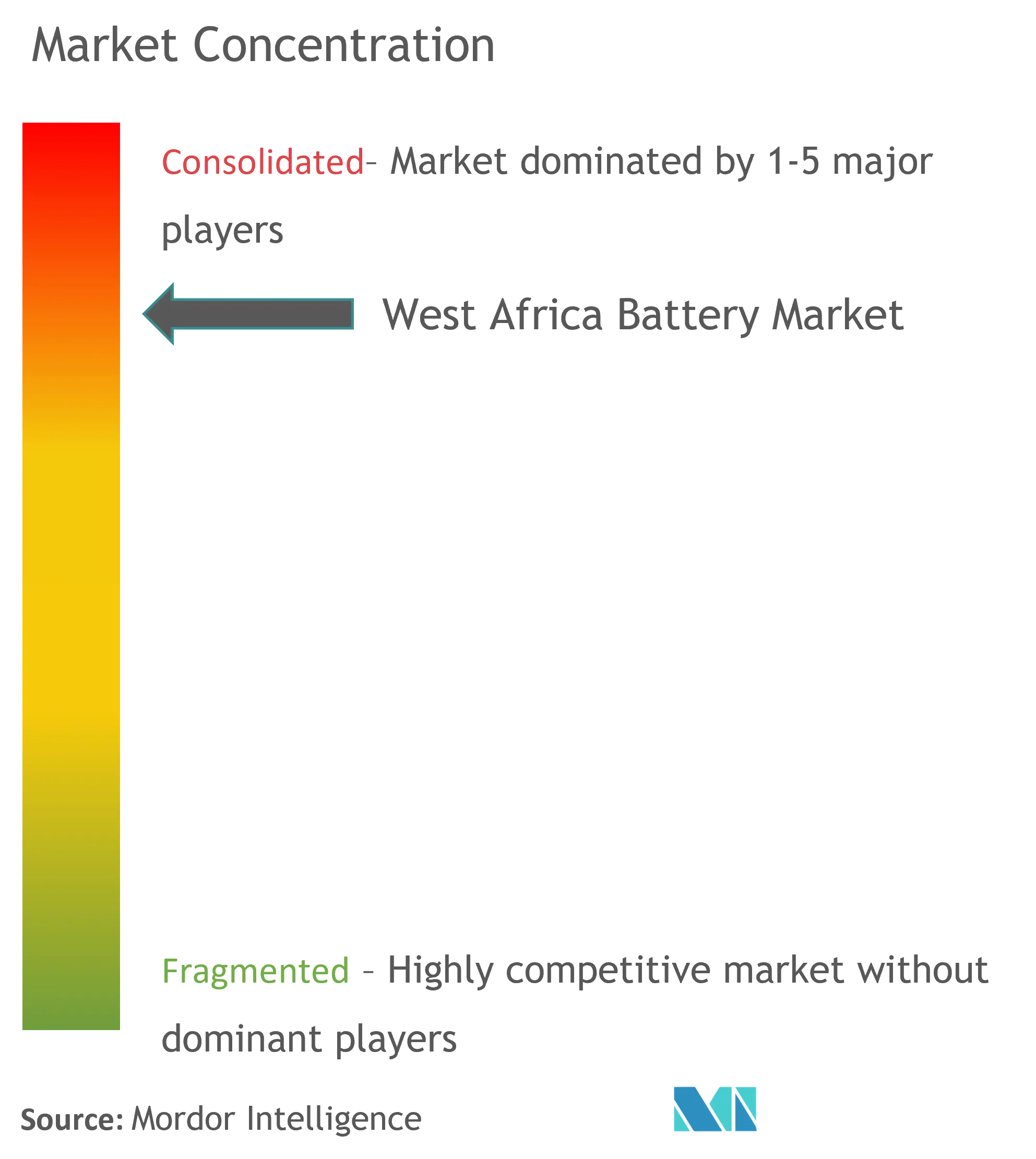
The West African battery market is moderately consolidated. The key players in the market include The Ibeto Group, Forgo Battery Company Limited, Luminous Power Technologies, Franerix Solar Solutions Limited, and Robert Bosch (Pty) Ltd.
West Africa Battery Industry Leaders
The Ibeto Group
Forgo Battery Company Limited
Luminous Power Technologies
Franerix Solutions Ltd
Robert Bosch (Pty) Ltd.
- *Disclaimer: Major Players sorted in no particular order

Market Opportunities and Future Outlook
Utility-scale and grid-support storage is becoming more bankable and is being contracted more often as part of solar buildouts. This supports near-term demand for integrators, EPCs, and O&M providers that can deliver bankable BESS designs aligned with regional standards. Project activity already provides demand signals, including Africa REN commissioning a 16 MWp solar-plus-storage plant in Senegal in January 2026 with a 10 MW/20 MWh battery system, and Toyota Tsusho securing an EPC contract in June 2026 to install a 50 MW/160 MWh BESS for three solar plants in Benin's Pobe region. In Cote d'Ivoire, a 105 MW/105 MWh BESS project was reported connected to the grid in April 2026, indicating momentum for grid-connected storage alongside renewables.
Industrial policy around critical minerals and end-of-life controls is also expanding addressable opportunities beyond finished product imports. Nigeria's July 2026 inauguration of a lithium processing plant and Ghana's June 2026 statements on local lithium processing and downstream battery manufacturing point to opportunities in midstream processing, module/pack assembly, and balance-of-system localization, including BMS, enclosures, and thermal management. These areas are most relevant where utilities and IPPs need shorter lead times and local service. For lead-acid, tighter controls on waste battery movements, including Cote d'Ivoire's 2025 suspension of waste battery exports and Nigeria's March 2024 battery control regulations, create space for compliant collection, recycling, and formal reverse logistics models that can stabilize secondary lead supply for SLI and stationary backup segments.
Recent Industry Developments
- July 2026: Nigeria inaugurated a lithium processing plant in Nasarawa State, described as West Africa's largest, with reported processing capacity of 6,000 metric tonnes of lithium ore per day. The move supports a shift from exporting raw ore to supplying processed inputs, boosting regional battery assembly and integration activity and attracting downstream battery manufacturing interest.
- October 2025: Luminous Power Technologies expanded its Nigeria portfolio with the LitCore Ultra lithium battery series (51.2V offerings including 105Ah, 230Ah, and 314Ah) alongside Rayverter NEO Elite hybrid inverters. This broadened the available lithium-based storage options for residential and small commercial solar-backup systems, increasing competitive pressure on conventional lead-acid bundles.
- March 2024: Nigeria issued National Environmental (Battery Control) Regulations under its environmental enforcement framework, covering licensing and life-cycle management of batteries, including import and export for new and used batteries. The regulation tightens environmental and waste controls and signals stricter compliance requirements for battery imports, end-of-life handling, and recycling across the country.


Research Methodology Framework and Report Scope
Market Definition and Coverage
For this methodology, the market includes batteries sold and used across West Africa for starting, traction, standby power, and portable uses, counted at the point of sale into the region across the study period.
Scope exclusions: Exclusions include standalone charging equipment, battery swapping services, and upstream raw materials (such as lithium, cobalt, and refined lead).
Segmentation Overview
- Technology
- Lead-acid Battery
- Lithium-ion Battery
- Other Battery Technologies
- Application
- Automotive (HEV, PHEV, EV)
- SLI (Starting, Lighting, and Ignition) Batteries
- Industrial Batteries (Motive, Stationary (Telecom, UPS, Energy Storage Systems (ESS), etc.))
- Portable Batteries (Consumer Electronics, etc.)
- Other Applications
- Geography
- Ghana
- Nigeria
- Senegal
- Rest of West Africa
Data Sources, Market Sizing, and Validation
Desk Research
Desk work starts by building the demand and supply story for batteries across West Africa, and then mapping it to data series that can be checked year to year. We used public sources such as UN Comtrade, the International Energy Agency, the World Bank, and national statistics offices where battery imports, vehicle parc, electrification, and industrial activity can be tracked.
After that, we cross-check direction and timing using manufacturer and distributor websites, investor presentations, and reported import or logistics commentary, which helps explain spikes that do not match normal seasonality. For pricing and product-mix logic, we also referenced paid subscriptions focused on company financials and intelligence, patent databases, and shipment-level import and export tracking, which help fill gaps where local reporting is thin. This desk source list is illustrative, and many other public documents were also used to collect, validate, and clarify data.
Primary Interviews and Surveys
Primary work was used to confirm what is really selling in-country, since product mix (lead-acid versus lithium-ion) and use case (SLI versus industrial backup) can change quickly. We spoke with stakeholders across the value chain such as importers, distributors, installers, fleet operators, telecom and power-backup buyers, and recycling or service networks, and we also checked views across key West African markets to reduce single-country bias.
Distribution of primary research fieldwork respondents
| Company type | Respondent position |
|---|---|
| Top tier: 29% | CXOs: 16% |
| Mid tier: 55% | Functional/Unit leaders: 34% |
| Smaller Players: 16% | Managers: 50% |
Market-Sizing & Forecasting
We sized the market using a top-down build where trade and consumption signals reconstruct battery demand across West Africa, and then that total is allocated by chemistry and major use patterns. Key inputs included battery import values and volumes, vehicle fleet and new registrations for SLI replacement cycles, telecom tower and backup power additions, solar and mini-grid rollout indicators, and typical replacement rates by application (which were stress-tested in calls).
To keep totals realistic, selective bottom-up checks were run using sampled price bands and observed sales volumes from distributors and installers, followed by channel checks on how much is sold into automotive, industrial backup, and portable uses. When a bottom-up view was incomplete for smaller countries, gaps were handled using proxy indicators like import share, population, and electrification trends, and then adjusted with expert feedback.
For forecasting, scenario analysis was used around a base case, since currency movement, import policy changes, and power reliability can swing demand year to year. Assumptions on price progression, chemistry shift, and replacement cycles were validated with respondents before the final forecast was locked.
Data Validation & Update Cycle
Totals were triangulated across independent signals, and then reviewed for outliers like sudden value jumps without matching volume movement, or unrealistic price swings versus known lead and lithium trends. If a variance was found, the underlying driver was rechecked and, when needed, respondents were re-contacted to confirm whether it was a one-off shipment, a policy shift, or a reporting artifact.
Before sign-off, our team runs a multi-step review so segment shares add up, growth rates make sense, and country splits are consistent with trade and demand indicators. Reports are refreshed annually, with interim updates for material events, and a final pre-delivery pass is completed so clients receive the most current view available.
Mordor Intelligence's West Africa Battery Market Size Compared Against Other Published Estimates
Published numbers for this market can look far apart because different sources count different battery categories, use different base years, and apply different pricing or currency assumptions. Timing also matters, since import-led markets can shift quickly when exchange rates or logistics costs change, and not every publisher refreshes inputs at the same pace.
Mobile consumer dry cells are excluded here, and that item sits outside Mordor Intelligence's scope, which is one reason the totals may not line up with sources that treat all battery shipments as one pool. Another common gap comes from using a single blended average price for the full region, since West Africa has wide spreads by chemistry, use case, and country mix, which can inflate or compress the headline value.
Benchmark comparison
| Source | Market Size | Gaps in Research Methodology |
|---|---|---|
| Mordor Intelligence | USD 1.00 B (2024) | |
| Regional Consultancy A | USD 1.05 B (2024) | Uses a wider chemistry and application basket and appears to include adjacent portable battery categories, which can lift totals when import values are aggregated without a strict end-use filter. |
| Trade Journal B | USD 0.01 B (2026) | Reports net growth added over a period rather than the full market value, which makes the figure look much smaller when compared directly with a year-specific market size. |
The spread is mainly explained by what gets counted as a battery in the first place and whether the number is a full-year market value or just incremental change over time. By keeping the scope tied to clear end-use demand pools and checking totals against trade, pricing, and replacement signals, we can provide a figure that is easier to reproduce and update.


Key Questions Answered in the Report
What is the current West Africa Battery Market size?
The West Africa Battery Market is projected to register a CAGR of 4.07% during the forecast period (2026-2031)
Who are the key players in West Africa Battery Market?
The Ibeto Group, Forgo Battery Company Limited, Luminous Power Technologies, Franerix Solutions Ltd and Robert Bosch (Pty) Ltd. are the major companies operating in the West Africa Battery Market.
What years does this West Africa Battery Market cover?
The report covers the West Africa Battery Market historical market size for years: 2020, 2021, 2022, 2023 and 2024. The report also forecasts the West Africa Battery Market size for years: 2026, 2027, 2028, 2029, 2030 and 2031.
Page last updated on:





