
Market Overview
| Study Period | 2021 - 2031 |
|---|---|
| Forecast Data Period | 2026 - 2031 |
| Historical Data Period | 2021 - 2024 |
| Growth Rate | 12.98 % |
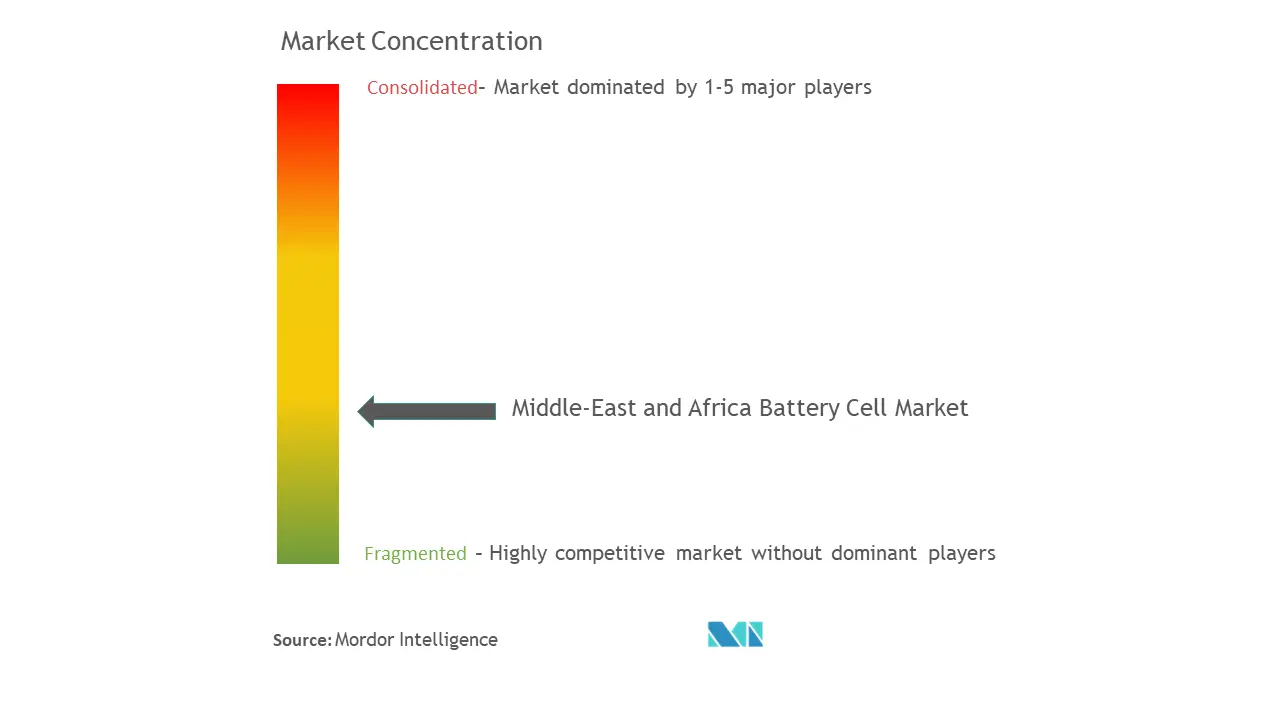
| Market Concentration | Medium |
Major Players *Disclaimer: Major Players sorted in no particular order Image © Mordor Intelligence. Reuse requires attribution under CC BY 4.0. | |
Middle East And Africa Battery Cell Market Analysis by Mordor Intelligence
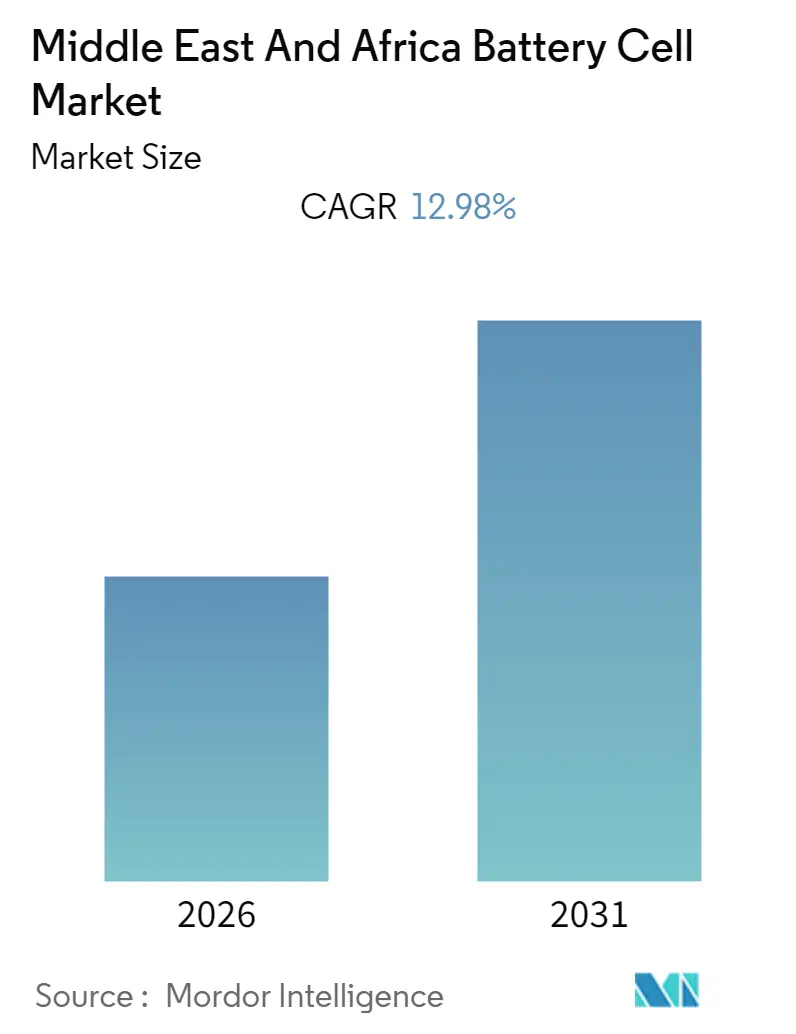
The Middle East and Africa Battery Cell Market size is expected to register a CAGR of greater than 12.98% during the forecast period (2026-2031).
- Rising investment in renewable energy projects and supportive government policies are likely to drive the battery cell market during the forecast period.
- Increased focus on the safety of battery cells coupled with rising investment in R&D of battery cells is expected to present a significant opportunity for battery cell manufacturing companies in the near future.
- South Africa has dominated the battery cell market. The government's supportive policies for the development of renewable energy sources, as well as EVs-related infrastructure development, are expected to drive the market in the country.
Note: Market size and forecast figures in this report are generated using Mordor Intelligence’s proprietary estimation framework, updated with the latest available data and insights as of 2026.
Market Trends and Insights
Rising renewable Energy Generation
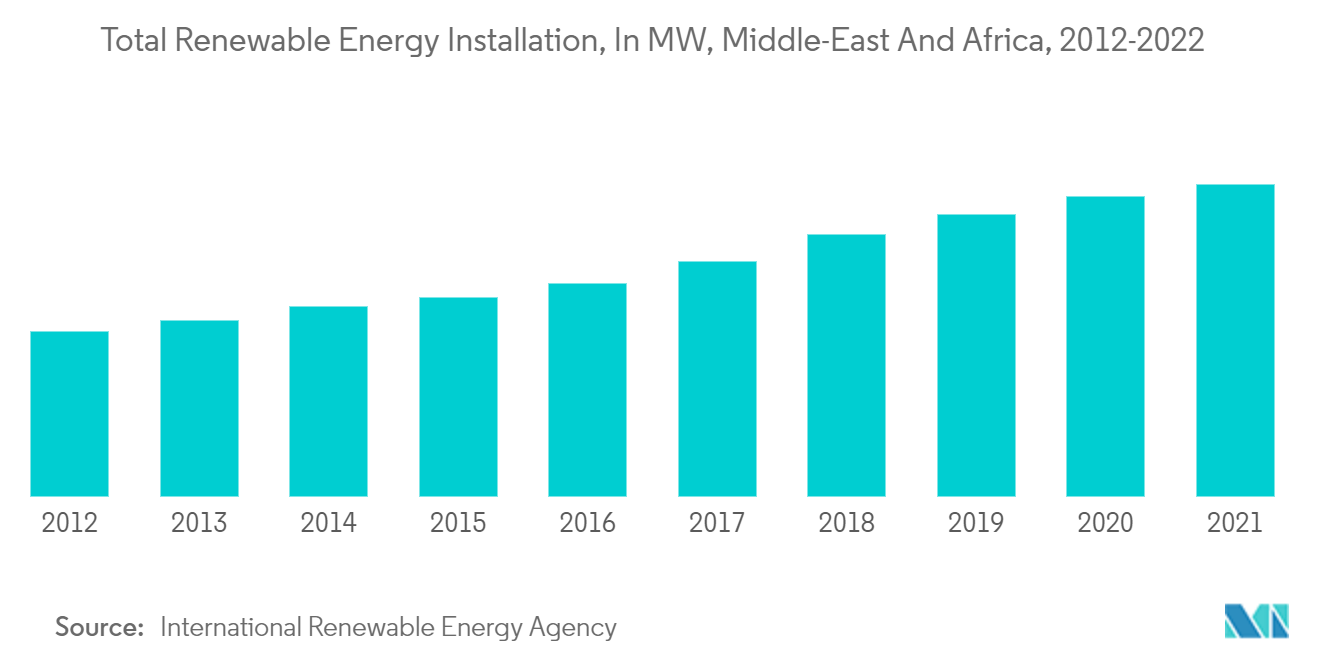
- Over the last decade, the renewable energy installed capacity and generation have been rising steadily in the Middle East and Africa. As renewable resources such as solar and wind generate power intermittently and at various levels, storing this energy later during peak demand is vital. Due to this, modern energy-storing systems are becoming an indispensable part of renewable energy projects.
- Traditionally, pumped storage systems are the most widely-used energy storage technology utilized globally. However, due to the geographical limitations of pumped hydro storage, large land footprint, and declining battery costs, battery energy storage systems have become increasingly popular for energy storage generated from renewable energy sources.
- Various governments across the Middle East and Africa are heavily investing in renewable energy projects to achieve net-zero emissions by 2050. For instance, according to the International Renewable Energy Agency (IRENA), United Arab Emirates is expected to install more than 18 GW of solar energy by 2030, which, in turn, is expected to drive the demand for smart grid networks as it is essential to integrate the renewable power sources, thus, creating vast opportunities for battery cell market players in the future.
- The Saudi Arabian government is significantly investing in renewable energy projects, and the government aims to generate 50% of its energy from renewable sources by 2030. Furthermore, Under Vision 2030, the country is projected to produce 27.3 GW of renewable energy by 2024 and 58.7 GW by 2030. To achieve these renewable energy targets government is working on around 13 renewable energy projects in the country. The projects have a total capacity of 4,870 MW, a solar PV capacity of 4,470 MW and wind at 400 MW. These projects are expected to be commercial by 2024. Thus, such government initiatives are likely to drive the demand for cylindrical and prismatic battery cells during the forecast period.
- Egypt is considered the most favourable African country for renewable energy project development and investment due to ideal conditions for solar energy projects in the country. In 2021, Egypt received a significant amount of foreign direct investments. Egypt's new renewable energy projects rose to USD 3.5 billion in 2021, double the registered value in 2020, with an electricity production capacity of about 3,570 MW. Furthermore, in December 2021, United Arab Emirates-based company Alnowais investment is to invest USD 1 billion in two clean energy projects in Egypt. The projects are expected to be in operation by 2025.
- All these initiatives taken by the governments in the Middle East and Africa are expected to witness a significant rise in demand for energy-storing systems, propelling the battery cell market during the forecast period.
South Africa Dominate the market
- According to the University of Oxford's Environment Change Institute study, in January 2022, South Africa has been identified as the most favourable African country for renewable energy project development and investments. The study states that strategic investments in solar and wind are crucial to ensuring energy security and sustainability across Africa.
- Due to this favourable condition for solar and wind energy projects, many countries are investing in renewable energy projects. For instance, in November 2021, the United States, United Kingdom, France, Germany, and the European Union agreed on a multi-billion-dollar partnership to help South Africa finance a quicker transition from coal to renewable energy. The initiative was valued at USD 8.5 billion.
- Furthermore, on 23rd March 2022, Norway and United Kingdom are also investing USD 39 Million in South Africa's Renewable Energy. This investment would help company H1 Capital build 2,400 MW of new wind and solar plants.
- The government of South Africa approved the Integrated Resource Plan (IRP) 2019, which aims to increase the renewable energy share in the total energy mix. By 2030, the country aims for an additional capacity of 14.4 GW of wind power, 6 GW of solar, 3 GW of gas, 2.5 GW of hydropower, 2.088 GW of storage, including battery energy storage systems, and 1.5 GW of coal.
- In June 2021, Eskom, South Africa's leading utility company and biggest greenhouse gas emitter, is planning to invest USD 10 billion in renewable energy projects and is expected to close its majority of coal-fired power stations by 2050. The company generates more than 90% of South Africa's electricity and aims to invest more in solar energy projects to achieve countries' net-zero emissions by 2050.
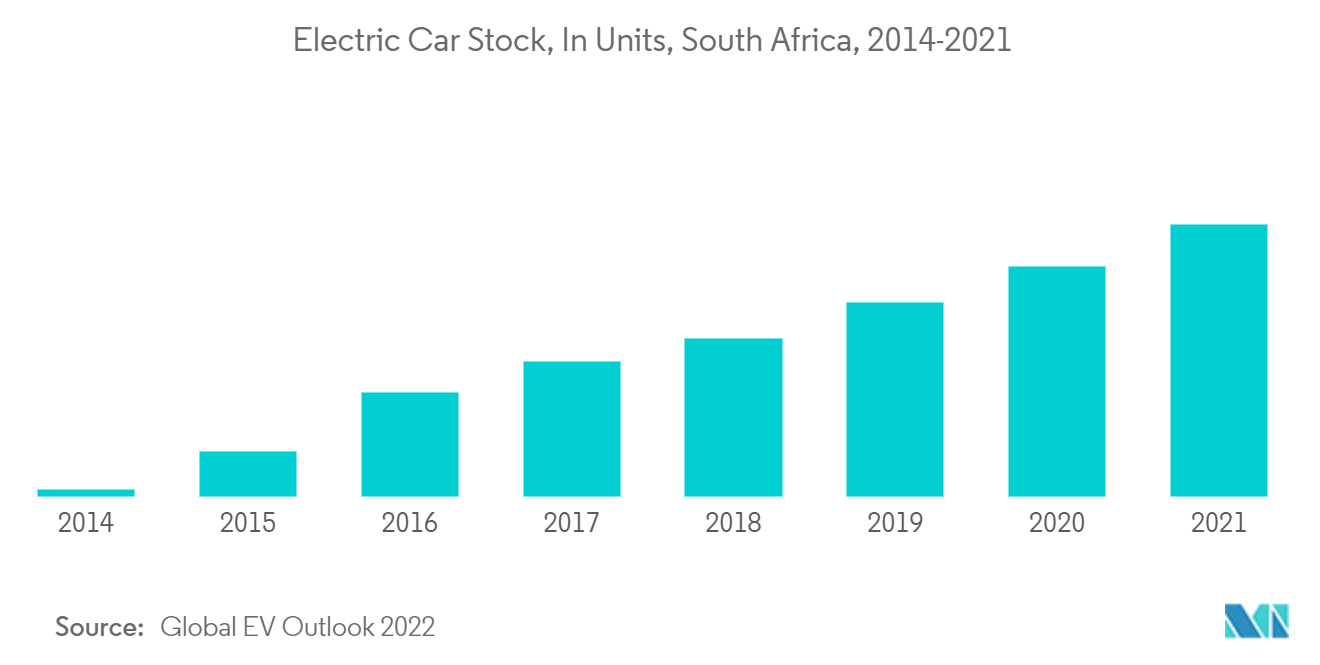
- The South African government is promoting electric vehicles. EV sales in 2021 were 1,739, which is more than 18% compared to the 2020 EV sales. The rise in auto sales can be ascribed to the South African government's support, such as incentive schemes and subsidies to manufacturers and buyers, which aims to boost exports of vehicles and components with a new focus on electric vehicles.
- Thus, these initiatives from the government are likely to witness an increase in investment in EVs and renewable energy, which would likely drive the battery cell market in South Africa during the forecast period.
Regulatory Landscape
Regulatory regimes across the Middle East and Africa shape battery cell and BESS deployment, with national safety and conformity requirements setting the baseline. In South Africa, the National Regulator for Compulsory Specifications (NRCS) requires UN 38.3 testing and related safety evidence for imported energy storage products. In Saudi Arabia, SASO governs conformity assessment using IEC 62660 style testing for lithium-ion cells, while utility procurement and traceability mandates in the United Arab Emirates, led by DEWA and EWEC, push suppliers to document provenance and performance records.
Regional policy and industrial-zone requirements are complemented by Atlantic Free Zone approvals in Morocco. Export-control constraints on lithium concentrates in several countries also influence local content and material flows, affecting how suppliers structure procurement and downstream manufacturing.
Value Chain Analysis
Battery value-chain localization is accelerating through giga-factory activity and material plant investments. Morocco's Kenitra gigafactory project and Oman's Sohar Freezone anode plant anchor midstream localization, supported by partnerships with Chinese manufacturers such as Gotion and Zhongke Electric to enable technology transfer and local assembly.
South Africa is also pursuing domestic value-chain participation through DTIC initiatives. Across the region, supply chains increasingly connect cathode and anode production with cell assembly to support deployment of BESS and other stationary storage solutions.
Competitive Landscape
The Middle-East and Africa battery cell market is highly fragmented. Some of the key players in the market include BYD Co. Ltd, Contemporary Amperex Technology Co. Limited, Duracell Inc., EnerSys, and Clarios.
Middle East And Africa Battery Cell Industry Leaders
-
BYD Co. Ltd
-
Contemporary Amperex Technology Co. Limited
-
Duracell Inc.
-
EnerSys
-
Clarios
- *Disclaimer: Major Players sorted in no particular order
Middle East And Africa Battery Cell Market Companies Covered in this Report
- BYD Co. Ltd
- Contemporary Amperex Technology Co. Limited
- Duracell Inc.
- EnerSys
- Clarios
- LG Chem Ltd (changed to LG Energy Solution, Ltd.)
- Panasonic Corporation
- Saft Groupe S.A.
- ElringKlinger AG
- GS Yuasa Corporation
Read Analysis of Middle East And Africa Battery Cell Companies
Market Opportunities and Future Outlook
Demand drivers for MEA battery cells include utility-scale storage, grid reliability needs, transport electrification, and industrial back-up power. Masdar's RTC project in Abu Dhabi illustrates multi-GWh-scale procurement, which raises the bar for bankable suppliers and strengthens traceability expectations in utility contracting.
On the supply side, Morocco's Kenitra giga factory phase 1 production targets 20 GWh annually, with potential for 100 GWh total capacity. Oman's Sohar Freezone project involves a USD 1 billion investment for anode capacity across three phases, while Saudi Arabia's ZOE Energy Storage base targets an initial 6 GWh capacity with expansion to 18 GWh. AfCFTA-backed trade dynamics support manufacturing corridors, and national programs in UAE and Saudi Arabia reinforce localization and after-sales coverage for stationary storage and grid services.
Recent Industry Developments in Middle East And Africa Battery Cell Market
- July 2026: The contract secures 11.275 GWh of battery storage for Masdar's Round the Clock RTC renewable project in Abu Dhabi, leveraging the Haohan storage system. The deployment targets utility-scale energy storage and highlights BYD's ability to integrate its storage technology into MEA mega-projects, pointing to demand for grid scale deployments and regional localisation potential.
- July 2026: BYD announced plans to explore a battery and component manufacturing plant in South Africa to localize production of the Blade Battery instead of vehicle assembly. The development localizes the supply chain in South Africa and expands regional component manufacturing capacity, which supports local jobs and reduces import exposure in the MEA market.
- July 2026: BYD signed a memorandum of cooperation with Eskom to pilot specialized flash charging nodes in South Africa. This work supports faster charging infrastructure and grid integration, which in turn helps enable broader EV adoption and energy services in the region.
Middle East And Africa Battery Cell Market Report Scope and Research Methodology
Market Definition and Coverage
For this report, the market is the value of battery cells sold into end uses across the Middle East and Africa, counted at the cell level and captured in current USD for the year measured.
Scope exclusions: Battery packs, battery modules, chargers, and non-cell battery management electronics are excluded from the market value.
Segments Covered in This Report
- Type
- Prismatic
- Cylindrical
- Pouch
- Application
- Automotive Batteries (HEV, PHEV, EV)
- Industrial Batteries (Motive, Stationary (Telecom, UPS, Energy Storage Systems (ESS), etc.)
- Portable Batteries (Consumer Electronics etc.)
- Power Tools Batteries
- SLI Batteries
- Others
- Geography
- United Arab Emirates
- Saudi Arabian
- South Africa
- Res of Middle-East and Africa
Data Sources, Market Sizing, and Validation
Desk Research
Desk research was used to build the foundation of the model, focusing on demand signals by country and on checks for trade flows and energy transition activity. Public sources included International Energy Agency releases on batteries and storage, International Renewable Energy Agency publications on power capacity additions, and IRENASTAT style datasets where available.
To sanity-check volumes and pricing, we also referred to sources such as UN Comtrade for battery-related trade codes, World Bank indicators for macro and industrial activity, and national statistics or energy ministry releases in key markets (for example, Saudi Arabia, the UAE, South Africa, and Egypt). Company annual reports, investor presentations, and reputable press were used to confirm factory announcements, commissioning timelines, and demand drivers across mobility, industrial, and stationary storage. We used paid subscriptions for company financials and for shipment-level import and export data selectively to close gaps in private-company disclosure, and to validate the direction of cross-border flows. These desk sources are illustrative only, and many additional public documents and datasets were also referenced for data capture, validation, and clarification.
Primary Interviews and Surveys
Primary work focused on validating what the desk sources cannot fully explain, mainly the realized cell demand split by application, typical procurement channels, and the price progression assumptions used in forecasts. We spoke with a mix of cell and battery supply chain participants, project developers, distributors, and large buyers, then aligned regional insights across GCC, North Africa, and sub-Saharan Africa to reduce country-level blind spots.
Distribution of primary research fieldwork respondents
| Company type | Respondent position |
|---|---|
| Top tier: 28% | CXOs: 16% |
| Mid tier: 56% | Functional/Unit leaders: 40% |
| Smaller Players: 16% | Managers: 44% |
Market-Sizing & Forecasting
Sizing started from a top-down build that reconstructs regional cell demand using end-use activity indicators, and then translates that demand into value using blended price points by chemistry and form factor. We used a single market value lens for consistency, where key inputs were checked country by country before being rolled up to the regional total.
The model was anchored on a short list of market fingerprints that are observable and can be refreshed, such as EV and two-wheeler rollout signals, utility-scale storage tender activity and commissioning dates, renewable capacity additions, telecom and data center backup demand cues, and battery-related imports that indicate near-term availability. Pricing assumptions were guided by pack and cell cost trajectories discussed in public energy reports, and then adjusted using interview feedback on local duties, logistics, and typical contract structures.
For forecasting, scenario analysis was used because demand in the region can change in steps when large projects are awarded or delayed. In the background, we ran a simple regression check against macro and energy buildout indicators to see if the scenario path stayed realistic. Bottom-up approximations were applied selectively, using supplier and channel checks and sampled ASP times volume calculations, and where company-level data was missing, we bridged gaps using capacity timelines and import intensity patterns rather than forcing an artificial full roll-up.
Data Validation & Update Cycle
Validation was done through stepwise triangulation, where model outputs were compared with independent signals like trade direction, project pipelines, and implied consumption per end use, and then reviewed again when variances looked high. We also ran anomaly checks on year-over-year changes in value so that sudden jumps could be traced to a clear driver such as a large storage award, a policy shift, or a pricing swing.
Before sign-off, assumptions and intermediate calculations go through multiple analyst reviews, and respondents are re-contacted when a key variable changes or a gap remains material. The report is refreshed annually, and interim updates are made when major events occur that can change the outlook. Before delivery, a final analyst pass is completed so clients receive the most current view available at that time.
Mordor Intelligence's Middle East and Africa Battery Cell Market Sizing Compared With Other Published Estimates
Published market sizes for battery cells in the Middle East and Africa can differ even when they seem to cover the same topic, because the boundary between cells, modules, and packs is not handled consistently. Differences also come from whether studies treat trade flows as demand, how they convert prices into USD, and how quickly they refresh assumptions when large regional projects change timelines.
By tracking cell-level demand indicators, refreshing price and currency timing assumptions, and then validating the roll-up through project pipeline and trade checks, Mordor Intelligence keeps the market value tied to battery cells rather than adjacent battery system revenue, which can inflate totals.
Benchmark comparison
| Source | Market Size | Gaps in Research Methodology |
|---|---|---|
| Mordor Intelligence | USD 4.00 B (2026) | |
| Regional Consultancy A | USD 1.54 B (2024) | Uses an earlier base year and appears to rely on broad trend narration without showing how cell ASP and end-use volumes are rebuilt for MEA, which can undercount large project step-changes. |
| Trade Journal B | USD 2.36 B (2024) | Often labels the market as lithium-ion batteries and may blend cells with batteries and packs, and it typically applies a single growth curve without separating utility-scale storage awards from smaller electronics demand. |
The spread across estimates mainly comes from scope boundaries and timing, not from a simple math mistake. When cells are counted only at the cell level, and demand is cross-checked against storage tenders, EV signals, and trade patterns, the total becomes easier to explain and to replicate during updates, which is what we aimed to do in this report.
Key Questions Answered in the Report
What is the current Middle-East and Africa Battery Cell Market size?
The Middle-East and Africa Battery Cell Market is projected to register a CAGR of greater than 12.98% during the forecast period (2026-2031)
Who are the key players in Middle-East and Africa Battery Cell Market?
BYD Co. Ltd, Contemporary Amperex Technology Co. Limited, Duracell Inc., EnerSys and Clarios are the major companies operating in the Middle-East and Africa Battery Cell Market.
What years does this Middle-East and Africa Battery Cell Market cover?
The report covers the Middle-East and Africa Battery Cell Market historical market size for years: 2020, 2021, 2022, 2023 and 2024. The report also forecasts the Middle-East and Africa Battery Cell Market size for years: 2026, 2027, 2028, 2029, 2030 and 2031.