
Middle East And Africa Rechargeable Battery Market Size and Share
| Study Period | 2019 - 2030 |
| Forecast Data Period | 2025 - 2030 |
| Historical Data Period | 2019 - 2023 |
| Market Size (2025) | USD 8.22 Billion |
| Market Size (2030) | USD 12.78 Billion |
| CAGR (2025 - 2030) | 9.22% |
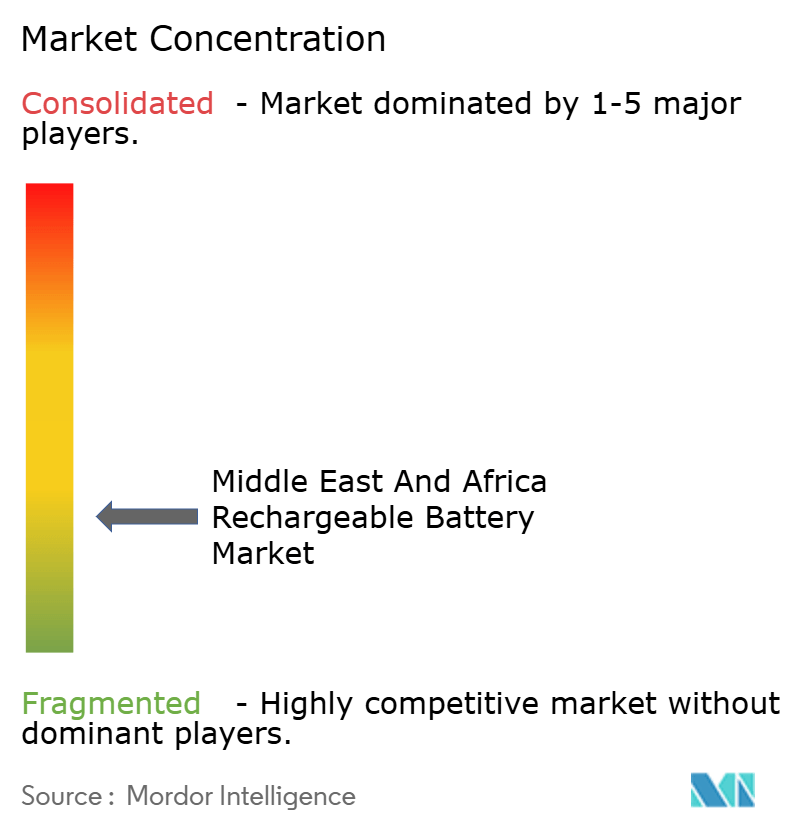
| Market Concentration | Low |
Major Players *Disclaimer: Major Players sorted in no particular order |
Middle East And Africa Rechargeable Battery Market Analysis by Mordor Intelligence
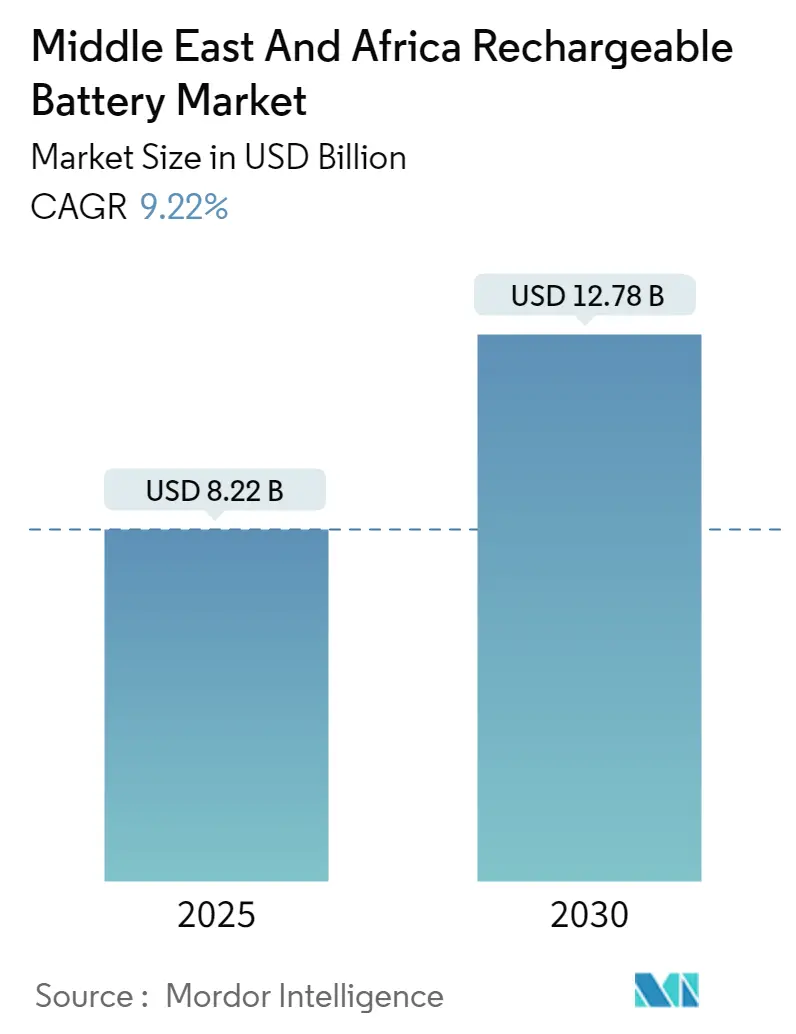
The Middle East And Africa Rechargeable Battery Market size is estimated at USD 8.22 billion in 2025, and is expected to reach USD 12.78 billion by 2030, at a CAGR of 9.22% during the forecast period (2025-2030).
- Over the medium term, rising electric vehicle (EV) production and declining lithium-ion battery prices are expected to drive the demand for the rechargeable batteries during the forecast period.
- On the other hand, the lack of raw material reserves can significantly restrain the growth of the rechargeable battery market.
- Nevertheless, the growing adoption of wearable devices like smartwatches, wireless earphones, smart bands, and more is expected to create significant opportunities for rechargeable battery market players in the near future.
- United Arab Emirates (UAE) is anticpated to witness significant growth in the Middle East and Africa rechargeable battery market.
Middle east and africa operates as part of an interconnected international environment rather than as a self-contained unit. The rechargeable battery market research by Mordor Intelligence places together all major regional developments across the globe within that wider frame.
Middle East And Africa Rechargeable Battery Market Trends and Insights
Lithium-Ion Battery to Dominate the Market
- The Middle East and Africa's lithium-ion rechargeable battery market is a dynamic arena, teeming with both opportunities and challenges. Lithium-ion batteries are outpacing other technologies in popularity, thanks to their superior capacity-to-weight ratio. Their adoption is further fueled by advantages like extended lifespan, minimal maintenance, enhanced shelf life, and a notable drop in prices.
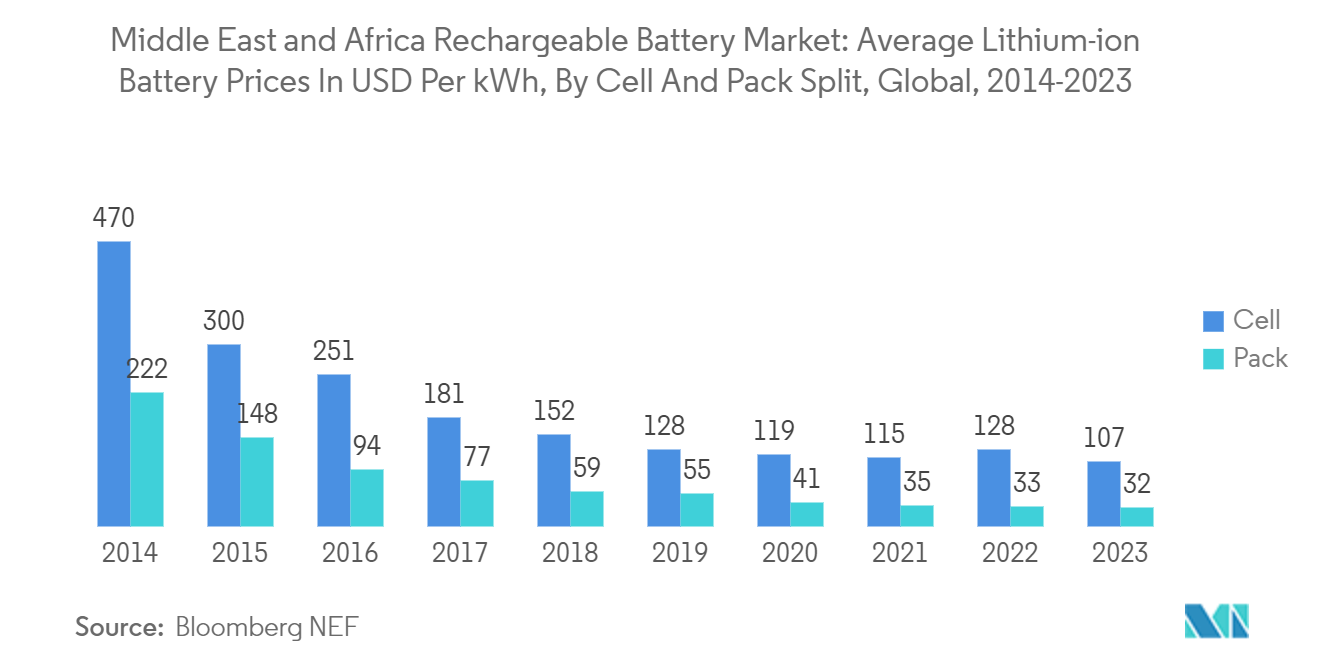
- While lithium-ion batteries traditionally commanded a premium over their counterparts, leading market players have been ramping up investments. Their focus on achieving economies of scale and bolstering R&D efforts has intensified competition, subsequently driving down lithium-ion battery prices.
- In 2023, battery prices saw a notable dip, settling at USD 139/kWh — a drop exceeding 13%. With the ramp-up of extraction and refining capacities, lithium prices are projected to stabilize, aiming for the USD 100/kWh mark by 2026.
- As the demand for electric vehicles and sustainable energy storage solutions surges, Middle Eastern and African nations are ramping up investments in lithium battery R&D. With its rich lithium deposits, Africa is positioning itself as a key player in the global lithium-ion battery supply chain.
- Countries like the Democratic Republic of Congo, Zimbabwe, and Namibia, boasting significant lithium reserves, are becoming prime targets for investments. These nations' abundant lithium resources position them as pivotal players in the burgeoning EV market.
- Moreover, the global shift towards cleaner energy and transportation has ignited an unprecedented demand for electric vehicles (EVs). This EV boom directly amplifies the need for lithium-ion rechargeable batteries. A testament to this trend: in April 2022, Saudi Arabia inked a deal with Lucid Motors, a company partly owned by the Kingdom's Public Investment Fund (PIF), to procure 100,000 EVs over the next decade.
- In a similar vein, in September 2023, Kenya's government collaborated with an electric motorbike manufacturer to introduce over a million EVs to the nation. The partnership includes Spiro's commitment to set up 3,000 battery charging and swapping stations, bolstering Kenya's EV infrastructure, and establishing a local manufacturing facility.
- Such initiatives and investments are poised to amplify EV production in the region, driving up the demand for lithium-ion rechargeable batteries during the forecast period.


United Arab Emirates (UAE) to Witness Significant Growth
- The United Arab Emirates (UAE) has emerged as a vibrant center for economic and technological progress in the Middle East and Africa. As the nation evolves, the demand for portable power sources, especially battery energy storage systems (BESS), is poised to surge in the coming years.
- BESS is pivotal in seamlessly integrating renewable energy sources, such as solar and wind, into the power grid. They mitigate fluctuations in energy production, ensuring a consistent and reliable electricity supply.
- As reported by the International Renewable Energy Agency (IRENA), the UAE's installed renewable energy capacity reached 6.05 GW in 2023, marking a staggering 45-fold increase over the past decade. Notably, a growth rate of nearly 68% was observed between 2022 and 2023.
- With an eye on the future, the UAE government has committed to investing USD 164 billion by 2050, aiming to meet the surging energy demand and foster sustainable economic growth. Dubai's Energy Strategy 2050 has already hit its 2020 target of deriving 7% of its energy from clean sources. The strategy ambitiously aims for 25% by 2030 and a remarkable 75% by 2050. Such ambitious targets are set to bolster the demand for BESS in the region.
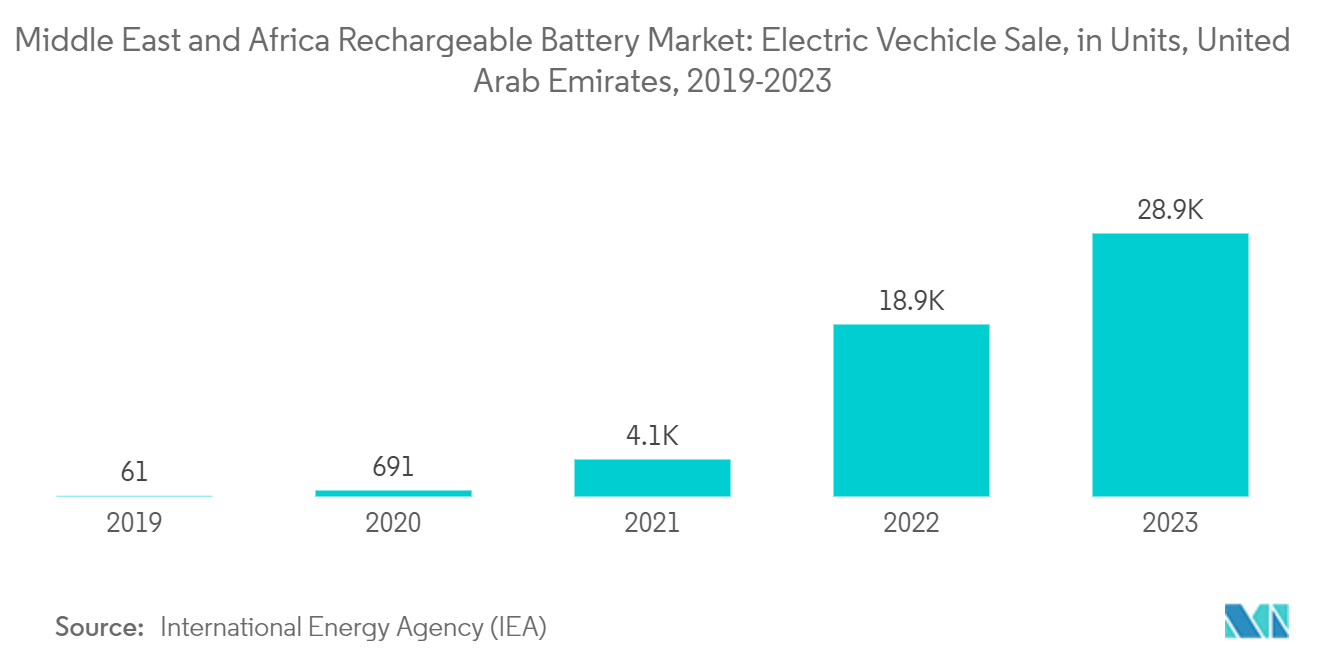
- The UAE is witnessing a steady uptick in electric vehicle (EV) adoption. Data from the International Energy Agency (IEA) indicates that 28,900 EVs were sold in 2023, marking a 52.9% increase from the previous year. Projections suggest a significant surge in EV sales in the coming years.
- To champion sustainable transportation, the UAE is fervently promoting EV adoption. As the global community pivots towards a greener future, the UAE is not just encouraging EVs but is also heavily investing in the necessary charging infrastructure.
- In July 2023, the Ministry of Energy and Infrastructure (MoEI) unveiled a comprehensive electric vehicle policy. This policy aims to establish robust regulatory standards for EV charging infrastructure, potentially bolstering the battery market in the UAE.
- Furthermore, MoEI has set an ambitious target: by 2050, 50% of all vehicles on UAE roads will be electric. This aligns with Dubai's goal of having 42,000 EVs by 2030.
- Given these initiatives and projections, the demand for rechargeable batteries in the UAE is set to witness a significant upswing in the coming years.

The rechargeable battery market is assessed by Mordor Intelligence through a multi-layered geographic lens, covering other regions such as Europe, North America, and Asia, along with detailed country-level analysis for Netherlands, Norway, Japan, Denmark, South Korea, and China.
Competitive Landscape
The Middle East and Africa rechargeable Battery is semi-fragmented. Some key players (not in particular order) are BYD Company Ltd, Duracell Inc., Exide Industries Ltd, EnerSys, and Panasonic Holdings Corporation, among others.
Middle East And Africa Rechargeable Battery Industry Leaders
BYD Company Ltd
Duracell Inc.
Exide Industries Ltd
EnerSys
Panasonic Holdings Corporation
- *Disclaimer: Major Players sorted in no particular order

Recent Industry Developments
- February 2024: ReElement Technologies and Afrivolt have signed a memorandum of understanding aimed at bolstering Africa's lithium-ion battery supply chains, both regionally and globally. Under this agreement, the two companies are set to collaborate in creating a holistic closed-loop ecosystem for lithium battery and electric vehicle manufacturing on the African continent.
- December 2023: In a significant move, the Federal Ministry of Power, alongside the China Ministry of Ecology and Environment, inked a deal with Nigeria's Federal Ministry of Power. This agreement paves the way for a Chinese firm to establish a lithium-ion battery manufacturing plant in Nigeria, with an investment of USD 150 million.


Middle East And Africa Rechargeable Battery Market Report Scope
Rechargeable batteries, also known as secondary batteries, are energy storage devices that can be recharged and reused multiple times. They play a crucial role in various applications, from consumer electronics to renewable energy storage. Rechargeable Batteries are widely used in smartphones, laptops, electric vehicles (EVs), and energy storage systems due to their high energy density and long cycle life.
The Middle East and Africa rechargeable battery market is Segmented by Technology, Application, and Geography. By technology, the market is segmented into Lithium-Ion Battery, Lead-Acid Battery, and Others NiMh, Nicd, etc.); by Application, the market is segmented into Automobile Batteries, Industrial Batteries (Motive, Stationary (Telecom, UPS, Energy Storage Systems (ESS), etc.), Portable Batteries (Consumer Electronics, etc.), and Other Applications. The report also covers the market size and forecasts for the Middle East and Africa rechargeable battery market across major countries. The Report Offers the Market Size and Forecasts in Revenue (USD) for all the Above.
| Lithium-ion Battery |
| Lead-Acid Battery |
| Others (NiMh, NiCd, etc.) |
| Automotive Batteries |
| Industrial Batteries (Motive, Stationary (Telecom, UPS, Energy Storage Systems (ESS), etc.) |
| Portable Batteries (Consumer Electronics, etc.) |
| Other Applications |
| United Arab Emirates |
| Saudi Arabia |
| Nigeria |
| Qatar |
| Egypt |
| South Africa |
| Rest of Middle East and Africa |
| Technology | Lithium-ion Battery |
| Lead-Acid Battery | |
| Others (NiMh, NiCd, etc.) | |
| Application | Automotive Batteries |
| Industrial Batteries (Motive, Stationary (Telecom, UPS, Energy Storage Systems (ESS), etc.) | |
| Portable Batteries (Consumer Electronics, etc.) | |
| Other Applications | |
| Geography | United Arab Emirates |
| Saudi Arabia | |
| Nigeria | |
| Qatar | |
| Egypt | |
| South Africa | |
| Rest of Middle East and Africa |


Key Questions Answered in the Report
How big is the Middle East And Africa Rechargeable Battery Market?
The Middle East And Africa Rechargeable Battery Market size is expected to reach USD 8.22 billion in 2025 and grow at a CAGR of 9.22% to reach USD 12.78 billion by 2030.
What is the current Middle East And Africa Rechargeable Battery Market size?
In 2025, the Middle East And Africa Rechargeable Battery Market size is expected to reach USD 8.22 billion.
Who are the key players in Middle East And Africa Rechargeable Battery Market?
BYD Company Ltd, Duracell Inc., Exide Industries Ltd, EnerSys and Panasonic Holdings Corporation are the major companies operating in the Middle East And Africa Rechargeable Battery Market.
What years does this Middle East And Africa Rechargeable Battery Market cover, and what was the market size in 2024?
In 2024, the Middle East And Africa Rechargeable Battery Market size was estimated at USD 7.46 billion. The report covers the Middle East And Africa Rechargeable Battery Market historical market size for years: 2019, 2020, 2021, 2022, 2023 and 2024. The report also forecasts the Middle East And Africa Rechargeable Battery Market size for years: 2025, 2026, 2027, 2028, 2029 and 2030.
Page last updated on:
Middle East And Africa Rechargeable Battery Market Report
Statistics for the 2025 Middle East And Africa Rechargeable Battery market share, size and revenue growth rate, created by Mordor Intelligence™ Industry Reports. Middle East And Africa Rechargeable Battery analysis includes a market forecast outlook for 2025 to 2030 and historical overview. Get a sample of this industry analysis as a free report PDF download.





