
Market Overview
| Study Period | 2021 - 2031 |
|---|---|
| Forecast Data Period | 2026 - 2031 |
| Historical Data Period | 2021 - 2024 |
| Market Size (2026) | USD 10.34 Billion |
| Market Size (2031) | USD 17.12 Billion |
| Growth Rate (2026 - 2031) | 10.61 % |
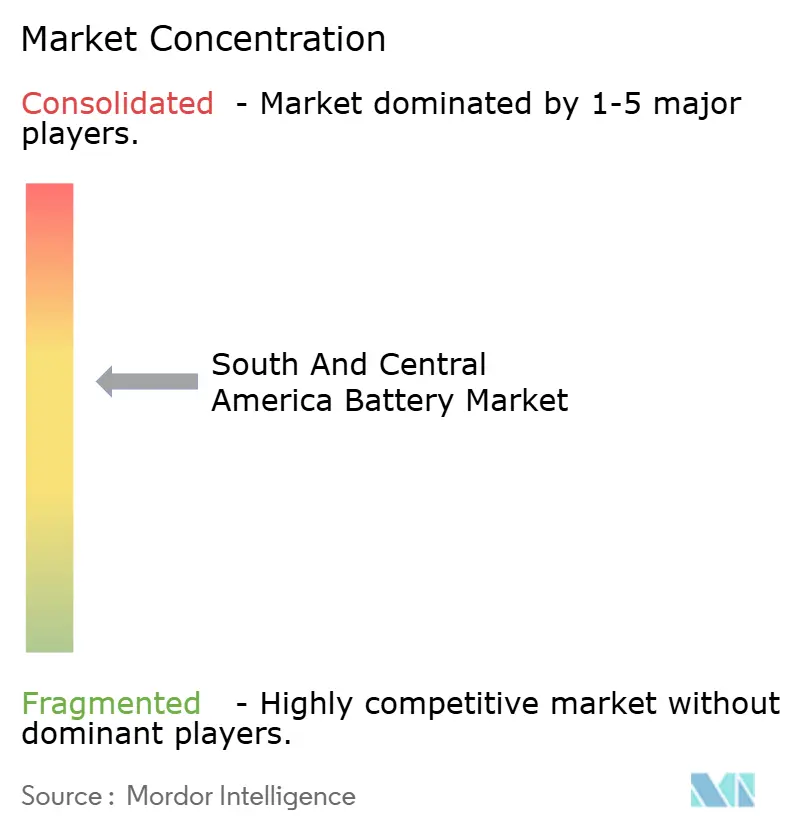
| Market Concentration | Medium |
Major Players *Disclaimer: Major Players sorted in no particular order Image © Mordor Intelligence. Reuse requires attribution under CC BY 4.0. | |
South And Central America Battery Market Analysis by Mordor Intelligence
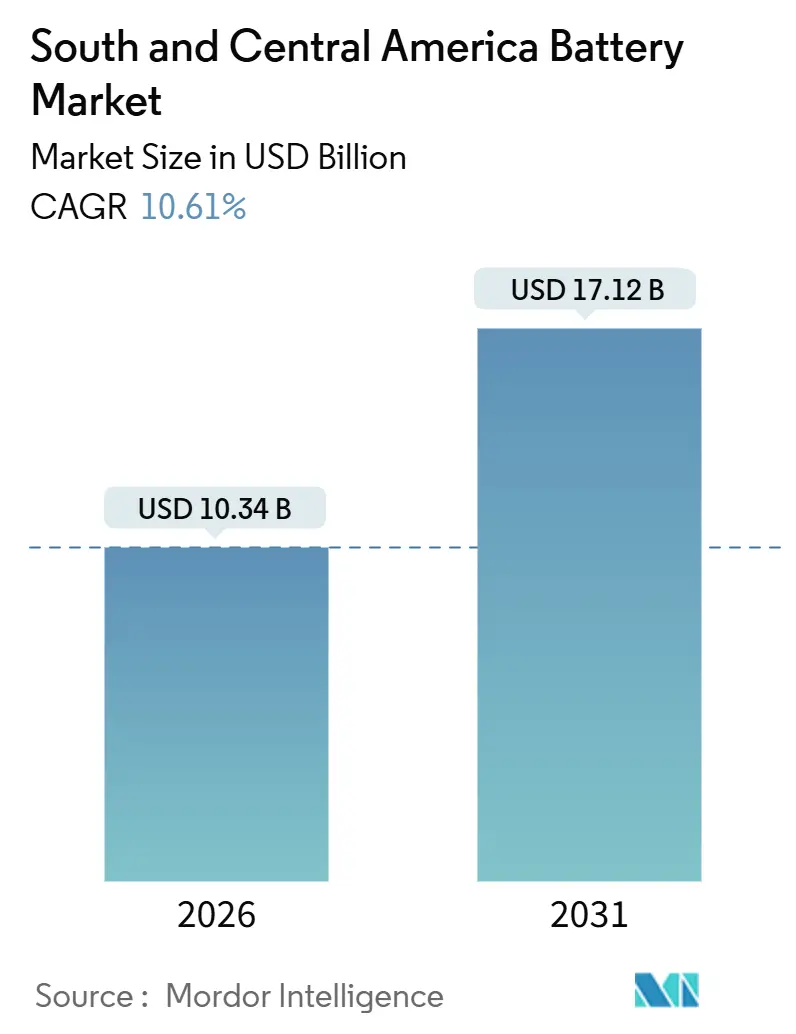
The South And Central America Battery Market size is estimated at USD 10.34 billion in 2026, and is expected to reach USD 17.12 billion by 2031, at a CAGR of 10.61% during the forecast period (2026-2031).
The expansion reflects synchronized policy support, local lithium refining that trims logistics costs, and rising electrification across transportation, grid storage, and telecom infrastructure. Incentives under Brazil’s MOVER program and Chile’s National Electromobility Strategy are narrowing the electric-vehicle price premium to 15% or less, which is accelerating demand for automotive packs. Simultaneously, lithium-triangle projects in Argentina, Chile, and Bolivia are shortening supply-chain lead times by up to two-thirds, improving cost competitiveness versus Asian imports. Stationary storage is gaining momentum as renewable penetration in key grids moves above 35%, while telecom operators transition from lead-acid to lithium-ion backup to cut cooling energy and site visits. These factors, coupled with accelerating spending on portable electronics in Colombia and Peru, underpin a durable growth runway for the South & Central America battery market.
Key Report Takeaways
- By battery type, secondary batteries captured 84.6% of the South & Central America battery market share in 2025, while solid-state chemistries are forecast to post the highest 28.7% CAGR through 2031.
- By technology, lithium-ion commanded 47.9% of revenue in 2025; solid-state is projected to deliver the fastest expansion, lifting its share from 0.3% in 2025 to 3.2% in 2031.
- By application, portable batteries represented 18.3% of demand in 2025 and are advancing at a 16.8% CAGR on the back of smartphone and remote-work uptake.
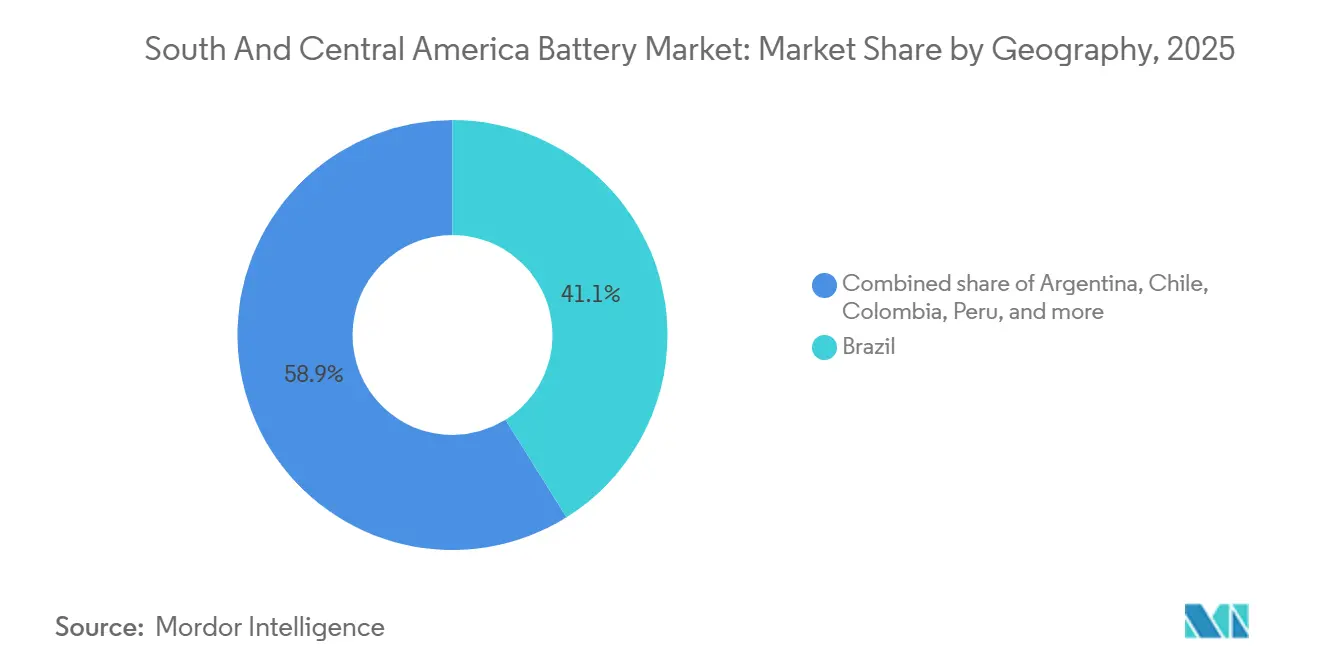
- By geography, Brazil held a 41.1% share in 2025, whereas Chile is the fastest-growing country with a 15.3% CAGR projected through 2031.
Note: Market size and forecast figures in this report are generated using Mordor Intelligence’s proprietary estimation framework, updated with the latest available data and insights as of January 2026.
South And Central America Battery Market Trends and Insights
Drivers Impact Analysis*
| Driver | (~) % Impact on CAGR Forecast | Geographic Relevance | Impact Timeline |
|---|---|---|---|
| EV purchase incentives in Brazil & Chile | +2.3% | Brazil, Chile | Medium term (2-4 years) |
| Renewable-powered micro-grids driving ESS demand | +1.8% | Chile, Brazil, Argentina | Long term (≥4 years) |
| Telecom-data-center backup upgrades | +1.1% | Brazil, Chile, Colombia | Short term (≤2 years) |
| Lithium-triangle mining investments enabling local supply | +2.9% | Argentina, Chile, Bolivia | Long term (≥4 years) |
| Urban e-scooter fleet proliferation | +0.7% | Brazil, Chile, Colombia, Peru | Short term (≤2 years) |
| Source: Mordor Intelligence | |||


EV Purchase Incentives in Brazil & Chile Compress Total Cost of Ownership
Tax credits granted under Brazil’s MOVER program and Chile’s import-duty waivers for sub-USD 50,000 electric cars have lowered upfront prices by 15%-25% relative to comparable internal-combustion models.[2]Staff Report, “Brazil’s MOVER Program Allocates BRL 19.6 Billion in EV Tax Credits Through 2028,” Reuters, reuters.com As a result, fleet operators in São Paulo and Santiago placed combined orders exceeding 1,500 electric buses in 2025, each requiring a 324 kWh lithium-ion pack. Leasing companies are rebalancing portfolios toward battery-electric vehicles to capture lower maintenance outlays and stronger residual values. The policy signal has also prompted domestic pack assembly expansions by BYD and Stellantis, which cuts logistics costs tied to imported modules. Fiscal durability diverges, however: Brazil faces a widening deficit and potential post-2026 revisions, whereas Chile funds its incentives via a carbon-tax mechanism that generated USD 400 million in 2025 and enjoys broad legislative support.
Renewable-Powered Micro-Grids Driving ESS Demand in Off-Grid Mining and Agriculture
High solar irradiation in the Atacama Desert and robust wind resources in Brazil’s Northeast are enabling large-scale solar-plus-storage projects that displace diesel gensets. Grenergy’s 11 GWh Oasis de Atacama system, paired with a 632 MW solar array, is designed to supply SQM’s lithium operations entirely off-grid. Similar initiatives from AES Andes and YPF Luz illustrate a wider push to match renewable peaks with battery discharge, thereby avoiding costly grid upgrades. Diesel price spikes (Argentine diesel rose 120% in 2024) reinforce the business case for batteries, while Scope 3 emission targets among European metal off-takers add further pressure. Analysts expect off-grid mining and remote agribusiness projects to add over 4 GWh of new storage between 2026 and 2031, lifting the South & Central America battery market.
Telecom-Data-Center Backup Upgrades Favor Lithium-Ion Over Lead-Acid
Brazilian mobile network operators have begun replacing valve-regulated lead-acid batteries with lithium-ion modules across 5G sites, securing 10,000-cycle life and a 60% reduction in air-conditioning loads. Saft’s 2025 contract covering 2,500 Telefónica towers is emblematic of a broader shift driven by Uptime Institute availability standards and ANATEL guidelines that recommend lithium-ion for unreliable-grid locations. Data centers in Santiago and Bogotá echo this transition, installing multi-MWh UPS banks that unlock insurance discounts tied to higher uptime. Lead-acid retains relevance in legacy nodes and budget-constrained environments, yet lithium-ion’s total cost of ownership advantage is widening as import tariffs on lithium-ion cells fall under regional trade accords.
Lithium-Triangle Mining Investments Enable Local Supply and Vertical Integration
Projects such as Rio Tinto’s USD 2.5 billion Rincon mine and Bolivia’s planned USD 1 billion hydroxide plant are ushering in a new era of regional cathode supply. By refining lithium near the brine assets, exporters can shrink logistics cycles from up to 120 days to under 45 days. Early estimates indicate delivered-cost reductions of 12%-15% versus shipping unrefined material to Asia, a differential large enough to entice BYD and LG Energy Solution to expand local pack lines. Geographic bottlenecks persist, notably Salta’s limited rail infrastructure and water-scarcity constraints near Uyuni, but policymakers are accelerating rail and desalination investments to sustain momentum. Provided timelines hold, South America could supply cathode precursor to regional gigawatt-scale pack plants by 2027, a development that would further reinforce the South & Central America battery market.
Restraints Impact Analysis*
| Restraint | (~) % Impact on CAGR Forecast | Geographic Relevance | Impact Timeline |
|---|---|---|---|
| Raw-material cost volatility | -1.4% | Brazil, Colombia, Peru | Short term (≤2 years) |
| Limited fast-charging infrastructure | -1.2% | Argentina, Colombia, Peru, rural Brazil | Medium term (2-4 years) |
| Currency-driven import price swings | -0.9% | Argentina, Brazil, Chile | Short term (≤2 years) |
| Environmental licensing delays for recycling plants | -0.5% | Brazil, Chile | Long term (≥4 years) |
| Source: Mordor Intelligence | |||
Raw-Material Cost Volatility Erodes Manufacturer Margins and Delays Capacity Commitments
Lithium carbonate prices fell 80% between early 2023 and mid-2024, squeezing manufacturers that secured high-priced offtake contracts during the upswing. Margin compression of 8-12 percentage points forced CATL, LG Energy Solution, and Samsung SDI to defer certain South American assembly investments. Cobalt and nickel price swings compounded budgeting uncertainty, making it harder for pack integrators to lock in fixed-price agreements with automakers. The resulting hesitation slowed capital deployment for local cell lines and contributed to under-investment in ancillary supply-chain assets. Relief is expected once European and North American gigafactories absorb excess raw material around 2027, but near-term volatility continues to temper the growth trajectory of the South & Central America battery market.
Limited Fast-Charging Infrastructure Constrains Long-Distance EV Adoption
The region hosted fewer than 2,000 DC fast chargers in 2025, with density concentrated in three capital cities. Long-haul corridors such as Rio-Manaus and Santiago-Arica remain underserved, forcing EV owners to rely on slower AC alternatives or abandon trips altogether. Regulatory uncertainty compounds the problem: Brazil’s ANEEL has yet to publish final tariff structures for public charging, while Chile requires environmental permits for chargers above 350 kW, adding 12-18 months to rollout schedules. The resulting range anxiety caps EV uptake outside major metros and, by extension, moderates near-term battery demand. Stakeholders anticipate a step change only after policy makers finalize clear tariffs, offer grid-connection subsidies, and streamline permitting, milestones that are unlikely before 2028.
*Our forecasts treat driver/restraint impacts as directional, not additive. The impact forecasts reflect baseline growth, mix effects, and variable interactions.
Segment Analysis
By Battery Type: Secondary Cells Extend Dominance Amid EV and Storage Tailwinds
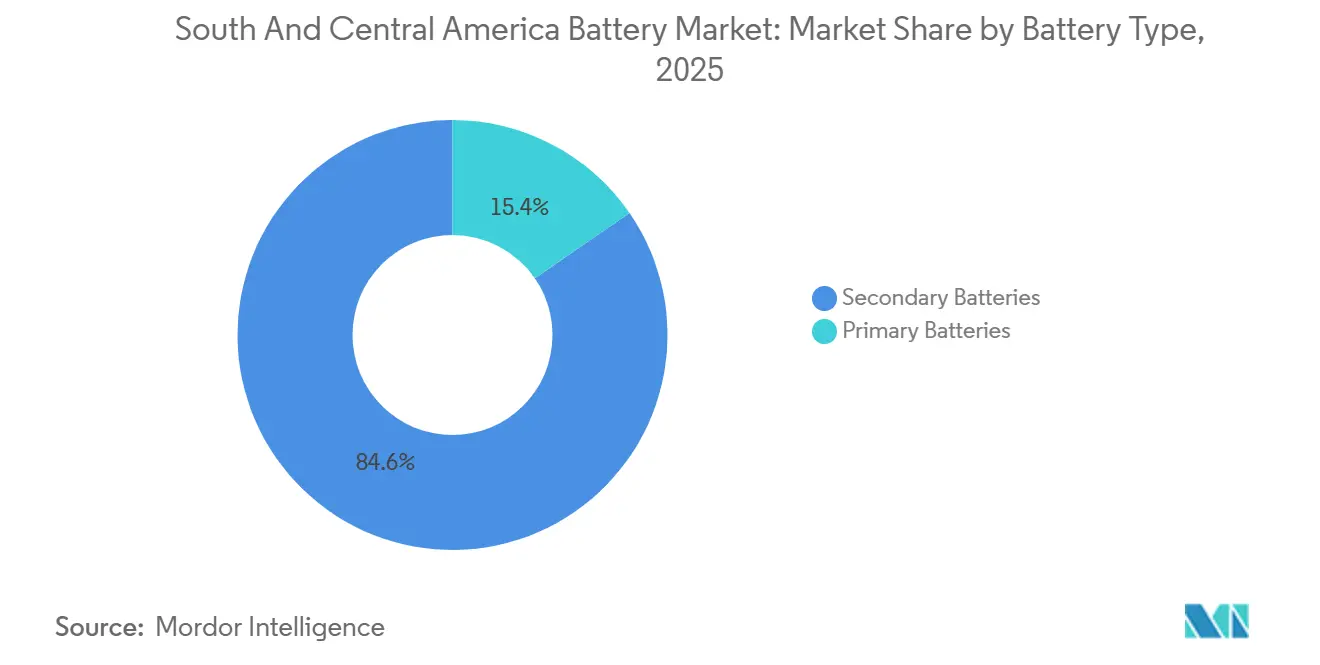
Secondary batteries commanded 84.6% of revenue in 2025 and are projected to post an 11.1% CAGR through 2031, outpacing the overall South & Central America battery market size over the same horizon.[3]Staff Report, “Chile’s National Electromobility Strategy Mandates 100% Zero-Emission Public Transport by 2035,” Bloomberg, bloomberg.com Within the segment, lithium-ion chemistry contributed 92% of value, reflecting its entrenched role in electric vehicles, grid storage, and telecom backup. Lead-acid retains a sizable 28% sub-segment share for industrial motive equipment and SLI replacements, sustained by cost-sensitive buyers that prioritize upfront price over energy density.
The growth engine remains a policy-led surge in renewable generation that requires oscillation management. Chile alone targets 8 GWh of utility-scale storage by 2028, reinforcing demand for high-cycle lithium-ion modules. At the same time, Brazil’s net-metering scheme under Normative Resolution 1,000/2021 is spurring residential and commercial adoption, with behind-the-meter batteries reaching 450 MWh in 2025.[4]Staff Report, “Saft Wins Contract to Replace Lead-Acid Batteries at Telefónica Towers,” Reuters, reuters.com Environmental rules mandating reverse logistics for alkaline and zinc-carbon products are accelerating substitution away from primary cells. Nonetheless, niche demand for primary lithium batteries persists in medical and industrial sensing scenarios, making the secondary-primary split a nuanced dynamic within the South & Central America battery market.


By Technology: Solid-State Set to Accelerate From 2027 Pilot Lines
Lithium-ion held a 47.9% share in 2025, reflecting its cost-performance sweet spot across multiple use cases. Lead-acid followed at 38.2%, while nickel-metal hydride and nickel-cadmium trailed as legacy chemistries. Solid-state batteries represented only 0.3% in 2025 but are on course for a 28.7% CAGR, positioning them as the fastest-growing technology in the South & Central America battery market share landscape.
Pilot production by Toyota-Idemitsu and QuantumScape in 2027-2028 will introduce 1,000-kilometer EV range and sub-10-minute charging capabilities. OEMs with local assembly, including Stellantis and General Motors, have signaled intent to migrate to solid-state packs once cost falls to USD 100/kWh at the pack level, a milestone expected near 2029. Sodium-ion is another emerging contender; CATL’s 160 Wh/kg cells are earmarked for entry-level EVs targeting an USD 18,000 sticker price, but energy-density constraints limit use to city cars and stationary storage. Flow batteries and sodium-sulfur configurations remain niche but are carving out long-duration storage roles in desert micro-grids, adding chemistries that diversify, but do not yet redefine, the South & Central America battery market size equation.
By Application: Portable Segment Becomes Fastest-Expanding Use Case
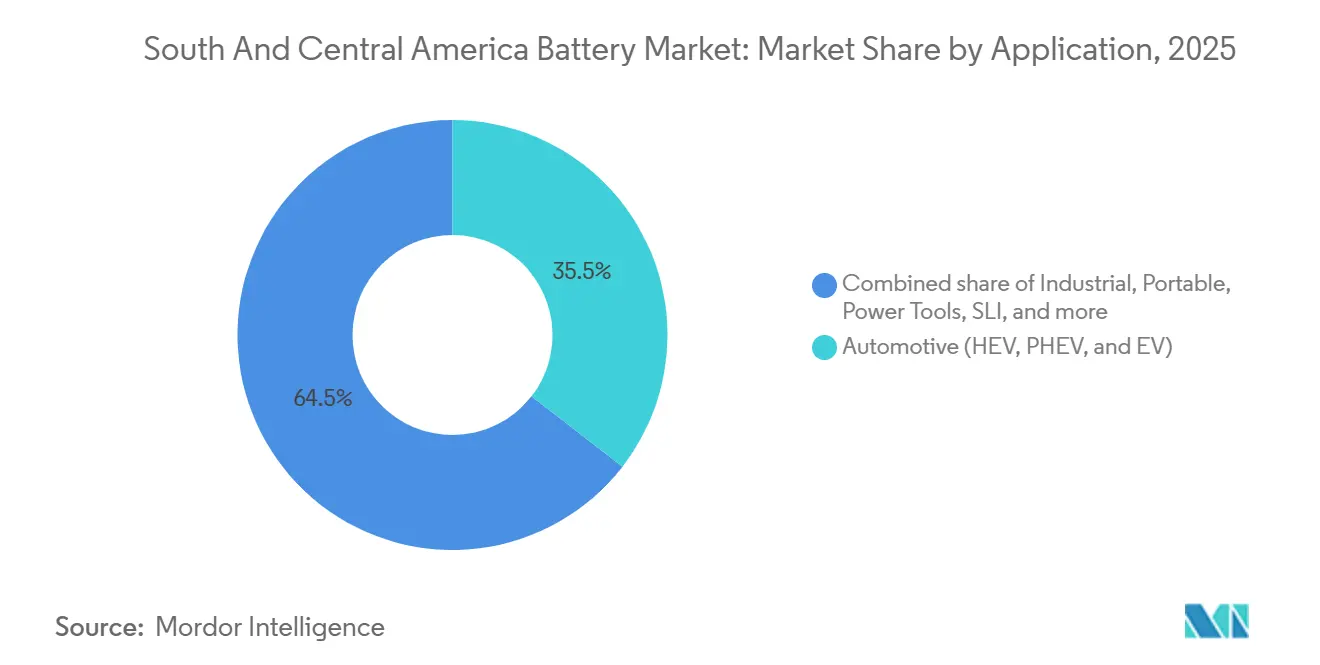
Automotive packs accounted for 35.5% of demand in 2025, mirroring EV volume gains in Brazil and Chile. Industrial batteries, including forklifts and telecom standby, held 28.7%. The portable segment, covering consumer electronics, power banks, and wearables, represented 18.3% and is forecast to grow at a 16.8% CAGR, making it the quickest-rising slice of the South & Central America battery market.
Smartphone penetration in Colombia and Peru has climbed to 82%, and remote-work trends are sustaining laptop and tablet demand. Rising power-tool adoption and the electrification of two-wheeler fleets provide additional lift. Meanwhile, SLI replacement cycles are lengthening as micro-hybrid technology reduces discharge depth, trimming the share of conventional lead-acid units. Collectively, application diversification underpins resilient growth even as automotive policies remain the dominant swing factor for the South & Central America battery market share outlook.
Geography Analysis
Brazil owned 41.1% of the South and Central America battery market size in 2025, supported by its population scale, automotive base, and telecom modernizations. The MOVER program’s USD-indexed tax credits have attracted BYD’s USD 150 million expansion that adds 10 GWh of pack capacity by 2026. Nevertheless, currency volatility and sparse fast-charging coverage outside coastal corridors temper upside.
Chile, though smaller in absolute terms, is expanding at a 15.3% CAGR, the fastest in the region. Its energy mix, dominated by solar and wind, and lithium endowment underpin both supply and demand pull for batteries. Grenergy’s 11 GWh project and Santiago’s growing fast-charger network illustrate a policy ecosystem that rewards storage deployment.
Argentina captured a 16.8% share in 2025 but faces an 8.9% CAGR ceiling as peso instability and policy uncertainty cool investor appetite. Colombia and Peru together hold a 13.2% share; both benefit from renewable mandates and mining electrification but need streamlined permitting to realize full potential. The balance of countries, including Bolivia and Uruguay, rely mostly on off-grid solar-plus-storage and pilot e-mobility schemes, which collectively contribute incremental volume to the broader South & Central America battery market.
Regulatory Landscape
Regulation across South and Central America is increasingly shaping batteries, especially BESS, as formal power-system assets with clarified interconnection, dispatch, and revenue treatment. In Brazil, ANEEL issued Normative Resolutions 1.161/2026 and 1.162/2026 (June 2026) to frame BESS as regulated assets, including mandatory grid-use contracts (CUSD/CUST) and billing rules for injection and consumption. The Ministry of Mines and Energy (MME) also published Normative Ordinance No. 136/2026 to set guidelines for the first two capacity reserve auctions (LRCAP 2026), splitting National Storage (with BNDES-linked local content requirements) from an open Storage track.
Chile also tightened grid-integration requirements for storage in 2026. The CNE issued Resolution N 45/2026 (February 2026), requiring grid-forming capabilities for new inverter-based storage connecting to the National Electric System. Separately, the Comptroller General approved Supreme Decree No. 1/2026 to amend PMGD rules (DS 88) so existing small-scale projects can add storage, and Supreme Decree No. 32 amended grid operation rules (DS 125) to incorporate efficient dispatch of storage using opportunity-cost calculations by the national grid coordinator (CEN).
Competitive Landscape
Moderate concentration defines the competitive field. The top five lithium-ion suppliers, BYD, CATL, LG Energy Solution, Samsung SDI, and Panasonic, controlled roughly 38% of segment revenue in 2025, while lead-acid leaders Clarios, Exide, and EnerSys held 52% of industrial and SLI sales. Global Tier-1 players favor asset-light supply agreements instead of regional gigafactories, mitigating currency risk and demand uncertainty.
Strategic moves in 2025-2026 include CATL’s tolling arrangement with BYD’s Campinas plant and LG Energy Solution’s module supply to Stellantis’s Betim facility. Panasonic and Honda are exploring export channels from new U.S. plants to serve South American assembly lines post-2027. White-space opportunities persist in stationary storage, where lithium-ion penetration remains below 15%, particularly among telecom and data-center operators seeking higher uptime.
Technology road maps suggest an inflection toward solid-state and sodium-ion, with Toyota’s 2027 pilot lines and CATL’s sodium-ion tests in Brazilian e-scooters providing key milestones. Regulatory compliance around reverse logistics is emerging as a competitive differentiator; Clarios operates 1,200 Brazilian recycling points, giving it a head start as extended-producer-responsibility rules tighten. These dynamics indicate a trajectory toward diversified chemistries and service-oriented revenue streams within the South & Central America battery market.
South And Central America Battery Industry Leaders
BYD Company Ltd.
Panasonic Corporation
EnerSys
EnerSys
Saft (TotalEnergies)
- *Disclaimer: Major Players sorted in no particular order

Market Opportunities and Future Outlook
Utility and regulated procurement is creating near-term whitespace for battery suppliers, integrators, and EPCs, particularly in grid-scale BESS and remote-area power replacement. In Argentina, the AlmaSADI program moved from tender launch (March 2026) to awards in July 2026, when 700.5 MW of BESS across 20 projects was awarded to developers including Genneia, DQD Energy, 360 Energy Solar, Aluar, and Intermepro (reported with an initial investment figure of about USD 700 million). This procurement-backed pipeline supports demand for EPC delivery, grid-forming inverter solutions, and long-term O&M capabilities across multiple provinces beyond the Buenos Aires metro area.
Brazil and Chile also offer opportunity through policy-driven market design and project execution. Brazil enacted Law 15.269 (published November 2025), establishing storage as an independent entity and supporting deployment through measures such as zeroing import taxes on BESS components and tax treatment under the Reidi regime for 2026-2030. In 2026, ANEEL and MME actions formalized BESS grid-use contracts and set capacity-auction guidelines that incorporate BNDES-linked national content pathways. Remote and off-grid replacement is further translating into bankable deployments, including the Huawei and Aggreko contract for a 120 MWh BESS in the Amazon announced in March 2026 to reduce reliance on diesel thermal generation. In Chile, DS32’s efficient dispatch rules for storage, together with large storage build-outs, increase the need for grid-compliant, grid-forming capable systems and expand service opportunities in controls, commissioning, and performance optimization.
Recent Industry Developments
- June 2026: BYD announced an investment of up to R$500 million (about USD 98 million) to establish a battery energy storage system (BESS) production line in Brazil. The move expands local supply for stationary storage projects and aligns with Brazil's shift toward formally regulated storage and auction-linked procurement that can favor localized capability.
- May 2025: Grenergy signed its largest battery purchase agreement with BYD Energy Storage, covering 3.5 GWh of systems for the Oasis de Atacama project in Chile. The contract strengthens BYD's position in utility-scale storage supply for one of the region's flagship solar-plus-storage developments and increases competitive pressure on other lithium-ion system providers.
- March 2024: EnerSys announced the availability of its Accelerated Throughput Package (ATP) upgrade for select NexSys TPPL batteries in the South American region. The upgrade targets industrial motive-power users seeking faster charge acceptance and higher usable throughput, supporting replacement and performance-driven demand in warehouse, logistics, and light industrial fleets.


Research Methodology Framework and Report Scope
Market Definition and Coverage
For this study, the market covers revenues generated from batteries sold and used across South and Central America, covering both primary and secondary batteries across key chemistries and common end uses.
Scope exclusions: Battery recycling services and second-life repurposing revenues are excluded unless they are explicitly billed as part of a new battery sale.
Segmentation Overview
- By Battery Type
- Primary Batteries
- Secondary Batteries
- By Technology
- Lead-acid
- Li-ion
- Nickel-metal hydride
- Nickel-cadmium
- Sodium-sulfur
- Solid-state
- Flow Battery
- Emerging chemistries
- By Application
- Automotive (HEV, PHEV, and EV)
- Industrial (Motive, Stationary (Telecom, UPS, ESS), etc.)
- Portable (Consumer Electronics, etc.)
- Power Tools
- SLI
- Other Applications
- By Geography
- Brazil
- Argentina
- Chile
- Colombia
- Peru
- Rest of South and Central America
Data Sources, Market Sizing, and Validation
Desk Research
Desk work started by building a fact base using demand drivers and supply signals that can be tracked by country, then rolling those signals up to the South and Central America aggregate. We relied on public sources such as national energy and mining agencies, customs and trade statistics portals, vehicle registration and electrification releases, and standards and safety documentation that indicate chemistry shifts.
To turn those signals into a sizing model, we also reviewed company annual reports, investor presentations, and reputable press coverage for capacity changes, pricing direction, and application adoption. In a few steps, paid subscriptions for company financials and intelligence, shipment-level import and export data, and patent databases were used to cross-check timelines and keep assumptions realistic. The named sources are illustrative and not exhaustive, and we used additional public documents for data collection, validation, and research clarification.
Primary Interviews and Surveys
Interviews and surveys with battery suppliers, distributors, fleet and automotive specialists, industrial users, storage developers, and energy experts across South and Central America are used to test secondary data. Respondents help clarify informal and imported supply, as well as adoption, pricing, and application assumptions. Re-contact is used when an answer materially differs from public evidence.
Distribution of primary research fieldwork respondents
| Company type | Respondent position |
|---|---|
| Top tier: 28% | CXOs: 20% |
| Mid tier: 47% | Functional/Unit leaders: 30% |
| Smaller Players: 25% | Managers: 50% |
Market-Sizing & Forecasting
Sizing was built using a top-down and bottom-up mix, where regional demand was reconstructed from visible demand pools and then tested against supply-side reality. On the top-down side, vehicle parc and new registrations, industrial backup power needs, and broader electrification and storage rollouts were translated into battery demand by chemistry and application, and then priced to arrive at value.
Those totals were corroborated using selective bottom-up approximations, including sampled price ranges by chemistry, distributor channel checks, and limited supplier revenue allocations to the region. This helped adjust for over-counting in overlapping applications. Practical variables tracked in the model included EV and hybrid penetration, SLI replacement cycles, telecom and UPS installation activity, grid and C&I storage deployments, and import intensity by battery type, which together explain most year-to-year movement.
For forecasting, we used scenario analysis so the outlook reflects different EV adoption speeds, industrial capex cycles, and lithium-ion pricing changes, and then tuned scenario weights based on what interviewees expected for the next 3 to 5 years. Where bottom-up checks had gaps, we applied conservative assumptions and then revisited them during validation calls to keep the final series internally consistent.
Data Validation & Update Cycle
Outputs were validated through triangulation across demand indicators, trade signals, and interview feedback, then reviewed for country outliers and sudden price jumps that did not match known timing. If a variance appeared, we re-checked conversion factors such as average battery size, replacement timing, and currency assumptions, and re-contacted sources when the gap remained.
Before sign-off, the model and written conclusions were reviewed by multiple analysts so the calculation steps and definitions stayed aligned. Reports are refreshed annually, with interim updates triggered by material events such as policy shifts, major plant announcements, or sharp commodity-linked price movement. A final pre-delivery pass is completed to ensure the latest information is reflected.
Mordor Intelligence's South and Central America Battery Market Market Size Measured Against Other Published Estimates
Published market sizes for batteries in South and Central America often do not match because the scope is defined differently, and because price and volume inputs are refreshed at different points in time. Differences also come from how overlapping uses are treated, since one battery category can appear across automotive, industrial backup, and energy storage discussions.
The main gap comes from whether primary batteries, SLI demand, and industrial stationary uses are included alongside secondary batteries, since those categories can add meaningful value in this region. Some estimates also anchor the number to a different base year, apply faster or slower lithium-ion ASP declines, or use a single regional proxy instead of country-level demand indicators, which can push the total up or down. The scope split is handled by Mordor Intelligence by counting primary and secondary batteries across major chemistries and applications, instead of limiting the value to a rechargeable-only slice.
Benchmark comparison
| Source | Market Size | Gaps in Research Methodology |
|---|---|---|
| Mordor Intelligence | USD 10.34 B (2026) | |
| Regional Consultancy A | USD 3.80 B (2024) | Uses an earlier base year and appears to anchor the value to a narrower application set, which can understate industrial stationary demand and SLI replacement volumes that are material in the region. |
| Industry Publisher B | USD 5.19 B (2024) | Covers a different geographic cut (South America only) and focuses on battery cells rather than the broader battery market, so pack-level and application-linked value can be counted differently. |
The spread in values mainly traces back to scope and year alignment rather than arithmetic. When the same geography, battery definition, and pricing timeline are applied consistently, the estimate becomes easier to reconcile to visible signals like imports, vehicle replacement needs, and industrial backup installations, and then it can be repeated each refresh without hidden step changes.


Key Questions Answered in the Report
How big is the South and Central America battery market in 2026?
The South and Central America battery market is estimated at USD 10.34 billion in 2026, continuing its path toward USD 17.12 billion by 2031 on a 10.61% CAGR.
Which country leads regional battery demand?
Brazil leads with 41.1% revenue share in 2025, driven by auto production scale, telecom upgrades, and generous tax incentives.
What is the fastest-growing battery technology?
Solid-state batteries are projected to expand at a 28.7% CAGR through 2031 as automakers plan 2027-2028 commercial launches.
Why is portable-battery demand rising so fast?
Higher smartphone penetration and remote-work adoption in Colombia, Peru, Brazil, and Chile are pushing power-bank and laptop-battery sales, producing a 16.8% CAGR in the portable segment.
What impedes faster EV adoption in the region?
Sparse fast-charging networks outside major cities and currency volatility that inflates imported component costs are the primary hurdles.
Are local lithium reserves reshaping the supply chain?
Yes, mining and refining projects in Argentina, Chile, and Bolivia are cutting lead times and logistics costs, enabling competitive regional cathode and pack assembly by 2027.
Page last updated on:





