
Market Overview
| Study Period | 2021 - 2031 |
|---|---|
| Forecast Data Period | 2026 - 2031 |
| Historical Data Period | 2021 - 2024 |
| Market Size (2026) | USD 7.64 Billion |
| Market Size (2031) | USD 10.96 Billion |
| Growth Rate (2026 - 2031) | 7.48 % |
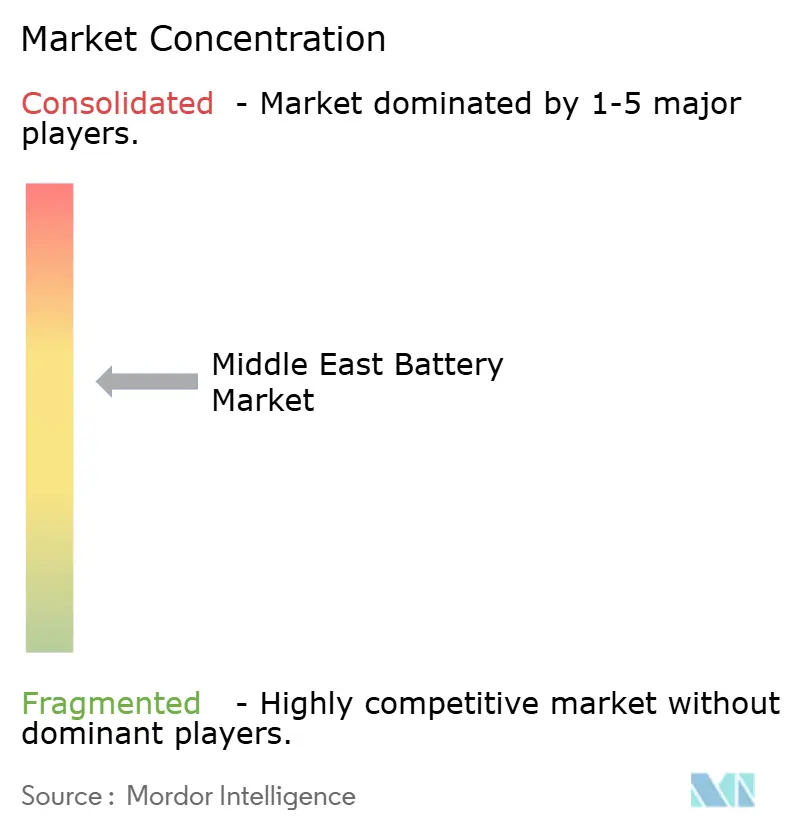
| Market Concentration | Medium |
Major Players *Disclaimer: Major Players sorted in no particular order Image © Mordor Intelligence. Reuse requires attribution under CC BY 4.0. | |
Middle East Battery Market Analysis by Mordor Intelligence
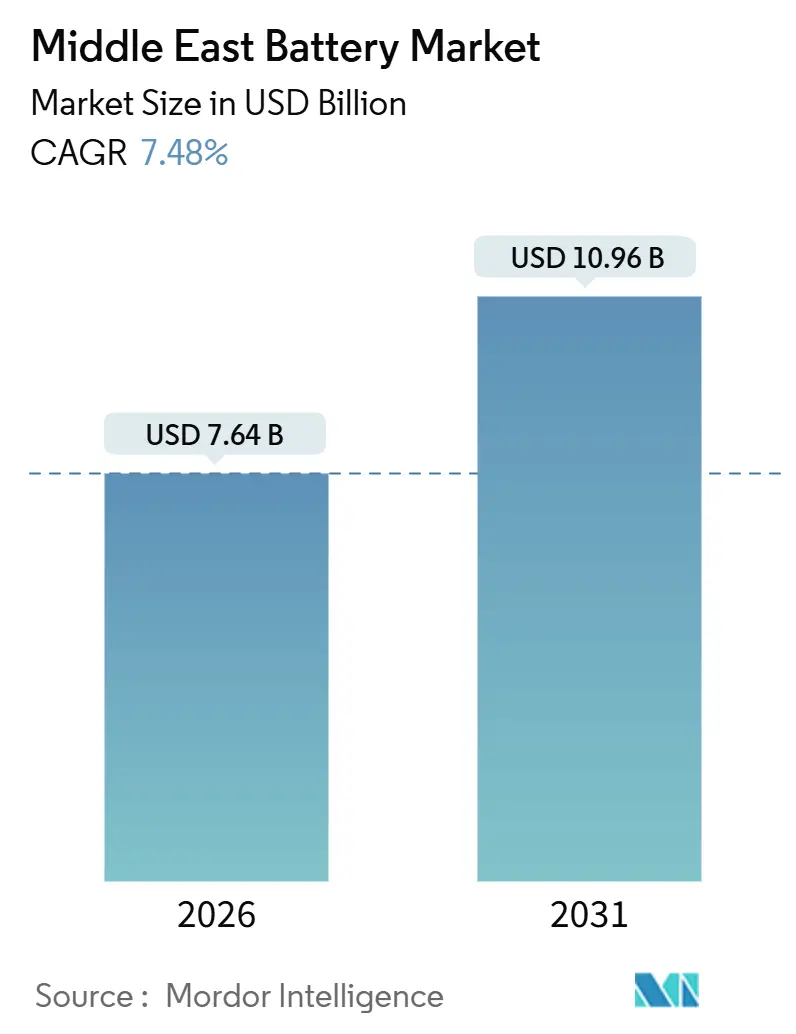
The Middle East Battery Market size is estimated at USD 7.64 billion in 2026, and is expected to reach USD 10.96 billion by 2031, at a CAGR of 7.48% during the forecast period (2026-2031).
Intensifying national Vision agendas are accelerating electrification, and utility-scale solar projects paired with storage are moving from pilots to multi-gigawatt procurements. Mandatory domestic-content rules are prompting global suppliers to form joint ventures, while falling lithium-ion costs are narrowing the price gap with diesel backup systems. Local recycling capacity, although nascent, is beginning to address end-of-life management. Raw-material import dependence and water scarcity remain structural headwinds, yet policy clarity and record-size tenders signal a durable demand runway for the Middle East battery market.
Key Report Takeaways
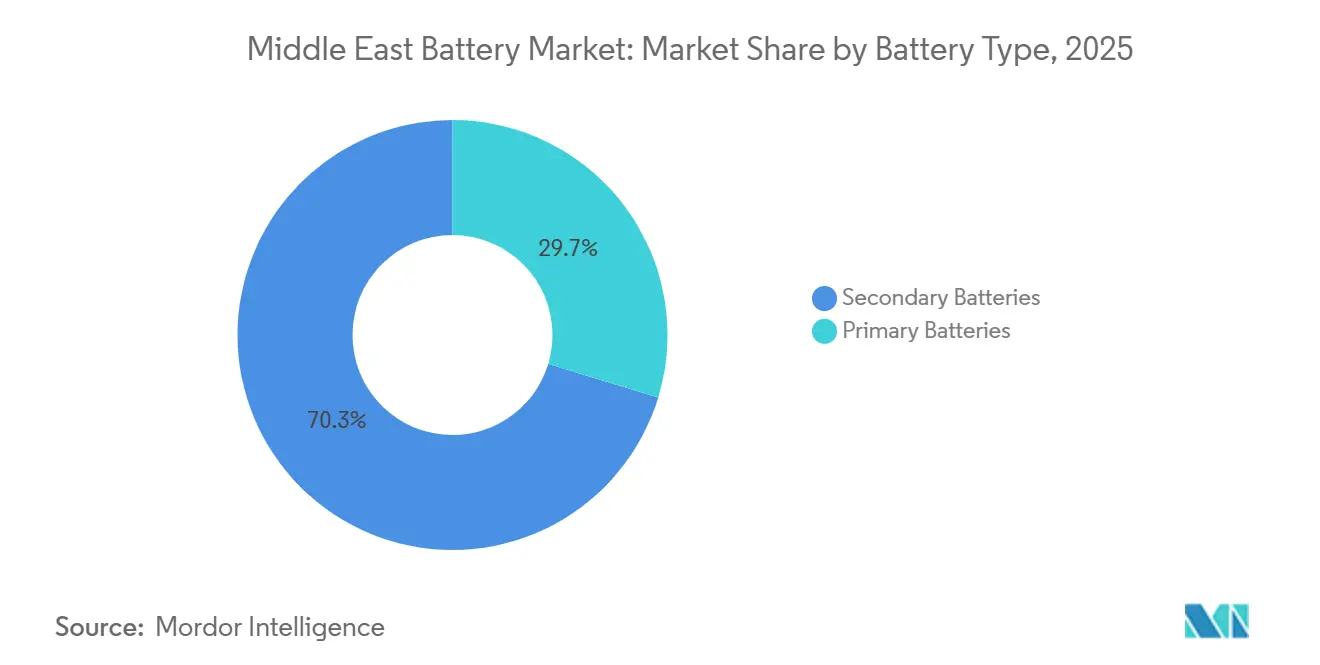
- By battery type, secondary batteries held 70.3% of the Middle East battery market share in 2025, and their revenue is forecast to grow at a 10.8% CAGR through 2031.
- By technology, lead-acid led with 39.8% share of the Middle East battery market size in 2025, while solid-state batteries are projected to expand at 30.9% CAGR during 2026-2031.
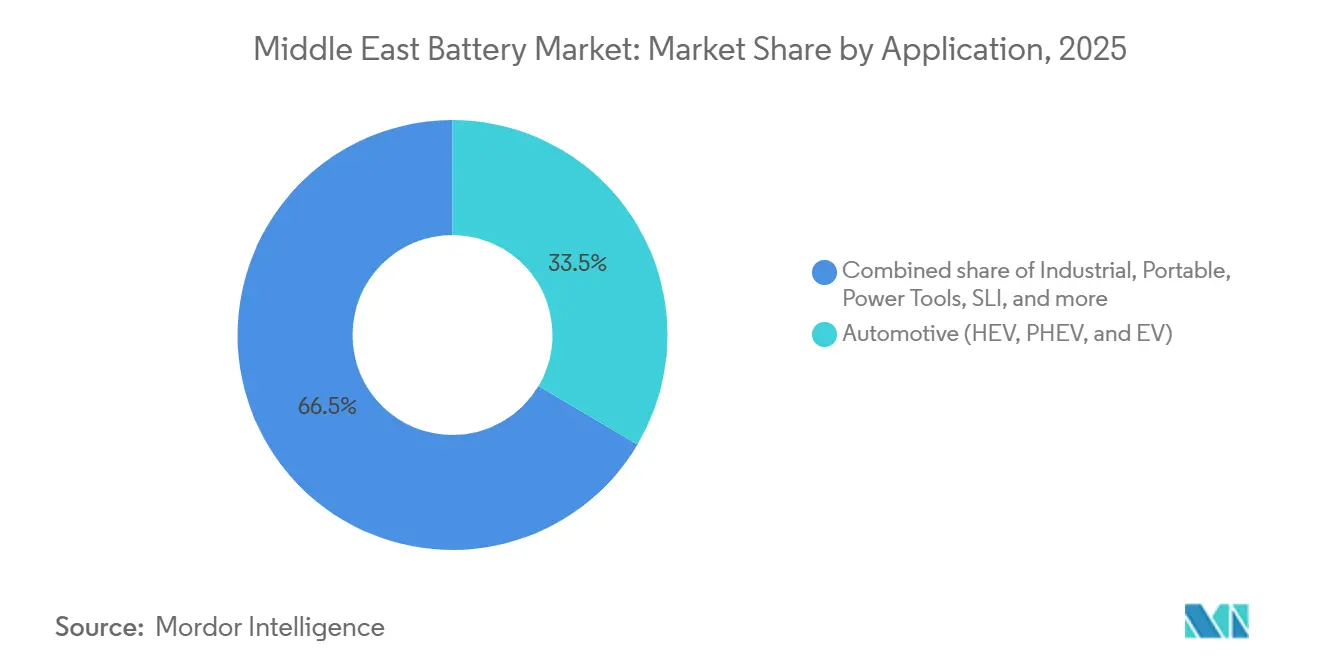
- By application, automotive batteries accounted for 33.5% of the Middle East battery market size in 2025 and are advancing at a 9.5% CAGR through 2031.
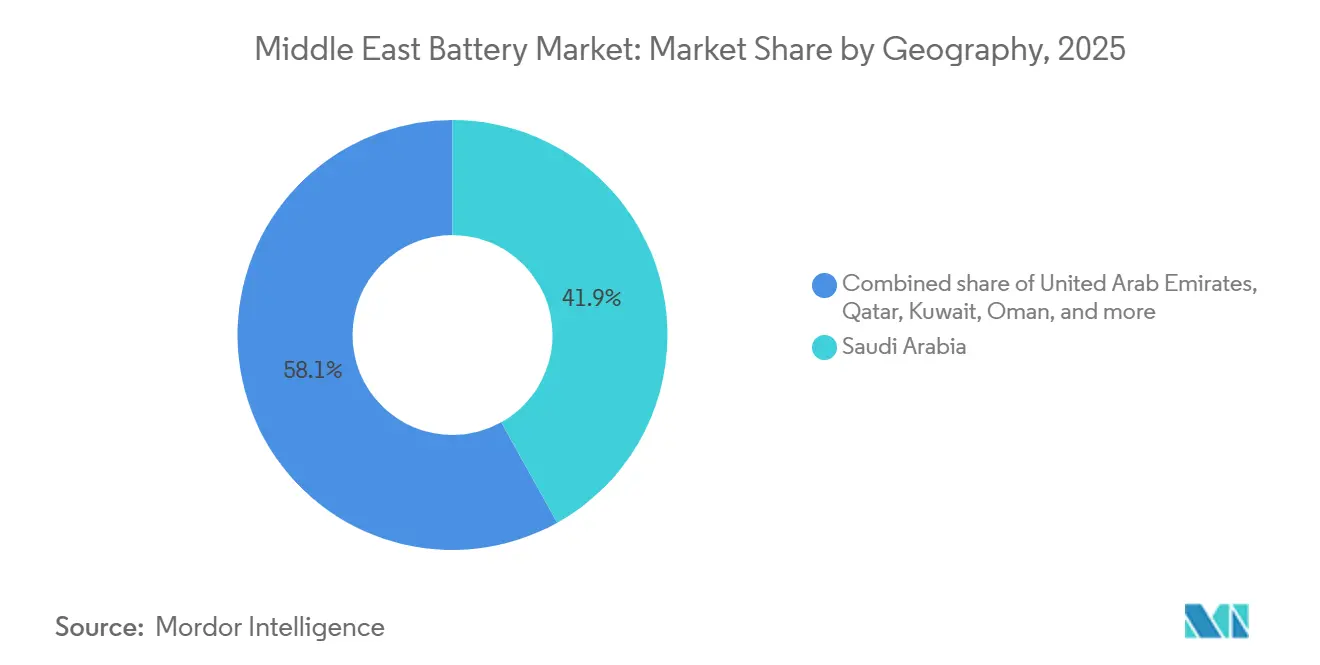
- By geography, Saudi Arabia captured 41.9% revenue share in 2025, whereas Oman is set to deliver the fastest 14.7% CAGR to 2031.
Note: Market size and forecast figures in this report are generated using Mordor Intelligence’s proprietary estimation framework, updated with the latest available data and insights as of January 2026.
Market Trends and Insights
Drivers Impact Analysis of Middle East Battery Market*
| Driver | (~) % Impact on CAGR Forecast | Geographic Relevance | Impact Timeline |
|---|---|---|---|
| EV adoption push under Vision agendas | +2.1% | Saudi Arabia, UAE, Qatar, Oman, Kuwait | Medium term (2-4 years) |
| Utility-scale renewables driving ESS demand | +2.8% | Saudi Arabia, UAE, Oman, Qatar | Long term (≥ 4 years) |
| Incentives for local battery manufacturing | +1.2% | Saudi Arabia, UAE | Long term (≥ 4 years) |
| Expanding telecom and data-center backup need | +0.9% | GCC-wide with UAE, Saudi Arabia, Qatar focus | Short term (≤ 2 years) |
| Electrification of upstream O&G operations | +0.7% | Saudi Arabia, UAE, Kuwait, Oman | Medium term (2-4 years) |
| Off-grid desalination projects with storage | +0.5% | Oman, Saudi Arabia, UAE coastal areas | Medium term (2-4 years) |
| Source: Mordor Intelligence | |||
EV Adoption Push Under National Vision Agendas
Saudi Arabia’s 2026 decision to nurture an electric-vehicle manufacturing sector is reshaping regional battery demand. Vision 2030 targets 30% electric-vehicle penetration in Riyadh by 2030, backed by an order to install 5,000 public chargers, and all new government fleet cars ordered after 2027 must be zero-emission.[1] Qatar’s plan for 2,000 charging points by 2030 adds a secondary demand node. Lucid Motors began vehicle assembly in 2024 and signals local capability expansion. Actual electric-vehicle registrations were below 5,000 units in 2025, which indicates that incentives and consumer engagement must accelerate. Diverse charging standards across the Gulf fragment supplier strategies.
Utility-Scale Renewables Driving ESS Demand
Solar curtailment has already reached 1.2 TWh in Saudi Arabia during 2025, or 8% of total renewable output, and similar patterns are emerging in the UAE.[2] Battery energy storage systems are the preferred remedy, typified by Saudi Arabia’s 8 GWh phase-one tender awarded in 2025 and the UAE’s 19 GWh CATL–Masdar project that will supply 1 GW of round-the-clock power by 2027.[3] Oman’s 100 MWh Ibri III storage plant shows that smaller states are embedding batteries at procurement launch. IRENA estimates that every new gigawatt of intermittent renewable capacity now requires 0.3-0.5 GWh of batteries to preserve grid stability.
Incentives for Local Battery Manufacturing
Saudi Arabia’s IKTVA rule mandating 30-50% in-kingdom value addition for awarded renewable and storage contracts, and the UAE’s “Make it in the Emirates” incentives, have brought cell makers to set up assembly lines. NEOM has earmarked USD 8.4 billion for hydrogen infrastructure that includes large batteries, creating further pull for local manufacturing. Tdafoq and Delectrik Power Systems agreed in 2025 to establish a flow-battery plant, exemplifying the shift from imports to joint ventures.
Expanding Telecom & Data-Center Backup Demand
The UAE hosts more than 50 active data centers in 2026, together exceeding 600 MW of IT load; each site relies on batteries for uninterruptible power supply. Saft’s lithium-ion rollout for Saudi telecom towers cut diesel use by 92% and truck rolls by 70%. EnerSys expanded a regional distribution network for PowerSafe batteries in 2024. Tesla’s Megapack has been adopted at off-grid sites where grid outages threaten connectivity. ITU guidelines standardize battery performance, so suppliers must guarantee sufficient cycle life under desert temperatures.
Restraints Impact Analysis of Middle East Battery Market*
| Restraint | (~) % Impact on CAGR Forecast | Geographic Relevance | Impact Timeline |
|---|---|---|---|
| Raw-material price volatility | -1.4% | GCC-wide | Short term (≤ 2 years) |
| Limited indigenous mineral supply | -0.9% | GCC-wide | Long term (≥ 4 years) |
| High capital cost versus diesel gensets | -0.7% | Saudi Arabia, Kuwait, Oman | Medium term (2-4 years) |
| Water-scarcity constraints on cooling and production | -0.6% | Saudi Arabia, UAE, Qatar | Long term (≥ 4 years) |
| Source: Mordor Intelligence | |||
Raw-Material Price Volatility
Lithium carbonate prices fluctuated between USD 12,000 and USD 18,000 per ton in 2025, unsettling budgetary planning for assemblers working on fixed-price contracts. With zero domestic lithium, cobalt, or nickel, every Middle East battery plant depends on imports. Cobalt supply disruptions in the Democratic Republic of Congo drove a 35% spot-price rise in early 2025, pushing suppliers toward cobalt-reduced chemistries. Saudi Arabia’s Public Investment Fund has acquired minority stakes in Australian and Chilean lithium ventures to hedge the exposure, yet end-product pricing inside the Middle East battery market still tracks global spot swings.
Limited Indigenous Mineral Supply
Regional geological surveys confirm negligible reserves of lithium, cobalt, or nickel, so refinery investment cannot offset upstream scarcity. The UAE signed a nickel hydroxide sourcing memorandum with Indonesia in 2025, but the material must still transit through third-party refiners. Recycling is immature: Dubatt’s 25,000 tpa lead-acid plant recovers only lead and cannot yet process lithium-ion scrap. Until closed-loop capacity scales are achieved, mineral dependence will restrain localized cost control.
*Our forecasts treat driver/restraint impacts as directional, not additive. The impact forecasts reflect baseline growth, mix effects, and variable interactions.
Middle East Battery Market Segment Analysis
By Battery Type:
Rechargeables Dominate Fleet and Grid SegmentsSecondary batteries led revenue with 70.3% in 2025, and the segment is projected to advance at a 10.8% CAGR through 2031. The figure reflects the rising share of electric vehicles, data-center backups, and grid-scale energy storage systems that demand thousands of deep cycles. The primary battery niche stays relevant in low-drain instrumentation and defense electronics but faces policy and cost headwinds as recycling mandates tighten.
Rechargeable uptake hinges on the total cost of ownership. BYD’s 6,000-cycle lithium iron phosphate pack for Saudi Electricity Company exemplifies economics that trump lower upfront prices of single-use chemistries.[4] Primary batteries supply under 30% of regional revenue, mainly in oilfield sensors where replacement intervals align with scheduled maintenance trips. Expanded enforcement of IEC 61960 standards in the UAE further cements safety requirements that favor reputable secondary suppliers.

By Technology:
Solid-State Pilots Challenge Lead-Acid IncumbencyLead-acid held 39.8% revenue in 2025, protected by cost leadership, robust recycling, and entrenched use in starter-lighting-ignition systems. Solid-state batteries, though still below 2% revenue, carry the highest 30.9% CAGR to 2031 as pilot lines migrate toward commercial runs in premium electric vehicles and high-reliability grid nodes.
Lithium-ion chemistries accounted for around 45% in 2025 and retained the default status for utility-scale storage. Flow batteries have broken into industrial slots after Aramco’s iron-vanadium unit demonstrated high-temperature tolerance. Enpower Greentech’s relocation under the UAE NextGenFDI program shows Gulf policymakers are courting solid-state pioneers with R&D incentives. Lead-acid prices remain 60-70% below lithium-ion on a per-kilowatt-hour basis but carry shorter cycle life, which narrows the advantage in long-run calculations.
By Application:
Automotive Batteries Outpace Industrial and Portable SegmentsAutomotive batteries held a 33.5% share in 2025 and are expected to grow at a 9.5% CAGR through 2031, reflecting aggressive domestic-manufacturing targets in Saudi Arabia and new charging corridors in the UAE. Industrial stationary storage, particularly utility-scale energy storage systems, emerged as the fastest-growing subset inside industrial applications, underpinned by multi-gigawatt tenders meant to reduce solar curtailment.
Automotive demand is being institutionalized. Saudi government fleets shift to zero-emission models from 2027, creating a guaranteed procurement channel. Lucid’s plant secured in-kingdom assembly lines and will add cell assembly by 2027 to comply with IKTVA requirements. Forklifts and automated guided vehicles in Gulf warehouses migrate from lead-acid to lithium-ion to support continuous multi-shift duty cycles. Portable batteries are mature and tied to consumer electronics replacement cycles, which are lengthening and thus producing modest growth.
Geography Analysis
Saudi Arabia Battery Market
Saudi Arabia generated 41.9% of the Middle East battery market revenue in 2025. The two-phase 18 GWh storage tender and a 15.1 GWh BYD project pipeline define the most assertive grid-modernization drive. Upstream electrification and NEOM’s hydrogen plans add industrial and long-duration niches. Domestic value-addition rules force suppliers into joint ventures, anchoring manufacturing footprints that should deepen over the forecast frame.
United Arab Emirates Battery Market
The United Arab Emirates contributed roughly 28% revenue in 2025. The USD 6 billion CATL–Masdar 19 GWh storage complex illustrates the scale of solar-plus-storage programs. Data-center construction in Abu Dhabi and Dubai sustains telecom-grade lithium-ion shipments. The UAE recycling ecosystem, headed by Dubatt, is the first to tackle circularity but lacks lithium-ion processing scale.
GCC Battery Market
Oman is on track for the fastest 14.7% CAGR to 2031, steered by Vision 2040 mandates and green-hydrogen export strategies. The 100 MWh Ibri III storage unit pioneers integrated solar-plus-storage procurement. Qatar targets 4 GW of renewable capacity by 2030 and hosts an emerging 1.675 GW solar-plus-storage pipeline. Kuwait’s Al Dibdibah project and Bahrain’s modest Noor 1 solar farm indicate earlier-stage renewable integration but create distributed opportunities for commercial storage systems.
Regulatory Landscape
In Saudi Arabia, SASO enforcement tightened market access for batteries and BESS through system-level validation. SASO moved toward enforcing IEC 62933-5-2:2026 (effective March 2026), requiring localized high-temperature cycle-life testing for imported energy storage systems and aligning certification to desert operating conditions. SASO also mandated IEC 62133-2:2026 for lithium battery products (effective July 10, 2026), including local type testing and a SASO Certificate of Conformity.
In the UAE, conformity assessment is governed by the Emirates Conformity Assessment Scheme (ECAS) under MoIAT. Utilities such as DEWA and EtihadWE require approval and re-inspection when battery integration constitutes a material change to grid connection. Additionally, Federal Decree-Law No. 11 of 2024 on Climate Change Reduction became mandatory for public and private entities in May 2026, intersecting procurement documentation for storage projects alongside safety standards. Across both markets, standards enforcement is shifting toward a mix of local testing, model-specific certification, and ongoing environmental reporting for larger BESS deployments.
Competitive Landscape
The five largest suppliers, BYD, CATL, LG Energy Solution, Tesla, and Samsung SDI, held an estimated 55-60% of 2025 revenue in the Middle East battery market. Regional players such as Middle East Battery Company, Saft, EnerSys, and Exide maintain leadership in lead-acid and specialized industrial niches. Chinese and South Korean cell makers, benefiting from gigawatt-scale capacity and cost advantages, capture most utility-scale storage awards. BYD’s 2025 joint development pact with Aramco aligns with the kingdom’s industrial strategy and embeds value transfer to satisfy IKTVA rules.
Technology diversification offers alternative differentiation. Aramco’s first commercial iron-vanadium flow battery validated long-duration storage outside lithium-ion’s four-hour window. Flow battery maker Tdafoq plans a Saudi plant, while Enpower Greentech is negotiating UAE incentives for solid-state trials. Recycling capability is the most conspicuous gap; Dubatt’s lead-acid plant recovers only a fraction of total end-of-life volume, offering a USD 200-300 million annual opportunity for lithium-ion recycling when consumer electric-vehicle fleets mature.
Smaller contenders position modular containerized batteries for telecom and microgrid deployments, betting on standardized architectures to shrink lead times. All suppliers must comply with IEC 62619 safety rules, which protect clients from thermal runaway and harmonize cell-qualification processes across Gulf markets.
Middle East Battery Industry Leaders
-
Exide Industries Ltd
-
Middle East Battery Company (MEBCO)
-
Tesla, Inc.
-
Saft Groupe SA
-
LG Energy Solution
- *Disclaimer: Major Players sorted in no particular order
Middle East Battery Market Companies Covered in this Report
- Tesla Inc.
- Panasonic Holdings Corp.
- Saft Groupe SA
- Middle East Battery Co. (MEBCO)
- C&D Technologies Inc.
- EnerSys
- Exide Industries Ltd.
- FIAMM Energy Technology SpA
- Statron AG
- LG Energy Solution
- Samsung SDI
- CATL
- BYD Co. Ltd.
- Amara Raja Batteries Ltd.
- GS Yuasa Corp.
- East Penn Manufacturing
- Leclanché SA
- Li-Cycle Holdings Corp.
- Clarios (Johnson Controls spin-off)
- InoBat
Market Opportunities and Future Outlook
Utility-scale storage procurement and round-the-clock renewable contracts are creating white space for bankable, grid-integrated BESS offerings, supported by local execution. SPPC prequalified 27 developers and technology providers for phase two of its BESS program, totaling 3 GW/12 GWh across six 500 MW/2 GWh projects under a BOO structure. This reinforces a multi-GW pipeline and supports a move toward standardized containerized solutions, EPC partnerships, and long-term O&M models suited to desert operation.
In the UAE, Masdar's July 2026 financial close on a 5.2 GW solar-plus-storage project with 19 GWh of batteries supplied by BYD and Sungrow shows how project financing is concentrating around multi-gigawatt solar paired with storage. That pattern expands demand for qualified cells, PCS, BMS, thermal management, and warranty-backed performance guarantees. Localization and upstream investments also broaden the opportunity beyond cell imports into BESS assembly and battery materials, including May 2026 ZOE Energy Storage signing a joint venture to establish a 6 GWh Saudi BESS facility, and Oman projects such as Zhongke Electric's 200,000 tpa Li-ion anode plant at Sohar Freezone and a USD 250 million EV and battery cell facility deal in Duqm.
Recent Industry Developments in Middle East Battery Market
- July 2026: SPPC prequalified 27 developers and technology providers for phase two of the BESS program, totaling 3 GW/12 GWh across six 500 MW/2 GWh projects under a BOO structure. The inclusion of top-tier integrators points to a crowded, bankable pipeline and clarifies procurement timelines for utility-scale storage in the region.
- October 2025: SPPC awarded phase-two storage capacity of 2.5 GW and 10 GWh, bringing Saudi Arabia to 4.5 GW and 18 GWh of contracted storage. The award highlights BESS as a central tool for managing renewable variability and emphasizes local execution readiness for multi-site deliveries.
- July 2024: Emirates Water and Electricity Company awarded a 400 MW battery contract to support the 2 GW Al Dhafra solar park's evening ramp. The project anchors a grid-services use case for batteries in the UAE and provides a reference point for qualifying systems under desert conditions.
Middle East Battery Market Report Scope and Research Methodology
Market Definition and Coverage
This market covers battery revenues generated within the Middle East across primary and secondary batteries that are sold for automotive, industrial, and portable uses, with values captured at the market level in USD.
Scope exclusions: We exclude aftermarket services such as installation labor, maintenance contracts, battery leasing fees, and standalone recycling processing revenue.
Segments Covered in This Report
- By Battery Type
- Primary Batteries
- Secondary Batteries
- By Technology
- Lead-acid
- Li-ion
- Nickel-metal hydride
- Nickel-cadmium
- Sodium-sulfur
- Solid-state
- Flow Battery
- Emerging chemistries
- By Application
- Automotive (HEV, PHEV, and EV)
- Industrial (Motive, Stationary (Telecom, UPS, ESS), etc.)
- Portable (Consumer Electronics, etc.)
- Power Tools
- SLI
- Other Applications
- By Geography
- Saudi Arabia
- United Arab Emirates
- Qatar
- Kuwait
- Oman
- Bahrain
- Rest of Middle East
Data Sources, Market Sizing, and Validation
Desk Research
To start, we map the demand signals that explain battery consumption in the Middle East, and then we align them to battery supply and trade realities. Public sources are used heavily here, such as UN Comtrade for battery trade flows, IEA releases for energy transition and storage context, IRENA publications for renewable additions that can pull stationary storage demand, and OICA for vehicle production context.
We also review central bank and national statistics portals (where available) for macro indicators that influence industrial activity, along with standards and safety references that shape technology mix. Company annual reports, investor presentations, and trusted press coverage help validate pricing direction and capacity announcements. Where it adds clarity, we reference paid subscriptions for company financials and intelligence, shipment-level trade databases, and patent databases to cross-check technology movement. These desk sources are illustrative and not exhaustive, and many other public and paid references are consulted for data collection, validation, and clarification.
Primary Interviews and Surveys
Next, we pressure-test the desk assumptions through expert interviews and short surveys with manufacturers, distributors, integrators, EPC-side contacts, and large end users in transport, telecom, and industrial facilities. Since this is a regional market, inputs are balanced across the Gulf and the wider Middle East so pricing, tender activity, and replacement cycles are not overfit to a single country.
Distribution of primary research fieldwork respondents
| Company type | Respondent position |
|---|---|
| Top tier: 25% | CXOs: 15% |
| Mid tier: 58% | Functional/Unit leaders: 34% |
| Smaller Players: 17% | Managers: 51% |
Market-Sizing & Forecasting
Sizing is built using a top-down approach where regional demand is reconstructed from a mix of application activity and battery-use intensity, and then converted into value using realistic average selling prices. For example, we look at vehicle parc and replacement behavior for SLI demand, industrial backup power needs tied to telecom and facility uptime requirements, and the project pipeline for stationary storage linked to renewables.
To keep totals grounded, results are corroborated using selective bottom-up checks such as sampled distributor channel checks, indicative supplier revenue ranges, and an ASP multiplied by shipment volume sanity check where trade data is meaningful. Key model inputs include the split between primary and secondary batteries, chemistry mix shifts toward lithium-ion, average battery life by application (replacement cycle), import dependence versus local assembly, and currency timing used for USD conversion. Forecasting is run mainly through scenario analysis, where growth paths are adjusted by how quickly grid storage projects move from award to commissioning and how fast transport electrification expands. When bottom-up coverage is incomplete for smaller channels, gap-filling is done using ratio-based scaling from better-observed countries and applications, followed by a recheck against regional totals.
Data Validation & Update Cycle
Before finalizing, we triangulate model outputs against independent signals, such as trade trends, project award activity, and observed price direction by chemistry, so the value path stays realistic. Outliers are reviewed country by country, and unusual jumps are traced back to a specific driver like a one-time project surge or a pricing assumption change.
A second analyst review is completed before sign-off, and any high-impact variance triggers a re-contact with industry respondents to confirm what changed. Reports are refreshed annually, with interim updates when material events occur, such as policy shifts, major plant announcements, or sharp commodity moves that affect battery pricing. Right before delivery, a fresh data pass is done so clients receive the latest updated view.
Mordor Intelligence's Middle East Battery Market Size Versus Other Published Estimates
Published market values for Middle East batteries can look far apart because firms choose different coverage boundaries, different year conventions, and different ways to translate volume signals into USD values. In practice, the biggest gaps usually come from what is counted as a battery market versus adjacent revenue streams, and how quickly price changes are pushed into the model.
By tracking application-level replacement cycles and ASP movement, and then refreshing the currency timing and project commissioning assumptions, Mordor Intelligence keeps the estimate tied to batteries sold into automotive, industrial, and portable demand rather than mixing in service add-ons. Differences also show up when some studies extend the region definition, combine Middle East with Africa, or lean on aggressive storage pipeline conversion without validating award-to-installation slippage.
Benchmark comparison
| Source | Market Size | Gaps in Research Methodology |
|---|---|---|
| Mordor Intelligence | USD 7.64 B (2026) | |
| Industry Consultancy A | USD 8.03 B (2022) | Uses an older base year and a faster growth curve, and the scope appears broader in end-use coverage, which can pull in adjacent electrical storage spending beyond battery packs. |
| Regional Consultancy B | USD 9.00 B (2024) | Combines a wider geographic footprint and may blend Middle East with neighboring markets, and the pricing path is not clearly reconciled to chemistry mix shifts and recent import price movements. |
The spread in the table is mainly explained by boundary choices (region and what revenue lines are included) and by how pricing and project timing are treated year to year. Our approach keeps the steps repeatable by linking demand pools to clear application drivers, and then validating totals with practical cross-checks so the final number is easier to defend on a client call.
Key Questions Answered in the Report
What is the forecast value of the Middle East battery market by 2031?
The market is expected to reach USD 10.96 billion by 2031, reflecting a 7.48% CAGR during 2026-2031.
Which battery type leads revenue in the Middle East?
Secondary (rechargeable) batteries held 70.3% of revenue in 2025 and are growing faster than primary batteries.
Which country contributes the largest share to regional demand?
Saudi Arabia generated 41.9% of revenue in 2025, driven by large grid-scale storage tenders and local manufacturing mandates.
What technology is growing the fastest?
Solid-state batteries show the highest growth outlook at 30.9% CAGR through 2031, although they remain in pilot phases today.
What is the main supply-chain risk for battery makers in the Gulf?
Complete reliance on imported lithium, cobalt, and nickel exposes manufacturers to raw-material price volatility and logistics disruptions.