
Market Overview
| Study Period | 2021 - 2031 |
|---|---|
| Forecast Data Period | 2026 - 2031 |
| Base Year Market Size (2025) | USD 6.52 Billion |
| Market Size (2026) | USD 7.07 Billion |
| Market Size (2031) | USD 11.20 Billion |
| Growth Rate (2026 - 2031) | 9.63 % |
| Market Concentration | Medium |
Major Players *Disclaimer: Major Players sorted in no particular order Image © Mordor Intelligence. Reuse requires attribution under CC BY 4.0. | |
Southeast Asia Battery Market Analysis by Mordor Intelligence
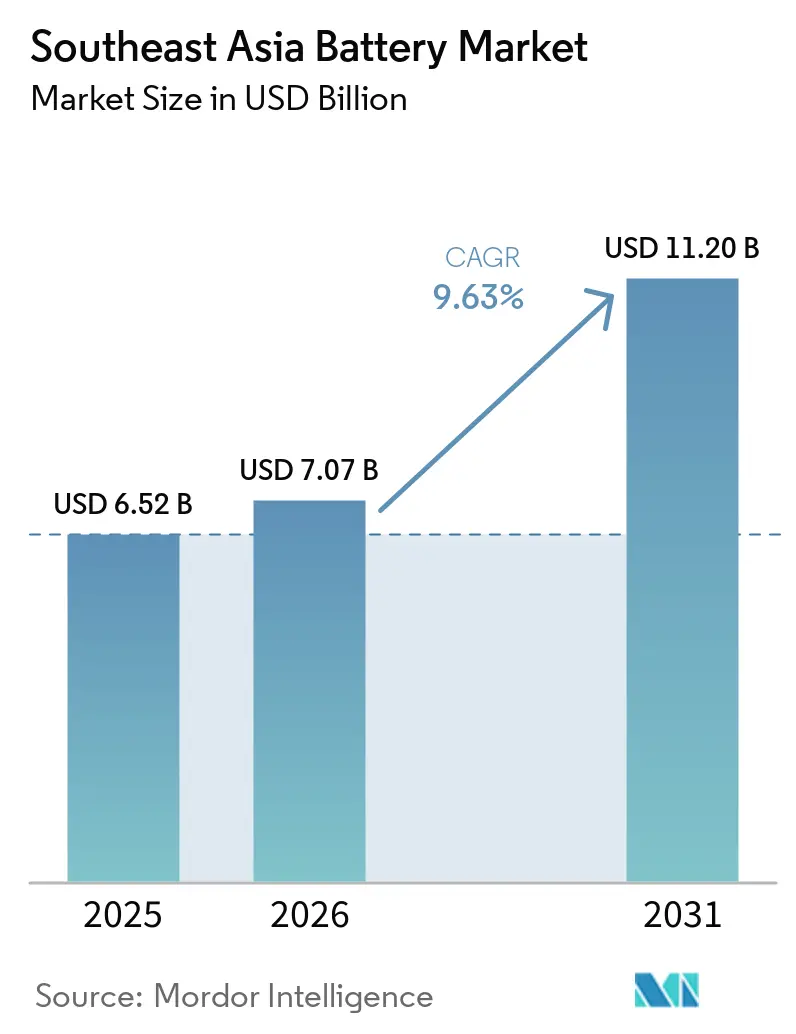
The Southeast Asia Battery Market size is expected to grow from USD 6.52 billion in 2025 to USD 7.07 billion in 2026 and is forecast to reach USD 11.20 billion by 2031 at 9.63% CAGR over 2026-2031.
Rising electric-vehicle mandates, fast-tracking of 5G telecom towers, and utility-scale solar-plus-storage procurements are lifting lithium-ion demand while squeezing legacy lead-acid volumes. Indonesia’s nickel laterite resources are lowering precursor costs, Thailand’s automotive supply chain is attracting cell and pack investments, and Vietnam’s portable-electronics hub is anchoring pouch-cell manufacturing. Joint ventures between Chinese cell makers and ASEAN conglomerates are creating local capacity that buffers tariff exposure. Meanwhile, stricter hazmat shipping rules are nudging producers to colocate cell, module, and pack lines inside the region to curb logistics risk.
Key Report Takeaways
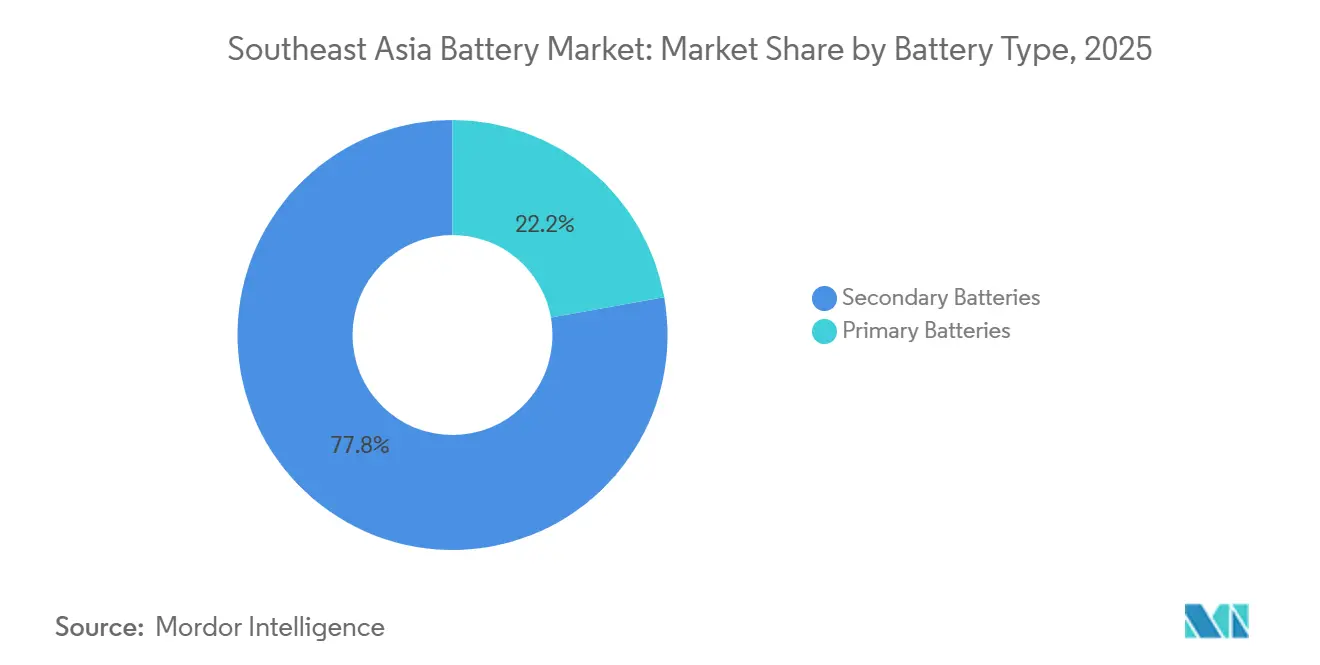
- By battery type, secondary rechargeable batteries captured 77.8% of regional revenue in 2025 and are advancing at a 10.5% CAGR through 2031.
- By technology, lead-acid retained 49.1% of the 2025 value, but solid-state batteries are projected to expand at a 34.8% CAGR into 2031 as oxide- and sulfide-based prototypes reach pilot scale.
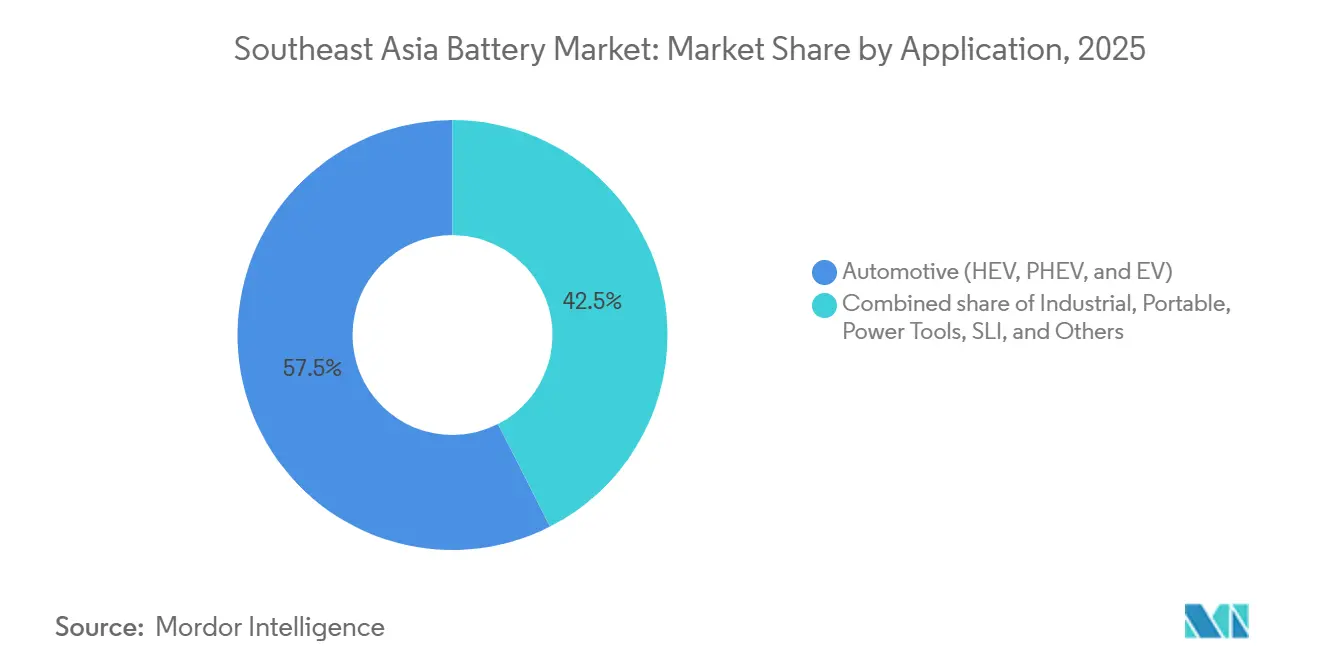
- By application, automotive traction batteries held a 57.5% share of the Southeast Asia battery market size in 2025 and are accelerating at a 15.7% CAGR to 2031, reflecting generous EV incentives in Indonesia and Thailand.
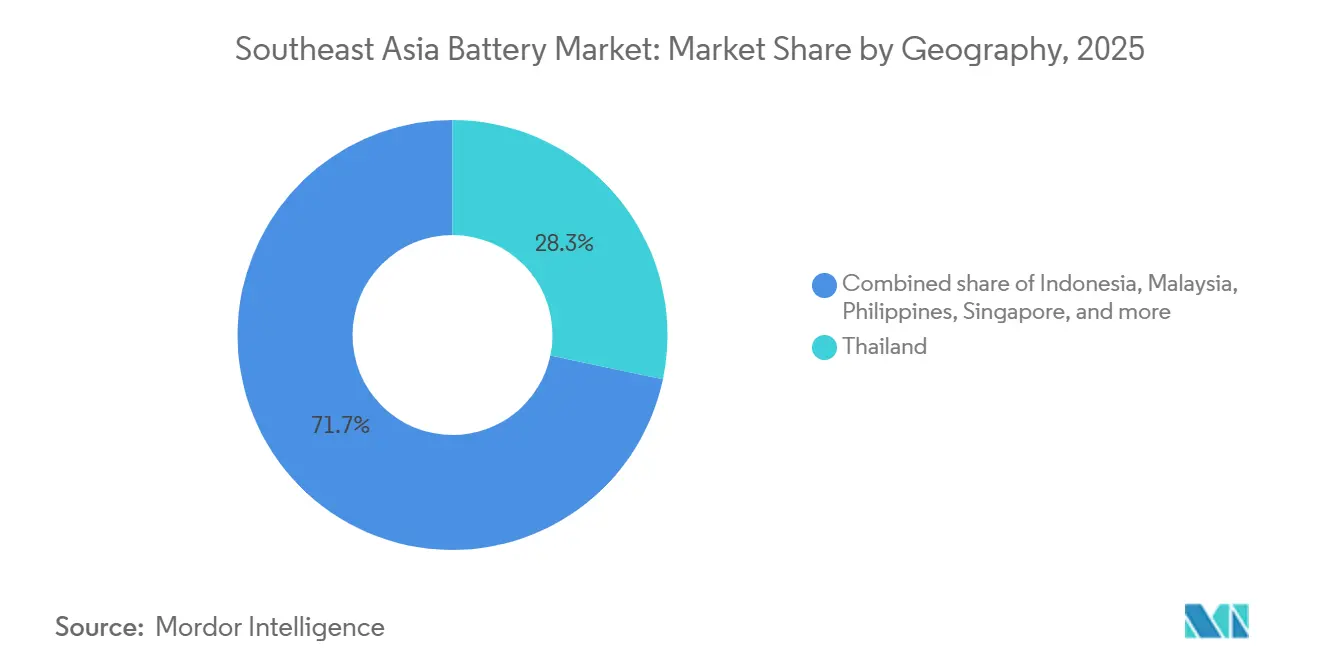
- By geography, Thailand led with 28.3% of Southeast Asia's battery market share in 2025, while Indonesia is on track for a 12.9% CAGR thanks to vertically integrated nickel-to-cathode complexes.
Note: Market size and forecast figures in this report are generated using Mordor Intelligence’s proprietary estimation framework, updated with the latest available data and insights as of January 2026.
Market Trends and Insights
Drivers Impact Analysis of Southeast Asia Battery Market*
| Driver | (~) % Impact on CAGR Forecast | Geographic Relevance | Impact Timeline |
|---|---|---|---|
| Rapid EV-adoption incentives across ASEAN | +2.8% | Indonesia, Thailand, Vietnam, Malaysia, Philippines | Medium term (2-4 years) |
| Telecom 5G tower back-up demand spike | +1.2% | Thailand, Vietnam, Indonesia urban centers | Short term (≤ 2 years) |
| Grid-scale solar + storage roll-outs | +1.9% | Malaysia, Thailand, Indonesia | Long term (≥ 4 years) |
| Regional supply-chain relocation from China | +2.1% | Indonesia, Thailand, Vietnam | Medium term (2-4 years) |
| Battery-swapping for 2-W & 3-W e-mobility | +0.9% | Vietnam, Indonesia, Thailand | Short term (≤ 2 years) |
| Nickel-laterite mining for precursor sufficiency | +1.5% | Indonesia, Philippines | Long term (≥ 4 years) |
| Source: Mordor Intelligence | |||
Rapid EV-Adoption Incentives Across ASEAN
Fiscal packages are compressing ownership costs for battery electric vehicles and pushing automakers to source cells locally. Indonesia waived luxury-goods tax on EVs priced below IDR 1.5 billion in 2024, prompting Hyundai and BYD to boost local assembly.[1] Thailand extended its EV 3.5 scheme through 2027 and ties eight-year corporate income-tax holidays to domestic pack production.[2] Vietnam’s Decision 876 sets a 5% penetration target by 2030, front-loading charging-infrastructure subsidies that cut the total cost of ownership by about 15%.[3] Malaysia’s Low Carbon Mobility Blueprint exempts EVs from excise duty until 2025, though deployment trails Indonesia and Thailand. Policymakers are thus shortening supply chains and drawing cell, module, and pack lines closer to end-markets.
Telecom 5G Tower Back-Up Demand Spike
Fifth-generation base stations draw two to three times more energy than 4G, motivating operators to swap diesel gensets for lithium-ion cabinets. Smart Axiata retrofitted 1,200 Cambodian towers in 2024, cutting fuel spend by 60% and abating 8,000 t of CO₂ annually.[4] Thailand’s AIS and True Corp are piloting solar-battery hybrids at rural sites to counter erratic grid service. EnerSys launched cabinets that hold cell temperature under 35 °C to curb capacity fade in tropical heat. Regulatory uptime mandates in Singapore obligate telecoms to maintain 99.9% service, effectively requiring high-reliability storage at key nodes. Faster recharge, smaller footprints, and lower maintenance costs are driving lithium-ion adoption ahead of automotive timelines in this niche.
Grid-Scale Solar+Storage Roll-Outs
Utilities must firm intermittent solar and wind generation to meet dispatch commitments. Malaysia’s Tenaga Nasional awarded 4 GW of solar plus 5.12 GWh of lithium-ion storage in 2024, with delivery milestones set between 2026 and 2028. Thailand’s Gulf Energy brought a 200 MW PV farm coupled with 100 MWh of LFP storage online in 2025. Singapore’s Sembcorp commissioned a 285 MWh system on Jurong Island in 2024 to provide frequency regulation for industrial clients. Indonesia’s PLN signed 500 MW of solar-storage PPAs, but tariff renegotiations in 2025 delayed financial close for multiple developers. Flow and sodium-sulfur batteries are emerging for six-hour discharge, yet lithium-ion retains cost leadership for projects needing four hours or less.
Regional Supply-Chain Relocation From China
Trade friction and nickel proximity are steering cell makers toward ASEAN. CATL’s USD 5.97 billion Sorowako complex will deliver 50 GWh annually by 2027 and is colocated with PT Vale Indonesia smelters to shave 12% off precursor logistics cost. LG Energy Solution’s USD 9 billion Karawang facility started shipping cells in 2025 and targets 30 GWh by 2026. Gotion High-Tech partnered with PT Trimegah Bangun Persada for 20 GWh of LFP cells plus cathode precursor lines. Panasonic doubled automotive-cell capacity in Thailand’s Chonburi province to serve Japanese OEMs assembling hybrids locally. Relocation spans upstream cathodes and anodes, not just final assembly, shrinking lead times for ASEAN vehicle plants.
Restraints Impact Analysis of Southeast Asia Battery Market*
| Restraint | (~) % Impact on CAGR Forecast | Geographic Relevance | Impact Timeline |
|---|---|---|---|
| High Li-ion capex versus legacy chemistries | -1.4% | Indonesia, Thailand, Philippines manufacturing zones | Medium term (2-4 years) |
| Under-developed recycling ecosystem | -0.8% | ASEAN-wide, acute in Indonesia, Philippines, Myanmar | Long term (≥ 4 years) |
| Bilateral PPA policy uncertainty | -0.6% | Indonesia, Philippines, Malaysia grid projects | Medium term (2-4 years) |
| Stricter haz-mat shipping rules | -0.5% | ASEAN port hubs | Short term (≤ 2 years) |
| Source: Mordor Intelligence | |||
High Li-Ion Capex Versus Legacy Chemistries
Lithium-ion gigafactories cost USD 100 million to USD 150 million per GWh, versus USD 20 million to USD 40 million for lead-acid lines. This gap explains why regional firms such as Malaysia’s Favelle Favco and Indonesia’s PT Nipress keep expanding lead-acid capacity to serve price-sensitive commercial-vehicle and stationary-backup buyers. Indonesia and Thailand offer multi-year tax holidays and subsidized land, yet world-class plants still need USD 5 billion to USD 10 billion, forcing local conglomerates into foreign joint ventures. Solid-state and flow-battery formats carry even steeper upfront costs because they require specialty production tools and unproven yields, limiting early adoption to large incumbents with deep R&D budgets.
Under-Developed Recycling Ecosystem
End-of-life collection trails production, creating environmental liabilities and forfeiting cobalt and nickel recovery. Indonesia enacted an extended-producer-responsibility rule in 2024 that mandates 50% collection by 2027, but enforcement mechanisms remain weak. Singapore’s Durapower opened a hydrometallurgical plant able to process 3,000 t per year at 95% metal-recovery rates, yet regional demand may top 50,000 t by 2030. Thailand’s draft regulation funds recycling through producer levies but exempts imported cells, diluting the impact. The Philippines exports scrap packs to China or consigns them to landfills, raising groundwater-contamination risks. Absent local recycling loops, cell makers are exposed to spot nickel price spikes like those seen under Indonesia’s 2024 export curbs.
*Our forecasts treat driver/restraint impacts as directional, not additive. The impact forecasts reflect baseline growth, mix effects, and variable interactions.
Southeast Asia Battery Market Segment Analysis
By Battery Type:
Rechargeable Dominance AcceleratesSecondary batteries accounted for 77.8% of 2025 revenue, with the segment tracking a 10.5% CAGR on the back of electric-vehicle, grid-storage, and telecom installations that require thousands of charge cycles. Primary formats remain in remote sensors and emergency gear, but are losing ground as microgrid deployment spreads. Vietnam’s battery-swapping mesh, led by VinFast, underscores how recurring-use designs stretch pack utilization and drive throughput in the Southeast Asia battery market. Regulatory proposals such as Singapore’s planned levy on single-use cells further tip the balance toward rechargeables.
Solid-state prototypes from Samsung SDI and Toyota exceed 500 Wh per kg and target 3,000-cycle life, signaling a medium-term bridge to even higher rechargeable share. Manufacturing yields below 80% and triple the cost of lithium-ion confines early deployments to premium EVs and aerospace. Nonetheless, longer range and thermal stability make solid-state a credible disruptor of the Southeast Asia rechargeable battery market over the next decade.

By Technology:
Lead-Acid Incumbency Meets Solid-State DisruptionLead-acid retained 49.1% of the 2025 value, upheld by automotive starting-lighting-ignition, forklifts, and telecom backup, where price trumps energy density. Lithium-ion is gaining traction in grid and portable electronics, though margin pressure from Chinese oversupply is squeezing cell makers. CATL’s average selling price per kWh fell 18% in 2024, illustrating deflationary forces in the Southeast Asia battery market. Nickel-metal hydride persists in Toyota’s mild-hybrid lines assembled in Thailand, while nickel-cadmium contracts because of cadmium-toxicity rules.
Solid-state cells are forecast to grow at a 34.8% CAGR through 2031. QuantumScape, Toyota, and Samsung SDI are closing in on pilot production that can unlock higher energy density and remove liquid-electrolyte fire risk. Sodium-sulfur and vanadium-flow variants are carving space in six-hour grid-support roles where lithium-ion economics degrade beyond four-hour discharge. NGK’s 14 MWh sodium-sulfur system in Thailand highlights growing technology pluralism.
By Application:
Automotive Traction Batteries Outpace Industrial SegmentsAutomotive traction packs held 57.5% of 2025 revenue and are running at a 15.7% CAGR toward 2031. Indonesia’s luxury-tax waiver on EVs under IDR 1.5 billion triggered sales spikes of LFP-based compact SUVs from Wuling and BYD, funneling cell demand into new plants in Java and Sulawesi. Thailand links tax holidays to local pack content, pushing GS Yuasa, Panasonic, and Clarios to expand in the Eastern Economic Corridor. Forklifts, data-center backup, and telecom sites anchor industrial demand but grow at a mid-single-digit pace, constrained by longer replacement windows.
Portable batteries for smartphones and laptops mature in line with GDP growth, yet value is shifting toward automotive-grade pouch cells. Samsung SDI retooled its Bac Ninh facility in 2024 to allocate more lines to traction formats, reflecting the profitability pivot within the Southeast Asia battery industry. Power-tool makers such as Bosch and Makita phase out nickel-cadmium for lithium-ion to lower weight and extend runtime.
Geography Analysis
Thailand Battery Market
Thailand led the Southeast Asia battery market with 28.3% revenue in 2025, drawing on a deep automotive cluster and Eastern Economic Corridor incentives that streamline permitting and fund shared infrastructure. Clarios and GS Yuasa upgraded Rayong plants in 2024, and Panasonic doubled capacity to support hybrid models from Toyota and Honda. The country also hosts early pilots of sodium-sulfur and flow storage for industrial customers seeking six-hour discharge profiles.
Indonesia Battery Market
Indonesia is on a 12.9% CAGR trajectory, underpinned by nickel-driven vertical integration. CATL, LG Energy Solution, and Gotion High-Tech are commissioning 100 GWh of combined cell capacity between 2025 and 2027, positioning the nation as a hub that ships cathodes and finished cells to ASEAN vehicle plants and Australia grid projects. Government bans on raw ore exports lock upstream value-addition inside the archipelago, further magnetizing investment.
ASEAN Battery Market
Vietnam leverages its electronics-export engine; Samsung and LG assemble pouch cells for Galaxy devices and consumer laptops while expanding into automotive grades. The country’s battery-swapping mandate underpins mass two-wheeler electrification, lifting domestic cell pull. Malaysia pitches itself as a storage hub; Gentari’s 1 GWh system in Bukit Jalil entered service in 2024, offering capacity-reserve services under long-term offtake. Singapore focuses on R&D and recycling due to land limits, with Durapower’s hydromet facility processing end-of-life packs from across ASEAN. The Philippines remains supply-constrained, although Meralco’s 100 MWh Luzon installation signals growing utility appetite for grid-support storage.
Regulatory Landscape
Battery policy in Southeast Asia is tightening around product standards, traceability, and localization. Thailand continues to anchor EV localization through EV 3.5-linked local content rules, and in June 2026 the National Electric Vehicle Policy Committee extended the deadline for counting imported battery cells toward local content requirements to June 30, 2026, while capping eligible imported-cell value at 10% of EV factory price. Vietnam is moving toward technical standardization for light e-mobility batteries, with the Ministry of Construction promulgating Circular No. 13/2026/TT-BXD to establish QCVN 31:2026/BXD for traction batteries used in electric motorcycles and mopeds, effective October 9, 2026.
Circularity and data requirements are also expanding across the region. Vietnam enacted mandatory Extended Producer Responsibility (EPR) for batteries in January 2024 (including lead-acid accumulators with a compulsory recycling rate), and Cambodia followed with its first mandatory EPR regulation explicitly covering lead-acid batteries (Prakas No. 2196/0325) in March 2025, shifting collection and recycling obligations toward producers and importers. Malaysia added a regional traceability anchor in November 2025 when Jabatan Standard Malaysia launched MS 2818, a battery passport standard for electrified vehicles, raising compliance expectations for EV battery suppliers selling into regulated OEM and fleet channels.
Competitive Landscape
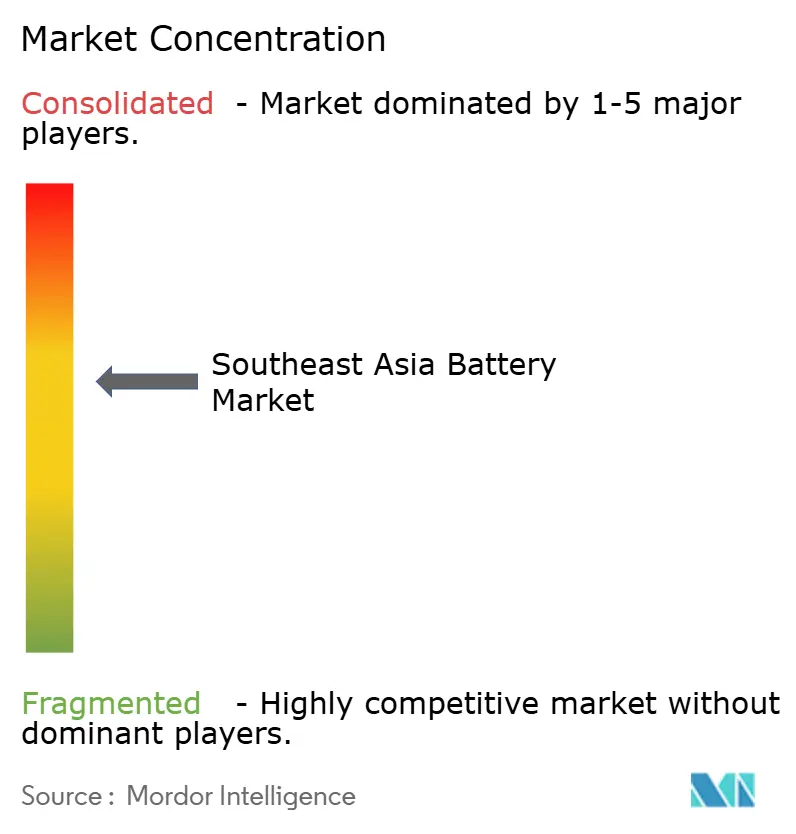
The Southeast Asia battery market is moderately concentrated. CATL, LG Energy Solution, Samsung SDI, and BYD together command roughly 55% of regional lithium-ion capacity, while Clarios, GS Yuasa, and Exide dominate lead-acid aftermarket channels. Chinese cell makers mitigate tariff exposure by pairing with local conglomerates; CATL’s tie-up with PT Vale and Gotion’s partnership with PT Trimegah illustrate vertical-integration plays that secure nickel and cut logistics drag. Korean firms lean on OEM relationships; LG Energy Solution supplies Hyundai’s Indonesian factory, and Samsung SDI feeds Vietnam’s electronics assembly.
Technology rivalry is intensifying around solid-state batteries. Samsung SDI ran oxide-based pilot lines in 2024, and Toyota targets a 2027 sulfide cell launch. Patent filings under IEC TC 21 rose 34% in 2024, with Chinese entities submitting 62% of lithium-ion safety and solid-electrolyte applications. Smaller entrants such as Narada Power and EVE Energy carve niches in battery-swapping and long-duration storage through localized service teams and tailored products. Overcapacity in Chinese plants is compressing margins, pushing Southeast Asian producers to compete on delivery speed and after-sales service rather than unit price.
Southeast Asia Battery Industry Leaders
-
LG Energy Solution
-
Panasonic Holdings Corp.
-
Samsung SDI Co. Ltd.
-
BYD Co. Ltd.
-
GS Yuasa Corporation
- *Disclaimer: Major Players sorted in no particular order
Southeast Asia Battery Market Companies Covered in this Report
- BYD Co. Ltd.
- CATL
- C&D Technologies Inc.
- Clarios
- East Penn Manufacturing Co. Inc.
- Exide Industries Ltd.
- FIAMM Energy Technology SpA
- GS Yuasa Corporation
- LG Energy Solution
- Panasonic Holdings Corp.
- Samsung SDI Co. Ltd.
- Saft Groupe SA
- Tesla Inc.
- Tianjin Lishen Battery Co. Ltd.
- Leoch International
- Narada Power
- EVE Energy
- Gotion High-Tech
- Vision Group
- VARTA AG
Market Opportunities and Future Outlook
Integrated cell, materials, and recycling buildouts in Indonesia create whitespace for local suppliers of cathode and anode materials, formation equipment, pack integration, and compliant logistics as localization policies and upstream resource advantages pull more steps of the value chain into-country. A concrete signal is the June 2025 start of construction of a USD 5.9 billion integrated battery project involving Indonesia Battery Corporation (IBC), PT Antam, and a CATL-led consortium, spanning nickel and materials processing and a cell plant in Karawang with an initial 6.9 GWh capacity and scale-up plans, plus recycling at East Halmahera. These large projects also broaden addressable demand beyond automotive into stationary storage, aligning with ongoing solar-plus-storage procurements in markets such as Malaysia and Singapore described in the report context.
Outside Indonesia, new manufacturing nodes in Malaysia highlight opportunities for contract manufacturing, localized BESS assembly, and supplier ecosystems around new plants. In March 2026, EVE Energy completed the second phase of its Kedah battery plant to reach 10 GWh annual capacity, expanding regional options for cell sourcing beyond the main Indonesia-Thailand-Vietnam corridor. Malaysia also saw government-linked efforts toward domestic production, with Gigafactory Malaysia (NanoMalaysia) initiating small-scale commercial battery manufacturing in July 2026, which although early in volume supports policy-driven demand for localized content and creates near-term openings in testing, certification, and recycling services to support compliance and lifecycle management initiatives such as Malaysia's battery passport standard.
Recent Industry Developments in Southeast Asia Battery Market
- March 2026: Panasonic Energy (Thailand) reaffirmed Thailand as a strategic regional hub for its dry battery business, citing cumulative production exceeding 20 billion batteries for export. The commitment reinforces continued investment focus on Thailand for regional battery operations and supply continuity, supporting industrial and consumer segments alongside the region's lithium-ion scale-up.
- April 2025: LG Energy Solution exited the multibillion-dollar Indonesia "Grand Package" battery investment plan while maintaining its HLI Green Power joint venture in Karawang. In the same period, it committed an additional USD 1.7 billion to HLI Green Power, taking total investment in that facility to about USD 2.8 billion, narrowing the footprint to a more executable Indonesia plan.
- July 2024: Hyundai Motor Group and LG Energy Solution inaugurated the HLI Green Power battery cell plant in Karawang, West Java, Indonesia, with an initial annual capacity of 10 GWh. The plant added local cell supply for Indonesia-based EV assembly and reinforced the region's push to colocate cells closer to end markets to reduce logistics and compliance risk.
Southeast Asia Battery Market Report Scope and Research Methodology
Market Definition and Coverage
This market covers battery revenues generated within Southeast Asia, across primary and secondary batteries used in automotive, industrial, and portable end uses. The sizing reflects the value of batteries sold into these applications during the study period, converted to USD for consistency.
Scope exclusions: We exclude battery materials and mining outputs, along with standalone chargers and power electronics that are not sold as part of a battery product.
Segments Covered in This Report
- By Battery Type
- Primary Batteries
- Secondary Batteries
- By Technology
- Lead-acid
- Li-ion
- Nickel-metal hydride
- Nickel-cadmium
- Sodium-sulfur
- Solid-state
- Flow Battery
- Emerging chemistries
- By Application
- Automotive (HEV, PHEV, and EV)
- Industrial (Motive, Stationary (Telecom, UPS, ESS), etc.)
- Portable (Consumer Electronics, etc.)
- Power Tools
- SLI
- Other Applications
- By Geography
- Indonesia
- Malaysia
- Philippines
- Singapore
- Thailand
- Vietnam
- Myanmar
- Rest of Southeast Asia
Data Sources, Market Sizing, and Validation
Desk Research
Desk work was used to set the factual base for Southeast Asia, especially for demand drivers, trade movement, and policy signals that impact battery shipments and pricing. We referenced public sources such as ASEAN Stats, UN Comtrade, and International Energy Agency releases to sanity-check regional momentum in vehicles, renewable additions, and storage adoption.
To anchor the country-level story, we also reviewed national statistics offices and energy agencies (for example, Indonesia, Thailand, Vietnam, Malaysia, and the Philippines), along with customs and tariff schedules where battery categories are clearly defined. Company filings, investor decks, and reputable press helped validate capacity additions and product focus, and then a paid subscription for company financials plus an import-export shipment database were used selectively to cross-check scale and direction. These examples are not exhaustive, and many other public sources were used for data collection, validation, and clarification.
Primary Interviews and Surveys
Primary inputs came from interviews and surveys with battery makers, distributors, OEM and aftermarket participants, and large commercial buyers across Southeast Asia. We used these conversations to confirm the demand split by application, typical pricing movement by chemistry, and the pace at which newer uses like EV and stationary storage are displacing older volume pools, and then we rechecked any sharp variances with follow-up outreach.
Distribution of primary research fieldwork respondents
| Company type | Respondent position |
|---|---|
| Top tier: 26% | CXOs: 18% |
| Mid tier: 53% | Functional/Unit leaders: 34% |
| Smaller Players: 21% | Managers: 48% |
Market-Sizing & Forecasting
Market sizing was built using top-down and bottom-up approaches, where the main build starts from country demand pools and is then reconciled with supply and trade signals. For the top-down build, battery demand was reconstructed using application indicators that can be tracked each year, such as vehicle parc and new vehicle sales, typical replacement cycles for SLI batteries, telecom tower and UPS installed base, and renewable additions that feed into stationary storage needs.
Once the demand pool was established, market value was calculated by applying chemistry-level and use-case-level pricing ranges gathered from primary checks, and then converted to USD using consistent currency timing. Bottom-up approximations were then used as a check, including selective roll-ups of reported regional revenue exposure from public documents, channel checks with distributors, and sampled ASP times volume builds in key countries where totals were not clean. When gaps showed up, especially in informal replacement channels, we filled them using conservative penetration assumptions that were validated again with local respondents.
For forecasting, scenario analysis was used because EV uptake and storage project execution can shift faster than a straight-line trend. Inputs such as EV sales trajectory, grid storage pipeline visibility, lead-acid replacement rates, and cost pass-through expectations were stress-tested with expert views, and then the final curve was set to reflect the most common operating outlook shared across the region.
Data Validation & Update Cycle
Before numbers are finalized, we triangulate model outputs against independent signals such as import and export direction, country-level production announcements, and application activity markers that should move together. Outliers are flagged, and then assumptions like replacement rates, ASP progression, and chemistry mix shifts are rechecked by a second analyst so the logic stays consistent end to end.
The report is refreshed annually, and interim checks are triggered when there are material events such as policy changes on EV incentives, sharp price movements in key battery inputs, or major capacity commissioning announcements. Right before delivery, an analyst completes a fresh pass on the latest public releases so clients receive an updated view aligned to current conditions.
Mordor Intelligence's Southeast Asia Battery Market Estimate Compared With Other Published Estimates
It is normal to see different market size numbers for Southeast Asia batteries, even when the topic label looks the same. The biggest reasons usually come from how the battery category is defined, which countries are included, and how pricing and mix changes are carried into the stated base year.
Some published figures narrow the market to rechargeable batteries only or focus on one high-growth pocket like EV packs, and that shifts the total because large, steady volumes like SLI replacement and industrial backup can be left out. For Mordor Intelligence, primary and secondary batteries are counted across automotive, industrial, and portable applications, and adjacent items like raw materials and standalone charging hardware sit outside the revenue total.
Benchmark comparison
| Source | Market Size | Gaps in Research Methodology |
|---|---|---|
| Mordor Intelligence | USD 6.52 B (2025) | |
| Industry Publisher A | USD 5.53 B (2025) | Often presented with a simplified application split and fewer checks on chemistry mix by country, which can understate replacement-led volumes in SLI and parts of industrial stationary demand. |
| Country-focused Journal B | USD 0.74 B (2023) | Uses a single-country lens and typically reflects a localized market value rather than a Southeast Asia regional total, which makes the figure not directly comparable to a multi-country definition. |
The spread in the table is mostly explained by geography coverage and by whether the estimate is built as a full battery revenue market or as a narrower slice tied to one battery type or one country. Because the model ties demand to trackable signals like vehicle parc, replacement timing, and backup power and storage needs, we can re-run the same steps as new data becomes available.
Key Questions Answered in the Report
What is the projected value of the Southeast Asia battery market in 2031?
The market is forecast to reach USD 11.20 billion by 2031.
Which chemistry is growing the fastest in the region?
Solid-state batteries are projected to post a 34.8% CAGR through 2031 as oxide- and sulfide-based cells exit pilot lines.
Why are Indonesia and Thailand pivotal locations for battery investment?
Indonesia offers nickel reserves and vertical-integration incentives, while Thailand supplies established automotive chains and generous tax holidays.
How are telecom operators addressing higher 5G power needs?
Operators are replacing diesel gensets with lithium-ion cabinets that recharge quickly and lower operating costs.
What is the main hurdle to lithium-ion plant expansion in ASEAN?
Capital expenditure of USD 100 million to USD 150 million per GWh is deterring local firms without foreign joint-venture partners.
Where is Southeast Asia's first large-scale lithium-ion recycling plant located?
Durapower opened a 3,000 t facility in Singapore in 2024.