
Market Overview
| Study Period | 2021 - 2031 |
|---|---|
| Forecast Data Period | 2026 - 2031 |
| Historical Data Period | 2021 - 2024 |
| Market Size (2026) | USD 1.13 Billion |
| Market Size (2031) | USD 1.83 Billion |
| Growth Rate (2026 - 2031) | 10.09 % |
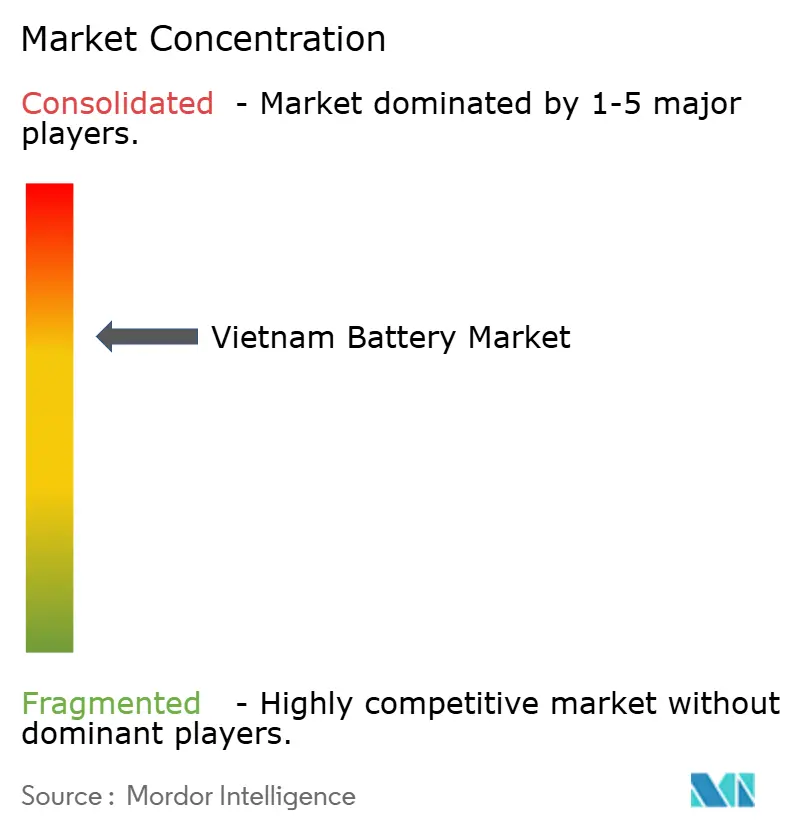
| Market Concentration | Medium |
Major Players *Disclaimer: Major Players sorted in no particular order Image © Mordor Intelligence. Reuse requires attribution under CC BY 4.0. | |
Vietnam Battery Market Analysis by Mordor Intelligence
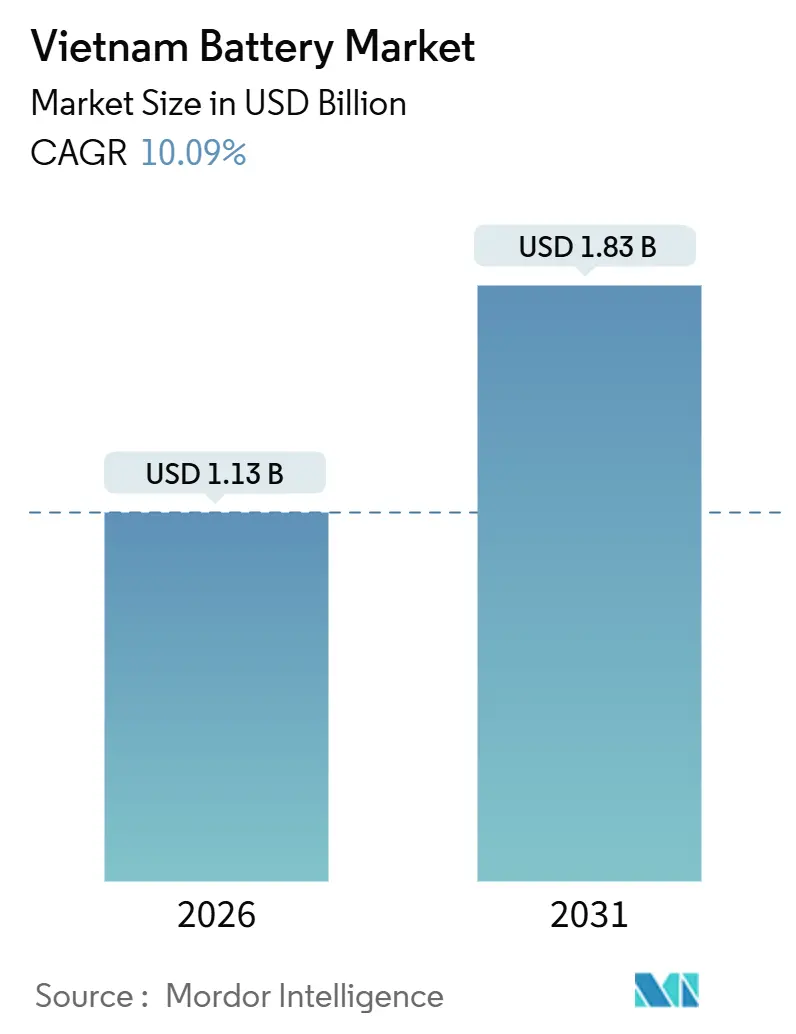
The Vietnam Battery Market size is estimated at USD 1.13 billion in 2026, and is expected to reach USD 1.83 billion by 2031, at a CAGR of 10.09% during the forecast period (2026-2031).
Momentum stems from surging electric-vehicle (EV) adoption, domestic conglomerates’ vertical-integration playbooks, and the government’s ambition to anchor regional battery manufacturing. Automakers led by VinFast delivered nearly 97,400 EVs in 2024, more than doubling the prior year and signaling robust lithium-ion uptake.[1] Investment announcements from LG Energy Solution and Gotion High-Tech underscore rising foreign interest, while 5G network densification and data-center expansion diversify demand beyond mobility. Yet the Vietnam battery market must overcome 80-100% import dependence for key raw materials and clarify revenue models for energy-storage systems before growth can be fully unlocked.[2]
Key Report Takeaways
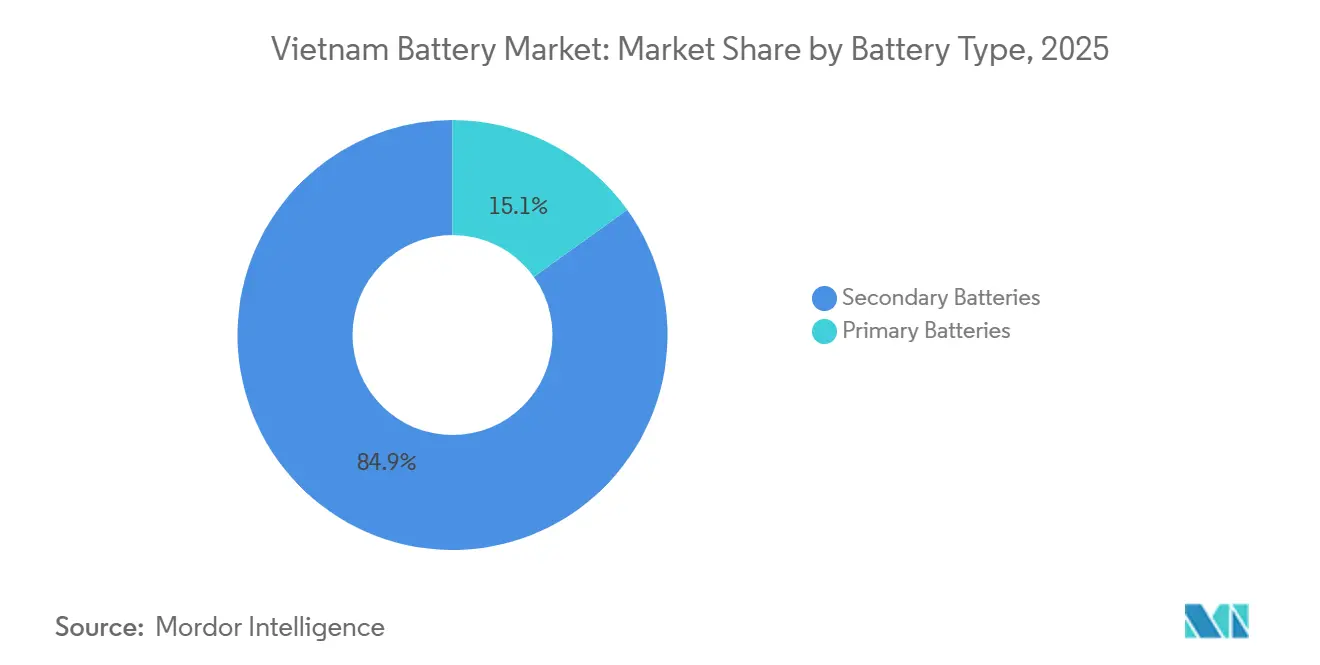
- By battery type, secondary rechargeable solutions held 84.9% of the Vietnam battery market share in 2025; primary cells trailed at 15.1% and are expanding at only 1.4% CAGR to 2031.
- By technology, solid-state platforms are forecast to post a 29.8% CAGR through 2031, while lithium-ion retained 55.2% of the Vietnam battery market share in 2025.
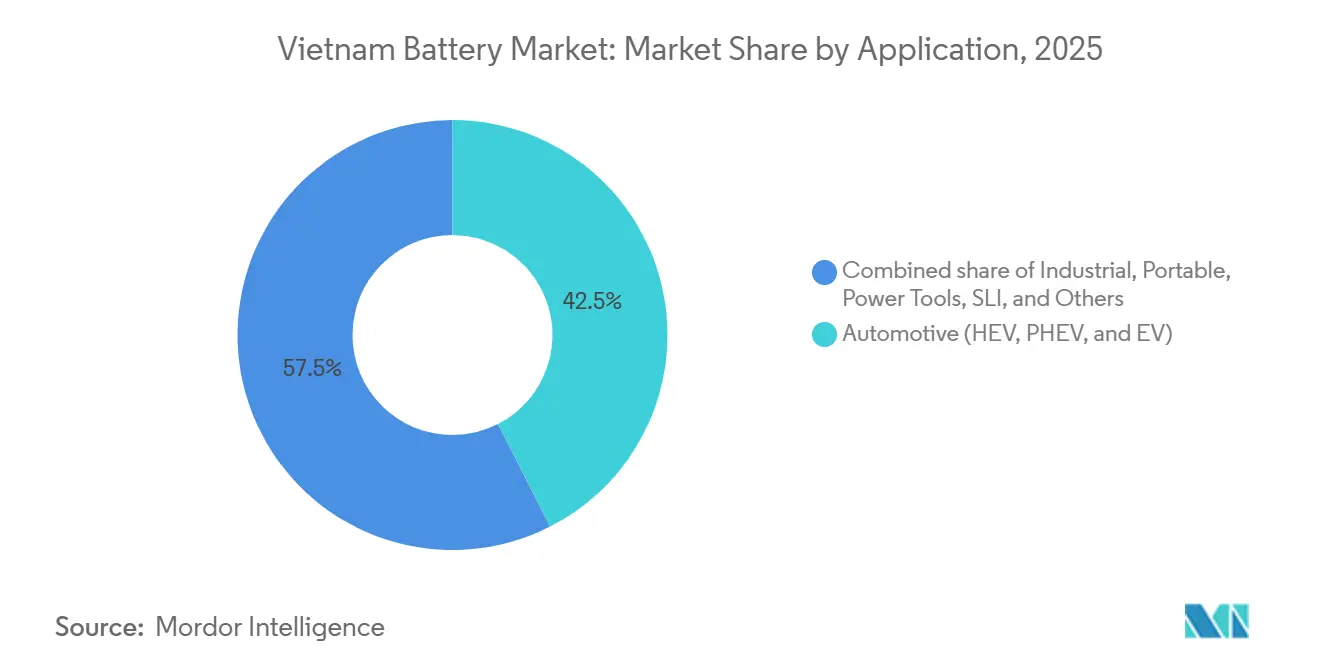
- By application, automotive captured 42.5% of the Vietnam battery market size in 2025 and is advancing at a 13.3% CAGR to 2031.
- VinES and its Gotion joint venture accounted for the single largest committed domestic EV-cell capacity at 5 GWh in 2025.
Note: Market size and forecast figures in this report are generated using Mordor Intelligence’s proprietary estimation framework, updated with the latest available data and insights as of January 2026.
Market Trends and Insights
Drivers Impact Analysis of Vietnam Battery Market*
| Driver | (~) % Impact on CAGR Forecast | Geographic Relevance | Impact Timeline |
|---|---|---|---|
| Declining lithium-ion cell prices | +2.1% | National, with stronger effect in price-sensitive e-motorcycle and industrial UPS segments | Medium term (2-4 years) |
| Surge in EV and e-bike adoption | +3.5% | National, concentrated in Hanoi and Ho Chi Minh City; spill-over to Da Nang and Can Tho | Short term (≤ 2 years) |
| Government incentives for local manufacturing | +1.8% | National, with priority zones in Ha Tinh, Hai Phong, and southern industrial corridors | Medium term (2-4 years) |
| Expansion of 5G and data-center back-up demand | +1.2% | Urban centers (Hanoi, Ho Chi Minh City) and coastal data-center hubs | Medium term (2-4 years) |
| VinFast/VinES vertical-integration investments | +2.3% | National, anchored by Ha Tinh cell plant and Hai Phong vehicle assembly | Short term (≤ 2 years) |
| Supply-chain diversification away from China | +1.6% | National, with cross-border logistics nodes in northern border provinces | Long term (≥ 4 years) |
| Source: Mordor Intelligence | |||
Declining Lithium-Ion Cell Prices
Pack costs for lithium-iron-phosphate systems slid under USD 100 per kWh in 2023, and global averages are poised to fall another 40% by 2030.[3] Material expenses dominate cell economics, so cheaper cathodes quickly translate into lower vehicle and storage prices. Vietnam’s e-motorcycle segment, already the world’s fourth largest, becomes price-competitive with 125 cc gasoline scooters once packs hit USD 80 per kWh, accelerating two-wheeler replacement. Industrial users see payback periods drop below three years when swapping valve-regulated lead-acid for lithium-ion, spurring uninterruptible-power-supply upgrades. Ho Chi Minh City’s plan to convert 400,000 motorcycles to electric propulsion starting in 2026 will test whether falling cell prices convert intent into mass adoption.
Surge in EV and E-Bike Adoption
Electric cars captured about 40% of new passenger-car sales in 2025, a level unrivaled in Southeast Asia and driven almost entirely by VinFast’s domestic ramp-up. Hanoi’s July 2026 ban on fossil-fuel motorcycles inside Ring Road 1 acts as a regulatory catalyst for two-wheeler electrification, while budget constraints postpone similar conversion in public bus fleets. Competition in e-motorcycles remains intense as Chinese brands such as Yadea battle local assemblers across battery-swap and plug-in architectures. Premium models deploy swappable lithium-ion packs, whereas ultra-low-cost options cling to lead-acid, bifurcating supply needs. Decision 876/QD-TTg further mandates 50% electrification of urban transport by 2030, solidifying long-term demand.[4]
Government Incentives for Local Manufacturing
Hanoi’s battery strategy links preferential tax, land-lease, and import-duty relief to projects in selected economic zones, notably Ha Tinh and Hai Phong. These carrots helped attract the 5 GWh VinES-Gotion lithium-iron-phosphate plant and sealed LG Energy Solution’s memorandum with Kim Long Motor targeting 1 GWh in Hue by mid-2026. Manufacturing incentives also stipulate localization ratios that push suppliers to build module and pack lines inside Vietnam. Policy clarity on battery waste and recycling under Circular 02/2022/TT-BTNMT, though nascent, signals a full-life-cycle orientation that appeals to multinationals under ESG scrutiny. If fully executed, fiscal levers could shave capital costs enough to offset raw-material import premiums.
VinFast/VinES Vertical-Integration Investments
VinES’ Ha Tinh cell complex underpins VinFast’s plan to surpass 200,000 EVs annually by 2027. The USD 2 billion funding pipeline from Vingroup illustrates a high commitment but concentrates volume risk in a single automaker. Pilot battery-energy-storage deployments at the Vinpearl resort showcase ambition to diversify revenue streams, although the absence of an ancillary-services market hampers returns. VinFast’s ProLogium tie-up aims to commercialize sulfide solid-state cells with 800 Wh per liter energy density by 2029, offering a local first-mover edge if timelines hold. Successful vertical integration could carve a defensible domestic supply chain, yet export penetration in North America and Europe remains an execution overhang.
Restraints Impact Analysis of Vietnam Battery Market*
| Restraint | % Impact on CAGR Forecast | Geographic Relevance | Impact Timeline |
|---|---|---|---|
| Reliance on pumped-hydro over BESS | -1.4% | National, with strongest effect in northern hydropower-rich provinces | Medium term (2-4 years) |
| Limited domestic raw-material base | -1.9% | National, affecting all lithium-ion cell and cathode production | Long term (≥ 4 years) |
| Stricter hazardous-waste regulations | -0.8% | National, with heightened enforcement in urban and industrial zones | Short term (≤ 2 years) |
| Grid-connection bottlenecks for large ESS | -1.1% | National, concentrated in provinces with high renewable penetration | Medium term (2-4 years) |
| Source: Mordor Intelligence | |||
Reliance on Pumped-Hydro Over BESS
Vietnam’s revised Power Development Plan VIII targets up to 16.3 GW of battery storage by 2030, yet historic preference for pumped-hydro keeps lithium-ion projects sidelined. Pumped-hydro’s longer discharge and multi-decade asset life appeal to planners, while lithium-ion’s sweet spot lies in short-duration frequency regulation. Electricity of Vietnam launched a 50 MW/50 MWh pilot in 2024 but has yet to publish standardized grid-connection codes for independent operators. Without a wholesale ancillary-services market, developers rely on time-of-use arbitrage alone, which seldom clears investment hurdles at USD 250–350 per kWh installed. Grid-scale deployment thus lags even as solar and wind curtailment rise in high-penetration provinces.
Limited Domestic Raw-Material Base
Vietnam boasts sizable nickel and graphite reserves yet lacks refinery throughput, resulting in near-total dependency on imported lithium compounds and cathode materials. Projected domestic demand of 46.9 GWh by 2030 will require roughly 9,400 t of lithium-carbonate equivalent and 23,500 t of cathode powders each year. Exposure to Chinese supply chains raises price and geopolitical risks. Extended producer responsibility rules under the Law on Environmental Protection 2020 and Circular 02/2022/TT-BTNMT mandate battery waste collection, yet hydrometallurgical recycling remains embryonic, limiting closed-loop material recovery. Absent upstream investments or offtake deals with Australian or Chilean miners, the Vietnam battery market stays a cell-assembly hub rather than a vertically integrated powerhouse.
*Our forecasts treat driver/restraint impacts as directional, not additive. The impact forecasts reflect baseline growth, mix effects, and variable interactions.
Vietnam Battery Market Segment Analysis
By Battery Type:
Rechargeables Dominate Amid EV SurgeSecondary rechargeable batteries held 84.9% of the Vietnam battery market share in 2025 and are expanding at an 11.5% CAGR through 2031, outstripping overall growth. The surge reflects VinFast’s volume ramp, e-motorcycle proliferation, and 5G tower upgrades shifting from lead-acid to lithium-ion. Industrial power-backup buyers now value 3,000-cycle life and reduced maintenance, nudging valve-regulated lead-acid out of telecom cabinets. T&T Group’s planned 2 GWh storage-products facility, scaling to 10 GWh, illustrates rising confidence in rechargeable demand.
Primary cells maintained a 15.1% foothold in 2025, concentrated in remote sensors, medical devices, and low-drain consumer goods, where shelf life trumps cycle costs. Yet the transition to USB-C charging and energy-harvesting IoT nodes caps growth. Rechargeable momentum implies incremental demand of nearly 8 GWh by 2031, pressuring domestic producers to secure cathode supply even as automotive volumes dominate. The Vietnam battery market size for rechargeables could therefore eclipse USD 1.5 billion by 2031 if localization targets hold.

By Technology:
Solid-State Disruption Looms Over Li-IonLithium-ion retained 55.2% share in 2025, but solid-state chemistries are set to post a blistering 29.8% CAGR, the highest among all platforms. Lead-acid still served 28% of demand in starter-lighting-ignition and industrial motive niches due to low capex and robust recycling streams. Nickel-metal hydride, nickel-cadmium, sodium-sulfur, and flow batteries together comprised less than 7%, confined to specialized use cases.
Solid-state’s advance hinges on ProLogium’s and SK On’s pilot lines that promise 800 Wh per liter energy density by 2029. Eliminating flammable liquid electrolytes addresses thermal-runaway risk, a critical safety differentiator for buses and high-capacity storage. Vietnam’s first solid-state volumes will likely feed VinFast's premium EV models, creating an early local demand anchor. The Vietnam battery market size for solid-state could approach USD 400 million by 2031 if commercialization timelines hold.
By Application:
Automotive Leads While Industrial StabilizesAutomotive captured 42.5% of the Vietnam battery market size in 2025 and is forecast to expand at a 13.3% CAGR through 2031, adding about 5 GWh in incremental demand. Hanoi’s fossil-fuel motorcycle ban inside Ring Road 1 and Ho Chi Minh City’s 400,000-unit conversion plan intensify two-wheeler consumption, while VinFast targets export growth. Industrial stationary batteries accounted for 35% of demand but trail with an 8% CAGR because energy-storage revenues remain policy-constrained. Portable electronics held an 18% share, growing 6% annually as foldable devices and AR wearables lift per-unit capacity despite mature smartphone penetration.
Power tools and residual starter-lighting-ignition segments combine for 5%, showing minimal expansion. The Vietnam battery market share weighted to automotive exposes the ecosystem to cyclical passenger-car swings and to VinFast’s export execution risk, underscoring diversification needs into industrial and grid segments once regulatory clarity improves.
Geography Analysis
Northern provinces led by Hanoi, Hai Phong, and Ha Tinh account for nearly two-thirds of Vietnam's battery market demand, anchored by VinFast’s vehicle line and VinES’ upcoming cell complex. Proximity to China’s Guangxi border enables just-in-time cathode and BMS imports but poses geopolitical exposure. Southern zones around Ho Chi Minh City supply consumer electronics packs yet lack major EV-cell commitments, although Google Cloud’s 2024 data-center launch stimulated lithium-ion UPS upgrades.
Central Vietnam, notably Hue and Da Nang, emerges as a secondary hub following LG Energy Solution’s collaboration with Kim Long Motor. Infrastructure gaps, including shallow-draft ports and intermittent grid reliability, limit scale for now. Rural Mekong Delta provinces lag due to sparse charging networks, though electric fishing vessels and agricultural machinery present niche opportunities if battery costs fall another 30% by 2028. Within ASEAN, Vietnam competes with Thailand’s USD 1.4 billion battery project pipeline and Indonesia’s nickel-anchored gigafactories. Local rare-earth reserves lend a future comparative advantage for motor magnet supply, but the absence of lithium resources keeps the country dependent on imports.
Regulatory Landscape
Vietnam is tightening market rules around EV batteries, grid storage, and end-of-life management while expanding demand-side incentives. For grid-connected storage, the Ministry of Industry and Trade (MOIT) issued Circular 62/2025/TT-BCT, effective January 26, 2026, setting a pricing framework for standalone battery energy storage systems (BESS) connected at 110 kV and above. The circular introduces a two-part payment structure (capacity and discharged energy) and caps the allowed IRR at 12%, addressing a key bankability gap for utility-facing BESS projects.
On technical compliance, Vietnam applies national safety standards across key battery use cases, including QCVN 101:2020/BTTTT for portable lithium batteries and TCVN 12503-3:2018 and TCVN 12241-3:2018 for lithium-ion traction batteries and cells used in road vehicles. Circular 02/2022/TT-BTNMT, under the Law on Environmental Protection 2020, reinforces extended producer responsibility and hazardous-waste obligations for battery collection and treatment. In March 2026, the Prime Minister issued Directive 09/CT-TTg to accelerate energy transition and EV development, including workstreams for battery recycling and recovery and the standardization of EV charging infrastructure.
Competitive Landscape
The Vietnam battery market hosts moderate fragmentation. Legacy lead-acid houses such as GS Battery Vietnam, PINACO, and Vision Group still dominate SLI and motive niches. In lithium-ion, Samsung SDI and Panasonic Energy operate consumer-electronics lines, while the VinES-Gotion joint venture commands the largest committed EV-cell capacity at 5 GWh. LG Energy Solution’s Hue pack project chases 80% localization to satisfy potential content rules tied to incentives.
Competitive dynamics bifurcate along technology. Multinationals invest in solid-state and high-nickel chemistries, seeking performance leadership. Domestic firms and Chinese entrants focus on cost-optimized lithium-iron-phosphate modules for e-motorcycles and distributed storage. White-space persists in grid-scale storage where no dominant supplier has emerged due to regulatory ambiguity. Early movers in flow or sodium-sulfur batteries could secure long-duration niches once ancillary-services pricing materializes.
Strategic moves in 2025 included LG Energy Solution’s MOU with Kim Long Motor, SK On’s pilot solid-state plant, and VinES’ pilot BESS deployment, all signaling a shift from import reliance toward local manufacturing depth. Market participants that accelerate R&D or secure upstream material supply will defend share as technology cycles compress.
Vietnam Battery Industry Leaders
-
Vision Group
-
PINACO
-
GS Battery Vietnam Co. Ltd
-
Leoch Battery Corporation
-
Heng Li (Vietnam) Battery Technology Co. Ltd
- *Disclaimer: Major Players sorted in no particular order
Vietnam Battery Market Companies Covered in this Report
- GS Battery Vietnam Co. Ltd
- PINACO
- Vision Group
- Leoch International Technology Ltd
- Saite Power Source (Vietnam) Co. Ltd
- Heng Li (Vietnam) Battery Technology Co. Ltd
- Ritar Power (Vietnam) Co. Ltd
- Tia Sang Battery JSC
- Eni-Florence Vietnam Co. Ltd
- Kung Long Batteries Industrial Co. Ltd
- VinES Energy Solutions JSC
- Panasonic Energy Vietnam
- Samsung SDI
- BYD Co. Ltd
- CATL
- Amara Raja Batteries
- Power Plus Technologies Vietnam
- EnerSys
- Exide Industries
- Furukawa Battery
Market Opportunities and Future Outlook
Policy and project activity are shifting Vietnam from a battery-import and pack-assembly market toward a broader mix that includes grid storage manufacturing, utility procurement, and more localized EV supply chains. Circular 62/2025/TT-BCT, effective January 26, 2026, sets out a pricing methodology for standalone BESS, which supports near-term contracting for grid-side and C&I projects. This is aligning with visible commissioning and procurement signals, including GG Power inaugurating a 5 GWh per year BESS factory in Hung Yen Province in April 2026 and a reported contract in June 2026 for a 110 MWh grid-side BESS with Northern Power Corporation (EVNNPC), pointing to demand pull from state-linked grid entities.
Opportunities also extend into multi-site urban deployments, critical infrastructure projects, and localization programs tied to EV and energy-transition targets. In July 2026, VinEnergo deployed a 50 MW/100 MWh BESS across five 110 kV substations in Hanoi, which illustrates a substation-level template for distributed storage. Outside the grid core, Jinko ESS deliveries of liquid-cooled storage systems for water infrastructure projects suggest additional municipal and industrial reliability use cases. In mobility, the market opening supports deeper localization of modules, packs, BMS, and thermal management to meet incentive conditions in priority zones such as Ha Tinh and Hai Phong, while recycling and recovery requirements under EPR frameworks create whitespace for domestic battery collection, diagnostics, and recycling as lithium-ion pack volumes rise.
Recent Industry Developments in Vietnam Battery Market
- July 2026: The Ministry of Industry and Trade issued Circular No. 18/2026/TT-BCT requiring imported lithium batteries and renewable energy storage systems to provide full original UL 9540A thermal runaway test data. The rule raises the compliance bar for imports and can reshape supplier qualification for ESS and lithium battery shipments into Vietnam. It also increases the advantage of suppliers with validated safety test packages and local partners that can manage documentation and conformity workflows.
- June 2026: HiTHIUM signed a three-year, 1 GWh supply agreement with Vietnam-based DSS Solar. The deal expands access to utility-scale and C&I storage products for EPCs and developers, supporting faster project execution as BESS commercialization moves beyond pilots. It also intensifies competitive pressure on incumbent lithium-ion suppliers and pack assemblers serving the storage segment.
- April 2026: GG Power inaugurated a battery energy storage system (BESS) factory in Hung Yen Province with 5 GWh of annual capacity. The commissioning adds in-country manufacturing capacity for storage products and supports localization objectives tied to Vietnam’s industrial policy for energy transition technologies. It strengthens supply availability for domestic C&I and grid-side deployments as pricing frameworks and utility procurements progress.
Vietnam Battery Market Report Scope and Research Methodology
Market Definition and Coverage
This market covers the total revenue generated from batteries sold for use in Vietnam across major end uses such as automotive, industrial, and portable devices. It includes both primary and rechargeable batteries across common chemistries where products are supplied into Vietnam demand.
Scope exclusions: It excludes upstream mining and refined raw materials, as well as standalone charging equipment and unrelated power electronics.
Segments Covered in This Report
- By Battery Type
- Primary Batteries
- Secondary Batteries
- By Technology
- Lead-acid
- Li-ion
- Nickel-metal hydride
- Nickel-cadmium
- Sodium-sulfur
- Solid-state
- Flow Battery
- Emerging chemistries
- By Application
- Automotive (HEV, PHEV, and EV)
- Industrial (Motive, Stationary (Telecom, UPS, ESS), etc.)
- Portable (Consumer Electronics, etc.)
- Power Tools
- SLI
- Other Applications
Data Sources, Market Sizing, and Validation
Desk Research
Desk work starts with building a clear demand story for Vietnam, so the model does not drift into global shipment assumptions. We review public sources such as Vietnam General Statistics Office releases, Vietnam Customs trade statistics, the Ministry of Industry and Trade updates, and EV and energy reports from the International Energy Agency.
To convert that demand story into measurable inputs, we also use sources such as World Bank macro indicators, UN Comtrade category guidance for cross checks, and peer reviewed journal articles on battery chemistries and performance trends. On top of this, company filings, investor presentations, and reputable local and international press help validate capacity announcements and timing. Where needed, we use a paid subscription focused on company financials and an import export shipment level database to sanity check pricing and trade direction. These examples are not exhaustive, and many other public sources were reviewed to collect data, validate numbers, and clarify assumptions.
Primary Interviews and Surveys
Primary work is used to pressure test what desk sources cannot fully explain, especially pricing moves, application mix shifts, and the real share of rechargeable demand. We interview and survey suppliers, distributors, integrators, and large end users across Vietnam, and insights are rechecked with industry specialists covering automotive batteries, industrial stationary uses, and portable device demand.
Distribution of primary research fieldwork respondents
| Company type | Respondent position |
|---|---|
| Top tier: 30% | CXOs: 14% |
| Mid tier: 54% | Functional/Unit leaders: 26% |
| Smaller Players: 16% | Managers: 60% |
Market-Sizing & Forecasting
For sizing, we start with a top-down build where Vietnam demand is reconstructed from application level adoption and replacement cycles, and then the totals are checked with selective bottom-up approximations. Those bottom-up checks include sampled price per unit times estimated volumes for key applications, plus channel checks on how much product moves through formal distribution versus direct supply.
Inputs used in the model are practical and traceable, and they are refreshed when better signals appear. Examples include EV and e-mobility penetration (especially two wheelers), vehicle parc and battery replacement frequency for SLI and traction uses, industrial back up power needs tied to telecom and data centers, import intensity by battery category, and average selling price progression by chemistry (lead-acid versus lithium-ion). When smaller product categories have weak public visibility, gaps are handled through conservative ranges and then narrowed using interview feedback.
Forecasting relies mainly on scenario analysis supported by simple regression checks, where the drivers are EV adoption, industrial electricity reliability needs, and expected price declines for lithium-ion packs. Assumptions are stress tested so growth does not jump faster than what capacity, trade flows, and adoption timelines can reasonably support.
Data Validation & Update Cycle
Validation is done through several passes so outliers are caught early and explained clearly. We compare the model outputs against independent signals such as Vietnam trade movements, macro demand indicators, and application level activity, and then we revisit any large variance before final sign off.
A second analyst review is used to verify formulas, units, and currency conversions, followed by a final consistency check across time series so growth rates stay realistic. Reports are refreshed annually, and interim updates are triggered when there are material events such as policy shifts, sudden pricing changes, or major capacity announcements. Before delivery, a fresh pass is completed so clients receive the latest updated view.
Mordor Intelligence's Vietnam Battery Market Size Compared With Other Published Estimates
Published market values for Vietnam batteries can look far apart because different authors draw the line around what is counted and which year is treated as the main reference point. In practice, the biggest gaps usually come from whether primary batteries are included, how broad the end use list is, and how pricing is converted into USD.
A second driver is the way demand is tied to real indicators. Some estimates lean heavily on trade value or a narrow EV linked view, while others blend volumes and prices across automotive, industrial, and portable uses and then smooth the forecast using different base case assumptions. When price decline curves for lithium-ion are applied too aggressively, or when lead-acid replacement demand is undercounted, the total can move sharply in either direction.
Benchmark comparison
| Source | Market Size | Gaps in Research Methodology |
|---|---|---|
| Mordor Intelligence | USD 1.13 B (2026) | |
| Energy Transition Program Report A | USD 0.30 B (2024) | The figure appears tied to an EV supply chain view and nearer term demand, which can exclude parts of industrial and portable usage, and it anchors on an earlier year that does not capture later adoption and pricing shifts. |
| Global Advisory B | USD 0.33 B (2024) | The scope shown is centered on a limited set of chemistries and applications, with a shorter forecast window, and it can miss broader technology coverage and later year growth that changes the total market value. |
The spread is mainly explained by the year used for the headline number and whether the market is treated as a broad battery demand pool across applications or a narrower slice linked to a few use cases. By keeping the application coverage wide and validating price and adoption assumptions against multiple signals, the 2026 value is positioned differently, a choice applied by Mordor Intelligence.
Key Questions Answered in the Report
How large is the Vietnam battery market in 2026?
The Vietnam battery market size stood at USD 1.13 billion in 2026.
Which battery technology is growing fastest in Vietnam?
Solid-state batteries are forecast to grow at nearly 30% annually to 2031, outpacing lithium-ion and lead-acid.
What share of Vietnam battery demand comes from automotive uses?
Automotive applications held 42.5% of market demand in 2025 and remain the largest single segment.
Why is raw-material supply a risk for Vietnamese battery makers?
Vietnam imports 80-100% of lithium and most cathode inputs, exposing producers to price volatility and geopolitical supply shocks.
What incentives exist for local battery manufacturing?
The government offers tax holidays, duty exemptions, and land-lease discounts in priority zones such as Ha Tinh and Hai Phong.
When will large-scale battery energy storage become viable?
Widespread deployment awaits clear ancillary-services pricing and standardized grid-connection rules, expected after 2027.