
Market Overview
| Study Period | 2021 - 2031 |
|---|---|
| Forecast Data Period | 2026 - 2031 |
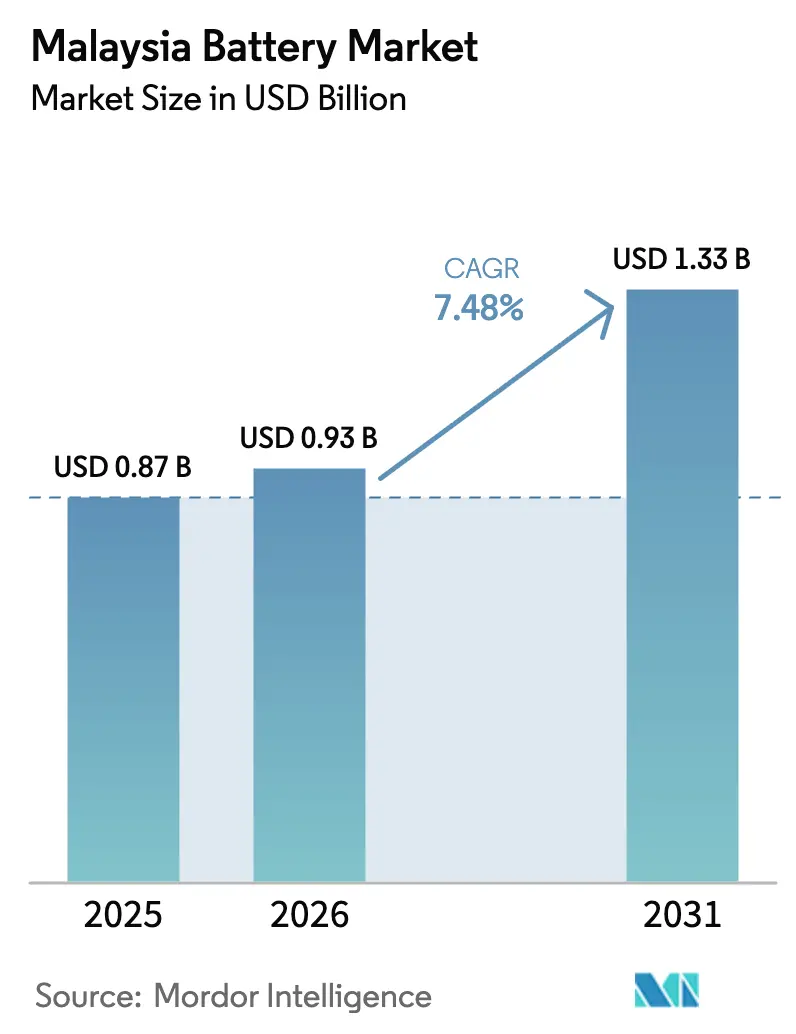
| Base Year Market Size (2025) | USD 0.87 Billion |
| Market Size (2026) | USD 0.93 Billion |
| Market Size (2031) | USD 1.33 Billion |
| Growth Rate (2026 - 2031) | 7.48 % |
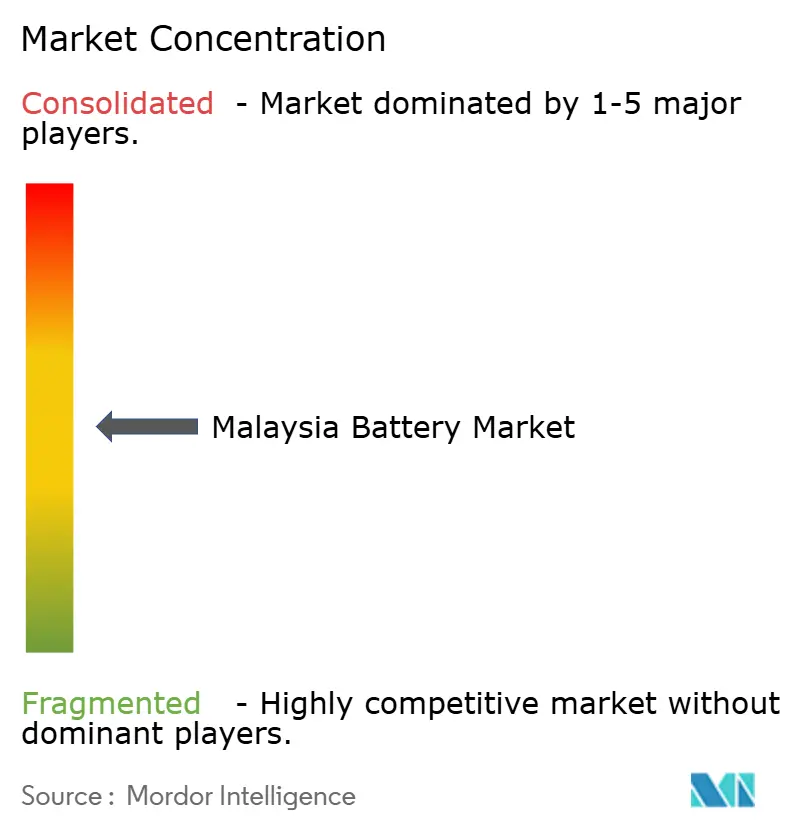
| Market Concentration | Medium |
Major Players/malaysia-battery-market---growth,-trends,-and-forecast-(2020---2025)_Companies_-_Malaysia_Battery.webp) *Disclaimer: Major Players sorted in no particular order Image © Mordor Intelligence. Reuse requires attribution under CC BY 4.0. | |
Malaysia Battery Market Analysis by Mordor Intelligence
The Malaysia Battery Market size is projected to expand from USD 0.87 billion in 2025 and USD 0.93 billion in 2026 to USD 1.33 billion by 2031, registering a CAGR of 7.48% between 2026 to 2031.
This trajectory stems from three structural shifts: mandatory battery energy storage adoption under the Solar ATAP framework that began in 2026, accelerating Chinese green-field cell manufacturing that leverages Malaysia’s tariff advantages, and rapid data-center buildouts that require high-reliability UPS solutions.[1]Malaysian Investment Development Authority, “Battery industry overview and incentives,” mida.gov.my Rising electric-vehicle (EV) registrations, grid-scale storage tenders, and foreign direct investment (FDI) inflows are rebalancing demand away from commodity lead-acid starting-lighting-ignition (SLI) units toward higher-value lithium-ion chemistries serving automotive, stationary, and industrial customers. Intensifying competition, together with overcapacity-driven price wars among Chinese manufacturers, exerts margin pressure on domestic assemblers but simultaneously widens downstream opportunities in pack integration, thermal management, and grid-service software. Malaysia’s dependence on imported lithium, cobalt, and nickel remains a supply-chain vulnerability, yet federal incentives under the National Energy Transition Roadmap encourage ecosystem buildout across Kedah, Johor, and Selangor, positioning the Malaysia battery market for multi-year growth.
Key Report Takeaways
- By battery type, secondary (rechargeable) batteries captured 88.1% of Malaysia's battery market share in 2025 and are forecast to grow at a 7.9% CAGR through 2031.
- By technology, lead-acid commanded 41.5% of the Malaysia battery market size in 2025, while solid-state batteries are expected to register the fastest 11.3% CAGR over 2026-2031.
- By application, automotive batteries held 44.6% of Malaysia's battery market share in 2025, and are projected to log the highest 8.8% CAGR to 2031.
- By geography, Kedah leads manufacturing capacity with EVE Energy's combined 10-15 GWh ESS expansion, whereas Johor is the fastest-growing deployment cluster, supported by a five-fold data-center pipeline increase to 2029.
- Panasonic Energy Malaysia, Samsung SDI, and GS Yuasa collectively accounted for roughly 25% of 2025 shipments, while new Chinese entrants added more than 9 GWh of announced capacity, intensifying rivalry in the Malaysia battery market.
Note: Market size and forecast figures in this report are generated using Mordor Intelligence’s proprietary estimation framework, updated with the latest available data and insights as of January 2026.
Malaysia Battery Market Trends and Insights
Drivers Impact Analysis*
| Driver | (~) % Impact on CAGR Forecast | Geographic Relevance | Impact Timeline |
|---|---|---|---|
| Declining lithium-ion battery prices | +1.2% | Global, import cost benefits nationwide | Medium term (2-4 years) |
| National Energy Transition Roadmap incentives for ESS | +1.8% | Peninsular grid zones | Long term (≥ 4 years) |
| Expansion of Malaysia’s data-center industry | +1.0% | Johor, Selangor growth corridors | Short term (≤ 2 years) |
| Net Energy Metering 4.0 boosting residential storage | +0.9% | Urban rooftop segments | Medium term (2-4 years) |
| Rapid growth of e-moped & e-scooter market | +0.6% | Urban logistics hubs | Short term (≤ 2 years) |
| Southeast Asia battery-manufacturing FDI inflows | +1.5% | Kedah and Johor industrial zones | Medium term (2-4 years) |
| Source: Mordor Intelligence | |||
Declining Lithium-Ion Battery Prices
Global lithium-ion pack costs averaged USD 108 per kWh in 2025, down 8% year-on-year despite volatile raw-material inputs. Stationary storage packs fell to USD 70 per kWh, slashing levelized costs for solar-plus-storage projects in Malaysia's commercial and industrial (C&I) sector. While falling prices compress margins for domestic cell assemblers, they expand addressable use-cases in off-grid telecom towers, industrial microgrids, and behind-the-meter systems. China's USD 84 per kWh average, 48% lower than Europe's, amplifies competitive pressure on Malaysian producers that lack scale efficiencies.[2]Anu Bhambhani, “Battery Pack Prices Hit New Low in 2025,” TaiyangNews, taiyangnews.info The IEA foresees a further 40% global decline by 2030, implying future Malaysia battery market competitiveness will hinge more on system integration and software than on cell costs.[3]International Energy Agency, “Batteries and Secure Energy Transitions,” iea.org
National Energy Transition Roadmap Incentives for ESS
Malaysia’s roadmap targets 70% renewable capacity by 2050 and underwrites a 500 MW BESS roll-out by 2030. The Solar ATAP framework, live since January 2026, mandates storage integration for large-scale solar and community projects, while SELCO guidelines require batteries for rooftop systems above 72 kWp. Tenaga Nasional Berhad’s MyBEST tender for 400 MW/1,600 MWh signals a shift from pilots to bankable procurement, yet capacity-payment mechanisms remain undefined, tempering private capital appetite. Early grid projects in Sarawak and Sabah validate technical viability but underscore reliance on multilateral financing.
Expansion of Malaysia’s Data-Centre Industry
Google’s USD 2 billion and Microsoft’s USD 2.2 billion hyperscale commitments are driving megawatt-scale UPS demand. Each megawatt of IT load requires roughly 1.5-2 MWh of backup storage to achieve 99.995% uptime, catalyzing lithium-ion adoption over VRLA solutions. Gold Peak Technology’s USD 150 million Johor plant, slated for 2028 operations, targets this UPS niche, betting on lower lifecycle costs and higher energy density. The technology shift spawns a bifurcated replacement market: legacy VRLA suppliers defend installed bases, while lithium-ion specialists secure greenfield buildouts.
Net Energy Metering 4.0 Boosting Residential Storage
The Solar ATAP program supersedes Net Energy Metering 3.0 and explicitly permits behind-the-meter storage. High-income households in Klang Valley and Penang are early adopters of 5-10 kWh lithium-ion systems despite payback periods above seven years, whereas middle-income segments await financing innovations. Newly published SIRIM safety standards favor certified brands and raise barriers for uncertified imports. Absent subsidies, community storage models are gaining traction in newly planned townships, although regulatory clarity on virtual net metering is still evolving.
Restraints Impact Analysis*
| Restraint | (~) % Impact on CAGR Forecast | Geographic Relevance | Impact Timeline |
|---|---|---|---|
| Limited domestic raw-material supply chain | -0.8% | Nationwide | Long term (≥ 4 years) |
| High upfront cost of stationary storage for households | -0.5% | Residential segments | Medium term (2-4 years) |
| Policy-continuity uncertainty in EV incentives | -0.7% | Automotive demand | Short term (≤ 2 years) |
| Influx of low-cost Chinese battery imports | -0.6% | Price-sensitive channels | Short term (≤ 2 years) |
| Source: Mordor Intelligence | |||
Limited Domestic Raw-Material Supply Chain
Malaysia lacks lithium, cobalt, and nickel refining at battery-grade purity, forcing manufacturers to import precursor materials primarily from China, Australia, and Indonesia. Secondary lead stocks are plentiful but largely below 99.97% purity, limiting usefulness for valve-regulated lead-acid upgrades. Rising ESG compliance costs and dependence on volatile commodity markets heighten supply-chain risk and reduce cost competitiveness relative to Chinese imports.
High Upfront Cost of Stationary Storage for Households
Residential BESS units cost RM 20,000-25,000 (USD 4,500-5,600), translating to 7-10-year payback periods at Malaysia’s flat residential tariffs of RM 0.40-0.50 per kWh. Absence of grants or low-interest loans limits adoption to affluent early adopters. Although community storage models promise cost sharing, regulatory gaps on third-party ownership and revenue splitting constrain rollout.
*Our forecasts treat driver/restraint impacts as directional, not additive. The impact forecasts reflect baseline growth, mix effects, and variable interactions.
Segment Analysis
By Battery Type: Rechargeable Dominance Accelerates
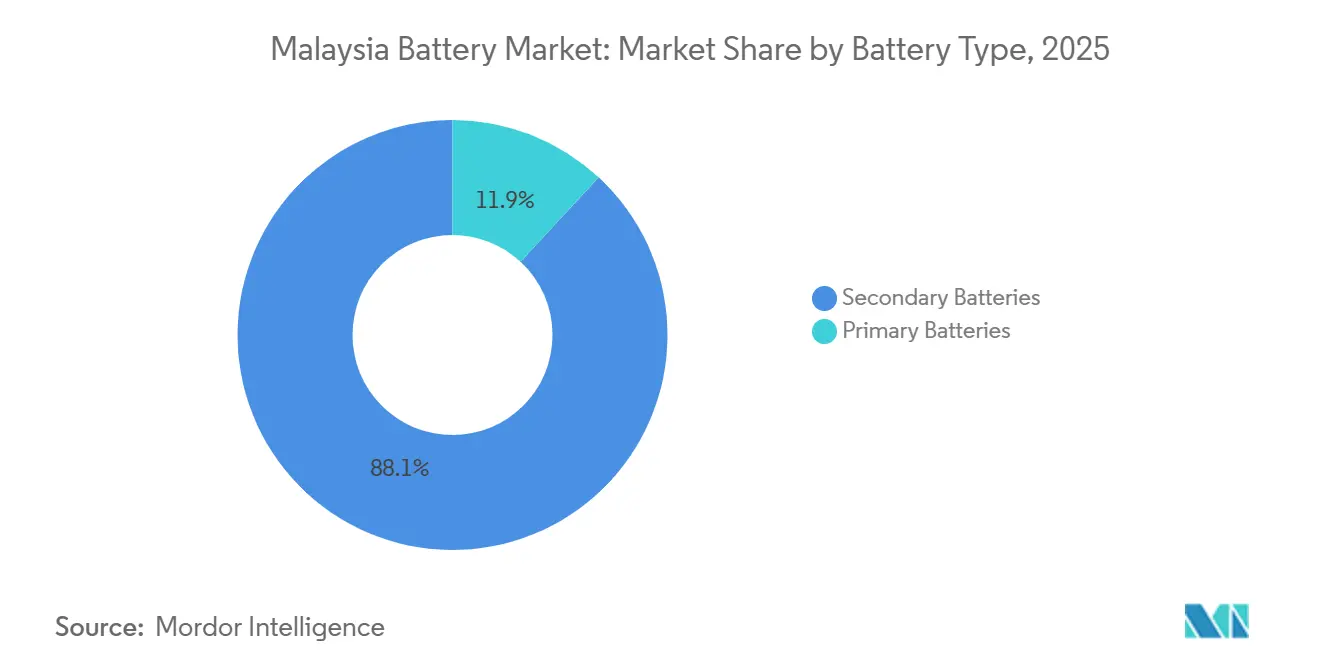
Secondary batteries held 88.1% of Malaysia's battery market share in 2025 and are forecast to grow at a 7.9% CAGR, buoyed by EV uptake, grid-scale mandates, and industrial motive replacements. Primary batteries retain 11.9% share, confined to remote sensors and medical devices. The National Energy Transition Roadmap and Solar ATAP program anchor demand for rechargeable systems, while EVE Energy's CNY 8.654 billion Phase 2 ESS investment exemplifies the scale economics needed to serve domestic and export customers. Primary battery innovation focuses on shelf-life and eco-chemistry tweaks, underscoring a structural pivot toward rechargeables.



By Technology: Lead-Acid Incumbency Meets Solid-State Disruption
Lead-acid commanded 41.5% of the Malaysia battery market size in 2025, underpinned by aftermarket SLI demand and cost-sensitive industrial fleets. Solid-state batteries, though nascent, are expected to record the fastest 11.3% CAGR through 2031 as pilot lines target 390-560 Wh/kg energy densities. Lithium-ion chemistries continue to capture incremental demand, with Samsung SDI’s USD 1.3 billion Seremban Plant 2 producing PRiMX 21700 cells and evaluating 4680 formats for potential Tesla supply. NiMH holds residual presence in non-plug-in hybrids, while NaS and flow batteries remain in pilot phases.
By Application: Automotive Batteries Lead, Industrial Diversifies
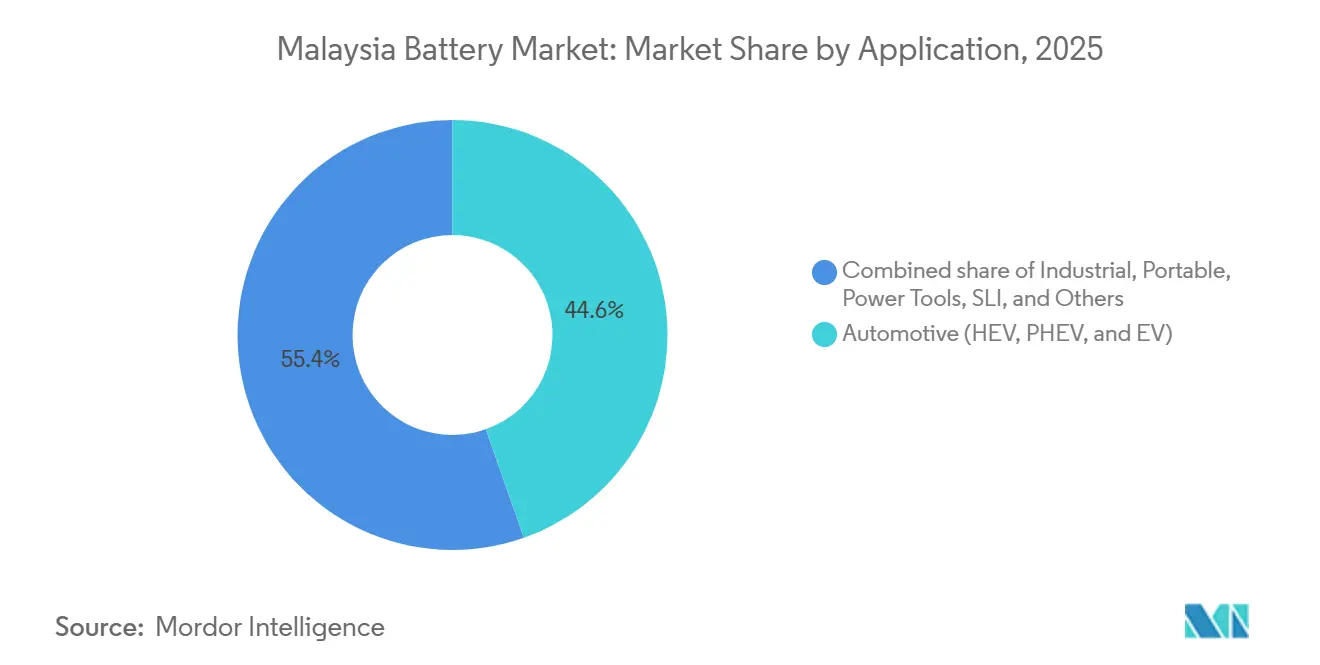
Automotive batteries represented 44.6% of Malaysia's battery market share in 2025 and are projected to clock an 8.8% CAGR to 2031, contingent on post-2025 incentive clarity. Industrial stationary segments, backed by data-center UPS and grid BESS projects, form the fastest-expanding non-automotive category. Portable consumer electronics face commoditization, prompting producers to pivot toward higher-margin silicon-anode cells for wearables, as exemplified by Enovix's USD 1.2 billion facility.[4]Malaysian Investment Development Authority, “EVE Energy Phase 2 expansion details,” mida.gov.my Power-tool demand benefits from EVE Energy's 680 million-cell annual output, supplying global OEMs.
Geography Analysis
Peninsular Malaysia dominates manufacturing, with Kedah hosting EVE Energy’s twin-phase gigafactory and Shenzhen Senior Technology Material’s separator line. Johor attracts UPS-centric lithium-ion investments linked to hyperscale data centers, while Selangor remains the legacy hub for Panasonic and Samsung SDI. East Malaysia’s Sabah and Sarawak focus on grid-scale storage installations, such as the 60 MW/80 MWh Sejingkat BESS and the 100 MW/400 MWh Sungrow project, illustrating regional renewable integration needs. Perak’s ascendance as an EV assembly node through BYD’s 150-acre plant suggests future pack-integration spillovers. Geographic dispersion creates logistics inefficiencies as cells produced in Kedah and Johor are shipped to Borneo, adding up to 7% to landed project costs.
Regulatory Landscape
Battery and energy storage products in Malaysia fall under electrical-equipment safety and grid-connection oversight led by the Energy Commission (Suruhanjaya Tenaga, ST). Under the Electricity Regulations 1994 and ST's Guidelines for the Approval of Electrical Equipment (2024 edition), relevant battery systems and associated power electronics generally require ST approval and compliance labeling through the ST-SIRIM framework before products can be placed on the market, which raises the compliance bar for imported and locally assembled solutions.
From 2026, policy and standards actions tightened for both stationary storage and electrified mobility. ST issued dedicated Guidelines on Battery Energy Storage System (BESS) Safety (May 2026), moving market practice toward formal safety engineering, installation controls, and inspection readiness for grid-scale and behind-the-meter projects. Separately, the Department of Standards Malaysia (JSM) and MITI launched MS 2818 (Battery Passport for Electrified Vehicles) in November 2025, anchoring lifecycle traceability requirements that affect EV battery supply chains and documentation practices alongside evolving EV import and local-assembly directives.
Value Chain Analysis
Malaysia relies on imported upstream inputs (battery-grade lithium, nickel, cobalt and processed precursors), while developing midstream and downstream capabilities around cell manufacturing, pack integration, and energy-storage systems for utilities and commercial users. Manufacturing and conversion activities concentrate in Peninsular clusters (notably Kedah and Selangor), where established E&E supply chains, industrial parks, and investment facilitation by MIDA support electrode materials, separators, cells, modules, and balance-of-system components. Downstream demand is pulled by automotive electrification, data-center UPS deployments in growth corridors, and grid-scale BESS procurement programs.
The operating model is increasingly project-led for stationary storage. Developers, EPCs, system integrators, and software/BMS providers assemble bankable offerings around utility tenders and large C&I sites, while logistics providers move cells and modules to final assembly and installation locations nationwide, including East Malaysia for selected grid projects. Competitive pressure from low-cost imports increases the importance of certification, quality assurance, and service networks in distribution and aftermarket channels, and industrial policy signals under NETR and NIMP 2030 reinforce local value capture across materials, manufacturing services, and recycling-related adjacencies.
Competitive Landscape
The Malaysia battery market is moderately fragmented. Incumbent Japanese and South Korean firms leverage long-term OEM contracts, vertical integration, and certification pedigrees to defend market share. Chinese entrants deploy modular gigafactories, achieving record 16-month commissioning cycles that undercut traditional timelines. Domestic lead-acid players compete on distribution density but face import-driven price compression. Strategic moves in 2025 include Samsung SDI’s pilot run of 4680 cells, EVE Energy’s Phase 2 ESS expansion, and Gold Peak’s Johor UPS plant announcement. Second-life battery integrators and BMS developers represent emerging niches with lower capital intensity and potential for local value capture.
Malaysia Battery Industry Leaders
Panasonic Energy Malaysia Sdn Bhd
Samsung SDI Energy Malaysia Sdn Bhd
GS Yuasa Corporation
FIAMM Energy Technology SpA
Yokohama Batteries Sdn Bhd
- *Disclaimer: Major Players sorted in no particular order

Market Opportunities and Future Outlook
Utility procurement and safety standardization are creating clearer commercialization pathways for grid-scale and large C&I battery systems. MyBeST acts as an anchor for bankable projects, including a 400 MW/1,600 MWh tranche with bidders shortlisted (December 2025), and the commissioning and grid connection of the 100 MW/400 MWh Santong BESS in Terengganu (inaugurated May 2026) shows progression from pilots to operational assets in Peninsular Malaysia. These developments expand whitespace for EPC and system-integration services, including BMS, EMS, thermal management, commissioning, O&M, and performance guarantees, that local players can package alongside imported cells.
Upstream and midstream localization in Kedah is also broadening, supporting a more integrated battery ecosystem beyond cell assembly. Novolyte Technology's electrolyte facility groundbreaking at Kulim Hi-Tech Park (January 2026, 30,000 metric tons capacity cited) and Putailai's anode material plant groundbreaking at Gurun Industrial Park (June 2026, 50,000 tonnes per annum cited) point to a maturing materials cluster that can reduce lead times and improve supplier optionality for Malaysian cell and pack producers. In parallel, electrified-vehicle governance, including the MS 2818 battery passport (November 2025) and revised import criteria announced by MITI in 2026, increases demand for traceable, certified batteries and documentation-ready supply chains, favoring manufacturers and integrators that can meet auditability and compliance requirements across automotive and stationary applications.
Recent Industry Developments
- July 2026: MITI implemented revised criteria for imported (CBU) electric vehicles, including minimum CIF value and performance thresholds, while maintaining incentives for locally assembled (CKD) models. The update supports localization of EV assembly and associated battery-pack supply chains, shifting procurement focus toward compliant, Malaysia-based manufacturing and integration partners.
- May 2026: The Energy Commission (Suruhanjaya Tenaga, ST) issued Guidelines on Battery Energy Storage System (BESS) Safety, formalizing expectations for design, installation, and operational safety for stationary storage. This strengthens bankability for grid and large C&I projects by standardizing compliance and raising entry requirements for uncertified equipment and installers.
- November 2025: The Department of Standards Malaysia (JSM) and MITI launched MS 2818, a battery passport standard for electrified vehicles, to promote lifecycle traceability. The standard pushes OEMs and suppliers to upgrade data capture and documentation across battery sourcing, manufacturing, and end-of-life handling, shaping supplier selection beyond price.


Research Methodology Framework and Report Scope
Market Definition and Coverage
For this study, the Malaysia battery market is defined as the value of batteries sold for use in Malaysia across key end uses, covering primary and rechargeable formats and the main chemistries used in the country.
Scope exclusions: We exclude chargers, battery management electronics sold as standalone items, and upstream raw materials unless they are priced and sold as part of a finished battery unit.
Segmentation Overview
- By Battery Type
- Primary Batteries
- Secondary Batteries
- By Technology
- Lead-acid
- Li-ion
- Nickel-metal hydride
- Nickel-cadmium
- Sodium-sulfur
- Solid-state
- Flow Battery
- Emerging chemistries
- By Application
- Automotive (HEV, PHEV, and EV)
- Industrial (Motive, Stationary (Telecom, UPS, ESS), etc.)
- Portable (Consumer Electronics, etc.)
- Power Tools
- SLI
- Other Applications
Data Sources, Market Sizing, and Validation
Desk Research
Desk work starts by locking down the market boundary and the demand signals that can be checked in public data. We leaned on official and non-paywalled sources such as the Department of Statistics Malaysia, the Royal Malaysian Customs Department trade statistics, Malaysia Investment Development Authority announcements, and energy publications from the International Energy Agency and IRENA for storage and renewables context. For automotive direction and local industrial activity, we also reviewed relevant releases from the Ministry of Transport Malaysia and Malaysia Automotive Robotics and IoT Institute, where available.
Next, we used listed company annual reports, investor presentations, and reputable local and international press to understand capacity additions, battery plant activity, and large project timelines (including grid support and data center build-outs). A paid subscription for company financials and news helped standardize revenue line items and confirm corporate actions without relying on a single document. The sources named here are illustrative only, and we used additional public materials to collect data, validate assumptions, and clarify market context.
Primary Interviews and Surveys
To pressure test the desk assumptions, we spoke with a mix of battery makers, distributors, recyclers, and large end users that procure batteries for automotive, industrial, and backup power needs. Interviews were used to confirm how volumes move through channels, how prices change by chemistry and form factor, and which applications are gaining share in Malaysia. When gaps showed up, follow-ups were done to align definitions (for example, whether SLI replacement demand was counted with industrial sales or kept separate).
Distribution of primary research fieldwork respondents
| Company type | Respondent position |
|---|---|
| Top tier: 28% | CXOs: 13% |
| Mid tier: 56% | Functional/Unit leaders: 41% |
| Smaller Players: 16% | Managers: 46% |
Market-Sizing & Forecasting
Sizing is built with a top-down demand pool that is reconstructed from application-level indicators in Malaysia, and then checked against practical supply-side signals. For example, we map battery consumption across SLI replacement, industrial motive and stationary uses, and portable demand, and then align totals with trade direction and local manufacturing activity.
Key inputs used in the model include vehicle parc and replacement behavior for lead-acid SLI, EV adoption and battery pack penetration for lithium-ion, installed and planned renewable capacity that drives storage demand, data center and telecom backup requirements linked to UPS deployments, and chemistry mix shifts that influence average selling prices. Where data is patchy, a conservative range is applied and then narrowed using interview feedback and channel checks.
Forecasts rely on scenario analysis supported by a light multivariate view, where adoption rates, price movement by chemistry, and major project timelines are the main levers. The model is not treated as fully bottom-up, but selective roll-ups (sampled volumes multiplied by typical prices, plus distributor splits) are used to confirm that the final totals remain realistic.
Data Validation & Update Cycle
Validation is done through multiple passes that compare the output against independent signals, such as import and export direction, announced capacity changes, and end-use growth markers in automotive and power systems. If a segment moves outside expected ranges, the assumptions are revisited, and we re-check definitions and unit conversions before sign-off.
Before a report is finalized, the model and key assumptions go through an internal review, and outliers are challenged with a short list of evidence that can be traced back to sources or interview notes. Reports are refreshed annually, and interim updates are made when material events occur, such as major plant announcements, policy shifts, or sharp commodity-driven price movements. Right before delivery, we complete a final pass so clients receive an up-to-date view.
Mordor Intelligence's Malaysia Battery Market Size Compared With Other Published Estimates
Different publishers often arrive at different market sizes for Malaysia batteries because they draw the line around included battery categories in different ways, and they also use different price and volume signals to build the total. Timing also matters, since battery pricing can shift quickly and a small change in chemistry mix can move the final value.
By tracking application-level volumes and refreshing price and chemistry assumptions through interviews, Mordor Intelligence keeps the Malaysia battery total tied to primary and rechargeable batteries used in-country rather than counting adjacent power equipment, installation work, or upstream materials. The spread across estimates is usually driven by whether imported packs are treated as complete batteries at the border, how SLI replacement demand is converted from vehicle parc into units, and whether faster EV and grid storage ramps are assumed without checks against project pipelines and trade direction.
Benchmark comparison
| Source | Market Size | Gaps in Research Methodology |
|---|---|---|
| Mordor Intelligence | USD 0.87 B (2025) | |
| Global Research Publisher A | USD 1.31 B (2024) | Uses a different base year and appears to apply broader application mapping (including large backup power demand) with limited clarity on whether non-battery components and services are included, which can lift the value versus a battery-only boundary. |
| Industry Report House B | USD 1.70 B (2025) | Uses an EV battery supply chain lens that can include value chain activities beyond finished batteries, and it also leans on faster growth assumptions tied to manufacturing hub plans that are not clearly reconciled with near-term consumption signals. |
When the scope is held to batteries sold for use in Malaysia and the pricing logic is linked to chemistry and end-use mix, the market size typically falls into a tighter range that is easier to audit. The table shows that wider value chain inclusion, base-year differences, and aggressive ramp assumptions are the main reasons totals can move away from what can be repeatedly checked using demand indicators and trade signals.


Key Questions Answered in the Report
What is the current value of the Malaysia battery market?
The market was valued at USD 0.93 billion in 2026 and is forecast to reach USD 1.33 billion by 2031.
How fast is the lithium-ion segment growing in Malaysia?
Lithium-ion demand is rising alongside EV sales and grid-scale projects, contributing to a 7.9% CAGR forecast for rechargeable batteries through 2031.
Which state hosts the largest battery manufacturing investments?
Kedah leads, anchored by EVE Energy's multi-phase gigafactory and Shenzhen Senior Technology Material's separator plant.
What policy changes shape stationary storage adoption?
The Solar ATAP framework effective in 2026 mandates BESS for large solar systems and introduces community storage requirements.
How will the expiry of EV tax incentives affect battery demand?
If duty exemptions lapse without replacement after December 2025, short-term EV and battery demand could dip, but local assembly incentives may cushion the impact.
Which companies dominate UPS batteries for data centers?
Gold Peak Technology, Samsung SDI, and GS Yuasa are leading suppliers, with new lithium-ion modules optimized for high-availability data-center architectures.
Page last updated on:




