
Health Insurance Market Size and Share
Market Overview
| Study Period | 2020 - 2031 |
|---|---|
| Market Size (2026) | USD 2.14 Trillion |
| Market Size (2031) | USD 3.11 Trillion |
| Growth Rate (2026 - 2031) | 7.76 % |
| Fastest Growing Market | Asia-Pacific |
| Largest Market | North America |
| Market Concentration | High |
Major Players *Disclaimer: Major Players sorted in no particular order Image © Mordor Intelligence. Reuse requires attribution under CC BY 4.0. | |
Health Insurance Market Analysis by Mordor Intelligence
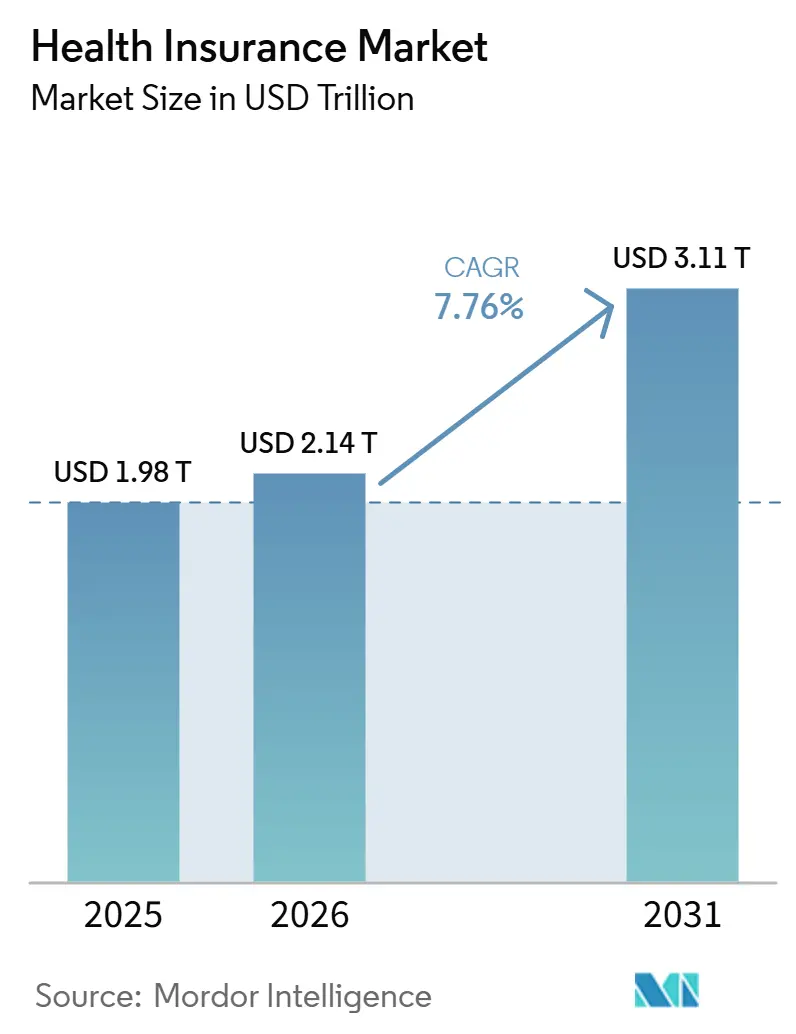
The Health Insurance Market size was valued at USD 1.98 trillion in 2025 and is estimated to grow from USD 2.14 trillion in 2026 to reach USD 3.11 trillion by 2031, at a CAGR of 7.76% during the forecast period (2026-2031).
The health insurance market continues to expand because public health systems in many countries face funding constraints, pushing individuals, employers, and governments toward private coverage to close access gaps. Medical costs remain elevated, which supports premium growth even as insurers face pressure on claims spending and operating margins. The health insurance industry also benefits from the steady role of employer-sponsored coverage, which still anchors large premium pools in developed economies while direct purchase models widen access in emerging markets. Digital enrollment, claims automation, and embedded distribution are changing how insurers compete, especially in areas where coverage penetration remains low and self-service models can reduce acquisition costs. Affordability pressure remains the main check on growth in the health insurance market because premium increases can weaken enrollment among lower-income and younger consumers, especially in unsubsidized individual plans.
Key Report Takeaways
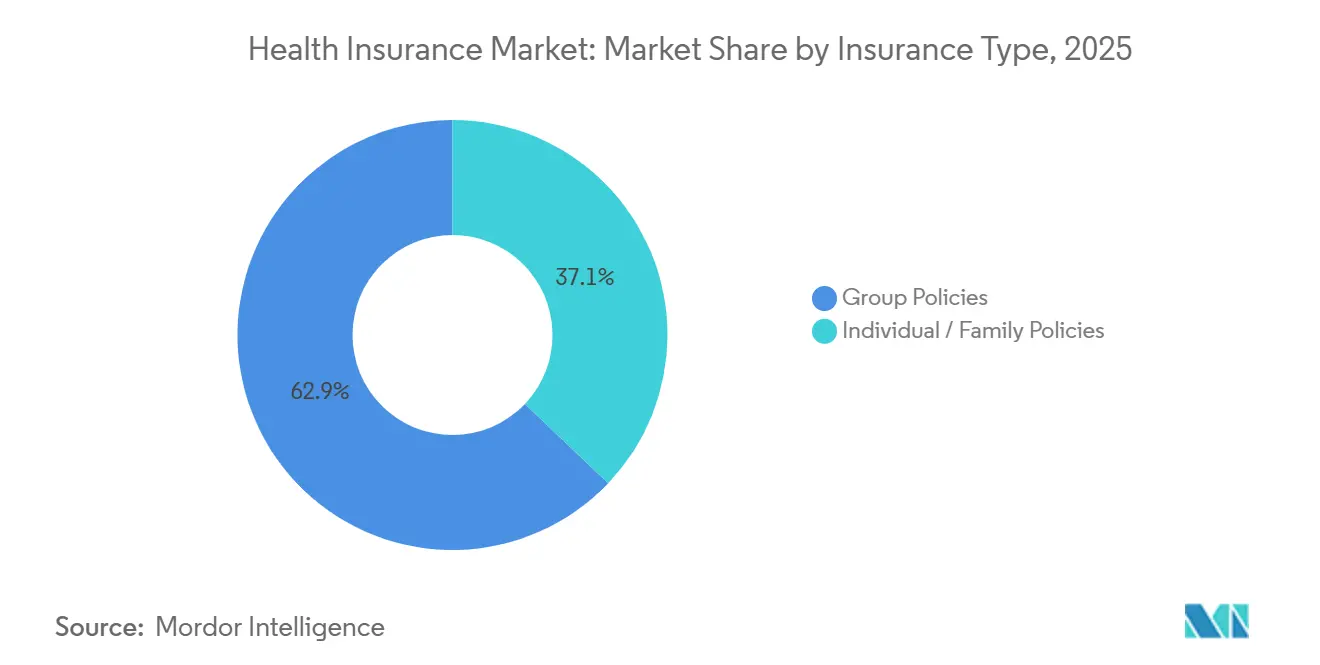
- By insurance type, group policies accounted for 62.9%of the health insurance market share in 2025, while individual and family policies are projected to grow at a 9.1% CAGR through 2031.
- By scheme type, voluntary health insurance accounted for 86.7% of the global health insurance market share in 2025, and is projected to grow at a 8.2% CAGR through 2031.
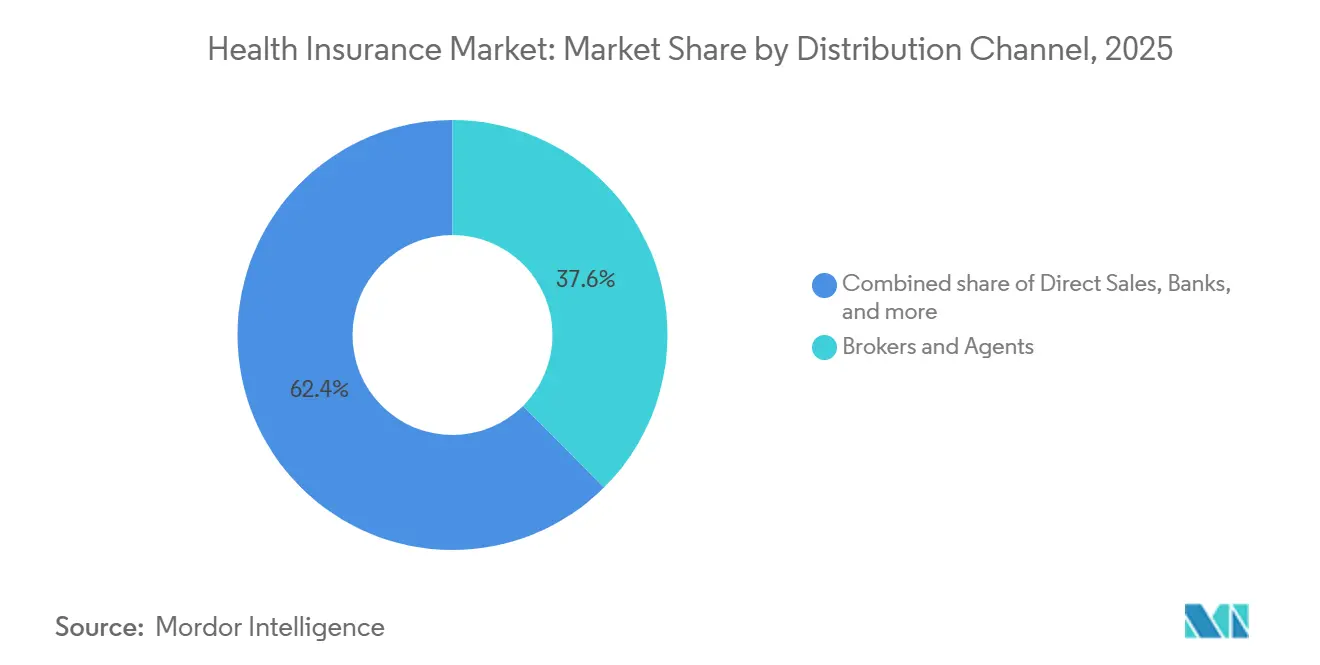
- By distribution channel, brokers and agents accounted for 37.6% of the health insurance industry share in 2025, while online platforms are projected to grow at 13.7% CAGR through 2031.
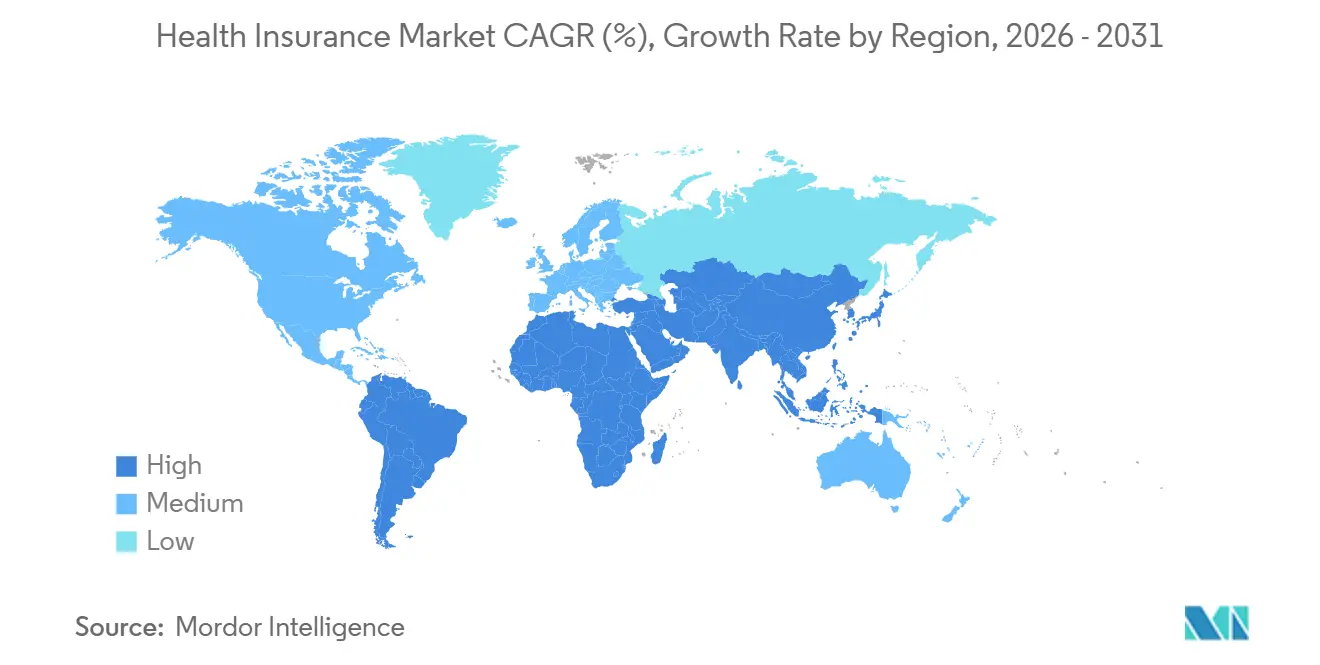
- By geography, North America held 54.4% of the health insurance market share in 2025, while the Asia-Pacific is projected to grow at 11.4% CAGR through 2031.
Note: Market size and forecast figures in this report are generated using Mordor Intelligence’s proprietary estimation framework, updated with the latest available data and insights as of January 2026.
Market Trends and Insights
Drivers Impact Analysis of Health Insurance Market*
| Driver | (~) % Impact on CAGR Forecast | Geographic Relevance | Impact Timeline |
|---|---|---|---|
| Employer Sponsored Coverage Expansion | +1.2% | Global, concentrated in North America and the Asia-Pacific corporate corridors | Medium term (2-4 years) |
| Claims Automation Adoption | +0.9% | Global, with early gains in North America, Western Europe, and urban Asia-Pacific | Short term (≤ 2 years) |
| Chronic Disease Prevalence Growth | +1.4% | Global, pronounced in North America, South Asia, and Southeast Asia | Long term (≥ 4 years) |
| Regulatory Coverage Expansion | +1.1% | GCC mandates, Asia-Pacific government programs, and the EU harmonization | Medium term (2-4 years) |
| Rising Outpatient Cost Inflation | +0.8% | Global, with a stronger effect in Asia-Pacific, and Latin America | Short term (≤ 2 years) |
| Embedded Distribution Partnerships | +0.7% | Asia-Pacific, Southeast Asia, East Africa, and Europe | Medium term (2-4 years) |
| Source: Mordor Intelligence | |||
Employer-Sponsored Coverage Expansion
Employer-sponsored coverage remains one of the strongest supports for the health insurance market because it gives carriers access to large, recurring premium pools and stable renewal cycles. The Business Group on Health reported that employers projected a median healthcare cost trend of 9% for 2026, which narrowed to 7.6% after benefit design changes, indicating that employers are actively managing health benefits rather than absorbing higher costs without intervention[1]. KFF reported in March 2025 that employer-sponsored health insurance covered 165.6 million people under age 65, which confirms the continued scale of this channel in the United States. KFF also showed a wide gap in access: only 60% of lower-paid workers were employed by firms offering a plan, compared with more than 80% of higher-paid workers, leaving room for supplemental and voluntary products to fill unmet demand. In the health insurance market, carriers that can support self-funded employers with data access, pharmacy integration, and measurable outcomes are better positioned to hold group accounts as benefit decisions become more cost-sensitive.
Claims Automation Adoption
Claims automation has become a practical requirement in the health insurance market because carriers need faster approvals, lower processing costs, and stronger fraud controls simultaneously. In June 2025, more than 60 major insurers pledged to provide real-time responses for at least 80% of prior authorization approvals by January 2026, which tied automation more closely to operating standards and customer expectations[2]. The Health Affairs analysis published in 2025 also showed that the broader use of AI in utilization review poses a second challenge, as algorithmic bias and adversarial fraud will shape how regulators evaluate automated decision systems. This means automation is no longer only a tool for efficiency, since it now affects compliance, medical review quality, and insurer credibility. In the health insurance market, carriers that combine automation with clinician oversight and clear audit trails are likely to compete more effectively than firms that rely on manual workflows or opaque algorithms.
Chronic Disease Prevalence Growth
Chronic disease remains a core demand driver for the health insurance market because it keeps claims utilization high and makes long-term coverage more necessary for employers and households. The CDC stated that chronic and mental health conditions account for 90% of the United States' USD 5.3 trillion in annual healthcare spending, which shows how deeply these conditions shape insurer cost structures[3]. A 2025 FAIR Health analysis, reported in February 2026, found that 57.5% of commercially insured patients had at least 1 chronic condition in 2024, while 11.5% had 2 conditions and 9.1% had 3 or more. This concentration of chronic illness raises claims intensity and increases the value of insurers that can manage disease burden rather than simply reimburse treatment. In the health insurance market, care management capability is becoming a more important differentiator because employers and other buyers are placing greater weight on outcomes, utilization control, and predictable medical loss performance.
Regulatory Coverage Expansion
Regulatory expansion continues to shape the health insurance market, as mandated coverage can accelerate insurance uptake faster than voluntary adoption alone. Niva Bupa reported that India's health segment recorded 16.7% growth in gross direct premium in FY2026, up from 9.1% in FY2025, with regulatory support such as the IRDAI sandbox and GST exemptions helping reduce friction in retail health insurance[4]. At the same time, the Washington State Office of the Insurance Commissioner showed how regulators are also focusing on affordability and market sustainability through tools such as reinsurance and stronger medical loss ratio standards. These two directions matter together because coverage mandates can increase premium volume, while affordability rules can change the amount of margin insurers can retain. In the health insurance market, regulatory support produces the best volume effect when participation rules, pricing controls, and risk-pool protections move in a coordinated way rather than in isolated policy changes.
Restraints Impact Analysis of Health Insurance Market*
| Restraint | (~) % Impact on CAGR Forecast | Geographic Relevance | Impact Timeline |
|---|---|---|---|
| Premium Affordability Pressure | -0.8% | Global, most acute in the North American individual market and lower-income Asia-Pacific markets | Short term (≤ 2 years) |
| Medical Loss Ratio Compression | -0.5% | North America and EU markets with statutory MLR standards | Medium term (2-4 years) |
| Fraud and Leakage Exposure | -0.4% | Global, pronounced in Asia-Pacific, Latin America, and MEA | Long term (≥ 4 years) |
| Network Adequacy Constraints | -0.3% | North America, especially rural areas and behavioral health, and MEA | Medium term (2-4 years) |
| Source: Mordor Intelligence | |||
Premium Affordability Pressure
Premium affordability is a direct restraint on the health insurance market because enrollment can fall when coverage costs rise faster than wages or subsidy support. KFF found that only 22.5% of Americans under 65 with incomes below 200% of poverty had employer-sponsored coverage, compared with 82.5% of those with incomes above 400% of poverty, underscoring how strongly income level shapes coverage access. This problem becomes more serious in individual plans because younger, healthier members are often the first to leave when premiums rise, thereby weakening the remaining risk pool. The result is a cycle in which higher costs lead to lower enrollment quality, and lower enrollment quality leads to new pricing pressure in the next renewal period. In the health insurance market, affordability is therefore not only a social issue, as it also affects the risk mix, premium stability, and the pace of expansion of direct-purchase products.
Medical Loss Ratio Compression
Medical loss ratio compression restricts profitability in the health insurance market because insurers must absorb rising claims while staying within regulated spending thresholds. The Washington State Office of the Insurance Commissioner examined whether higher MLR standards could serve as a cost-control tool, indicating that regulators remain willing to tighten requirements when affordability concerns increase. This creates pressure on insurers that lack sufficient operational scale or care-management capability to hold down claims costs through genuine efficiency. The issue is more acute in individual and small-group books because those segments are already more sensitive to affordability and pricing limits. In the health insurance market, firms with stronger provider networks, better claims discipline, and more advanced utilization controls are better placed to protect margins when MLR scrutiny intensifies.
*Our forecasts treat driver/restraint impacts as directional, not additive. The impact forecasts reflect baseline growth, mix effects, and variable interactions.
Health Insurance Market Segment Analysis
By Insurance Type:
Group Policies Anchor Revenue as Individual Plans AccelerateGroup policies accounted for 62.9% of global premium volume in 2025, making them the largest segment of this part of the health insurance market. Their leading position reflects the enduring role of employer-funded benefits in North America and Western Europe, where large organizations continue to use health coverage as a core employee benefit. The group segment also benefits from predictable renewal cycles and longer contractual relationships, which support retention and planning stability for carriers. Individual and family policies are projected to grow at a 9.1% CAGR through 2031, making them the fastest-growing insurance type in the health insurance market. This growth reflects the spread of self-employment, gig work, and direct-purchase programs that are widening access outside traditional employer channels.
Group policies held 62.9% of the health insurance market share in 2025, but their maturity also means that insurers compete more on pricing discipline, pharmacy integration, and service quality than on pure enrollment expansion. The Business Group on Health showed that employers are redesigning benefits to manage cost pressures more actively, which supports demand for insurers that can help clients balance plan value with cost control. UnitedHealthcare reported that pharmacy costs rose 11% within its fully insured and self-funded business in 2025, which highlights how drug spending is changing benefit design and retention priorities in employer plans. That shift matters because employers now expect more than broad provider access and basic claims payment from their insurers. In the health insurance market, carriers that can pair group stability with low-cost digital acquisition for individual plans are better positioned to manage both present scale and future growth.
By Scheme Type:
Voluntary Health Insurance Commands Revenue Dominance Across Global MarketsVoluntary health insurance accounted for 86.7% of global scheme-type premium revenue in 2025, making it the dominant structure in the health insurance market. The same segment is projected to grow at a 8.2% CAGR through 2031, indicating that volume and growth leadership remain with the same scheme type. This pattern shows that private employer-sponsored and individually purchased contracts still account for the majority of premium flows globally. Compulsory private health insurance accounted for the remaining 13.3% and was more concentrated in markets with strong legal mandate structures. The broad shape of the health insurance market, therefore, remains private-market led even where statutory systems continue to influence benefits design and pricing.
Voluntary health insurance also gives insurers greater room to differentiate on product range, network design, service quality, and digital experience than compulsory systems usually allow. In compulsory markets, pricing flexibility is often narrower, and switching behavior tends to reflect service factors more than product innovation. That difference gives voluntary carriers more scope to expand through supplemental benefits, modular plan design, and targeted offerings for underserved income groups. The health insurance market size for voluntary health insurance is projected to expand at 8.2% CAGR between 2026-2031, which supports continued investment in customer acquisition and retention models. In the health insurance industry, this segment remains central because it carries both the broadest revenue base and the clearest connection to employer and household purchasing behavior.
By Distribution Channel:
Broker Networks Retain Scale but Digital Platforms Claim the Growth PremiumBrokers and agents commanded 37.6% of global premium distribution in 2025, maintaining their leading channel position across the health insurance market. Their scale remains tied to the complexity of group benefits decisions, especially for mid-sized and large employers that still rely on intermediaries for plan selection, carrier comparison, and compliance support. Direct sales and bancassurance also contribute important volumes in markets where physical access, branch networks, or established customer trust still matter for enrollment. Online platforms are projected to grow at a 13.7% CAGR through 2031, making them the fastest-growing distribution channel in the health insurance market. That growth reflects higher investment in digital enrollment, stronger demand for self-service, and wider adoption of simplified products for first-time buyers.
The channel mix is changing because digital platforms are not just adding another route to market; they are also lowering acquisition friction in segments that traditional channels serve less efficiently. Mastercard and Hillcroft launched embedded insurance solutions across East Africa in September 2025, demonstrating how financial platforms can expand access to health protection products in underinsured regions. AXA Partners and bolttech also formed a strategic partnership in September 2025 to expand embedded insurance solutions across Europe, the United Kingdom, and Switzerland, which points to the same distribution shift in more mature markets . The health insurance market size for online platforms is projected to expand at 13.7% CAGR between 2026-2031, which suggests that channel economics will increasingly favor carriers with strong digital integration capabilities. In the health insurance market, brokers are likely to retain a large role in complex group business, while digital and embedded models gain share in standardized and price-sensitive products.
Geography Analysis
North America Health Insurance Market
North America accounted for 54.4% of global premium volume in 2025, making it the largest region in the health insurance market. KFF reported that employer-sponsored insurance covered 165.6 million people under age 65 in March 2025, underscoring the scale of the United States' coverage base that supports regional premium volume. The region remains anchored by the size and maturity of employer-sponsored coverage, especially in the United States. Canada adds support through supplementary private coverage as public systems face workforce and access pressures. Mexico also contributes to regional growth as formal employment expands, boosting demand for organized group coverage.
The Americas Health Insurance Market
North America accounted for 54.4% of the health insurance market share in 2025, but the region also faces affordability challenges in individual coverage. This matters because disruption in the unsubsidized or lightly subsidized segment can weaken enrollment quality and increase adverse selection for remaining carriers. The health insurance market in South America is also shaped by high medical cost pressure, which can lift nominal premium growth while limiting real affordability for lower-income households. These conditions make it harder to translate premium inflation into durable increases in insured lives. As a result, the health insurance industry in the Americas combines deep premium scale with uneven enrollment resilience across income groups and plan types.
APAC and EMEA Health Insurance Market
Asia-Pacific is projected to grow at a 11.4% CAGR through 2031, making it the fastest-growing regional segment in the health insurance market. Niva Bupa reported that India's health segment grew 16.7% in FY2026, up from 9.1% in FY2025, highlighting how regulation and retail demand are accelerating expansion. Europe remains a steadier part of the health insurance market, supported by lower medical cost pressure than many other regions and by strong employer participation in private supplemental coverage. The Middle East and Africa offer significant growth opportunities, as mandatory coverage programs in Gulf markets are expanding the insured base, while broader African markets remain underpenetrated and are more open to digital and embedded distribution models.
Competitive Landscape
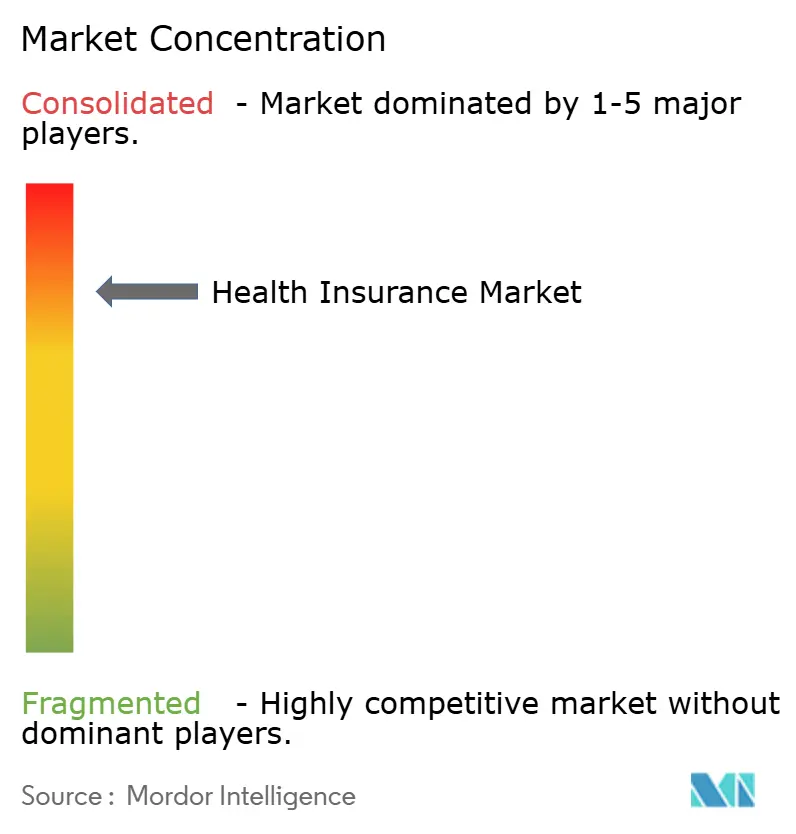
The health insurance market remains fragmented at the global level even though many national markets are led by a small group of strong domestic carriers. In North America, UnitedHealth Group and CVS Health remain central competitors because they combine insurance operations with broader healthcare service capabilities. In Europe, large players such as AXA and Allianz remain important because of their reach across multiple insurance lines and regional distribution systems. In Asia, Ping An Insurance stands out because scale, digital capability, and domestic brand strength remain important in highly competitive local markets. The health insurance market, therefore, shows concentration within countries, but not across the world as a whole.
Competitive behavior in 2025 and 2026 shows that carriers are adjusting portfolios in response to margin pressure, utilization trends, and channel shifts. Elevance Health described 2026 as a year of execution and repositioning, which reflected a broader focus on margin recovery rather than growth at any cost among large payers. The Cigna Group reported in May 2026 that it planned to exit the ACA individual exchanges after 2026, signaling a clear move away from less attractive product lines toward employer-sponsored health and pharmacy services. This pattern matters because the health insurance market rewards carriers that are willing to narrow their focus where economics are weak and reinvest where service integration is stronger. It also shows that insurers are treating portfolio discipline as a competitive tool rather than only as a financial safeguard.
Technology has become a central competitive variable in the health insurance market because it affects claims processing speed, compliance, care navigation, and distribution efficiency simultaneously. UnitedHealth Group stated that Optum Insight is scaling AI products for claims adjudication and coverage validation, with broader commercial deployment planned for late 2026. CVS Health launched Health100 in 2026 as a technology subsidiary built with Google Cloud AI to create an integrated consumer engagement platform, which shows a similar push toward tech-enabled retention and service differentiation. AXA Partners and bolttech expanded their collaboration in embedded insurance, underscoring that strategic moves in the health insurance market now extend beyond underwriting into platform-led distribution. The health insurance industry is therefore moving toward a model in which strong data systems, integrated service layers, and disciplined channel strategy matter as much as product breadth.
Health Insurance Industry Leaders
-
UnitedHealth Group Incorporated
-
Elevance Health, Inc.
-
The Cigna Group
-
CVS Health Corporation
-
Humana Inc.
- *Disclaimer: Major Players sorted in no particular order
Health Insurance Market Companies Covered in this Report
- UnitedHealth Group Incorporated
- CVS Health Corporation
- The Cigna Group
- Elevance Health, Inc.
- Humana Inc.
- Centene Corporation
- Kaiser Foundation Health Plan, Inc.
- Bupa
- AXA SA
- Allianz SE
- UnitedHealthcare
- Aetna Inc.
- Blue Cross Blue Shield Association
- Ant Group Co., Ltd.
- Ping An Insurance (Group) Company of China, Ltd.
- Nippon Life Insurance Company
- Zurich Insurance Group Ltd
- Medi Assist Healthcare Services Limited
- Discovery Limited
- Vitality Group International
- Sanitas Seguros, S.A.
- DKV Seguros y Reaseguros, S.A.E.
- HDFC ERGO General Insurance Company Limited
- ICICI Lombard General Insurance Company Limited
Recent Industry Developments in Health Insurance Market
- May 2026: CVS Health expanded its collaboration with Salesforce to deploy Agentforce Health across multiple CVS businesses, representing Salesforce's largest Agentforce deal to date in regulated industries. The platform uses AI to personalize call-center interactions for millions of members and providers, signaling the acceleration of AI adoption in payer-member engagement and in reducing administrative costs.
- April 2026: Covered California announced an expanded partnership with Google Public Sector and Deloitte to deploy Google Cloud's Document AI across CalHEERS, setting a national standard for AI-powered eligibility determination in state-based exchanges and covering millions of Californians.
- April 2026: AI-native brokerage platform Gyde acquired Benavest, a national health insurance distribution platform licensed in 48 states and serving thousands of agents, to accelerate growth in ACA, Medicare, and ICHRA distribution segments with AI-enabled tools.
- March 2026: CVS Health and Google Cloud announced a strategic partnership to launch Health100, a health technology services subsidiary built as an open-ecosystem platform integrating pharmacy, insurance, care, and PBM data for United States consumers, with initial rollout in 2026.
Global Health Insurance Market Report Scope
Segmentation Overview
| Individual / Family Policies |
| Group Policies |
| Voluntary Health Insurance Schemes |
| Compulsory Private Health Insurance Schemes |
| Direct Sales |
| Online Platforms |
| Brokers and Agents |
| Banks, Bancassurance |
| Other Channels |
| North America | United States |
| Canada | |
| Mexico | |
| South America | Brazil |
| Argentina | |
| Rest of South America | |
| Europe | United Kingdom |
| Germany | |
| France | |
| Italy | |
| Spain | |
| Rest of Europe | |
| Asia-Pacific | China |
| Japan | |
| India | |
| South Korea | |
| Australia | |
| Indonesia | |
| Thailand | |
| Malaysia | |
| Singapore | |
| Vietnam | |
| Rest of Asia-Pacific | |
| Middle East and Africa | Saudi Arabia |
| United Arab Emirates | |
| Turkey | |
| South Africa | |
| Egypt | |
| Rest of Middle East and Africa |
| By Insurance Type | Individual / Family Policies | |
| Group Policies | ||
| By Scheme Type | Voluntary Health Insurance Schemes | |
| Compulsory Private Health Insurance Schemes | ||
| By Distribution Channel | Direct Sales | |
| Online Platforms | ||
| Brokers and Agents | ||
| Banks, Bancassurance | ||
| Other Channels | ||
| By Geography | North America | United States |
| Canada | ||
| Mexico | ||
| South America | Brazil | |
| Argentina | ||
| Rest of South America | ||
| Europe | United Kingdom | |
| Germany | ||
| France | ||
| Italy | ||
| Spain | ||
| Rest of Europe | ||
| Asia-Pacific | China | |
| Japan | ||
| India | ||
| South Korea | ||
| Australia | ||
| Indonesia | ||
| Thailand | ||
| Malaysia | ||
| Singapore | ||
| Vietnam | ||
| Rest of Asia-Pacific | ||
| Middle East and Africa | Saudi Arabia | |
| United Arab Emirates | ||
| Turkey | ||
| South Africa | ||
| Egypt | ||
| Rest of Middle East and Africa | ||
Key Questions Answered in the Report
What is the current size of the health insurance market?
The sector is forecast to reach USD 3.11 trillion by 2031, rising from USD 2.14 trillion in 2026 at a 7.8% CAGR over 2026-2031.
Which insurance type leads global premium volume?
Group policies led with 62.9% of global premium volume in 2025, supported by the scale of employer-sponsored coverage.
Which regional market is growing the fastest through 2031?
Asia-Pacific is projected to expand at 11.4% CAGR through 2031, making it the fastest-growing regional segment.
Which distribution channel is expanding the fastest?
Online platforms are expected to grow at 13.7% CAGR through 2031 as digital enrollment and embedded distribution models gain traction.
Why is employer-sponsored coverage still important for insurers?
It provides scale, recurring premium pools, and more stable renewal cycles, and KFF reported that 165.6 million people under 65 were covered through employer-sponsored plans in the United States in 2025.
What is the main risk to enrollment growth over the forecast period?
Affordability pressure is the main risk because higher premiums can push younger and lower-income consumers out of coverage, which weakens the risk pool and raises future pricing pressure.