
Market Overview
| Study Period | 2020 - 2032 |
|---|---|
| Forecast Data Period | 2027 - 2032 |
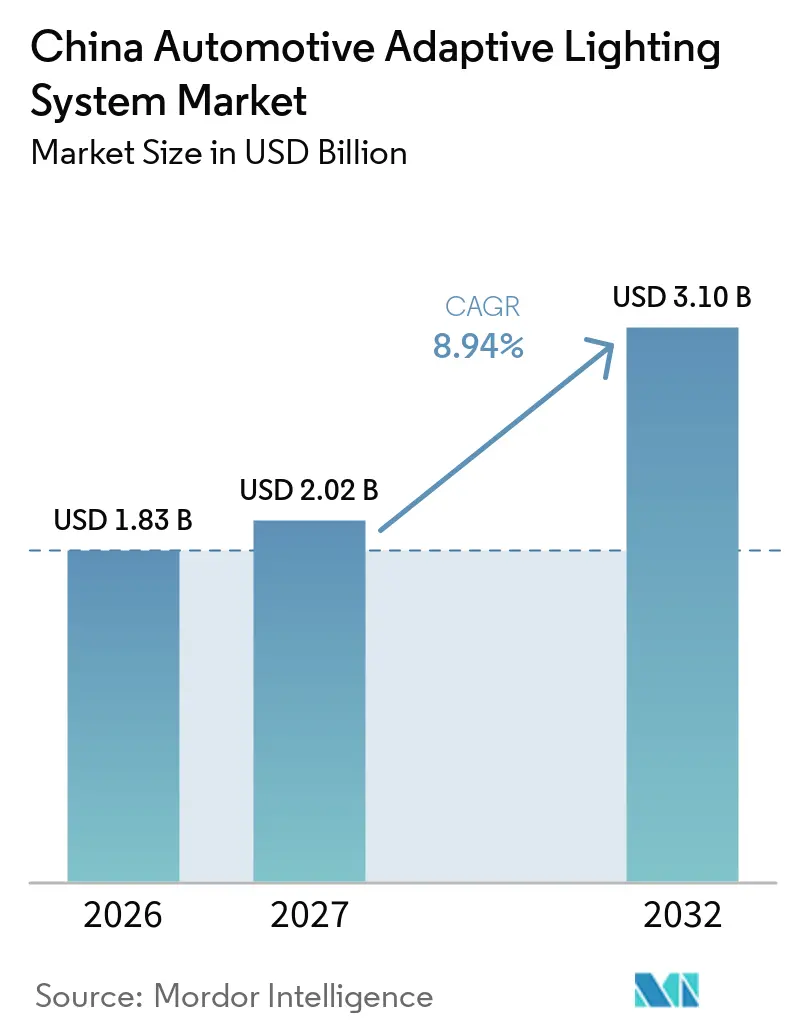
| Base Year Market Size (2026) | USD 1.83 Billion |
| Market Size (2027) | USD 2.02 Billion |
| Market Size (2032) | USD 3.10 Billion |
| Growth Rate (2027 - 2032) | 8.94 % |
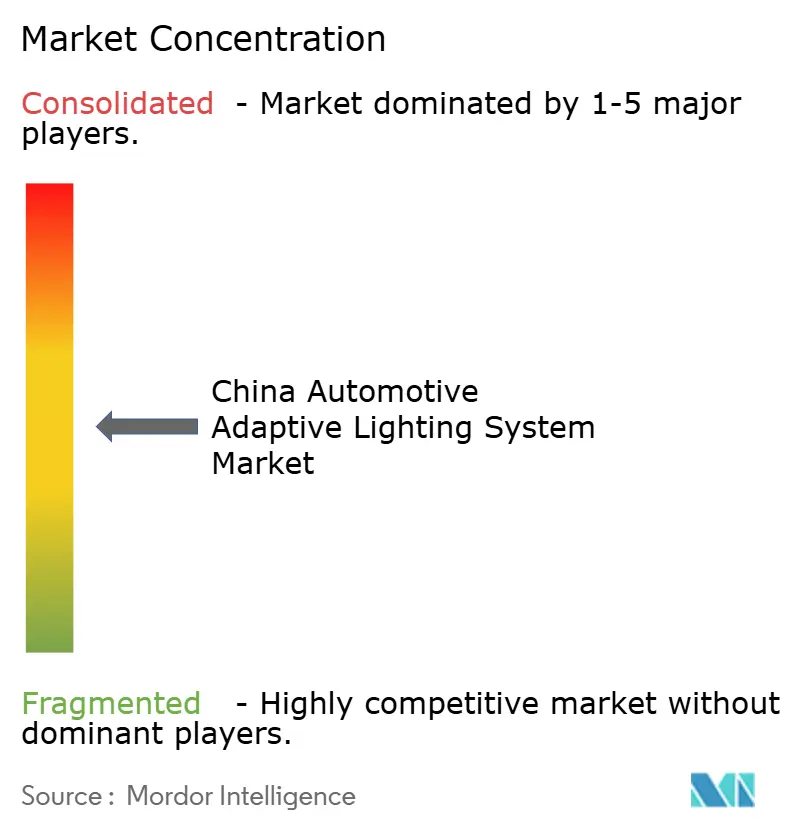
| Market Concentration | Medium |
Major Players *Disclaimer: Major Players sorted in no particular order Image © Mordor Intelligence. Reuse requires attribution under CC BY 4.0. | |
China Automotive Adaptive Lighting System Market Analysis by Mordor Intelligence
The China automotive adaptive lighting system market size was valued at USD 1.83 billion in 2026, is estimated at USD 2.02 billion in 2027, and is projected to reach USD 3.10 billion by 2032, growing at a CAGR of 8.94% from 2027 to 2032. The Chinese automotive adaptive lighting system market is being reshaped by the rapid shift toward new-energy vehicles, in which centralized electrical architectures make it easier to integrate lighting with vehicle software. This shift gives suppliers a stronger reason to develop lamps as part of a wider sensing and control system rather than as isolated hardware. Domestic suppliers are expanding their control over chips, optical modules, and lamp integration, which can reduce dependence on sourcing and intensify price competition. Foreign suppliers are responding with localized engineering, while protecting their position in high-resolution lighting for premium vehicle programs. The Chinese automotive adaptive lighting system market also faces pressure from excess capacity, falling unit prices, and the need to validate each software-driven change before it reaches production.
Key Report Takeaways
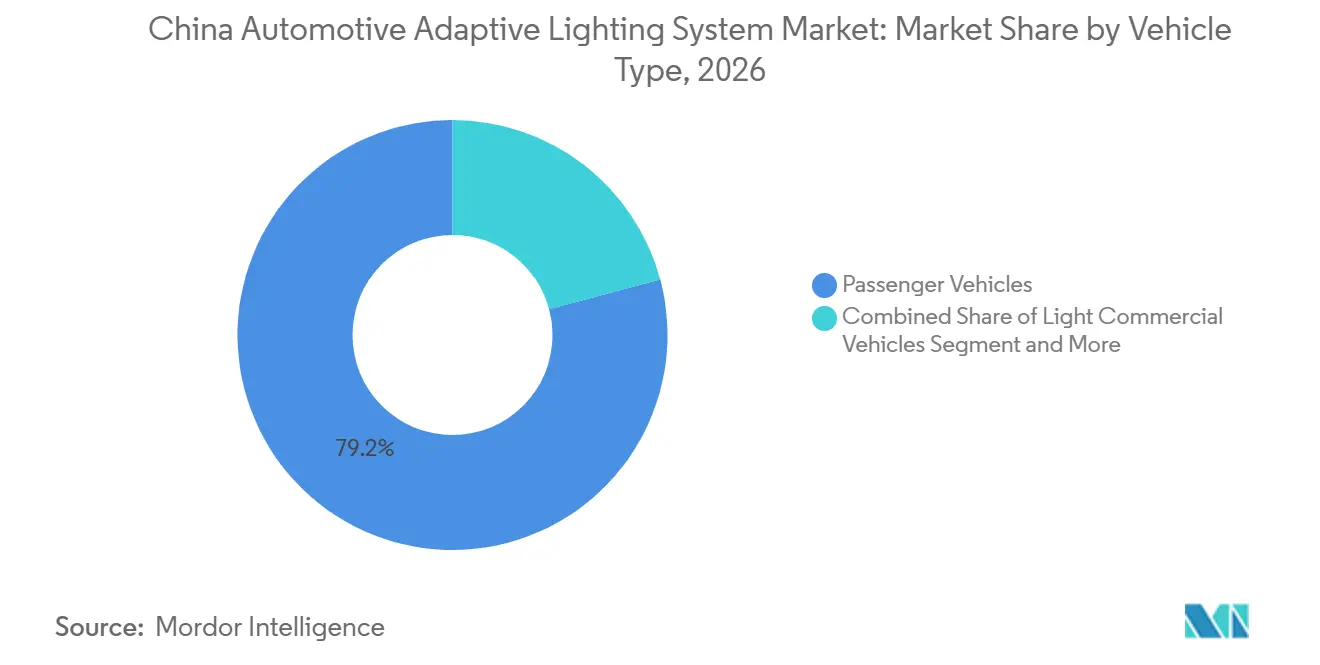
- By vehicle type, passenger vehicles held 79.15% of the Chinese automotive adaptive lighting system market revenue in 2026, while light commercial vehicles are forecast to grow at an 11.36% CAGR through 2032.
- By application, exterior lighting accounted for 94.22% of the Chinese automotive adaptive lighting system market share in 2026 and is projected to grow at a 10.45% CAGR by 2032.
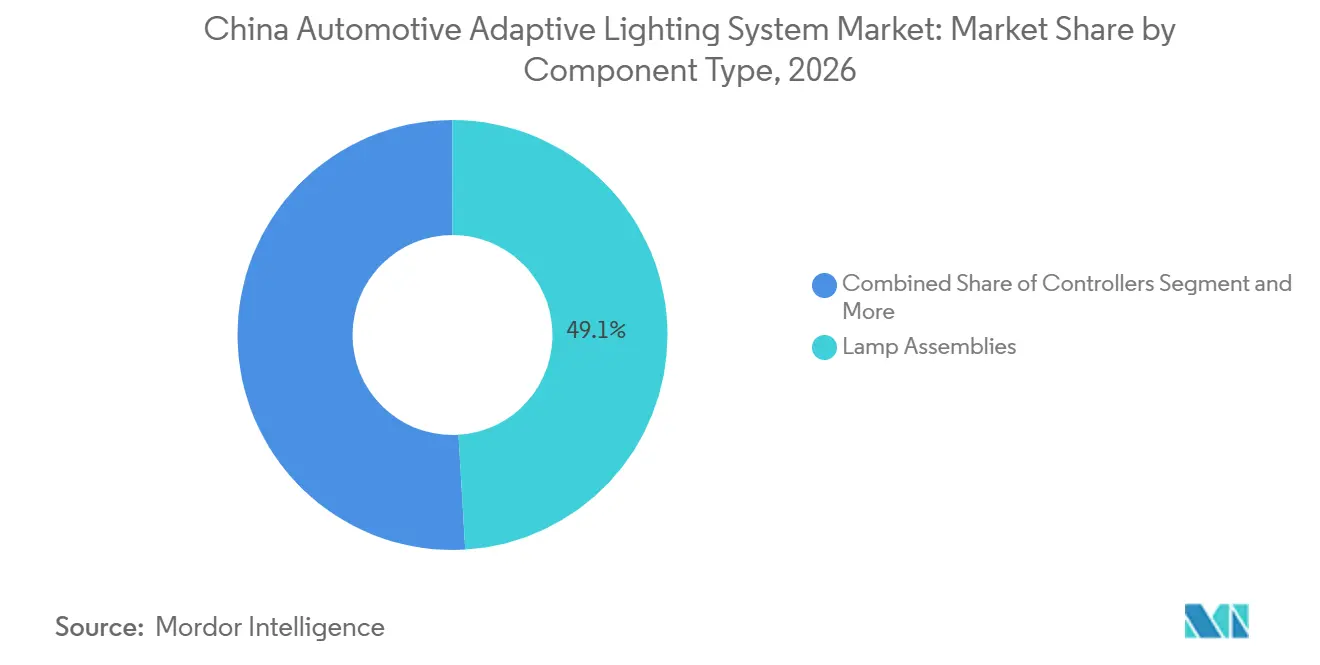
- By component type, lamp assemblies held 49.05% of the Chinese automotive adaptive lighting system market share in 2026, while sensors/cameras are forecast to expand at an 11.74% CAGR through 2032.
- By technology, LED technology accounted for 88.13% of the Chinese automotive adaptive lighting system market revenue in 2026 and is set to become the fastest-growing segment, with a 9.35% CAGR through 2032.
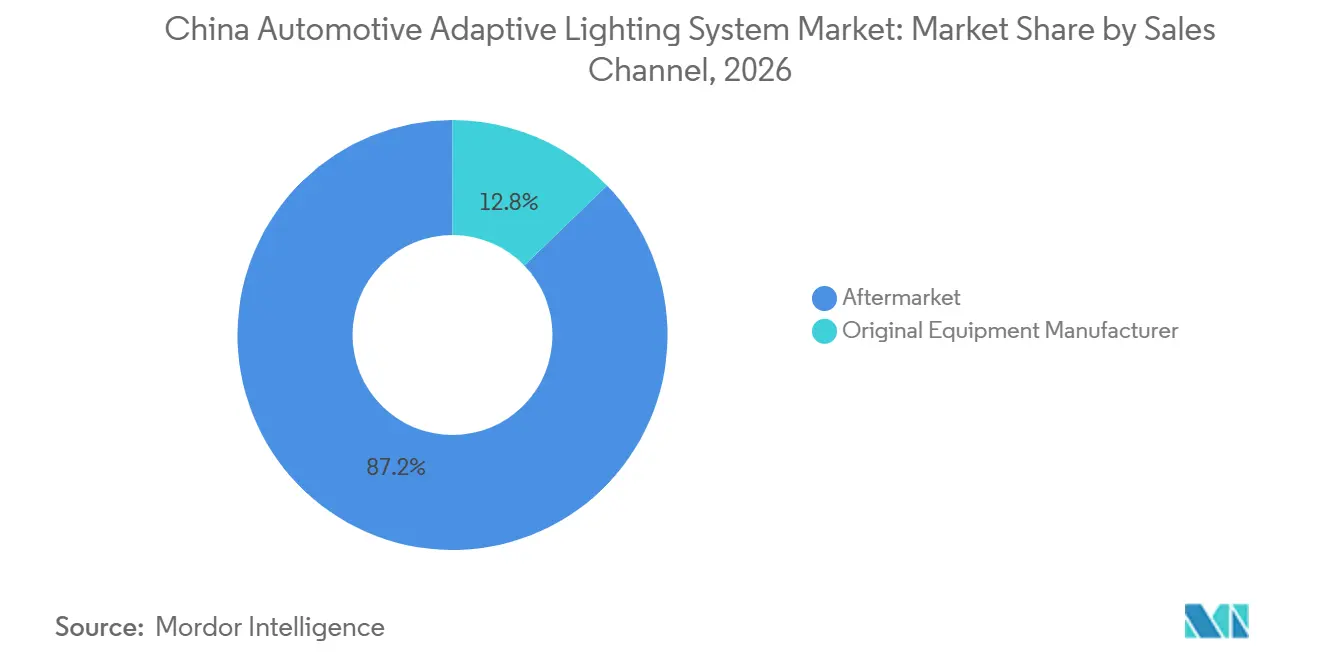
- By sales channel, the aftermarket accounted for 87.24% of the Chinese automotive adaptive lighting system market revenue in 2026; the OEM channel is the fastest-growing channel and will grow at a 9.86% CAGR through 2032.
- By functionality, Adaptive Front Lighting held a 44.35% of the Chinese automotive adaptive lighting system market share in 2026 and is forecast to expand at a 12.04% CAGR through 2032.
Note: Market numbers in this report are based on Mordor Intelligence's proprietary estimation framework, which combines nine months of actuals with Q4 projections for base year 2026.
China Automotive Adaptive Lighting System Market Trends and Insights
Drivers Impact Analysis*
| Driver | (~) % Impact on CAGR Forecast | Geographic Relevance | Impact Timeline |
|---|---|---|---|
| New-Energy and Premium-EV Penetration | +2.8% | National, concentrated in Yangtze River Delta and Greater Bay Area | Short term (≤ 2 years) |
| Falling LED and Semiconductor Costs | +1.5% | National, with supply-chain depth in Jiangsu and Guangdong | Medium term (2-4 years) |
| Lighting Standards and C-NCAP Evaluation | +1.2% | National | Short term (≤ 2 years) |
| Sensor Fusion and Software-Defined Vehicle | +1.0% | National, with early gains in Shanghai, Hangzhou, and Shenzhen | Medium term (2-4 years) |
| OTA-Updatable Lighting and Digital Monetization | +0.7% | National | Medium term (2-4 years) |
| Lighting as External Human-Machine Interface | +0.4% | National, with early deployment in Tier-1 cities | Long term (≥ 4 years) |
| Source: Mordor Intelligence | |||
New-Energy Vehicle and Premium-EV Penetration
China’s new-energy vehicle expansion is supporting demand for adaptive lighting systems rather than only increasing vehicle output. Battery-electric and plug-in hybrid platforms often use centralized electronic architectures, which can reduce the integration burden of connected lighting functions. Premium electric-vehicle brands use lighting design and interactive features to distinguish their vehicles, making advanced lamps more visible to buyers. This helps shorten the decision cycle for pixel lighting and adaptive beam features in volume vehicle programs. The Chinese automotive adaptive lighting system market therefore benefits when new platforms are designed around software-connected electrical systems from the start.
Falling LED and Semiconductor Costs Through Localized Supply
Local supply development is lowering a cost barrier that once restricted adaptive lighting to luxury vehicles. Chinese suppliers are building capability in LED chips, driver integrated circuits, optical modules, and lamp integration. Xingyu has described strategic cooperation with Oritek and LatticePower that supports its lighting technology development. Broader local sourcing can narrow the gap between basic LED lamps and more capable matrix systems. The China automotive adaptive lighting system market may therefore see adaptive functions reach lower vehicle price bands when qualified local inputs are available at scale. This cost shift also increases pressure on suppliers that rely on imported high-flux LED dies or driver components.
GB Lighting Standards and C-NCAP Safety Evaluation
Lighting requirements and vehicle safety assessments are creating a clearer path for adaptive systems to enter production. Updated standards increase the importance of photometric performance, durability testing, and documentation across the supplier base. These requirements raise the engineering threshold for complex pixel lamps, but they also favor suppliers with proven validation processes. Adaptive high-beam capability can support vehicle safety positioning, especially for manufacturers seeking stronger ratings. The China automotive adaptive lighting system market benefits because compliance and safety needs make advanced lighting a product-development priority rather than an optional styling feature. Suppliers must still manage the added testing effort when a software release changes beam behavior.
ADAS Sensor Fusion and Software-Defined Vehicle Architectures
Adaptive lighting is increasingly linked to the broader driver-assistance system. Camera, radar, map, and vehicle data can inform beam shaping, glare control, and object recognition. Volkswagen Group China introduced an AI-powered ADAS system for intelligent electric vehicles in 2025, illustrating the growing importance of integrated vehicle software [1]. This architecture places greater value on suppliers that can integrate optical hardware with central compute and vehicle software. The Chinese automotive adaptive lighting system market is likely to reward companies that can support these interfaces, not only companies that can supply lamp assemblies. Suppliers without software integration capability may remain confined to lower-value component roles.
Restraints Impact Analysis*
| Restraint | (~) % Impact on CAGR Forecast | Geographic Relevance | Impact Timeline |
|---|---|---|---|
| Integration, Validation, and Thermal-Management Costs | -1.2% | Most acute in mid-tier production hubs in Jiangsu and Zhejiang | Medium term (2-4 years) |
| Price Erosion and Supplier Overcapacity | -0.9% | National, most severe in aftermarket LED and standard adaptive segments | Short term (≤ 2 years) |
| Revalidation Across Software and OTA Releases | -0.5% | National, with compliance governed by SAMR and MIIT | Medium term (2-4 years) |
| Ownership of Perception, Lighting, and Vehicle E/E | -0.4% | National, with the highest impact where multiple Tier-1 suppliers support the same platform | Long term (≥ 4 years) |
| Source: Mordor Intelligence | |||
High Integration, Validation, and Thermal-Management Costs
High-resolution adaptive lamps place more optical power and electronic content into a smaller package than conventional headlamps. This raises the need for thermal design, durable materials, and testing across the vehicle operating range. FORVIA HELLA localized its SSL|HD technology for a Zeekr program with 25,000 individually controllable pixels in each headlamp. Each configuration requires functional-safety work and environmental validation before it can be approved for production. These requirements can extend program timing when a single supplier supports multiple pixel formats across different OEM architectures. Consequently, the Chinese automotive adaptive lighting system market favors suppliers that have integrated optical, thermal, electronic, and validation capabilities.
Price Erosion and Supplier Overcapacity
Price competition remains a major constraint for lighting suppliers serving China. Capacity additions have continued even as utilization and unit values have come under pressure in both standard and aftermarket applications. Price pressure is strongest in lower-cost vehicle programs, where OEM cost targets move through the supply chain. The Chinese automotive adaptive lighting system market can still expand, but suppliers will need to protect margins through technology differentiation, production efficiency, and stronger program selection.
*Our forecasts treat driver/restraint impacts as directional, not additive. The impact forecasts reflect baseline growth, mix effects, and variable interactions.
Segment Analysis
By Vehicle Type: Passenger Volume Anchors Revenue, Commercial Vehicles Accelerate
Passenger vehicles held 79.15% of China's automotive adaptive lighting system market share in 2026. The segment benefits from its large production base and the high concentration of new-energy vehicle launches in the passenger-car segment. Passenger-car OEMs also have stronger incentives to specify higher-value lighting that supports safety ratings and visible design differentiation. Matrix LED and adaptive high-beam functions are reaching vehicle price bands where domestic brands compete most actively. FORVIA HELLA developed intelligent headlamps for NIO’s ONVO L90, a mainstream-premium new-energy SUV launched in July 2025 [2]. The company also created customized LED matrix headlamps for the smart#5 program. These programs show that adaptive specifications now extend across more than one premium vehicle position.
Light commercial vehicles are forecast to record an 11.36% CAGR through 2032, the fastest rate among vehicle types. Electrification of logistics and last-mile delivery fleets gives OEMs a reason to improve night-driving safety and vehicle identity. Fleet operators have a practical interest in systems that can improve forward visibility on repetitive urban and highway routes. Commercial vehicle buyers also value distinct lighting signatures that support fleet branding and vehicle recognition. Although medium- and heavy-duty commercial vehicles currently account for a smaller share, their long operating hours strengthen the case for adaptive high-beam and cornering lighting functions. Highway use increases the relevance of glare management and road illumination during overnight operations. The Chinese automotive adaptive lighting sector has an opportunity to tailor durable systems for trucks rather than relying on passenger-car designs.

By Application: Exterior Lighting Dominates, Interior Functions Add Complexity
Exterior lighting accounted for 94.22% of China's automotive adaptive lighting system market revenue in 2026 and is set to grow at a 10.45% CAGR. Headlamps and rear lamps are of greatest value because they must meet photometric requirements while remaining visible design elements. Their functions can also be evaluated by safety organizations and understood directly by vehicle buyers. This creates a close connection between lighting specification, vehicle positioning, and product appeal. FORVIA HELLA launched a Star-Diamond Rear Lamp for the Zeekr 9X with an integrated indicator that supports assisted-driving communication. The product demonstrates how exterior lamps are moving beyond basic illumination and signaling.
Interior lighting remains a small revenue area, but it is gaining functional depth in new-energy vehicles. OEMs are using ambient lighting that changes with vehicle modes, driver attention states, and occupant interactions. Marelli presented lighting technologies for the age of the software-defined vehicle at Auto China 2026 [3]. Its presentation included flat lighting surfaces and MicroLED concepts that connect display, lighting, and signaling functions. These systems suggest that interior and exterior functions can share software and electronic building blocks. Shared platforms can reduce the incremental development burden of adding adaptive interior features. The Chinese automotive adaptive lighting system market may therefore benefit from common lighting architectures, even as interior lighting remains a smaller revenue stream.
By Component Type: Sensors and Cameras Lead Growth as Intelligence Moves Upstream
Lamp assemblies held 49.05% of China's automotive adaptive lighting system market revenue in 2026. They remain the main optical output stage and include the housings, LEDs, lenses, thermal paths, and embedded electronics needed for advanced functions. Their value remains high as systems move from fixed beams to dense pixel arrays. Suppliers must balance optical precision with manufacturability when deploying more controllable light sources. The move toward high-resolution beams does not eliminate the need for robust lamp-assembly engineering. It increases the importance of thermal control, sealing, and reliable optical alignment. Lamp makers with established manufacturing scale are therefore well-positioned in the Chinese automotive adaptive lighting system market.
Sensors/cameras are forecast to grow at an 11.74% CAGR through 2032, the fastest rate among component categories. Adaptive beam control relies on perception data to detect vehicles, road users, and surrounding conditions. Camera quality and the available sensor data influence the accuracy of glare suppression and beam placement. This shifts part of the value chain from the lamp itself toward perception and central vehicle computing. Dedicated lighting controllers are also changing as vehicle architectures centralize compute functions. Suppliers may need to provide software interfaces rather than standalone electronic control units. Actuators and supporting components are smaller in revenue but essential for switching, thermal control, and functional reliability.
By Technology: LED Dominates, Laser Remains a Premium Option
LED technology accounted for 88.13% of China's automotive adaptive lighting system market revenue in 2026 and is projected to grow at the fastest CAGR of 9.35%. Its position reflects long-term gains in light output, energy efficiency, packaging flexibility, and cost. LED systems are moving from fixed arrays toward high-resolution pixel formats with many independently controlled light sources. This transition supports functions such as selective glare suppression and road projection. LED platforms are likely to remain the core technology base of the Chinese automotive adaptive lighting system market. Their scalability gives suppliers a practical route to offer different pixel and feature levels across vehicle segments.
Laser lighting occupies a much smaller revenue position, but it remains relevant to flagship vehicles where long-distance high-beam performance supports a premium message. Its use is most suited to vehicle programs where safety performance and brand distinction can justify a higher system cost. Laser systems are not expected to displace LEDs across volume programs because LED platforms offer broader flexibility and a stronger cost path. Xenon and high-intensity discharge technologies are becoming less relevant as LED performance improves. Halogen lamps remain mainly in lower-cost passenger vehicles and commercial applications with limited adaptive requirements. The central technology shift is not simply a change in light source. It is a move toward software-configurable pixel platforms that can deliver different functions from a common hardware base.
By Sales Channel: Aftermarket Holds Revenue, OEM Capture Accelerates
The aftermarket held 87.24% of China's automotive adaptive lighting system market revenue in 2026. This reflects a large installed base of vehicles that can receive LED replacements and visible lighting upgrades after purchase. Chinese manufacturers also have a dense base of suppliers that can offer aftermarket modules at competitive prices. Most aftermarket products focus on visible styling changes or basic brightness improvements. They do not generally reproduce the full sensor fusion and software control available in factory-fitted adaptive systems. This distinction becomes more important as lighting functions depend on vehicle cameras, data networks, and over-the-air updates. The aftermarket will continue to serve demand for retrofits and replacement lamps.
The OEM channel will be the fastest-growing sales channel, with a 9.86% CAGR by 2032. OEM programs require long design-in cycles and documented quality, safety, and validation processes. These requirements create a meaningful barrier for suppliers that have experience only in replacement products. FORVIA HELLA’s work across ONVO, smart, LUXEED, and Zeekr programs illustrates the value of direct integration with vehicle manufacturers. Factory-fitted systems can connect to vehicle sensors and centralized software in a way that retrofit systems cannot easily match. This gives OEM suppliers access to the most advanced categories of adaptive lighting. It also places greater responsibility on them to support updates, validation, and lifecycle quality. Aftermarket specialists that do not build OEM-grade capability could be limited to less complex product categories.
By Functionality: Adaptive Front Lighting Leads Growth, Base Functions Sustain Volume
Adaptive Front Lighting accounted for a 44.35% of China's automotive adaptive lighting system market share in 2026 and is forecast to grow at a 12.04% CAGR through 2032. It includes cornering support, matrix glare suppression, and road-projection functions that rely on sensing and control. These features concentrate much of the investment occurring across the lighting value chain. They also provide a practical way for OEMs to integrate safety, software, and vehicle design into a single, visible feature set. Xingyu has described smart lighting systems for the AITO M8 and STELATO S9 with pixel adaptive-driving-beam capabilities and expandable projection functions.
Automatic high beam and dynamic bending light functions remain the volume base for adaptive lighting. Automatic high beam is available across a broad range of Chinese passenger vehicles and provides the camera integration needed for later feature upgrades. Dynamic bending light adjusts illumination in response to steering input and remains relevant for cost-sensitive programs. Cornering light functions also provide an entry point for commercial vehicles and lower-cost passenger models. These foundational functions help suppliers achieve higher production volumes before deploying dense-pixel systems. As pixel adaptive-driving-beam capability becomes more common in mid-range vehicles, unit prices may decline. Suppliers may then seek additional value in interactive projection and vehicle-to-environment communication.
Geography Analysis
The Chinese automotive adaptive lighting system market is a single-country market, but demand and supply are strongly concentrated in several regional clusters. The Yangtze River Delta, including Shanghai, Jiangsu, and Zhejiang, is the most important area for supplier capacity, electronics capability, and vehicle innovation. The cluster also includes major OEM activity and a deep network of electronics and semiconductor companies. This proximity helps lighting suppliers coordinate with vehicle programs and local component providers. New-energy vehicle programs in the region create short development cycles for advanced lighting features. The area, therefore, remains central to the Chinese automotive adaptive lighting system market’s technology and manufacturing base.
The Greater Bay Area is an important growth center because it concentrates technology-focused vehicle programs and software-led ecosystems. Lighting content on regional vehicle platforms is placing more emphasis on interactive functions and over-the-air feature capability. FORVIA HELLA launched highly integrated headlamps for the LUXEED R7 in August 2025. These programs show the pull of software-first vehicle architectures in Guangdong’s wider vehicle ecosystem. Features introduced on technology-centered platforms can spread quickly to other Chinese OEM programs. The Greater Bay Area has no separate revenue-share figure in the supplied material. Its importance comes from the type of vehicle programs that shape feature expectations across the country. This makes the region a key source of demand for connected and configurable lighting systems.
Central and Northeast China continue to contribute important traditional OEM volumes, although their shift toward higher-value adaptive specifications is more gradual. Wuhan, Chongqing, Changchun, and Shenyang remain relevant through established production bases and supplier networks. The Chengdu-Chongqing cluster also benefits from growing domestic new-energy vehicle production. These locations can add demand as manufacturers introduce more advanced lighting to established vehicle lines. Their role is particularly relevant for production scale and commercial-vehicle applications. The Chinese automotive adaptive lighting system market will depend on these regions to widen adoption beyond the leading coastal technology clusters. Regional differences will remain visible in the pace of adoption, but they do not change the national nature of the market.
Competitive Landscape
The Chinese automotive adaptive lighting system market is moderately consolidated at the system-supply level and more fragmented among component suppliers. Changzhou Xingyu has expanded its role in domestic vehicle programs, while established Japanese and European suppliers retain positions in specialized and premium applications. The market shows moderate consolidation among system suppliers and fragmentation among component providers. High-resolution pixel lighting is a key competitive area, as it integrates optical design, thermal management, electronics, software, and validation. Local suppliers are building integrated capability in smart lamps and vision functions. Competition, therefore, extends beyond manufacturing scale to the ability to connect lamps with vehicle software.
Koito’s restructuring of its production network in China reflects a distinct strategic response focused on improving operational efficiency and optimizing capacity utilization. These actions demonstrate that suppliers are addressing the same market dynamics through technology development, vehicle program localization, or production restructuring. The Chinese automotive adaptive lighting system market favors companies that effectively balance these approaches. As OEMs increasingly seek programmable lighting functions, suppliers cannot rely solely on conventional headlamp volumes. They must also manage pricing pressure in high-volume vehicle segments.
Several areas remain open to competitive development. Commercial vehicles remain less penetrated by adaptive systems than passenger vehicles, leaving room for suppliers to offer durable, cost-effective solutions. Software-linked lighting features also present a potential path to recurring feature revenue, although the supplied material does not show this model operating at scale. Global suppliers still have strengths in advanced optical systems, vehicle-program support, and validation experience. Domestic companies have strengths in local OEM access, cost positioning, and growing system integration. The competitive landscape will be shaped by whether suppliers can turn these strengths into reliable, scalable production programs. The Chinese automotive adaptive lighting system market is unlikely to be defined by a single supplier category. Instead, leading positions will depend on the ability to support both volume programs and increasingly software-connected premium platforms.
China Automotive Adaptive Lighting System Industry Leaders
-
HASCO Vision Technology Co., Ltd.
-
Hella GmbH & Co. KGaA (FORVIA HELLA)
-
Changzhou Xingyu Automotive Lighting Systems Co., Ltd.
-
Valeo SA
-
Koito Manufacturing Co., Ltd.
- *Disclaimer: Major Players sorted in no particular order
Recent Industry Developments
- June 2026: Forvia Hella achieved a key milestone by introducing its high-resolution SSL | HD headlamp system in China for the first time through fully localized development and production. The company integrated the advanced lighting technology into the new Zeekr 8X, marking a significant step in its strategy to expand its presence in the Chinese automotive market.
- April 2026: Marelli showcased its latest advanced automotive lighting technologies at Auto China 2026 in Beijing. The company’s h-Digi® MicroLED is a high-resolution MicroLED projection module for intelligent headlighting systems, available in 25K- and 40K-pixel configurations across multiple vehicle segments. The 25K MicroLED version is a mature, compact, and energy-efficient solution that supports high-precision adaptive driving beam (ADB), adaptive front-lighting functions, road projections, and dynamic lighting animations.
China Automotive Adaptive Lighting System Market Report Scope
The scope includes segmentation by vehicle type (passenger vehicles, light commercial vehicles, and medium- and heavy-duty commercial vehicles), application (exterior lighting and interior lighting), component type (controllers, sensors/cameras, lamp assemblies, actuators, and others), technology (light-emitting diodes, xenon and high-intensity discharge, halogen, and laser lighting), sales channel (original equipment manufacturer and aftermarket), and functionality (automatic high beam, dynamic bending light, cornering light, and adaptive front lighting). Market size and growth forecasts are presented by value in USD and volume in Units.
By Vehicle Type
| Passenger Vehicles |
| Light Commercial Vehicles |
| Medium and Heavy Commercial Vehicles |
By Application
| Exterior Lighting |
| Interior Lighting |
By Component Type
| Controllers |
| Sensors/Cameras |
| Lamp Assemblies |
| Actuators |
| Others |
By Technology
| Light-Emitting Diode |
| Xenon and High-Intensity Discharge |
| Halogen |
| Laser Lighting |
By Sales Channel
| Original Equipment Manufacturer |
| Aftermarket |
By Functionality
| Automatic High Beam |
| Dynamic Bending Light |
| Cornering Light |
| Adaptive Front Lighting |
Cross-Segmentation Analysis
| Vehicle Type by Application |
| Vehicle Type by Component Type |
| By Vehicle Type | Passenger Vehicles |
| Light Commercial Vehicles | |
| Medium and Heavy Commercial Vehicles | |
| By Application | Exterior Lighting |
| Interior Lighting | |
| By Component Type | Controllers |
| Sensors/Cameras | |
| Lamp Assemblies | |
| Actuators | |
| Others | |
| By Technology | Light-Emitting Diode |
| Xenon and High-Intensity Discharge | |
| Halogen | |
| Laser Lighting | |
| By Sales Channel | Original Equipment Manufacturer |
| Aftermarket | |
| By Functionality | Automatic High Beam |
| Dynamic Bending Light | |
| Cornering Light | |
| Adaptive Front Lighting | |
| Cross-Segmentation Analysis | Vehicle Type by Application |
| Vehicle Type by Component Type |
Key Questions Answered in the Report
What is the projected value of China’s automotive adaptive lighting systems by 2032?
The China automotive adaptive lighting system market is projected to reach USD 3.10 billion by 2032, growing at an 8.94% CAGR from 2027 to 2032.
Which vehicle type has the largest demand for adaptive lighting in China?
Passenger vehicles led with 79.15% of revenue in 2026 because they combine high production volumes with strong adoption of new-energy vehicle features.
Why are LED systems dominant in China’s vehicle lighting sector?
LED technology held 88.13% of revenue in 2026 because it offers flexible packaging, strong performance, and a practical path to high-resolution pixel functions.
How are OEM-fitted systems different from aftermarket products?
OEM systems can connect with vehicle cameras, networks, and software updates, while aftermarket products mainly provide replacement, brightness, or styling upgrades.