
Market Overview
| Study Period | 2020 - 2032 |
|---|---|
| Forecast Data Period | 2027 - 2032 |
| Base Year Market Size (2026) | USD 147.29 Million |
| Market Size (2027) | USD 157.63 Million |
| Market Size (2032) | USD 221.29 Million |
| Growth Rate (2027 - 2032) | 7.02 % |
| Market Concentration | Medium |
Major Players *Disclaimer: Major Players sorted in no particular order Image © Mordor Intelligence. Reuse requires attribution under CC BY 4.0. | |
Russia Automotive Adaptive Lighting System Market Analysis by Mordor Intelligence
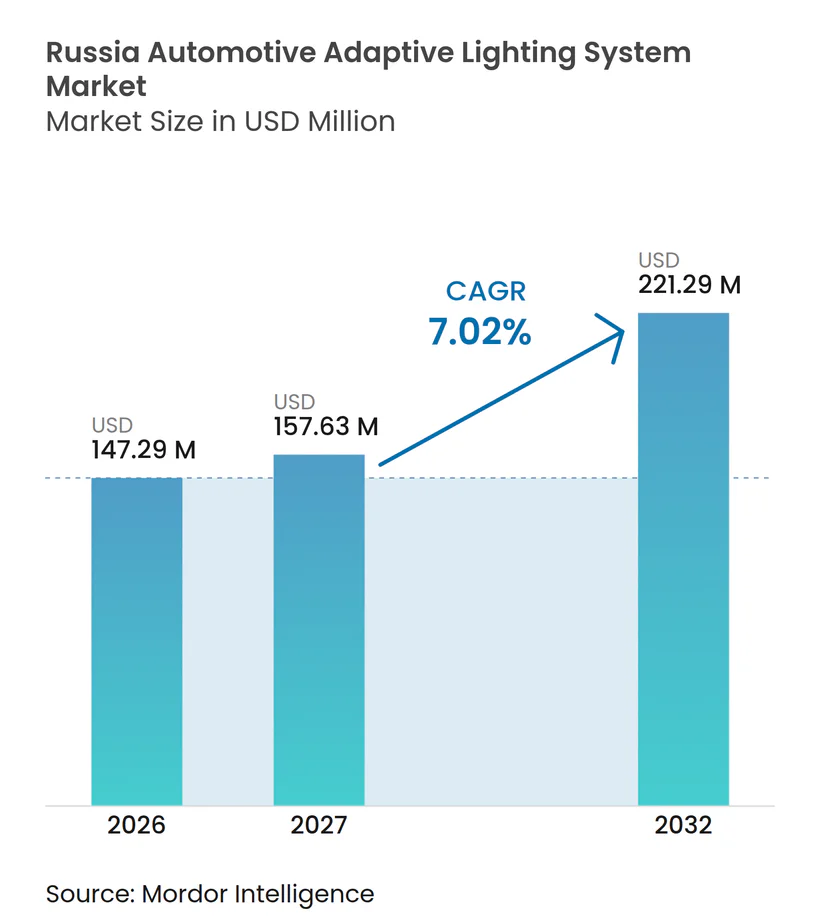
The Russian automotive adaptive light market size was valued at USD 147.29 million in 2026 and is estimated at USD 157.63 million in 2027, and is projected to reach USD 221.29 million by 2032, growing at a CAGR of 7.02% from 2027 to 2032. The Russian automotive adaptive light market is expanding even as total new-car sales declined in 2025, as a greater proportion of new vehicles are factory-fitted with LED and adaptive lighting systems. Chinese vehicle platforms are shifting the product mix toward these features on mid-range models. Local assembly is also moving the decision on lighting specifications closer to Russian production lines. This supports demand for calibrated systems, replacement parts, and related electronics across both OEM and aftermarket channels. Import restrictions and the price of advanced modules remain the principal limits on wider adoption, especially where specialist components, compatible software, and skilled diagnostic support are not readily available to vehicle owners or service providers, or where replacement systems require a formal approval and calibration process before they can return to use, maintain a correct beam pattern, and operate with the vehicle’s existing safety equipment.
Key Report Takeaways
- By vehicle type, passenger cars held 78.29% of the Russian automotive adaptive light market share in 2026, while commercial vehicles are forecast to grow at a 7.87% CAGR through 2032.
- By type, front lighting held 73.18% of revenue in 2026, while interior and other adaptive lighting are forecast to grow at a 7.78% CAGR through 2032.
- By sales channel, OEM held an 84.63% revenue share in 2026, while aftermarket is forecast to grow at a 7.69% CAGR through 2032.
- By technology, LED adaptive front-lighting held a 59.22% revenue share in 2026, while matrix and pixel LED is forecast to grow at a 7.22% CAGR through 2032.
- By function, automatic high-beam control held a 33.11% revenue share in 2026, while adaptive front-lighting, bending, and cornering are forecast to grow at a 7.29% CAGR through 2032.
- By component, lamp assembly accounted for 46.62% of revenue in 2026, while sensors and cameras are forecast to grow at an 8.11% CAGR through 2032.
- By geography, the Central Federal District held a 41.87% revenue share in 2026, while the Far Eastern Federal District is forecast to grow at an 8.09% CAGR through 2032.
Note: Market numbers in this report are based on Mordor Intelligence's proprietary estimation framework, which combines nine months of actuals with Q4 projections for base year 2026.
Russia Automotive Adaptive Lighting System Market Trends and Insights
Drivers Impact Analysis*
| Driver | (~) % Impact on CAGR Forecast | Geographic Relevance | Impact Timeline |
|---|---|---|---|
| Rising Penetration of Chinese Passenger-Vehicle Brands | +2.5% | National, concentrated in Central and Volga Federal Districts | Short term (≤ 2 years) |
| Increasing Localized Production of LED Automotive Lighting | +1.5% | National, with early gains in Tula (Haval), Vyazniki (OSVAR), and Minsk–Vyazniki corridor (Rudensk) | Medium term (2–4 years) |
| Demand for Improved Nighttime Visibility in Snow, Fog, and Long-Distance Driving | +1.0% | National, amplified in Siberian, Ural, and Northwestern Federal Districts | Medium term (2–4 years) |
| Integration of Adaptive Lighting With Camera-Based Driver-Assistance Systems | +0.9% | National, with early gains in Moscow and Saint Petersburg OEM platforms | Short to medium term (≤ 4 years) |
| Expansion of Adaptive Lighting in Premium and Upper-Mid-Segment Vehicles | +0.8% | National, with early concentration in Central Federal District (Moscow metropolitan zone) | Medium term (2–4 years) |
| Replacement of Imported Western Lighting Systems Through Local and Chinese Supply Chains | +0.7% | National, acute in Volga Federal District (AvtoVAZ/Tolyatti) and EAEU production zones | Short to medium term (≤ 4 years) |
| Source: Mordor Intelligence | |||
Rising Penetration of Chinese Passenger-Vehicle Brands
Chinese OEM platforms are a major source of demand for the Russian automotive adaptive light market. Their vehicle specifications commonly include full-LED systems or adaptive beam functions at price points where prior models often used halogen or static xenon lamps, so newer vehicles enter the national fleet with a higher level of lighting content. This changes the installed base as newer crossovers replace older vehicles and increases the relevance of platform-compatible parts and diagnostics. Local production also allows these specifications to be applied during assembly rather than added later through imports, which can simplify the integration of controls with the vehicle’s existing electronics. The result is a larger fleet that requires platform-specific calibration, repairs, and compatible electronic controls over its service life. Differences between Chinese and Russian trim configurations can still create an aftermarket opportunity when advanced lighting is not included at the factory, particularly for owners seeking upgrades that must remain compatible with the original cameras, sensors, and control units.
Increasing Localized Production of LED Automotive Lighting
The exit of several Western suppliers has increased the importance of regional lighting production in the Russian automotive adaptive lighting market. Following an investment program, Rudensk JSC has reached design capacity for next-generation LED headlamps and reported a high level of product localization [1]. The company supplies lighting products to KAMAZ, NizhKomAvto, and Rostselmash. NPP Losev has also completed import substitution for LED modules used in Lada Vesta units supplied through Avtosvet LLC to AvtoVAZ. OSVAR supplies lighting systems to domestic vehicle manufacturers, including KAMAZ, AvtoVAZ, GAZ Group, and UAZ. While regional plants can support volumes for mainstream vehicle platforms, Chinese suppliers remain important for more advanced Matrix and Pixel LED configurations.
Demand for Improved Nighttime Visibility in Snow, Fog, and Long-Distance Driving
Difficult driving conditions support demand for lighting that can improve beam management and visibility. Long routes across cold and remote areas make high-beam range and thermal stability important product considerations. Snow, fog, and limited daylight increase the practical value of adaptive functions for drivers and fleet operators. The Russian automotive adaptive light market therefore has a use case that extends beyond premium vehicle styling. Siberian, Ural, and Northwestern locations may provide demanding conditions for product validation. These conditions also create demand for service providers that can maintain cameras, sensors, and beam alignment.
Integration of Adaptive Lighting With Camera-Based Driver-Assistance Systems
Adaptive lighting is increasingly linked to camera-based driver-assistance architecture. High-beam control uses forward-facing camera inputs, while the same vehicle platform may use cameras for lane support and collision avoidance. This shared hardware can make lighting functions more practical to include in vehicle electronics packages. The Russian automotive adaptive light market benefits when OEMs use common control units and sensors across several safety functions. LED systems that exceed the specified luminous-output thresholds also require automatic beam leveling under the applicable EAEU vehicle safety framework. These requirements encourage integrated design and vehicle-level calibration rather than simple replacement of lamp units.
Restraints Impact Analysis*
| Restraint | (~) % Impact on CAGR Forecast | Geographic Relevance | Impact Timeline |
|---|---|---|---|
| Sanctions, Import Restrictions, and Parallel-Import Uncertainty | -2.1% | National, with acute impact outside Central and Northwestern Federal Districts | Short term (≤ 2 years) |
| Inconsistent Access to Imported Semiconductors, Sensors, and Specialized Optical Components | -1.1% | National, with acute exposure in Eastern supply chains rerouted via Turkey and the UAE | Short to medium term (≤ 4 years) |
| High Cost and Limited Availability of Matrix LED, Pixel LED, and Laser Components | -0.8% | National, with disproportionate impact in Siberian, Ural, and Far Eastern Federal Districts | Long term (≥ 4 years) |
| Fragmented Calibration and Service Capability Outside Major Russian Cities | -0.5% | National, most acute in Siberian, Far Eastern, and North Caucasian Federal Districts | Medium term (2–4 years) |
| Source: Mordor Intelligence | |||
Sanctions, Import Restrictions, and Parallel-Import Uncertainty
Supply restrictions create friction at several stages of the adaptive lighting supply chain. Specialist optical parts, semiconductor controls, sensors, and lighting modules can require longer and less predictable procurement routes. The removal of Hyundai and KIA components from the approved parallel-import list in May 2025 narrowed formal supply options for some Korean-brand vehicles. This particularly affects aftermarket businesses that service older vehicles with integrated electronic modules. Higher sourcing costs can make advanced repairs less attractive outside the largest urban markets. The Russian automotive adaptive light market is therefore more dependent on compatible regional supply and dependable certification than conventional lamp replacement.
High Cost and Limited Availability of Matrix LED, Pixel LED, and Laser Components
Matrix, Pixel LED, and laser systems remain difficult to adopt widely because their electronic architecture is costly. They require pixel-control modules, dedicated microcontrollers, projectors, and specialized optical components, and their replacement can be more complex than that of basic LED assemblies. These items are largely linked to East Asian production networks and can face import uncertainty, which affects both initial vehicle specification and later service availability. Higher vehicle prices can reduce the willingness of mid-market buyers to select advanced lighting options when the feature adds to a broader package of vehicle costs. Cost-reduction work by Chinese manufacturers could improve the position of these technologies over later model cycles and make more advanced functions available on higher-volume platforms. Until then, the Russian automotive adaptive light market will be weighted toward LED systems with more manageable equipment and service costs, while Matrix and Pixel systems remain concentrated in better-equipped vehicles.
*Our forecasts treat driver/restraint impacts as directional, not additive. The impact forecasts reflect baseline growth, mix effects, and variable interactions.
Segment Analysis
By Vehicle Type: Passenger Platforms Set the Main Specification Pattern
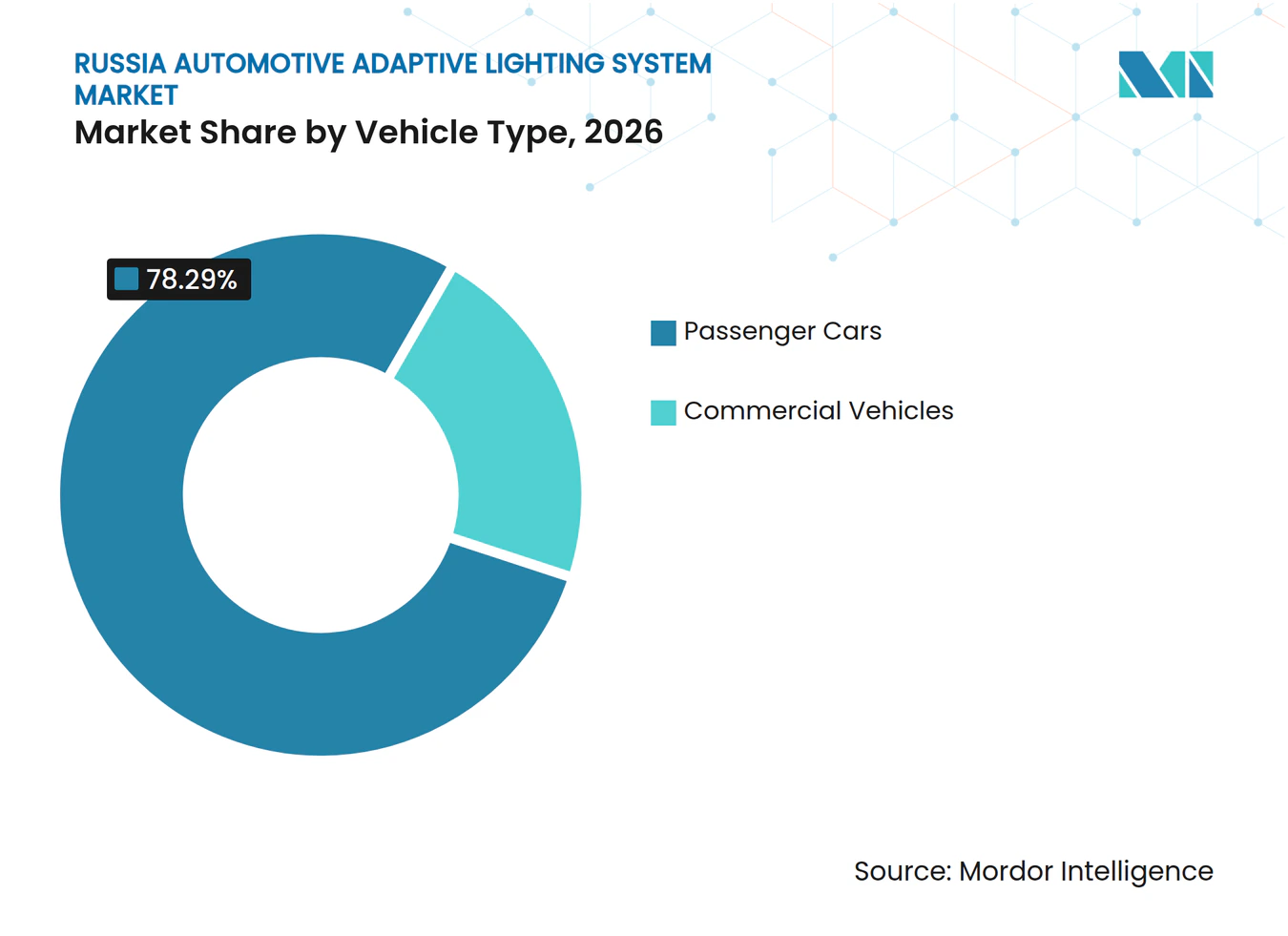
Passenger cars account for 78.29% of the Russian automotive adaptive light market size in 2026. This position reflects the crossover-heavy product mix used by Chinese brands in the country. Haval, Chery, Geely, and related local assembly programs place LED and adaptive equipment on a substantial number of passenger vehicles. These vehicles define the main demand pattern for factory-fitted lighting. The passenger segment also creates demand for replacement modules, lenses, sensors, and calibration. Its scale means that changes in trim-level strategy can quickly affect the wider lighting supplier base.
Commercial vehicles are forecast to grow at 7.87% CAGR through 2032. Long-haul fleets and domestic truck platforms support the need for durable lighting equipment because vehicles often operate over long routes in varying weather and under sustained load. OSVAR’s supply relationships with KAMAZ and other domestic manufacturers are relevant to this demand because fleet vehicles need parts that can be supplied and serviced consistently. Commercial purchasers focus on operating requirements, maintenance planning, and safety-related functionality rather than solely on feature differentiation. This gives fleet demand a different basis from consumer confidence in passenger vehicles. The Russia automotive adaptive light industry can therefore rely on both consumer crossover programs and commercial vehicle upgrades, although the purchasing process and service requirements differ between these customer groups.


By Type: Front Lighting Remains the Core Application
Front adaptive lighting accounts for 73.18% of the Russian automotive adaptive lighting market in 2026. Headlamp systems are the main point of integration for beam control, leveling, and adaptive functions. They also require type approval under the EAEU framework, which limits simple aftermarket substitution. OEM fitment is therefore particularly important for this type of equipment. The installed base includes both newer LED systems and older halogen or xenon configurations. Front lighting will remain the main revenue source because its assemblies combine optics, electronics, and vehicle-specific integration.
Interior and other adaptive lighting is forecast to grow at a 7.78% CAGR through 2032. Chinese OEMs use multi-zone ambient lighting and driver-selectable settings to differentiate higher-trim vehicles, which makes these features part of the overall vehicle experience rather than a standalone replacement purchase. This expands adaptive lighting beyond external visibility functions and gives component suppliers another route into vehicle interiors. Premium platform design can also influence expectations for lighting features in other vehicle classes as buyers become familiar with selectable lighting controls. FORVIA HELLA and Zeekr introduced 25,000-pixel SSL|HD Galaxy Diamond Matrix Headlamps in March 2026, showing the direction of advanced lighting development on Chinese platforms. The effect in Russia is likely to be strongest where Chinese platform specifications are carried into localized or imported models and where vehicle makers can support the necessary software and electronic integration [2].
By Sales Channel: OEM Installation Holds the Structural Advantage
Original equipment manufacturer (OEM) held 84.63% of revenue in the Russia automotive adaptive light market in 2026. Adaptive beam systems need calibration that reflects each platform’s sensors, suspension geometry, and control software. Assembly-line installation allows that work to be completed as part of normal vehicle production. This makes factory fitment more practical than a later retrofit for most buyers. OEM channels also benefit from type approval and integration with other electronic systems. As local vehicle assembly develops, lighting suppliers with platform relationships will retain a clear advantage.
The aftermarket is forecast to grow at 7.69% CAGR through 2032. It serves owners of pre-2022 European vehicles seeking LED or adaptive upgrades and repairs, particularly when original parts require replacement or vehicle owners want a more current lighting configuration. It also responds to feature gaps between China-market and Russia-market vehicle configurations, where the vehicle may support a function that is absent from its local trim level. Replacement demand includes modules, sensors, controllers, lenses, and recalibration services. Product authenticity and calibration quality can vary considerably outside major cities, which makes professional diagnostics important for the safe functioning of connected lighting controls. The Russian automotive adaptive light market needs reliable diagnostics and compliant installation practices for this channel to grow without compromising road safety.
By Technology: LED Is Established While Matrix Systems Grow From a Small Base
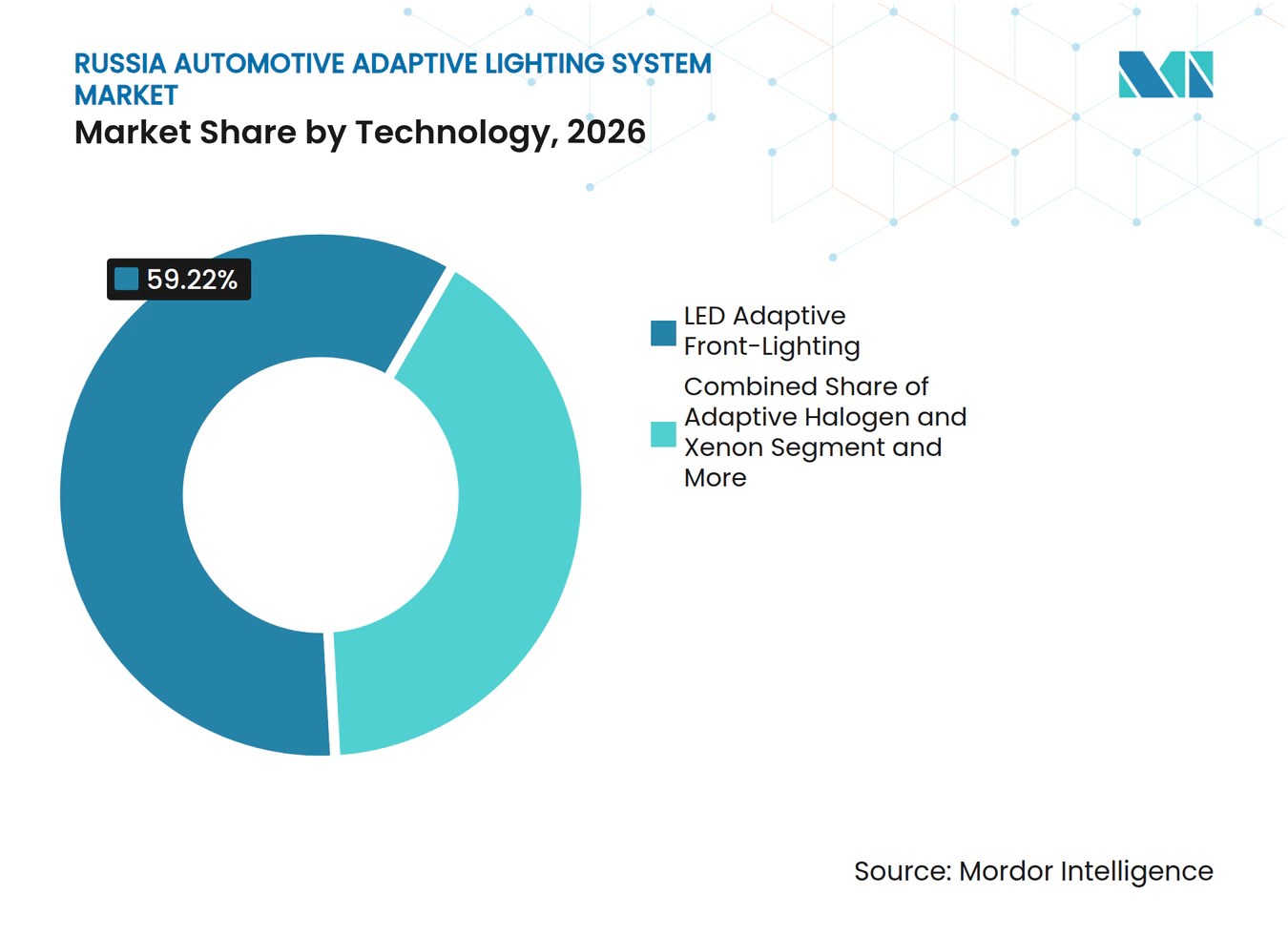
LED adaptive front-lighting holds 59.22% of the Russia automotive adaptive light market in 2026. Chinese OEM standardization and regional production investment support this established position. LED assemblies offer an accessible route to modern lighting functions when compared with laser systems. They are relevant across new passenger cars, commercial vehicles, and replacement demand. Halogen and xenon units continue to serve an older vehicle fleet, especially among models retained rather than replaced. The technology mix is therefore evolving without an immediate disappearance of legacy equipment.
Matrix and pixel LED is forecast to expand at 7.22% CAGR through 2032. These architectures provide more precise beam shaping than standard LED arrangements because they use more sophisticated control of individual lighting elements. Their adoption is supported by Chinese supplier efforts to reduce production costs and increase manufacturing consistency, especially as advanced lighting moves from premium models to upper-mid vehicle trims. However, advanced components and import constraints continue to limit broad mid-market penetration. Laser lighting remains more restricted because it relies on specialized components and lacks a comparable regional supply base. The Russia automotive adaptive light industry will continue to favor conventional LED scale before matrix systems become a broader standard, even as product development raises consumer awareness of their capabilities.


By Function: High-Beam Automation Provides the Broadest Entry Point
Automatic High-Beam Control accounts for 33.11% of the Russian automotive adaptive light market in 2026. The function uses a front-facing camera to switch the beam pattern based on road conditions and other traffic. It does not require the complex mechanical or high-resolution optical parts used by some other adaptive functions. This makes it suitable for entry- and mid-level vehicle trims. Chinese OEMs can include the function alongside other camera-based features. Its broad fitment creates a foundation for more advanced lighting functions over time.
Adaptive Front-Lighting, Bending, and Cornering is forecast to grow at 7.29% CAGR through 2032. These systems adjust the beam geometry in response to steering direction and road conditions, helping direct light toward the driver’s intended path during curves and other turning maneuvers. They are relevant to SUV use on secondary roads and routes with frequent turns, where a fixed beam pattern may not address all driving conditions. The systems can require swiveling modules, controls, and vehicle-specific calibration. Their value is closely tied to the quality of sensors and associated electronics because inaccurate inputs can reduce the effectiveness of beam adjustment. Dynamic leveling remains important for loaded commercial vehicles and larger crossovers where vehicle attitude can affect the beam pattern.
By Component: Lamp Assemblies Lead Current Revenue, While Sensors Gain Importance
Lamp Assemblies account for 46.62% of the Russian automotive adaptive light market in 2026. Complex LED and matrix units have a higher value than the halogen assemblies they replace. Assembly volumes are closely linked to OEM production output and factory installation programs. The component includes the physical housing, optics, LEDs, and related electronic parts. Its large share reflects the direct value of the finished lighting unit. Regional production of complete units can also reduce exposure to selected imported subcomponents.
Sensors and Cameras are forecast to grow at an 8.11% CAGR through 2032. A camera used for high-beam control can also support lane support, collision avoidance, and driver monitoring functions, allowing a vehicle platform to use related inputs across several systems. This overlap connects lighting electronics with the broader driver-assistance architecture and increases the importance of software compatibility. Suppliers that can provide both lighting and electronics may have an advantage in OEM procurement because they can address multiple linked requirements within a single vehicle program. Controllers and actuators remain necessary for beam movement and system response. The Russian automotive adaptive light industry is consequently becoming more dependent on electronic integration than on optics alone, while still requiring robust lamp assemblies that can operate in demanding conditions.
Geography Analysis
The Central Federal District accounts for 41.87% of the Russian automotive adaptive light market in 2026. Moscow concentrates demand for higher-specification Haval and Tank models, as well as a large retained population of pre-2022 European vehicles, so both new-vehicle and replacement needs are present in the same regional service network. These vehicles support OEM-linked demand and upgrade or repair activity, including replacement lamp assemblies, control modules, and recalibration where connected components require service. The Central district also benefits from dealership density and established service capacity, which makes it better positioned to handle systems that depend on specialized diagnostics. The Volga Federal District is important because it includes AvtoVAZ’s Tolyatti plant and is directly linked to domestic vehicle production. Local LED module activity involving NPP Losev and Avtosvet LLC ties regional demand to domestic production schedules, component availability, and the pace at which locally built models adopt more advanced lighting configurations.
The Northwestern Federal District remains an active aftermarket region because of its large retained vehicle base. Saint Petersburg had previously been a production center for Toyota and Hyundai, and the legacy fleet still requires compatible parts and service when electronic lighting components or related controls need replacement. The Ural Federal District provides a relevant introduction point for Chinese vehicle platforms, giving local buyers exposure to current LED and adaptive lighting features. The Southern and North Caucasian districts saw steep declines in new-car sales in 2025. Their greater sensitivity to vehicle price increases can limit the adoption of more costly adaptive lighting options, as these features compete with other vehicle purchase costs. These districts may therefore depend more on basic LED replacement and repair than premium factory features, while the scale of service demand remains tied to the existing vehicle population.
The Far Eastern Federal District is forecast to grow at 8.09% CAGR through 2032. Japanese right-hand-drive imports remain important in this area and necessitate calibration, sensor replacement, and beam-pattern recertification, particularly when vehicles must meet local technical requirements after import. This produces an aftermarket demand profile that differs from that of regions led primarily by new Chinese vehicle sales, as it includes work on vehicles that already have factory-installed adaptive systems. Siberia has experienced lower new-vehicle demand, but locally assembled Haval models bring adaptive LED systems into mid-market dealerships and expand the potential installed base. Harsh climate and distance make durable parts and correct beam alignment especially relevant in both areas, since vehicle owners may have fewer convenient service options. The Russian automotive adaptive light market has a dual demand channel in the Far East, combining Japanese-imported vehicles with growing Chinese brand penetration and the supporting needs for parts, calibration, and compliant servicing.
Competitive Landscape
Market Concentration
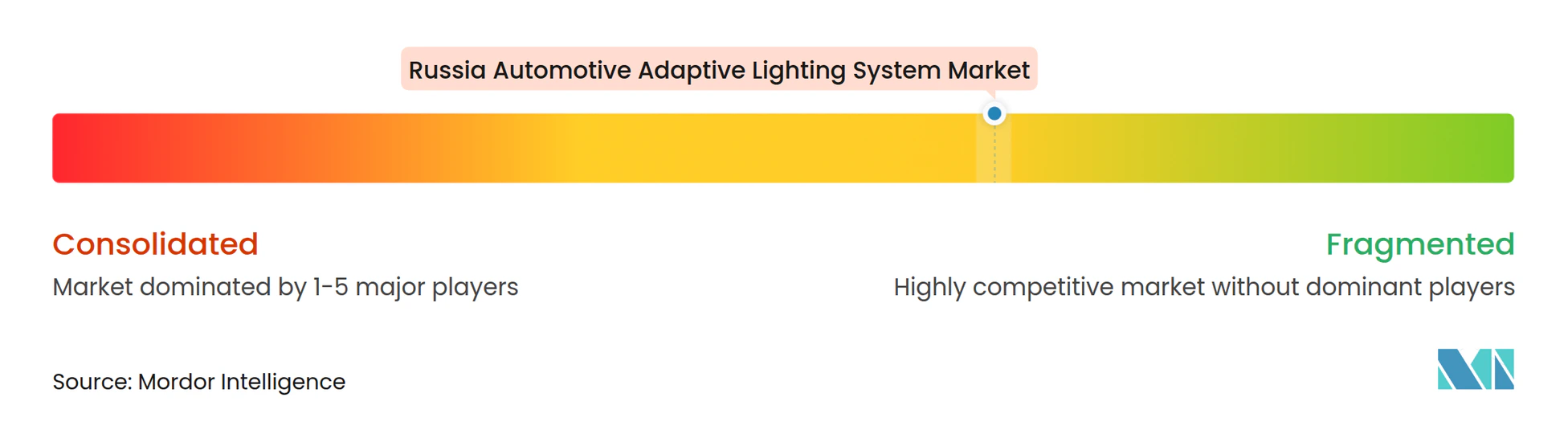
The Russian automotive adaptive light market is moderately fragmented. Domestic and Belarusian producers serve Russian OEM platforms, while Chinese suppliers gain access through vehicle programs that are either localized in Russia or imported into Russia. OSVAR JSC and Avtosvet LLC have established OEM relationships with AvtoVAZ, KAMAZ, GAZ Group, and UAZ, which link their lighting supply to production plans for domestic platforms. These relationships provide a stable route to domestic production volumes and make supplier continuity important for OEM operations. Rudensk has added in-house optical lens and printed circuit board capabilities, which reduce its exposure to imported inputs and support the regional availability of LED assemblies. The competitive environment therefore includes both local manufacturing capability and embedded Chinese tier-1 supply, with each group serving different vehicle programs and equipment requirements.
Chinese suppliers are positioned through the growth of Chinese OEM platforms in Russia. Their role is strongest in advanced LED, Matrix, and Pixel LED systems specified as part of the vehicle program, rather than those selected through a separate local purchasing decision after the vehicle reaches Russia. This gives them access to factory demand without requiring a separate aftermarket sales network. Regional suppliers remain important where domestic OEMs require dependable production, service support, and local familiarity with platform needs. The competitive balance also depends on the availability of compliant components and related electronics, since adaptive systems must work as an integrated vehicle function. Companies that can manage both lighting hardware and control systems have a more complete position in the Russian automotive adaptive lighting market and can meet requirements for both initial installation and later replacement.
FORVIA HELLA’s March 2026 collaboration with Zeekr on 25,000-pixel SSL|HD Galaxy Diamond Matrix Headlamps provides a benchmark for high-resolution lighting technology. Rudensk’s continued supply of LED headlamps to KAMAZ, NizhKomAvto, and Rostselmash shows the parallel importance of regional production capacity for Russian vehicle programs. EAC conformity assessment and type-approval documentation create a barrier for informal suppliers because compatible equipment must meet vehicle-level requirements and perform with the vehicle’s electronic systems. Established suppliers can leverage their certifications and OEM relationships to protect their position, while suppliers without these capabilities face a higher barrier to entry.
Russia Automotive Adaptive Lighting System Industry Leaders
-
Changzhou Xingyu Automotive Lighting Systems Co., Ltd.
-
FORVIA SE
-
Stanley Electric Co., Ltd.
-
ams-OSRAM AG
-
Koninklijke Philips NV
- *Disclaimer: Major Players sorted in no particular order
Recent Industry Developments
- July 2026: The Industry Development Fund disclosed that it provided a RUB 1.6 billion (USD 20.4 million) loan to Lighting Solutions JSC, a Russian automotive lighting manufacturer. The loan is intended to support the company's production capabilities and expand its presence in the domestic automotive lighting market.
- January 2026: The National Automobile Union (NAS) has submitted a proposal to Vladimir Kolokoltsev, Head of the Ministry of Internal Affairs of the Russian Federation. The appeal notes that the union regularly receives complaints about vehicles fitted with non-standard lighting devices, including xenon and LED lamps, as well as vehicles with modified exhaust systems.
Russia Automotive Adaptive Lighting System Market Report Scope
The Russia automotive adaptive lighting system report scope is segmented by vehicle type, type, sales channel, technology, function, component, and geography. By vehicle type, the market is segmented into passenger cars and commercial vehicles. By type, the market is segmented into front, rear, interior, and other adaptive lighting. By sales channel, the market is segmented into OEM and aftermarket. By technology, the market is segmented into adaptive halogen and xenon, LED adaptive front-lighting, matrix and pixel LED, laser lighting, and other adaptive lighting technologies. By function, the market is segmented into adaptive front-lighting, bending and cornering, automatic high-beam control, dynamic levelling, and other adaptive lighting functions. By component, the market is segmented into lamp assembly, controller, sensors and cameras, actuators and levelling modules, and other components, and by geography, the market is segmented into Central Federal District, Volga Federal District, Northwestern Federal District, Southern and North Caucasian Federal Districts, Ural Federal District, Siberian Federal District, and Far Eastern Federal District. The Market Forecasts are Provided in Terms of Value (USD).
By Vehicle Type
| Passenger Cars |
| Commercial Vehicles |
By Type
| Front |
| Rear |
| Interior and Other Adaptive Lighting |
By Sales Channel
| Original Equipment Manufacturer |
| Aftermarket |
By Technology
| Adaptive Halogen and Xenon |
| LED Adaptive Front-Lighting |
| Matrix and Pixel LED |
| Laser Lighting |
| Other Adaptive Lighting Technologies |
By Function
| Adaptive Front-Lighting, Bending and Cornering |
| Automatic High-Beam Control |
| Dynamic Levelling |
| Other Adaptive Lighting Functions |
By Component
| Lamp Assembly |
| Controller |
| Sensors and Cameras |
| Actuators and Levelling Modules |
| Other Components |
By Geography
| Central Federal District |
| Volga Federal District |
| Northwestern Federal District |
| Southern and North Caucasian Federal Districts |
| Ural Federal District |
| Siberian Federal District |
| Far Eastern Federal District |
| By Vehicle Type | Passenger Cars |
| Commercial Vehicles | |
| By Type | Front |
| Rear | |
| Interior and Other Adaptive Lighting | |
| By Sales Channel | Original Equipment Manufacturer |
| Aftermarket | |
| By Technology | Adaptive Halogen and Xenon |
| LED Adaptive Front-Lighting | |
| Matrix and Pixel LED | |
| Laser Lighting | |
| Other Adaptive Lighting Technologies | |
| By Function | Adaptive Front-Lighting, Bending and Cornering |
| Automatic High-Beam Control | |
| Dynamic Levelling | |
| Other Adaptive Lighting Functions | |
| By Component | Lamp Assembly |
| Controller | |
| Sensors and Cameras | |
| Actuators and Levelling Modules | |
| Other Components | |
| By Geography | Central Federal District |
| Volga Federal District | |
| Northwestern Federal District | |
| Southern and North Caucasian Federal Districts | |
| Ural Federal District | |
| Siberian Federal District | |
| Far Eastern Federal District |
Key Questions Answered in the Report
What is the forecast growth rate for automotive adaptive lighting in Russia?
The Russia automotive adaptive light market is forecast to grow at a 7.02% CAGR from 2027 to 2032, reaching USD 221.29 million by 2032.
Which vehicle category creates the largest demand for adaptive lighting in Russia?
Passenger cars lead with 78.29% share in 2026, supported by crossover-oriented Chinese OEM product programs.
Why do OEM channels account for most adaptive lighting sales?
OEM accounted for 84.63% in 2026 because adaptive systems require vehicle-specific calibration with cameras, suspension geometry, and control software.
Which component has the strongest projected growth?
Sensors and Cameras are forecast to grow at 8.11% CAGR through 2032 because adaptive lighting increasingly shares hardware with driver-assistance systems.
Which Russian region has the fastest expected growth?
The Far Eastern Federal District is forecast to grow at 8.09% CAGR through 2032, supported by Japanese imports and increasing Chinese vehicle sales.