
Market Overview
| Study Period | 2020 - 2032 |
|---|---|
| Forecast Data Period | 2027 - 2032 |
| Base Year Market Size (2026) | USD 0.26 Billion |
| Market Size (2027) | USD 0.28 Billion |
| Market Size (2032) | USD 0.43 Billion |
| Growth Rate (2027 - 2032) | 8.72 % |
| Market Concentration | Medium |
Major Players *Disclaimer: Major Players sorted in no particular order Image © Mordor Intelligence. Reuse requires attribution under CC BY 4.0. | |
Canada Automotive Adaptive Lighting System Market Analysis by Mordor Intelligence
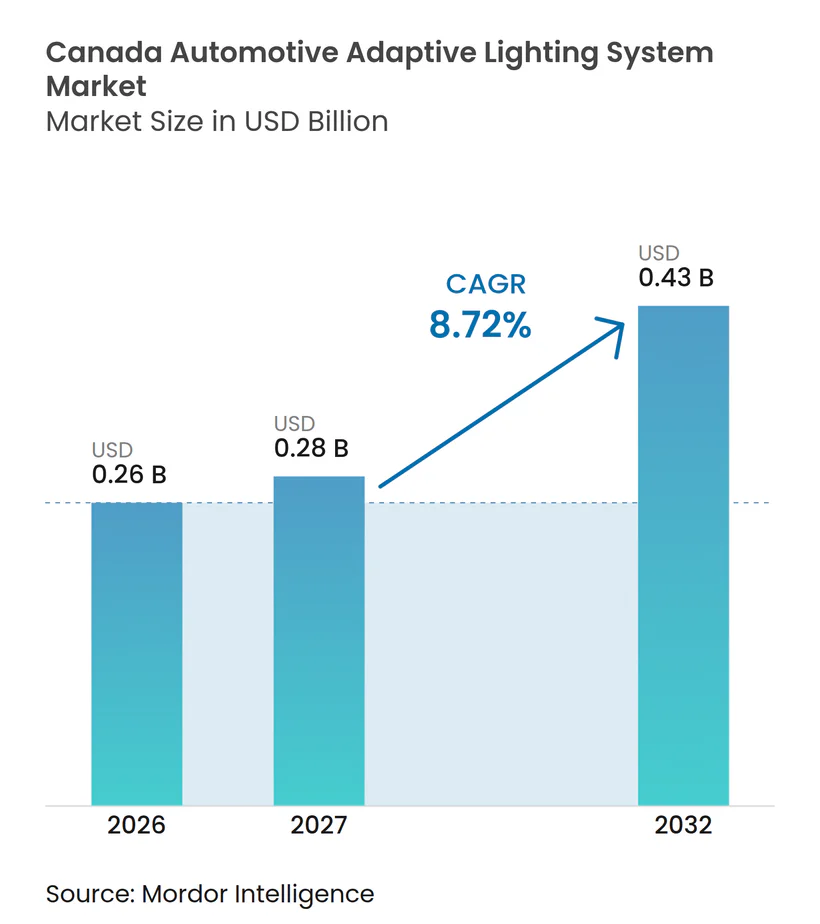
The Canada automotive adaptive lighting system market size is valued at USD 0.26 billion in 2026 and is expected to grow from USD 0.28 billion in 2027 to reach USD 0.43 billion by 2032, expanding at a CAGR of 8.72% during 2027–2032. The April 2025 revision to Canada’s lighting standard has removed a key barrier that once required separate Canadian and United States adaptive driving beam specifications[1]. This change permits manufacturers to carry compatible adaptive beam systems across shared North American vehicle platforms, reducing engineering duplication and supporting wider fitment. Severe winter conditions and long-distance driving add a practical safety case for systems that manage glare and improve forward illumination. Ontario’s concentrated assembly and supplier base also enables lighting suppliers to serve Canadian and U.S. programs through closely linked production networks.
Key Report Takeaways
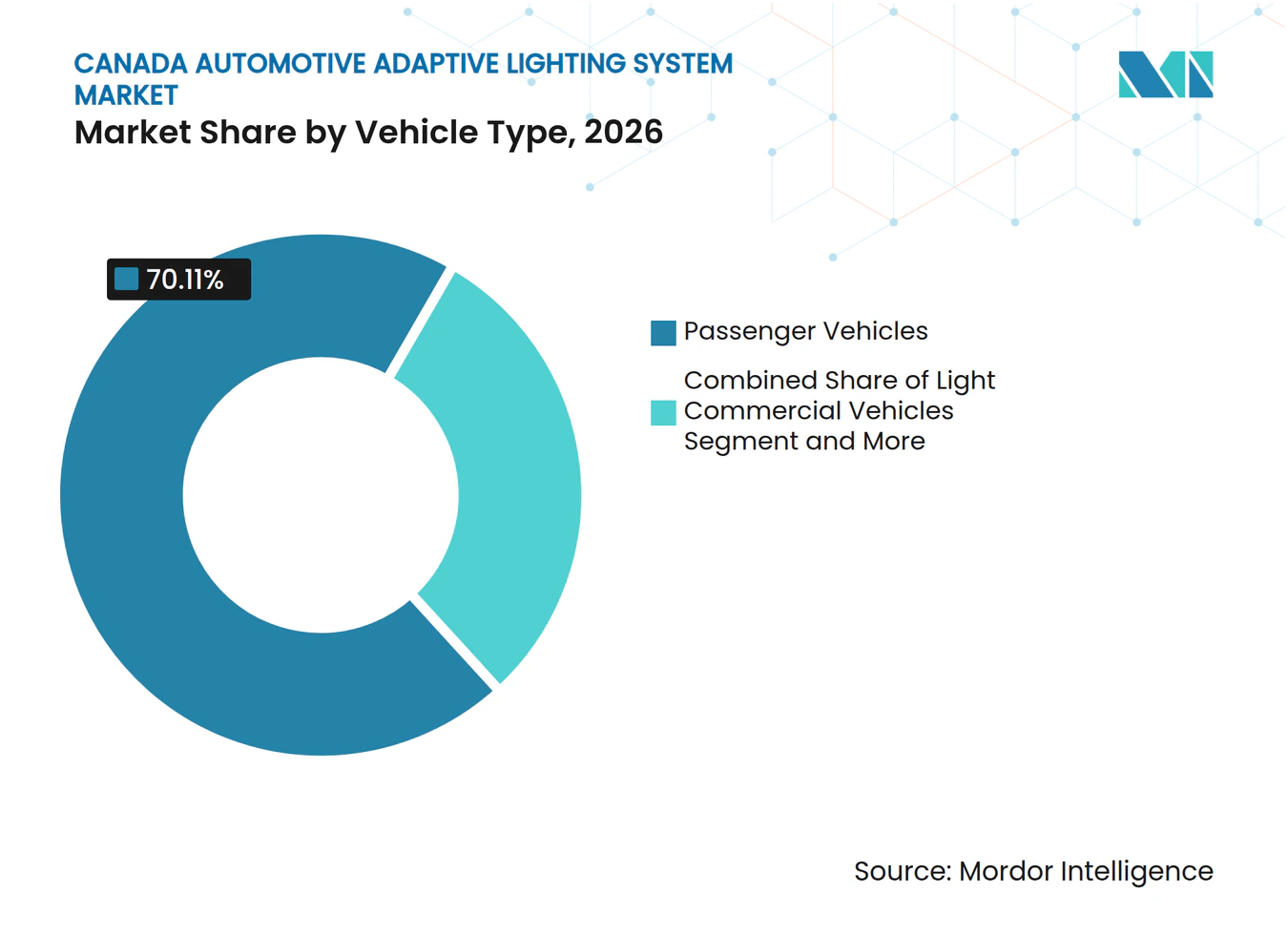
- By vehicle type, passenger vehicles held 70.11% of the Canadian automotive adaptive lighting system market share in 2026, while medium and heavy commercial vehicles are forecast to expand at a 9.25% CAGR through 2032.
- By application, exterior lighting accounted for 88.45% oof the Canadian automotive adaptive lighting system market share in 2026, while interior lighting will advance at a 10.34% CAGR through 2032.
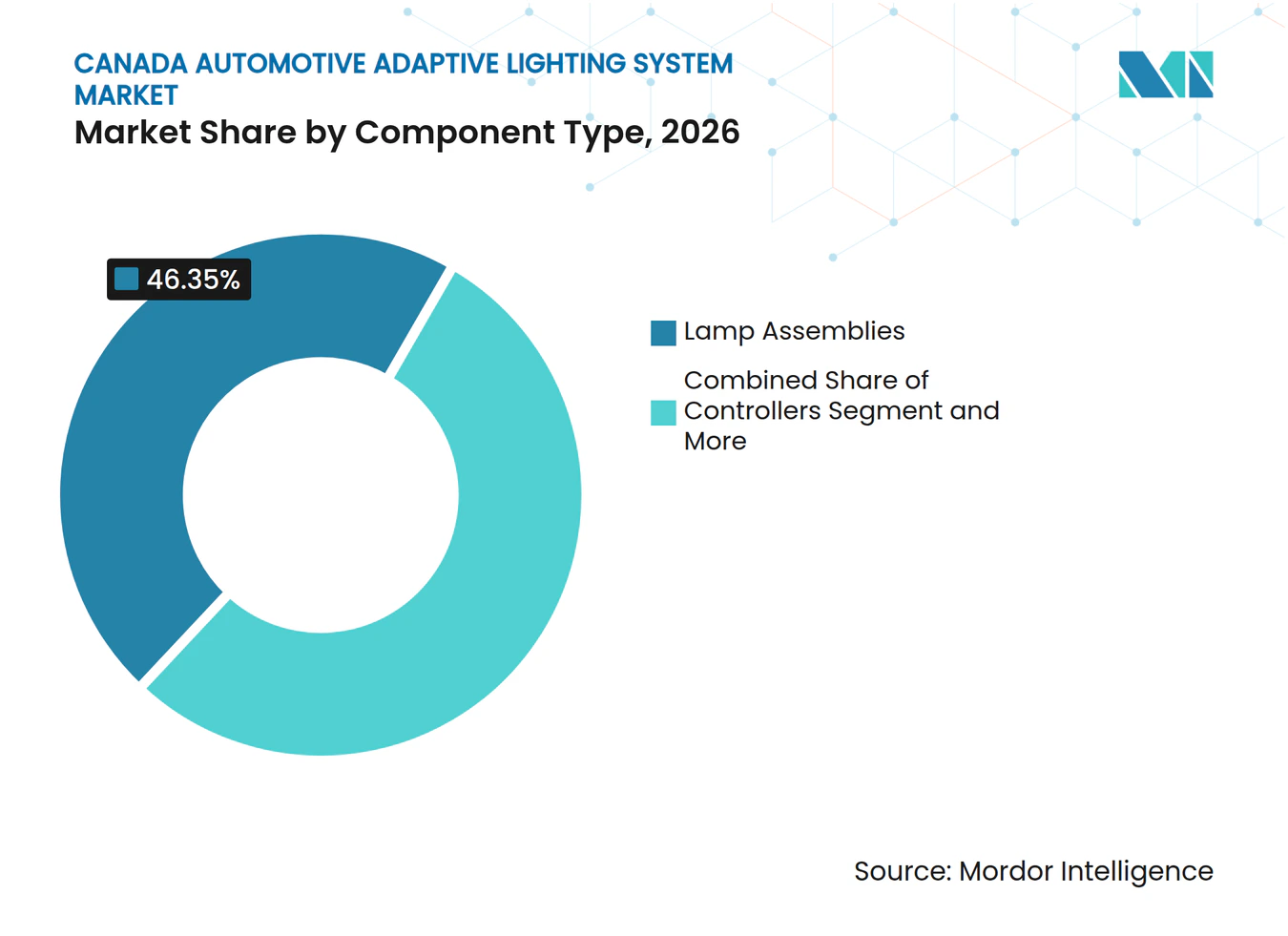
- By component type, lamp assemblies held 46.35% of the Canadian automotive adaptive lighting system market share in 2026, while sensors/cameras are projected to record the highest CAGR at 12.15% through 2032.
- By technology, LED systems held a 59.14% of the Canadian automotive adaptive lighting system market share in 2026, while laser lighting is forecast to expand at a 13.48% CAGR through 2032.
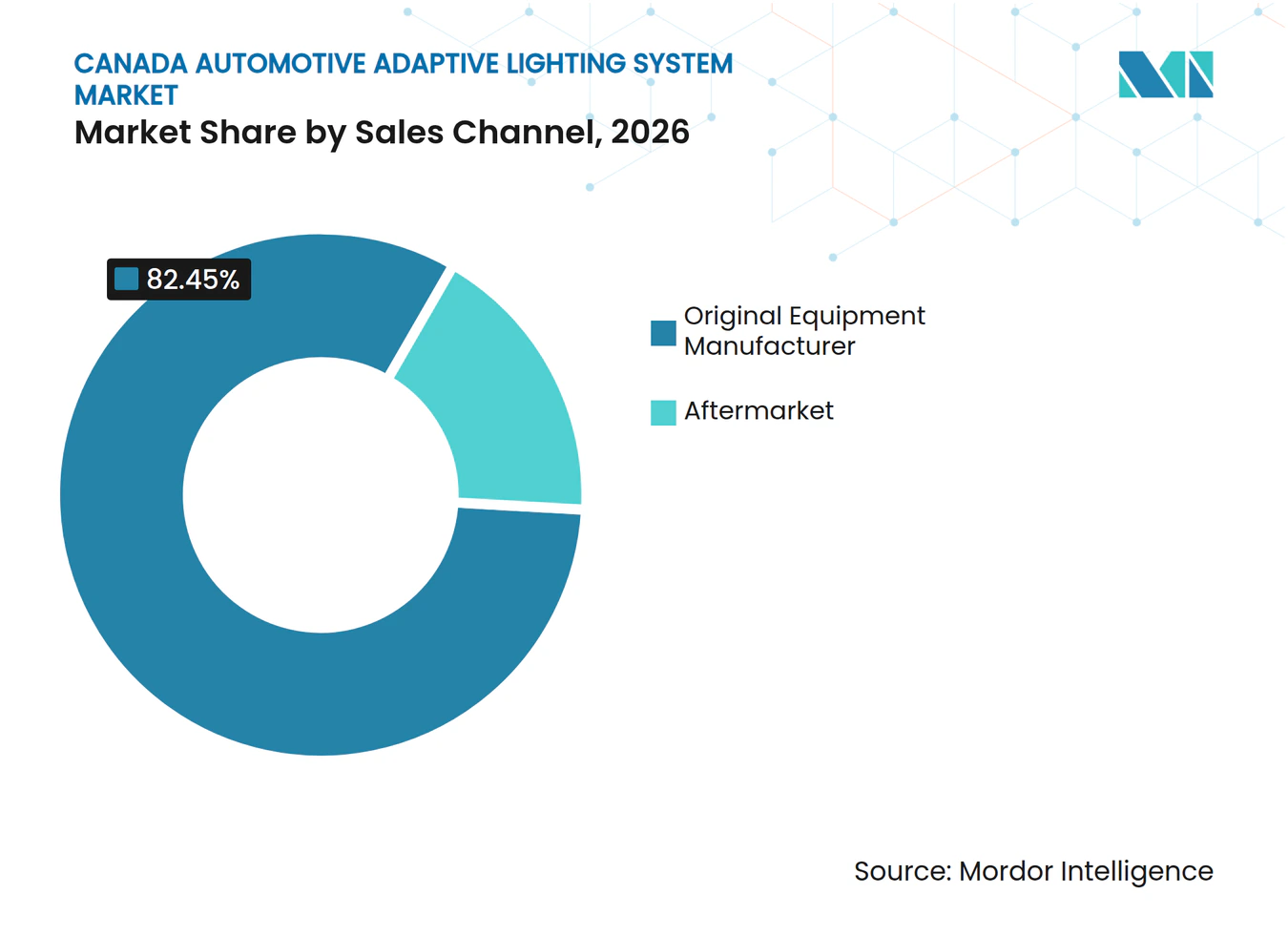
- By sales channel, OEM systems held an 82.45% of the Canadian automotive adaptive lighting system market share in 2026, while the aftermarket is projected to grow at a 9.86% CAGR through 2032.
- By functionality, automatic high beam held a 38.06% of the Canadian automotive adaptive lighting system market share in 2026, while adaptive front lighting systems are forecast to grow at an 11.23% CAGR through 2032.
Note: Market numbers in this report are based on Mordor Intelligence's proprietary estimation framework, which combines nine months of actuals with Q4 projections for base year 2026.
Canada Automotive Adaptive Lighting System Market Trends and Insights
Drivers Impact Analysis*
| Driver | (~) % Impact on CAGR Forecast | Geographic Relevance | Impact Timeline |
|---|---|---|---|
| Alignment With Adaptive Driving Beam Standards | +1.8% | National, concentrated in Ontario OEM assembly corridor | Short term (≤ 2 years) |
| Night Driving and Variable Weather Visibility | +1.5% | BC and Alberta alpine corridors, Northern and Central Ontario, Prairie provinces | Long term (≥ 4 years) |
| Premium SUV and Pickup Feature | +1.4% | National, Ontario assembly, Alberta and BC purchase clusters | Medium term (2-4 years) |
| Camera and Sensor Enabled Vehicle Expansion | +1.2% | National, with ADAS activity concentrated in Southern Ontario and Quebec | Medium term (2-4 years) |
| Ontario OEM and Supplier Ecosystem | +1.0% | Ontario, Windsor-Ottawa corridor | Long term (≥ 4 years) |
| Cross Border North American Commonality | +0.9% | National, with early gains in Windsor-Detroit and Toronto-area engineering centers | Medium term (2-4 years) |
| Source: Mordor Intelligence | |||
CMVSS 108 Alignment With Adaptive Driving Beam Standards
Transport Canada’s April 2025 update to Technical Standards Document 108 incorporated the adaptive driving beam requirements used in U.S. Federal Motor Vehicle Safety Standard 108. The standard specifies light limits directed toward other road users and includes system requirements for adaptive driving beam operation. This removes the need to develop distinct Canadian headlamp specifications for many shared North American platforms. Manufacturers can therefore apply compatible systems to vehicles intended for Canada and the United States. The Canadian automotive adaptive lighting system market benefits because a common specification improves the case for adding these systems to more vehicle trims. Suppliers also gain from using a single validated module and software configuration across a larger production base.
Winter Night-Driving and Variable-Weather Visibility Requirements
Winter driving remains a significant safety issue because Canadian roads are characterized by low light, snow, fog, ice, and rapid weather changes. Transport Canada reported 1,964 road fatalities in 2023, which was the highest annual total in a decade. Adaptive systems can reduce glare while extending useful illumination where road and traffic conditions allow. Active light direction significantly improves nighttime perceptual performance. This supports the growing link between lighting design and vehicle sensing. The Canadian automotive adaptive lighting system market is therefore supported by demand for lighting that performs under difficult night-driving conditions.
Premium SUV and Pickup Feature-Take-Rate Expansion
Premium SUVs, pickups, and crossovers have helped advance lighting from a limited luxury feature to a broader equipment option. Upper trims commonly bundle adaptive headlights, cornering functions, and automatic high beams with other driver-assistance features. Cadillac lists choreographed adaptive headlamps, cornering lights, and headlamp leveling on the 2026 Escalade [2]. Such packaging raises the value of lighting content on higher-priced vehicles. It also gives suppliers a route to scale components before those features move to lower vehicle segments.
Camera- and Sensor-Enabled Vehicle Expansion
Forward-facing cameras are becoming more common in vehicles with safety and driver-assistance features. Front automatic emergency braking is expected to become increasingly prevalent among registered vehicles in North America by 2029. These cameras can provide a useful hardware base for adaptive beam functions that need to identify other road users. Transport Canada is also consulting on changes related to automatic emergency braking systems for light vehicles. This supports closer integration between lighting, sensing, and software. As a result, sensors and cameras are set to outgrow traditional component categories in the Canadian automotive adaptive lighting system market.
Restraints Impact Analysis*
| Restraint | (~) % Impact on CAGR Forecast | Geographic Relevance | Impact Timeline |
|---|---|---|---|
| Cost for Integrated LED and Matrix Modules | -1.5% | National, acute in mid-income markets outside Ontario and BC | Medium term (2-4 years) |
| Retrofit and Inspection Complexity | -0.8% | Ontario, Quebec, British Columbia, provinces with differentiated inspection regimes | Long term (≥ 4 years) |
| Weather Electronics and Thermal Stress | -0.7% | Northern Ontario, Prairie provinces, Northern Quebec | Long term (≥ 4 years) |
| Limited Domestic Production Scale | -0.6% | National | Medium term (2-4 years) |
| Source: Mordor Intelligence | |||
High Replacement Cost for Integrated LED and Matrix Modules
Integrated LED, matrix, and laser headlamp assemblies can create a costly repair decision after a collision. The design combines optics, thermal management, electronics, sensors, and controllers within a sealed housing. A fault in one element can require replacement of the complete assembly. This can push consumers and insurers toward replacement decisions instead of repair. It also slows adoption in vehicle segments where the added-feature cost is difficult to recoup through resale value.
Retrofit and Inspection Complexity
Aftermarket installation remains more difficult than factory fitment because adaptive systems must meet both vehicle and lighting requirements. Provincial inspection practices can add further documentation needs for modified vehicles. This increases the cost and time required for retrofit businesses. OEM-installed systems avoid much of this burden because they are validated with the vehicle during production. The channel structure, therefore, continues to favor factory-supplied systems in the Canadian automotive adaptive lighting system market.
*Our forecasts treat driver/restraint impacts as directional, not additive. The impact forecasts reflect baseline growth, mix effects, and variable interactions.
Segment Analysis
By Vehicle Type: Commercial Vehicle Uptake Diversifies the Base
Passenger vehicles held 70.11% of the Canadian automotive adaptive lighting system market share in 2026. Crossovers, SUVs, and premium sedans support this position because advanced lighting is common in higher trim packages. Cadillac and Lexus offer advanced lighting features on selected Canadian-market vehicles. Light commercial vehicles drive demand, with vans and midsize pickups used for delivery and service work. Passenger vehicles will remain the primary revenue source as retail demand favors light trucks and utility vehicles.
Medium and heavy commercial vehicles are forecast to register a 9.25% CAGR through 2032, the highest rate by vehicle type. Long-haul fleets can use adaptive systems to manage glare and improve forward coverage on rural and intercity roads. The standard applies across vehicle classes, giving commercial platforms access to the common adaptive beam pathway. Shared camera and sensor modules can also support broader safety functions. The faster growth rate diversifies demand toward safety-focused commercial applications.



By Application: Exterior Dominance Shapes System Architecture
Exterior lighting accounted for 88.45% of the Canadian automotive adaptive lighting system market size in 2026. Headlamps, cornering lamps, and adaptive beam systems carry most of the value because they deliver the core safety function. The range of exterior functions is widening on premium and electric vehicle platforms. Valeo presented a laser-scanning ground-projection module with Infineon MEMS technology at Auto China 2026. The module supports hazard projection, lane marking, and pedestrian signaling.
Interior lighting is expected to grow at a 10.34% CAGR through 2032. Ambient lighting and rear-cabin illumination are the main current uses. Electric vehicle makers use these features to differentiate interiors, but their application remains smaller than that of exterior lighting. Near-infrared illumination for driver-monitoring cameras may add a functional use case over time. Exterior systems will remain the leading application because they address central safety and regulatory requirements.
By Component Type: Sensors Outpace Traditional Lamp Assemblies
Lamp assemblies accounted for 46.35% of the Canadian automotive adaptive lighting system market in 2026. The headlamp remains the largest revenue item because it combines optics, housings, heat management, electronic drivers, and control functions. Controllers and actuators support beam movement and intensity adjustment in many adaptive designs. Lamp assemblies will retain a substantial share as vehicle makers increase their use of LED and pixel-based modules. Their position makes module reliability central to supplier competition.
Sensors/cameras are forecast to grow at a 12.15% CAGR through 2032. Updated adaptive beam requirements rely on detection functions that distinguish oncoming and leading vehicles. OMNIVISION introduced its OX08D20 8-megapixel automotive image sensor in October 2025, with low-light technology and a package 50% smaller than comparable exterior sensors. These designs can help broader vehicle segments adopt advanced lighting hardware.

By Technology: LED Dominance Challenged by Laser Precision
LED technology held 59.14% of the Canadian adaptive lighting systems sector in 2026. Its position reflects broad use across passenger and commercial vehicles, as well as fleet applications. LED modules provide a practical path away from halogen and xenon systems on new vehicle programs. Their thermal management is relevant in regions that experience severe winter conditions. Halogen systems are losing importance as new platforms shift toward LED specifications.
Laser lighting is forecast to achieve a 13.48% CAGR through 2032, the fastest rate by technology. Audi states that its laser lighting can extend the high-beam cone to 600 meters. The technology is well-suited for high-speed, long-distance use, but its cost limits its fitment to premium vehicles. Digital Matrix LED alternatives are also advancing and may reduce the future cost advantage of laser modules. Both technologies operate within the adaptive beam standards applied under Canada’s updated regulatory framework.
By Sales Channel: OEM Concentration Sustains Revenue Quality
OEM sourcing accounted for 82.45% of the Canadian automotive adaptive lighting system market value in 2026. This channel leads because complex modules need vehicle-level validation, thermal testing, and regulatory documentation. Factory installation also lets automakers package lighting with cameras, driver-assistance systems, and trim features. Ontario’s assembly concentration supports close delivery relationships between automakers and lighting suppliers. These conditions make OEM supply the main route for sophisticated adaptive systems.
The aftermarket is forecast to grow at a 9.86% CAGR through 2032. Demand comes from vehicles entering the used fleet with advanced hardware and from owners replacing aging halogen products. ams OSRAM expanded its ECE-approved Night Breaker LED SPEED range in October 2026 for several lamp types. Full adaptive systems still require compliance and calibration. The aftermarket will therefore remain smaller than the OEM supply despite its faster growth rate.
By Functionality: Adaptive Front Lighting Outstrips High Beam Control
Automatic high beam held 38.06% of the Canadian automotive adaptive lighting system market share in 2026. It is the most established adaptive feature and appears on many mid-range vehicles. The function shifts between high and low beam based on surrounding traffic. Dynamic bending lights and cornering lights are generally added in higher trim packages. Automatic high beam will retain the broadest reach because it offers an accessible entry point.
Adaptive front lighting systems are forecast to grow at an 11.23% CAGR through 2032. These systems use camera inputs and lighting control to direct illumination where it is most useful. Directing illumination toward detected objects improves nighttime perception performance. This gives adaptive front lighting a role beyond driver comfort. It can support the wider sensor stack used for vehicle safety functions.
Geography Analysis
Ontario serves as the primary geographic hub of Canada's automotive adaptive lighting system market. The province has a well-established automotive ecosystem, including automakers, assembly plants, and an extensive supplier base along the Windsor-Ottawa corridor. This industrial base makes a significant contribution to Canada's automotive sector gross domestic product and vehicle production. Ontario is expected to remain the primary hub for program development, sourcing, and factory installation.
Alberta and British Columbia represent important demand centers for commercial and premium vehicle applications. Long-distance road networks, freight activity, and challenging winter conditions create a practical need for enhanced illumination. Heavy commercial vehicles are expected to be the fastest-growing vehicle type during the forecast period. Alberta supports large fleets that operate year-round, while British Columbia's mountainous routes increase the value of systems that manage glare and improve visibility during nighttime travel.
Quebec has a meaningful secondary role through Montreal-area automotive research and a vehicle base that includes higher-end European marques. Provincial inspection requirements can make aftermarket modifications more difficult, which favors factory-installed systems. Atlantic Canada remains smaller because it has fewer vehicles, less freight density, and limited assembly activity. Winter driving needs still support demand for better lighting in those provinces. The Canadian automotive adaptive lighting system market will retain a national footprint with a clear Ontario production center.
Competitive Landscape
Market Concentration
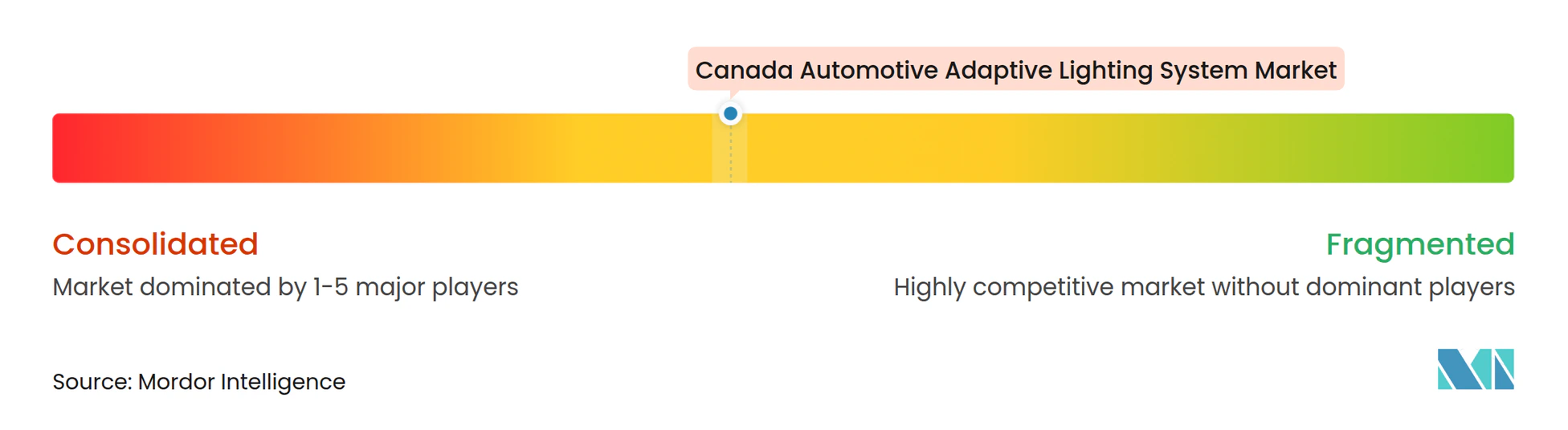
The Canadian automotive adaptive lighting system market is moderately concentrated among established Tier-1 suppliers. FORVIA HELLA, Valeo, and Koito hold strong positions through long-term OEM supply relationships and global lighting capabilities. FORVIA HELLA stated in April 2026 that its Lighting division is focusing on volume-segment technologies, manufacturing cost optimization, premium adaptive driving beam systems, and pixel LED architectures [3]. Supplier scale is valuable because automakers require reliable validation, manufacturing quality, and program support. Competitive positions are strengthened by relationships that span several vehicle cycles.
Valeo presented a ground-projection module that integrates Infineon MEMS technology for hazard projection, lane marking, and pedestrian signaling. Koito prioritizes the early market introduction of adaptive driving beam systems and next-generation communication lamps while expanding capacity in the Americas. ams OSRAM has also worked with ZKW on the EVIYOS HD25 module used in the Audi Q3. These actions show that component suppliers are influencing headlamp architecture earlier in the design cycle. The Canadian automotive adaptive lighting system market gives these suppliers a route into shared North American vehicle programs.
New suppliers face barriers because adaptive systems require photometric testing, sensor integration, thermal validation, and OEM qualification. The Canadian automotive adaptive lighting system industry remains led by experienced global integrators that can meet these requirements. Competition will depend on product cost, compliance, and the ability to integrate lighting with safety functions.
Canada Automotive Adaptive Lighting System Industry Leaders
-
Koito Manufacturing Co., Ltd.
-
Valeo SA
-
Stanley Electric Co., Ltd.
-
Hella GmbH & Co. KGaA
-
Marelli Holdings Co., Ltd.
- *Disclaimer: Major Players sorted in no particular order
Recent Industry Developments
- February 2026: Toyota introduced the all-new 2026 C-HR, expanding its growing battery electric vehicle (BEV) lineup. The new C-HR BEV is one of 21 electrified models in Toyota’s Canadian lineup. Its Automatic High Beams (AHB) system detects the headlights of oncoming vehicles and the taillights of preceding vehicles, automatically switching between high and low beams as appropriate.
- February 2026: The 2026 Volkswagen Tiguan was launched with a completely redesigned safety architecture tailored to Alberta's unique driving conditions. Dynamic headlights with cornering lights adjust the beam direction based on steering input, improving visibility through turns. The Adaptive Front-light System modifies beam patterns to suit driving conditions.
Canada Automotive Adaptive Lighting System Market Report Scope
The scope includes segmentation by vehicle type (passenger vehicles, light commercial vehicles, and medium- and heavy-duty commercial vehicles), application (exterior lighting and interior lighting), component type (controllers, sensors/cameras, lamp assemblies, actuators, and others), technology (light-emitting diode, xenon and high-intensity discharge, halogen, and laser lighting), sales channel (original equipment manufacturer and aftermarket), and functionality (automatic high beam, dynamic bending light, cornering light, and adaptive front lighting). Market size and growth forecasts are presented by value in USD and volume in Units.
By Vehicle Type
| Passenger Vehicles |
| Light Commercial Vehicles |
| Medium and Heavy Commercial Vehicles |
By Application
| Exterior Lighting |
| Interior Lighting |
By Component Type
| Controllers |
| Sensors/Cameras |
| Lamp Assemblies |
| Actuators |
| Others |
By Technology
| Light-Emitting Diode (LED) |
| Xenon and High-Intensity Discharge |
| Halogen |
| Laser Lighting |
By Sales Channel
| Original Equipment Manufacturer (OEM) |
| Aftermarket |
By Functionality
| Automatic High Beam |
| Dynamic Bending Light |
| Cornering Light |
| Adaptive Front Lighting |
Cross-segmentation Analysis
| Vehicle Type by Application |
| Vehicle Type by Sales Channel |
| By Vehicle Type | Passenger Vehicles |
| Light Commercial Vehicles | |
| Medium and Heavy Commercial Vehicles | |
| By Application | Exterior Lighting |
| Interior Lighting | |
| By Component Type | Controllers |
| Sensors/Cameras | |
| Lamp Assemblies | |
| Actuators | |
| Others | |
| By Technology | Light-Emitting Diode (LED) |
| Xenon and High-Intensity Discharge | |
| Halogen | |
| Laser Lighting | |
| By Sales Channel | Original Equipment Manufacturer (OEM) |
| Aftermarket | |
| By Functionality | Automatic High Beam |
| Dynamic Bending Light | |
| Cornering Light | |
| Adaptive Front Lighting | |
| Cross-segmentation Analysis | Vehicle Type by Application |
| Vehicle Type by Sales Channel |
Key Questions Answered in the Report
What is the forecast growth rate for adaptive vehicle lighting in Canada?
The Canada automotive adaptive lighting system market is projected to grow at a CAGR of 8.72% during the forecast period (2027–2032), reaching USD 0.43 billion by 2032.
Which vehicle type leads demand for adaptive lighting systems in Canada?
Passenger vehicles lead with 70.11% share in 2026, supported by crossovers, SUVs, and premium sedans.
Which lighting technology is growing fastest in Canada?
Laser lighting has the highest projected growth rate, with a 13.48% CAGR through 2032.
Which sales channel dominates advanced automotive lighting systems?
OEM sourcing leads with 82.45% share in 2026 because factory installation supports vehicle-level testing, integration, and compliance.