
Market Overview
| Study Period | 2019 - 2031 |
|---|---|
| Forecast Data Period | 2026 - 2031 |
| Base Year Market Size (2025) | USD 27.17 Million |
| Market Size (2026) | USD 29.47 Million |
| Market Size (2031) | USD 44.25 Million |
| Growth Rate (2026 - 2031) | 8.47 % |
| Market Concentration | Medium |
Major Players *Disclaimer: Major Players sorted in no particular order Image © Mordor Intelligence. Reuse requires attribution under CC BY 4.0. | |
Argentina Automotive Adaptive Lighting System Market Analysis by Mordor Intelligence
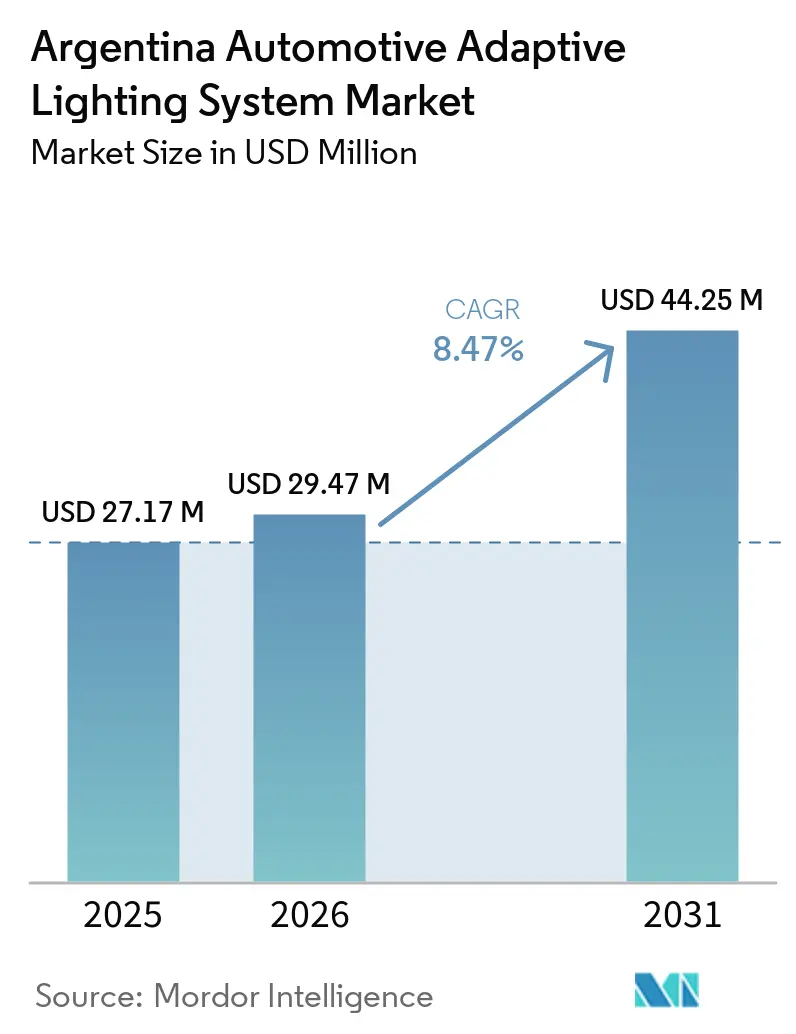
The Argentine Automotive Adaptive Lighting System Market size was valued at USD 27.17 million in 2025 and is estimated to grow from USD 29.47 million in 2026 to reach USD 44.25 million by 2031, at a CAGR of 8.47% during the forecast period (2026-2031). Regulatory harmonization with Mercosur, a rapid post-pandemic production rebound, and Córdoba’s component-cluster incentives are creating favorable conditions for the adoption of matrix LED and camera-linked beam-steering technologies. Automakers are localizing high-value lighting modules to mitigate foreign-exchange risk, while tier-one suppliers are integrating perception hardware to support ADAS roadmaps. Demand also benefits from an aging vehicle fleet, which extends replacement cycles, and from insurers offering significant premium discounts for ADAS-equipped vehicles. Furthermore, Mercosur’s planned adoption of UN ECE vehicle lighting regulations is triggering large-scale model refreshes that favor solid-state adaptive driving beams.
Key Report Takeaways
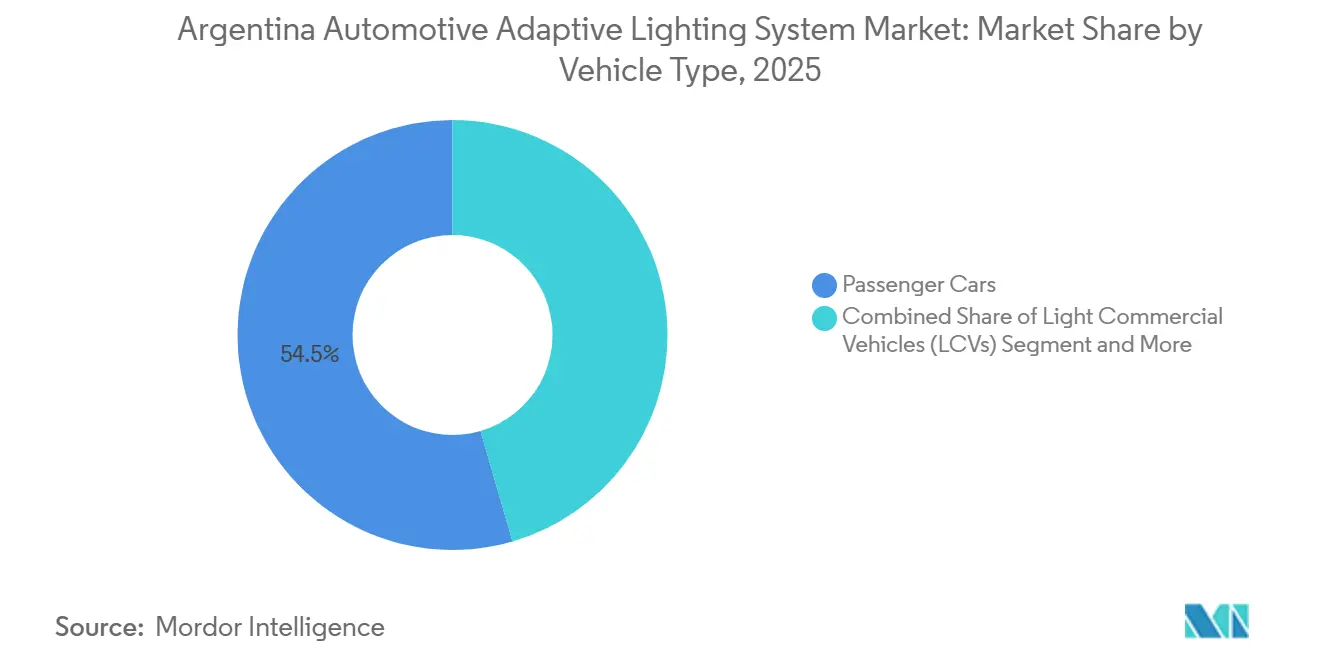
- By vehicle type, passenger cars led with 54.46% of the Argentine automotive adaptive lighting system market share in 2025, whereas light commercial vehicles are forecast to grow at a 9.55% CAGR through 2031.
- By lighting type, front adaptive headlamps dominated with 63.41% revenue share in 2025, while rear adaptive tail-lamps are poised to advance at a 9.64% CAGR to 2031.
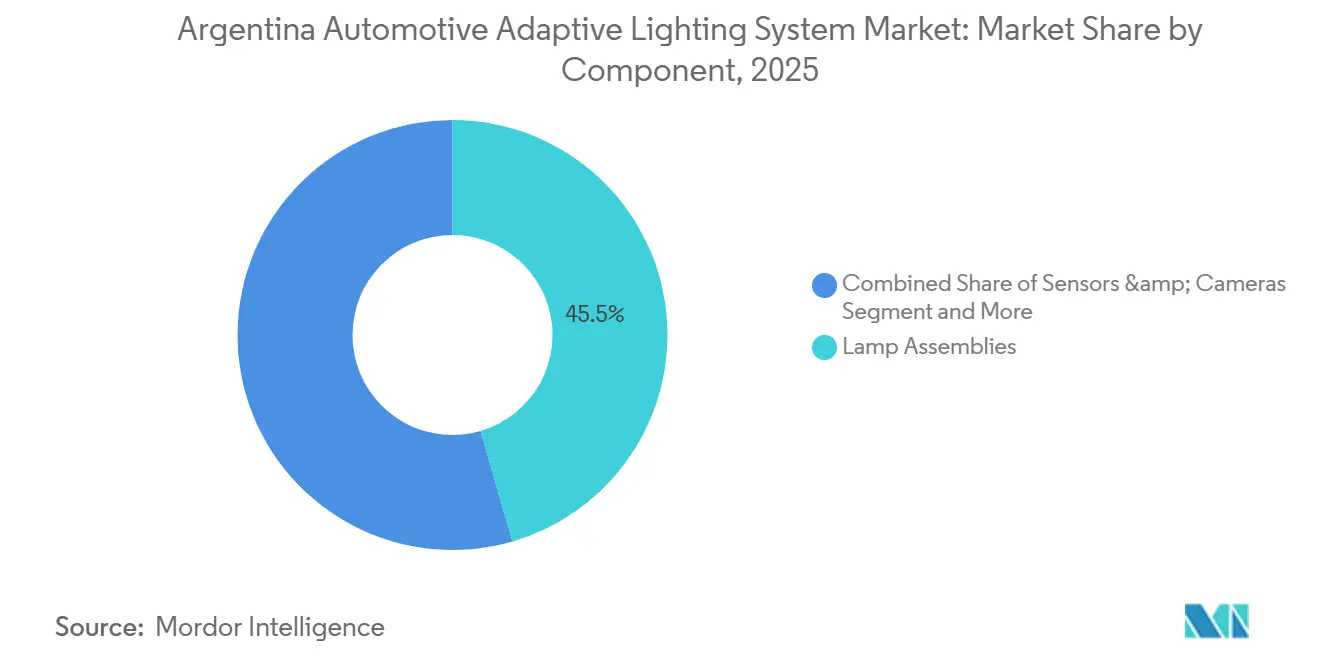
- By component, lamp assemblies accounted for 45.53% of the Argentine automotive adaptive lighting system market size in 2025, and sensors are expected to register a 9.58% CAGR between 2026 and 2031.
- By sales channel, OEM supply captured 83.37% of 2025 revenue, as the aftermarket is projected to climb at a 9.61% CAGR on wider availability of OE-grade adaptive parts.
Note: Market size and forecast figures in this report are generated using Mordor Intelligence’s proprietary estimation framework, updated with the latest available data and insights as of January 2026.
Argentina Automotive Adaptive Lighting System Market Trends and Insights
Drivers Impact Analysis*
| Driver | (~) % Impact on CAGR Forecast | Geographic Relevance | Impact Timeline |
|---|---|---|---|
| Stricter UN ECE R123 Lighting Compliance Slated for Mercosur 2026 | +4.1% | National (Argentina, Uruguay, Paraguay, Brazil alignment) | Short term (≤ 2 years) |
| Growing Consumer Demand for In-Vehicle Safety & Comfort | +3.2% | National, concentrated in Greater Buenos Aires, Córdoba, Rosario metro areas | Medium term (2-4 years) |
| Post-Pandemic Rebound of Passenger-Car Production Volumes | +2.8% | National, led by Córdoba and Buenos Aires manufacturing hubs | Medium term (2-4 years) |
| Córdoba LED-Component Cluster Incentives Boosting Local Supply | +2.6% | Córdoba province, spillover to Santa Fe and Buenos Aires | Long term (≥ 4 years) |
| Insurer Premium Discounts for ADAS-Equipped Vehicles Boosting Adaptive Take-Rates | +1.9% | National, early adoption in Córdoba provincial fleets | Medium term (2-4 years) |
| Mercosur–EU Tech-Transfer Pacts on Smart Lighting IP | +1.5% | National, technology diffusion from São Paulo and Buenos Aires R&D centers | Long term (≥ 4 years) |
| Source: Mordor Intelligence | |||
Stricter UN ECE R123 Lighting Compliance Slated for Mercosur 2026
In a move to streamline imports, Argentina has consented to recognize Annex 5-B test reports. However, this decision underscores a challenge: the country has limited capacity for accredited testing labs. Recently, certification fees increased significantly, leading to a noticeable rise in unit costs. This shift is steering suppliers towards pursuing higher-volume contracts to offset the increased expenses. Meanwhile, global tier-1 suppliers, like Valeo, are adopting software-defined LED arrays. These advanced systems can be updated over-the-air, sidestepping the need for expensive hardware redesigns in response to evolving regulations [1].
Growing Consumer Demand for In-Vehicle Safety & Comfort
Argentina’s aging fleet now averages 14.2 years, and owners replacing vehicles increasingly insist on factory-fitted adaptive LEDs for night-time crash avoidance [2]. Fleet buyers representing 38% of light commercial registrations negotiate lower insurance premiums when adaptive lighting is specified. Corolla Cross and Kardian launched in 2024, deploying adaptive lamps in mainstream trims, signaling that the feature has shifted from a luxury option to a baseline safety requirement. Higher take-rates shorten supplier payback periods and justify Córdoba-based LED assembly lines. The trend also pressures workshops to upskill so they can offer camera alignment and beam calibration outside the dealer network.
Post-Pandemic Rebound of Passenger-Car Production Volumes
Output experienced significant growth from a low point in the past to a much higher level in recent years, with expectations of steady performance in the near future as Stellantis and Toyota introduce new platforms. Volkswagen is expanding Amarok output at its General Pacheco plant, lifting annual capacity, with adaptive lighting fitted as standard. Córdoba, which dominates national production, benefits from shorter lead times as suppliers localize modules; for example, F2JLighting significantly reduced its shipment cycles after launching its matrix-capable line. Additionally, the depreciation of the peso has increased the cost of imported parts, further encouraging OEMs to prioritize domestic sourcing for lighting solutions.
Córdoba LED-Component Cluster Incentives Boosting Local Supply
Provincial Law 10,622 cuts the gross-receipts tax in half for electronics suppliers. Meanwhile, federal Decree 281/2023 offers accelerated depreciation on capital equipment. F2JLighting, with a significant investment in its plant, produces a substantial volume of full-LED headlamps annually for multiple OEMs and collaborates with INTI Córdoba to train a considerable number of technicians. Due to access to the Universidad Nacional de Córdoba’s photonics lab, prototype cycles are significantly shortened. With EU-Mercosur tariffs on lighting components gradually decreasing, Argentine firms are seizing the opportunity to localize early, positioning themselves to scale up before facing full competition from Europe.
Restraints Impact Analysis*
| Restraint | (~) % Impact on CAGR Forecast | Geographic Relevance | Impact Timeline |
|---|---|---|---|
| High Upfront Cost of Adaptive Lighting Modules | -2.4% | National, most acute in price-sensitive compact and subcompact segments | Medium term (2-4 years) |
| Macro-Economic Volatility and Import-License Delays | -1.8% | National, concentrated impact on importers and non-integrated suppliers | Short term (≤ 2 years) |
| Tier-2 Skills Gap in Camera/Sensor Calibration | -1.3% | Córdoba, Buenos Aires, Rosario industrial zones | Medium term (2-4 years) |
| Scarcity of Local Homologation and Photometry Labs | -0.9% | National, bottleneck for aftermarket and small-volume OEMs | Long term (≥ 4 years) |
| Source: Mordor Intelligence | |||
High Upfront Cost of Adaptive Lighting Modules
Vehicle costs increase significantly with the addition of an adaptive LED headlamp. This premium is notable, particularly in a market where a majority of sales occur at lower price points. In the aftermarket, replacement units for certain vehicle models are priced substantially higher compared to their halogen counterparts. Currency depreciation during the specified period further drove up prices for imported components, such as driver ICs and cameras, despite a global decline in semiconductor prices. Consequently, OEMs are now limiting adaptive lamps to mid-level or higher trims, ensuring a clear price distinction between entry-level and premium models. Although local production is gradually reducing this cost disparity, it continues to be a barrier for consumers with limited purchasing power.
Macro-Economic Volatility and Import-License Delays
DJAI permits transition to SIMI, streamlining paperwork to a much shorter process. However, numerous tariff codes, encompassing items like LEDs and cameras, still mandate non-automatic licenses. These licenses can significantly extend foreign-exchange access. Suppliers, maintaining safety stocks for several months, find their capital tied up and face potential currency losses. Meanwhile, Decree 384/2024 has put a stop to importing used parts. This move not only shut down a gray market that catered to a notable portion of the replacement demand but also nudged consumers towards pricier OE units. In response to these challenges, multinationals are now hedging against peso fluctuations and strategically positioning their inventory—maneuvers that prove challenging for smaller firms to replicate.
*Our forecasts treat driver/restraint impacts as directional, not additive. The impact forecasts reflect baseline growth, mix effects, and variable interactions.
Segment Analysis
By Vehicle Type: Fleet Electrification Spurs Commercial Uptake
Light commercial vehicles are projected to post a 9.55% CAGR through 2031, outpacing passenger cars despite the latter’s 54.46% revenue share in 2025. Passenger cars remain the backbone of the Argentine automotive adaptive lighting system market, buoyed by the Corolla Cross and Kardian launches that embed adaptive LEDs as standard in mid-range trims. Medium and heavy trucks lag, given 12-15 year asset lives and tighter payback hurdles, but Stellantis tooling investments hint that adoption will spread once component prices fall. Localized headlamp output slashes import lead times, enabling OEMs to add adaptive functions in line with regulatory cycles and consumer demand.
Argentina's automotive adaptive lighting system market growth in commercial segments is magnified by last-mile logistics and by incentives for flex-fuel platforms that reward vibration-resistant optics. Passenger-car demand aligns with rising safety awareness and vehicles that now average eight-to-ten-year replacement spans. The segment mix creates a balanced outlook: passenger cars secure volume for local plants, while light commercials inject above-average revenue per unit, strengthening the overall Argentine automotive adaptive lighting system market trajectory.



By Lighting Type: Rear Modules Leverage ADAS Convergence
Front adaptive headlamps captured 63.41% of 2025 revenue and will remain the technology anchor as UN ECE R123 comes into force. Rear adaptive tail-lamps are set to compound at 9.64% as OEMs roll out camera-integrated reversing lights and sequential indicators that satisfy UN ECE R48 amendments. Drive Sensing Technology from Magna merges blind-spot detection with lighting functions, cutting bill-of-materials and delivering a clean design surface for stylists. The Argentine automotive adaptive lighting system market thus shows a dual engine: regulation drives front modules, while design and ADAS fusion propel the rear.
Rear-lighting expansion also benefits from easier packaging in compact vehicles where front-end real estate is crowded with radar and camera sensors. Sequential taillights are migrating from premium SUVs to subcompact crossovers, widening accessible volume. Altogether, the cross-pollination of safety compliance and brand identity elevates penetration across both axes of the Argentine automotive adaptive lighting system market.
By Component: Sensors Capture Fastest Growth Curve
Lamp assemblies remained the largest revenue slice at 45.53% in 2025, yet sensors and cameras will deliver a 9.58% CAGR as perception merges with illumination. KOITO’s purchase of Cepton positions solid-state LiDAR inside headlamps, shrinking integration cost and unlocking over-the-air upgrades. Aptiv’s PULSE sensor couples 360-degree cameras with ultra-short-range radar, a combination OEMs view as a one-stop ADAS enabler. Controller units evolve alongside, but tighter semiconductor integration pressures margins per board. Consequently, the Argentine automotive adaptive lighting system market mixes a maturing lamp segment with an accelerating sensor tier, securing layered revenue over the forecast window.
Even as sensors surge, replacement demand in the aging fleet anchors lamp volumes. Magneti Marelli lists more than 5,000 OE references, sustaining a sizable aftermarket flow. Connector and harness subcategories see steady if modest growth as OEMs standardize interfaces for global platforms, further integrating the Argentine automotive adaptive lighting system industry into wider supply chains.

By Sales Channel: Aftermarket Opens as OE Parts Reach Independents
OEM channels claimed 83.37% of 2025 revenue, reflecting long-term supply contracts with Stellantis, Toyota, Volkswagen, and Renault. The aftermarket is projected to expand at a 9.61% CAGR, driven by Magneti Marelli’s distribution of OE-grade adaptive modules to independent workshops. Bosch’s tablet-guided calibration platform aims to democratize access to capability, though the hardware costs deter small shops. As volumes grow and skills expand, the aftermarket will play a pivotal support role in the Argentine automotive adaptive lighting system market.
OEM demand continues to benefit from production expansion plans such as Volkswagen’s Amarok and Stellantis flex-fuel lines, guaranteeing baseline volumes for local tier-1s. Vertically integrated suppliers with local plants buffer against currency risk and licensing delays, positioning them to dominate early aftermarket share once warranty periods lapse.
Geography Analysis
In Argentina, the adaptive lighting value chain is primarily concentrated in Córdoba, Buenos Aires, and Rosario. Córdoba, a major hub for the country's vehicle production, benefits from substantial provincial tax reductions. These incentives support F2JLighting’s high-capacity headlamp plant, positioning the province as a key production center. Buenos Aires accounts for a dominant share of the country's new-vehicle sales and has the largest dealer network, supporting strong aftermarket demand. Rosario, home to General Motors’ pickup production line, contributes a smaller share of output and relies on Córdoba’s photometry laboratories, which lengthen homologation cycles. Although SIMI license reforms have reduced administrative lead times, non-automatic classifications for LEDs and cameras continue to create significant foreign-exchange delays, benefiting suppliers located in Córdoba.
In Tier-2 cities, such as Mendoza and Tucumán, limited dealership coverage has created calibration deserts, constraining consumer adoption. However, mobile service units represent an emerging opportunity. As the EU-Mercosur tariff phase-down progresses, Córdoba’s early investments in localized electronics position the province to protect its market share from European imports.
Argentina's automotive adaptive lighting system market exhibits a core-periphery dynamic, with production and R&D activities concentrated in Córdoba, supported by the province's established automotive manufacturing base and supplier ecosystem. Greater Buenos Aires represents the primary demand center, driven by its high vehicle population, concentration of dealerships, and relatively stronger consumer adoption of advanced automotive technologies.
Competitive Landscape
Market Concentration
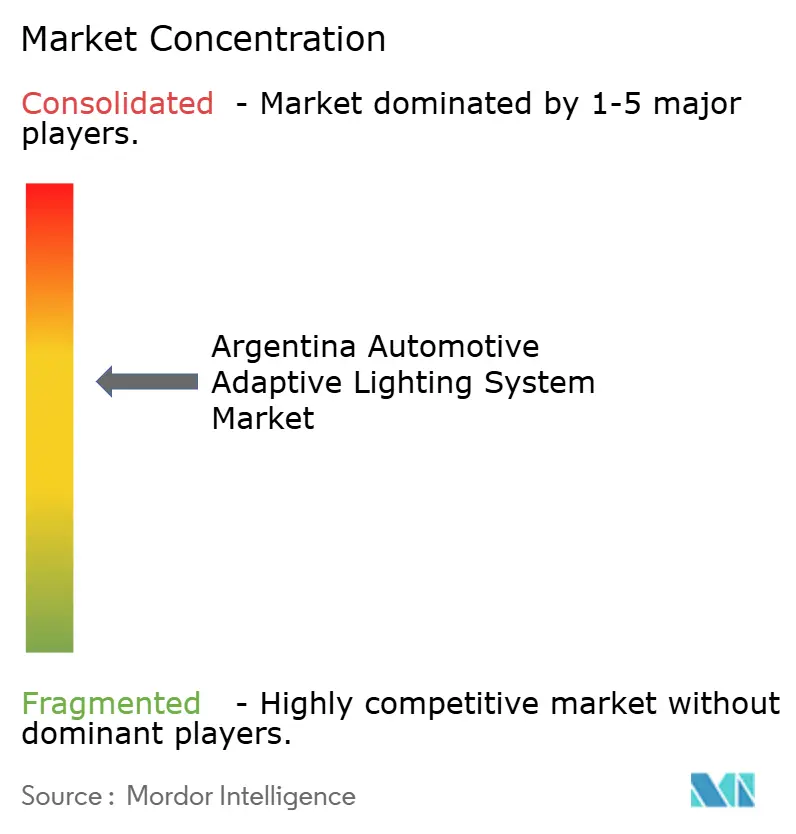
Global tier-1s—HELLA, Valeo, Magneti Marelli, KOITO, and OSRAM Continental—dominate a significant share of contracted volumes. They achieve design wins by swiftly adhering to UN ECE standards and offering bundled ADAS functionalities. Meanwhile, local integrators like Flex-N-Gate Argentina, Cibie Argentina, and FATE Lighting capitalize on their proximity to OEM assembly lines and lower labor costs, securing a notable portion of the market.
Technology convergence is reshaping the competitive landscape: KOITO’s acquisition of Cepton brings LiDAR into its fold, Valeo’s partnership with ams OSRAM paves the way for software-defined pixels, and Magna is embedding ADAS sensors into rear lamps. Córdoba-based F2JLighting stands out with its localized approach, producing matrix-ready units and upskilling technicians to meet national demands.
INTI’s constrained lab capacity inadvertently benefits established players with multi-model contracts, creating hurdles for newcomers. The EU-Mercosur R&D fund is set to heighten competition, granting European suppliers advantageous collaboration terms. While start-ups introducing cloud calibration and retrofittable sensor packs eye potential service niches, they face challenges in homologation and currency, necessitating robust capital. Overall, the Argentine automotive adaptive lighting system market showcases a blend of moderate concentration and dynamic technological evolution.
Argentina Automotive Adaptive Lighting System Industry Leaders
-
HELLA GmbH & Co. KGaA
-
Valeo SA
-
Koninklijke Philips N.V.
-
Stanley Electric Co. Ltd.
-
ams-OSRAM AG
- *Disclaimer: Major Players sorted in no particular order
Recent Industry Developments
- January 2026: Hella GmbH & Co. KGaA expanded its front-lighting portfolio by integrating adaptive daytime running light (DRL) signatures into its next-generation systems. These architectures featured energy-optimized configurations designed to reduce auxiliary battery drain in electric and hybrid vehicles.
- September 2025: Valeo Group enhanced its smart exterior lighting platforms with dynamic intensity control modules. These systems are natively integrated with onboard forward-facing cameras and ADAS radar data to automatically adjust light distribution and mitigate blind spots in bend lighting.
- September 2025: Valeo and Ennostar unveiled a Mini LED exterior display system for high-definition signaling.
- April 2025: Stanley Electric and Mitsubishi Electric Mobility created a joint venture to develop next-generation automotive lamp systems combining optical control and ADAS-oriented electronics.
Argentina Automotive Adaptive Lighting System Market Report Scope
The scope of the report includes Vehicle Type (Passenger Cars and More), Lighting Type (Front Adaptive Lighting and Rear Adaptive Lighting), Component (Lamp Assemblies and More), and Sales Channel (OEM and Aftermarket). The Market Forecasts are Provided in Terms of Value (USD) and Volume (Units).
By Vehicle Type
| Passenger Cars |
| Light Commercial Vehicles (LCVs) |
| Medium & Heavy Commercial Vehicles (M&HCVs) |
By Lighting Type
| Front Adaptive Lighting (Headlamps) |
| Rear Adaptive Lighting (Tail-lamps) |
By Component
| Lamp Assemblies |
| Sensors & Cameras |
| Controllers |
| Others |
By Sales Channel
| OEM |
| Aftermarket |
| By Vehicle Type | Passenger Cars |
| Light Commercial Vehicles (LCVs) | |
| Medium & Heavy Commercial Vehicles (M&HCVs) | |
| By Lighting Type | Front Adaptive Lighting (Headlamps) |
| Rear Adaptive Lighting (Tail-lamps) | |
| By Component | Lamp Assemblies |
| Sensors & Cameras | |
| Controllers | |
| Others | |
| By Sales Channel | OEM |
| Aftermarket |
Key Questions Answered in the Report
How large is the Argentine automotive adaptive lighting system market in 2026?
The market is valued at USD 29.47 million in 2026 and is forecast to reach USD 44.25 million by 2031.
Which vehicle class is growing fastest for adaptive lighting adoption?
Light commercial vehicles are expected to record a 9.55% CAGR through 2031 thanks to fleet safety upgrades.
What regulation is driving technology upgrades in Argentine headlamps?
The forthcoming Mercosur adoption of UN ECE R123 will require adaptive driving beams on all new models from 2026.
Why is Córdoba significant within the national supply chain?
The province hosts 62% of vehicle output, offers 50% tax relief on electronics, and contains Argentina’s main LED headlamp factory.
What limits aftermarket growth for adaptive lighting?
A shortage of technicians trained in ADAS camera calibration forces many repairs into expensive dealer workshops.
How are suppliers combining lighting with ADAS functions?
Tier-1s embed cameras, radar, or LiDAR inside lamp housings, enabling perception and adaptive beam control in a single module.