
Market Overview
| Study Period | 2019 - 2031 |
|---|---|
| Forecast Data Period | 2026 - 2031 |
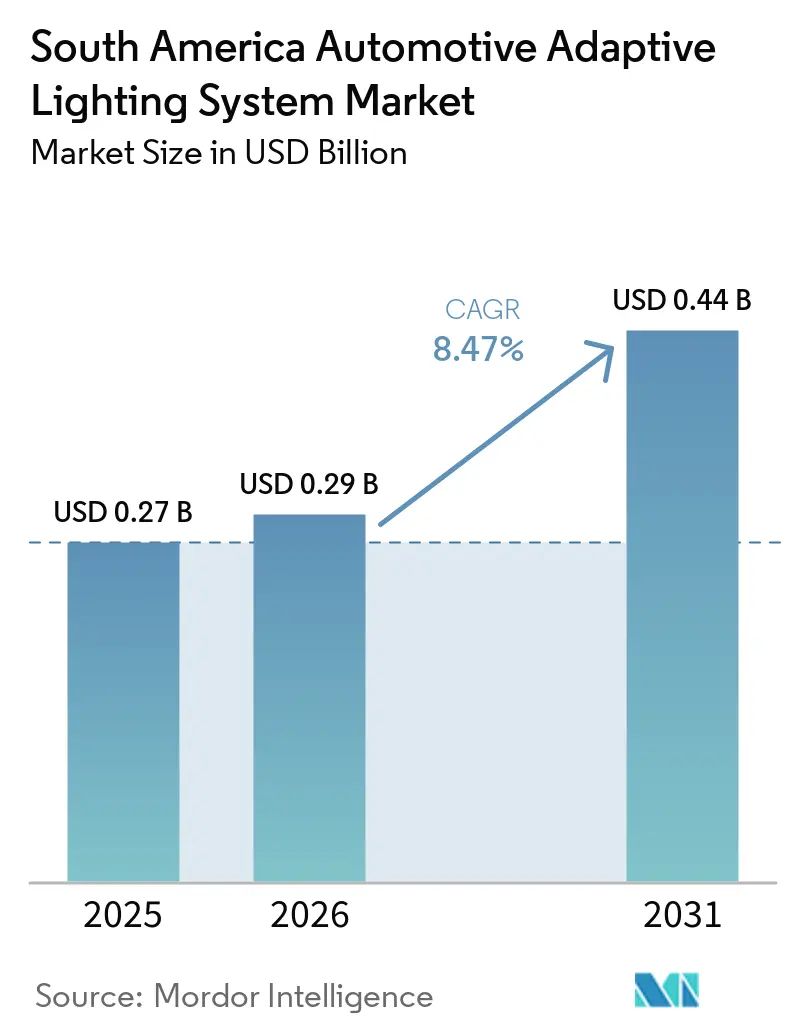
| Base Year Market Size (2025) | USD 0.27 Billion |
| Market Size (2026) | USD 0.29 Billion |
| Market Size (2031) | USD 0.44 Billion |
| Growth Rate (2026 - 2031) | 8.47 % |
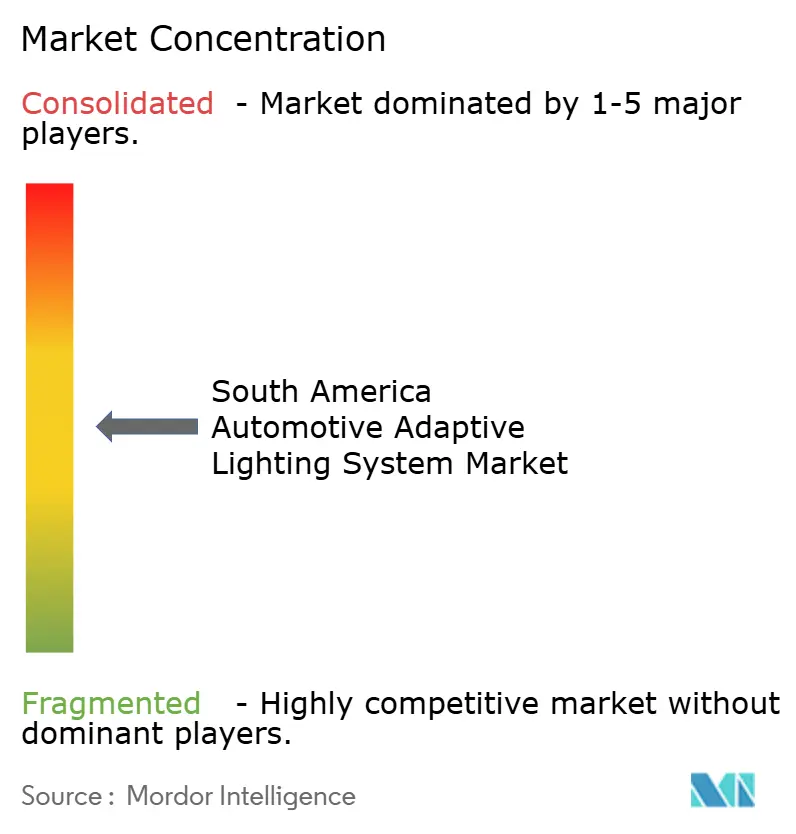
| Market Concentration | Medium |
Major Players
*Disclaimer: Major Players sorted in no particular order Image © Mordor Intelligence. Reuse requires attribution under CC BY 4.0. |
|
South America Automotive Adaptive Lighting System Market Analysis by Mordor Intelligence
The South America automotive adaptive lighting system market size was valued at USD 0.27 billion in 2025 and is estimated to grow from USD 0.29 billion in 2026 to reach USD 0.44 billion by 2031, at a CAGR of 8.47% during the forecast period (2026-2031). The South America automotive adaptive lighting system market is being shaped by wider LED adoption, more safety-related vehicle features, and demand for better visibility at night. Vehicle makers are integrating lighting systems earlier in the design process, which makes factory-installed systems more important than later upgrades. Electrification also enables higher lighting content, as newer vehicle platforms can integrate lighting controls with other electronic functions. Cost remains important in entry-level vehicles, so suppliers are working to offer simpler adaptive functions that fit lower-priced models. Brazil remains central to regional activity because it combines vehicle assembly, a large installed fleet, and a broad base of replacement parts.
Key Report Takeaways
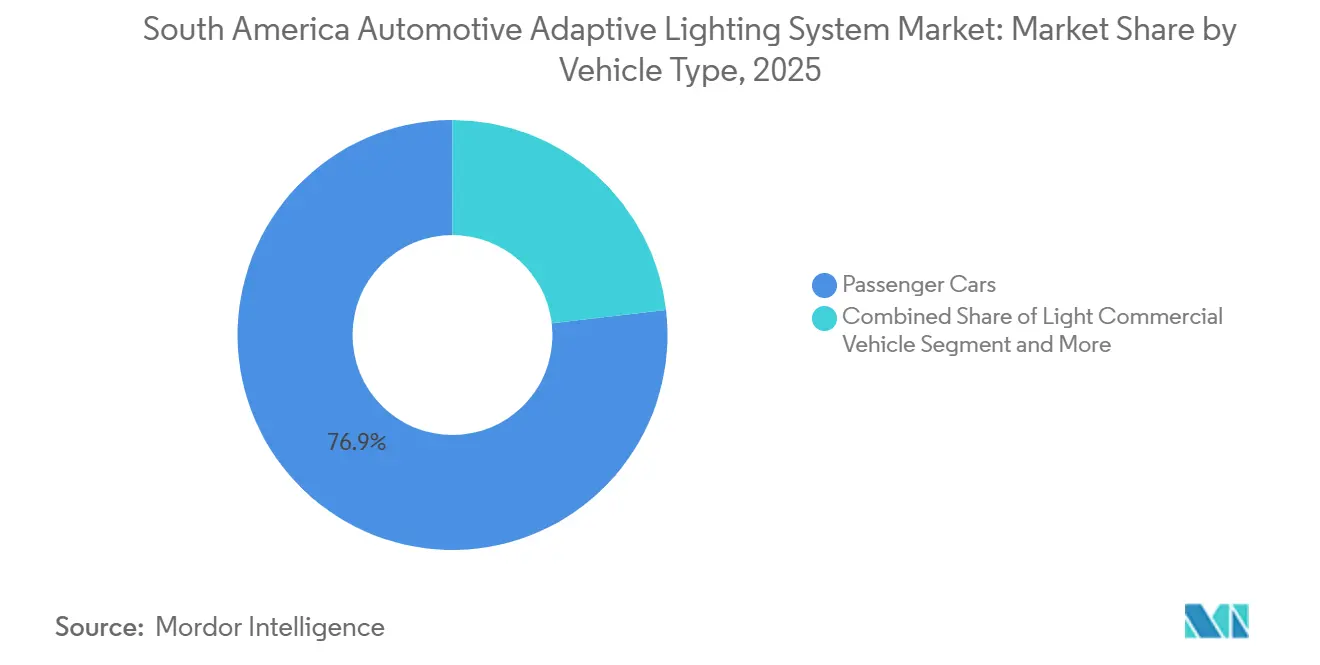
- By vehicle type, passenger cars held 76.86% of revenue in 2025, while two-wheelers are forecast to grow at an 11.13% CAGR through 2031.
- By system type, adaptive front-lighting systems held 58.41% of revenue in 2025, while road-projection lighting systems are forecast to grow at a 15.18% CAGR through 2031.
- By component, lamp assemblies held 52.26% of revenue in 2025, while sensors and cameras are forecast to grow at a 13.16% CAGR through 2031.
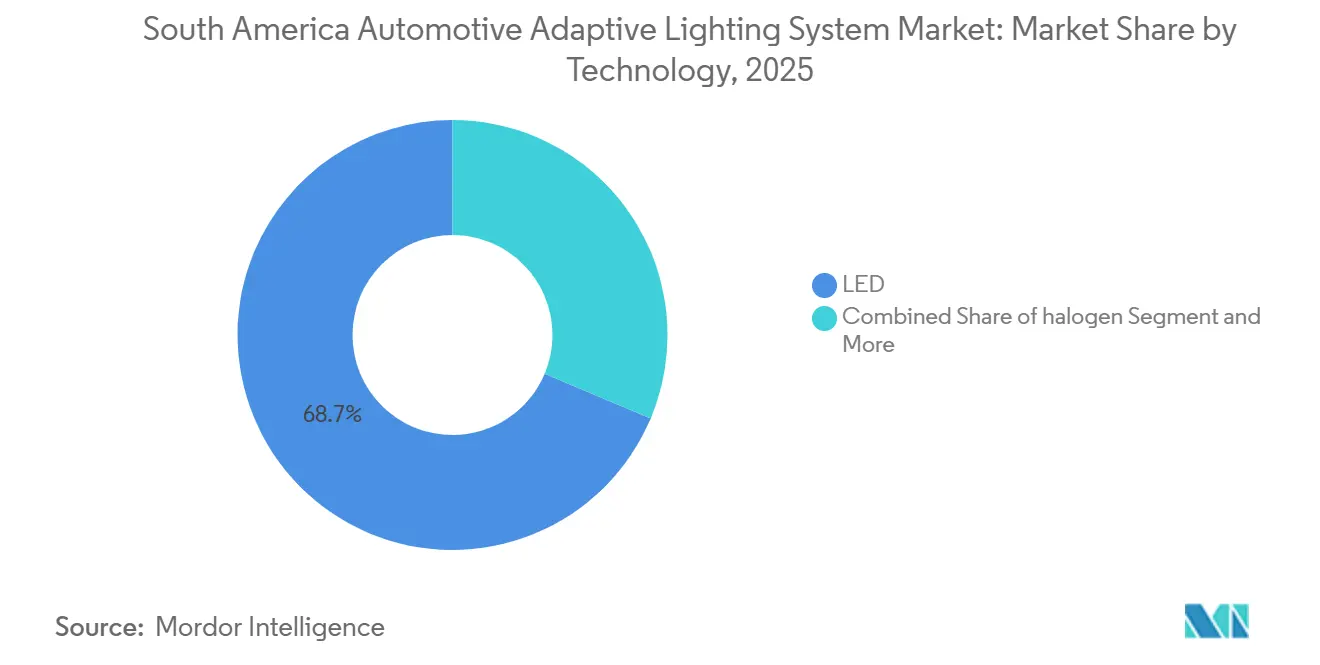
- By technology, LED held 68.66% of revenue in 2025, while matrix LED is forecast to grow at a 10.12% CAGR through 2031.
- By application, front lighting held 66.61% of revenue in 2025, while pedestrian and road-hazard projection is forecast to grow at a 15.18% CAGR through 2031.
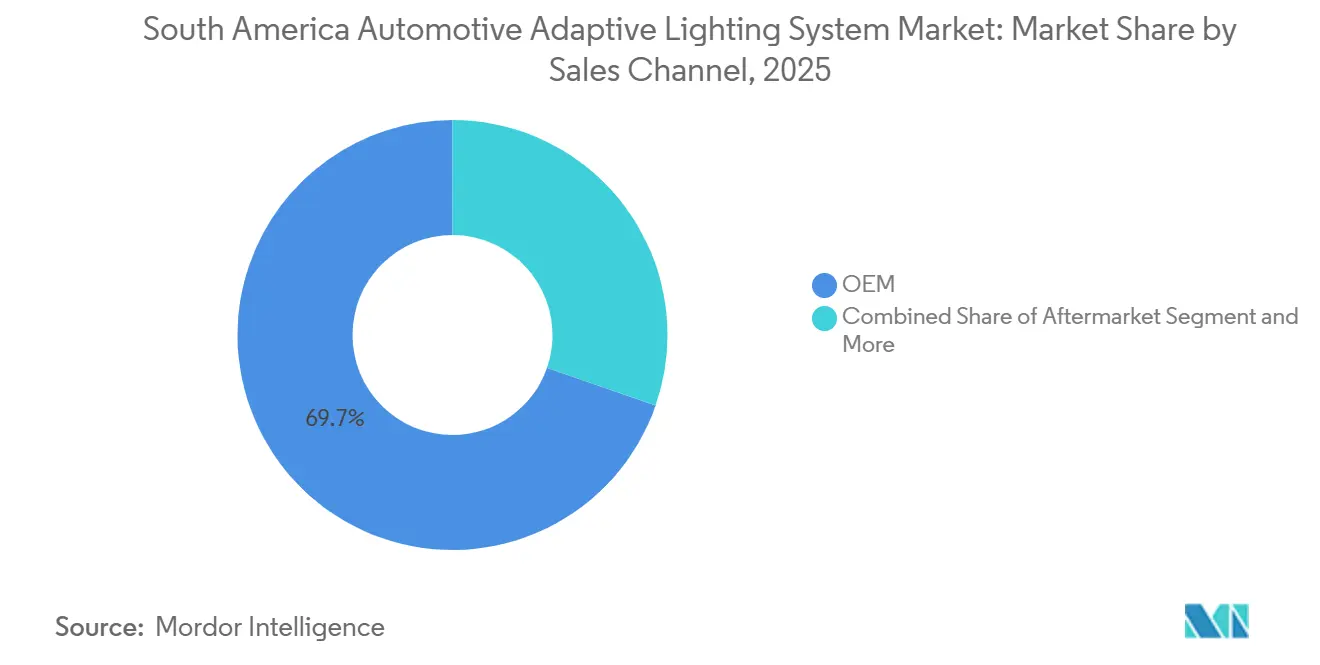
- By sales channel, OEM held 69.68% of revenue in 2025, while the aftermarket is forecast to grow at an 8.15% CAGR through 2031.
- By end user, passenger mobility held 74.81% of revenue in 2025, while commercial transport fleets are forecast to grow at an 11.13% CAGR through 2031.
- By country, Brazil accounted for 37.92% of revenue in 2025, while Argentina is exected to grow at a 9.01% CAGR.
Note: Market size and forecast figures in this report are generated using Mordor Intelligence’s proprietary estimation framework, updated with the latest available data and insights as of January 2026.
South America Automotive Adaptive Lighting System Market Trends and Insights
Drivers Impact Analysis*
| Driver | (~) % Impact on CAGR Forecast | Geographic Relevance | Impact Timeline |
|---|---|---|---|
| LED and Matrix Lighting Adoption | +2.5% | São Paulo (Brazil), Minas Gerais (Brazil), Córdoba (Argentina), Buenos Aires Province (Argentina) | Short term (≤ 2 years) |
| Rising Integration of Safety and ADAS Features | +2.0% | São Paulo (Brazil), Minas Gerais (Brazil), Buenos Aires Province (Argentina), Antioquia (Colombia) | Medium term (2-4 years) |
| Increasing Lighting Content per Vehicle | +1.5% | Chile (Región Metropolitana), Uruguay, São Paulo (Brazil), Bogotá-Cundinamarca (Colombia) | Long term (≥ 4 years) |
| Safer Night-Time Driving Demand | +1.0% | Brazil (nationwide, acute concentration in Rio de Janeiro, São Paulo, Minas Gerais), Colombia, Chile | Medium term (2-4 years) |
| Imported Vehicle Specifications Accelerating Technology Transfer | +0.8% | São Paulo (Brazil), Buenos Aires Province (Argentina), Región Metropolitana (Chile) | Short term (≤ 2 years) |
| Retrofit Demand from an Aging Vehicle Parc | +0.5% | Brazil (nationwide), Argentina (nationwide, concentrated in Greater Buenos Aires and Córdoba Province) | Medium term (2-4 years) |
| Source: Mordor Intelligence | |||
Progressive Adoption of LED and Matrix Lighting
LED lighting is now the principal technical base for adaptive headlamp systems across the South America automotive adaptive lighting system market. It has become easier for vehicle makers to include LED lighting across a wider range of models because it can be used with established headlamp designs. Matrix LED systems add more precise control, since individual light elements can be adjusted to manage illumination around other road users. This capability is particularly relevant on intercity roads where drivers need strong forward visibility but must avoid glare. Koito’s expansion of production capacity in the Americas included investment in its Brazilian operation, showing that suppliers expect continued demand for advanced headlamp assemblies in the region. The South America automotive adaptive lighting system market, therefore, has a clearer local supply path for advanced lighting, although matrix systems will remain more common in higher-value vehicles in the near term.
Rising OEM Integration of Safety and ADAS Features
Vehicle safety requirements are encouraging manufacturers to consider lighting as part of a broader electronic safety package. Cameras, sensors, and lighting controls can work together to help vehicles identify road conditions and respond to traffic around them. Adaptive high-beam functions and controlled beam patterns fit naturally into that approach. The South America automotive adaptive lighting system market benefits when these functions are specified during vehicle development rather than added later as optional equipment. This also makes dependable local engineering support more valuable to vehicle manufacturers that are updating their safety-related systems.
Electrification Increasing Lighting Content per Vehicle
Electric vehicles often arrive with LED headlamps and more integrated electronic controls than comparable conventional vehicles. This gives vehicle makers a practical basis for adding adaptive lighting functions without treating the headlamp as an isolated feature. The link is important because electronic control units, sensors, and lighting drivers can be developed as part of the same vehicle architecture. Chile, Uruguay, and Brazil are important locations for this pattern because electric vehicle use is expanding in those markets. The International Energy Agency identified continued growth in electric vehicle adoption across emerging markets, including South America, in its 2025 outlook[1]"Global EV Outlook 2025," IEA, iea.org. The South America automotive adaptive lighting system market can therefore gain from a gradual increase in the technical content installed on each newer vehicle.
Consumer Demand for Safer Night-Time Driving
Night driving remains a material safety concern for drivers, fleet managers, and vehicle buyers. Brazil’s road freight and transport association reported that 47.8% of fatalities on federal highways occurred at night[2]CNT Transport Agency, "Accidents on federal highways generate costs of R$ 16.8 billion and expose challenges in behavior and infrastructure," National Confederation of Transport, cnt.org.br. Better forward illumination can help drivers identify road edges, pedestrians, and changing traffic conditions earlier. This matters for passenger vehicles, delivery fleets, and ride-hailing operators that spend significant time on the road after dark. Suppliers are responding with more basic automatic high-beam and leveling functions that can fit mid-range vehicles. The South America automotive adaptive lighting system market is therefore supported by a safety use case that extends beyond styling or premium vehicle positioning.
Restraints Impact Analysis*
| Restraint | (~) % Impact on CAGR Forecast | Geographic Relevance | Impact Timeline |
|---|---|---|---|
| Costly Matrix Modules and Sensor-Electronics Packages | -2.0% | Brazil (Northeast, Center-West), Argentina (nationwide), Peru, Rest of South America | Long term (≥ 4 years) |
| Price Sensitivity in Entry-Level Vehicles | -1.5% | Brazil (Northeast, Center-West), Argentina (nationwide), Colombia, Peru | Medium term (2-4 years) |
| Regulatory Fragmentation and Delayed Homologation | -1.2% | Argentina, Colombia, Peru, Uruguay, Rest of South America | Long term (≥ 4 years) |
| Calibration and Skilled-Service Constraints | -0.8% | Brazil (interior states), Argentina (provinces outside Buenos Aires), Colombia, Peru, Rest of South America | Medium term (2-4 years) |
| Source: Mordor Intelligence | |||
High Cost of Matrix Modules and Sensor-Electronics Packages
Matrix LED systems require detailed optics, electronic drivers, cooling arrangements, and software controls. These elements create a higher system cost than basic LED or halogen lighting. Import dependence for advanced electronic components can make the cost challenge more persistent for regional suppliers and vehicle makers. Currency changes can also complicate purchasing decisions when components are sourced across borders. Local assembly can improve delivery reliability and reduce some logistics costs, but it does not eliminate dependence on imported electronic content. The South America automotive adaptive lighting system market will continue to face a limit on adoption where vehicle pricing does not support advanced headlamp packages.
Price Sensitivity in Entry-Level Vehicles
Entry-level and compact vehicles account for much of the region’s vehicle demand. These models have tight feature budgets, so manufacturers often choose basic lighting configurations to preserve affordability. More advanced systems generally move from premium models to mid-range vehicles over several model cycles. This makes the change in lighting content steady rather than immediate. Suppliers are exploring modular designs that add selected functions to conventional LED housings without requiring a complete system redesign. The South America automotive adaptive lighting system market will depend on whether those designs can deliver reliable performance at a price suitable for larger-volume vehicle platforms.
*Our forecasts treat driver/restraint impacts as directional, not additive. The impact forecasts reflect baseline growth, mix effects, and variable interactions.
Segment Analysis
By Vehicle Type: Passenger Cars Lead While Two-Wheelers Grow Faster
Passenger cars held 76.86% of the South America automotive adaptive lighting system market share by vehicle type in 2025. Their leading position reflects the wider availability of LED and adaptive headlamps on passenger models sold in the region. Premium and upper-mid-range vehicles have been the main entry point for these systems. Buyers in major urban areas often encounter the technology first through factory-installed lighting packages. Manufacturers can also align these functions with cameras and other safety-related equipment on passenger vehicles. Light commercial vehicles form another important part of demand because delivery and service fleets operate in varied road and traffic conditions. Their adoption is more selective because fleet purchasers compare the added lighting cost with operating budgets.
Two-wheelers are forecast to expand at an 11.13% CAGR through 2031, the fastest rate within the vehicle-type grouping. Adaptive LED functions are beginning to move from specialized motorcycles toward more widely used commuter models. Motorcycle riders often face low visibility, uneven road surfaces, and frequent changes in traffic conditions. These conditions make controlled illumination and cornering support relevant features. The transfer of technology will still depend on component cost and the ability of manufacturers to use durable designs. Heavy commercial vehicles have a different demand profile because fleets focus on safety, reliability, and total operating cost. Automatic leveling can be relevant for trucks that carry varying loads or travel on long freight routes. However, full adaptive systems may remain limited where fleet specifications prioritize basic durability.



By System Type: Adaptive Front Lighting Systems Remain the Main System
Adaptive front-lighting systems held 58.41% of the regional revenue share by system type in 2025. Their position reflects compatibility with headlamp designs already used by many vehicle manufacturers. The systems can adjust lighting behavior without requiring a wholly new vehicle architecture. This helps manufacturers introduce the function on a broader range of passenger vehicles. Adaptive driving beam systems are also becoming more familiar in higher-specification imported sedans and sport utility vehicles. They can manage illumination more selectively when other vehicles are detected. Automatic high-beam assistance and dynamic cornering functions are also established on premium models.
Road-projection lighting systems are forecast to grow at a 15.18% CAGR through 2031, the fastest rate within system types. These systems can communicate road-related information by projecting warnings or guidance onto the road surface. The concept is relevant in dense urban settings where drivers, pedestrians, and cyclists share constrained road space. It also fits the wider development of digitally controlled headlamp systems. Early use is likely to remain concentrated in imported and premium vehicles because of the technology required. Automatic headlamp leveling provides a more accessible option for light commercial fleets and vehicles exposed to uneven routes. It can support consistent beam direction when vehicle loading changes. System suppliers must balance technical capability with the practical needs of regional vehicle programs.
By Component: Lamp Assemblies Provide the Largest Current Value
Lamp assemblies held 52.26% of the regional revenue share by component in 2025. The headlamp assembly remains the physical center of an adaptive lighting system. It brings together the light source, optics, housing, thermal management, and mounting structure. Vehicle makers depend on this integrated unit for performance, styling, and regulatory compliance. Optical modules and light guides remain important because they determine how light is shaped and directed. Their design can help suppliers distinguish their products in vehicle programs where appearance and beam quality matter. Electronic control units are also becoming more capable as lighting functions connect with camera and driver-assistance systems. This makes coordination between traditional lamp suppliers and electronics specialists increasingly important. Lamp assemblies will remain the largest component category as the South America automotive adaptive lighting system market develops.
Sensors and cameras are forecast to grow at a 13.16% CAGR through 2031, the fastest rate among components. Their growth reflects the need for systems to respond to traffic, road conditions, and surrounding vehicles in real time. Cameras can help a lighting system identify an oncoming vehicle or a vehicle ahead. Sensors and controls can then adjust the beam pattern to maintain useful illumination while limiting glare. LED drivers and power electronics also become more important when headlamps contain many individually controlled elements. This shifts more technical value toward electronic content within the overall lighting architecture. Suppliers with expertise across optical, electronic, and control functions may be better placed to serve integrated vehicle programs.
By Technology: LED Holds the Broadest Position While Matrix LED Advances
LED held 68.66% of the regional revenue share by technology in 2025. Vehicle manufacturers have used LED lighting across a growing range of models because it supports compact design and efficient operation. The technology is also suitable for the electronic control features used in adaptive lighting. Its availability in passenger vehicles has helped move advanced lighting beyond the narrowest premium segment. LED lighting can be particularly useful on electric vehicles, where manufacturers already use more integrated electronic systems. Halogen remains relevant in lower-priced new vehicles and in older vehicle replacement demand. It continues to appeal where repair cost and part availability are the main decision factors. Retrofit LED products may broaden the installed base over time if they can be fitted and serviced reliably.
Matrix LED is forecast to grow at a 10.12% CAGR through 2031, the fastest rate in the technology grouping. Its main advantage is the ability to direct light with greater precision around other road users. This can improve useful illumination on poorly lit roads without requiring the driver to switch between beam settings as often. The technology is still most closely associated with premium imported vehicles and higher-value regional models. Wider use will depend on lower component costs and the availability of local technical support. Laser lighting, OLED, and digital light processing remain at an earlier stage in the region. They are mainly associated with specialized applications and top-tier vehicle programs.
By Application: Front Lighting Is the Largest Use Case
Front lighting held 66.61% of the regional revenue share by application in 2025. Headlamps are where adaptive functions are most directly connected to driver visibility. Vehicle makers use front lighting to combine low-beam, high-beam, cornering, and automatic control functions in one area. This gives front lighting a clear place in safety-related vehicle design. High-beam control and low-beam adaptation are important related applications because they address changing traffic and road conditions. Manufacturers may include them when a vehicle is designed for improved safety equipment or a higher specification level. Rear lighting is also gaining attention through integrated exterior lighting packages. Such packages can simplify platform design and give vehicle lines a more consistent visual identity.
Pedestrian and road-hazard projection is forecast to grow at a 15.18% CAGR through 2031, the fastest rate within applications. The function can place a visible warning or guidance cue in the driver’s line of travel. This is relevant in urban areas with heavy pedestrian activity and irregular crossing behavior. It provides another way to communicate information when the driver may not notice a dashboard alert immediately. The application is still emerging and requires more advanced digital headlamp hardware. Automatic beam leveling has a more immediate role for vehicles that operate with changing loads or on inconsistent road surfaces. Cornering illumination is also becoming more relevant for motorcycles and sport utility vehicles.
By Sales Channel: OEM Programs Hold the Largest Position
OEM held 69.68% of the regional revenue share by sales channel in 2025. Factory installation remains important because adaptive headlamps often require integration with the vehicle’s electrical systems and sensors. Manufacturers can validate performance and fitment more easily when the system is included during production. OEM supply also supports vehicle warranty requirements and approved repair procedures. Authorized service and original equipment service networks remain relevant after the initial sale. They can provide replacement units and calibration support for newer vehicles. Their role is strengthened by the technical complexity of repairing and aligning adaptive lighting systems. Independent workshops may not always have the equipment needed for more advanced systems. OEM programs will therefore remain the main route to current revenue in the South America automotive adaptive lighting system market.
The aftermarket is forecast to grow at an 8.15% CAGR through 2031, the fastest rate by sales channel. Older vehicles create demand for replacement lamps, LED upgrades, and selected retrofit functions. Owners outside warranty periods may choose independent workshops because they offer broader choice and lower service costs. This channel can expand if products are designed for straightforward installation and dependable operation. Basic automatic high-beam modules may be more suitable for this setting than systems requiring extensive recalibration. Suppliers serving the aftermarket need broad vehicle coverage and clear installer support. They also need products that can perform consistently across different vehicle conditions. The aftermarket does not replace OEM demand, but it widens the addressable base for the South America automotive adaptive lighting system market. Its growth will be linked to vehicle age, service capability, and the affordability of upgrade products.
By End User: Passenger Mobility Accounts for the Largest Demand
Passenger mobility held 74.81% of the regional revenue share by end user in 2025. This group includes private vehicle owners and drivers using passenger mobility platforms. Visibility and confidence during night driving are central reasons for interest in adaptive lighting. Private buyers are most likely to encounter these systems through factory-installed features on new vehicles. Drivers who spend more time on the road may also see value in automatic beam control and better road illumination. Urban mobility operators can influence fleet specifications by considering safety equipment during vehicle selection. Demand is strongest where newer vehicles and higher-specification trims are more common.
Commercial transport fleets are forecast to grow at an 11.13% CAGR through 2031, the fastest rate among end users. Trucks and delivery vans can operate long hours and may travel after dark on varied roads. Fleet managers have a practical interest in lighting functions that support visibility and reduce driver workload. Automatic leveling and high-beam assistance can be relevant where vehicle loads and travel conditions change frequently. Adoption will remain dependent on cost, durability, and the ability to service systems in remote areas. Public transport and industrial vehicle operators are at an earlier stage of adoption. Their exposure to active safety requirements can increase through fleet purchasing and vehicle tender specifications. Commercial fleets offer a growing use case, while passenger mobility remains the primary source of demand.
Geography Analysis
Brazil held 37.92% of the South America automotive adaptive lighting system market share in 2025. Its position is supported by vehicle assembly activity, a large circulating fleet, and a developed replacement-parts network. São Paulo remains a key location because it combines manufacturers, suppliers, and related engineering capabilities. Brazil also has an important role in the regional adoption of vehicle safety technology. Local investments by lighting and electronics suppliers point to continued interest in serving regional vehicle programs. The country’s large installed fleet also creates a later opportunity for replacement and retrofit products. However, entry-level vehicle demand means suppliers must keep system cost under control.
Argentina is forecast to grow at a 9.01% CAGR through 2031, the fastest country-level rate in the region. Imported premium vehicles and local assembly activity in Córdoba and Buenos Aires Province support the use of higher-specification lighting systems. Vehicle fleet modernization also creates a reason for buyers to consider newer safety and visibility features. Economic volatility can still affect procurement timing and weaken confidence in near-term investment decisions. Chile and Uruguay have a different profile because electric vehicle adoption supports more electronically integrated vehicle configurations. Imported electric vehicles often arrive with LED headlamps and more advanced lighting features as standard equipment. Colombia and Peru remain earlier-stage locations for adaptive lighting adoption. Their demand is supported mainly by imported vehicle specifications and increasing interest in road safety.
The Rest of South America grouping includes Ecuador, Bolivia, Paraguay, and Venezuela. These countries remain at earlier stages of adaptive lighting adoption, with most advanced systems fitted to premium imported vehicles. Limited local assembly activity restricts opportunities for factory-specified systems. Road conditions and incomplete technical approval processes can also slow broader use. The replacement channel may be more accessible because it can serve older vehicles without waiting for new-vehicle programs. Even then, installers need suitable parts and the knowledge to fit systems safely. Improvements in trade conditions could reduce barriers to importing advanced automotive components in the future. Regional safety standards can also influence multi-country vehicle purchasing decisions over time.
Competitive Landscape
The South America automotive adaptive lighting system market is moderately concentrated because a small group of established lighting suppliers supports major vehicle manufacturers. FORVIA HELLA, Valeo, Marelli, Koito, Stanley Electric, and ZKW have long experience supplying vehicle lighting and related electronic systems. European suppliers are recognized for optical design and digitally controlled beam functions. Japanese suppliers have strong relationships with Japanese vehicle manufacturers operating in the region. These established relationships create high expectations for quality, delivery, validation, and local program support. Upstream component suppliers also influence headlamp performance through their work on LEDs, drivers, sensors, and related electronics. Competition is not limited to the lamp itself because control systems and software are becoming more important.
Local production and local partnerships are becoming more relevant to supplier strategy. Koito’s capacity expansion of the Americas includes its Brazilian operation, supporting access to regionally produced headlamp assemblies. Suppliers are also adapting their products for vehicle programs that need advanced features without the cost of a full premium system. Modular control units are one potential approach because they can add selected functions to LED housings. This can be useful in the replacement channel as well as in lower-cost vehicle programs. Arteb’s work with MIND shows the interest in combining local market reach with access to advanced lighting technology. Stanley Mobility Electric also reflects a broader focus on electronic and control components for next-generation lamp systems. These moves show that suppliers are building capability in controls and integration, not only in optics.
Opportunities are most visible in two-wheelers and in replacement products for vehicles beyond their initial warranty period. No single supplier has a clear dominant position in regional adaptive lighting for two-wheelers. This leaves room for products that meet the practical needs of commuter motorcycles and local repair networks. The retrofit opportunity is also important because a large number of vehicles remain in use for many years. Suppliers need to ensure that upgrade products can be installed safely and that workshop staff can support them. Premium systems that require specialized calibration will remain harder to scale through independent service channels. Companies that provide simpler, reliable functions may be able to reach a broader group of vehicle owners.
South America Automotive Adaptive Lighting System Industry Leaders
-
Stanley Electric Co. Ltd
-
FORVIA HELLA
-
Valeo SA
-
Marelli Holdings Co., Ltd.
-
Koito Manufacturing Co., Ltd.
- *Disclaimer: Major Players sorted in no particular order

Recent Industry Developments
- August 2026: The BMW 4 Series Cabrio was introduced in Argentina as an M Performance model, featuring dual-zone climate control, a 12-speaker Harman Kardon sound system, adaptive LED headlights, and 19-inch wheels.
- June 2026: The next-generation Hyundai i20 was launched in the Brazilian market, featuring LED headlamps, a 12.3-inch digital display, wireless charging, Apple CarPlay and Android Auto, OTA updates, and connected car technology.


South America Automotive Adaptive Lighting System Market Report Scope
The South America Automotive Adaptive Lighting System market is segmented by vehicle type, system type, component, technology, application, sales channel, end user, and country.
By Vehicle Type, the market is segmented into Passenger Cars, Light Commercial Vehicles, Medium and Heavy Commercial Vehicles, and Two-Wheelers. By System Type, the market is segmented into Adaptive Front Lighting System, Adaptive Driving Beam, Automatic High Beam, Dynamic Cornering Light, Automatic Headlight Leveling, and Road-Projecting Headlights. By Component, the market is segmented into Lamp Assembly, Electronic Control Unit (ECU), Sensors and Cameras, Actuators and Motors, LED Driver ICs, Optical Modules, and Wiring, Connectors, and Harnesses. By Technology, the market is segmented into Halogen, Xenon and High-Intensity Discharge (HID), LED, Matrix LED, Laser Lighting, and OLED and Advanced Display Technology. By Application, the market is segmented into Front Lighting, Rear Lighting, High-Beam Assist, Low-Beam Assist, Cornering Lights, Automatic Leveling, Glare-Free High Beam, and Pedestrian Detection and Signage. By Sales Channel, the market is segmented into OEM, Aftermarket, Authorized Dealerships, and Independent Garages and Retailers. By End User, the market is segmented into Passenger Car Owners, Commercial Fleet Operators, Public Transportation Authorities, Industrial and Logistics Companies, and Private Vehicle Enthusiasts. By Country, the market is segmented into Brazil, Argentina, Colombia, Peru, Chile, Uruguay, and Rest of South America.
By Vehicle Type
| Passenger Cars |
| Light Commercial Vehicles |
| Medium and Heavy Commercial Vehicles |
| Two-Wheelers |
By System Type
| Adaptive Front-lighting Systems |
| Adaptive Driving Beam Systems |
| Automatic High-Beam Assist Systems |
| Dynamic Cornering Lighting Systems |
| Automatic Headlamp Levelling Systems |
| Road-Projection Lighting Systems |
By Component
| Lamp Assembly |
| Electronic Control Unit |
| Sensors and Cameras |
| Actuators and Stepper Motors |
| LED Driver and Power Electronics |
| Optical Modules and Light Guides |
| Wiring, Connectors and Communication Interfaces |
By Technology
| Halogen |
| Xenon and High-Intensity Discharge |
| LED |
| Matrix LED |
| Laser Lighting |
| OLED and Digital Light Processing |
By Application
| Front Lighting |
| Rear Lighting |
| High-Beam Control |
| Low-Beam Adaptation |
| Cornering Illumination |
| Automatic Beam Levelling |
| Glare-Free Beam Shaping |
| Pedestrian and Road-Hazard Projection |
By Sales Channel
| OEM |
| Aftermarket |
| Authorized Service and OES |
| Independent Workshops and Installers |
By End User
| Passenger Mobility |
| Commercial Transport Fleets |
| Public Transport Fleets |
| Industrial and Utility Vehicles |
| Private Vehicle Owners |
By Country
| Brazil |
| Argentina |
| Columbia |
| Peru |
| Chile |
| Uruguay |
| Rest of South America |
| By Vehicle Type | Passenger Cars |
| Light Commercial Vehicles | |
| Medium and Heavy Commercial Vehicles | |
| Two-Wheelers | |
| By System Type | Adaptive Front-lighting Systems |
| Adaptive Driving Beam Systems | |
| Automatic High-Beam Assist Systems | |
| Dynamic Cornering Lighting Systems | |
| Automatic Headlamp Levelling Systems | |
| Road-Projection Lighting Systems | |
| By Component | Lamp Assembly |
| Electronic Control Unit | |
| Sensors and Cameras | |
| Actuators and Stepper Motors | |
| LED Driver and Power Electronics | |
| Optical Modules and Light Guides | |
| Wiring, Connectors and Communication Interfaces | |
| By Technology | Halogen |
| Xenon and High-Intensity Discharge | |
| LED | |
| Matrix LED | |
| Laser Lighting | |
| OLED and Digital Light Processing | |
| By Application | Front Lighting |
| Rear Lighting | |
| High-Beam Control | |
| Low-Beam Adaptation | |
| Cornering Illumination | |
| Automatic Beam Levelling | |
| Glare-Free Beam Shaping | |
| Pedestrian and Road-Hazard Projection | |
| By Sales Channel | OEM |
| Aftermarket | |
| Authorized Service and OES | |
| Independent Workshops and Installers | |
| By End User | Passenger Mobility |
| Commercial Transport Fleets | |
| Public Transport Fleets | |
| Industrial and Utility Vehicles | |
| Private Vehicle Owners | |
| By Country | Brazil |
| Argentina | |
| Columbia | |
| Peru | |
| Chile | |
| Uruguay | |
| Rest of South America |


Key Questions Answered in the Report
What is driving demand for automotive adaptive lighting systems in South America?
LED adoption, vehicle safety features, electrification, and the need for better night-time visibility are supporting demand.
Which vehicle type has the largest demand for adaptive lighting in South America?
Passenger cars led vehicle-type revenue in 2025 with a 76.86% share.
Which adaptive lighting technology is expanding fastest in South America?
Matrix LED is forecast to grow at a 10.12% CAGR through 2031 within the technology grouping.
Why is Brazil important for adaptive vehicle lighting?
Brazil combines vehicle production, a large installed fleet, safety-related policy developments, and an established replacement-parts base.
Page last updated on:





