
Market Overview
| Study Period | 2019 - 2031 |
|---|---|
| Forecast Data Period | 2026 - 2031 |
| Base Year Market Size (2025) | USD 2.48 Billion |
| Market Size (2026) | USD 2.74 Billion |
| Market Size (2031) | USD 4.51 Billion |
| Growth Rate (2026 - 2031) | 10.48 % |
| Market Concentration | Medium |
Major Players *Disclaimer: Major Players sorted in no particular order Image © Mordor Intelligence. Reuse requires attribution under CC BY 4.0. | |
China Automotive Camera Market Analysis by Mordor Intelligence
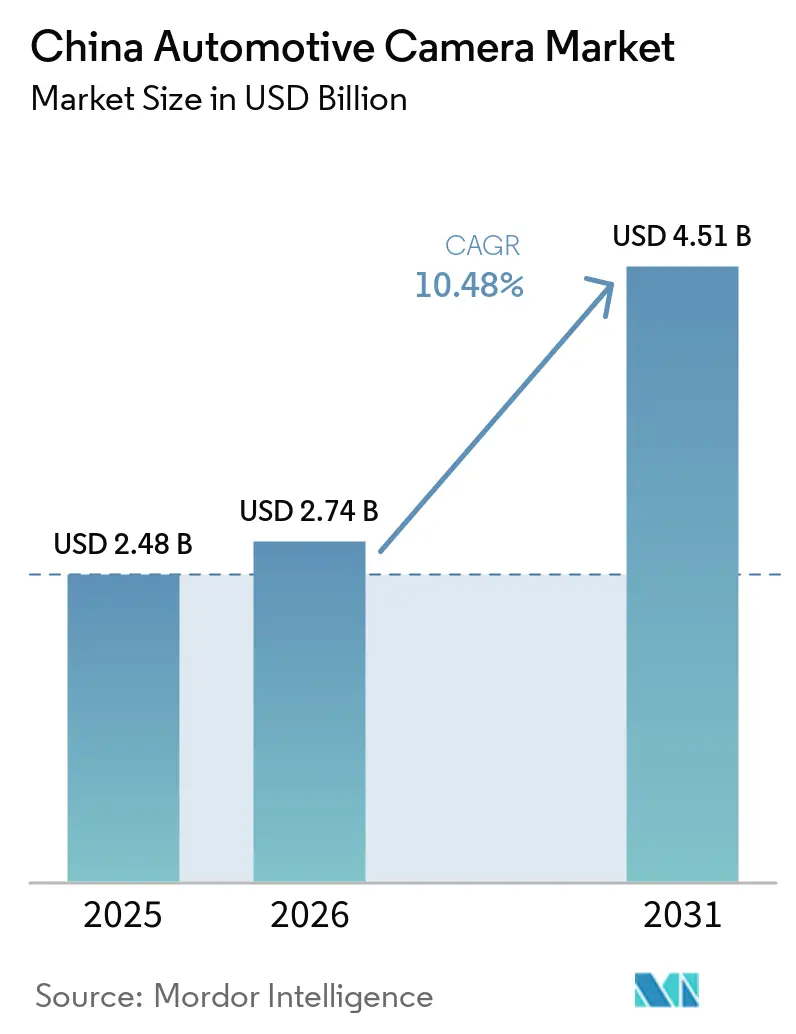
The Chinese automotive camera market size was valued at USD 2.48 billion in 2025, is estimated at USD 2.74 billion in 2026, and is projected to reach USD 4.51 billion by 2031, growing at a CAGR of 10.48% from 2026 to 2031. Beijing's new regulations, which mandate rear-view and ADAS cameras, coupled with a surge in New Energy Vehicle (NEV) adoption and a trend among automakers towards map-less perception, have led to a significant increase in camera installations. Mid-segment sedans now feature as many as 12 cameras, compared to just a few units in the past. Leading domestic brands, including BYD, NIO, XPeng, and Li Auto, are equipping several of their models with standard 11-camera suites. This advancement allows them to use Bird's-Eye-View (BEV) algorithms without lidar, thereby shortening their suppliers' payback periods. In response, global Tier-1 suppliers have begun to localize their production and collaborate with Chinese partners on module design. However, they grapple with cost pressures from local players, such as Sunny Optical, OFILM, and Desay SV, which have significantly expanded their production capacity.
Key Report Takeaways
- By vehicle type, passenger cars led with 87.22% of China's automotive camera market share in 2025, while commercial vehicles are advancing at a 10.72% CAGR through 2031 as fleet operators retrofit LCVs to cut insurance premiums.
- By camera type, viewing modules accounted for 69.73% of revenue in 2025; sensing modules posted the fastest growth at a 10.73% CAGR, driven by lane-keeping and AEB upgrades.
- By application, ADAS accounted for a 59.64% slice of the China automotive camera market size in 2025; driver monitoring is expanding at a 10.56% CAGR under MIIT’s inattentive-driver mandate.
- By resolution, the 2–5 MP band held 57.24% share in 2025, while above-5 MP sensors post an 11.29% CAGR as OEMs migrate to 8 MP front cameras that read plates at 50 m.
- By sales channel, OEM-fit systems dominated at 82.43% in 2025; the aftermarket is growing at a 10.94% CAGR as Tier 3 city workshops retrofit older sedans.
- By mounting location, front cameras held 50.51% share in 2025; interior cameras are projected to post the fastest 11.12% CAGR through 2031.
Note: Market size and forecast figures in this report are generated using Mordor Intelligence’s proprietary estimation framework, updated with the latest available data and insights as of 2026.
China Automotive Camera Market Trends and Insights
Drivers Impact Analysis*
| Driver | (~) % Impact on CAGR Forecast | Geographic Relevance | Impact Timeline |
|---|---|---|---|
| Rapid ADAS Penetration In China | +2.3% | National, led by domestic NEV brands in coastal provinces | Medium term (2-4 years) |
| Mandate For Rear‑View and ADAS Cameras | +2.1% | National, with accelerated enforcement in Tier-1 cities (Beijing, Shanghai, Shenzhen) | Short term (≤ 2 years) |
| NEV Boom Driving Multi‑Camera Demand | +1.9% | National, concentrated in Guangdong, Zhejiang, Jiangsu manufacturing hubs | Medium term (2-4 years) |
| Map‑Less BEV Algorithms Raising Camera Count | +1.7% | National, driven by software-defined vehicle platforms | Medium term (2-4 years) |
| Cost‑Down of 2+ MP CMOS Modules | +1.4% | National, with supply-chain benefits radiating to Southeast Asia | Long term (≥ 4 years) |
| Camera‑Linked ADB/Micro‑LED Headlights | +0.8% | Premium segment in Tier-1/2 cities, gradual adoption in mass market | Long term (≥ 4 years) |
| Source: Mordor Intelligence | |||
Rapid Level-2/2+ ADAS Penetration in China
Level-2 features have become increasingly standard in new-car sales as price wars have made ACC and LKA bundles more accessible in affordable sedans. XPeng's P7+ and Li Auto's AD Max highlight the industry's shift toward vision-only systems, which are replacing costly lidar solutions. This transition aligns with the State Council's objectives for software-defined vehicles, enabling suppliers to spread their R&D efforts across higher volumes and reduce unit costs ahead of schedule.
Regulatory Mandate for Rear-View and ADAS Cameras
MIIT’s enforcement of GB 15084 and GB 7258 regulations bans mirror-only builds, requiring new passenger vehicles to include rear cameras and ADAS-grade forward units. Commercial trucks must also comply within a tighter timeline compared to similar EU regulations. Consequently, automakers are accelerating sourcing from domestic suppliers. These suppliers maintain ISO 26262-certified stock within China, which reduces customs delays and drives notable near-term demand.
NEV Boom Boosting Multi-Camera Demand
Recent deliveries have seen a significant share attributed to NEVs, creating electrical headroom that was previously unavailable on traditional ICE platforms. This shift underscores the increasing adoption of NEVs in the automotive market, driven by technological advancements and consumer demand for sustainable mobility solutions. Mid-level trims now feature BYD's "God's Eye" 12-camera suite. Thanks to body-in-white standardization, installation costs have decreased, resulting in a surge in backlogs at Sunny Optical and OFILM. The reduced costs and increased adoption of advanced camera systems underscore the evolving dynamics of the automotive supply chain, with suppliers like Sunny Optical and OFILM benefiting from heightened demand.
Emergence of Camera-Linked ADB/Micro-LED Headlights
China's new transport regulations have approved adaptive-beam headlights, which utilize a forward-facing camera to dynamically adjust the beam to avoid shading oncoming traffic. These advanced headlights are designed to enhance road safety by improving visibility for drivers while reducing glare for oncoming vehicles. Demonstrating their efficacy, Audi's Matrix LED and local micro-LED prototypes have shown promise in curbing nighttime crashes. This technological advancement has also influenced the insurance industry, as insurers are now offering reduced premiums on compliant models equipped with these innovative lighting systems.
Restraints Impact Analysis*
| Restraint | (~) % Impact on CAGR Forecast | Geographic Relevance | Impact Timeline |
|---|---|---|---|
| High Cost of 8+ MP Sensors | -1.2% | National, concentrated in Tier-2/3 cities with price-sensitive buyers | Medium term (2-4 years) |
| Cybersecurity and Data Privacy Costs | -1.1% | National, with stricter enforcement in Beijing, Shanghai, Guangdong | Short term (≤ 2 years) |
| Harsh‑Weather Reliability Challenges | -0.9% | Northern provinces (Heilongjiang, Liaoning) and coastal regions with heavy rainfall | Short term (≤ 2 years) |
| Precision Optics Supply Bottlenecks | -0.7% | National, affecting all OEMs reliant on imported German and Japanese lens elements | Medium term (2-4 years) |
| Source: Mordor Intelligence | |||
High ASP of Above-8 MP Sensors and ISP Limiting Mid-Tier Adoption
Fabs, prioritizing the demand for 7nm silicon, are making 8 MP sensors significantly pricier than their 2 MP counterparts. This cost disparity is primarily due to the limited production capacity allocated to higher-resolution sensors, as fabs focus on meeting the growing demand for advanced silicon technology used in smartphones and other devices. Brands eyeing models under USD 15,000 are holding off on introducing 8 MP sensors, anticipating a drop in average selling prices (ASPs) as new capacity comes online. The delay in adopting 8 MP sensors reflects a strategic decision to balance cost efficiency with market competitiveness in the budget segment.
Precision-Optics Supply Bottlenecks Raising Lead Times
Only a limited number of global foundries produce automotive-grade aspheric lenses. Recently, lead times have increased as demand for smartphones continues to consume available capacity. Although Sunny Optical's new Yuyao plant is expected to commence operations soon, achieving full AEC-Q100 qualification will take time. As a result, relief in the supply chain is anticipated to be delayed.
*Our forecasts treat driver/restraint impacts as directional, not additive. The impact forecasts reflect baseline growth, mix effects, and variable interactions.
Segment Analysis
By Vehicle Type: Commercial Fleets Embrace Cameras
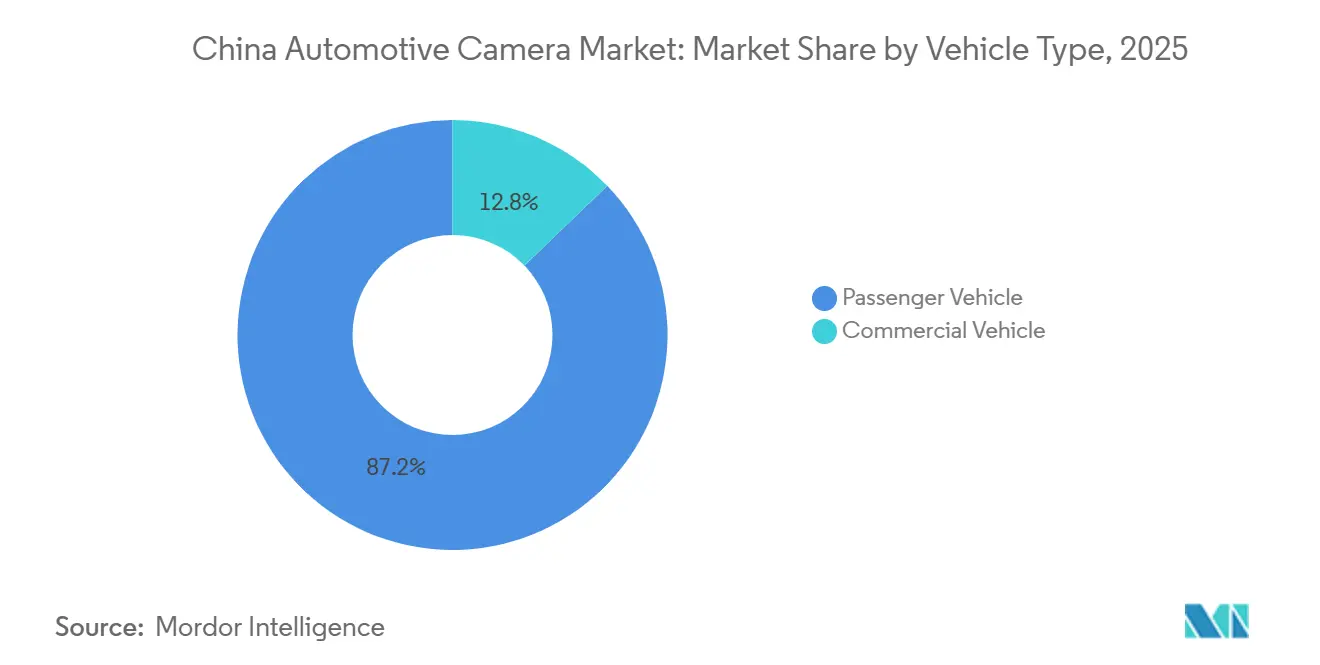
China's automotive camera market size for passenger vehicles accounted for an 87.22% share in 2025. The passenger slice is driven by sedan and SUV buyers seeking Level-2 safety at mass-market prices. Logistics firms are retrofitting LCVs, driving significant growth in commercial fleets at a 10.72% CAGR to 2031. This move not only secures them substantial insurance discounts but also ensures compliance with upcoming mirror-elimination regulations.
NEV makers are driving the sedan sub-segment's rapid expansion by bundling ADAS at no additional cost. Meanwhile, SUVs dominate the passenger market, thanks to their elevated ride height and expansive dashboards that prominently feature 360-degree camera views. Trucks weighing over 12 tons are now being factory-integrated with rear and side cameras to meet provincial registration standards. Additionally, the aftermarket is enhancing the heavy-truck lifecycle with competitively priced retrofit kits.


By Camera Type: Sensing Cameras Gain Ground
Viewing cameras generated 69.73% of the 2025 revenue, as every vehicle requires at least one rear-view unit. Sensing modules nevertheless book a 10.73% CAGR as C-NCAP awards bonus points for night pedestrian AEB, forcing OEMs to add ≥3 MP HDR units up front.
Aftermarket demand still skews toward low-cost viewing kits priced under USD 60, while OEM programs integrate dual-function 5 MP cameras that stitch surround views and feed neural networks. Valeo’s “Smart Camera,” which combines a 5 MP imager with embedded AI, eliminates one ECU and 1.2 kg of wiring, thereby reducing both cost and weight budgets simultaneously.
By Application: Driver Monitoring Climbs Fast
ADAS functions delivered 59.64% of the 2025 value, anchored by FCW, LKA, and ACC, which come standard on 68% of new cars. Driver monitoring is expected to grow at a 10.56% CAGR because, by January 2027, MIIT will enforce distraction detection, potentially impacting millions of units annually.
Ride-hailing operators are now required to install in-cabin cameras, highlighting a growing demand for in-cabin monitoring despite privacy concerns. In Tier-1 city garages, where curbside widths have narrowed, parking cameras are evolving from four to six modules. This shift aims to address blind spots, leading OEMs to standardize the positioning of side-fender cameras.
By Resolution: Premium Shifts to 8 MP
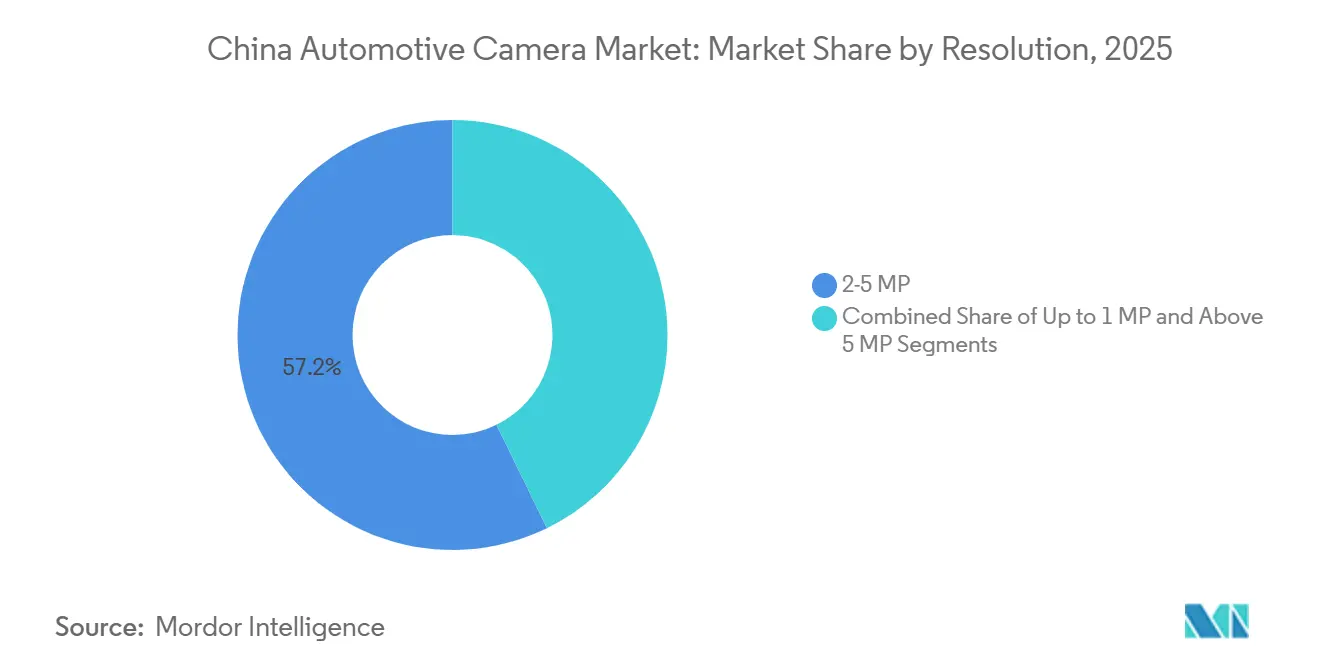
The 2–5 MP tier captured 57.24% of 2025 shipments, striking a balance between clarity and cost. However, sensors above 5 MP are expected to post an 11.29% CAGR, as brands like NIO deploy 8 MP front cameras that can recognize plates at 50 m in low-light conditions.
In the Chinese automotive camera market, demand for 8 MP units outstrips supply, creating a significant supply-demand imbalance. The high-end segment is led by OmniVision’s OX03C and Sony’s IMX728, which together command a considerable market share. Both models boast AEC-Q100 Grade 2 ratings, guaranteeing dependable performance in temperature extremes from -40 °C to +105 °C. This reliability in extreme conditions makes these models highly sought after, further contributing to the demand-supply gap in the market.


By Sales Channel: Aftermarket Gains Traction
OEM-fit programs accounted for 82.43% of 2025 sales, as factory calibration ensures ISO 26262 compliance. Yet the aftermarket grows at a 10.94% CAGR as seven-year-old sedans in Tier-3 cities retrofit USD 150–300 kits to comply with municipal parking mandates and satisfy peer-to-peer rental insurers.
In China, provincial inspection bureaus now require proof of precise alignment. This mandate forces small garages to either invest in costly calibration rigs or leave the market. The increasing stringency of these regulations is reshaping the competitive landscape, favoring larger players with the resources to comply. Furthermore, ride-hailing fleets are purchasing OEM camera hardware but are outsourcing installation to third-party centers. This strategy helps them reduce downtime and highlights a rising trend in the automotive camera market, driven by the growing adoption of advanced driver-assistance systems (ADAS) and the need for efficient fleet management solutions.
By Mounting Location: Interior Cameras Surge
Front-facing modules held a 50.51% share in 2025 due to C-NCAP five-star requirements. Interior cameras are projected to post the fastest 11.12% CAGR because MIIT’s inattentive-driver rule is scheduled to take effect in 2027, despite 34% of buyers expressing privacy concerns.
To achieve quieter cabins and improve highway fuel efficiency, side cameras are transitioning from traditional mirrors to fenders. Meanwhile, to address concerns about low-light parking, rear units are now standardized at higher resolutions. Additionally, some suppliers are introducing paired wide-angle and telephoto front modules. These innovations consolidate lane and sign recognition into a single ECU, resulting in a reduction of harness weight.
Geography Analysis
The Chinese automotive camera market has experienced significant growth, with a substantial portion of spending concentrated in Tier 1 cities, such as Beijing, Shanghai, and Shenzhen. These cities were the first to implement the MIIT's rear-view mandate, and automakers have introduced Level-2 suites as standard equipment. Camera attachment rates for new-car sales in these areas are exceptionally high, driven by the popularity of New Energy Vehicles (NEVs) and the expectation of surround-view parking as a standard feature. Additionally, Tier-1 traffic bureaus require video evidence for accident claims, prompting ride-hailing fleets to retrofit their vehicles with in-cabin and side cameras shortly after vehicle onboarding. Premium automotive brands are localizing operations in these cities to expedite over-the-air validation loops, which municipal regulators closely monitor for cybersecurity compliance. Companies like Sunny Optical, Desay SV, and Bosch have established 24-hour calibration lines in Suzhou and Changchun to efficiently address backlogs in these regions.
Coastal provinces such as Guangdong, Zhejiang, and Jiangsu are emerging as key growth areas. These provinces host a significant portion of China's NEV assembly capacity and attract suppliers of 2–5 MP modules, which are integrated directly into assembly plants without requiring import paperwork. Provincial subsidies for locally produced NEVs are accelerating OEM adoption rates and sustaining shipment growth, even as national subsidies decline. Local governments are also streamlining processes by waiving specific tests for mirrorless side-camera systems, reducing homologation cycles for exporters targeting ASEAN markets. Efficient logistics, supported by express-lane customs at Ningbo and Yantian ports, help maintain competitive pricing for sensors, reinforcing the cost advantages of coastal regions.
In northern provinces like Heilongjiang and Liaoning, adoption is slower but still notable. The region's harsh winters have increased demand for ultrasonic lens cleaners, which reduce fog-related warranty claims. In Tier 3 inland cities, where vehicles tend to be older, retrofit activity is on the rise. Small workshops offer affordable packages for rear cameras and displays, significantly undercutting dealer prices. However, new regulations requiring third-party calibration certificates have increased compliance costs, favoring larger chains that can absorb the expense of advanced alignment equipment. Supply constraints are more pronounced in these interior markets, as precision-optics shipments from coastal factories face extended lead times. Despite these challenges, aftermarket volumes in these regions are expanding steadily, driven by logistics fleets retrofitting surround-view kits to secure insurance discounts from regional carriers.
Competitive Landscape
Market Concentration
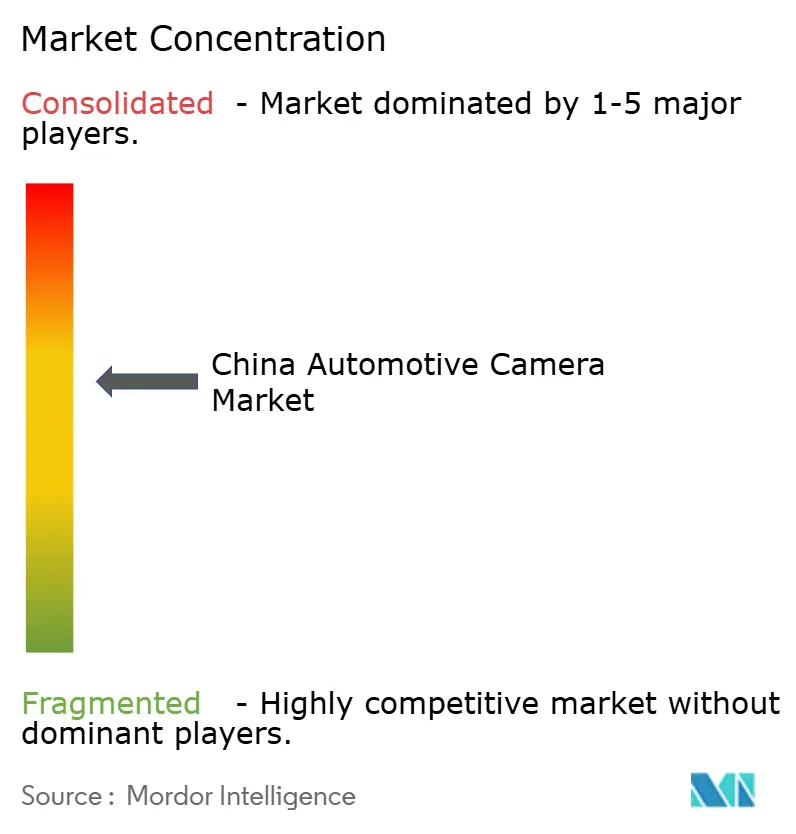
The Chinese automotive camera market is moderately concentrated, with leading players such as Sunny Optical, ZF Friedrichshafen AG, DENSO Corporation, Continental, and Bosch holding a significant combined market share [1]. Domestic leaders have achieved scale through the vertical integration of lens glass and CMOS packaging, driving down average selling prices (ASPs) and prompting global Tier-1 suppliers to establish manufacturing facilities in key locations, such as Suzhou and Changchun.
Growth opportunities are centered on retrofitting commercial vehicles and aftermarket Driver Monitoring System (DMS) kits, particularly in regions where established players lack robust maintenance networks. Freetech's partnerships with local transport bureaus for subsidized installations highlight this strategic approach. Competition is intensifying around on-device AI technology, with advancements such as BYD Semiconductor's efficient vision chip enabling mid-tier trims to adopt map-less Bird's-Eye-View (BEV) perception without requiring separate compute boards [2].
Capacity expansion poses risks of oversupply as domestic module output continues to grow. Meanwhile, companies like Sony and OmniVision are forward-integrating into modules, altering the industry's bargaining dynamics. Additionally, Bosch, Valeo, and Continental maintain a stronghold on patents related to camera-linked Adaptive Driving Beam (ADB) and ultrasonic lens cleaning, creating licensing challenges for new entrants[3].
China Automotive Camera Industry Leaders
-
Continental AG
-
DENSO Corporation
-
Robert Bosch GmbH
-
ZF Friedrichshafen AG
-
Sunny Optical Technology (Group) Company Limited
- *Disclaimer: Major Players sorted in no particular order
Recent Industry Developments
- August 2026: Horizon Continental Technology Shanghai Co., Ltd. (neueHCT), an intelligent driving technology joint venture between Continental AG and Horizon Robotics, Inc., announced that its HCT Luna High-Performance Smart Camera Solution, powered by the Horizon Journey 6B computing platform, has secured a global passenger vehicle platform program from a leading German automotive group.
- June 2026: KD announced that Hinge Technology, a China-based leader in advanced vehicle electronics architecture, implemented its KD7251 optical transceiver in a new automotive camera system for 10 Gb/s data transmission. This implementation validates the transceiver’s applicability in real-world in-vehicle networks. The system uses optical connectivity to support high-resolution camera data links over a fiber-optic backbone, enabling zonal and centralized architectures.
China Automotive Camera Market Report Scope
The China automotive camera market report is segmented by vehicle type (passenger vehicle and commercial vehicle), camera type (viewing and sensing), application (ADAS, parking and surround view, and driver monitoring)), resolution (Up to 1 MP, 2-5 MP, and above 5 MP), sales channel (OEM-fit and aftermarket), mounting location (front, rear, side, and interior/in-cabin). The market forecasts are provided in terms of value (USD).
By Vehicle Type
| Passenger Vehicle | Hatchback |
| Sedan | |
| Sports Utility Vehicle | |
| Multi-Purpose Vehicle | |
| Commercial Vehicle | Light Commercial Vehicle (LCV) |
| Medium and Heavy Commercial Vehicle (M&HCV) |
By Camera Type
| Viewing Camera |
| Sensing Camera |
By Application
| ADAS |
| Parking and Surround View |
| Driver Monitoring |
By Resolution
| Up to 1 MP |
| 2-5 MP |
| Above 5 MP |
By Sales Channel
| OEM-Fit |
| Aftermarket |
By Mounting Location
| Front |
| Rear |
| Side |
| Interior / In-Cabin |
| By Vehicle Type | Passenger Vehicle | Hatchback |
| Sedan | ||
| Sports Utility Vehicle | ||
| Multi-Purpose Vehicle | ||
| Commercial Vehicle | Light Commercial Vehicle (LCV) | |
| Medium and Heavy Commercial Vehicle (M&HCV) | ||
| By Camera Type | Viewing Camera | |
| Sensing Camera | ||
| By Application | ADAS | |
| Parking and Surround View | ||
| Driver Monitoring | ||
| By Resolution | Up to 1 MP | |
| 2-5 MP | ||
| Above 5 MP | ||
| By Sales Channel | OEM-Fit | |
| Aftermarket | ||
| By Mounting Location | Front | |
| Rear | ||
| Side | ||
| Interior / In-Cabin | ||
Key Questions Answered in the Report
How large will the China automotive camera market be by 2031?
Forecasts indicate USD 4.51 billion driven by 10.48% CAGR and multi-camera NEV architectures.
Which vehicle segment is expanding fastest for cameras?
Commercial fleets, especially LCVs, post a 10.72% CAGR as operators retrofit surround-view systems to lower insurance costs.
What drives demand for in-cabin cameras?
MIIT’s 2027 inattentive-driver rule and ride-hailing platform mandates, despite ongoing privacy concerns among buyers.
Why are 8 MP sensors still expensive in China?
Limited 7 nm ISP capacity keeps sensor ASPs at USD 28–35, three times higher than 2 MP units, delaying mid-tier adoption.