
Market Overview
| Study Period | 2020 - 2032 |
|---|---|
| Forecast Data Period | 2027 - 2032 |
| Base Year Market Size (2026) | USD 0.15 Billion |
| Market Size (2027) | USD 0.16 Billion |
| Market Size (2032) | USD 0.21 Billion |
| Growth Rate (2027 - 2032) | 6.13 % |
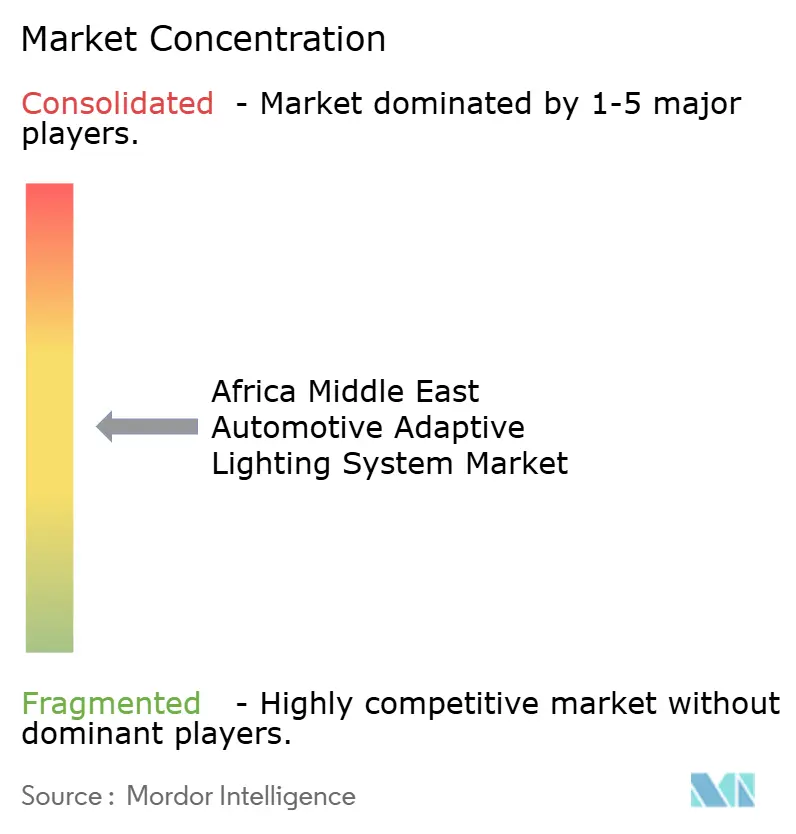
| Market Concentration | Medium |
Major Players *Disclaimer: Major Players sorted in no particular order Image © Mordor Intelligence. Reuse requires attribution under CC BY 4.0. | |
Africa Middle East Automotive Adaptive Lighting System Market Analysis by Mordor Intelligence
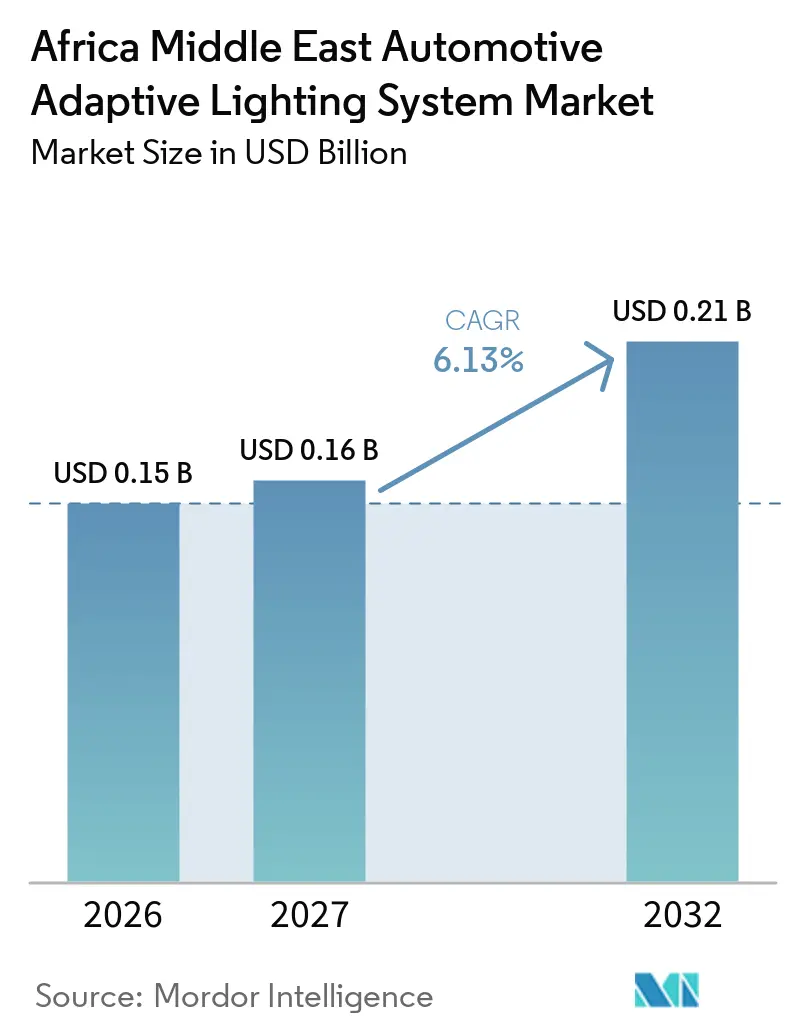
The Africa and Middle East automotive adaptive lighting system market size is valued at USD 0.15 billion in 2026, is projected to reach USD 0.16 billion in 2027, and is expected to reach USD 0.21 billion by 2032, growing at a CAGR of 6.13% from 2027 to 2032. Growth follows OEM decisions on vehicle platforms more than consumer retrofit demand. The Gulf Cooperation Council combines high demand for premium vehicles with established import and certification practices. North and Sub-Saharan African markets have broader demand for lower-cost vehicles, which slows adoption of advanced lighting systems. Adaptive lighting is increasingly linked with front cameras, vehicle sensors, and connected features. Suppliers with approved products and strong OEM relationships are better placed to serve the Africa and Middle East automotive adaptive lighting system market.
Key Report Takeaways
- By product and light position, front adaptive lighting systems held 86.73% of the Africa and Middle East automotive adaptive lighting system market share in 2026 and are projected to grow at a 6.19% CAGR through 2032.
- By vehicle application, passenger cars held 82.46% of the Africa and Middle East automotive adaptive lighting system market share in 2026, and are projected to grow at a 6.32% CAGR through 2032.
- By technology and light source, LED held a 71.84% share in 2026, while Laser and LED-laser hybrid technology are projected to grow at an 8.74% CAGR through 2032.
- By function, automatic high beam held a 24.71% share in 2026, while digital projection and vehicle-to-infrastructure signaling are projected to grow at an 11.08% CAGR through 2032.
- By sales channel, original equipment manufacturers held a 74.28% share in 2026 and are projected to grow at a 6.43% CAGR through 2032.
- By Geography, Saudi Arabia held 25.83% share in 2026, while Morocco is projected to grow at a 6.81% CAGR through 2032.
Note: Market numbers in this report are based on Mordor Intelligence's proprietary estimation framework, which combines nine months of actuals with Q4 projections for base year 2026.
Market Trends and Insights
Drivers Impact Analysis of Africa Middle East Automotive Adaptive Lighting System Market*
| Driver | (~) % Impact on CAGR Forecast | Geographic Relevance | Impact Timeline |
|---|---|---|---|
| OEM Adoption of Matrix LED and Glare-Free High Beam Systems | +2.1% | Saudi Arabia, UAE, Qatar | Short term (≤ 2 years) |
| Expansion of Premium SUV and Luxury Vehicle Fleets in Gulf Countries | +1.8% | Saudi Arabia, UAE, Kuwait, Qatar | Short term (≤ 2 years) |
| Lighting Integration with Camera-Based ADAS and Connected-Vehicle Platforms | +1.4% | UAE, Saudi Arabia, Israel | Medium term (2–4 years) |
| Mandatory Vehicle Lighting Homologation and LED Compliance Requirements | +0.9% | Saudi Arabia (SABER/SASO), UAE (ESMA), GCC-wide (GSO) | Short term (≤ 2 years) |
| Rising Night-Time Driving and Road-Safety Requirements | +0.6% | Nigeria, South Africa, Egypt, Morocco | Long term (≥ 4 years) |
| Desert-Climate Demand for High-Performance Thermal Management | +0.4% | Saudi Arabia, UAE, Egypt, Morocco | Medium term (2–4 years) |
| Source: Mordor Intelligence | |||
OEM Adoption of Matrix LED and Glare-Free High Beam Systems
OEM adoption of matrix LED and glare-free high-beam systems supports the Africa and Middle East automotive adaptive lighting system market because vehicle makers increasingly treat beam control as part of a wider safety and driver-assistance package. These systems are moving beyond flagship vehicles and into premium compact models, where buyers expect high-value features that were previously limited to the most expensive vehicles. Global platform decisions matter because many GCC vehicles enter as fully built units that were designed and approved in other regions. A higher lighting specification on an imported platform can raise regional penetration without a separate local design program, local factory investment, or an individual distributor decision. Digital matrix systems can provide more selective beam control and support functions that are not available with conventional headlamps.
Expansion of Premium SUV and Luxury Vehicle Fleets in Gulf Countries
Premium SUVs continue to provide an important source of demand across Gulf countries because they commonly feature higher lighting specifications and are used in urban, highway, and long-distance driving settings. Buyers in Saudi Arabia and the UAE often seek vehicles with more advanced safety and comfort features, particularly on imported models that compete on equipment content. Chinese vehicle brands are also bringing richer lighting specifications to the region and making matrix LED functions more widely available in passenger vehicles. This trend broadens the range of vehicles that can use adaptive systems and gives component suppliers more opportunities across vehicle brands and price points. It also reduces the pricing advantage that suppliers previously enjoyed by treating adaptive lighting as an exclusive luxury feature, as equipment expectations are shifting into more mainstream premium categories.
Lighting Integration with Camera-Based ADAS and Connected-Vehicle Platforms
Adaptive lighting increasingly works alongside front cameras and other driver assistance components, rather than acting as an isolated headlamp feature. Cameras can identify oncoming traffic and help control beam masking, while the lighting module responds by adjusting the illuminated area. Connected functions can also support projected road warnings and guidance that communicate vehicle information in the driver’s forward view. The UAE, Saudi Arabia, and Israel offer suitable early markets because these countries have stronger interest in vehicle technology and more frequent access to newer imported models. ams-OSRAM described how its EVIYOS HD25 solution supports intelligent headlamp functions through a production vehicle program with Marelli[1].
Mandatory Vehicle Lighting Homologation and LED Compliance Requirements
Vehicle lighting approval requirements favor suppliers that already hold type-approval documentation and can demonstrate that their products meet the technical rules used by national authorities. Saudi Arabia requires conformity documents for regulated products before clearance through its SABER process, which makes formal documentation part of the route to market. GCC requirements also create a technical baseline for lighting assemblies and provide a common reference point for suppliers serving several Gulf countries. These rules can improve product consistency and restrict the use of uncertified replacement products that may not provide the intended optical performance or reliability. They may also add time and cost for smaller importers that lack established compliance processes, specialist staff, and a tested product portfolio.
Restraints Impact Analysis of Africa Middle East Automotive Adaptive Lighting System Market*
| Restraint | (~) % Impact on CAGR Forecast | Geographic Relevance | Impact Timeline |
|---|---|---|---|
| High System Cost and Limited Penetration Beyond Premium Vehicle Segments | -1.2% | Nigeria, Egypt, Morocco, Sub-Saharan Africa | Long term (≥ 4 years) |
| Fragmented Homologation, Import-Certification, and Retrofit Compliance Requirements | -0.8% | Nigeria, Egypt, Rest of MEA, GCC aftermarket | Medium term (2–4 years) |
| Dust, Sand, Heat, and Voltage Instability Increasing Field-Failure Risk | -0.5% | Saudi Arabia, UAE, Egypt, North Africa | Medium term (2–4 years) |
| Limited Local Calibration, Repair, and Diagnostic Capability | -0.4% | Nigeria, Sub-Saharan Africa, Egypt | Long term (≥ 4 years) |
| Source: Mordor Intelligence | |||
High System Cost and Limited Penetration Beyond Premium Vehicle Segments
High system cost limits adoption outside premium and upper-mid vehicle categories, where buyers are more likely to accept the price of advanced equipment. Matrix LED and adaptive driving beam modules require more components than conventional headlamps, including electronics, optical elements, and systems that work with cameras or vehicle controls. Their use is therefore strongest where vehicle buyers accept higher equipment costs and where the vehicle program has already incorporated the feature at the factory. Entry-level and mid-priced vehicles remain important across Egypt and much of Sub-Saharan Africa, which constrains the number of models that can support these systems. Import dependence also ties the cost of lighting modules to international supply conditions and the cost of bringing approved products into local markets.
Fragmented Homologation, Import-Certification, and Retrofit Compliance Requirements
Vehicle lighting rules differ across the region, creating a practical barrier for suppliers seeking to serve multiple African and Middle Eastern markets from a single distribution base. Markets outside the GCC do not operate under a single approval framework, even where they refer to related international vehicle standards. Suppliers may need separate documentation for products sold in Egypt, Nigeria, Morocco, and South Africa, as well as different processes for original parts and replacement assemblies. This increases working-capital needs and can delay distribution because importers must manage product files, approvals, and inventory by country. Large importer groups with established compliance teams can manage the process more easily than smaller distributors that lack regulatory experience or regular access to certification support.
*Our forecasts treat driver/restraint impacts as directional, not additive. The impact forecasts reflect baseline growth, mix effects, and variable interactions.
Africa Middle East Automotive Adaptive Lighting System Market Segment Analysis
By Product and Light Position:
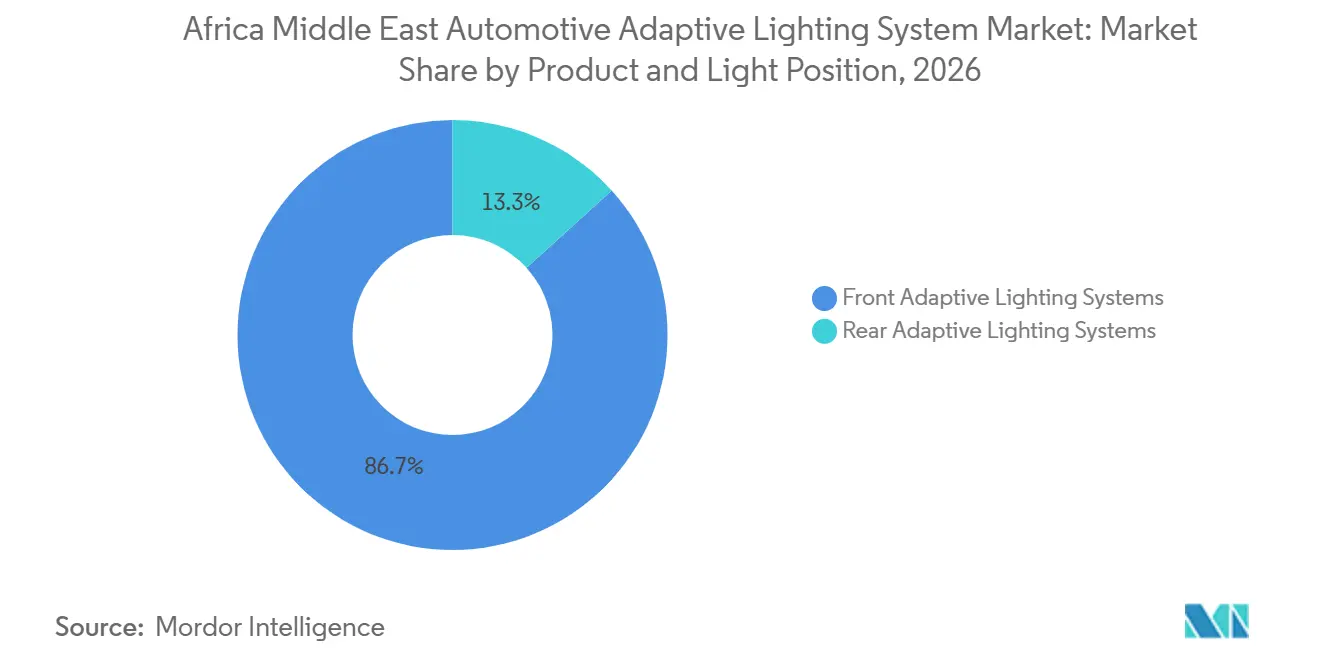
Front Systems Set the Technology StandardFront adaptive lighting systems accounted for 86.73% of segment value in 2026. The front of the vehicle remains the main location for visibility, beam control, and driver-assistance functions during night driving and in changing traffic conditions. Adaptive driving beam and adaptive front-lighting systems carry much of the technical content because they manage the direction and intensity of light in real time. Automatic high beam systems offer a more accessible step into adaptive lighting for vehicle makers that want a practical feature without a high-definition lighting module. They require less complex calibration than high-definition projection systems and can be fitted across a wider range of passenger vehicle platforms. Rear systems remain a smaller priority because manufacturers focus first on forward visibility and safety functions that affect the driver’s immediate field of view.
Front adaptive lighting systems are projected to grow at a 6.19% CAGR through 2032. Suppliers are moving toward pixelated LED and micro-LED designs that can manage the beam more precisely, reduce glare for other road users, and support a wider set of vehicle functions. Digital matrix technology is becoming relevant to compact premium vehicles as automakers extend advanced functions across more vehicle classes. Road-surface projection and lane guidance are emerging as differentiating features for vehicles sold to Gulf buyers who compare imported models across several global brands. Rear signature lighting may grow in importance on Chinese premium models, but it does not yet match the technology role of front systems in safety and driver-assistance applications.
By Vehicle Application:
Passenger Cars Maintain the Broadest Demand BasePassenger cars held 82.46% of segment value in 2026. Premium SUVs are a major segment in Saudi Arabia and the UAE, where buyers value safety features, comfort equipment, and distinctive exterior design. Many imported passenger vehicles arrive with their lighting systems already specified by the manufacturer, which reduces the role of local distributors in technology selection. Commercial vehicles use adaptive systems more selectively because operators tend to assess each added feature against the vehicle's cost and the operating environment. Premium coaches and executive buses can justify added safety equipment where long-distance routes, passenger service standards, and night operations support the investment. Two-wheelers and three-wheelers have limited near-term use for sophisticated adaptive lighting because price sensitivity and basic vehicle design continue to shape demand.
Passenger cars are projected to grow at a 6.32% CAGR through 2032. This growth reflects continued demand for advanced equipment on vehicles entering Gulf markets, particularly where global models carry the same lighting specification across multiple export destinations. Passenger models give suppliers a direct path to scale when a vehicle platform uses a common headlamp design and a stable set of component suppliers. Fleet operators in logistics, tourism, and government procurement may form a secondary source of demand because they place value on safety features and predictable vehicle maintenance. Their purchasing process can support technology adoption when vehicle specifications are set at the fleet level rather than chosen by individual retail buyers.
By Technology and Light Source:
LED Is Established While Laser Hybrids Gain InterestLED represented 71.84% of segment value in 2026. The technology has a developed supply chain and can meet a broad range of vehicle requirements, from standard forward lighting to more advanced matrix beam control. Standard LED and matrix LED designs serve most current demand because manufacturers can use them across several price points and vehicle classes. LED also offers a familiar route for manufacturers that need adaptive functions without moving to laser-based designs that require more specialized thermal and optical engineering. Micro-LED and high-definition LED systems are beginning to appear on premium vehicle fitment lists as automakers add more detailed beam control and projection features. Xenon and HID systems have a more limited role as vehicle lighting technology advances and manufacturers favor electronically controlled solutions.
Laser and LED-laser hybrid technology is projected to grow at an 8.74% CAGR through 2032. Valeo and Appotronics announced a 2025 partnership to develop front-lighting systems that combine laser technology with adaptive driving beam and road projection[2]. Longer-range illumination can be relevant for high-speed intercity driving and desert conditions, where drivers may need earlier awareness of road conditions and obstacles. The technology still faces thermal-management, approval, and cost requirements that make it better suited to premium and upper-mid vehicle applications. Suppliers must demonstrate that these systems operate reliably in high-heat and dusty environments and can be serviced with the tools available in regional workshops.
By Function:
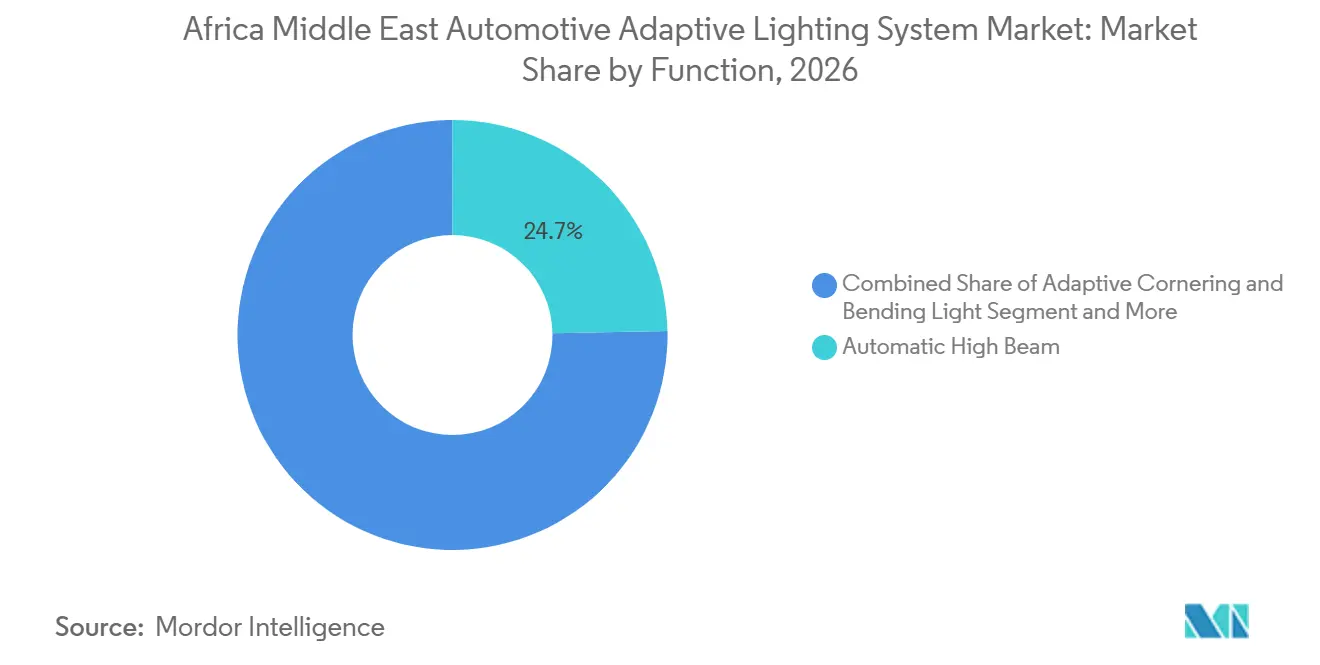
Automatic High Beam Leads Current FitmentAutomatic high beam accounted for 24.71% of segment value in 2026. It provides a practical, adaptive function for many mid-tier vehicle platforms by reducing driver workload during night driving without requiring the most complex optical hardware. The feature adjusts the high beam in response to surrounding traffic and can improve visibility while reducing unwanted glare for approaching vehicles. This makes it easier for manufacturers to offer a recognizable safety feature without the full cost of a high-definition system that projects information onto the road. Adaptive cornering, bending light, and variable light distribution serve other driving conditions and give automakers ways to tailor lighting behavior to the vehicle class. Weather-adaptive functions are still developing despite the region’s demanding dust and heat conditions, which make consistent lighting performance important for drivers.
Digital projection and vehicle-to-infrastructure signaling is projected to grow at an 11.08% CAGR through 2032. This function turns the headlamp into a communication point for the driver and road users by placing visual information directly within the driver’s forward view. It can project warnings, lane guidance, and hazard information onto the road surface, which can complement vehicle displays and conventional roadside signs. ams-OSRAM reported that its multi-pixel LED technology is used in a vehicle application that supports road projection and other intelligent lighting functions. Infrastructure conditions in parts of Morocco and South Africa could make better road guidance particularly valuable where driving conditions differ between major corridors and less developed routes. The Africa and Middle East automotive adaptive lighting system industry is moving toward functions that combine illumination with vehicle information, sensor inputs, and software control.

By Sales Channel:
OEM Supply Remains the Primary Route to AdoptionOriginal equipment manufacturer sales accounted for 74.28% of segment value in 2026. Lighting specifications are usually decided before imported vehicles reach regional distributors, which makes original vehicle programs the main route for advanced system adoption. A supplier that wins a global platform nomination can therefore supply systems for vehicles sold in several regional markets without developing a separate local product. This model is especially important in the GCC, where imported vehicles make up much of the available fleet and distributors receive vehicles with factory-set specifications. Local channel decisions have limited influence over the original lighting technology fitted to a vehicle, although they remain important for after-sales support. OEM relationships remain the most important commercial route for suppliers of advanced systems because they combine product design, procurement, and vehicle launch planning.
Original equipment manufacturer sales are projected to grow at a 6.43% CAGR through 2032. The aftermarket includes replacement assemblies, retrofit kits, and repair components, but its growth depends on local availability of approved parts and qualified service. Formal compliance requirements can strengthen certified replacement channels in Saudi Arabia by making documentation more important for lighting assemblies. FORVIA HELLA introduced a thermal-management product portfolio for the regional aftermarket in 2025. Replacement of camera-integrated headlamps still requires diagnostic tools and qualified technicians who can restore the system’s original operating settings. The Africa and Middle East automotive adaptive lighting system market will need more calibration capacity if the aftermarket is to expand beyond major Gulf cities and serve more dispersed vehicle fleets.
Geography Analysis
GCC Automotive Adaptive Lighting System Market
Saudi Arabia held 25.83% of the regional segment in 2026. The country is the main revenue base because of its large vehicle demand, formal import process, and strong interest in premium features that are often supplied through original vehicle programs. The UAE also has a high concentration of premium vehicles, especially in Dubai and Abu Dhabi, and this supports demand for factory-fitted technology. Qatar, Kuwait, Oman, and Bahrain extend the regional base for high-specification imports and established distributor networks. Israel contributes through its alignment with advanced vehicle technology and driver-assistance adoption, even though the structure of its vehicle market differs from the Gulf. Morocco has a different role because it is connected to automotive production for European markets and related vehicle requirements.
Africa Automotive Adaptive Lighting System Market
Morocco is projected to grow at a 6.81% CAGR through 2032. Its automotive export position and alignment with European vehicle requirements support the use of advanced lighting on locally produced vehicles and on models built for export. South Africa offers another production and approval environment that supports higher-specification systems and creates demand linked to global automaker programs. Egypt and Nigeria have large vehicle demand but remain more centered on lower-cost models, where buyers and fleet operators give greater weight to acquisition cost. This limits current adoption of adaptive lighting in those markets and makes the service ecosystem less mature for advanced replacement systems. The Africa and Middle East automotive adaptive lighting system market is therefore divided between premium import demand, manufacturing-linked demand, and price-sensitive markets with different adoption speeds.
The Rest of Middle East and Africa includes smaller Gulf states and Sub-Saharan markets outside Nigeria and South Africa. These markets have different road conditions, vehicle fleets, service capacity, and ability to support advanced replacement work. Night driving, unlit roads, dust, heat, and voltage conditions can increase the value of reliable lighting performance, particularly where drivers travel long distances outside major urban areas. At the same time, technicians and workshops may not have the tools needed to calibrate camera-linked headlamps or check whether a replacement assembly restores the original beam pattern. Chinese vehicle brands can introduce advanced LED lighting on models that were previously sold with simpler equipment and can make these systems more familiar to regional buyers.
Competitive Landscape
The Africa and Middle East automotive adaptive lighting system market has a moderate concentration because global Tier-1 suppliers lead OEM nominations while the aftermarket remains fragmented. FORVIA, Valeo, Marelli, KOITO, and Stanley Electric benefit from relationships developed with vehicle manufacturers in Europe and Asia, where product design and supplier nominations are typically decided. Their global supply programs can extend to vehicles that enter the GCC as imports, allowing regional demand to be served through international vehicle platforms. Existing approval documentation is an additional advantage in markets with formal certification processes, because suppliers can support importers with product records and established compliance practices. Suppliers also compete on optical performance, electronics, thermal management, software capability, and their ability to support the full life of a lighting module after vehicle sale. The market does not show the conditions of a single-supplier structure because replacement channels remain dispersed across distributors, workshops, and local service businesses.
Valeo has continued to invest in advanced front-lighting technology through its work with Appotronics on laser-based adaptive beam and projection solutions. ams-OSRAM has highlighted a multi-pixel LED solution used with Marelli for intelligent headlamp functions, showing how component suppliers can contribute to a more software-led lighting system. FORVIA HELLA has also added regional aftermarket activity with its thermal-management portfolio launch, which reflects the need for suppliers to support vehicles after their original sale. These moves show that suppliers are competing both through original vehicle programs and post-sale service capability, rather than through headlamp output alone. More advanced digital beam functions are also entering smaller premium vehicle classes as manufacturers extend their technology features across their global model ranges. The Africa and Middle East automotive adaptive lighting system market rewards suppliers that can transfer global product advances into local vehicle fleets and support the technical needs of distributors and repair networks.
Three areas remain difficult for suppliers and distributors. High heat, sand, and dust create a need for durable thermal management, especially for laser and hybrid modules that use more complex optical and electronic components. Software updates for lighting functions must also remain compatible with local approval requirements and with the vehicle’s existing electronic architecture. Local networks for adaptive driving beam calibration are not yet widely available outside leading Gulf cities, which can limit confident replacement and repair work in other markets. Regional distributors that invest in diagnostic equipment and technician training may address this gap and could build a stronger role in the certified aftermarket. Chinese-origin suppliers are expanding their presence in replacement channels with competitively priced matrix LED modules, which can widen product choice for distributors. This increases price pressure in the aftermarket without removing the advantage of established suppliers in OEM nomination programs, where long-standing vehicle manufacturer relationships remain important.
Africa Middle East Automotive Adaptive Lighting System Industry Leaders
-
Valeo SE
-
Marelli Holdings Co., Ltd.
-
KOITO MANUFACTURING CO., LTD.
-
Stanley Electric Co., Ltd.
-
FORVIA HELLA
- *Disclaimer: Major Players sorted in no particular order
Africa Middle East Automotive Adaptive Lighting System Market Companies Covered in this Report
- FORVIA HELLA
- Valeo SE
- Marelli Holdings Co., Ltd.
- KOITO MANUFACTURING CO., LTD.
- Stanley Electric Co., Ltd.
- ams-OSRAM AG
- Hyundai MOBIS Co., Ltd.
- ZKW Group GmbH
- Continental AG
- DENSO CORPORATION
- Robert Bosch GmbH
- Lumileds Holding B.V.
- Varroc Engineering Limited
- TYC Brother Industrial Co., Ltd.
- DEPO Auto Parts Ind. Co., Ltd.
- Samvardhana Motherson International Limited
- Grupo Antolin-Irausa, S.A.
- Ichikoh Industries, Ltd.
Read Analysis of Africa Middle East Automotive Adaptive Lighting System Companies
Recent Industry Developments in Africa Middle East Automotive Adaptive Lighting System Market
- September 2026: GAC launched the all-new GAC GS7 PHEV in the UAE, combining premium comfort, intelligent technology, and 501 hp of electrified performance. It features AI emotion-adaptive headlights with 2,248 LED units and a 2.6-meter skyline light bar.
- September 2026: BMW Group Middle East introduced the new BMW 7 Series in the region, featuring a monolithic exterior, an illuminated kidney Iconic Glow grille, minimalist crystal headlights, cleaner sides, and slimmer rear lights.
Africa Middle East Automotive Adaptive Lighting System Market Report Scope
The Africa Middle-East automotive adaptive lighting systems market covers the latest trends and technological development and provides analysis on the market demand by application type, technology, vehicle type, and market share of major automotive adaptive lighting system manufacturing companies across Africa Middle-East.
Segmentation Overview
By Product and Light Position
| Front Adaptive Lighting Systems | Adaptive Front-Lighting Systems |
| Adaptive Driving-Beam Systems | |
| Automatic High-Beam Systems | |
| Adaptive Low-Beam Systems | |
| Rear Adaptive Lighting Systems | Adaptive Brake and Stop-Lamp Systems |
| Adaptive Rear-Signature Systems | |
| Other Rear Adaptive Lighting Systems |
By Vehicle Application
| Passenger Cars | Economy and Entry-Level Passenger Cars |
| Mid-Priced Passenger Cars | |
| Premium and Luxury Passenger Cars | |
| Commercial Vehicles | Light Commercial Vehicles |
| Heavy Commercial Vehicles | |
| Buses and Coaches | |
| Two-Wheelers and Three-Wheelers |
By Technology and Light Source
| LED | Standard LED |
| Matrix LED | |
| Micro-LED and High-Definition LED | |
| Laser and LED-Laser Hybrid | |
| Xenon and High-Intensity Discharge | |
| Other Light Sources |
By Function
| Adaptive Cornering and Bending Light |
| Automatic High Beam |
| Matrix and Adaptive Driving Beam |
| Variable Light Distribution |
| Weather- and Environment-Adaptive Lighting |
| Road-Sign, Pedestrian, and Hazard Highlighting |
| Digital Projection and Vehicle-to-Infrastructure Signaling |
| Other Adaptive Lighting Functions |
By Sales Channel
| Original Equipment Manufacturer | |
| Aftermarket | Replacement Assemblies |
| Retrofit Kits | |
| Repair and Refurbishment Components |
By Country
| Saudi Arabia |
| United Arab Emirates |
| Israel |
| Qatar |
| Kuwait |
| Oman |
| Bahrain |
| South Africa |
| Morocco |
| Egypt |
| Nigeria |
| Rest of Middle East and Africa |
| By Product and Light Position | Front Adaptive Lighting Systems | Adaptive Front-Lighting Systems |
| Adaptive Driving-Beam Systems | ||
| Automatic High-Beam Systems | ||
| Adaptive Low-Beam Systems | ||
| Rear Adaptive Lighting Systems | Adaptive Brake and Stop-Lamp Systems | |
| Adaptive Rear-Signature Systems | ||
| Other Rear Adaptive Lighting Systems | ||
| By Vehicle Application | Passenger Cars | Economy and Entry-Level Passenger Cars |
| Mid-Priced Passenger Cars | ||
| Premium and Luxury Passenger Cars | ||
| Commercial Vehicles | Light Commercial Vehicles | |
| Heavy Commercial Vehicles | ||
| Buses and Coaches | ||
| Two-Wheelers and Three-Wheelers | ||
| By Technology and Light Source | LED | Standard LED |
| Matrix LED | ||
| Micro-LED and High-Definition LED | ||
| Laser and LED-Laser Hybrid | ||
| Xenon and High-Intensity Discharge | ||
| Other Light Sources | ||
| By Function | Adaptive Cornering and Bending Light | |
| Automatic High Beam | ||
| Matrix and Adaptive Driving Beam | ||
| Variable Light Distribution | ||
| Weather- and Environment-Adaptive Lighting | ||
| Road-Sign, Pedestrian, and Hazard Highlighting | ||
| Digital Projection and Vehicle-to-Infrastructure Signaling | ||
| Other Adaptive Lighting Functions | ||
| By Sales Channel | Original Equipment Manufacturer | |
| Aftermarket | Replacement Assemblies | |
| Retrofit Kits | ||
| Repair and Refurbishment Components | ||
| By Country | Saudi Arabia | |
| United Arab Emirates | ||
| Israel | ||
| Qatar | ||
| Kuwait | ||
| Oman | ||
| Bahrain | ||
| South Africa | ||
| Morocco | ||
| Egypt | ||
| Nigeria | ||
| Rest of Middle East and Africa | ||
Key Questions Answered in the Report
What is driving demand for adaptive automotive lighting in Africa and the Middle East?
Demand is supported by OEM adoption of advanced lighting, premium vehicle sales in Gulf countries, and closer integration with vehicle cameras and driver-assistance systems. These factors are strongest where imported vehicle platforms carry advanced lighting as standard equipment.
What is driving demand for adaptive automotive lighting in Africa and the Middle East?
Demand is supported by OEM adoption of advanced lighting, premium vehicle sales in Gulf countries, and closer integration with vehicle cameras and driver-assistance systems. These factors are strongest where imported vehicle platforms carry advanced lighting as standard equipment and where local distributors can support approved products and maintenance.
How large is the Africa and Middle East automotive adaptive lighting system market?
The market is projected to grow from USD 0.16 billion in 2027 to USD 0.21 billion by 2032 at a 6.13% CAGR. Growth is expected to be led by original vehicle fitment and higher adoption of connected lighting functions, rather than by broad consumer retrofit demand.
Which vehicle category has the strongest demand for adaptive lighting systems?
Passenger cars led vehicle applications with 82.46% share in 2026 and are projected to grow at a 6.32% CAGR through 2032. Premium SUVs and other imported passenger models are the main source of fitment demand because the original lighting specification is set before the vehicle reaches regional dealers.