
Market Overview
| Study Period | 2019 - 2031 |
|---|---|
| Forecast Data Period | 2026 - 2031 |
| Base Year Market Size (2025) | USD 5.79 Billion |
| Market Size (2026) | USD 6.17 Billion |
| Market Size (2031) | USD 8.51 Billion |
| Growth Rate (2026 - 2031) | 6.63 % |
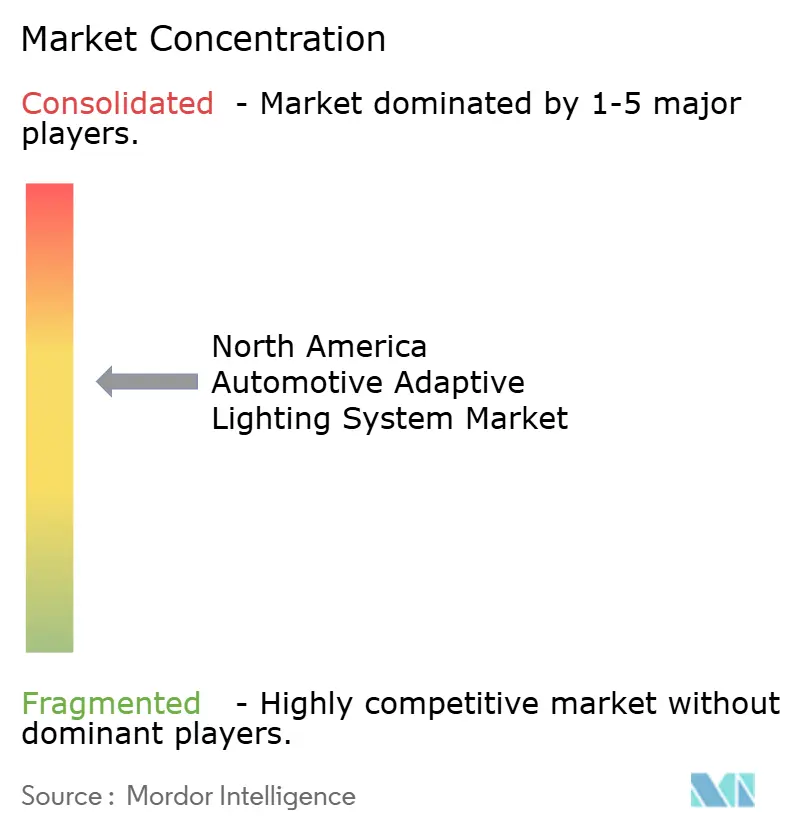
| Market Concentration | Medium |
Major Players *Disclaimer: Major Players sorted in no particular order Image © Mordor Intelligence. Reuse requires attribution under CC BY 4.0. | |
North America Automotive Adaptive Lighting System Market Analysis by Mordor Intelligence
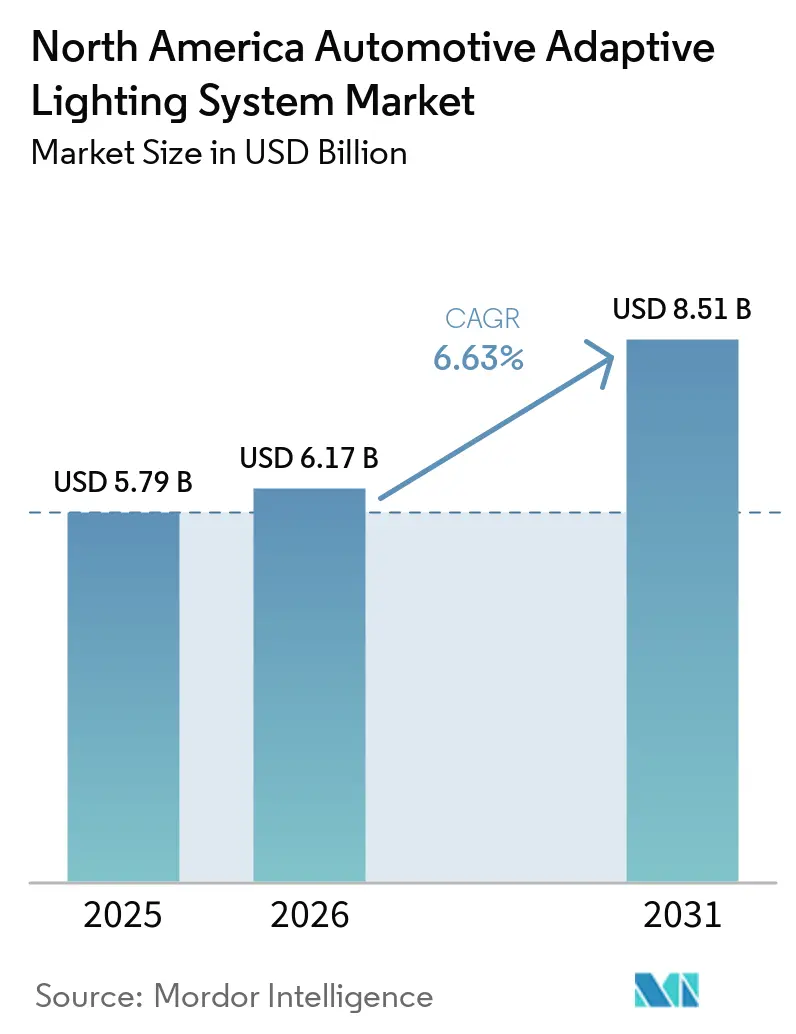
The North America automotive adaptive lighting system market size was valued at USD 5.79 billion in 2025 and is projected to expand from USD 6.17 billion in 2026 to USD 8.51 billion by 2031, registering a CAGR of 6.63% between 2026 and 2031. The federal pathway for adaptive driving beam headlamps has reduced a longstanding barrier to wider deployment in the United States. Manufacturers can now align more lighting designs across North America and Europe, which can simplify product planning. The North America automotive adaptive lighting system market also depends on closer integration between lighting, vehicle sensors, and software controls. Premium vehicles remain an early adoption point, while broader adoption depends on costs, repair access, and dependable electronic-component supply. Suppliers are responding through product development, regional manufacturing, and partnerships that connect lighting functions with broader vehicle systems.
Key Report Takeaways
- By vehicle type, passenger cars held 72.09% of the North America automotive adaptive lighting system market share in 2025, while medium and heavy commercial vehicles are forecast to grow at a 10.57% CAGR through 2031.
- By application, exterior lighting accounted for 91.84% of the North America automotive adaptive lighting system market size in 2025, while interior lighting is forecast to grow at a 9.12% CAGR through 2031.
- By component, lamp assemblies held 46.41% share in 2025, while sensors and cameras are forecast to grow at a 12.01% CAGR through 2031.
- By technology and light source, LED held 64.19% share in 2025, while laser lighting is forecast to grow at a 16.13% CAGR through 2031.
- By functionality, automatic high beam held 39.01% share in 2025, while adaptive front lighting is forecast to grow at a 13.01% CAGR through 2031.
- By sales channel, original equipment manufacturers held 83.94% share in 2025, while aftermarket is forecast to grow at a 9.65% CAGR through 2031.
- By country, United States accounted for 80.98% market share in 2025 and is forecast to register a CAGR of 7.19% to 2031.
Note: Market size and forecast figures in this report are generated using Mordor Intelligence’s proprietary estimation framework, updated with the latest available data and insights as of January 2026.
Market Trends and Insights
Drivers Impact Analysis of North America Automotive Adaptive Lighting System Market*
| Driver | (~) % Impact on CAGR Forecast | Geographic Relevance | Impact Timeline |
|---|---|---|---|
| NHTSA and CMVSS Enablement of Adaptive Driving Beams | +2.1% | United States (primary), Canada (secondary, via CMVSS alignment) | Short term (≤ 2 years) |
| ADAS and Camera Integration | +1.5% | United States, Ontario and Michigan automotive corridors | Medium term (2–4 years) |
| Premium SUV and EV Feature Penetration | +1.2% | United States (California, Texas, Florida), Canada (Ontario, British Columbia) | Medium term (2–4 years) |
| LED Cost and Performance Improvement | +0.8% | United States, Mexico (manufacturing corridor), Canada | Short term (≤ 2 years) |
| OTA Beam-Pattern Upgrades and Software-Defined Lighting | +0.6% | United States (California, Texas, Washington) | Long term (≥ 4 years) |
| Mexico-Based Lamp Module Localization Under USMCA | +0.4% | Mexico (San Luis Potosí, Aguascalientes, Querétaro) | Medium term (2–4 years) |
| Source: Mordor Intelligence | |||
NHTSA and CMVSS Enablement of Adaptive Driving Beams
NHTSA allowed certification of adaptive driving beam headlamps under Federal Motor Vehicle Safety Standard No. 108 in 2022. The agency denied petitions for reconsideration in December 2024, which confirmed the regulatory direction for U.S. vehicle programs[1]. The settled framework gives automakers a clearer basis for planning compliant adaptive lighting systems. It also allows suppliers to prepare products for U.S. launches without relying on uncertain policy outcomes. The North America automotive adaptive lighting system market can therefore move from limited deployment toward more planned vehicle-program adoption.
ADAS and Camera Integration
Adaptive lighting increasingly uses camera, radar, and other vehicle inputs to adjust beam patterns while driving. This shifts attention from the lamp as a stand-alone part toward the coordination of sensors, controllers, and software. Suppliers that can support these connected functions may be more useful to automakers than suppliers focused only on hardware. Software also creates a path for qualified lighting features to be activated or adjusted after a vehicle is sold. The North America automotive adaptive lighting system market benefits as vehicle sensing systems become more common across new platforms.
Premium SUV and EV Feature Penetration
Premium SUVs and electric vehicles provide an early home for advanced lighting features because their designs carry more electrical and software capability. Buyers in these vehicle classes often place more value on safety features and distinctive exterior lighting. Automakers can use adaptive functions to support vehicle positioning without changing the basic role of the headlamp. The feature can also fit naturally within electric-vehicle software architectures that already support updates. This pattern gives the North America automotive adaptive lighting system market a base from which adoption can spread to more vehicle classes.
LED Cost and Performance Improvement
Improved LED performance has made adaptive systems more practical for a wider range of vehicle designs. Compact optical designs can help suppliers address space and energy requirements in newer platforms. Mexico-based lamp assembly can also support shorter supply routes for vehicles produced in North America. Koito has identified adaptive driving beam products for the U.S. market and has expanded production capacity in Mexico for regional customers[2]. These developments support the North America automotive adaptive lighting system market by linking product improvements with regional production plans.
Restraints Impact Analysis of North America Automotive Adaptive Lighting System Market*
| Restraint | (~) % Impact on CAGR Forecast | Geographic Relevance | Impact Timeline |
|---|---|---|---|
| High System and Repair Cost | -1.3% | United States (nationwide), Canada (major urban centers) | Short term (≤ 2 years) |
| GaN and High-Power Semiconductor Supply Concentration | -0.8% | United States, Canada, Mexico (supplier-dependent) | Long term (≥ 4 years) |
| Thermal Management in High-Lumen Modules | -0.5% | United States (Southwest, Southeast), Canada (Northern provinces) | Medium term (2–4 years) |
| CAN-FD and OTA Cybersecurity Exposure | -0.3% | United States, Canada | Long term (≥ 4 years) |
| Source: Mordor Intelligence | |||
High System and Repair Cost
Adaptive headlamp systems combine optics, electronics, actuators, and control software in a single assembly. That design can increase replacement costs when a component fails or is damaged. Repair providers also need vehicle-specific equipment and training to calibrate the system correctly. Availability of qualified service can be uneven outside major metropolitan areas. These factors may slow adoption in price-sensitive vehicle classes within the North America automotive adaptive lighting system market.
GaN and High-Power Semiconductor Supply Concentration
Advanced lighting systems rely on specialized electronic components that can face a concentrated upstream supply. Long automotive qualification processes can make it difficult to substitute a new source quickly when the supply is disrupted. High-output modules also need effective thermal management across hot and cold operating conditions. Connected lighting networks require secure software controls because beam settings can be changed through vehicle electronics. NHTSA recall records show that headlamp performance settings can be corrected through software, reinforcing the need for robust validation and cybersecurity practices[3].
*Our forecasts treat driver/restraint impacts as directional, not additive. The impact forecasts reflect baseline growth, mix effects, and variable interactions.
North America Automotive Adaptive Lighting System Market Segment Analysis
By Vehicle Type:
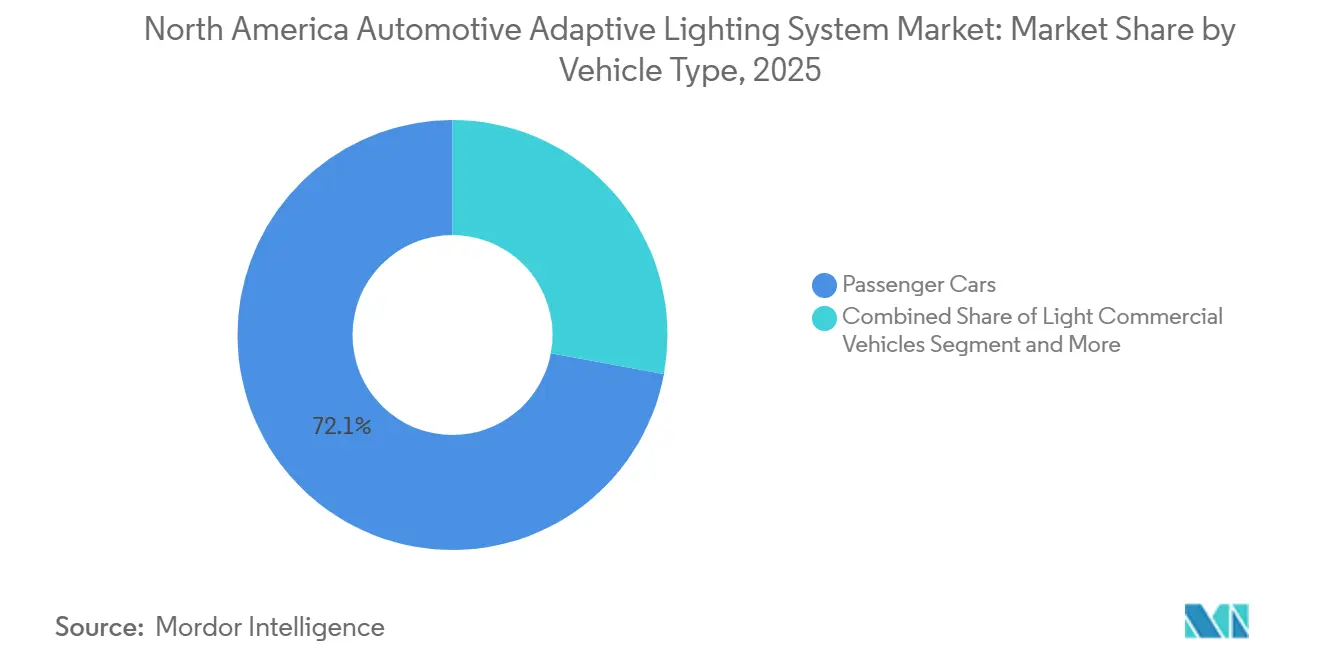
Passenger Vehicles Remain the Core Demand BasePassenger cars held a 72.09% share in the North American automotive adaptive lighting system market in 2025. SUVs and crossovers support demand because automakers often introduce advanced lighting on higher-value vehicle lines. Their vehicle architectures can accommodate the sensors and control functions needed for adaptive operation. Sedans and hatchbacks have lower feature adoption rates, with buyers placing more emphasis on purchase price. Light commercial vehicles sit between consumer and heavy-duty use cases, as delivery fleets renew vehicles and add practical safety features.
Medium and heavy commercial vehicles are forecast to grow at a 10.57% CAGR through 2031. Fleet operators can value lighting that improves visibility on long and poorly lit routes. Safety policies and insurance requirements can make nighttime performance relevant to commercial procurement decisions. Suppliers that document reliable beam operation may be better placed in fleet discussions. The North America automotive adaptive lighting system industry, therefore, has a separate opportunity in working vehicles, not only in premium passenger models.

By Application:
Exterior Lighting Holds the Central RoleExterior lighting accounted for 91.84% share in 2025 in the North America automotive adaptive lighting system market. Headlamps, cornering lights, and adaptive signaling remain closely connected to the safety purpose of these systems. Front lighting attracts much of the engineering and compliance work because it must manage road illumination and glare. Rear lighting can also evolve as vehicle systems use speed and navigation data more actively. The large exterior position reflects the current focus of automaker lighting programs.
Interior lighting is forecast to grow at a 9.12% CAGR through 2031. Automakers are using ambient lighting more often as part of the vehicle experience and software feature set. This use case can support functions that are updated or activated after delivery when the vehicle design allows it. Valeo announced an interior-lighting program using In-Mold Structural Electronics technology for a premium automaker. The North America automotive adaptive lighting system market may see interior lighting become more closely tied to user-interface and software decisions.
By Component:
Lamp Assemblies Lead, While Sensing Content AdvancesLamp assemblies held 46.41% share in 2025 in the North America automotive adaptive lighting system market. Modern headlamp modules combine multiple physical and electronic elements, which support their central role in system value. Suppliers must coordinate optics, thermal performance, packaging, and vehicle interfaces within the assembly. This makes lamp modules important even as more control functions move into vehicle electronics. Automakers also evaluate these assemblies for fit, styling, durability, and regulatory performance.
Sensors and cameras are forecast to grow at a 12.01% CAGR through 2031. These components help the system interpret traffic, road conditions, and other inputs before changing the light output. Their role increases the importance of data processing and system integration in supplier selection. Controllers and electronic control units also become more relevant as vehicle electrical architectures evolve. The North America automotive adaptive lighting system market will increasingly depend on coordination among component suppliers rather than on isolated lamp design.
By Technology and Light Source:
LED Is Established, Laser Has a Specialized RoleLED held 64.19% share in 2025 in the North America automotive adaptive lighting system market. The technology has a developed supply base and fits many current vehicle lighting designs. LED systems can support detailed beam management while meeting packaging and energy requirements. Xenon, HID, and halogen options are less aligned with the direction of new adaptive systems. OLED and Micro-LED remain relevant for designs that require thin formats or more precise visual control.
Laser lighting is forecast to grow at a 16.13% CAGR through 2031. Its longer forward illumination can be relevant for certain high-speed and premium vehicle applications. Valeo and Appotronics have described a front-lighting collaboration that combines adaptive driving beam, road projection, and display functions. These efforts show how laser solutions can be positioned as part of a multifunction system rather than only as a light source. The North America automotive adaptive lighting system market will still need suppliers to address cost and durability before such systems can move beyond narrower applications.
By Functionality:
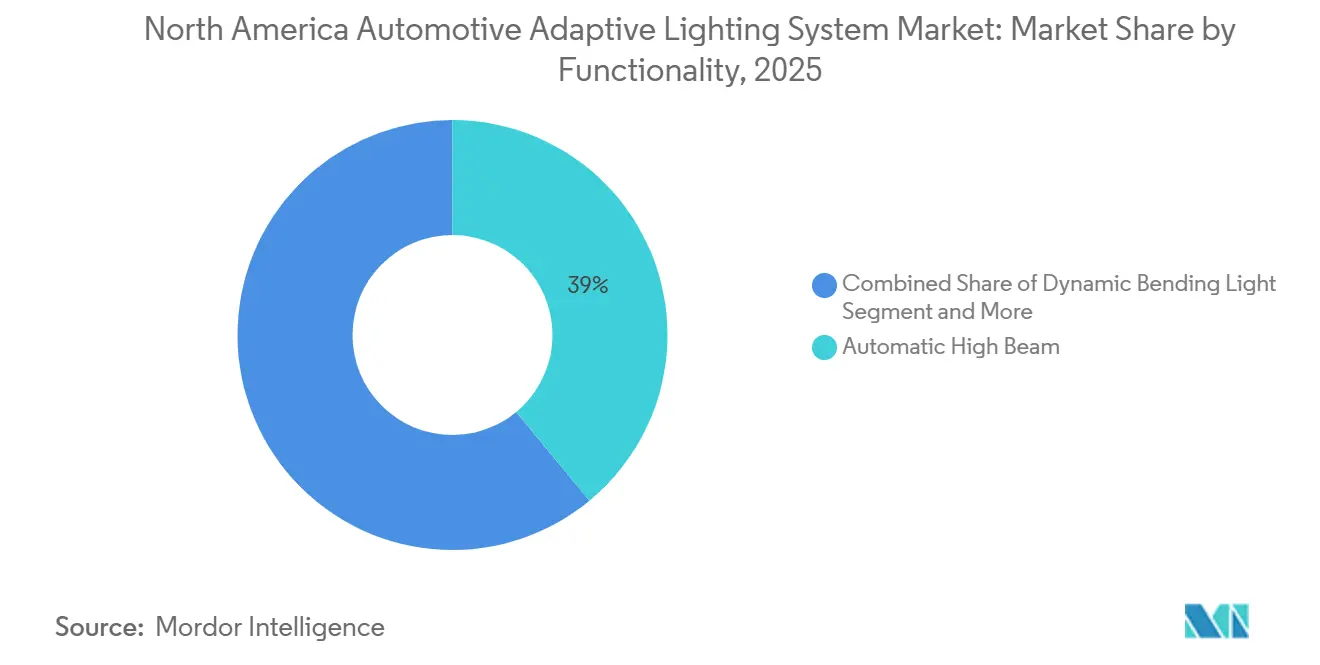
Automatic High Beam Is Established, Adaptive Front Lighting ExpandsAutomatic high beam held 39.01% share in 2025 in the North America automotive adaptive lighting system market. It was compatible with the earlier U.S. regulatory approach and gained adoption before adaptive driving beam certification was available. Its broad presence makes it a familiar entry point for drivers and automakers. As more capable systems become available, it may serve as a baseline function within a wider lighting package. Dynamic bending and cornering functions can build on related sensing and control capabilities.
Adaptive front lighting is forecast to grow at a 13.01% CAGR through 2031. The function can combine cameras, actuators, and beam controllers to adjust illumination for changing driving conditions. Once that infrastructure is installed, automakers may add related capabilities through the same vehicle architecture. This supports more durable supplier relationships when a system is selected for a platform. The North America automotive adaptive lighting system market is shaped by this move from one function to a connected set of lighting capabilities.
By Sales Channel:
OEM Programs Continue to Define System AdoptionOEM held 83.94% share in 2025 in the North America automotive adaptive lighting system market. Vehicle-specific calibration and integration make factory installation the most practical route for full-featured adaptive systems. The lighting module must work with the vehicle sensor array, suspension geometry, and software controls. This technical fit gives automakers a strong role in setting the pace of adoption. It also favors suppliers that can meet long program-development and validation requirements.
The aftermarket is forecast to grow at a 9.65% CAGR through 2031. Some vehicle owners may seek permitted upgrades to compatible lighting hardware or functions after purchase. The opportunity is more limited for systems that require extensive calibration and close integration with factory electronics. NHTSA safety information confirms that adaptive headlamp settings can be addressed through software actions in appropriate cases. The North America automotive adaptive lighting system market will require clear compliance and service pathways before aftermarket activity can broaden materially.
Geography Analysis
United States Automotive Adaptive Lighting System Market
The United States held 80.98% of regional revenue in 2025 and is forecast to grow at a 7.19% CAGR through 2031. It remains the main source of vehicle demand within the North America automotive adaptive lighting system market. The established U.S. framework for adaptive driving beams has given vehicle programs clearer guidance on compliance. Large automaker platforms and electric-vehicle activity support demand for higher-function lighting packages. Koito has stated that it plans adaptive driving beam products for the United States, indicating supplier preparation for broader regional programs.
Canada Automotive Adaptive Lighting System Market
Canada has a distinct role because its vehicle programs had an earlier engineering basis for adaptive beam technologies. Demand is linked to vehicle replacement, electric-vehicle adoption, and the integration of Canadian production with U.S. programs. The Ontario and Quebec automotive corridors connect to a broader Great Lakes manufacturing network. Similar technical requirements in Canada and the United States can reduce the need for separate lighting designs. This alignment can support efficient cross-border sourcing for the North America automotive adaptive lighting system market.
Mexico Automotive Adaptive Lighting System Market
Mexico is important as a manufacturing and supply-chain location for lamps, cameras, and associated electronic parts. Regional production can help suppliers serve U.S.-bound vehicle programs with shorter logistics routes. Koito began production at its second San Luis Potosí facility in April 2026 to support North American customers. Local manufacturing also gives suppliers a way to respond to automaker demand for regional content. Mexico’s role will remain tied to the reliability of its supplier base and its links with U.S. and Canadian assembly operations.
Competitive Landscape
The North America automotive adaptive lighting system market has a moderate concentration because leading suppliers hold meaningful positions without a commanding combined share. Koito Manufacturing, Valeo, FORVIA HELLA, Marelli, and Stanley Electric are among the important established suppliers. Their positions reflect long experience in vehicle lighting, established automaker relationships, and broad manufacturing capabilities. Competition is shifting as lighting functions require closer links with sensing, electronics, and software. This creates pressure on suppliers that offer lamp hardware without supporting control or integration capabilities.
Koito is expanding regional production and has identified adaptive driving beam offerings for the U.S. market. FORVIA HELLA has moved its FlatLight technology into series production, showing continued work on compact lighting designs. Valeo has used partnerships to develop laser-based front-lighting functions and other lighting applications. These actions show that leading companies are combining product development with manufacturing and technology relationships. The North America automotive adaptive lighting system market rewards suppliers that can move from design work to validated vehicle production.
Specialty suppliers can retain a role in fleet, aftermarket, and vehicle categories where service support and application knowledge matter. New entrants face substantial requirements for vehicle validation, software security, and regulatory compliance. The rise of software-managed beam functions may create opportunities for companies with strong electronics expertise. It may also raise warranty and support obligations for established lighting suppliers. The competitive position of each company will depend on its ability to meet automaker requirements across hardware, software, and regional operations.
North America Automotive Adaptive Lighting System Industry Leaders
-
Koito Manufacturing Co., Ltd.
-
Valeo SE
-
FORVIA HELLA
-
Marelli Holdings Co., Ltd.
-
Stanley Electric Co., Ltd.
- *Disclaimer: Major Players sorted in no particular order
North America Automotive Adaptive Lighting System Market Companies Covered in this Report
- ams-OSRAM AG
- Aptiv PLC
- Continental AG
- DENSO Corporation
- FORVIA HELLA
- Gentex Corporation
- Hyundai Mobis Co., Ltd.
- J.W. Speaker Corporation
- Johnson Electric Holdings Limited
- Koito Manufacturing Co., Ltd.
- Lear Corporation
- LG Electronics Inc. and ZKW Group
- Marelli Holdings Co., Ltd.
- Magna International Inc.
- North American Lighting, Inc.
- OPmobility SE
- Robert Bosch GmbH
- Stanley Electric Co., Ltd.
- Valeo SE
- Varroc Engineering Limited
Read Analysis of North America Automotive Adaptive Lighting System Companies
Recent Industry Developments in North America Automotive Adaptive Lighting System Market
- May 2026: Audi announced its next-generation adaptive Matrix LED headlights will be available in the United States on the upcoming Q9 three-row crossover SUV, factory-enabled for the first time.
- March 2026: Valeo presented Panovision, a pillar-to-pillar head-up display projecting driving data and safety alerts across the windshield, alongside e-Chromic Glasses that adjust tint via Bluetooth using sensor and GPS data.
North America Automotive Adaptive Lighting System Market Report Scope
The North America Automotive Adaptive Lighting System Market is segmented by vehicle type, application, component, technology and light source, functionality, sales channel, and country. By Vehicle Type, the market is segmented into Passenger Cars (Sedans, SUVs and Crossovers and Hatchbacks), Light Commercial Vehicles, and Medium and Heavy Commercial Vehicles. By Application, the market is segmented into Exterior Lighting (Front Lighting and Rear Lighting) and Interior Lighting. By Component, the market is segmented into Controllers and ECUs, Sensors and Cameras, Lamp Assemblies, Actuators and Motors, and Other Components. By Technology and Light Source, the market is segmented into LED, Xenon and HID, Halogen, Laser Lighting, and OLED and Micro-LED. By Functionality, the market is segmented into Automatic High Beam, Dynamic Bending Lights, Cornering Lights, Adaptive Front Lighting System (AFS), and Adaptive Driving Beam (ADB). By Sales Channel, the market is segmented into Original Equipment Manufacturer (OEM) and Aftermarket. By Country, the market is segmented into United States, Canada, and Rest of North America. Market forecasts are provided in terms of Value (USD) and Volume (Units).
Segmentation Overview
By Vehicle Type
| Passenger Cars | Sedans |
| SUVs and Crossovers | |
| Hatchbacks | |
| Light Commercial Vehicles | |
| Medium and Heavy Commercial Vehicles |
By Application
| Exterior Lighting | Front Lighting |
| Rear Lighting | |
| Interior Lighting |
By Component
| Controllers and ECUs |
| Sensors and Cameras |
| Lamp Assemblies |
| Actuators and Motors |
| Other Components |
By Technology and Light Source
| LED |
| Xenon and HID |
| Halogen |
| Laser Lighting |
| OLED and Micro-LED |
By Functionality
| Automatic High Beam |
| Dynamic Bending Light |
| Cornering Lights |
| Adaptive Front Lighting |
| Adaptive Driving Beam |
By Sales Channel
| Original Equipment Manufacturers |
| Aftermarket |
By Country
| United States |
| Canada |
| Rest of North America |
| By Vehicle Type | Passenger Cars | Sedans |
| SUVs and Crossovers | ||
| Hatchbacks | ||
| Light Commercial Vehicles | ||
| Medium and Heavy Commercial Vehicles | ||
| By Application | Exterior Lighting | Front Lighting |
| Rear Lighting | ||
| Interior Lighting | ||
| By Component | Controllers and ECUs | |
| Sensors and Cameras | ||
| Lamp Assemblies | ||
| Actuators and Motors | ||
| Other Components | ||
| By Technology and Light Source | LED | |
| Xenon and HID | ||
| Halogen | ||
| Laser Lighting | ||
| OLED and Micro-LED | ||
| By Functionality | Automatic High Beam | |
| Dynamic Bending Light | ||
| Cornering Lights | ||
| Adaptive Front Lighting | ||
| Adaptive Driving Beam | ||
| By Sales Channel | Original Equipment Manufacturers | |
| Aftermarket | ||
| By Country | United States | |
| Canada | ||
| Rest of North America | ||
Key Questions Answered in the Report
What is driving adoption of automotive adaptive lighting systems in North America?
U.S. approval of adaptive driving beam headlamps has given automakers a clearer compliance path. Adoption is also supported by closer links between lighting, vehicle sensors, and software controls. Premium SUVs and electric vehicles provide an early setting for these functions.
How large is the North America automotive adaptive lighting system market?
The North America automotive adaptive lighting system market is projected to reach USD 8.51 billion by 2031. It is projected to grow from USD 6.17 billion in 2026 at a CAGR of 6.63%. The outlook reflects expected adoption across vehicle programs and the regional supply base.
Which vehicle type leads demand for adaptive lighting systems?
Passenger cars led with 72.09% share in 2025. Premium SUVs and crossovers are important because their designs can accommodate advanced lighting features. Medium and heavy commercial vehicles have the highest projected growth rate among vehicle types.
Which lighting technology is growing fastest in North America?
Laser lighting is forecast to grow at a 16.13% CAGR through 2031. It can support specialized, longer-range, and multifunction lighting applications. Wider use will depend on how suppliers address cost, durability, and vehicle-program requirements.
Why do OEMs dominate adaptive lighting sales?
OEM installation supports the vehicle-specific calibration required between lighting modules, sensors, suspension geometry, and software controls. This makes factory integration the practical route for full-featured systems. Suppliers must therefore meet automaker validation and program-development requirements.