
Cervical Cancer Diagnostic Market Size and Share
Market Overview
| Study Period | 2020 - 2031 |
|---|---|
| Market Size (2026) | USD 6.75 Billion |
| Market Size (2031) | USD 8.85 Billion |
| Growth Rate (2026 - 2031) | 5.58 % |
| Fastest Growing Market | Asia-Pacific |
| Largest Market | North America |
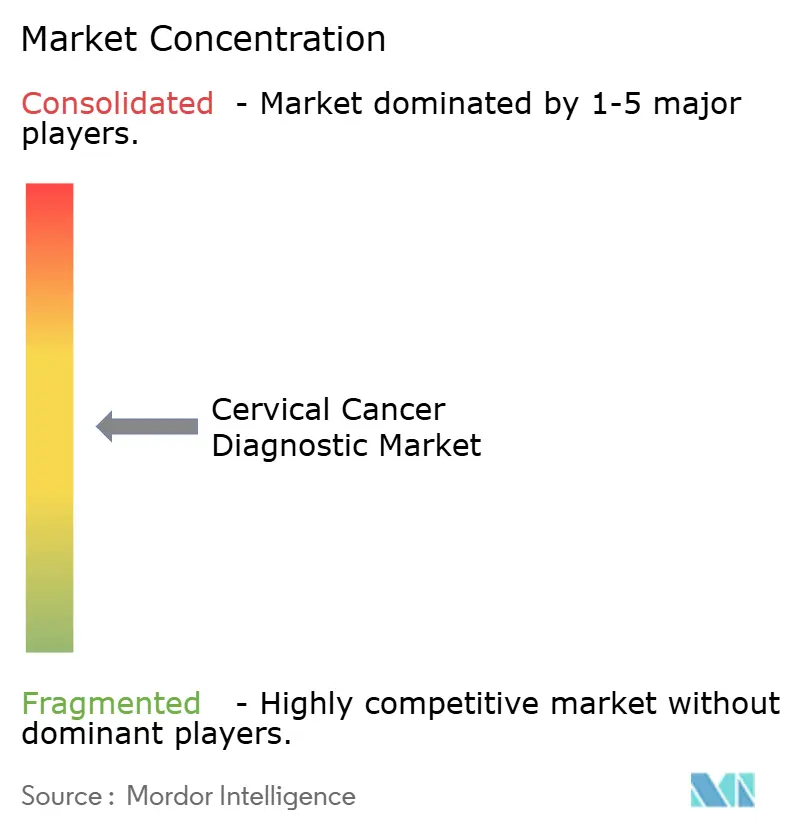
| Market Concentration | Medium |
Major Players *Disclaimer: Major Players sorted in no particular order Image © Mordor Intelligence. Reuse requires attribution under CC BY 4.0. | |
Cervical Cancer Diagnostic Market Analysis by Mordor Intelligence
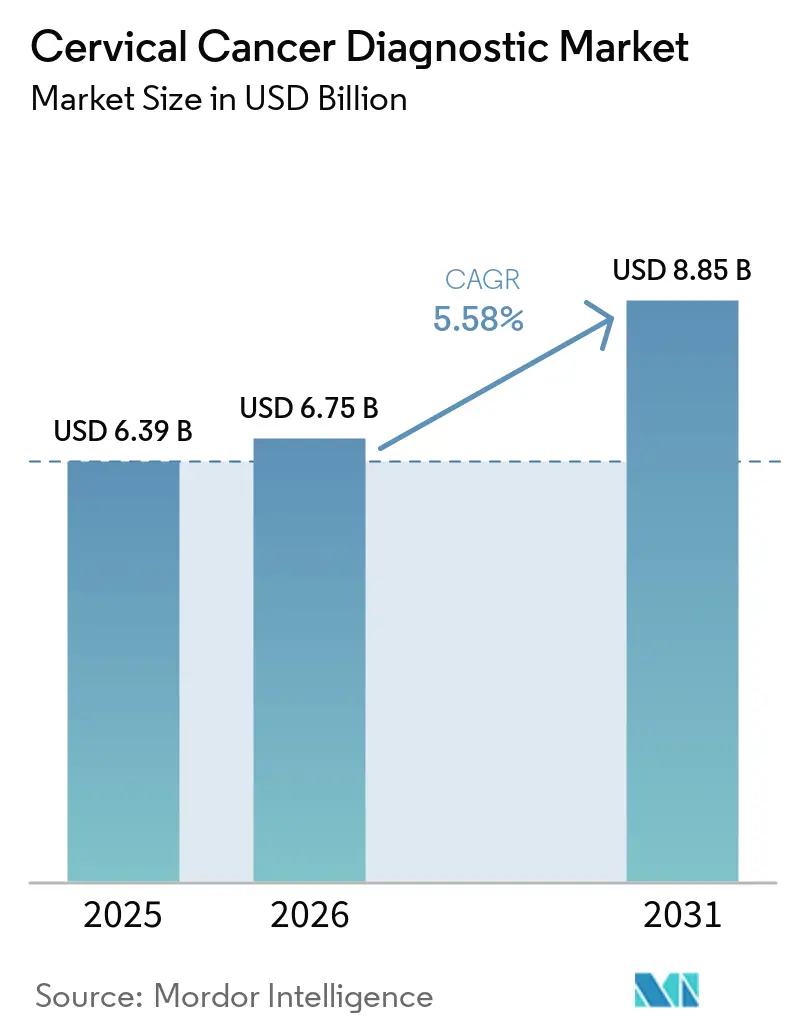
The Cervical Cancer Diagnostic Market size is projected to expand from USD 6.39 billion in 2025 and USD 6.75 billion in 2026 to USD 8.85 billion by 2031, registering a CAGR of 5.58% between 2026 to 2031.
HPV, which causes over 99% of cervical cancer cases globally, highlights the critical need for screening, with more than 1 billion women still unscreened. High-income countries are advancing toward primary HPV screening and self-collection methods, while lower-income nations focus on establishing basic screening infrastructure for broader population coverage. This situation links the cervical cancer diagnostic market to changes in clinical guidelines in developed regions and the expansion of public health programs in emerging markets. The 2027 U.S. mandate for no-cost self-collected high-risk HPV testing is expected to increase screening rates and improve access for women previously hindered by cost or exam-related barriers.[1]World Health Organization, “Cervical Cancer Elimination Initiative,” World Health Organization, who.int
Key Report Takeaways
- By test type, pap smear testing held the leading position in 2025, while HPV testing is forecast to expand at a 6.52% CAGR through 2031.
- By end user, hospitals held 38.55% of the cervical cancer diagnostic market share in 2025, while diagnostic centers are projected to grow at a 7.89% CAGR through 2031.
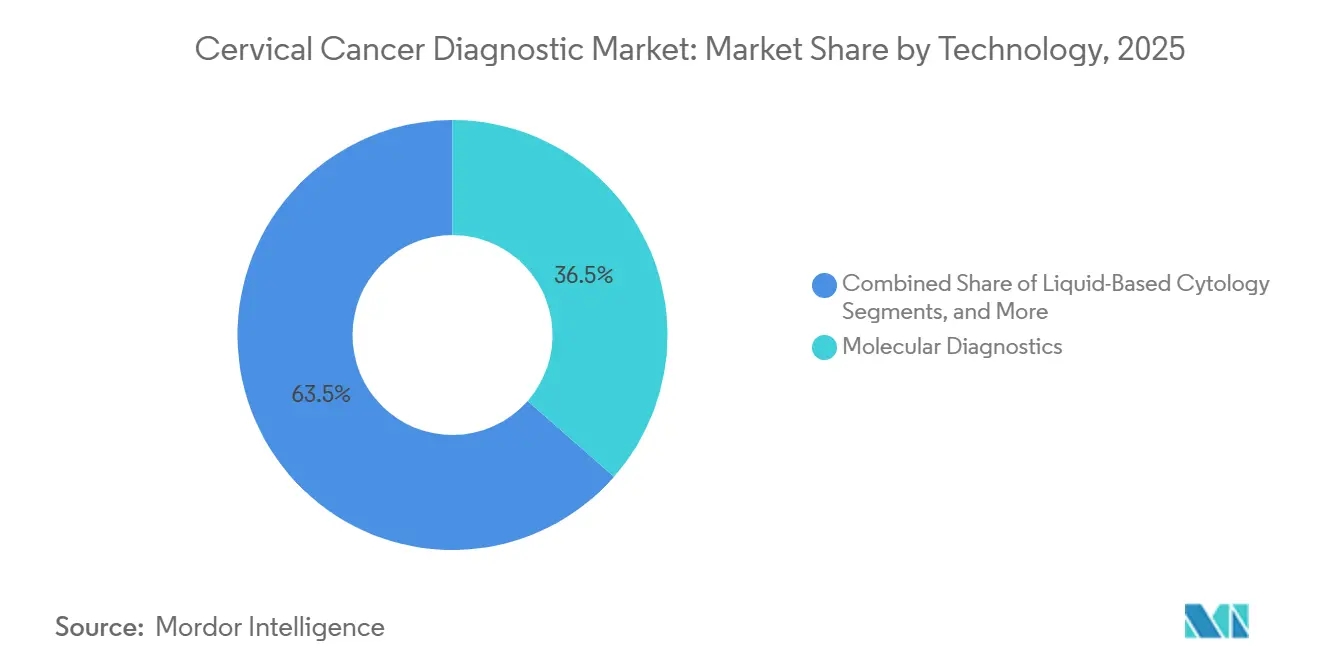
- By technology, molecular diagnostics accounted for 36.45% of the cervical cancer diagnostic market size in 2025, while liquid-based cytology is projected to grow at a 6.95% CAGR through 2031.
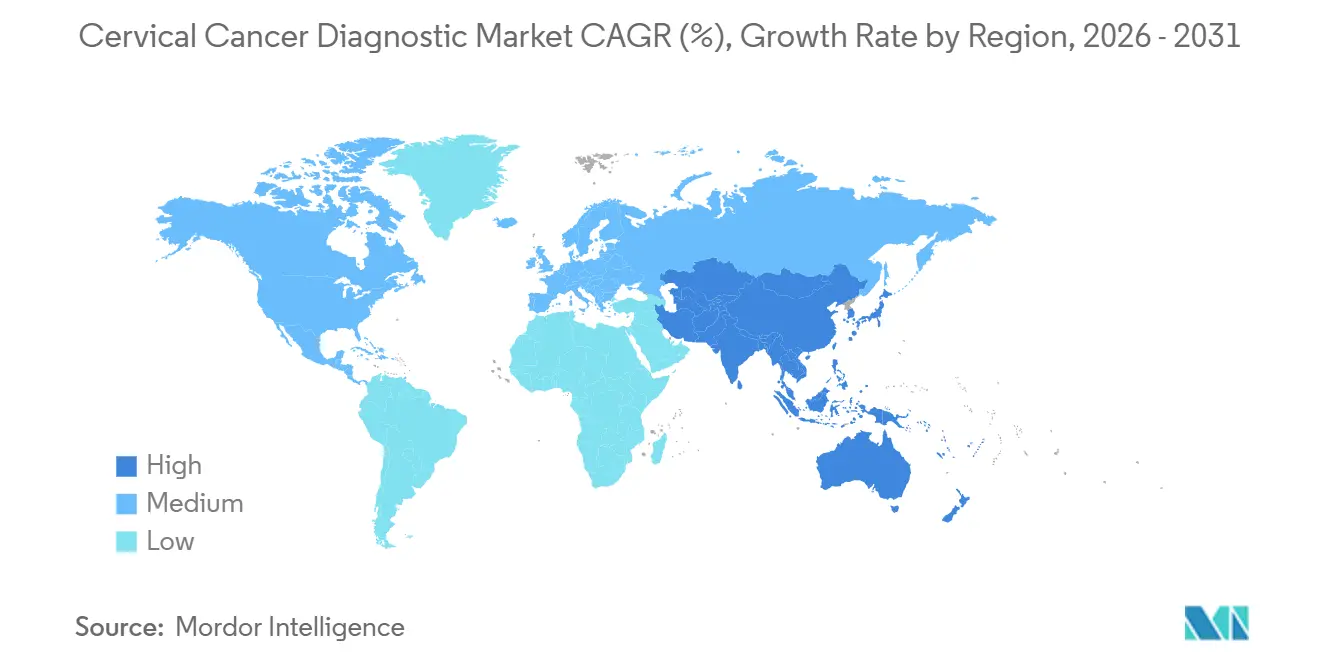
- By geography, North America led the market in 2025, while Asia-Pacific is projected to advance at a 7.34% CAGR through 2031.
Note: Market size and forecast figures in this report are generated using Mordor Intelligence’s proprietary estimation framework, updated with the latest available data and insights as of January 2026.
Global Cervical Cancer Diagnostic Market Trends and Insights
Drivers Impact Analysis*
| DRIVER | (~) % IMPACT ON CAGR FORECAST | GEOGRAPHIC RELEVANCE | IMPACT TIMELINE |
|---|---|---|---|
| Rising cervical cancer burden and persistent hpv prevalence | +1.6% | Global | Long term (≥ 4 years) |
| Expansion of hpv primary screening and self-sampling | +1.5% | North America and Europe, with spillover to Asia-Pacific | Short term (≤ 2 years) |
| Ai-enabled cytology and digital colposcopy workflow automation | +1.0% | North America, Europe, and core Asia-Pacific markets | Medium term (2-4 years) |
| Government screening mandates and elimination targets | +0.9% | Asia-Pacific, Middle East and Africa, and South America | Medium term (2-4 years) |
| Expanded access through decentralized laboratory networks | +0.6% | Asia-Pacific, Middle East and Africa, and rural South America | Long term (≥ 4 years) |
| Source: Mordor Intelligence | |||
Rising Cervical Cancer Burden and Persistent HPV Prevalence
The cervical cancer diagnostic market thrives on unmet screening needs rather than technological saturation. HPV is responsible for over 99% of cervical cancer cases globally, making screening essential across healthcare systems. A staggering 90% of cervical cancer deaths occur in low to middle-income nations, where access to screening remains limited and unevenly distributed. WHO highlights that over 1 billion women have never undergone screening, indicating a vast demand for first-time testing outside organized care. While vaccination programs aim to reduce future burdens, they will not significantly lower the immediate demand for adult screenings due to the need for monitoring infected and aging populations. This positions the cervical cancer diagnostic market to address substantial unmet screening needs in both developed and emerging regions.
Expansion of HPV Primary Screening and Self-Sampling
The cervical cancer diagnostic market is shifting toward HPV-centric screening methods as regulators and clinical entities endorse primary HPV testing and self-collection. In February 2026, Hologic received FDA approval for its Aptima HPV Assay, expanding its application to Pap testing, co-testing, and primary HPV screening. The ASCCP approved self-collection capabilities for Abbott Alinity, BD Onclarity, and Roche Cobas in healthcare settings, strengthening compliance. ACOG endorsed high-risk HPV testing for average-risk women aged 30 to 65 every three years in April 2026, marking a significant shift in routine screening practices.[2]Waters Corporation, “Waters Announces FDA Clearance of the Most Comprehensive At-Home Cervical Cancer Screening Tool, the Onclarity HPV Self-Collection Kit and FDA-Approved HPV Assay,” Waters Corporation, waters.com A U.S. policy effective in 2027 will further support this trend, as self-collected tests will be fully covered by most health plans. Self-collection expands the market by attracting women previously deterred from clinic-based screenings.[3]The ASCO Post, “FDA Approves At-Home Self-Collection Device for Cervical Cancer Screening,” The ASCO Post, ascopost.com
AI-Enabled Cytology and Digital Colposcopy Workflow Automation
The cervical cancer diagnostic market is adapting to workforce shortages in cytology reading and colposcopy follow-ups by focusing on workflow efficiency. AI-assisted digital cytology and image-supported colposcopy are transitioning from pilot phases to daily operations. Hologic’s Genius Digital Diagnostics System exemplifies AI-augmented cytology workflows in regulated environments. Automation enables labs to handle higher slide volumes, reduce reading times, and maintain consistency despite limited trained personnel. This segment is expected to grow as it enhances capacity in established systems and supports scaled screenings in resource-limited areas.
Government Screening Mandates and Elimination Targets
Government-driven screening initiatives are providing long-term support to the cervical cancer diagnostic market. In June 2025, WHO and Unitaid committed USD 50 million over two years, with USD 18 million allocated to assist 18 nations across Africa, Asia-Pacific, Latin America, and the Caribbean. Gavi set a 2026-2030 target to vaccinate over 120 million additional girls against HPV, reinforcing cervical cancer elimination efforts. These initiatives align screening programs with national strategies and international funding, making volumes more predictable. This alignment facilitates instrument placements, assay planning, and channel development in regions like Asia-Pacific, Africa, and Latin America, strengthening the market's presence in previously challenging areas.
Restraints Impact Analysis*
| RESTRAINT | (~) % IMPACT ON CAGR FORECAST | GEOGRAPHIC RELEVANCE | IMPACT TIMELINE |
|---|---|---|---|
| Low screening coverage in resource-constrained settings | -0.8% | Middle East and Africa, South America, and rural Asia-Pacific | Long term (≥ 4 years) |
| Shortage of trained cytotechnologists and colposcopists | -0.6% | Global | Medium term (2-4 years) |
| Reimbursement variation and high upfront test costs | -0.5% | Asia-Pacific, Middle East and Africa, and South America | Medium term (2-4 years) |
| Specimen quality and false-negative risk in real-world use | -0.4% | Global, with near-term relevance in North America | Short term (≤ 2 years) |
| Source: Mordor Intelligence | |||
Low Screening Coverage in Resource-Constrained Settings
In lower-resource countries, limited screening coverage significantly restricts the growth of the cervical cancer diagnostic market. According to the WHO, in many low- and middle-income nations, fewer than 5% of women undergo cervical cancer screening, highlighting the need for substantial improvements. Basic challenges such as weak public health infrastructure, inconsistent referral pathways, financial constraints, and limited access outside urban areas persist. Even with funding, achieving sustainable national coverage is a gradual process requiring the development of laboratory networks, registries, workforce training, and follow-up systems. As a result, the market in these regions grows unevenly, favoring suppliers that adapt to phased public programs and practical access models over those targeting premium urban demand.
Shortage of Trained Cytotechnologists and Colposcopists
The cervical cancer diagnostic market faces challenges due to a shortage of trained cytotechnologists and colposcopists, even in regions with established test demand. High-income markets struggle with an aging specialist workforce, while lower-income systems lack adequate follow-up staff after positive screenings. This leads to slower laboratory turnaround times and higher patient drop-off rates between initial screening and confirmatory diagnosis. The staffing shortfall also drives demand for digital and AI-driven platforms that reduce labor intensity, pushing the market toward automated and higher-value workflow solutions.
*Our forecasts treat driver/restraint impacts as directional, not additive. The impact forecasts reflect baseline growth, mix effects, and variable interactions.
Segment Analysis
By Test Type: HPV Testing Protocols Redefining Screening Architecture
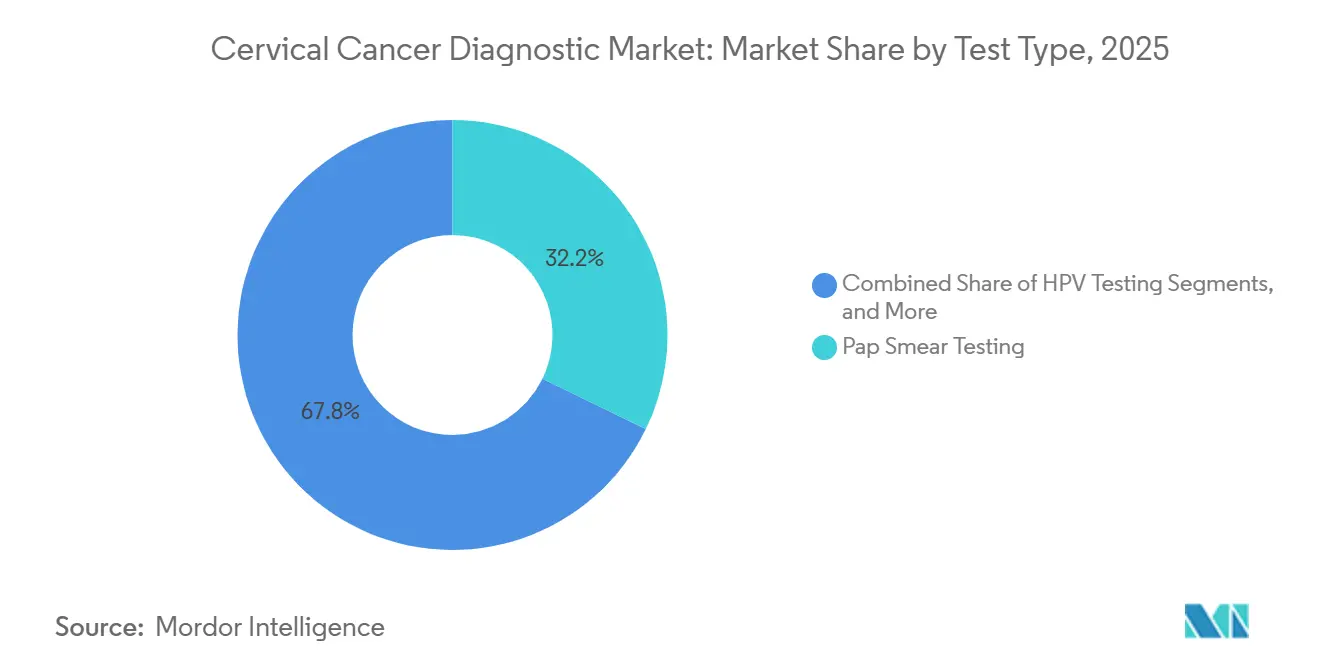
HPV testing is the fastest-growing test type in the cervical cancer diagnostic market, with a projected CAGR of 6.52% from 2026 to 2031. Pap smear testing held the largest position among test types in 2025 due to its established role in organized screening systems and co-testing workflows. Hologic’s FDA approval for the Aptima HPV Assay in February 2026 strengthened the shift toward HPV-led primary screening by expanding the company’s coverage across all major screening approaches. ACOG’s endorsement of patient self-collected high-risk HPV testing and Waters’ FDA clearance for the BD Onclarity HPV Self-Collection Kit in April 2026 further supported the move toward accessible sample collection methods.
HPV testing growth is not solely driven by replacing older modalities. Approximately 60% of cervical cancer cases arise in under-screened or never-screened individuals, highlighting the potential of new access models to expand the tested population. The HRSA guideline update effective in 2027 will support this shift by ensuring approved self-collected tests are covered without cost-sharing under most U.S. plans. Colposcopy, cervical biopsies, and endocervical curettage remain critical follow-up tools, with their volumes tied to abnormal findings from HPV-led screening. Biomarker-based triage tools are gaining relevance as providers seek better risk stratification after positive HPV results, balancing high-volume screening tests with high-value confirmatory pathways.



By End User: Hospitals Anchor Volume While Diagnostic Centers Accelerate
Hospitals accounted for 38.55% of the cervical cancer diagnostic market share in 2025, reflecting their role in national screening programs, gynecology services, and oncology referral networks that drive consistent testing demand. Centralized hospital laboratories process significant HPV and cytology volumes, offering reliable opportunities for assay suppliers. Diagnostic centers are the fastest-growing end-user group, projected to expand at a 7.89% CAGR through 2031, driven by the rise of specialized private lab chains in urban markets where patients prioritize faster access and lower costs.
Diagnostic centers, with their streamlined workflows, handle higher volumes and effectively compete with hospital-based testing for routine screenings. Specialty clinics remain vital due to their proximity to the core female screening population and their ability to guide both clinician-collected and self-collected pathways post-2026 ACOG update. Cancer and radiation therapy centers benefit from downstream diagnostic demand following abnormal screening referrals. Home care settings, though in early commercial stages, gained credibility with the U.S. authorization of the Teal Wand, which demonstrated 96% concordance with clinician-collected samples. This diversification broadens the cervical cancer diagnostic market beyond traditional hospital channels.
By Technology: Molecular Diagnostics Command Share, AI Cytology Reshapes Long-Term Trajectory
Molecular diagnostics led the cervical cancer diagnostic market in 2025 with a 36.45% share, driven by the widespread use of HPV DNA and mRNA assays in primary screening and co-testing protocols across North America, Europe, and high-income Asia-Pacific markets. These assays offer high sensitivity and align with evolving guidelines. Liquid-based cytology, the fastest-growing technology segment through 2031, supports cleaner sample handling and integrates seamlessly with molecular testing workflows.
Digital cytology and AI-assisted imaging are gaining traction as laboratories seek productivity improvements without expanding specialist teams, addressing workforce shortages that impact scale and turnaround times. Hologic’s Genius Digital Diagnostics System is a notable example of AI-enhanced cytology deployment. Immunohistochemistry and biomarker testing play a focused role in specialist referral settings, particularly for enhanced triage after positive HPV results. This evolution reduces reliance on a single technology and fosters integrated workflows connecting screening, triage, and follow-up processes.
Geography Analysis
In 2025, North America led the regional market due to its advanced laboratory infrastructure, strict guideline adherence, and extensive reimbursement support. A 2027 U.S. policy update introducing zero-cost-sharing coverage for self-collected high-risk HPV testing is expected to enhance participation by addressing financial and access barriers. Key approvals in 2025 and 2026, including the Teal Wand, Hologic's Aptima HPV Assay for primary screening, and BD's Onclarity HPV Self-Collection Kit for home use, further strengthened the region's position. Canada is advancing through centralized provincial screening systems, while Mexico is exploring broader adoption of HPV pathways beyond traditional Pap-led public care models.
Europe exhibits diversity in policy timing and technology adoption across countries. The United Kingdom's early adoption of primary HPV testing has set a benchmark for other nations considering similar transitions. Germany, France, and Italy are navigating co-testing structures and evaluating the cost-effectiveness of shifting to HPV-first protocols. TruScreen's 2026 expansion into Romania and Italy highlights growing commercial interest in Southern and Eastern Europe as these regions transition from conventional screening methods.
The Asia-Pacific region is the fastest-growing market for cervical cancer diagnostics, with a projected 7.34% CAGR through 2031. This growth is driven by a large target population, increased government focus on elimination goals, and rising private diagnostic investments in urban areas. China has deployed TruScreen AI cervical screening devices across 11 provinces under public health insurance reimbursement, showcasing the scalability of practical screening tools. Malaysia's 2026 launch of the 3-year EPICC cervical cancer elimination program reflects a strong commitment to enhancing registries, capacity building, and equitable screening access.

Competitive Landscape
In the cervical cancer diagnostic market, major players like Hologic, Roche, Waters Corporation, Abbott, and QIAGEN dominate the molecular HPV assay segment. Meanwhile, larger firms are broadening their portfolios, integrating assays with self-collection tools and digital workflow systems. On the other hand, smaller entities such as DYSIS Medical, Guided Therapeutics, TruScreen, and Femasys carve out their niche by honing in on specific technologies, catering to lower-resource settings, or targeting narrower clinical applications. This dynamic ensures the market remains centered around high-volume assay platforms, yet allows for specialized competition in areas like access, imaging, and triage.
In a significant move, Blackstone and TPG acquired Hologic in April 2026, paying up to USD 79 per share in cash, inclusive of a contingent value right. This acquisition is pivotal as it transitions a leading cervical screening platform into private hands, coinciding with a growing demand for reimbursement-backed diagnostics. Waters made headlines in April 2026 with the FDA's green light on the BD Onclarity HPV Self-Collection Kit, granting it extended genotyping approval for at-home use. Meanwhile, Hologic bolstered its standing with a February 2026 Aptima approval, making it the sole mRNA-based assay endorsed across all three guideline-recommended screening methods.
Looking ahead, the cervical cancer diagnostic market is poised to evolve, with the next wave of competition likely centering on self-collection infrastructure, AI-enhanced colposcopy, and biomarker-driven triage, rather than merely standard assay chemistry. The significance of decentralized specimen collection and transport is underscored by the need for reliable logistics, lab connectivity, and result communication, especially for at-home and remote pathways. AI-driven imaging solutions are gaining traction as they effectively tackle staffing challenges that influence both the scale of screening and the quality of follow-ups. Additionally, biomarker tools like p16 and Ki-67 for triage are garnering attention, as providers seek refined management strategies for HPV-positive patients post-initial testing.
Cervical Cancer Diagnostic Industry Leaders
Abbott Laboratories
Becton, Dickinson and Company
F. Hoffmann-La Roche Ltd
Hologic, Inc.
QIAGEN N.V.
- *Disclaimer: Major Players sorted in no particular order

Recent Industry Developments
- April 2026: Waters Corporation received FDA clearance for the BD Onclarity HPV Self-Collection Kit and approval for the BD Onclarity HPV Assay for at-home use, covering 6 individual and 3 pooled HPV genotypes under major insurance plans.
- April 2026: Blackstone and TPG completed the acquisition of Hologic, Inc. for up to USD 79 per share in cash, including a contingent value right, following stockholder approval in February 2026.
- April 2026: ACOG updated cervical cancer screening guidelines, endorsing self-collected high-risk HPV testing every 3 years for average-risk women aged 30 to 65 to address under-screening in the U.S.
- February 2026: Hologic's Aptima HPV Assay, supported by a study of over 650,000 women, received FDA approval for clinician-collected primary HPV screening, becoming the only mRNA-based assay approved for all guideline-recommended methods.
- February 2026: TruScreen signed its first sales contract in Uzbekistan for 8 AI-enabled cervical cancer screening devices and 8,280 single-use sensors, expanding its reach across Central Asia to over 12 million women.
- September 2025: Abbott’s Alinity m HR HPV assay received FDA PMA approval for high-risk HPV primary screening, joining Roche Cobas and BD Onclarity as approved platforms for self-collection in healthcare settings.


Global Cervical Cancer Diagnostic Market Report Scope
As per the scope of the report, Cervical cancer is the uncontrolled growth of abnormal cells in the cervix the lower, narrow part of the uterus that connects to the vagina. It primarily results from persistent, high-risk Human Papillomavirus (HPV) infections.
The cervical cancer diagnostic market is segmented by test type, end-user, technology, and geography. By test type, the market includes Pap smear testing, HPV testing, colposcopy, cervical biopsies and endocervical curettage, and other diagnostic tests. By end-user, the market is segmented into hospitals, specialty clinics, diagnostic centers, cancer and radiation therapy centers, and home care settings. By technology, the market is segmented into liquid-based cytology, molecular diagnostics, digital cytology and AI-assisted imaging, and immunohistochemistry and biomarker testing. By geography, the market is analyzed across North America, Europe, Asia-Pacific, the Middle East and Africa, and South America. The report also covers the estimated market sizes and trends for 17 countries across major regions globally. The report offers the market sizes and forecasts in terms of value (USD) for the above segments.
| Pap Smear Testing |
| HPV Testing |
| Colposcopy |
| Cervical Biopsies and Endocervical Curettage |
| Other Diagnostic Tests |
| Hospitals |
| Specialty Clinics |
| Diagnostic Centers |
| Cancer and Radiation Therapy Centers |
| Home Care Settings |
| Liquid-Based Cytology |
| Molecular Diagnostics |
| Digital Cytology and AI-Assisted Imaging |
| Immunohistochemistry and Biomarker Testing |
| North America | United States |
| Canada | |
| Mexico | |
| Europe | Germany |
| United Kingdom | |
| France | |
| Italy | |
| Spain | |
| Rest of Europe | |
| Asia-Pacific | China |
| India | |
| Japan | |
| Australia | |
| South Korea | |
| Rest of Asia-Pacific | |
| Middle East and Africa | GCC |
| South Africa | |
| Rest of Middle East and Africa | |
| South America | Brazil |
| Argentina | |
| Rest of South America |
| By Test Type | Pap Smear Testing | |
| HPV Testing | ||
| Colposcopy | ||
| Cervical Biopsies and Endocervical Curettage | ||
| Other Diagnostic Tests | ||
| By End User | Hospitals | |
| Specialty Clinics | ||
| Diagnostic Centers | ||
| Cancer and Radiation Therapy Centers | ||
| Home Care Settings | ||
| By Technology | Liquid-Based Cytology | |
| Molecular Diagnostics | ||
| Digital Cytology and AI-Assisted Imaging | ||
| Immunohistochemistry and Biomarker Testing | ||
| By Geography | North America | United States |
| Canada | ||
| Mexico | ||
| Europe | Germany | |
| United Kingdom | ||
| France | ||
| Italy | ||
| Spain | ||
| Rest of Europe | ||
| Asia-Pacific | China | |
| India | ||
| Japan | ||
| Australia | ||
| South Korea | ||
| Rest of Asia-Pacific | ||
| Middle East and Africa | GCC | |
| South Africa | ||
| Rest of Middle East and Africa | ||
| South America | Brazil | |
| Argentina | ||
| Rest of South America | ||


Key Questions Answered in the Report
What is the current value of the cervical cancer diagnostic market in 2026?
The cervical cancer diagnostic market stands at USD 6.75 billion in 2026 and is projected to reach USD 8.85 billion by 2031 at a 5.58% CAGR.
Which test category is growing the fastest in cervical cancer diagnostics?
HPV testing is the fastest-growing test type, with a projected 6.52% CAGR from 2026 to 2031, supported by guideline changes and self-collection adoption.
Why is self-collection becoming important in cervical cancer screening?
Self-collection reduces cost and exam-related barriers, and U.S. zero-cost-sharing coverage will begin in 2027 for approved self-collected high-risk HPV testing, which should improve access and participation.
Which end-user group leads demand for cervical cancer diagnostic products?
Hospitals led with 38.55% share in 2025 because they anchor national screening programs, gynecology services, and oncology referrals.
Which region is expected to grow the fastest through 2031?
Asia-Pacific is projected to grow the fastest, at a 7.34% CAGR, supported by public health commitments, rising private diagnostic investment, and wider program rollout.
What are the main factors limiting faster growth in cervical cancer diagnostics?
The biggest barriers are low screening coverage in resource-constrained settings, a shortage of trained cytotechnologists and colposcopists, uneven reimbursement, and specimen quality concerns in real-world self-collection use.
Page last updated on:





