
Market Overview
| Study Period | 2020 - 2032 |
|---|---|
| Forecast Data Period | 2027 - 2032 |
| Base Year Market Size (2026) | USD 0.28 Billion |
| Market Size (2027) | USD 0.31 Billion |
| Market Size (2032) | USD 0.43 Billion |
| Growth Rate (2027 - 2032) | 7.47 % |
| Market Concentration | Medium |
Major Players *Disclaimer: Major Players sorted in no particular order Image © Mordor Intelligence. Reuse requires attribution under CC BY 4.0. | |
Canada Automotive Electric Actuators Market Analysis by Mordor Intelligence
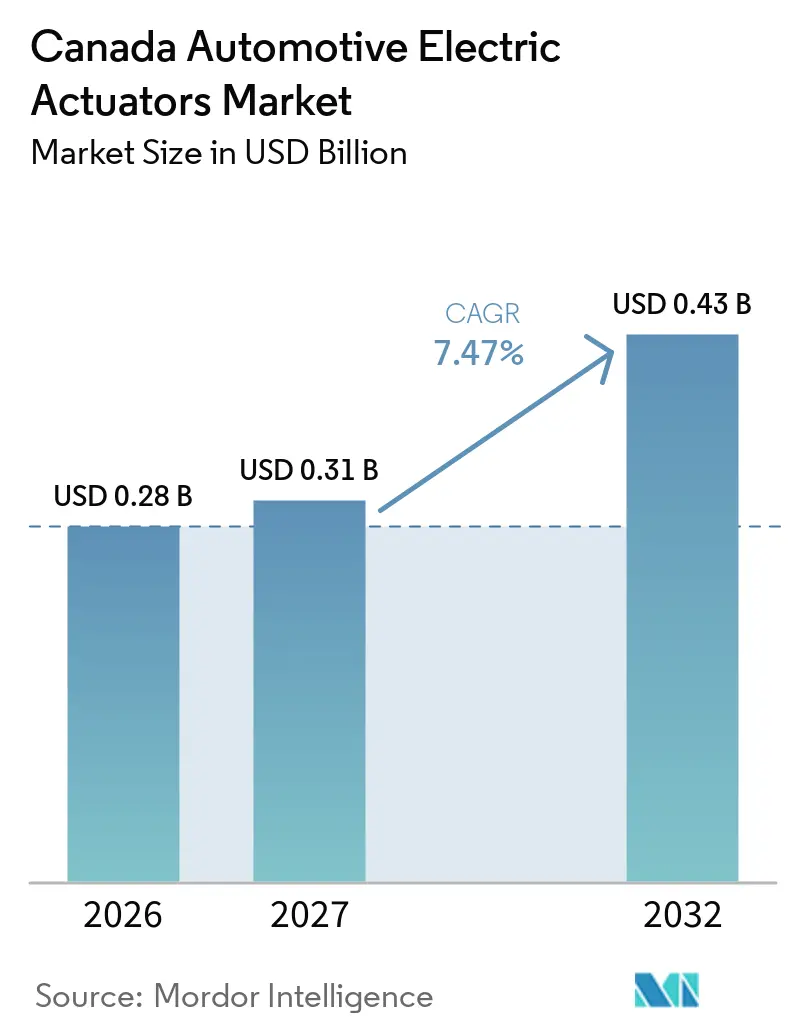
The Canada automotive electric actuators market size was valued at USD 0.28 billion in 2026 and is expected to grow from USD 0.31 billion in 2027 to reach USD 0.43 billion by 2032, registering a CAGR of 7.47% between 2027 and 2032. Electrified powertrains add thermal management, battery cooling, and HVAC control functions that require precise electric motion systems. Hybrid registrations rose significantly in 2025, keeping demand tied to more than just battery-electric vehicles. Software-defined vehicle designs also require actuators that can provide diagnostics, position data, and firmware support, raising the value of integrated systems. Canadian assembly activity and CUSMA content rules favor suppliers with North American manufacturing and engineering capabilities. Suppliers that can validate products for cold-weather, corrosion, safety, and electronic-controls performance are better positioned for long vehicle program cycles.
Key Report Takeaways
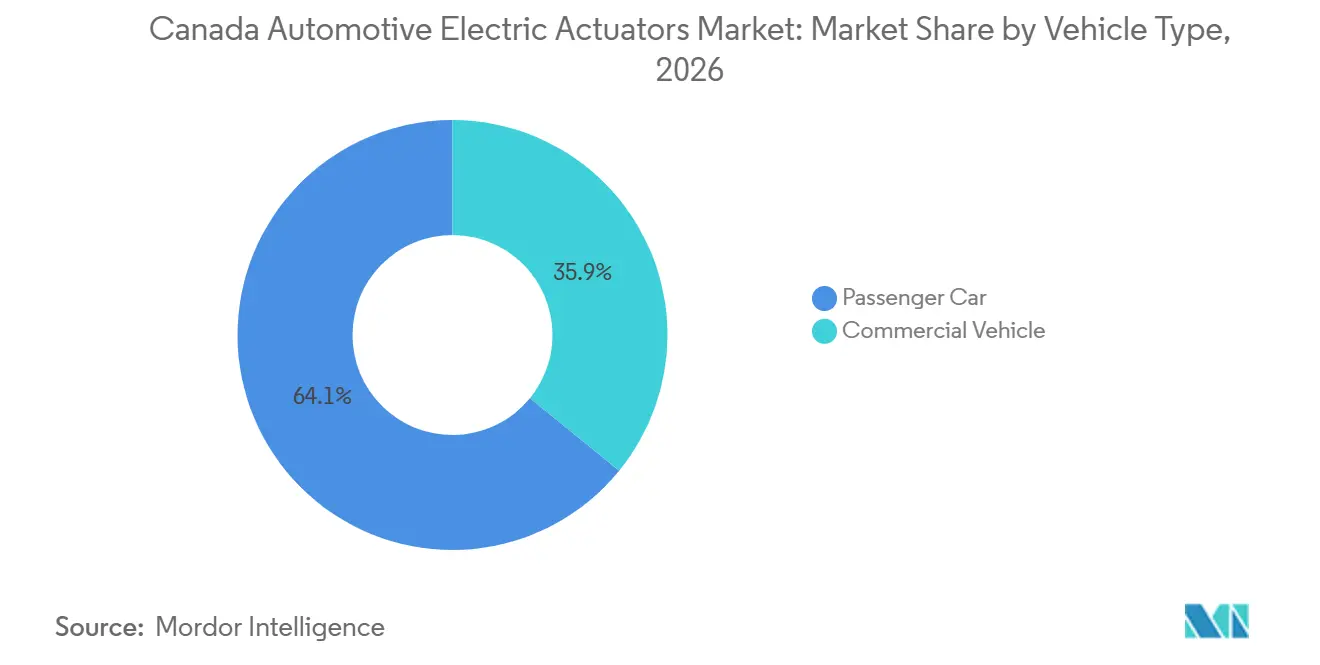
- By vehicle type, passenger cars held 64.12% of the Canadian automotive electric actuators market share in 2026, while commercial vehicles are projected to record the highest CAGR at 10.25% through 2032.
- By application type, closure, door, and liftgate actuators accounted for 21.33% of the Canadian automotive electric actuators market in 2026, while brake actuators are advancing at an 11.18% CAGR through 2032.
- By motion type, rotary actuators held 69.04% of the Canadian automotive electric actuators market share in 2026, while linear actuators are projected to record the highest CAGR at 9.33% through 2032.
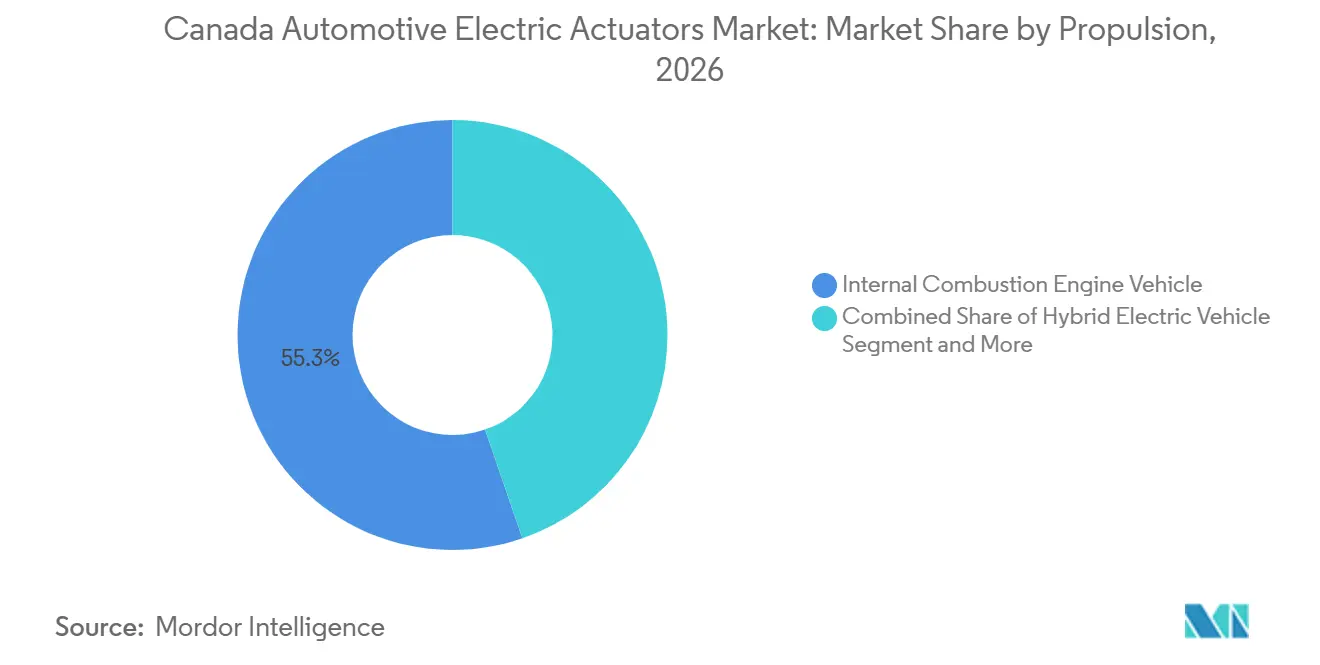
- By propulsion, ICE vehicles accounted for 55.28% of the Canadian automotive electric actuators market share in 2026, while BEVs are set to advance at a 16.34% CAGR through 2032.
- By sales channel, OEM channels held 87.13% of the Canadian automotive electric actuators market share in 2026, while the aftermarket is projected to record the highest CAGR at 8.15% through 2032.
- By geography, Ontario held 53.44% of the Canadian automotive electric actuators market share in 2026, while Quebec is projected to record the highest CAGR at 8.76% through 2032.
Note: Market numbers in this report are based on Mordor Intelligence's proprietary estimation framework, which combines nine months of actuals with Q4 projections for base year 2026.
Canada Automotive Electric Actuators Market Trends and Insights
Drivers Impact Analysis*
| Driver | (~) % Impact on CAGR Forecast | Geographic Relevance | Impact Timeline |
|---|---|---|---|
| Electrification and Thermal Management Actuation | +2.5% | National, concentrated in Ontario and Quebec OEM assembly corridors | Long term (≥ 4 years) |
| Integration of Safety and Comfort | +1.8% | National, strongest in passenger car and SUV segments in Ontario and Quebec | Medium term (2-4 years) |
| CUSMA-Supported Automotive Localization | +1.2% | National, with strategic gains in Ontario supplier clusters | Medium term (2-4 years) |
| Software-Defined and Diagnosable Actuators | +1.0% | National, early gains in Ontario R&D corridors around Kanata and Waterloo | Long term (≥ 4 years) |
| Conversion in Commercial Fleets and Transit Vehicles | +0.9% | National, with early gains in Ontario transit and Alberta fleet operations | Medium term (2-4 years) |
| Winter Conditions and Road-Salt Replacement | +0.6% | National, with highest impact in Quebec, Ontario, and Prairie provinces | Short term (≤ 2 years) |
| Source: Mordor Intelligence | |||
Vehicle Electrification and Thermal Management Actuation
The Canadian automotive electric actuators market gains new demand as electric and hybrid vehicles replace simple combustion-only control systems. BEV and HEV architectures use valves for battery cooling, coolant distribution, and HVAC air control. Magna offers a Thermal Management Actuator for PHEV and BEV cooling-water distribution, showing the direct link between platform design and added actuator functions. Canada added 376,386 HEV and BEV vehicles in 2025, a 29.6% increase in the combined fleet [1]. The retail slowdown in BEV sales after the iZEV rebate suspension did not reverse the larger fleet expansion, and the installed base continues to support future replacement demand.
Integration of Safety and Comfort Functions
The Canadian automotive electric actuators market benefits as manufacturers replace cable and hydraulic mechanisms with electric systems in doors, liftgates, chassis systems, and other vehicle functions. These systems can reduce weight, provide diagnostics, and support changes through vehicle software. Procurement is shifting toward packages that combine the actuator, sensor, and control module. Magna Closures received a U.S. patent in September 2025 for a powered swing-door actuator that uses an electric-motor-driven leadscrew. SUVs, crossovers, and premium models more often use powered tailgates, adaptive chassis systems, and multi-zone HVAC controls than basic vehicle designs. This increases the actuator content of many passenger vehicle programs even before new safety functions are introduced.
CUSMA-Supported North American Automotive Localization
The Canadian automotive electric actuators market is supported by CUSMA rules that require 75% regional value content for qualifying automotive goods [2]. The rules give manufacturers a reason to select North American suppliers for long production programs. Canada's 2025 tariff remission framework also linked tariff treatment to continued Canadian production and CUSMA compliance. Linamar announced an automotive technology investment for Ontario in January 2025, with public support for eAxle propulsion, inverters, and semiconductor packaging. These areas sit upstream from electric motors and drive electronics used in actuator systems. Local content, engineering support, and established quality systems therefore become part of the supplier qualification process.
Software-Defined and Diagnosable Actuators
The Canadian automotive electric actuators market is changing as vehicles require components to share health and position data with central computing systems. Compatible devices must support diagnostic interfaces and firmware updates while retaining accurate motion control. ISO 17978-3:2026 establishes requirements for service-oriented vehicle diagnostics and was published in March 2026 [3]. This creates a clearer baseline for vehicle programs that rely on diagnostic information across electronic control units. Suppliers must increasingly pair mechanical design with embedded LIN or CAN-FD communication functions. The requirement favors large Tier 1 companies with hardware, software, and validation resources, while smaller specialists may seek partnerships or acquisitions to close those gaps.
Restraints Impact Analysis*
| Restraint | (~) % Impact on CAGR Forecast | Geographic Relevance | Impact Timeline |
|---|---|---|---|
| Validation and Compliance Costs | -0.8% | National, highest burden on smaller Ontario and Quebec Tier 2 suppliers | Long term (≥ 4 years) |
| Imported Electronics, Motors, and Rare-Earth Inputs | -0.7% | National, with acute exposure in Ontario-based assembly operations | Medium term (2-4 years) |
| Concentration on Limited OEM Platforms | -0.5% | Ontario and Quebec, where a few platforms drive the bulk of volume | Medium term (2-4 years) |
| Corrosion and Low-Temperature Reliability | -0.4% | National, highest in Quebec, Ontario, and Prairie provinces | Short term (≤ 2 years) |
| Source: Mordor Intelligence | |||
High Validation and Compliance Costs for Safety-Critical Actuators
Brake, steering, and suspension actuators require detailed validation before an OEM can approve them for production. ISO 26262-related testing can cover electromagnetic compatibility, thermal cycling, corrosion resistance, failure analysis, and functional safety. These requirements lengthen development cycles and raise the cost of entering the Canadian automotive electric actuators market. Knorr-Bremse plans series production of its redundant braking system for autonomous commercial vehicles in 2027, illustrating the extended development path for safety-related braking systems. Firmware updates add further work because each change must preserve safety performance. The burden is highest for smaller suppliers that are trying to move from subcomponents into complete actuator systems.
Dependence on Imported Electronics, Motors, and Rare-Earth Inputs
Many rotary and linear electric actuators depend on permanent-magnet motors and electronic subassemblies obtained through international supply chains. Price movements in rare-earth oxides can be passed through to motor costs within normal production cycles. Larger suppliers can manage some exposure through long-term supply agreements, but smaller assemblers face greater pressure on margins. Canada's 2026 Automotive Strategy recognizes critical-mineral and supply-chain vulnerabilities and sets out public investment measures for the sector. New domestic processing facilities would require several years to establish and cannot provide immediate stability in input costs. The Canadian automotive electric actuators market therefore remains exposed to imports of motor, magnet, and electronic components during the forecast period.
*Our forecasts treat driver/restraint impacts as directional, not additive. The impact forecasts reflect baseline growth, mix effects, and variable interactions.
Segment Analysis
By Vehicle Type: Commercial Vehicles Accelerate on Fleet Electrification
Passenger cars held 64.12% of the Canadian automotive electric actuators market share in 2026, supported by the large base of compact, midsize, SUV, crossover, and premium vehicle platforms. Each platform uses more door, seat, HVAC, and chassis actuators when electric mechanisms replace cables or hydraulic parts. SUV and crossover models are actuator-intensive because they often include powered liftgates, adaptive suspension, and multi-zone air controls. Premium models commonly introduce new actuation functions before they appear on broader vehicle lines. Commercial vehicles are projected to grow at a 10.25% CAGR through 2032 as fleet electrification and transit modernization expand their use of electric controls. Light commercial vehicles benefit from broader eligibility in ZEV programs and shorter operating payback periods. Medium and heavy vehicles are supported by transit requirements and logistics fleet decarbonization plans. This keeps the vehicle type mix dependent on both consumer vehicle features and commercial operating needs.
Commercial vehicle actuators operate under longer duty cycles and more demanding temperature and ingress conditions than many passenger-car components. Suppliers must adapt product validation and mechanical design for workshop use, extended operation, and fleet maintenance schedules. The Canadian automotive electric actuators industry must therefore serve both high-volume passenger platforms and more specialized commercial applications. Cold-weather operation, road exposure, and frequent stop-start use can increase wear on moving parts and connectors. These conditions make fleet specifications different from passenger vehicle specifications, even where both use similar electric motors or controllers.


By Application Type: Brake-by-Wire Reshapes the Application Revenue Hierarchy
Closure, door, and liftgate actuators accounted for 21.33% of the Canadian automotive electric actuators market in 2026. Powered tailgates and automated door systems are widely used in mid-range and premium passenger vehicles. Brake actuators are set to grow at an 11.18% CAGR through 2032 as electric and hybrid platforms adopt more electromechanical braking functions. Regenerative braking requires closer coordination between mechanical and electric braking systems. Suspension, chassis, and steering actuators are gaining importance as active chassis and steer-by-wire systems expand. Schaeffler has demonstrated electromechanical damping and steer-by-wire technologies that support electronically controlled vehicle motion. HVAC flap, throttle, and grille shutter actuators support thermal management and emissions control. Turbocharger, wastegate, and EGR actuators remain essential for internal combustion engines and hybrid powertrains.
Other applications include headlamp leveling, mirror and lighting adjustment, seat adjustment, and transmission and drivetrain control. These stable, mid-volume applications support comfort features and powertrain automation. Large platform awards can create design and manufacturing expertise transferable across international supply networks. Fast-growing applications, such as braking, steering, and active suspension, require greater integration than basic comfort devices. Closure and comfort products serve a broad customer base across vehicle trims, while braking, steering, and chassis systems require closer coordination with vehicle software and safety engineering. Different design cycles can complicate production planning but diversify demand across end applications.
By Motion Type: Rotary Dominance Masks the Linear Actuator Acceleration
Rotary actuators held 69.04% of the Canadian automotive electric actuators market share in 2026. They are established in throttle control, HVAC flap positioning, seat adjustment, mirror leveling, and turbocharger functions. Rotational motion fits these mechanisms directly and has benefited from years of miniaturization in products. The installed base of HVAC, throttle, and mirror applications also provides recurring replacement demand. Linear actuators are projected to grow at a 9.33% CAGR through 2032. They are used where a system requires direct translational force, including brake-by-wire, active suspension, and powered-closure functions. This technical distinction explains why linear products can grow faster even from a smaller base. It also changes the mix of design and validation work required by suppliers.
Linear actuator programs usually carry higher unit values because they combine mechanical force, sensing, control logic, and safety-related requirements. They often require close co-development between the supplier and the vehicle engineering team. This supports Tier 1 suppliers with local engineering resources and embedded software capabilities. Schaeffler introduced compact EMA-50 and EMA-60 electromechanical linear actuator variants at Hannover Messe 2026. These products show continued development toward higher force capability and integrated position sensing. Rotary products will remain the volume base for the Canadian automotive electric actuators market. Linear systems will increase their importance as high-value safety and closure applications expand. Their wider use does not displace established rotary products in HVAC, throttle, seating, and mirror functions.
By Propulsion: BEV Content Density Accelerates While ICE Fleet Sustains Volume
Internal Combustion Engine Vehicle accounted for 55.28% of the Canadian automotive electric actuators market in 2026. Canada's large fleet of combustion vehicles and ongoing investment in truck and SUV propulsion support actuator demand for throttle, EGR, and turbocharger functions. GM's St. Catharines Propulsion plant continues to support engine production for full-size trucks and SUVs through related Ontario programs. BEVs are expected to grow at a 16.34% CAGR through 2032. They require additional actuators for thermal management, battery cooling, and brake-by-wire systems. This raises content value per vehicle even before higher BEV volumes are considered. The result is a market that remains tied to both installed ICE fleets and growth in electric platforms.
HEVs and PHEVs combine electric and combustion control needs, which gives them high actuator content per vehicle. Other propulsion types, including fuel-cell and extended-range designs, remain smaller but strategically relevant. ISO 16750 uses -40°C as the lower temperature test boundary for automotive electronic components. Cold-climate qualification therefore remains important for Canada's automotive electric actuators industry participants across propulsion types. Hybrid vehicles can be important during the transition because they retain combustion-related systems while adding electric controls. That combination broadens their actuator requirements and allows suppliers to build experience with new thermal and diagnostic functions.


By Sales Channel: OEM Dominance Persists as Aftermarket Build Phase Begins
Original Equipment Manufacturer (OEM) channels held 87.13% of the Canadian automotive electric actuators market share in 2026. Actuator designs are commonly developed for vehicle platforms and supplied through production programs lasting 5-7 years. A limited set of platform awards at Ford, GM, and Stellantis facilities determines a large share of near-term demand. The aftermarket is projected to grow at an 8.15% CAGR through 2032. Electrified vehicles registered from 2020 to 2025 will increasingly reach their first major component replacement cycle after 2027. Liftgate, door, and brake actuators may therefore generate growing replacement demand. The channel mix will continue to be led by OEM sourcing, but replacement demand will become more visible.
Electric actuators can carry higher replacement values than the cable and hydraulic mechanisms they displace. The aftermarket also has a different set of participants, including remanufacturers and regional distributors. These companies may not compete directly for original equipment platform awards. This creates a potential opening for suppliers that invest in testing, repair, and remanufacturing capability. Repair networks will need products that meet original-equipment fit and performance expectations. They will also require diagnostic capability where an actuator is connected to vehicle control systems. These needs can favor suppliers that carry original-equipment knowledge into their aftermarket offerings rather than treating the channel as a simple parts-distribution business.
Geography Analysis
Ontario held 53.44% of the Canadian automotive electric actuators market share in 2026. Its position reflects major assembly operations, including GM's Oshawa plant, Stellantis's Windsor plant, and Ford's Oakville facility. Ford is retooling Oakville for F-Series truck production. Ontario has attracted significant investments in vehicle manufacturing and EV battery supply chains over the years. These investments support the supplier capacity and engineering base that underpins actuator programs.
Volkswagen's PowerCo project in St. Thomas is a long-term battery supply chain anchor, with construction underway and production planned on a revised timeline. The project can support future BEV platform development and associated thermal management demand. Ontario's 2026 budget committed CAD 17.5 million (approximately USD 12.27 million) to nine Regional Technology Development Sites through OVIN [4]. The sites are designed to support made-in-Ontario automotive technology, including sensors and vehicle software. This infrastructure can shorten the time required for collaboration between suppliers and vehicle programs. Ontario remains the central production and engineering location for the Canadian automotive electric actuators market.
Quebec is projected to grow at an 8.76% CAGR through 2032, the highest provincial rate. In 2025, zero-emission vehicles accounted for a notable share of registered light-duty vehicles in Quebec, according to Statistics Canada. This supports earlier growth in demand for electrified-vehicle service and replacement. Quebec's energy transition program has attracted battery supply chain activity, including a planned cathode manufacturing facility in Bécancour. The facility involves Ford, EcoProBM, and SK On, adding upstream battery activity to the province. Quebec's higher ZEV penetration also means that powered closures, battery thermal-management components, and other electric systems will enter service in a larger relative base of vehicles. Distribution capability in the Greater Montreal area can become more important as these vehicles age. Alberta, British Columbia, Saskatchewan, and Atlantic and Northern provinces see demand driven more by commercial fleets and vehicle replacement than by local assembly. Cold temperatures, road salt, and commercial fleet use make durability requirements particularly important outside the Ontario-Quebec assembly corridor.
Competitive Landscape
Market Concentration
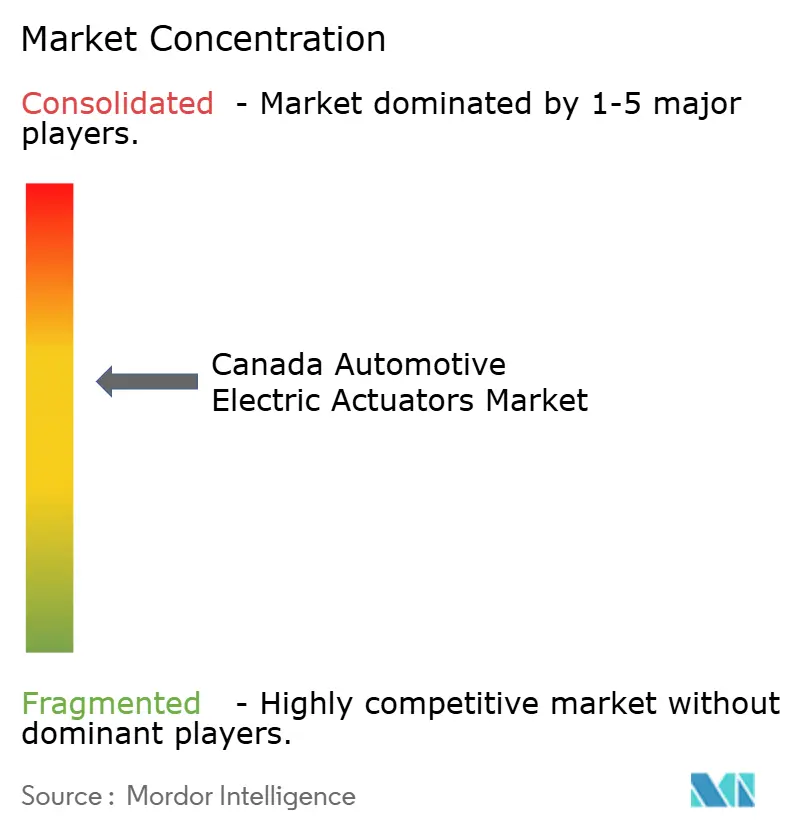
The Canadian automotive electric actuators market has a moderately consolidated OEM supply tier. Robert Bosch GmbH, DENSO Corporation, Magna International Inc., and BorgWarner Inc. compete through integrated hardware, firmware, and software packages. Their scale helps them meet vehicle-program requirements for validation, software diagnostics, and production quality. In February 2026, BorgWarner announced a contract with a North American OEM to supply an 800-volt integrated drive module and a dual-inverter generator module. The program demonstrates how suppliers can integrate individual actuator content into larger electrified system awards. CUSMA regional content rules further strengthen the position of suppliers with established North American operations. Consequently, leading companies compete on system integration capabilities as well as component design.
Schaeffler is strengthening its position in electric systems following its merger with Vitesco Technologies. At its 2026 technology presentations, the company showcased steer-by-wire and electromechanical damping systems. These developments position traditional mechanical component suppliers closer to vehicle motion-control and diagnostic functions. Magna continues to invest in electrically actuated closure and thermal management applications. BorgWarner also won an integrated drive module program in August 2026, with production expected to begin in 2027. Such actions show that the Canadian automotive electric actuators market is shaped by broader strategies for electrification systems. Product development must increasingly connect mechanical movement, power electronics, and vehicle software.
Specialists such as Stabilus, Kiekert, and Johnson Electric compete through focused expertise in closure systems, latch actuation, and high-volume rotary motors. Potential areas of differentiation in Canada include cold-climate validation, integrated thermal management modules, and remanufacturing for electrified vehicle actuators. Competition remains concentrated at the OEM system level, while specialist suppliers retain positions in individual applications. Platform concentration can make supplier demand sensitive to the timing of a small number of model launches, production changes, or program discontinuations. This is particularly relevant in Ontario and Quebec, where a limited number of vehicle programs drive most local production demand.
Canada Automotive Electric Actuators Industry Leaders
-
Robert Bosch GmbH
-
DENSO Corporation
-
AUMOVIO SE
-
Magna International Inc.
-
ZF Friedrichshafen AG
- *Disclaimer: Major Players sorted in no particular order
Recent Industry Developments
- October 2026: Geely Auto entered the Canadian market and plans to launch its first consumer vehicles in 2027. The company has begun establishing local operations and developing a retail and service network. Geely Auto’s entry into Canada is highly relevant to the Canadian automotive electric actuator market, as it creates a significant new source of local procurement, manufacturing demand, and localized supply chain integration.
- August 2026: The Government of Canada announced a Strategic Response Fund investment in Hanon Systems for a vapor-injected electric compressor plant in Vaughan, Ontario, targeting production of 1.5 million e-compressors per year by 2034, providing thermal management actuation supply chain infrastructure critical to Ontario EV platform programs.
Canada Automotive Electric Actuators Market Report Scope
The scope includes segmentation by vehicle type (passenger cars [compact and midsize passenger car, sport utility vehicle and crossover, and luxury and premium passenger car], and commercial vehicle [light commercial vehicle and medium- and heavy-duty commercial vehicle]), application type (throttle actuator, seat adjustment actuator, brake actuator, closure, door, and liftgate actuator, HVAC flap actuator, turbocharger, wastegate, and EGR actuator, grille shutter actuator, headlamp leveling, mirror, and lighting actuator, suspension, chassis, and steering actuator, transmission and drivetrain actuator, and other automotive electric actuators), motion type (linear actuator and rotary actuator), propulsion type (internal combustion engine vehicle, hybrid electric vehicle, plug-in hybrid electric vehicle, battery electric vehicle, and other propulsion types), and sales channel (original equipment manufacturer and aftermarket). The analysis also covers regional-level segmentation including Ontario, Quebec, and the Rest of Canada. Market size and growth forecasts are presented by value in USD and volume in Units.
By Vehicle Type
| Passenger Car | Compact and Midsize Passenger Car |
| Sport Utility Vehicle and Crossover | |
| Luxury and Premium Passenger Car | |
| Commercial Vehicle | Light Commercial Vehicle |
| Medium and Heavy Commercial Vehicle |
By Application Type
| Throttle Actuator |
| Seat Adjustment Actuator |
| Brake Actuator |
| Closure, Door, and Liftgate Actuator |
| HVAC Flap Actuator |
| Turbocharger, Wastegate, and EGR Actuator |
| Grille Shutter Actuator |
| Headlamp Levelling, Mirror and Lighting Actuator |
| Suspension, Chassis, and Steering Actuator |
| Transmission and Drivetrain Actuator |
| Other Automotive Electric Actuators |
By Motion Type
| Linear Actuator |
| Rotary Actuator |
By Propulsion
| Internal Combustion Engine Vehicle |
| Hybrid Electric Vehicle |
| Plug-in Hybrid Electric Vehicle |
| Battery Electric Vehicle |
| Other Propulsion Types |
By Sales Channel
| Original Equipment Manufacturer |
| Aftermarket |
By Geography
| Ontario |
| Quebec |
| Rest of Canada |
Cross-Segmentation Analysis
| Motion Type by Vehicle Type |
| Motion Type by Sales Channel |
| By Vehicle Type | Passenger Car | Compact and Midsize Passenger Car |
| Sport Utility Vehicle and Crossover | ||
| Luxury and Premium Passenger Car | ||
| Commercial Vehicle | Light Commercial Vehicle | |
| Medium and Heavy Commercial Vehicle | ||
| By Application Type | Throttle Actuator | |
| Seat Adjustment Actuator | ||
| Brake Actuator | ||
| Closure, Door, and Liftgate Actuator | ||
| HVAC Flap Actuator | ||
| Turbocharger, Wastegate, and EGR Actuator | ||
| Grille Shutter Actuator | ||
| Headlamp Levelling, Mirror and Lighting Actuator | ||
| Suspension, Chassis, and Steering Actuator | ||
| Transmission and Drivetrain Actuator | ||
| Other Automotive Electric Actuators | ||
| By Motion Type | Linear Actuator | |
| Rotary Actuator | ||
| By Propulsion | Internal Combustion Engine Vehicle | |
| Hybrid Electric Vehicle | ||
| Plug-in Hybrid Electric Vehicle | ||
| Battery Electric Vehicle | ||
| Other Propulsion Types | ||
| By Sales Channel | Original Equipment Manufacturer | |
| Aftermarket | ||
| By Geography | Ontario | |
| Quebec | ||
| Rest of Canada | ||
| Cross-Segmentation Analysis | Motion Type by Vehicle Type | |
| Motion Type by Sales Channel | ||
Key Questions Answered in the Report
What is the projected growth rate of the automotive electric actuators market in Canada?
It is projected to grow at a CAGR of 7.47% during 2027–2032, rising from USD 0.31 billion in 2027 to USD 0.43 billion by 2032.
Which vehicle type drives demand in Canada?
Passenger cars held the largest share in 2026, at 64.12%, supported by Canada’s broad installed base of passenger cars, SUVs, crossovers, and premium vehicle platforms. Commercial vehicles are projected to grow at a faster CAGR of 10.25% through 2032, as fleet operators add electrified vehicles and upgrade control systems.
Which automotive electric actuator application is expected to grow the fastest?
Brake actuators are projected to grow at a CAGR of 11.18% through 2032, driven by the increasing adoption of electronically controlled braking functions in electric and hybrid vehicle platforms.
Which Canadian province has the largest demand base?
Ontario held a 53.44% share in 2026 because it has major assembly operations, supplier capacity, and automotive technology investment. Its truck, battery, and EV supply-chain projects support a concentrated engineering and production base for vehicle component programs.