
Wealth Management Market Size and Share
Market Overview
| Study Period | 2020 - 2031 |
|---|---|
| Market Size (2026) | USD 127.72 Trillion |
| Market Size (2031) | USD 180.90 Trillion |
| Growth Rate (2026 - 2031) | 7.21 % |
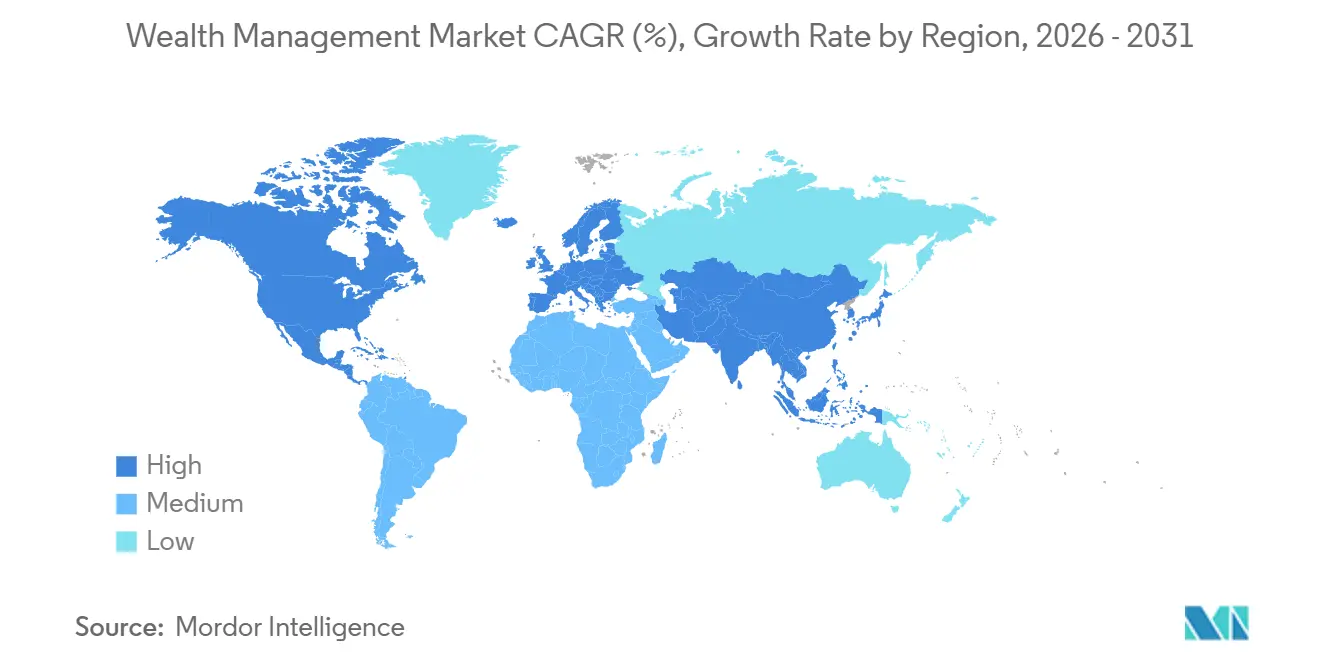
| Fastest Growing Market | Asia-Pacific |
| Largest Market | North America |
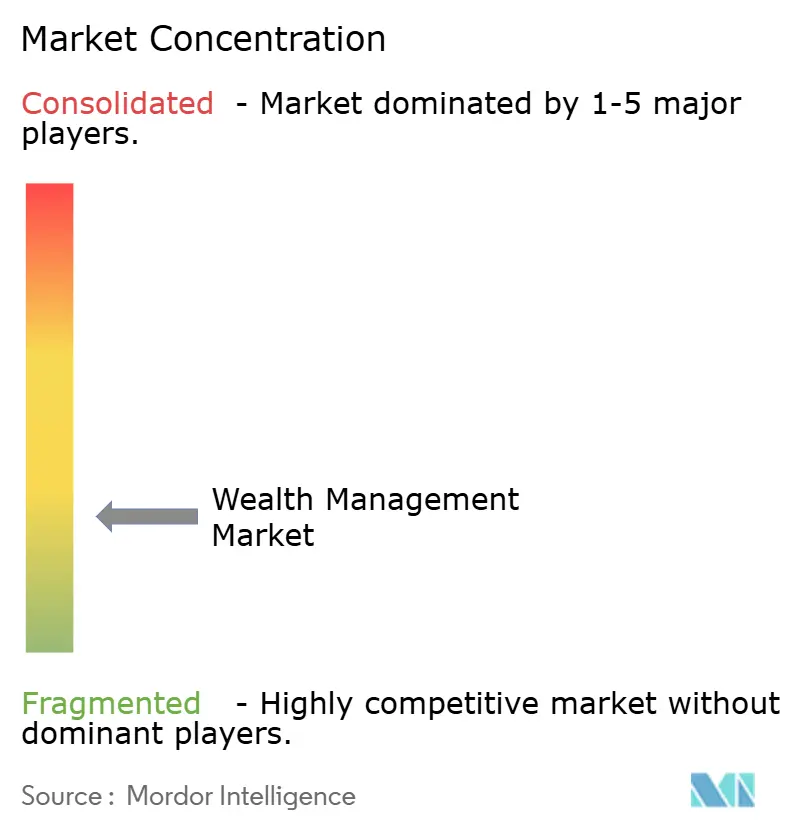
| Market Concentration | Low |
Major Players *Disclaimer: Major Players sorted in no particular order Image © Mordor Intelligence. Reuse requires attribution under CC BY 4.0. | |
Wealth Management Market Analysis by Mordor Intelligence
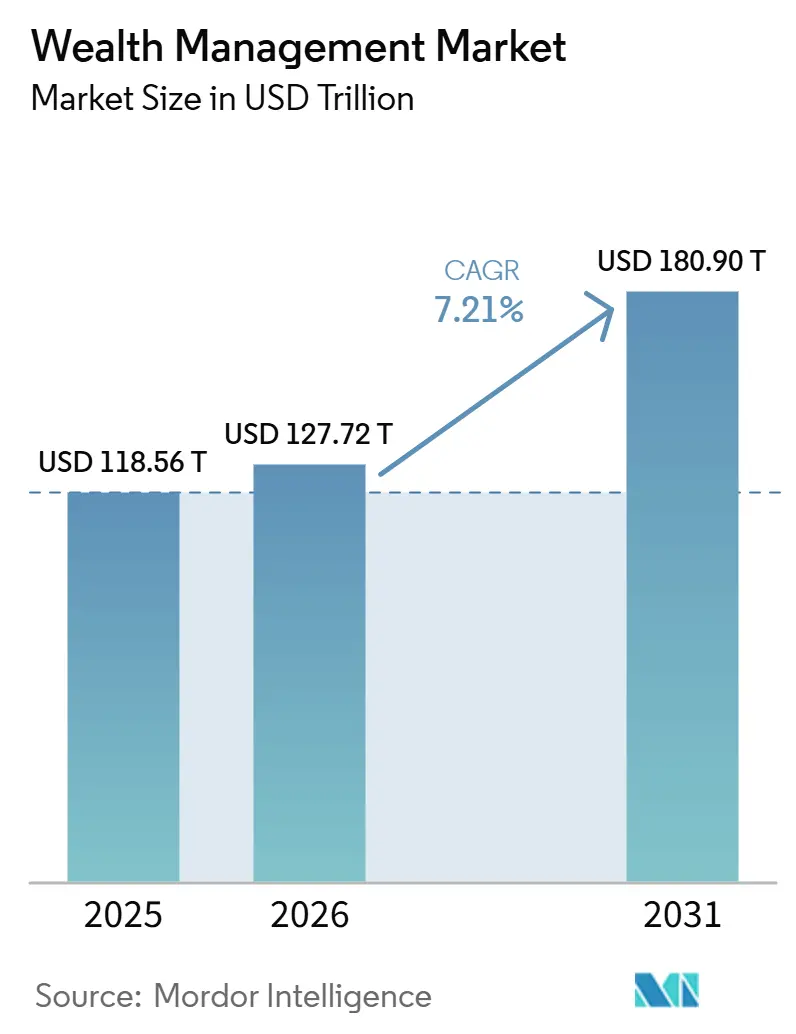
The Wealth Management Market size is expected to increase from USD 118.56 trillion in 2025 to USD 127.72 trillion in 2026 and reach USD 180.90 trillion by 2031, growing at a CAGR of 7.21% over 2026-2031.
The wealth management market is being supported by stronger demand for structured advice as wealthy clients look beyond portfolio performance and focus more on estate planning, family discussions, and long-term asset stewardship. Bank of America’s 2026 study shows these topics now rank among the main areas where wealthy individuals want deeper engagement from advisors, which keeps planning-led mandates central to the wealth management market. The wealth management market is also seeing stronger product depth in private assets, with private markets nearing USD 20 trillion globally and 86% of private wealth professionals planning to increase private market allocations in 2026. Competitive strategy in the wealth management market is shifting toward AI-enabled service models, broader access to alternative investments, and more tailored advisory workflows, as shown by Vanguard’s Expert Insights launch and Citi Wealth’s Citi Sky rollout in 2026. At the same time, the wealth management market remains under pressure to defend pricing and client loyalty as more high-net-worth clients work with multiple firms to gain access to products, especially in alternatives and cross-border planning.
Key Report Takeaways
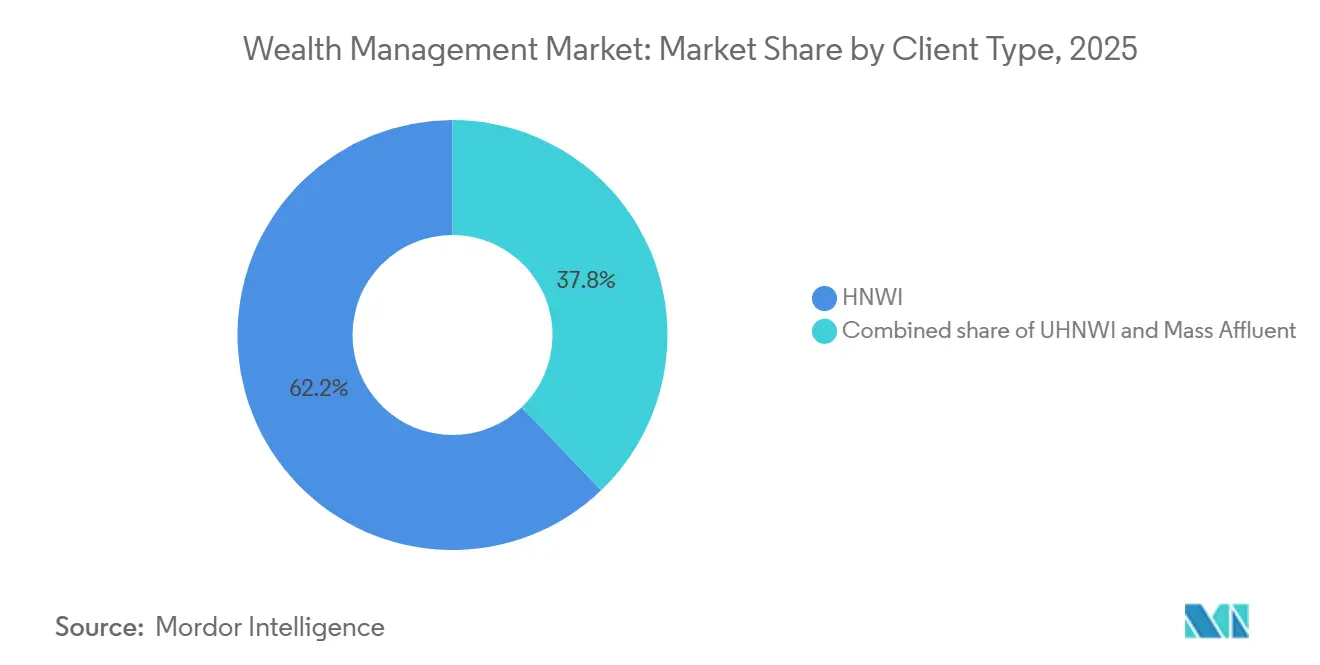
- By client type, HNWIs captured 62.17% of the wealth management market share in 2025, while the mass affluent segment is projected to grow at a 9.79% CAGR through 2031.
- By asset class, equities accounted for 46.58% of the wealth management market size in 2025, while alternatives are projected to grow at 10.96% CAGR through 2031.
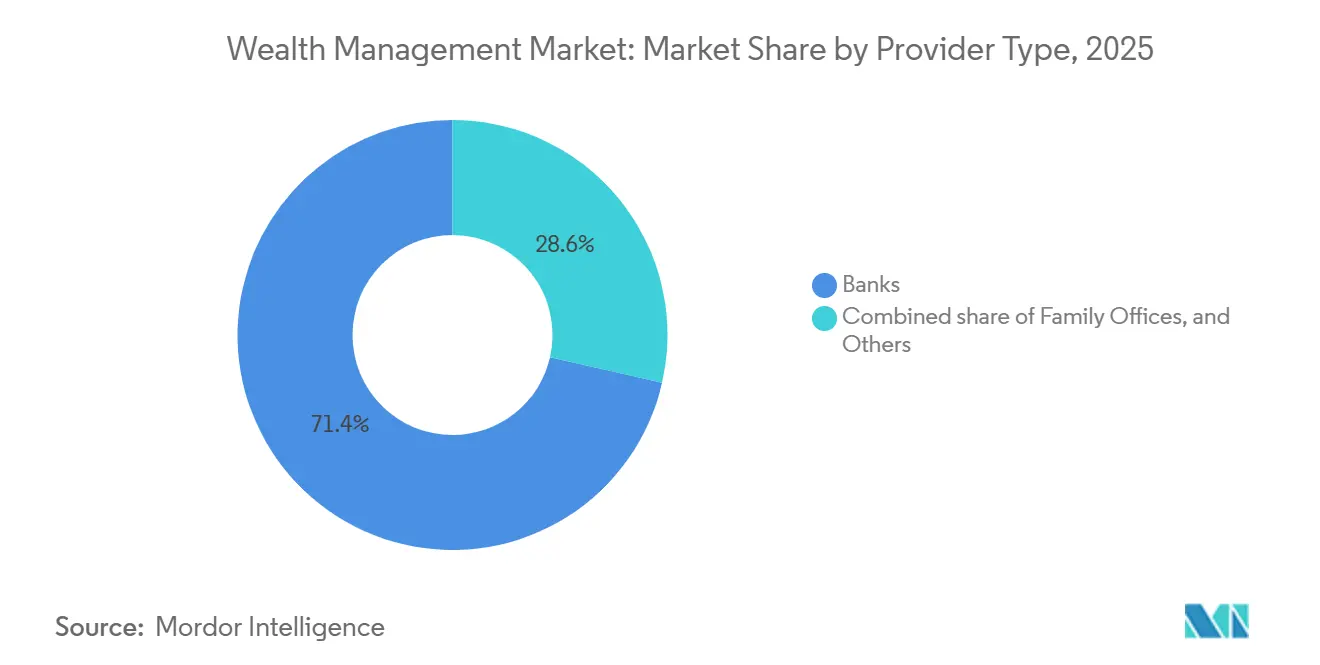
- By provider type, banks held 71.43% of the wealth management market size in 2025, while family offices are projected to grow at 11.85% CAGR through 2031.
- By delivery model, human advisory captured 59.66% of the wealth management market share in 2025, while robo advisory is projected to grow at 15.21% CAGR through 2031.
- By geography, North America accounted for 37.78% of the wealth management market size in 2025, while Asia-Pacific is projected to grow at 9.36% CAGR through 2031.
Note: Market size and forecast figures in this report are generated using Mordor Intelligence’s proprietary estimation framework, updated with the latest available data and insights as of January 2026.
Global Wealth Management Market Trends and Insights
Drivers Impact Analysis*
| Driver | (~) % Impact on CAGR Forecast | Geographic Relevance | Impact Timeline |
|---|---|---|---|
| Rising Global HNWI Population | +1.8% | Global | Long term (≥ 4 years) |
| Intergenerational Wealth Transfer and Succession Planning Demand | +1.2% | Global, North America, Europe, Asia-Pacific core | Medium term (2-4 years) |
| Expansion of Hybrid Advisory and AI-Enabled Client Service Models | +1.1% | Global, Asia-Pacific, and North America lead adoption | Medium term (2-4 years) |
| Growth of Private Markets, Alternatives, and Customized Portfolios | +1.0% | North America, Europe, Asia-Pacific | Medium term (2-4 years) |
| Greater Demand for Consolidated Financial Planning Across Life Stages | +0.7% | North America, Europe, Australia | Medium term (2-4 years) |
| Cross-Border Wealth Structuring and International Tax Complexity | +0.6% | Europe, North America, Asia-Pacific hubs, including Singapore and Hong Kong | Long term (≥ 4 years) |
| Source: Mordor Intelligence | |||
Rising Global HNWI Population
The global HNWI population reached 25.3 million in 2025, up 7.9% year over year, while the ultra-high-net-worth segment rose 9.4% to nearly 250,000 individuals[1]Capgemini Research Institute, “World Wealth Report 2026,” Capgemini, capgemini.com. North America remained the largest pool, yet Asia-Pacific recorded the strongest regional wealth growth at 10.5% in 2025, which shows that new wealth creation is broadening the addressable client base for the wealth management market. McKinsey’s research also points to a shortage of nearly 100,000 advisors in the United States by 2034 at current productivity levels, which raises the importance of scalable service models in the wealth management market. Firms that increase capacity through workflow automation and advisor productivity tools are better positioned to capture this expanding client base than those that rely solely on advisor hiring. Knight Frank’s 2026 report also shows that the global UHNWI population reached 713,626, reinforcing the sustained rise in clients who need complex planning, governance, and private asset access.
Intergenerational Wealth Transfer and Succession Planning Demand
A USD 124 trillion generational wealth transfer is projected through 2048, and that shift is pushing the wealth management market toward multi-generational planning rather than single-client servicing. Bank of America’s 2026 Wealth Study shows estate planning and family discussions about wealth use rank among the key topics wealthy clients want to address more often with advisors[2] Bank of America Private Bank, “2026 Wealth Study, Inside the Great Wealth Transfer,” Bank of America Private Bank, privatebank.bankofamerica.com. UBS reported in 2026 that 35% of surveyed family offices still lacked a defined succession plan, leaving a significant advisory gap in trusts, governance, and ownership transitions. This demand supports firms that can connect investment management with legal, tax, family governance, and asset transfer coordination in a single relationship model. Deloitte’s 2026 outlook further notes that firms that fully redesign workflows around AI and multi-generational engagement are growing assets under management 4 times faster than peers and delivering operating margins near 30%.
Expansion of Hybrid Advisory and AI-Enabled Client Service Models
The wealth management market is moving toward a hybrid service model, as firms need to combine automation with human judgment rather than treating them as substitutes. Deloitte estimates that 41% of advisors’ time is still consumed by operational work, and its modeling suggests AI-led workflow automation could add USD 10 trillion to USD 35 trillion in net AUM capacity across the broader wealth management market by 2032. Vanguard launched Expert Insights in April 2026 to give advisors AI-enabled portfolio analysis, and Citi Wealth introduced Citi Sky in June 2026 as an always-on AI capability for client support[3]Vanguard, “Vanguard Launches Expert Insights, Equipping Advisors with AI-Powered Portfolio Analysis Expertise,” Vanguard, corporate.vanguard.com. These moves show that major firms are investing in advisor productivity, faster personalization, and more responsive client communication at scale. Regulatory scrutiny is also increasing, so the winning models in the wealth management market will be the ones that pair automation with explainability, governance, and clear client disclosure.
Growth of Private Markets, Alternatives, and Customized Portfolios
Private markets have expanded to nearly USD 20 trillion globally, and 86% of private wealth professionals surveyed in January 2026 said they plan to increase private market allocations[4]J.P. Morgan Asset Management, “Alternative Investments Outlook 2026,” J.P. Morgan Asset Management, am.jpmorgan.com. iCapital’s June 2026 report also showed that hedge fund AUM reached a record USD 5.4 trillion in 2025, with USD 116 billion in net inflows, confirming that alternatives are moving deeper into client portfolios in the wealth management market. Morgan Stanley Wealth Management widened access in June 2026 by expanding its PMAX offering and removing the accredited investor requirement for PMAX Balanced, which broadens private market access for a wider retail-adjacent client base. Hamilton Lane also found that 47% of wealth professionals planned to increase exposure to venture capital and growth strategies in 2026, suggesting stronger demand for specialized portfolio construction and manager selection. As retail participation expands, the CFA Institute notes that governance, valuation transparency, and liquidity oversight will become increasingly important, underscoring the value of advisors who can clearly explain these products to wealth management clients.
Restraints Impact Analysis*
| Restraint | (~) % Impact on CAGR Forecast | Geographic Relevance | Impact Timeline |
|---|---|---|---|
| Fee Compression in Core Advisory and Execution Services | -1.4% | North America and Europe, with a broader global effect | Short term (≤ 2 years) |
| Compliance Burden Across Multi-Jurisdiction Wealth Platforms | -0.8% | Global, including Switzerland, Singapore, Luxembourg, and the UAE | Medium term (2-4 years) |
| Talent Retention Pressure in Senior Advisor and Relationship Manager Roles | -0.7% | North America, Europe | Short term (≤ 2 years) |
| Client Trust Friction Around Data Use, AI Explainability, and Digital Advice | -0.5% | Global, especially older HNWI and affluent segments | Medium term (2-4 years) |
| Source: Mordor Intelligence | |||
Fee Compression in Core Advisory and Execution Services
Advisory fee pressure is becoming an operating issue for the wealth management market rather than a distant risk. Cerulli data cited in 2025 shows asset-based fees for clients with USD 1.5 million or more in assets fell by 2 basis points on average from 2020 to 2024, with a further 1 basis point decline projected by 2026. This pressure is linked to automation, broader fee transparency, and larger firms using scale and productivity gains to compete more aggressively on price. JD Power’s 2025 study also found that firms are facing rising expectations for broader service breadth and clearer value communication. As a result, more providers in the wealth management market are shifting toward estate coordination, tax optimization, and life-stage planning, where the value proposition is harder to commoditize.
Compliance Burden Across Multi-Jurisdiction Wealth Platforms
Compliance complexity continues to weigh on the wealth management market, especially for firms operating across multiple legal and tax regimes. As of January 2026, 112 jurisdictions participate in the OECD’s Automatic Exchange of Information framework, and more than 111 million financial accounts are exchanged annually, which shows the scale of reporting requirements across cross-border structures. EY’s 2026 regulatory outlook identifies fragmentation across Asia-Pacific, the United States, and the Middle East as a lasting challenge for financial firms with cross-border wealth platforms. Platforms must now manage FATCA, CRS, BEPS, AIFMD II, Pillar Two, ATAD, and CARF requirements in parallel, which raises the cost of manual reporting and supervision. Firms that automate these functions are likely to hold a structural cost advantage as the wealth management market expands into more international client structures.
*Our forecasts treat driver/restraint impacts as directional, not additive. The impact forecasts reflect baseline growth, mix effects, and variable interactions.
Segment Analysis
By Client Type: HNWI Anchors Scale While Mass Affluent Drives Expansion
HNWIs held 62.17% of the wealth management market in 2025, which confirms that high-balance relationships still form the core revenue and asset base for most providers. Within the same category, Mass Affluent is projected to grow at a 9.79% CAGR through 2031, making it the fastest-expanding client group in the wealth management market. The strength of the HNWI segment stems from larger account sizes, broader product usage, and stronger demand for lending, estate planning, tax coordination, and access to private assets. At the same time, the client mix is becoming more competitive because high-net-worth households are increasingly willing to spread assets across multiple firms to gain specialized capabilities. This means scale remains important, but exclusivity is becoming harder to defend in the wealth management industry.
Capgemini’s January 2026 portfolio data showed that equities accounted for 25% of HNWI portfolios and fixed income rose to 20%, suggesting a client base that remains active across both growth and stabilization allocations. The ultra-high-net-worth tier, at nearly 250,000 individuals globally in 2025, remains the most complex and service-intensive sub-segment inside the wealth management market. Mass affluent growth is being supported by digital delivery models, lower cost-to-serve thresholds, and large under-penetrated wealth pools that are now becoming commercially viable for advisory platforms. Cerulli identified a USD 25 trillion United States mass-affluent opportunity in 2026, while Deloitte highlighted 59 million European households with nearly EUR 4 trillion (USD 4.55 trillion) in investable assets and historically low advisor penetration. Together, these conditions give the wealth management market a dual growth structure in which HNWIs preserve scale and Mass Affluent expands the next layer of addressable demand.


By Asset Class: Equities Lead but Alternatives Reshape Allocation Architectures
Equities accounted for 46.58% of the wealth management market size in 2025, while Alternatives are expected to expand at 10.96% CAGR through 2031. This pattern shows that public equities still anchor portfolio construction in the wealth management market, but faster growth is shifting toward private and less traditional exposures. Equity allocations benefited from gains in AI-linked technology names and broader strength in major equity markets during 2025. In contrast, fixed income and cash allocations are facing a more selective role as rate normalization reduces their relative yield advantage. The result is a portfolio mix that is becoming more diversified and more customized across client tiers.
The alternatives category is broadening through private equity, private credit, infrastructure, hedge funds, and newer access vehicles that make these exposures easier to place within adviser-led portfolios. Hamilton Lane’s 2026 survey showed that private equity accounted for 19% of alternatives exposure, private credit 16%, and infrastructure 15%, while 88% of advisors in the 2025 CAIS and Mercer survey planned to increase their alternatives allocations over the next 2 years. The CFA Institute also notes that governance and valuation transparency remain key pressure points as retail capital enters private markets through interval funds and evergreen structures. The Others category remains smaller, but DBS has already introduced a bank-backed trust structure for cryptocurrencies, signaling that tokenized and digital exposures are moving closer to a formal wealth platform architecture. This keeps alternatives at the center of product differentiation across the wealth management industry.
By Provider Type: Banks Hold Share, But Family Offices Challenge the Value Architecture
Banks commanded 71.43% of the wealth management market in 2025, reflecting their scale advantages in deposits, lending, execution, and cross-selling. Family Offices are projected to grow at a 11.85% CAGR through 2031, making them the fastest-growing provider category in the wealth management market. Banks still benefit from established distribution, strong regulation-linked trust, and the ability to combine wealth services with credit and treasury relationships. Even so, many ultra-wealthy families are choosing more tailored governance models that give them greater control over direct investments and asset allocation decisions. This is shifting part of the value architecture away from standardized private banking toward customized ownership and oversight frameworks.
Deloitte expects the number of family offices globally to rise by a third to more than 10,700 by 2030, with much of that growth centered in North America and Asia-Pacific. UBS reported in 2026 that 60% of surveyed family offices planned strategic asset allocation changes within 12 months, suggesting a client base that demands more bespoke execution than standardized advisory menus typically provide. FINTRX also noted stronger interest among newer family offices in direct investments, private equity, and venture capital, while advisor movement toward independent platforms continues to support the Others category. This means the wealth management market is not only expanding in terms of assets, but also diversifying by operating model, as clients choose between integrated bank platforms and more independent structures. The provider landscape, therefore, remains broad even with bank-led scale at the top.
By Delivery Model: Human Advisory Retains Scale as Robo Channels Redefine Reach
Human Advisory held 59.66% of the wealth management market in 2025, while Robo Advisory is projected to grow at 15.21% CAGR through 2031. The wealth management market is therefore not moving away from human advice, but it is changing where human advice is used and how technology extends service reach. Complex mandates such as estate coordination, business succession, tax structuring, and family governance still require judgment, nuance, and trust that pure automation cannot fully replace. Robo channels are expanding fastest because they lower onboarding friction, reduce service costs, and make basic portfolio management more accessible to a wider client set. This keeps the delivery model discussion centered on task allocation rather than full substitution.
Hybrid formats are positioned to benefit most because they blend automated portfolio construction with advisor intervention at more consequential decision points. Vanguard Personal Advisor crossed USD 300 billion in managed assets in 2025, which supports the idea that hybrid propositions can scale without losing client confidence. McKinsey’s work on affluent investors also shows that digital self-service is useful for routine updates, while higher-net-worth clients still want frequent multi-channel access and in-person support when decisions become more complex. Janus Henderson found in 2026 that 79% of investors would be upset if their advisor used AI without disclosure, which means transparency will shape adoption in the wealth management market as strongly as convenience. The strongest delivery models will likely be those that preserve human accountability while leveraging technology to improve speed, consistency, and cost discipline.
Geography Analysis
North America accounted for 37.78% of the wealth management market in 2025, making it the largest regional contributor by assets. The region remains anchored by the United States, where strong capital markets, a deep advisory ecosystem, and large pools of intergenerational wealth continue to support demand across the wealth management market. Capgemini reported that the United States added 736,000 new millionaires in 2025, and that Canada also recorded solid millionaire growth, reinforcing the breadth of underlying wealth creation across the region. North America also benefits from a mature operating environment in which private banking, wirehouse advisory, RIA platforms, and family offices compete across overlapping client tiers. This creates both scale advantages and intense relationship competition, especially in alternatives, tax planning, and succession-led mandates.
Asia-Pacific is the fastest-growing region in the wealth management market, projected to expand at a 9.36% CAGR through 2031. Capgemini data for 2025 showed regional HNWI wealth growth of 10.5%, with Japan and China adding large numbers of new millionaires, which highlights the pace of wealth formation across the region. PwC’s 2026 regional outlook projects that Asia-Pacific AUM will reach USD 34.5 trillion by 2030, keeping the region on a faster path than North America and Europe. Singapore continues to act as a major cross-border hub, while India, China, Thailand, Malaysia, and Vietnam are creating more demand for advisory frameworks that combine local wealth creation with international structuring. Lombard Odier’s 2026 Asia-Pacific HNWI study also found that only 1 in 5 surveyed high-net-worth individuals had a comprehensive asset allocation strategy in place, which shows that asset growth is still ahead of advisory penetration in several fast-growing markets.
Europe remains a major wealth center in the wealth management market, led by Germany, the United Kingdom, and France, while secondary regions provide a smaller but still relevant growth layer. Capgemini reported that Europe’s HNWI population grew 6.5% in 2025 after a prior decline, with Germany showing particularly strong momentum among the larger wealth pools. Knight Frank’s 2026 model also places Europe at roughly 25% of the global UHNWI population, which confirms the region’s importance for cross-border advisory, private banking, and family office activity. In the Middle East and Africa, performance is more uneven, with oil-linked sensitivity and local market conditions affecting millionaire growth across countries. South America remains smaller by asset base, but Brazil continues to act as the main regional engine, while OECD reporting standards are reshaping cross-border structuring preferences across Europe, MEA, and South America. The result is a global wealth management market where regional scale is still concentrated, but demand for multi-jurisdiction planning is widening beyond the largest traditional hubs.

Competitive Landscape
The wealth management market is fragmented, with a broad mix of global banks, Swiss wealth managers, private banks, registered investment advisors (RIAs), independent advisory firms, and family offices competing for client assets. While leading institutions continue to operate at a significant scale, no single provider dominates the market. Morgan Stanley's wealth division reported USD 8.52 billion in Q1 2026 revenue and USD 118 billion in net new assets, UBS Global Wealth Management generated USD 7.11 billion in revenue while continuing the Credit Suisse integration, and Goldman Sachs Asset & Wealth Management reached a record USD 3.65 trillion in assets under supervision during Q1 2026. These firms benefit from extensive product capabilities, global distribution networks, and strong brand recognition; however, advisor mobility, the growth of independent advisory platforms, digital wealth providers, and family offices continue to distribute assets across a wide range of market participants, reinforcing the fragmented nature of the wealth management market.
Strategic moves in the wealth management market are centered on product expansion, technology deployment, and partnership-led access to new client pools. Morgan Stanley widened access to alternatives in June 2026 by expanding PMAX and removing the accredited investor requirement for one of its offerings, opening private markets to a broader client base. Citi Wealth launched Citi Sky in June 2026 to build AI-enabled client support into its advisory model, while Vanguard introduced Expert Insights in April 2026 to improve advisor-side analysis and recommendation workflows. Goldman Sachs also deepened its wealth proposition through its strategic collaboration with T. Rowe Price, extending public and private investment solutions for retirement and wealth segments in late 2025. These examples show that leading firms are strengthening both distribution and product depth rather than relying solely on asset growth.
Another defining feature of the wealth management market is the race to capture the mass-affluent segment without weakening service quality for HNWI and ultra-HNWI clients. Cerulli has described the United States mass-affluent opportunity as a USD 25 trillion pool, which helps explain why digital-first service design is becoming a strategic priority across the competitive field. At the same time, Diamond Consultants reported that 11,172 experienced advisors changed firms in 2025, up 16.2% year over year, keeping client relationships portable and adding momentum to consolidation in the independent channel. UBS’s strategic collaboration with 360 ONE WAM in India also shows how global firms are using local alliances to extend reach in important emerging wealth corridors. The net result is a wealth management market where leading firms are large and well-resourced, but sustained fragmentation keeps execution, retention, and advisor productivity central to competitive success.
Wealth Management Industry Leaders
Morgan Stanley
UBS Group AG
J.P. Morgan Chase and Co.
Bank of America Corp.
The Goldman Sachs Group Inc.
- *Disclaimer: Major Players sorted in no particular order

Recent Industry Developments
- June 2026: Morgan Stanley Wealth Management expanded access to its Private Markets and Alternatives Fund PMAX by removing the accredited investor requirement, introducing daily subscriptions, and launching PMAX Growth. This materially broadens the private-market distribution opportunity for retail-adjacent clients.
- June 2026: Citi Wealth unveiled Citi Sky, an always-on AI-powered capability built using Google Cloud and Google DeepMind's Gemini Enterprise Agent Platform, targeting Citigold clients in a phased United States rollout beginning summer 2026.
- May 2026: UBS published its Global Family Office Report 2026, drawing on insights from 307 family offices across 30+ markets with an average net worth of USD 2.7 billion. The report found that 60% of family offices plan strategic asset allocation changes within 12 months, and 65% expect confidence in the United States dollar's reserve status to weaken.
- April 2026: Vanguard launched Expert Insights, an AI-enabled portfolio analysis tool for financial advisors that translates complex portfolio data into client-ready recommendations at scale.


Global Wealth Management Market Report Scope
| UHNWI |
| HNWI |
| Mass Affluent |
| Equities |
| Fixed Income |
| Alternatives |
| Cash and Cash Equivalents |
| Others |
| Banks |
| Family Offices |
| Others (Independent/External Asset Managers) |
| Human Advisory |
| Hybrid Advisory |
| Robo Advisory |
| North America | United States |
| Canada | |
| Mexico | |
| South America | Brazil |
| Argentina | |
| Rest of South America | |
| Europe | United Kingdom |
| Germany | |
| France | |
| Italy | |
| Spain | |
| Rest of Europe | |
| Asia-Pacific | China |
| Japan | |
| India | |
| South Korea | |
| Australia | |
| Indonesia | |
| Thailand | |
| Malaysia | |
| Singapore | |
| Vietnam | |
| Rest of Asia-Pacific | |
| Middle East and Africa | Saudi Arabia |
| United Arab Emirates | |
| Turkey | |
| South Africa | |
| Egypt | |
| Rest of Middle East and Africa |
| By Client Type | UHNWI | |
| HNWI | ||
| Mass Affluent | ||
| By Asset Class | Equities | |
| Fixed Income | ||
| Alternatives | ||
| Cash and Cash Equivalents | ||
| Others | ||
| By Provider Type | Banks | |
| Family Offices | ||
| Others (Independent/External Asset Managers) | ||
| By Delivery Model | Human Advisory | |
| Hybrid Advisory | ||
| Robo Advisory | ||
| By Geography | North America | United States |
| Canada | ||
| Mexico | ||
| South America | Brazil | |
| Argentina | ||
| Rest of South America | ||
| Europe | United Kingdom | |
| Germany | ||
| France | ||
| Italy | ||
| Spain | ||
| Rest of Europe | ||
| Asia-Pacific | China | |
| Japan | ||
| India | ||
| South Korea | ||
| Australia | ||
| Indonesia | ||
| Thailand | ||
| Malaysia | ||
| Singapore | ||
| Vietnam | ||
| Rest of Asia-Pacific | ||
| Middle East and Africa | Saudi Arabia | |
| United Arab Emirates | ||
| Turkey | ||
| South Africa | ||
| Egypt | ||
| Rest of Middle East and Africa | ||


Key Questions Answered in the Report
What is the 2026 value of the wealth management market?
The wealth management market is estimated at USD 127.72 trillion in 2026 and is forecast to reach USD 180.90 trillion by 2031 at a 7.2% CAGR.
Which client group holds the largest asset base?
HNWIs held 62.17% of total assets in 2025, making them the largest client category by scale.
Which client segment is expanding the fastest through 2031?
Mass Affluent is projected to grow at 9.79% CAGR through 2031, supported by digital delivery models and lower service costs.
Which asset class is growing faster than the rest?
Alternatives are projected to grow at 10.96% CAGR through 2031, even though Equities remained the largest asset class with 46.58% share in 2025.
Which region leads global assets and which one is growing fastest?
North America led with 37.78% share in 2025, while Asia-Pacific is projected to post the fastest growth at 9.36% CAGR through 2031.
How are major firms changing their operating models in 2026?
Leading firms are expanding private market access and using AI in advisor workflows, with examples including Morgan Stanley’s PMAX expansion, Citi Sky, and Vanguard Expert Insights.
Page last updated on:


 Your data is secure and never sold or shared.


