
Financial Wellness Platform Market Size and Share
Market Overview
| Study Period | 2020 - 2031 |
|---|---|
| Market Size (2026) | USD 4.04 Billion |
| Market Size (2031) | USD 7.03 Billion |
| Growth Rate (2026 - 2031) | 11.75 % |
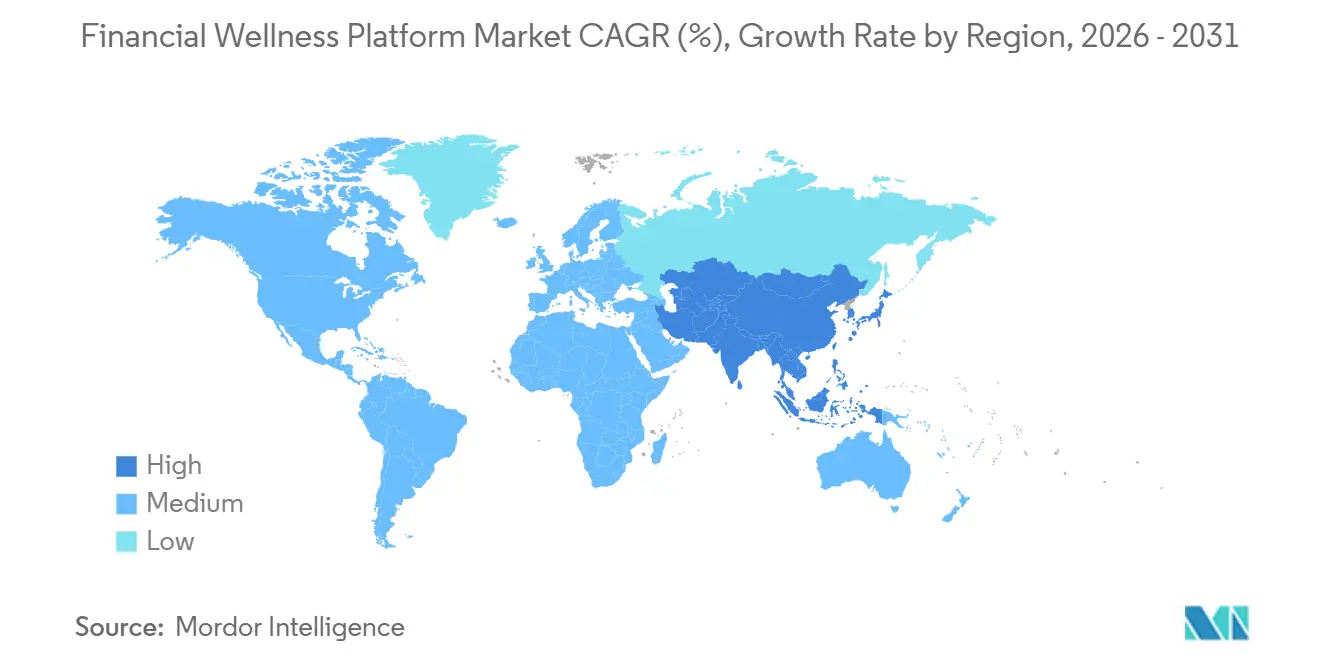
| Fastest Growing Market | Asia-Pacific |
| Largest Market | North America |
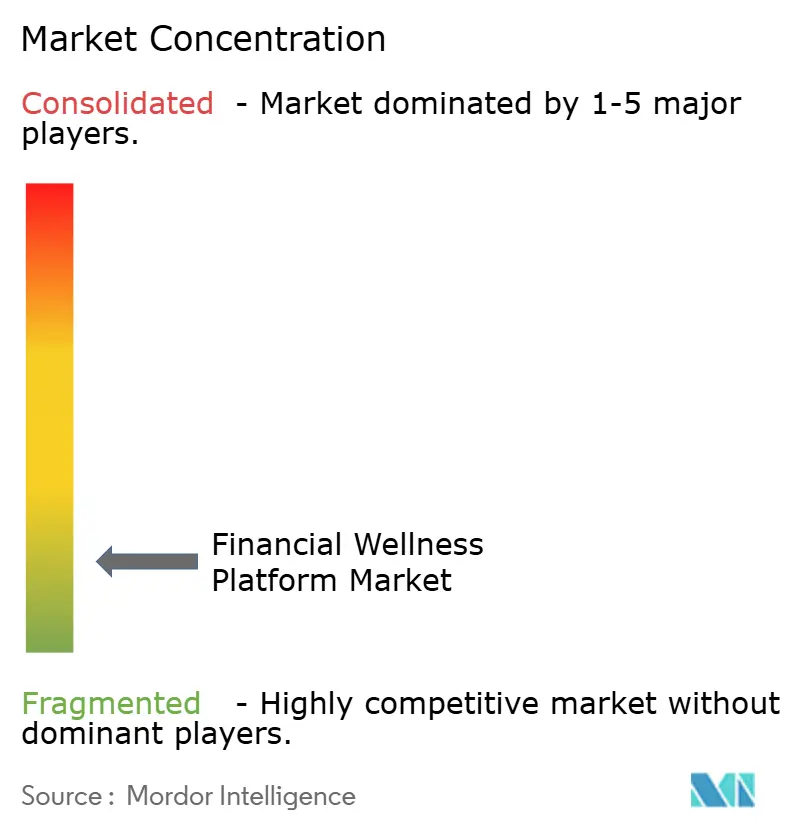
| Market Concentration | Low |
Major Players *Disclaimer: Major Players sorted in no particular order Image © Mordor Intelligence. Reuse requires attribution under CC BY 4.0. | |
Financial Wellness Platform Market Analysis by Mordor Intelligence
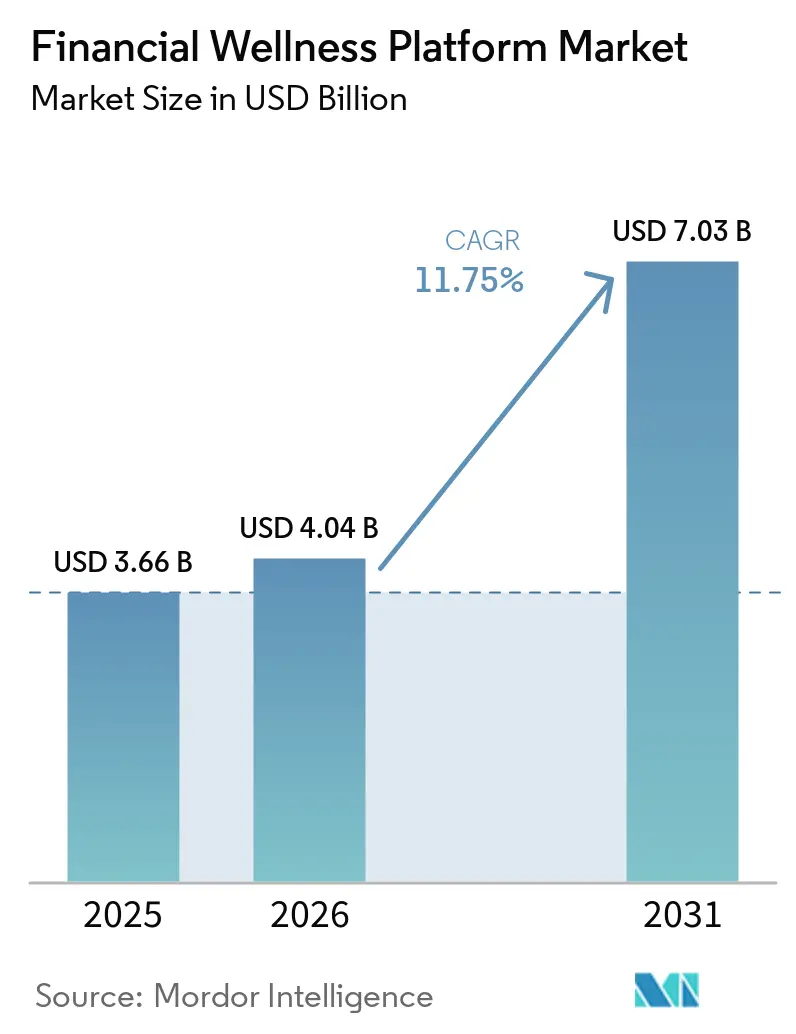
The financial wellness platform market size is expected to increase from USD 3.66 billion in 2025 to USD 4.04 billion in 2026 and reach USD 7.03 billion by 2031, growing at a CAGR of 11.75% over 2026-2031. Persistent cost-of-living pressures and weak real wage growth are making employee financial stress a visible business issue rather than a private concern. Automatic enrollment rules that now apply to new workplace retirement plans are also expanding participation and increasing the need for platforms that can manage more connected savings, guidance, and payroll workflows. Employers are treating financial strain as a productivity and retention problem, thereby widening the role of these platforms within broader benefits programs. The financial wellness platform market is also shifting toward cloud-connected and mobile delivery because employers want payroll-linked guidance, faster setup, and more relevant employee support. At the same time, tighter expectations around data protection and recommendation controls are raising the entry bar for smaller vendors and strengthening established providers with deeper compliance and integration capabilities.
Key Report Takeaways
- By component, software held 67.21% revenue share in 2025, while services is projected to expand at a 14.04% CAGR through 2031.
- By solution type, financial planning and goal setting accounted for 29.12% share in 2025, while earned wage access and cash-flow support is forecast to grow at a 12.91% CAGR through 2031.
- By deployment mode, on-premises captured 62.34% share in 2025, while cloud-based deployment is projected to advance at a 14.42% CAGR through 2031.
- By organization size, large enterprises held 59.42% share in 2025, while small and medium-sized enterprises are expected to grow at a 14.81% CAGR through 2031.
- By buyer type, employer-sponsored platforms held 56.71% of financial wellness platform market share in 2025, while institution-enabled platforms are projected to record a 13.71% CAGR through 2031.
- By geography, North America accounted for 37.23% of global revenue in 2025, while Asia-Pacific is expected to expand at a 13.34% CAGR through 2031.
Note: Market size and forecast figures in this report are generated using Mordor Intelligence’s proprietary estimation framework, updated with the latest available data and insights as of January 2026.
Market Trends and Insights
Drivers Impact Analysis of Financial Wellness Platform Market*
| Driver | (~) % Impact on CAGR Forecast | Geographic Relevance | Impact Timeline |
|---|---|---|---|
| Rising Employee Financial Stress and Cost-of-Living Pressure | +2.8% | Global | Short term (≤ 2 years) |
| Employer Focus on Productivity, Retention, and Benefits ROI | +2.3% | Global, with concentration in North America and Europe | Medium term (2-4 years) |
| AI-Enabled Personalization and Digital Financial Coaching | +2.0% | Global | Medium term (2-4 years) |
| Cloud, Mobile, and HRIS-Payroll Integration Adoption | +1.6% | North America and APAC core, spill-over to Europe | Medium term (2-4 years) |
| SECURE 2.0 Emergency Savings and Student-Loan Match Design Expanding Embedded Benefits Workflows | +1.2% | United States primarily | Short term (≤ 2 years) |
| Real-Time Payment Rails Accelerating Earned Wage Access and Daily Cash-Flow Use Cases | +0.9% | North America and APAC | Short term (≤ 2 years), Medium term (2-4 years) |
| Source: Mordor Intelligence | |||
Rising Employee Financial Stress and Cost-of-Living Pressure
Financial stress has become one of the clearest reasons employers are expanding the financial wellness platform market across benefit programs. Morgan Stanley at Work’s May 2026 survey shows that 80% of HR managers say employee financial issues hurt productivity, and 56% of employees say financial stress reduces their job performance. Zellis also reports that 92% of employees in its United Kingdom and Ireland study experienced financial stress over the past year, and 89% said it affected their concentration, confidence, energy, and ambition at work. CAPTRUST adds a more detailed view by showing that early-career employees experience greater stress and health effects than mid-career groups, suggesting that platforms that tailor support by career stage can increase relevance and engagement. In India, ADP data cited in 2025 showed that 46% of organizations were prioritizing broader financial well-being programs, and 55% of business leaders saw stress reduction as a core payroll responsibility. This pattern supports stronger demand in the financial wellness platform market for tools that move beyond static content and respond to employee needs as they change over time.
Employer Focus on Productivity, Retention, and Benefits ROI
The financial wellness platform market is also benefiting from a clear shift in employer buying logic, as financial support is now judged by workforce outcomes rather than goodwill alone. Morgan Stanley at Work reports that 91% of employees would consider changing jobs for better financial benefits, and 65% of HR executives rank hiring and retention as their top strategic financial priority for 2026. CAPTRUST shows why employers are pressing harder on utilization, because 98% of employees say they would use a free financial advisor, yet actual engagement with one-on-one support remains low in many programs. That gap matters more than basic program adoption, since employers can pay for licenses without seeing better retention or stronger employee follow-through. Principal Financial Group found that 80% of small and medium-sized businesses and 83% of employees agreed on the importance of financial wellness to well-being, while 89% of employees said it supports retention. As a result, vendors in the financial wellness platform market that can connect counseling, payroll signals, and measurable outcomes are gaining stronger positioning in enterprise buying decisions.
AI-Enabled Personalization and Digital Financial Coaching
Artificial intelligence is changing the financial wellness platform market by making personalized guidance easier to deliver at much larger employee volumes. BrightPlan stated in March 2026 that it had surpassed 9.2 million employees served across more than 50 countries, along with 41% year-over-year recurring revenue growth and a 68% CAGR over the prior 5 years, which it tied to its AI-driven personalization model.[1]BBVA’s June 2025 launch of an AI-powered financial coach inside its banking app shows that this model is spreading beyond employer plans and into financial institution channels as well. In a regulated benefits setting, the main advantage is not only model capability, because buyers also want systems trained on approved content and built to stay within permitted guidance boundaries. That gives established vendors an edge, as they already hold payroll, utilization, and counseling history that can improve relevance without increasing compliance risk. The result is that the financial wellness platform market is rewarding practical, controlled personalization rather than generic automation.
Cloud, Mobile, and HRIS-Payroll Integration Adoption
The financial wellness platform market is moving steadily toward cloud-based delivery as employers seek connected data flows rather than isolated benefit tools. Rain’s July 2025 launch of a fully embedded on-demand pay integration within Workday demonstrated that payroll-linked financial tools can now be activated directly within a core HR system. Rain extended that strategy through a bi-directional Paylocity integration in October 2025 and a Microsoft Teams integration in February 2026, each of which widened access to live payroll and scheduling data. DailyPay also became Workday’s strategic partner for on-demand pay in the United States and Canada in August 2025, which deepened switching costs for enterprise clients already operating within that ecosystem. OnePay’s April 2026 partnership with Workday added financial well-being tools and direct deposit switching to the same workflow, reinforcing the value of delivery inside systems employees already use. Over time, this favors providers in the financial wellness platform market that can connect payroll, time, and employee communication data without adding operational friction.
Restraints Impact Analysis of Financial Wellness Platform Market*
| Restraint | (~) % Impact on CAGR Forecast | Geographic Relevance | Impact Timeline |
|---|---|---|---|
| Data Privacy, Cybersecurity, and Sensitive Financial Data Concerns | -1.4% | Global | Short term (≤ 2 years) |
| Low Employee Engagement and Difficulty Proving Program ROI | -1.0% | Global | Medium term (2-4 years) |
| Advice-Versus-Guidance Regulatory Boundary and Fiduciary Exposure | -0.7% | North America primarily | Medium term (2-4 years) |
| State-By-State Earned Wage Access Rules and Multijurisdiction Compliance Fragmentation | -0.5% | North America, with emerging issues in Europe and APAC | Medium term (2-4 years) |
| Source: Mordor Intelligence | |||
Data Privacy, Cybersecurity, and Sensitive Financial Data Concerns
Data security remains a meaningful brake on the financial wellness platform market because these platforms often sit close to payroll, savings, and identity information. The Betterment incident disclosed in January 2026 demonstrated how a third-party marketing operations platform could expose the names, email addresses, physical addresses, phone numbers, and birthdates of nearly 1.4 million customers. That episode also reinforced a broader concern among enterprise buyers: that supply-chain weaknesses can create material exposure even when the core platform is not directly breached. In response, procurement teams are applying greater scrutiny to notification timelines, vendor oversight, and security certifications before approving new deployments. This adds cost and slows sales cycles across the financial wellness platform market, especially for smaller providers without long operating records or large compliance teams.
Low Employee Engagement and Difficulty Proving Program ROI
Low utilization continues to limit the market for financial wellness platforms because employers do not judge value solely by platform access. CAPTRUST shows the gap clearly, with 98% of employees saying they would use a free financial advisor even though actual one-on-one usage remains low where the benefit is already available. That disconnect makes it harder for HR teams to show that platform spending is improving retention, productivity, or financial behavior in measurable ways. Morgan Stanley at Work’s 2026 findings further raise the pressure because employers now link financial benefits more directly to engagement and job-switching decisions. Principal’s small business survey points in the same direction, with broad agreement among employers and employees that financial wellness matters, but that still does not remove the need to prove actual usage and business results. Vendors that can tie activity to payroll and benefits outcomes are therefore in a stronger position, while less measurable offerings face longer review cycles in the financial wellness platform market.
*Our forecasts treat driver/restraint impacts as directional, not additive. The impact forecasts reflect baseline growth, mix effects, and variable interactions.
Financial Wellness Platform Market Segment Analysis
By Component:
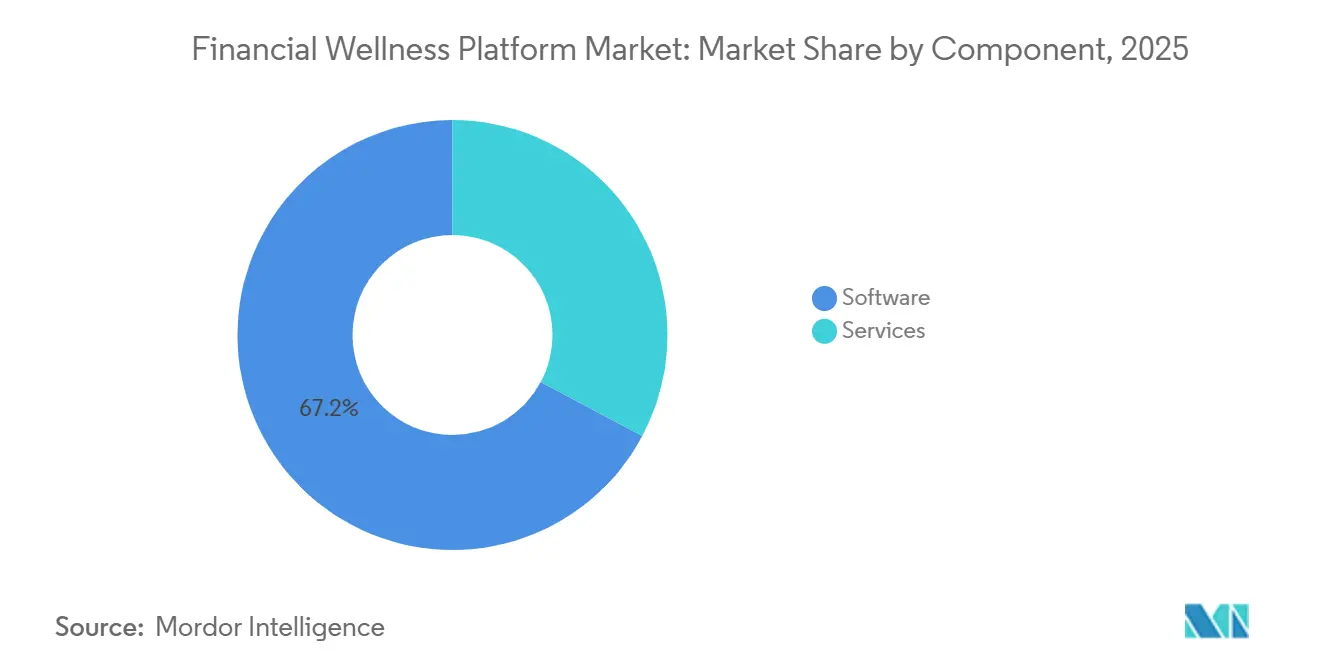
Services Gain as Buyers Seek Measurable OutcomesServices are projected to grow at a 14.04% CAGR from 2026 to 2031, making them the fastest-growing component of the financial wellness platform market. Software still held a 67.21% revenue share in 2025, indicating that employers had strongly favored digital tools, dashboards, and self-service access during the first wave of adoption. In practice, that earlier model worked well for broad rollout and lower seat costs, but it often left employers with weaker engagement and less clarity on outcome delivery. This is why more buyers in the financial wellness platform market are now asking vendors to pair software access with counseling, managed administration, and direct employee support.
The shift toward services is tied to the limits of passive digital use. LearnLux stated in March 2026 that 73% of its members used platform tools for financial guidance and that 91% reported better work focus due to reduced financial stress, which it linked to a model combining digital tools with unlimited access to Certified Financial Planner professionals. That hybrid structure is particularly relevant for employers with workforces that need different kinds of help across debt, budgeting, emergency savings, and retirement planning. Vendors in the financial wellness platform market that can let AI handle basic questions and refer more complex cases to human specialists are better positioned to scale this model efficiently. The result is a component mix that is moving from feature access toward guided outcomes, not away from software but beyond software alone.
By Solution Type:
Planning Remains Largest While Cash-Flow Support Expands FastestFinancial planning and goal setting accounted for 29.12% of the financial wellness platform market size in 2025, making it the largest segment that year. Earned wage access and cash-flow support are forecast to expand at a 12.91% CAGR through 2031, indicating that short-cycle liquidity needs are becoming a larger part of employer financial support. The contrast between the two is important because planning tools reflect a long-standing benefits category, while wage access reflects the newer link between payroll technology and everyday cash management. Together, they show that the financial wellness platform market is widening from retirement readiness into real-time financial support.
Morgan Stanley at Work reported in May 2026 that employees most often struggled with budgeting, financial goal setting, and retirement planning, which supports the continued need for broad product coverage rather than a single-point solution. Retirement planning and savings workflows are also changing as student-loan matching contributions and pension-linked emergency savings options become more practical for employers to implement. Debt management and credit improvement tools remain especially relevant for younger workers who feel the most immediate pressure from repayment burdens and cash constraints. Budgeting tools also benefit when they sit on the same payroll-linked data layer as earned wage access, because employees are more likely to use both when the experience feels connected. In that sense, the financial wellness platform industry is moving toward suites that reflect how employees manage money in real life, rather than isolated educational modules.
By Deployment Mode:
Cloud Adoption Rises as Integration Needs IncreaseOn-premises deployment held a 62.34% share in 2025, indicating it represented the larger installed base in the financial wellness platform market at that time. Cloud-based deployment is forecast to grow at a 14.42% CAGR through 2031, the fastest pace across deployment options. This split reflects a market that is still carrying older infrastructure choices while newer buyers prioritize connectivity and faster release cycles. The financial wellness platform market is therefore not abandoning legacy systems overnight, but growth is moving clearly toward cloud delivery.
The main reason is operational rather than cosmetic. Real-time earned wage access, mobile employee support, and event-based guidance work better when platforms can read current payroll, scheduling, and HR data without long update cycles. Rain’s embedded Workday model and DailyPay’s strategic Workday partnership both show how deployment choices now affect distribution, data quality, and client stickiness. OnePay’s April 2026 Workday partnership added another example by embedding financial well-being tools and direct deposit switching inside payroll workflows that employees already use. As certified integrations become more important, the financial wellness platform market is giving an advantage to vendors that can work smoothly inside the major cloud HR ecosystems.
By Organization Size:
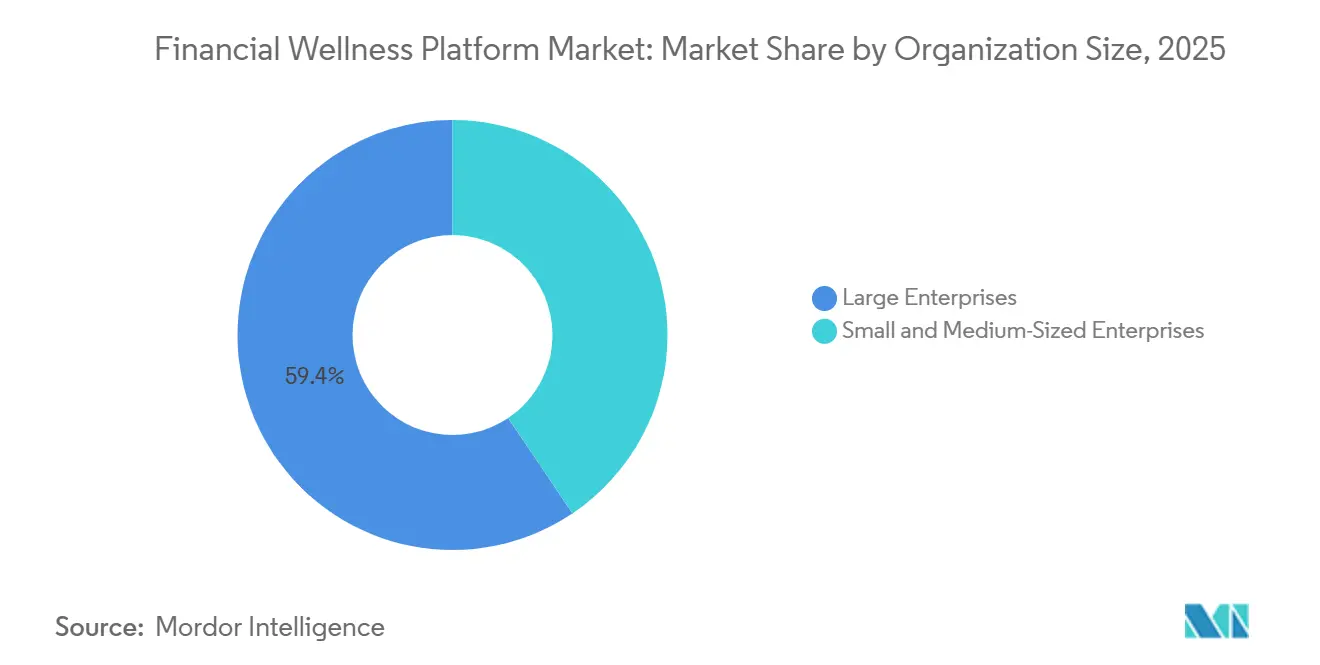
SME Demand Builds as Access Costs DeclineLarge enterprises held 59.42% of the revenue share in 2025, giving them the leading position in the financial wellness platform market. Small and medium-sized enterprises are projected to grow at a 14.81% CAGR through 2031, making them the faster-growing employer group. This pattern reflects the traditional strength of large firms in benefits spending, compliance staffing, and vendor management. It also shows that the next growth wave in the financial wellness platform market is likely to come from organizations that were previously priced out or operationally constrained.
EBRI data published through NAPA-Net showed that 16% of firms with fewer than 100 employees offered no financial wellness benefits, while 34% offered 8 or more benefit types, suggesting a split between highly active adopters and businesses still waiting for simpler delivery models. That leaves a broad middle group that understands the value of financial support but still needs lower setup effort and clearer return. Auris announced in April 2026 that it had embedded ZayZoon’s earned wage access offering across a network of more than 50,000 businesses at no cost to employers, demonstrating how payroll channels can reduce friction for smaller clients. Principal’s 2025 SMB Sentiment results support the same direction, because 80% of SMBs linked financial wellness to well-being, and 75% linked it to retention. The financial wellness platform market is therefore becoming easier for smaller employers to enter, as distribution runs through existing payroll relationships rather than separate software procurement.
By Buyer Type:
Employer Channels Lead While Institution-Led Models Scale FasterEmployer-sponsored platforms captured 56.71% of buyer-type revenue in 2025, giving them the largest share of the financial wellness platform market that year. Institution-enabled platforms are forecast to expand at a 13.71% CAGR through 2031, making them the fastest-growing buyer channel. The current lead for employer-sponsored platforms reflects the fact that HR departments still control most workplace benefit budgets and vendor selection. The faster growth of institution-enabled models shows that banks and credit unions are becoming more active distribution partners in the financial wellness platform market.
That channel has a practical advantage because the end user already has a financial relationship with the institution providing the tool. iGrad states that its Enrich platform serves more than 45 million consumers through more than 70 financial institution partners, which shows that white-label distribution can scale without long employer sales cycles.[2]Chime Enterprise announced in February 2026 that it was adding employer partners such as Cedarhurst Senior Living and eXp Realty, demonstrating that consumer fintech companies are also moving toward employer and institutional distribution. Alight’s March 2026 expansion of its Partner Network with nudge Global and Benifex points to the same convergence, because global administrators are becoming a shared route for both employer-sponsored and institution-supported education delivery. Within the financial wellness platform industry, competition is widening beyond direct employer procurement into relationship-based distribution through financial institutions and benefits intermediaries.
Geography Analysis
The Americas Financial Wellness Platform Market
North America accounted for 37.23% of global revenue in 2025, making it the largest region in the financial wellness platform market. The United States remains the core of regional demand because employer-sponsored benefits are well established, digital payroll systems are mature, and retirement policy continues to create new workflow requirements. Automatic enrollment rules for new plans beginning in 2025 and IRS guidance on student-loan matching contributions are pushing employers toward updated benefits administration and savings support tools. Canada is also becoming more active, as DailyPay announced its expansion there in 2025 with early employer clients in hospitality, services, and childcare. South America remains at an earlier stage, where adoption is centered more on earned wage access and basic financial education for hourly and high-turnover workforces than on full-suite employer programs.
APAC Financial Wellness Platform Market
Asia-Pacific is projected to grow at a 13.34% CAGR through 2031, making it the fastest-growing regional market for the financial wellness platform. In Japan, Rakuten Securities and Mizuho Bank launched Workplace Tsumitate NISA in 2025, bringing payroll-deduction investing into the employer benefits setting through a bank-securities partnership. SmartHR added a Money Portal service in October 2025 that combined financial education, group insurance access, and asset-building support inside its cloud HR platform. In India and China, growth is being supported by stronger employer interest in financial well-being and by broader workplace benefit digitization, with ADP-linked findings showing expansion priorities in India and Dongfang Fuli reporting coverage across more than 500 cities and more than 405 top-500-company clients in China.
EMEA Financial Wellness Platform Market
Europe remains a significant region in the financial wellness platform market, with the United Kingdom, Germany, and France leading adoption. Zellis reported in May 2026 that 52% of UK employees saw the cost of living as their main financial pressure, 70% struggled to keep up with bills, and 85% were actively tracking earnings, indicating strong demand for employer-backed support. Alight’s addition of Nudge Global to its Partner Network in March 2026 also shows that multinational employers want more consistent financial education delivery across countries.[3] The Middle East and Africa are still early-stage opportunities, but demand is building for support with multi-currency planning, broad financial literacy, and simpler benefit delivery models.
Competitive Landscape
The financial wellness platform market remains fragmented, with no single provider controlling leadership across all solution types, buyer channels, and regions. Competition is centered around 3 broad groups: earned wage access specialists, such as DailyPay and Rain; full-service financial wellness providers, such as BrightPlan and LearnLux; and retirement-linked platforms, such as Vestwell, that are expanding into adjacent savings and planning needs. Each group is trying to widen its role by adding capabilities that were once outside its original category. In practice, the strongest positions in the financial wellness platform market now come from payroll access, trusted distribution relationships, and the ability to operate within strict compliance limits. Vestwell’s USD 385 million Series E in February 2026, which doubled its valuation to USD 2 billion, shows that investors still see room for scaled providers that can connect retirement infrastructure with broader employee financial support.
There is still meaningful open space in the financial wellness platform market for providers that can serve smaller employers with minimal setup, banks and credit unions that want white-label financial support, and employers operating across multiple countries. iGrad’s institution-led scale and SavvyMoney’s positioning for banks and credit unions show that financial institutions are becoming a more credible route to market for wellness tools. Compliance also remains a key screening factor, as enterprise buyers want vendors to explain clearly how personalized support stays within the guidance limits under the current U.S. fiduciary framework.[4]This means scale matters, but clarity, operating discipline, and integration depth matter just as much in the financial wellness platform market.
Recent strategic moves show how providers are building those positions. Rain joined the Aptia Amplify Partners program in May 2026, which expanded distribution of earned wage access, budgeting support, and coaching tools through a benefits administration channel serving more than 6 million covered lives. Alight added Nudge Global and Benifex to its Partner Network in March 2026, which strengthened its ability to serve multinational employers with broader wealth and education support. Vestwell’s acquisition of Accrue 401(k) in February 2026 expanded its product offering to include emergency savings, student debt support, personalized investing, and goal-based investing. Chime Enterprise’s addition of new employer partners in February 2026 shows that consumer fintech brands are also moving into workplace distribution, which keeps competitive pressure high across the financial wellness platform market.
Financial Wellness Platform Industry Leaders
-
Payactiv, Inc.
-
DailyPay, LLC
-
BrightPlan LLC
-
Rain Technologies Inc.
-
Vestwell Holdings Inc.
- *Disclaimer: Major Players sorted in no particular order
Financial Wellness Platform Market Companies Covered in this Report
- Financial Finesse
- LearnLux
- Blend Financial Inc. dba Origin Financial
- BrightPlan LLC
- Payactiv, Inc.
- FinFit, LLC
- Salary Finance Limited
- DailyPay, LLC
- Rain Technologies Inc.
- ZayZoon
- FlexWage Solutions
- nudge Global Ltd.
- Vestwell Holdings Inc.
- Financial Wellness Labs, Inc. (Questis)
- My Secure Advantage, Inc.
- iGrad LLC (Enrich Financial Wellness)
- BrightDime, Inc.
- Savology
- Best Money Moves
- Your Money Line
Recent Industry Developments in Financial Wellness Platform Market
- May 2026: Rain Technologies joined the Aptia Amplify Partners program, integrating Rain's employer-sponsored financial health tools, including earned wage access, budgeting support, spending analysis, and financial coaching, with Aptia's employer base of more than 6 million covered lives across 1,100-plus clients, at no cost to employers. The partnership reflects the accelerating trend of benefits administration platforms embedding financial health tools within existing benefit stacks rather than requiring separate vendor procurement.
- May 2026: OnPay and Betterment at Work launched a 360° 401(k) integration for small businesses, automating headcount updates and the flow of contribution data between payroll and retirement plan systems. The integration targeted the finding that only 41% of small businesses currently offer workplace retirement plans. Concurrently, OnPay raised more than USD 100 million in new capital, including a USD 63 million Series B led by Carrick Capital Partners with participation from AB Private Credit Investors.
- April 2026: ZayZoon's earned wage access platform was embedded into Auris, formerly Heartland Payroll, deploying earned wage access at no employer cost across Auris's network of more than 50,000 businesses nationwide. The integration requires no administrative effort from employers and automatically handles repayments through payroll deductions.
- March 2026: BrightPlan received a new investment from Riverside Acceleration Capital with participation from existing investors, alongside disclosures of 9.2 million employees served across more than 50 countries, 41% year-over-year recurring revenue growth, USD 7.6 billion in assets under advisement, and a 68% CAGR over 5 years driven by AI-driven personalization and global enterprise expansion.
Global Financial Wellness Platform Market Report Scope
The Financial Wellness Platform market encompasses digital solutions and services aimed at enhancing individuals' financial health, covering budgeting, savings, debt management, and financial education. These platforms, provided by employers, financial institutions, and fintechs, strive to boost financial literacy and alleviate employee financial stress. Often, these solutions seamlessly integrate with payroll systems, facilitating automated savings, optimizing benefits, and offering real-time financial insights. Catering to a diverse audience, the market addresses the needs of employees, retail consumers, and underserved groups aspiring for financial stability.
The Financial Wellness Platform Market Report is Segmented by Component (Software, and Services), Solution Type (Financial Planning and Goal Setting, Financial Education and Counseling, Retirement Planning and Savings, Budgeting and Expense Management, Debt Management and Credit Improvement, Earned Wage Access and Cash-Flow Support, and Other Solution Types), Deployment Mode (Cloud-Based, and On-Premises), Organization Size (Large Enterprises, and Small and Medium-Sized Enterprises), Buyer Type (Employer-Sponsored Platforms, Direct-to-Consumer Platforms, and Institution-Enabled Platforms), and Geography (North America, South America, Europe, Asia-Pacific, Middle East, and Africa). The Market Forecasts are Provided in Terms of Value (USD).
Segmentation Overview
| Software |
| Services |
| Financial Planning and Goal Setting |
| Financial Education and Counseling |
| Retirement Planning and Savings |
| Budgeting and Expense Management |
| Debt Management and Credit Improvement |
| Earned Wage Access and Cash-Flow Support |
| Other Solution Types |
| Cloud-Based |
| On-Premises |
| Large Enterprises |
| Small and Medium-Sized Enterprises |
| Employer-Sponsored Platforms |
| Direct-to-Consumer Platforms |
| Institution-Enabled Platforms |
| North America | United States |
| Canada | |
| Mexico | |
| South America | Brazil |
| Argentina | |
| Rest of South America | |
| Europe | Germany |
| United Kingdom | |
| France | |
| Italy | |
| Spain | |
| Russia | |
| Rest of Europe | |
| Asia-Pacific | China |
| Japan | |
| India | |
| Australia | |
| South Korea | |
| Rest of Asia-Pacific | |
| Middle East | United Arab Emirates |
| Saudi Arabia | |
| Turkey | |
| Rest of Middle East | |
| Africa | South Africa |
| Nigeria | |
| Rest of Africa |
| By Component | Software | |
| Services | ||
| By Solution Type | Financial Planning and Goal Setting | |
| Financial Education and Counseling | ||
| Retirement Planning and Savings | ||
| Budgeting and Expense Management | ||
| Debt Management and Credit Improvement | ||
| Earned Wage Access and Cash-Flow Support | ||
| Other Solution Types | ||
| By Deployment Mode | Cloud-Based | |
| On-Premises | ||
| By Organization Size | Large Enterprises | |
| Small and Medium-Sized Enterprises | ||
| By Buyer Type | Employer-Sponsored Platforms | |
| Direct-to-Consumer Platforms | ||
| Institution-Enabled Platforms | ||
| By Geography | North America | United States |
| Canada | ||
| Mexico | ||
| South America | Brazil | |
| Argentina | ||
| Rest of South America | ||
| Europe | Germany | |
| United Kingdom | ||
| France | ||
| Italy | ||
| Spain | ||
| Russia | ||
| Rest of Europe | ||
| Asia-Pacific | China | |
| Japan | ||
| India | ||
| Australia | ||
| South Korea | ||
| Rest of Asia-Pacific | ||
| Middle East | United Arab Emirates | |
| Saudi Arabia | ||
| Turkey | ||
| Rest of Middle East | ||
| Africa | South Africa | |
| Nigeria | ||
| Rest of Africa | ||
Key Questions Answered in the Report
What is the size of the financial wellness platform market?
The financial wellness platform market was valued at USD 3.66 billion in 2025, stands at USD 4.04 billion in 2026, and is projected to reach USD 7.03 billion by 2031 at an 11.75% CAGR.
Which region leads global demand?
North America led in 2025 with 37.23% of global revenue, supported by mature employer benefits systems and strong payroll technology adoption.
Which solution area is growing the fastest?
Earned wage access and cash-flow support is the fastest-growing solution type, with a projected 12.91% CAGR through 2031, driven by real-time payroll connectivity and employer demand for daily cash-flow support.
Why are employers investing more in employee financial support tools?
Employers are linking financial stress to lower productivity, weaker retention, and underused benefit budgets, which is pushing them toward more measurable and better-integrated programs.
What is changing the product mix the most?
The shift toward services, cloud deployment, and AI-enabled personalization is changing the mix, because employers want outcomes, payroll-linked delivery, and more relevant guidance rather than access alone.
Which customer group offers the strongest growth opportunity?
Small and medium-sized enterprises represent the strongest growth opportunity, with a projected 14.81% CAGR, as payroll-channel distribution and lower implementation effort make adoption easier.