
Asset Allocation Consulting Market Size and Share
Market Overview
| Study Period | 2020 - 2031 |
|---|---|
| Market Size (2026) | USD 12.05 Billion |
| Market Size (2031) | USD 16.72 Billion |
| Growth Rate (2026 - 2031) | 6.77 % |
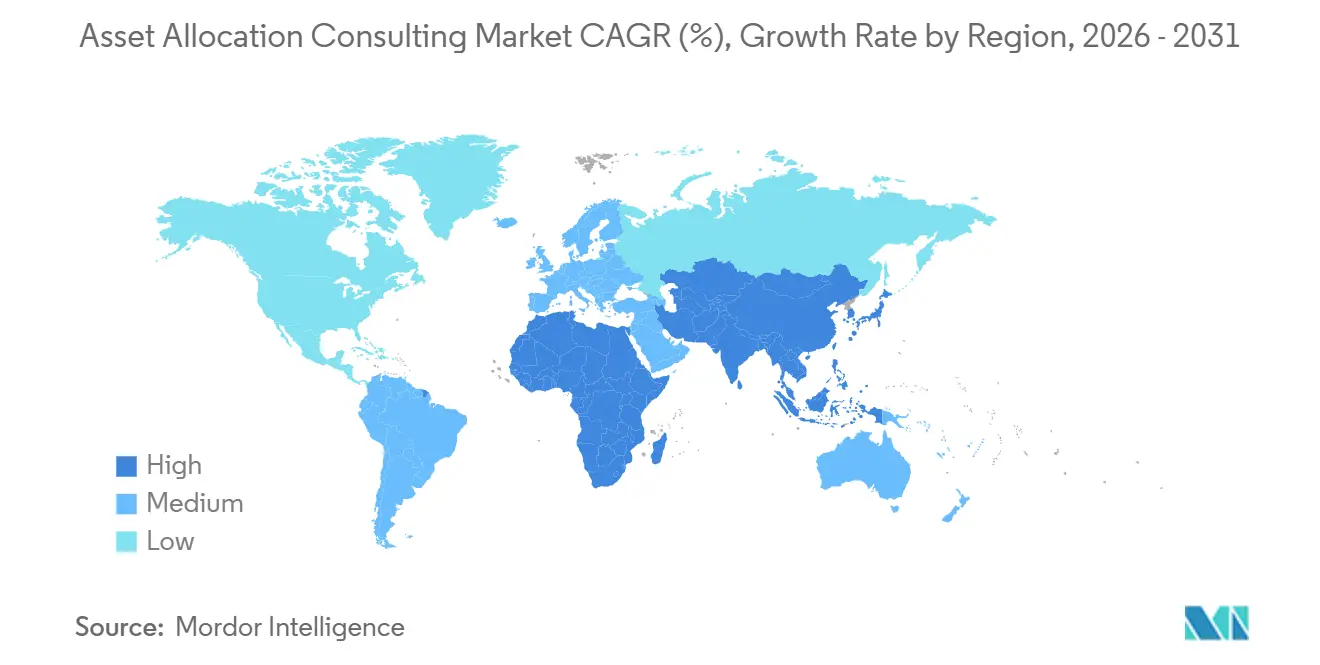
| Fastest Growing Market | Asia-Pacific |
| Largest Market | North America |
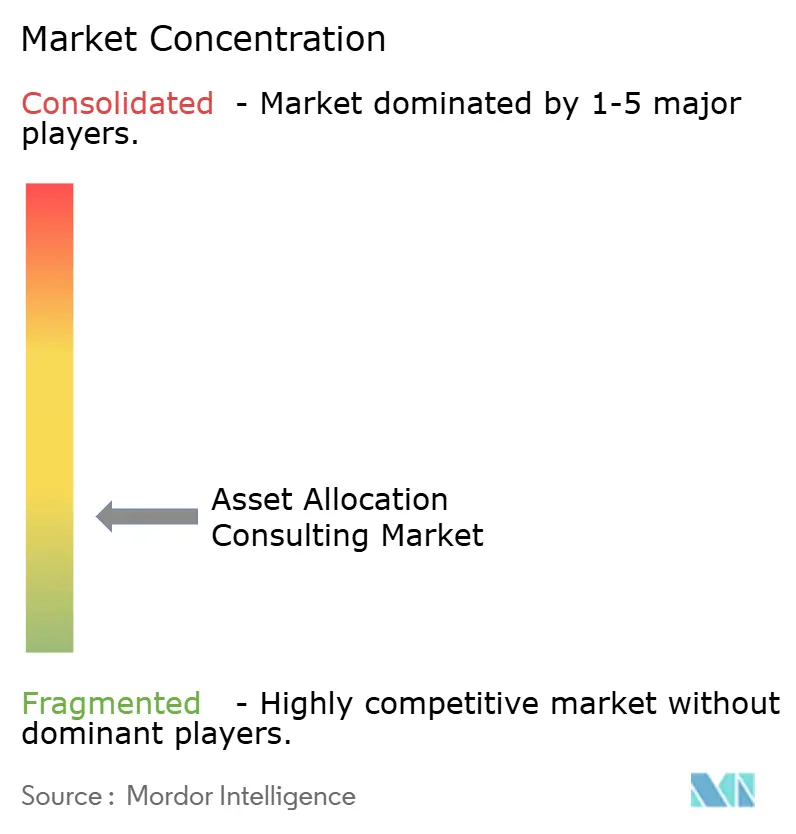
| Market Concentration | Low |
Major Players *Disclaimer: Major Players sorted in no particular order Image © Mordor Intelligence. Reuse requires attribution under CC BY 4.0. | |
Asset Allocation Consulting Market Analysis by Mordor Intelligence
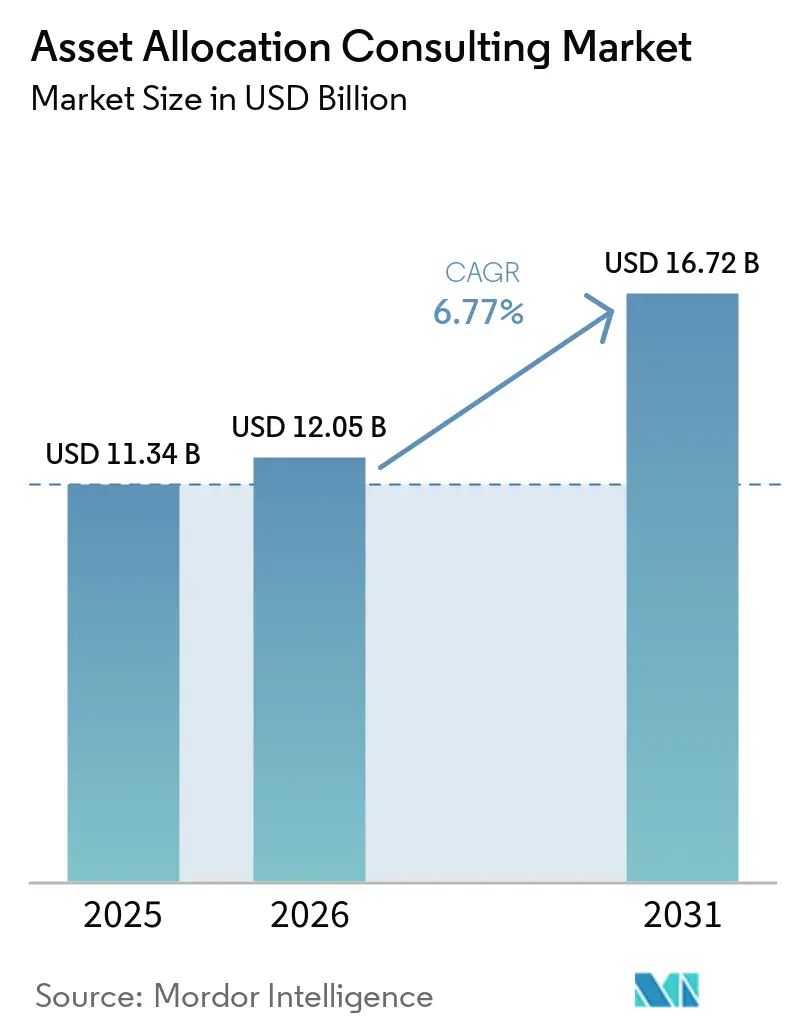
The Asset Allocation Consulting Market size is projected to expand from USD 11.34 billion in 2025 and USD 12.05 billion in 2026 to USD 16.72 billion by 2031, registering a CAGR of 6.77% between 2026 to 2031.
The market is expanding because institutional investors are dealing with more asset classes, weaker historical correlations, and wider use of private markets, which are stretching internal investment teams and increasing reliance on external advice. Global OCIO assets under management stood at USD 3.3 trillion at the end of 2024 and are forecast to reach USD 5.6 trillion by 2029, with USD 1.3 trillion expected from first-time adopters, which shows that delegated investment models are moving further into the mainstream of institutional governance. Private wealth clients’ allocation to alternatives is projected to rise from USD 4 trillion to USD 13 trillion by 2032, underscoring the need for advice on liquidity, pacing, manager selection, and cross-asset portfolio design in the asset allocation consulting market. At the same time, pricing pressure in traditional advisory work is pushing firms to differentiate through technology, private markets capabilities, and broader fiduciary support rather than relying solely on basic allocation reviews. The result is a market where scale, data depth, and execution support matter more, and where well-capitalized firms are better placed to capture complex mandates while mid-tier firms face tighter operating conditions.
Key Report Takeaways
- By engagement model, discretionary advisory accounted for 47.7% of the asset allocation consulting market share in 2025 and is projected to grow at an 8.3% CAGR through 2031.
- By core service, strategic asset allocation accounted for 29.8% of the asset allocation consulting market share in 2025, while multi-asset and alternatives allocation is projected to grow at 9.8% CAGR through 2031.
- By client segment, defined benefit pension plans captured 36.8% of the asset allocation consulting market share in 2025, while family offices and ultra-high-net-worth individuals are projected to grow at 9.1% CAGR through 2031.
- By asset class, traditional public markets captured 43.9% of the asset allocation consulting market share in 2025, while alternative and private markets are projected to grow at 10.3% CAGR through 2031.
- By geography, North America accounted for 56.4% of the asset allocation consulting market share in 2025, while Asia-Pacific is projected to grow at a 8.9% CAGR through 2031.
Note: Market size and forecast figures in this report are generated using Mordor Intelligence’s proprietary estimation framework, updated with the latest available data and insights as of January 2026.
Market Trends and Insights
Drivers Impact Analysis of Asset Allocation Consulting Market*
| Driver | (~) % Impact on CAGR Forecast | Geographic Relevance | Impact Timeline |
|---|---|---|---|
| Rising Portfolio Complexity Across Asset Classes | +1.5% | Global | Medium term (2-4 years) |
| Growth In Institutional Outsourcing Of Asset Allocation | +1.2% | North America and Europe, with spill-over to the Asia-Pacific | Medium term (2-4 years) |
| Expansion Of ESG And Liability-Driven Allocation Mandates | +0.9% | Europe, United Kingdom, North America | Medium term (2-4 years) |
| Demand For AI-Assisted Scenario Modeling And Rebalancing | +0.8% | Global, early gains in North America and Asia-Pacific | Short term (≤ 2 years) |
| Rising Multi-Jurisdiction Tax, Liquidity, And Governance Complexity | +0.6% | Global, UHNW-dense markets in North America, Europe, and Asia-Pacific | Long term (≥ 4 years) |
| Intergenerational Wealth Transfer Driving Bespoke Allocation Needs | +0.5% | North America, Europe, Asia-Pacific, including Singapore, Australia and Japan | Long term (≥ 4 years) |
| Source: Mordor Intelligence | |||
Rising Portfolio Complexity Across Asset Classes
Portfolio construction in the asset allocation consulting market now covers private credit, infrastructure, real assets, digital instruments, and liquid alternatives, rather than a narrower public equity and bond mix. Private equity alone is approaching USD 20 trillion in global private markets value, which shows how much capital has moved into structures that require different liquidity, valuation, and risk frameworks. Institutional investors are also using hybrid private market structures that combine closed-end funds, co-investments, multi-asset vehicles, and evergreen formats, which raises the burden on governance and oversight. Historical asset-class relationships have also become less stable during periods of inflation and geopolitical stress, reducing the usefulness of simpler optimization approaches and increasing the value of forward-looking advice. This is supporting demand in the asset allocation consulting market because clients need outside specialists who can connect allocation design with liquidity planning, risk budgeting, and ongoing governance.
Growth In Institutional Outsourcing of Asset Allocation
Institutional outsourcing remains one of the clearest demand drivers for the asset allocation consulting market, as more asset owners move from advisory-only relationships to delegated structures. Global OCIO assets under management reached USD 3.3 trillion at the end of 2024 and are projected to rise to USD 5.6 trillion by 2029, with nearly 43% of first-time OCIO adoption expected to come from corporate defined benefit and defined contribution plans. The shift is now moving up the institutional size ladder, as larger organizations are seeking customized structures that fit their funding path, liability profile, private markets pacing needs, and governance model. Russell also noted that clients are using OCIO less as a simple outsourcing tool and more as a broader operating framework that integrates decision-making, execution, and oversight. This supports the asset allocation consulting market because discretionary mandates usually last longer, generate deeper data relationships, and create wider revenue opportunities across portfolio construction, manager oversight, and reporting.
Expansion of ESG and Liability-Driven Allocation Mandates
ESG and liability-driven mandates are expanding the asset allocation consulting market, as institutional clients now need allocation frameworks that meet return, funding, and compliance goals simultaneously. Legal and General’s 2026 view on LDI showed that 50% of United States defined benefit plan sponsors did not intend to terminate their plans in 2025, up from 36.7% in 2023, which points to stronger demand for enduring liability-aware portfolio structures[1]. In Europe, ESG rating regulation enters full application on July 2, 2026, requiring ESMA authorization for providers and changing how data will be used in investment design and monitoring. The overlap between CSRD, SFDR changes, and banking guidance on ESG risk is adding a compliance layer that many institutions do not want to manage alone. This is increasing the role of consultants that can connect liability hedging, private credit, and sustainability data in one mandate design rather than treating ESG as a separate overlay.
Demand for AI-Assisted Scenario Modeling and Rebalancing
AI-assisted scenario modeling is changing the service mix in the asset allocation consulting market by shortening the time between market changes and portfolio responses. A 2025 study in Scientific Reports demonstrated a 24.5-millisecond inference time for a 50-asset portfolio rebalancing scenario, which was 8.7 times faster than conventional neural approaches[2]. Mercer’s 2025 CFO survey showed that dashboards, scenario models, and predictive analytics had already become standard tools in pension governance, and some sponsors were using automated glide-path triggers tied to funding levels or rates. These capabilities matter because large consultants can train models on broader mandate datasets and then embed those tools directly into client oversight processes. As a result, technology is becoming a stronger competitive filter in the asset allocation consulting market, especially for discretionary mandates where timing, monitoring, and execution support matter more.
Restraints Impact Analysis of Asset Allocation Consulting Market*
| Restraint | (~) % Impact on CAGR Forecast | Geographic Relevance | Impact Timeline |
|---|---|---|---|
| Fee Pressure From Commoditized Advisory Benchmarks | -0.9% | Global, most acute in North America and Europe | Short term (≤ 2 years) |
| Data, Talent, And Technology Cost Burden For Smaller Firms | -0.6% | Global, particularly emerging markets and mid-sized advisory firms | Medium term (2-4 years) |
| Slow Institutional Decision Cycles And Internal Governance Friction | -0.5% | Global, particularly larger DB pension markets | Long term (≥ 4 years) |
| Model Risk, Fiduciary Liability, And Compliance Exposure | -0.4% | North America and Europe, under SEC and FCA oversight | Medium term (2-4 years) |
| Source: Mordor Intelligence | |||
Fee Pressure from Commoditized Advisory Benchmarks
Fee pressure is limiting expansion in the asset allocation consulting market because core services such as strategic allocation reviews, manager research, and reporting are becoming easier to benchmark across providers. Callan’s 2025 Investment Management Fee Study showed that negotiated fees for passive United States large-cap strategies had dropped as low as 1.9 basis points, which reflects the wider push toward lower-cost institutional solutions[3]. Cerulli also reported that 83% of advisors expected to charge under 1% for clients with more than USD 5 million by 2026, and the average fee for clients with more than USD 10 million was around 66 basis points. This pricing pressure is resetting expectations for what clients will pay for standardized advice, especially when they can access model portfolios, due diligence databases, and digital reporting tools from multiple sources. The firms that hold up better are those that can tie advice to private markets capability, fiduciary execution, or technology-enabled oversight, rather than relying solely on basic consulting work.
Data, Talent, And Technology Cost Burden For Smaller Firms
Rising platform costs are another restraint on the asset allocation consulting market, as smaller firms need to invest in data, analytics, reporting, and specialist talent simultaneously. EY’s 2026 Future of Asset Management Study noted that tighter transparency and resilience requirements were increasing the cost of people and technology, while cross-border divergence on ESG and digital assets added more operational complexity[4]. Firms also need expertise in private credit due diligence, quantitative allocation, ESG analytics, and cross-jurisdiction tax structuring, which raises compensation costs in an environment where fee pressure already exists. This creates a structural gap between large firms, which can spread investment across a broad client base, and smaller firms, which cannot build the same platform without hurting margins. The result is slower scaling for many mid-sized providers in the asset allocation consulting market, along with a stronger incentive to merge, specialize, or focus on narrower client segments.
*Our forecasts treat driver/restraint impacts as directional, not additive. The impact forecasts reflect baseline growth, mix effects, and variable interactions.
Asset Allocation Consulting Market Segment Analysis
By Engagement Model:
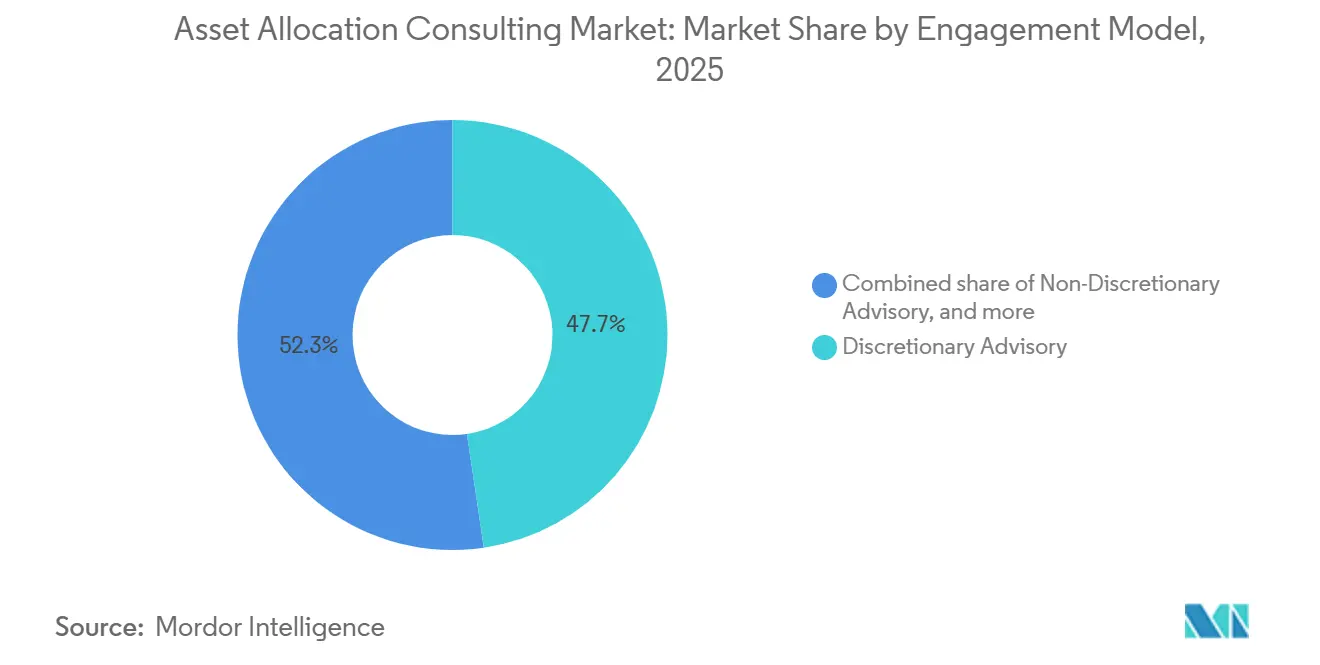
Discretionary Advisory Drives Platform-Scale GrowthDiscretionary advisory held 47.7% of the asset allocation consulting market share in 2025 and is projected to grow at a 8.3% CAGR through 2031, keeping it ahead of other engagement formats. The segment is benefiting from the wider use of OCIO structures, in which the consultant assumes fiduciary responsibility and manages implementation rather than stopping at advice. This model fits institutions that want faster decision-making, tighter execution discipline, and a clearer line of accountability across portfolio design and monitoring. Non-discretionary advisory still matters for clients with established in-house investment teams that want strategic reviews, manager search support, or validation of internal decisions. Hybrid models are also gaining ground because some institutions want to phase into delegation rather than move directly into a full outsourced structure.
The asset allocation consulting market is also seeing a behavioral shift within this segment, as large institutions are demanding more customized, delegated arrangements than in earlier OCIO cycles. Russell’s 2026 outlook noted stronger demand from larger and more complex asset owners seeking solutions aligned with their funding paths, governance styles, and private markets pacing needs. Discretionary mandates also create a stronger data loop because retained accounts feed performance and implementation experience back into the consultant’s operating model. That gives large providers an advantage in the asset allocation consulting industry because they can improve portfolio design, reporting, and client retention across a wider book of mandates.
By Core Service:
Strategic Allocation Leads Revenue While Alternatives Consulting Leads GrowthStrategic asset allocation accounted for 29.8% of the asset allocation consulting market in 2025, underscoring that long-term policy design remains the foundation of most institutional relationships. It stays important because every other service line, including rebalancing, risk budgeting, and alternatives pacing, still depends on a policy structure that defines return targets, risk ranges, and liquidity boundaries. However, multi-asset and alternatives allocation is growing faster at 9.8% CAGR through 2031, reflecting stronger demand for help with private equity, private credit, infrastructure, and real assets. Adams Street Partners reported that 89% of advisors believed private markets would outperform public markets over the long term, and 70% expected more clients to invest in private markets over the next 3 years. This is lifting demand for consultants who can translate allocation intent into pacing, manager selection, and governance frameworks.
LDI and asset-liability management are also strengthening as institutions revisit how to hedge liabilities while preserving return flexibility. Legal and General’s 2026 view showed that newer LDI frameworks are incorporating private credit and opportunistic fixed income rather than relying only on traditional duration tools. Tactical asset allocation and rebalancing is seeing more automation, which reduces pricing power for simple execution tasks but increases the importance of interpretive oversight. Risk budgeting, factor allocation, and governance services continue to expand because larger institutions want more measurable decision frameworks across multi-manager portfolios.
By Client Segment:
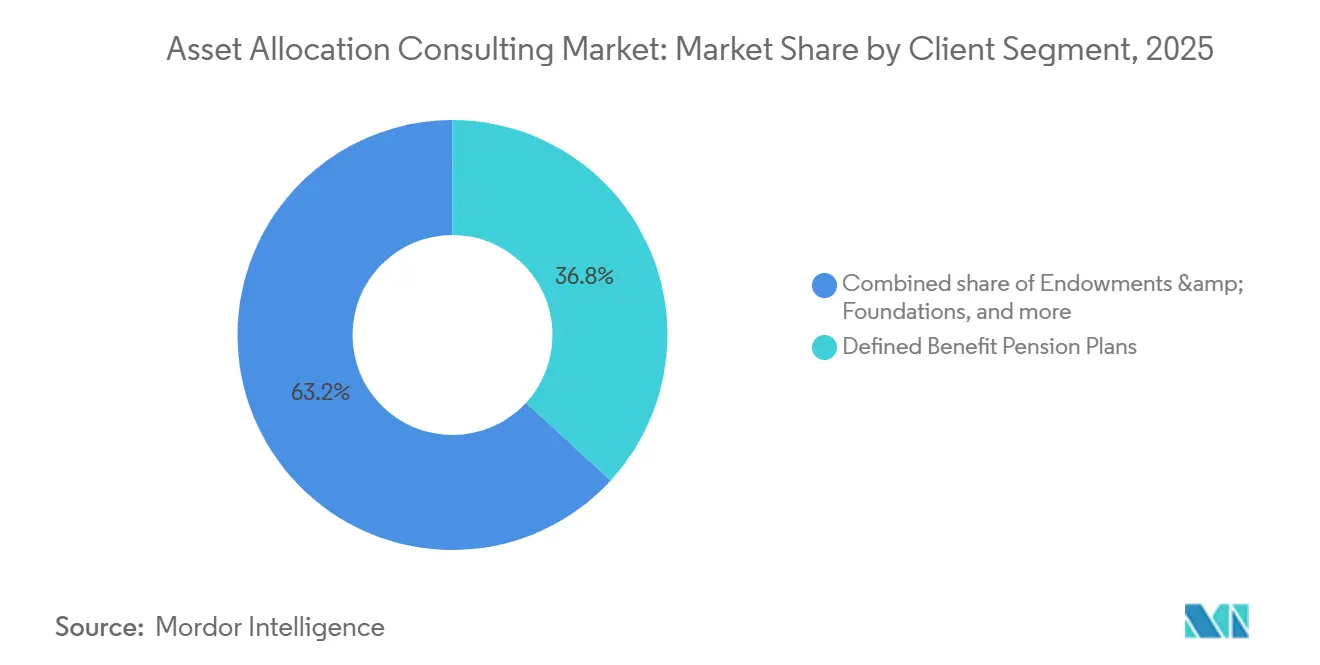
Pension Plans Lead Revenue While Family Offices Lead GrowthDefined benefit pension plans accounted for 36.8% of revenue in 2025 in the asset allocation consulting market, supported by stronger funded status and a broader shift toward governance simplification. Milliman’s 2025 Corporate Pension Funding Study found that 36 companies in the Milliman 100 held a combined surplus of USD 45 billion in frozen United States pension plans, providing sponsors with more room to consider delegation and strategy redesign. Mercer’s 2025 CFO Survey also found that nearly 40% of plan sponsors were operating under a full OCIO model, indicating that outsourced governance is becoming more common for pension oversight. Family offices and ultra-high-net-worth individuals are expanding faster, at a 9.1% CAGR through 2031, as wealth transfers are driving demand for custom allocation structures, tax-aware implementation, and broader use of alternatives. Bank of America projected USD 124 trillion in intergenerational wealth transfers in the United States through 2048, which supports stronger long-term demand for bespoke advice.
Natixis reported in 2026 that Millennial and Gen X heirs showed greater interest in alternatives, private investments, and active strategies than the boomer generation, suggesting a different portfolio mix for inherited wealth. Defined contribution plans are also attracting more attention as private market access expands within retirement structures and governance complexity increases. Endowments, foundations, sovereign wealth funds, and insurers remain important because they need specialized advice tied to funding goals, long-duration liabilities, or state-linked capital deployment. This keeps the client base broad in the asset allocation consulting industry, even though pensions and family offices currently drive the main revenue and growth.
By Asset Class:
Public Markets Anchor Revenue While Alternatives Capture MomentumTraditional Public Markets accounted for 43.9% of the asset allocation consulting market in 2025, reflecting the continued scale of public equity, fixed income, and cash allocations across institutional portfolios. This segment remains central because large investors still use public assets for liquidity, liability matching, and core return generation. Even so, the service mix here is becoming more focused on factor construction, drawdown control, and policy precision than on standard equity and bond splits alone. Alternative and private markets are projected to expand at a 10.3% CAGR through 2031, making it the fastest-growing segment of the full asset allocation consulting market. That pace reflects a deeper reallocation toward assets that require more due diligence, longer pacing schedules, and tighter liquidity and valuation governance.
BlackRock’s 2025 Global Family Office Survey found that alternatives accounted for 42% of family office portfolios, up from 39% in 2022 and 2023, with private credit and infrastructure attracting the strongest forward allocation intent. Mercer and CAIS reported in 2026 that 88% of advisors planned to increase alternative allocations over the next 2 years, marking the fourth straight year of growth intent. Multi-asset and balanced mandates remain an important transition point for clients moving from single-asset relationships toward integrated portfolio oversight. Cash, liquidity, and short-duration mandates also gained more advisory relevance as rate normalization improved available yield and made cash positioning a more active portfolio decision.
Geography Analysis
North America Asset Allocation Consulting Market
North America accounted for 56.4% of the asset allocation consulting market share in 2025, which kept it well ahead of every other region. The region benefits from the largest concentration of pension funds, endowments, foundations, and outsourced investment providers. United States OCIO assets under management exceeded USD 3 trillion in 2025, which shows the scale already reached by delegated investment models. The regional market also benefits from more co-sourced governance models, in which institutions retain strategic control while delegating execution and oversight. That expands the addressable market beyond a simple choice between full OCIO and fully internal management.
Europe Asset Allocation Consulting Market
Europe remained the second-largest regional block in 2025 and continues to be shaped by the United Kingdom fiduciary management market, German corporate pensions, and Dutch liability-driven investing capabilities. The region is also seeing more demand for ESG-integrated allocation work because multiple regulations are changing how institutions classify products, use sustainability data, and manage risk. Amundi described 2026 as a key year for aligning ESG product ranges with investor preferences, which shows how regulation is feeding directly into mandate design and advisory work. Europe therefore remains important in the asset allocation consulting market not only because of asset size, but also because compliance now affects portfolio construction more directly.
APAC, MEA and South America Asset Allocation Consulting Market
Asia-Pacific asset allocation consulting market size is projected to expand at 8.9% CAGR through 2031, making it the fastest-growing region. Growth is being supported by government-linked institutions and family offices, which creates a client mix that differs from the pension-heavy structure seen in North America and parts of Europe. The Business Times reported in 2026 that Singapore, Japan, and India were helping drive stronger outsourced CIO demand across the region. In the Middle East and Africa, sovereign investors are creating demand for both domestic allocation design and international portfolio structuring as capital pools diversify. South America remains a smaller base for the asset allocation consulting market, but advisory activity is gradually rising where pension reform and institutional asset growth are creating a need for broader portfolio restructuring.
Competitive Landscape
The asset allocation consulting market is fragmented, with global investment consulting firms competing alongside numerous regional and specialist advisers. Leading firms such as Mercer, Aon, and Willis Towers Watson (WTW) maintain strong positions through their extensive institutional client bases, global research capabilities, and integrated advisory and implementation services. Competition has increasingly shifted beyond traditional strategic asset allocation towards outsourced CIO (OCIO), delegated investment management, private markets advisory, and portfolio implementation, narrowing the distinction between investment consulting and asset management. Industry consolidation has also accelerated as firms expand their alternatives capabilities, exemplified by Mercer's acquisitions of Cardano and its announced acquisitions of SECOR Asset Management and AltamarCAM's private markets platform.
Technology and data are now shaping competition more directly in the asset allocation consulting market. Firms that can integrate scenario tools, funded-status monitoring, private markets analytics, and implementation workflows into a single service stack are achieving stronger client retention. In March 2026, S&P Global partnered with Cambridge Associates and Mercer to launch standardized private markets performance datasets for private credit and real assets, which shows how data access is becoming part of competitive positioning. This raises the entry threshold for smaller firms because clients increasingly expect both advice and platform support rather than advice alone.
The middle tier faces the greatest pressure because it competes with large firms on breadth and boutiques on specialization. That is especially visible in mandates tied to private markets, tax structuring, or delegated governance, where clients want either full platform capability or deep niche expertise. White space still exists in the USD 500 million to USD 1 billion institutional segment because many organizations are outsourcing or planning to outsource, yet not all providers offer cost structures and service models that fit this segment. Regional players are also responding, as Sumitomo Mitsui Asset Management announced in 2026 enhanced advisory services for asset owners, combining allocation planning, fund selection, and custody into a single solution. This suggests that the asset allocation consulting market will continue to reward firms that combine investment judgment, execution capability, and scalable data infrastructure.
Asset Allocation Consulting Industry Leaders
-
Mercer
-
Aon
-
Willis Towers Watson
-
Cambridge Associates
-
BlackRock, Inc.
- *Disclaimer: Major Players sorted in no particular order
Asset Allocation Consulting Market Companies Covered in this Report
- Mercer
- Aon
- Willis Towers Watson
- Cambridge Associates
- BlackRock, Inc.
- UBS
- J.P. Morgan Asset Management
- State Street Global Advisors
- Fidelity Investments
- Northern Trust Asset Management
- Russell Investments
- Invesco Ltd
- T. Rowe Price Group, Inc.
- Goldman Sachs Asset Management
- PIMCO
- Amundi
- Schroders plc
- Allianz Global Investors
- Neuberger Berman
- Albourne Partners
Recent Industry Developments in Asset Allocation Consulting Market
- April 2026: Sumitomo Mitsui Asset Management (part of SMBC Group, Japan) announced enhanced advisory services for asset owners, combining asset allocation planning, fund selection, and custody under a unified solution, reflecting the acceleration of OCIO-adjacent offerings in the Japanese institutional market.
- March 2026: Mercer agreed to acquire AltamarCAM Partners, a Madrid-based private markets manager with approximately EUR 20 billion (USD 22 billion) in AUM, in a deal expected to close in H2 2026. The acquisition adds secondaries, co-investments, and evergreen vehicle capabilities to Mercer's private markets platform, strengthening its position against asset managers entering the allocation consulting space.
- March 2026: S&P Global, Cambridge Associates, and Mercer jointly launched the S&P Global Private Markets Performance Analytics datasets, providing standardized, cross-fund benchmarking data for private credit and real assets for the first time at an institutional scale. Datasets for private equity will follow later in 2026, and the collaboration signals a move to institutionalize data infrastructure as a competitive moat.
- October 2025: Goldman Sachs Asset Management was appointed by Eli Lilly and Company to manage approximately USD 25 billion in the United States and Puerto Rico retirement plan assets under an OCIO mandate, adding to GSAM's prior USD 40 billion Shell pension mandate in September 2025. GSAM's total OCIO assets under supervision reached approximately USD 450 billion.
Global Asset Allocation Consulting Market Report Scope
Segmentation Overview
| Non-Discretionary Advisory |
| Discretionary Advisory |
| Hybrid |
| Strategic Asset Allocation |
| Tactical Asset Allocation & Rebalancing |
| Liability-Driven Investing (LDI) & Asset-Liability Management (ALM) |
| Multi-Asset & Alternatives Allocation |
| Risk Budgeting, Factor Allocation & Custom Solutions |
| Portfolio Implementation, Oversight & Governance |
| Defined Benefit Pension Plans |
| Defined Contribution / Retirement Savings Plans |
| Endowments & Foundations |
| Sovereign Wealth Funds & Government/Public Sector Entities |
| Insurance Companies |
| Family Offices & Ultra-High-Net-Worth Individuals |
| Wealth Management Platforms & Intermediaries |
| Traditional Public Markets (Public Equity + Fixed Income + Cash) |
| Alternative & Private Markets (Private Equity, Private Debt, Real Estate, Infrastructure, Hedge Funds, etc.) |
| Multi-Asset / Balanced Mandates |
| Cash, Liquidity & Short-Duration Management |
| Other Asset Classes |
| North America | United States |
| Canada | |
| Mexico | |
| South America | Brazil |
| Argentina | |
| Rest of South America | |
| Europe | United Kingdom |
| Germany | |
| France | |
| Italy | |
| Spain | |
| Rest of Europe | |
| Asia-Pacific | India |
| China | |
| Japan | |
| South Korea | |
| Australia | |
| South East Asia (Singapore, Malaysia, Thailand, Indonesia, Vietnam, and Philippines) | |
| Middle East and Africa | United Arab Emirates |
| Saudi Arabia | |
| South Africa | |
| Nigeria | |
| Rest of Middle East and Africa |
| By Engagement Model | Non-Discretionary Advisory | |
| Discretionary Advisory | ||
| Hybrid | ||
| By Core Service | Strategic Asset Allocation | |
| Tactical Asset Allocation & Rebalancing | ||
| Liability-Driven Investing (LDI) & Asset-Liability Management (ALM) | ||
| Multi-Asset & Alternatives Allocation | ||
| Risk Budgeting, Factor Allocation & Custom Solutions | ||
| Portfolio Implementation, Oversight & Governance | ||
| By Client Segment | Defined Benefit Pension Plans | |
| Defined Contribution / Retirement Savings Plans | ||
| Endowments & Foundations | ||
| Sovereign Wealth Funds & Government/Public Sector Entities | ||
| Insurance Companies | ||
| Family Offices & Ultra-High-Net-Worth Individuals | ||
| Wealth Management Platforms & Intermediaries | ||
| By Asset Class | Traditional Public Markets (Public Equity + Fixed Income + Cash) | |
| Alternative & Private Markets (Private Equity, Private Debt, Real Estate, Infrastructure, Hedge Funds, etc.) | ||
| Multi-Asset / Balanced Mandates | ||
| Cash, Liquidity & Short-Duration Management | ||
| Other Asset Classes | ||
| By Geography | North America | United States |
| Canada | ||
| Mexico | ||
| South America | Brazil | |
| Argentina | ||
| Rest of South America | ||
| Europe | United Kingdom | |
| Germany | ||
| France | ||
| Italy | ||
| Spain | ||
| Rest of Europe | ||
| Asia-Pacific | India | |
| China | ||
| Japan | ||
| South Korea | ||
| Australia | ||
| South East Asia (Singapore, Malaysia, Thailand, Indonesia, Vietnam, and Philippines) | ||
| Middle East and Africa | United Arab Emirates | |
| Saudi Arabia | ||
| South Africa | ||
| Nigeria | ||
| Rest of Middle East and Africa | ||
Key Questions Answered in the Report
What is the 2026 value of the asset allocation consulting space?
The asset allocation consulting market stands at USD 12.05 billion in 2026 and is forecast to reach USD 16.72 billion by 2031 at a 6.8% CAGR.
Which engagement model is leading demand?
Discretionary Advisory leads with 47.7% revenue share in 2025 and is also the fastest-growing engagement model at 8.3% CAGR through 2031.
Why are private markets increasing demand for consultants?
Private equity, private credit, infrastructure, and real assets require deeper due diligence, pacing, liquidity planning, and governance, which increases reliance on specialist external advice.
Which client group is growing the fastest?
Family Offices and Ultra-High-Net-Worth Individuals are the fastest-growing client segment, with a projected 9.1% CAGR through 2031.
Which region is expanding the quickest?
Asia-Pacific is the fastest-growing region, with an 8.9% CAGR through 2031, supported by government-linked institutions and family offices.
What is the main competitive shift among providers?
Competition is moving toward firms that combine consulting, discretionary execution, private markets capability, and data infrastructure rather than firms offering only traditional advisory work.