
Market Overview
| Study Period | 2020 - 2031 |
|---|---|
| Forecast Data Period | 2026 - 2031 |
| Base Year Market Size (2025) | USD 44.92 Trillion |
| Market Size (2026) | USD 46.87 Trillion |
| Market Size (2031) | USD 58.02 Trillion |
| Growth Rate (2026 - 2031) | 4.35 % |
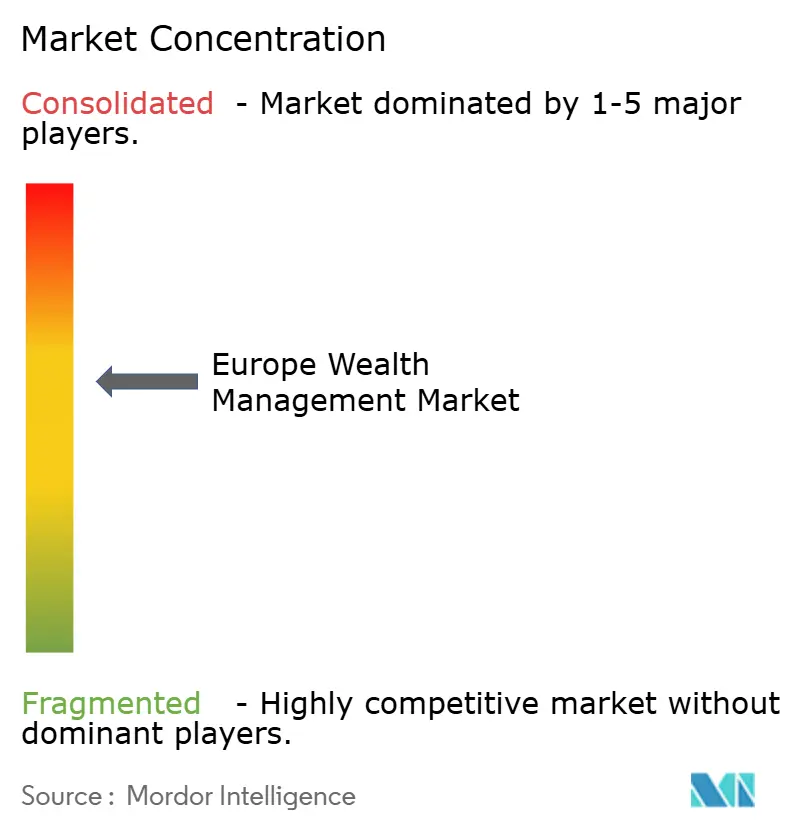
| Market Concentration | Medium |
Major Players *Disclaimer: Major Players sorted in no particular order Image © Mordor Intelligence. Reuse requires attribution under CC BY 4.0. | |
Europe Wealth Management Market Analysis by Mordor Intelligence
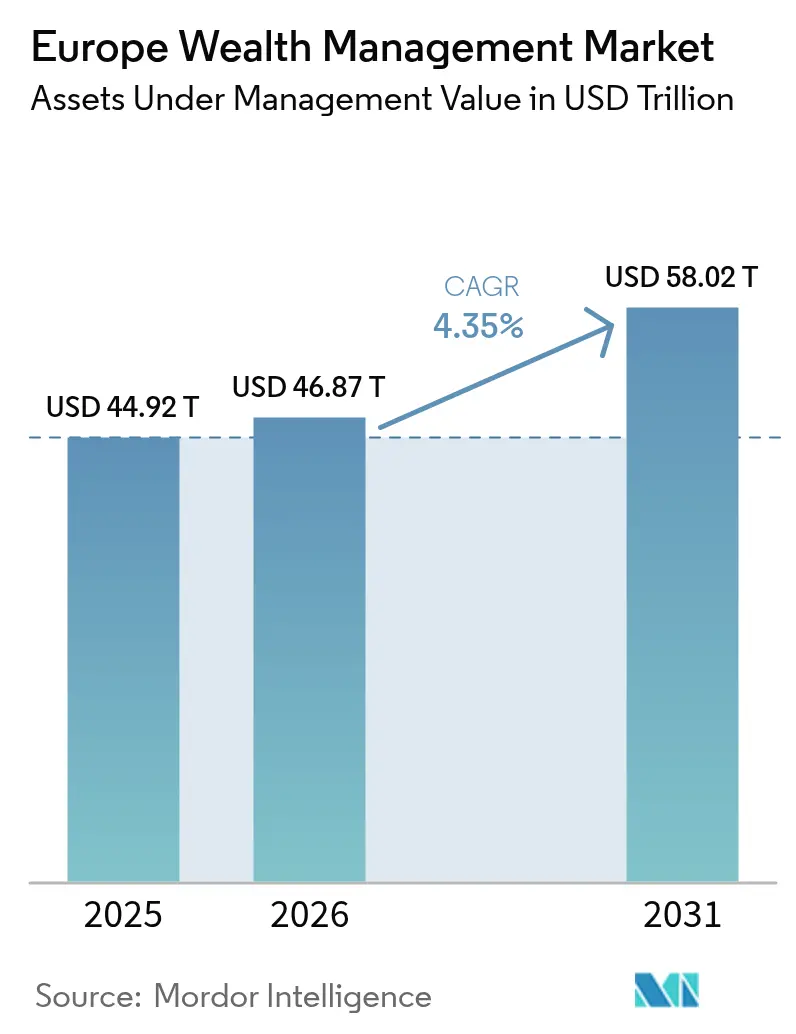
The Europe wealth management market size is expected to grow from USD 44.92 trillion in 2025 to USD 46.87 trillion in 2026 and is forecast to reach USD 58.02 trillion by 2031 at 4.35% CAGR over 2026-2031. This growth path positions the European wealth management market as the financial backbone of the continent’s push toward a deeper Capital Markets Union, with wealth managers increasingly functioning as conduits that redirect household savings into long-term capital‐market instruments [1]European Central Bank, “Household Sector Report,” ecb.europa.eu. Strong demand for ESG-aligned portfolios, accelerated shifts into technology-enabled advisory models, and the full rollout of the Markets in Crypto-Assets (MiCA) framework are reshaping product suites, operating cost structures, and competitive dynamics. Regulatory harmonization, especially under the Sustainable Finance Disclosure Regulation (SFDR) and the Distributed Ledger Technology (DLT) pilot, is encouraging product innovation while simultaneously pushing smaller players toward consolidation as compliance costs rise. Household cash deposits of EUR 13.9 trillion remain a vast pool of under-allocated capital that wealth managers aim to migrate into investment products through open-finance capabilities. Operating margins, however, face pressure from MiFID II fee transparency, an aging advisor workforce, and higher cybersecurity spending tied to the Digital Operational Resilience Act (DORA).
Key Report Takeaways
- By client wealth tier, high-net-worth individuals commanded 58.42% of Europe's wealth management market share in 2025, while the ultra-high-net-worth cohort is projected to grow at 6.98% CAGR to 2031.
- By mode of advisory, human advice retained an 85.47% share of the European wealth management market size in 2025, whereas robo-advisory solutions are advancing at a 15.42% CAGR through 2031.
- By firm type, private banks led with a 53.11% share of the European wealth management market in 2025; family offices are forecasted to expand at a 6.45% CAGR through 2031.
- By product group, equities held 36.62% of the European wealth management market size in 2025, yet alternative investments are expected to post the strongest 6.89% CAGR to 2031.
- By management source, onshore accounted for 75.21% of the European wealth management size in 2025 and are expected to expand at a 6.73% CAGR through 2031.
- By geography, the United Kingdom accounted for 21.32% of the European wealth management market in 2025, while Spain is on track to register the highest 5.74% CAGR to 2031.
Note: Market size and forecast figures in this report are generated using Mordor Intelligence’s proprietary estimation framework, updated with the latest available data and insights as of 2026.
Europe Wealth Management Market Trends and Insights
Drivers Impact Analysis*
| Driver | (~) % Impact on CAGR Forecast | Geographic Relevance | Impact Timeline |
|---|---|---|---|
| Rebound in European HNWI AUM post-2024 | +0.8% | UK, Germany, France | Short term (≤ 2 years) |
| EUR 1.6 trillion Great Wealth Transfer | +1.2% | Western Europe, Nordics | Medium term (2-4 years) |
| Hybrid & robo-advisory cost reductions | +0.6% | Germany, France, Nordics | Medium term (2-4 years) |
| EU DLT-pilot tokenized private-market access | +0.4% | Luxembourg, Netherlands, Germany | Long term (≥ 4 years) |
| SFDR Level-2 premium ESG fee pools | +0.7% | EU-wide, strongest in Germany, France | Short term (≤ 2 years) |
| EUR 14 trillion cash deposit migration | +0.9% | Euro-area, led by Germany, France | Medium term (2-4 years) |
| Source: Mordor Intelligence | |||
Rebound in European HNWI AUM post-2024
Net new money inflows rebounded in 2024 as improving fixed-income yields and stabilizing equity markets restored client confidence, lifting fee income and freeing capital for technology upgrades. Higher asset values particularly benefit private banks and family offices because concentrated portfolios naturally carry higher advisory margins. This momentum is allowing firms to accelerate hiring in tax planning, succession, and alternative-investment teams, thereby strengthening client retention. Active management regained traction after underperformance in 2022-2023, reversing fee compression caused by passive funds. The durability of this rebound will depend on moderate inflation, stable interest-rate expectations, and disciplined cost control across front-office and compliance functions.
EUR 1.6 trillion Great Wealth Transfer to Millennials & Women by 2030
Europe’s intergenerational transfer is reshaping service models as beneficiaries demand digital-first engagement, ESG integration, and direct investment opportunities[2]Henley & Partners, “Global Wealth Migration Report 2025,” henleyglobal.com. Wealth managers who deploy educational content and transparent fee frameworks are already improving the retention of next-generation heirs. Female inheritors, who receive a rising share of the transferred assets, are placing a higher value on planning clarity, catalyzing the launch of women-led advisory teams. Incumbent firms face elevated churn risk—millennials switch providers more readily—yet that risk unlocks acquisition opportunities for agile competitors offering personalized impact-oriented portfolios. To capture the flow, providers are widening their multi-family-office offerings and deepening digital engagement so that heirs can toggle between human advice and self-directed tools without friction.
Hybrid & Robo-Advisory Adoption Cuts Advice Costs 30–50%
Hybrid architectures that marry automated portfolio algorithms with human oversight are now firmly established in Germany and France, producing 30-50% cost savings versus purely human models. Robo engines handle portfolio drift checks, risk scoring, and rebalancing triggers, elevating service consistency and freeing relationship managers to focus on tax and estate complexities. Client acceptance has risen sharply because intuitive mobile dashboards demystify portfolio performance and fee breakdowns. Mass-affluent households gain institutional-grade diversification for far lower minimums, expanding the total addressable market. Implementation success hinges on robust data integration between core banking platforms and front-office portals so that advisors can convert automated insights into actionable recommendations during client meetings.
EU DLT-Pilot Regime Spurs Tokenized Private-Market Access
Luxembourg and the Netherlands are spearheading tokenized fund launches that fractionalize private equity and infrastructure stakes, letting high-net-worth clients gain exposure with ticket sizes as low as EUR 10,000[3]EY Luxembourg, “DLT Pilot Regime Readiness,” ey.com. Blockchain-based issuances improve settlement speed and secondary liquidity, addressing traditional illiquidity concerns. Early movers are packaging multi-strategy vintages that combine European mid-market buyouts, real estate, and renewables into tokenized share classes. Wealth managers earn structuring fees plus ongoing administration income, counterbalancing margin pressure in core portfolios. Adoption remains contingent on client education and vendor interoperability, but the regulatory sandbox has removed legal uncertainty that previously deterred large custodians.
Restraints Impact Analysis*
| Restraint | (~) % Impact on CAGR Forecast | Geographic Relevance | Impact Timeline |
|---|---|---|---|
| Fee-compression from MiFID II & passives | −0.9% | EU-wide, strongest in Germany, France | Short term (≤ 2 years) |
| Relationship-manager talent shortage | −0.6% | UK, Germany, Switzerland | Medium term (2-4 years) |
| Regulatory grey zones under MiCA | −0.3% | EU-wide, varying national rollout | Short term (≤ 2 years) |
| Escalating cyber & AI-model risk compliance | −0.5% | Global, highest in systemically important institutions | Long term (≥ 4 years) |
| Source: Mordor Intelligence | |||
Fee-Compression from MiFID II & Passives
MiFID II’s granular cost disclosures have heightened client sensitivity to advisory charges, while the surge in low-cost ETFs has eroded active-management fee headroom. Research-bundling prohibitions force wealth managers to fund analyst coverage independently, squeezing margins. Private banks counter by spotlighting tax optimization, succession planning, and access to private-market deals that ETFs cannot replicate, but these services demand higher advisor skill sets and digital tooling. Price transparency also limits cross-selling of non-portfolio banking products, tightening overall wallet share. Consequently, firms are migrating from traditional asset-based fees toward blended retainers linked to planning complexity and outcome metrics.
Relationship-Manager Talent Shortage & Ageing Advisor Base
More than 30% of European relationship managers are expected to retire within five years, yet graduate pipelines remain thin as younger professionals gravitate toward fintech roles with faster equity upside. The resulting talent gap jeopardizes the continuity of high-touch client relationships that underpin loyalty and referral flows. Wealth managers are deploying mentorship programs and accelerated certification tracks, but visa restrictions and international mobility hurdles complicate cross-border hiring. Compensation inflation further compresses profitability, especially within mid-tier Swiss banks that face head-to-head competition with London boutiques. Firms increasingly invest in digital self-service portals to relieve advisors of routine tasks, yet many clients still insist on personal counsel for complex decisions.
*Our forecasts treat driver/restraint impacts as directional, not additive. The impact forecasts reflect baseline growth, mix effects, and variable interactions.
Segment Analysis
By Client Wealth Tier: UHNWI Growth Outpaces Mass Market
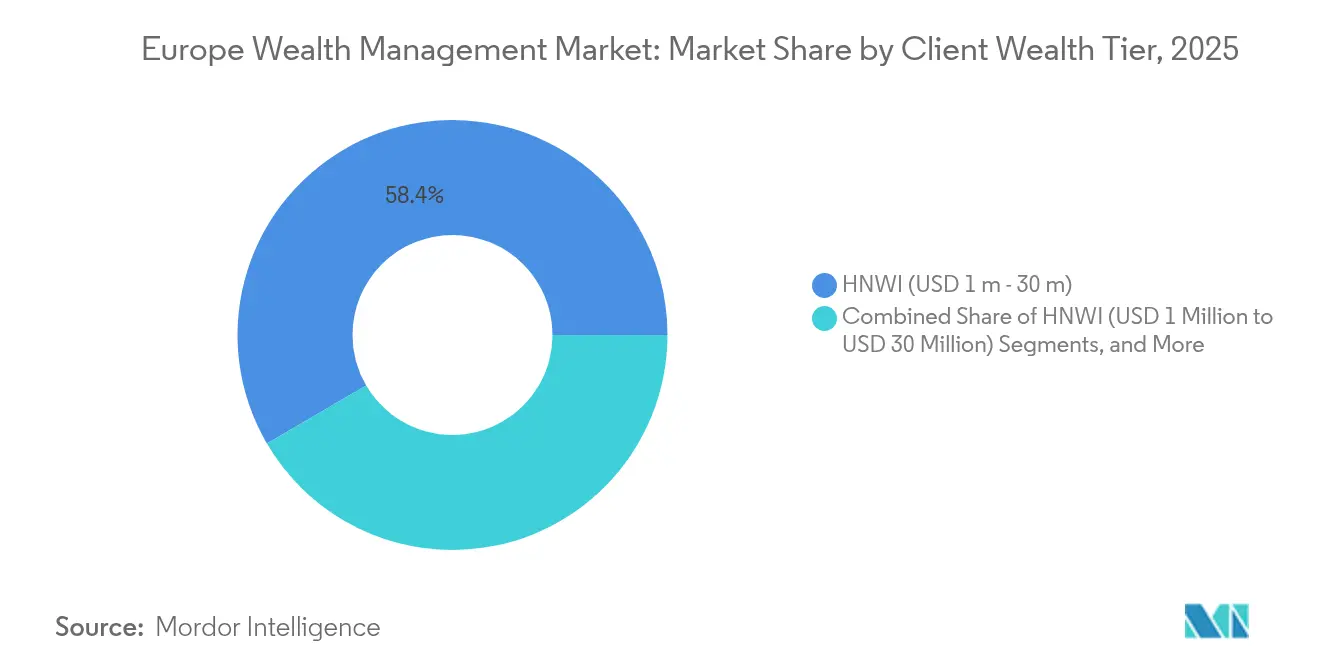
In 2025, high-net-worth individuals captured 58.42% of Europe's wealth management market share, reflecting a broad base of professionals and entrepreneurs benefiting from the post-pandemic recovery. The ultra-high-net-worth segment holds the fastest trajectory at a 6.98% CAGR, propelled by liquidity events in technology, healthcare, and renewable infrastructure ventures. The European wealth management market size linked to UHNWI clients is expected to climb steadily as their demand for bespoke direct investments and philanthropy structures boosts advisory revenue density. Wealth concentration favors private banks and multi-family offices that supply customized lending and co-investment opportunities.
UHNWI clients exhibit a higher willingness to pay for multi-jurisdictional estate plans, impact investing vehicles, and private-equity co-investment gates unavailable to retail investors. Family offices are leveraging that demand by extending in-house deal origination desks. Mass-affluent households, by contrast, remain price sensitive and gravitate toward robo platforms that parcel diversified model portfolios at sub-50-basis-point fees. Successful providers, therefore, tier their service stack: algorithmic allocation for mass-affluent clients, hybrid advice for the upper affluent, and specialist verticals for UHNWI families.



By Mode of Advisory: Digital Transformation Accelerates
Human advisers still commanded 85.47% of the European wealth management market size in 2025, but robo engines are amplifying reach among younger investors who favor transparent fee grids and mobile engagement. The segment’s 15.42% CAGR underscores persistent demand for low-cost automation complemented by selective human touchpoints. The European wealth management market continues to integrate hybrid models that embed automated tax-loss harvesting and ESG scoring while reserving relationship managers for complex credit, philanthropy, and inheritance tasks.
Pure robo players struggle with client acquisition costs, pushing them toward B2B partnerships with incumbent banks that white-label portfolios. Meanwhile, incumbent private banks retrofit legacy architectures with open-API layers, enabling advisors to generate on-demand proposals during virtual sessions. The migration toward hybrid advice lowers operating costs by trimming routine portfolio rebalancing workflows and reallocating human capital toward higher-margin strategic conversations.
By Firm Type: Family Offices Challenge Traditional Models
Private banks retained 53.11% share of the European wealth management market in 2025, leveraging broad product shelves and regulatory expertise. Yet family offices are projected to expand at a 6.45% CAGR as wealth creators seek direct control over governance, asset allocation, and philanthropic mandates. The European wealth management market size booked through single- and multi-family offices is projected to rise sharply because these entities can underwrite co-investments and club deals without intermediation fees.
Independent asset managers also gain traction by aligning remuneration to performance hurdles rather than asset-based fees, resonating with price-conscious heirs. Private banks counter by establishing dedicated family-advisory units that bundle concierge services, thematic impact portfolios, and succession consultants. Regulatory capital rules, however, restrict the flexibility of bank-owned product manufacturing, leaving room for non-bank firms to differentiate.
By Product Type: Alternatives Drive Premium Growth
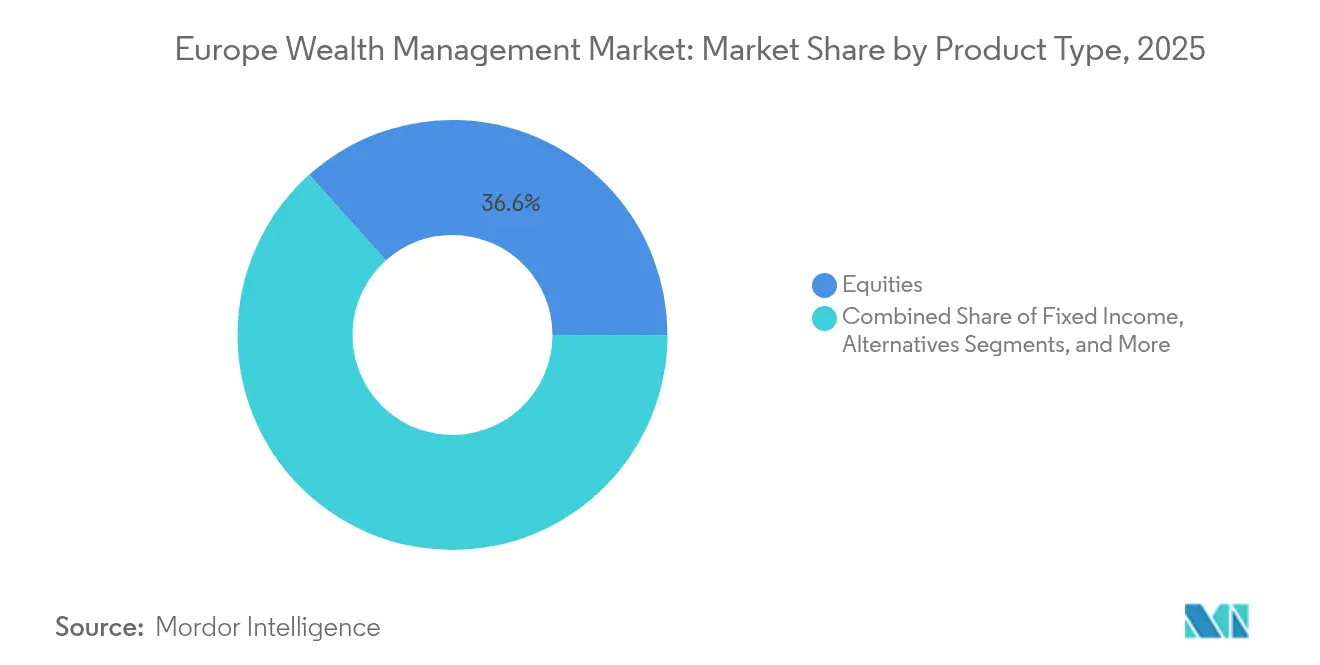
Equities accounted for 36.62% share of the European wealth management market in 2025 on the back of a strong post-pandemic rally, yet alternative investments show the greatest upside with a 6.89% CAGR to 2031. The European wealth management market size attributed to real estate, private credit, and infrastructure vehicles is rising as clients pursue inflation protection and uncorrelated returns. Tokenization under the EU DLT pilot reduces the minimum ticket for such strategies, broadening access among upper-affluent investors.
Private-market allocations earn higher advisory and performance fees, insulating providers from MiFID-II price compression. Hedge-fund interest is resurging as rate volatility fuels macro and relative-value strategies. Cash allocations are receding as open banking nudges households into higher-yielding instruments. Within traditional fixed income, duration-barbell approaches attract flows, exploiting diverging central-bank policy paths across the euro area and the UK.
By Management Source: Onshore Dominance Reflects Regulatory Trends
Onshore segment held 75.21% share of the European wealth management market in 2025 and exhibits a 6.73% CAGR outlook. The European wealth management market’s shift toward onshore booking is driven by automatic exchange-of-information (AEOI) treaties and tighter anti-money-laundering scrutiny that erode offshore secrecy advantages. Luxembourg and Ireland thrive as “regulated onshore hubs” combining EU passporting certainty with efficient tax treaty networks.
Offshore strongholds such as the Channel Islands respond by emphasizing substance requirements, fiduciary expertise, and bespoke trustee services. Wealth managers now pitch onshore structures as risk mitigants that shield families from reputational harm while preserving planning flexibility. Cross-border advisers must therefore master a patchwork of tax regimes and reporting standards without compromising operational scalability.
By Country: Spain Emerges as Growth Leader
The United Kingdom remains the largest single market with a 21.32% share of the European wealth management market in 2025, thanks to London’s legal system, capital-market depth, and global connectivity, even as outbound millionaire migration picks up. Spain’s 5.74% CAGR through 2031 is powered by advantageous non-resident tax regimes and residency pathways that lure mobile wealth from Northern Europe. Meanwhile, Germany and France provide stable fee pools anchored in entrenched private-banking relationships and robust domestic wealth creation.
Benelux jurisdictions ride on Luxembourg’s fund-servicing ecosystem, capturing cross-border mandates from multinational families. Nordic markets extend leadership in ESG adoption, aligning with regional sustainability values and advanced digital infrastructure. Southern European nations such as Portugal and Greece are accelerating via “Golden Visa” programs and favorable flat-tax regimes for new residents, contributing incremental asset inflows without displacing established hubs.
Geography Analysis
The United Kingdom, with a 21.32% share in 2025, remains the nucleus of the European wealth management market despite heightened wealth-tax discussions and ongoing post-Brexit regulatory adjustments. London’s professional-services cluster, liquid capital markets, and deep talent bench sustain international mandates, but firms are bolstering booking centers in Dublin and Luxembourg to mitigate equivalence risk. A net outflow of 16,500 millionaires projected for 2025 intensifies competition for domestic assets, prompting incumbent banks to enhance digital onboarding, cross-border lending, and non-domiciled tax planning support to protect revenue.
Germany displays resilient organic wealth creation via its Mittelstand exporters, generating steady fee income from family-owned enterprises seeking succession solutions. Local institutions leverage strong brand trust to expand ESG-labelled discretionary mandates, while global banks invest in Frankfurt desks that specialize in cross-border philanthropic structures. France offers similar characteristics but contends with higher wealth taxation, driving affluent residents to diversify booking centers within the EU. Domestic policy stability nonetheless underpins a large captive base for discretionary portfolio management and life-insurance wrappers.
Spain records the region’s fastest pace at 5.74% CAGR as favorable Beckham-law tax treatment and lifestyle advantages attract Northern European retirees and digital nomads. This inflow supports real-estate backed lending and bespoke visa advisory services that augment traditional portfolio fees. Luxembourg and the Netherlands consolidate their positions as structuring hubs, processing pan-European fund vehicles that feed into private-bank platforms. Nordic countries harness long-standing digital identity frameworks to roll out fully remote wealth-advisory journeys, catering to sustainability-focused households. Italy, Portugal, and Greece round out the opportunity set with investor-visa incentives and incremental liberalization of capital markets regimes.
Regulatory Landscape
EU wealth management operations continue to be shaped by cross-border supervisory convergence and product-governance requirements spanning MiFID II fee transparency, SFDR sustainability disclosures, and the rollout of MiCA for crypto-asset activities. In 2026, the European Commission advanced its Savings and Investments Union (SIU) agenda with market-integration and supervision proposals presented in March 2026, followed by an April 2026 progress update calling for Member State action. The sequence reinforces the policy direction to channel household savings into capital markets while reducing fragmentation for firms distributing products across jurisdictions.
A key operational change in 2026 is the implementation of the EU liquidity-management-tool framework for funds used widely in discretionary mandates. Commission Delegated Regulation (EU) 2026/465 (adopted 17 November 2025) starts applying from 16 April 2026, specifying the characteristics of liquidity management tools for UCITS and open-ended AIFs and setting out a transition window (until 16 April 2027 for AIFs constituted before 16 April 2026). ESMA has also issued work program and guidance related to liquidity management tools, which raises expectations around fund governance, reporting readiness, and the ability of platforms and custodians to support LMT selection, activation, and investor communication workflows.
Value Chain Analysis
The European wealth management value chain begins with client acquisition and onboarding (KYC/AML, suitability and risk profiling), moves through advice and portfolio construction (model portfolios, discretionary mandates, and bespoke mandates), and then into product manufacturing and packaging across funds, structured products, and alternatives. Execution and custody typically sit with banking groups and global custodians, while fund administration, transfer agency, and cross-border fund domiciliation concentrate in hubs such as Luxembourg and Ireland. These locations host significant shares of global fund assets and support EU passporting for distribution into multiple markets.
Distribution remains bank-led, with banks and insurers acting as primary channels for fund distribution across Europe. External asset managers, family offices, and robo or hybrid platforms are increasingly competing through fee transparency and digital journeys. Core enabling layers include market data and index providers, ESG data and reporting vendors to meet SFDR requirements, and regtech and cybersecurity providers aligned to rising operational resilience requirements. Bottlenecks persist around fragmented national rules for product distribution and tax, integration of legacy core banking platforms with open-API front ends, and the cost of compliance, which has reinforced consolidation moves among sub-scale private banks and specialist managers seeking scale in technology, legal, and risk functions.
Competitive Landscape
Europe’s wealth arena shows moderate concentration: the top five banking groups hold significant shares of assets, leaving scope for niche challengers. Recent megadeals, such as UBS’s integration of Credit Suisse and BNP Paribas’s purchase of HSBC’s German private-bank operations, demonstrate how scale economies in compliance and technology are becoming decisive. Integration agendas focus on harmonizing core banking systems, rationalizing overlapping booking centers, and extracting procurement savings. The European wealth management market, therefore, rewards organizations capable of rapid post-merger tech migration and culturally sensitive client communications.
Technology investment has moved from differentiator to baseline requirement: 74% of firms raised digital budgets during 2024 to comply with SFDR data capture, MiCA reporting, and DORA stress-testing mandates. ESG data aggregation, AI-driven client-risk profiling, and conversational banking bots constitute the most prevalent initiatives. However, each advancement raises cyber-threat exposure, compelling parallel growth in security spending that eats into efficiency gains. Mid-tier private banks lacking economies of scale in tech procurement are now prime targets for consolidation.
Family offices, external asset managers, and fintech robo advisers intensify competition by offering fee-transparent models and access to club deals. Large incumbents respond with semi-open architecture platforms that welcome third-party specialist funds while retaining core custody, lending, and treasury flows in-house. White-space opportunities persist around tokenized private-asset distribution, intergenerational wealth-transfer coaching, and ESG impact verification. Firms that master these capabilities, while preserving the human relationship element that underpins trust, stand to gain share as the market expands.
Europe Wealth Management Industry Leaders
UBS Group AG
JPMorgan Chase & Co.
BNP Paribas Wealth Management
HSBC Holdings
Allianz SE
- *Disclaimer: Major Players sorted in no particular order

Market Opportunities and Future Outlook
Product and platform whitespace is opening around private markets access and portfolio reporting, particularly as wealth managers expand alternatives for HNWI and UHNWI clients and seek better transparency across complex holdings. A concrete proof point is UBS and MSCI announcing a strategic partnership in July 2026 to standardize and increase transparency in private markets, with UBS positioned as an early adopter of the platform. The announcement points to demand for more industrialized data and analytics across private assets that sit alongside traditional discretionary portfolios.
Distribution and operating-model opportunities are increasingly tied to regulatory and supervisory initiatives that push standardization across Europe while raising the bar for governance and resilience. The SIU program (European Commission, March to April 2026 updates) reinforces the focus on deeper capital-markets participation by retail savers. The liquidity-management-tools framework applying from 16 April 2026 under Delegated Regulation (EU) 2026/465 also requires platform, product, and client-communication readiness for UCITS and open-ended AIFs used in wealth portfolios. Separately, WealthTech activity provides a route for incumbents to partner or acquire capability: Q1 2026 recorded 47 WealthTech deals (up 27% from Q1 2025), with the UK accounting for 43% of total deals. That deal mix supports ongoing investment in hybrid advisory tooling, onboarding automation, and advisor productivity layers aimed at offsetting fee pressure and relationship-manager capacity constraints.
Recent Industry Developments
- July 2026: UBS and MSCI announced a strategic partnership focused on standardizing and improving transparency in private markets, with UBS positioned as an early adopter of the new platform. The move strengthens private-asset reporting and analytics capabilities that have become central to HNWI and UHNWI portfolio construction. It also raises the competitive bar for peers that rely on fragmented private markets data across custody, fund admin, and GP reporting.
- March 2026: BNP Paribas Wealth Management completed the acquisition of HSBC's private banking activities in Germany, expanding its local scale to more than EUR 40 billion of assets under management. The transaction deepens coverage of German entrepreneurs and family-owned businesses and adds capacity for cross-selling discretionary mandates, alternatives, and lending. It also reinforces consolidation dynamics as firms seek larger operating platforms to absorb technology and compliance costs.
- November 2024: Swiss private banks Gonet & Cie and ONE Swiss Bank announced a merger to create a combined group managing around CHF 12 billion in assets, subject to FINMA clearance. The deal reflects continued pressure on smaller wealth managers to gain scale in regulatory compliance, cybersecurity, and client-service technology. It also supports broader industry consolidation as boutiques combine to protect profitability under fee transparency and rising operational requirements.


Research Methodology Framework and Report Scope
Market Definition and Coverage
For this study, the Europe wealth management market is measured as total client assets under management that are actively serviced through advisory or discretionary mandates by wealth managers in Europe, and it covers bank-led and non-bank wealth managers across major client wealth brackets.
Scope exclusions: Corporate treasury pools and institutional-only pension mandates are excluded from the total.
Segmentation Overview
- By Client Wealth Tier
- UHNWI (More than USD 30 Million)
- HNWI (USD 1 Million to USD 30 Million)
- Mass Affluent (Less than USD 1 Million)
- By Mode of Advisory
- Human Advisory
- Robo-Advisory
- By Firm Type
- Private Banks
- Family Offices
- Others (Independent/External Asset Managers)
- By Product Type
- Fixed Income
- Equities
- Alternatives
- Cash and Deposits
- Others
- By Management Source
- Offshore
- Onshore
- By Country
- United Kingdom
- Germany
- France
- Spain
- Italy
- Benelux (Belgium, Netherlands, and Luxembourg)
- Nordics (Sweden, Norway, Denmark, Finland, and Iceland)
- Rest of Europe
Data Sources, Market Sizing, and Validation
Desk Research
Desk work started with building a clean fact base on investable assets and household wealth across Europe, then mapping how much of that pool typically sits in advised or discretionary formats. Public sources that anchored inputs included Eurostat datasets, the European Central Bank statistical data warehouse, the World Bank indicators, the OECD household finance series, and national financial regulator publications such as periodic market supervision reports.
We also reviewed annual reports, investor presentations, and regulatory filings of wealth managers and large banking groups to understand disclosed AUM splits, client mix, and fee model direction. In parallel, a paid subscription for company financials and news was used selectively to speed up comparable-company checks and track major AUM moves around market events. The desk sources listed here are illustrative only, and many other public sources were reviewed to collect, validate, and clarify inputs.
Primary Interviews and Surveys
Fieldwork covers wealth managers, private banking professionals, family office advisers, investment specialists, and distribution leaders within Europe. Interviews and surveys clarify asset coverage, advisory adoption, product demand, fee direction, and country-level assumptions that public data cannot fully explain. Re-contact is used when responses conflict with market indicators or the modeled total.
Distribution of primary research fieldwork respondents
| Company type | Respondent position |
|---|---|
| Top tier: 28% | CXOs: 18% |
| Mid tier: 47% | Functional/Unit leaders: 31% |
| Smaller Players: 25% | Managers: 51% |
Market-Sizing & Forecasting
Sizing was built from a top-down demand pool using household financial assets and investable wealth indicators to reconstruct the addressable AUM by country that typically sits under wealth management mandates. The model then applies market-specific take-up rates for advised relationships and the discretionary share of AUM, and it incorporates the effect of cross-border booking centers before rolling up to the Europe total.
To keep the result grounded, we corroborated totals with selective bottom-up approximations based on sampled AUM disclosures, country level provider mixes, and reasonableness checks on implied AUM per relationship manager where that signal was available from interviews. Key inputs tracked included equity and bond market levels, net new money trends, household savings rates, changes in policy rates that affect deposit retention, and the growth of digital advisory penetration. Forecasts use scenario analysis supported by expert views on market returns and net flows, and gaps in provider disclosures are handled through conservative ranges that are later tightened during interview validation.
Data Validation & Update Cycle
Model outputs are checked against independent signals such as household balance sheet direction, broad AUM disclosures from large institutions, and country level wealth trends that should move in the same direction. When large variances show up, assumptions are re-tested, and follow-up calls are triggered to confirm whether the difference is driven by market moves, client re-risking, or changes in mandate type.
Before sign-off, a second analyst reviews the full chain from inputs to totals, and outliers are documented with the reason for keeping or adjusting them. Reports are refreshed annually, and interim updates are made when material events shift returns, net flows, or currency assumptions. Right before delivery, a final review pass is completed so clients receive the most current view available.
Mordor Intelligence's Europe Wealth Management Market Sizing Compared With Other Published Estimates
Published market sizes for Europe wealth management can look far apart because some sources measure revenue pools while others measure assets under management, and because the country list and booking treatment differ in small but important ways. Timing also matters, since a market tied to traded-asset values can change quickly with currency moves and broad market returns.
A common gap driver is whether the estimate counts only advised and discretionary mandates, or if it also folds in institutional-only pools and corporate balances that sit with the same financial groups. Another driver is geography, where some publishers use EU-only coverage, while others add major non-EU hubs and offshore flows without clearly separating them. The spread below is mainly explained by keeping the total limited to actively serviced AUM across 27 EU states plus the UK, Norway, Switzerland, and Iceland, and by excluding institutional-only pension mandates and corporate treasury pools, a scope choice applied by Mordor Intelligence.
Benchmark comparison
| Source | Market Size | Gaps in Research Methodology |
|---|---|---|
| Mordor Intelligence | USD 44.92 T (2025) | |
| Regional Consultancy A | USD 40.10 T (2025) | Uses a narrower Europe definition that appears closer to EU-only coverage, and it applies more conservative cross-border booking assumptions, which lowers the implied AUM pool. |
| Industry Association B | USD 49.60 T (2025) | Blends institutional pools and broader managed assets into the total, and it does not clearly separate corporate and pension-only mandates from wealth-client advised AUM. |
When the market is anchored to a defined investable-asset pool and filtered through clear mandate rules, the resulting size becomes easier to reproduce and stress-test. The comparison shows that most differences come from what is counted as wealth AUM and which European countries and booking flows are included, so keeping those decisions explicit helps users interpret the numbers correctly.


Key Questions Answered in the Report
What is the current size of the Europe wealth management market?
The market stands at USD 46.87 trillion in 2026 and is projected to reach USD 58.02 trillion by 2031.
Which client segment is expanding fastest?
Ultra-high-net-worth individuals segment is projected to grow at a 6.98% CAGR through 2031, outpacing all other wealth tiers.
How quickly are robo-advisory platforms scaling in Europe?
Robo solutions are advancing at a 15.42% CAGR as hybrid models cut advisory costs by up to 50%.
Why is Spain the fastest-growing European market?
Competitive tax regimes and residency incentives are drawing high-net-worth migrants, driving a 5.74% CAGR through 2031.
What regulatory changes most influence product innovation?
The SFDR Level-2 rules and the EU DLT-pilot regime are spurring growth in ESG-labelled funds and tokenized private-market offerings.
How are compliance costs affecting smaller firms?
DORA and MiCA requirements raise cybersecurity and reporting spend, pushing sub-scale boutiques toward consolidation or strategic partnerships.
Page last updated on:


 Your data is secure and never sold or shared.


