
Germany Renewable Gas Waste Feedstock Management Market Size and Share
Market Overview
| Study Period | 2020 - 2031 |
|---|---|
| Forecast Data Period | 2026 - 2031 |
| Base Year Market Size (2025) | USD 1.73 Billion |
| Market Size (2026) | USD 1.84 Billion |
| Market Size (2031) | USD 2.58 Billion |
| Growth Rate (2026 - 2031) | 6.99 % |
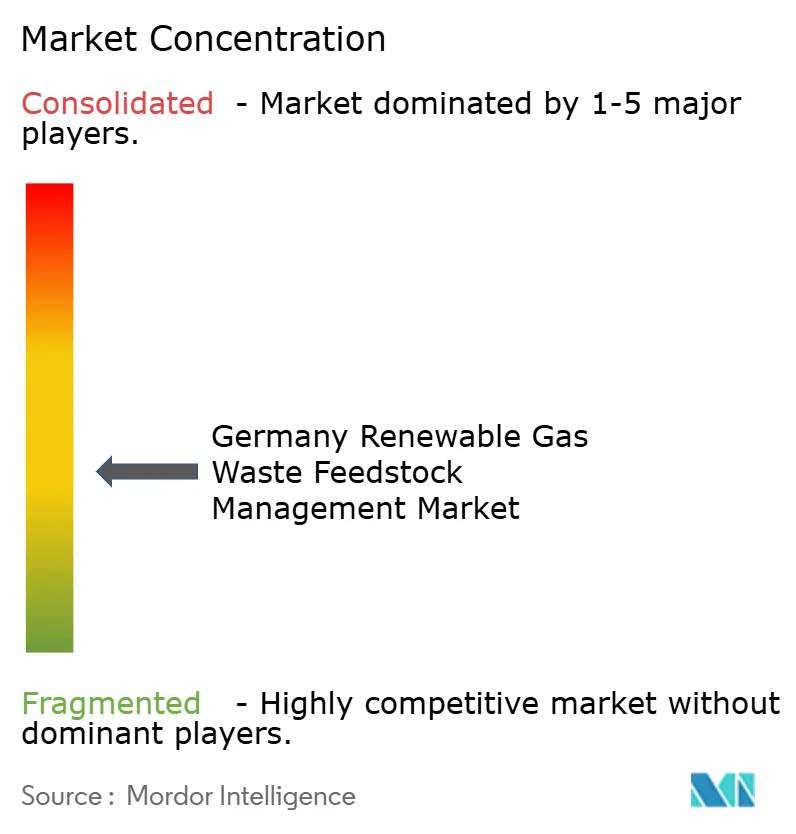
| Market Concentration | Medium |
Major Players *Disclaimer: Major Players sorted in no particular order Image © Mordor Intelligence. Reuse requires attribution under CC BY 4.0. | |
Germany Renewable Gas Waste Feedstock Management Market Analysis by Mordor Intelligence
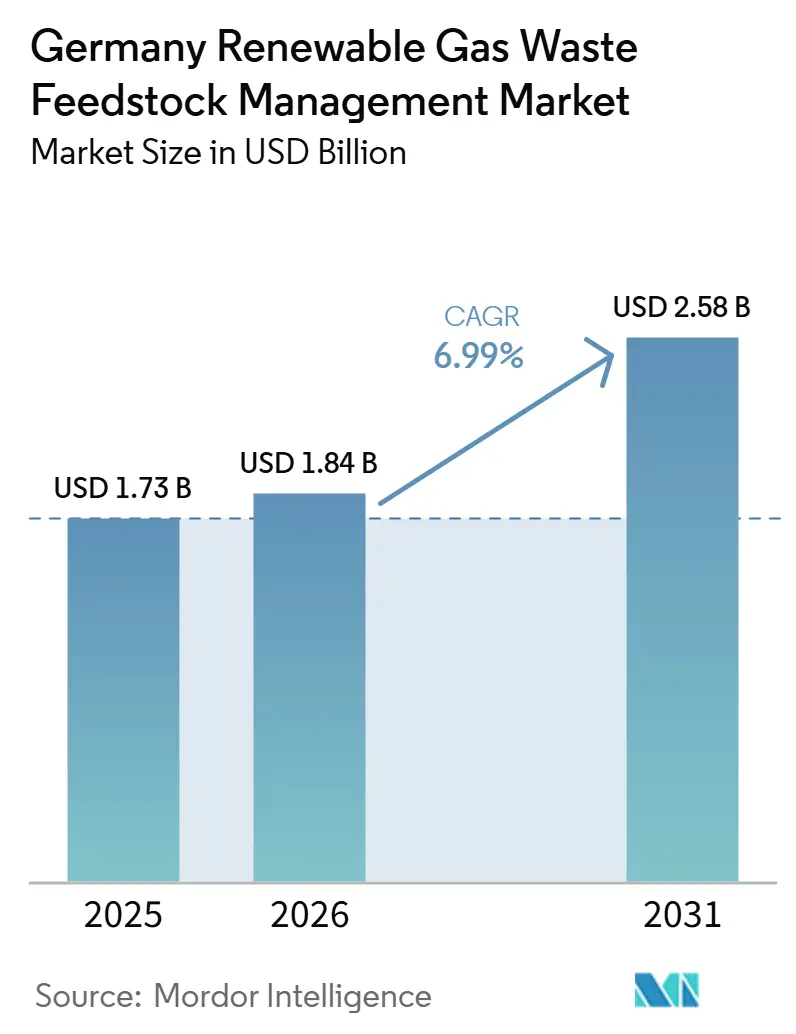
The Germany Renewable Gas Waste Feedstock Management Market size is expected to increase from USD 1.73 billion in 2025 to USD 1.84 billion in 2026 and reach USD 2.58 billion by 2031, growing at a CAGR of 6.99% over 2026-2031.
Germany has one of Europe's largest renewable gas industries, providing a strong foundation for renewable gas waste feedstock management services. Policy support, energy security priorities, separate organic waste collection, and continued investment in biogas infrastructure are driving demand for feedstock collection, aggregation, pre-treatment, quality assurance, storage, and transportation services. The September 2025 approval of a EUR 7.9 billion (USD 8.9 billion) increase in Germany's biomass and biogas support scheme further strengthens investment in renewable gas projects and their upstream feedstock supply chains. Rising biomethane production capacity is increasing the need for reliable, year-round feedstock sourcing, encouraging municipalities, agricultural cooperatives, and private waste operators to establish long-term supply agreements. As sustainability and traceability requirements become more stringent, demand is expected to grow for feedstock management services that ensure consistent feedstock quality, contamination control, and regulatory compliance across the renewable gas value chain.
Key Report Takeaways
- By feedstock type, agricultural waste held 29.4% of the Germany renewable gas waste feedstock management market size in 2025, while food and beverage processing waste is forecast to grow at a 7.2% CAGR through 2031.
- By end-use facility type, anaerobic digestion plants held 46.3% of the Germany renewable gas waste feedstock management market share in 2025, while wastewater treatment plants using co-digestion are forecast to grow at an 8.1% CAGR through 2031.
- By service type, feedstock collection and transport held 26.8% of the Germany renewable gas waste feedstock management market share in 2025, while digital feedstock monitoring platforms are forecast to grow at an 11.3% CAGR through 2031.
Note: Market size and forecast figures in this report are generated using Mordor Intelligence’s proprietary estimation framework, updated with the latest available data and insights as of January 2026.
Germany Renewable Gas Waste Feedstock Management Market Trends and Insights
Drivers Impact Analysis*
| Driver | (~) % Impact on CAGR Forecast | Geographic Relevance | Impact Timeline |
|---|---|---|---|
| Government Support for Biomethane and Renewable Gas | +2.0% | Germany and EU-wide regulatory spillover | Short term (≤ 2 years) |
| Energy Security and Lower Dependence on Imported Fossil Gas | +1.5% | Germany and the EU-wide | Short term (≤ 2 years) |
| Availability of Organic Waste Feedstocks | +1.2% | Germany-wide, strongest in Bavaria and North Rhine-Westphalia | Medium term (2-4 years) |
| Expansion of Separate Bio-Waste Collection Systems | +0.8% | Germany-wide municipal regions | Medium term (2-4 years) |
| Investment in Biogas Upgrading and Grid Injection Infrastructure | +0.7% | Germany and EU pipeline corridors | Long term (≥ 4 years) |
| Circular Economy and Waste Valorization Initiatives | +0.5% | Germany and the EU-wide | Long term (≥ 4 years) |
| Source: Mordor Intelligence | |||
Government Support for Biomethane and Renewable Gas
Germany’s established biogas base reflects sustained public support and provides the renewable gas waste feedstock management market with a large set of facilities that need dependable inputs. Germany accounted for 53% of EU biogas production and 29% of EU biomethane production in 2024, when combined output reached 329 PJ.[1] In September 2025, the European Commission approved a EUR 7.9 billion (USD 8.9 billion) addition to Germany’s biomass and biogas support scheme, including higher tender volumes, a special quota for biomass plants linked to heating networks, and higher payments for flexible electricity generation. The support structure increases the value of long-term supply arrangements because plant owners must demonstrate the availability of suitable and consistent feedstock. RED III implementation also ties sustainability requirements more closely to national support eligibility, making auditable supply chains more important. The EU Biomethane Mechanism, launched in June 2026, connects buyers, sellers, investors, and project developers and may increase demand for traceable renewable gas volumes.[2]
Energy Security and Lower Dependence on Imported Fossil Gas
Energy security is increasing the strategic importance of domestic renewable gas and the services that prepare waste for conversion. Russia’s share of EU gas imports fell from 45% in 2021 to 12% in 2025, while the Ukraine-Russia gas transit agreement expired in December 2024. The European Commission reported in April 2026 that around 90% of EU gas was still imported from third countries. Waste-derived biomethane can reduce exposure to imported gas when plants receive steady local feedstock volumes. Municipal and agricultural waste is distributed across the country, reducing reliance on distant fuel supply routes during disruptions.The REPowerEU Roadmap, published in May 2025, prioritizes domestic renewable gas production and supports feedstock providers that can deliver consistent volumes under contract. Since its publication, the policy has encouraged greater investment in local feedstock collection, aggregation, and preprocessing infrastructure to ensure a stable domestic supply of renewable gas inputs.
Availability of Organic Waste Feedstocks
Growing organic-waste volumes and separate collection systems are expanding the available supply base for the Germany renewable gas waste feedstock management market. Germany collected 10.7 million tonnes of household bio-waste in 2024, up 5.9% from 2023, and the material represented 28% of household waste.[3] The EU Waste Framework Directive requires separate collection of biowaste, and Germany had already exceeded the EU’s 2025 municipal-waste recycling target of 65%. Higher collection volumes create a larger processing opportunity, but also shift the main constraint toward depackaging, contamination removal, and other pre-treatment capacity. The expansion of source-segregated collection systems is improving the reliability and continuity of feedstock supply for anaerobic digestion facilities, enabling operators to optimize plant performance. As municipalities continue to enhance organic waste collection infrastructure, the availability of recoverable feedstock is expected to support sustained growth in Germany's renewable gas production capacity.
Expansion of Separate Bio-Waste Collection Systems
Germany’s separate bio-waste collection systems are expanding the volume and consistency of material available to renewable gas operators. The EU Waste Framework Directive requires separate collection of biowaste, creating a continuing requirement for municipalities to make source-separated material available. Germany had already exceeded the EU’s 65% municipal-waste recycling target for 2025, supported by established collection infrastructure. Better separation at the point of collection can reduce contamination and improve the usable quality of feedstock delivered to digesters. This creates more predictable supply volumes for processors and supports long-term agreements with municipal waste authorities. Municipal investments in dedicated bio-waste bins, collection logistics, and preprocessing facilities are further improving feedstock quality while reducing sorting costs for anaerobic digestion plants. As municipalities continue expanding separate collection coverage, renewable gas producers gain greater feedstock security, supporting capacity expansion and long-term project investment across Germany.
Restraints Impact Analysis*
| Restraint | (~) % Impact on CAGR Forecast | Geographic Relevance | Impact Timeline |
|---|---|---|---|
| Feedstock Collection and Transportation Costs | -1.5% | Germany-wide, especially in rural agricultural regions | Short term (≤ 2 years) |
| Capital Investment for Feedstock Processing Infrastructure | -1.2% | Germany-wide, limiting small and medium-sized enterprises | Medium term (2-4 years) |
| Environmental and Sustainability Compliance Requirements | -0.8% | Germany and the EU-wide regulatory burden | Medium term (2-4 years) |
| Seasonal and Regional Variability in Feedstock Supply | -0.5% | Agricultural regions and rural Germany | Short term (≤ 2 years) |
| Source: Mordor Intelligence | |||
Feedstock Collection and Transportation Costs
Collection and transportation remain a persistent cost restraint for the Germany renewable gas waste feedstock management market, particularly outside dense urban areas. Animal manure has a high moisture content, limiting the economically viable collection radius to 10 km from a centralized biodigester. Small biodigesters below 250 m³ per hour had biomethane production costs of USD 30/GJ, compared with USD 15/GJ for facilities above 1,000 m³ per hour. Dispersed farm waste requires more collection routes, while changes in diesel prices can affect the cost of fixed-price supply contracts. Seasonal availability also makes it harder for operators to maintain steady throughput from agricultural sources. Operators may need aggregation hubs to pool material, but this adds cost before the feedstock reaches the processing site. These logistical constraints reduce operational efficiency and make it more difficult for smaller feedstock suppliers to compete with larger, centrally located operations. As transportation distances and fuel expenses increase, feedstock management costs rise, placing additional pressure on project profitability and limiting renewable gas expansion in rural regions.
Capital Investment for Feedstock Processing Infrastructure
High upfront investment and compliance needs limit entry into the Germany renewable gas waste feedstock management market. Depackaging equipment, thermal hydrolysis units, enzymatic reactors, and biochemical methane potential monitoring systems require capital before a site earns gate-fee revenue. Large biodigesters above 1,000 m³ per hour have capital costs per unit of energy output that are 67% lower than small-scale facilities, and their operating costs can be up to 40% lower. European biogas projects usually take 2 to 5 years to develop, while some permitting processes can take up to seven years. RED III sustainability rules and proof-of-sustainability requirements add administrative work and documentation costs for feedstock operators. These conditions favor organizations with sufficient capital, established quality-control systems, and access to project finance. The combination of lengthy development timelines and stringent regulatory requirements increases project risk and delays returns on investment for new market entrants. Consequently, smaller waste management companies often face significant barriers to scaling operations, reinforcing the competitive advantage of established players with stronger financial and technical capabilities.
*Our forecasts treat driver/restraint impacts as directional, not additive. The impact forecasts reflect baseline growth, mix effects, and variable interactions.
Segment Analysis
By Feedstock Type: Agricultural Waste Leads While Waste Streams Gain Importance
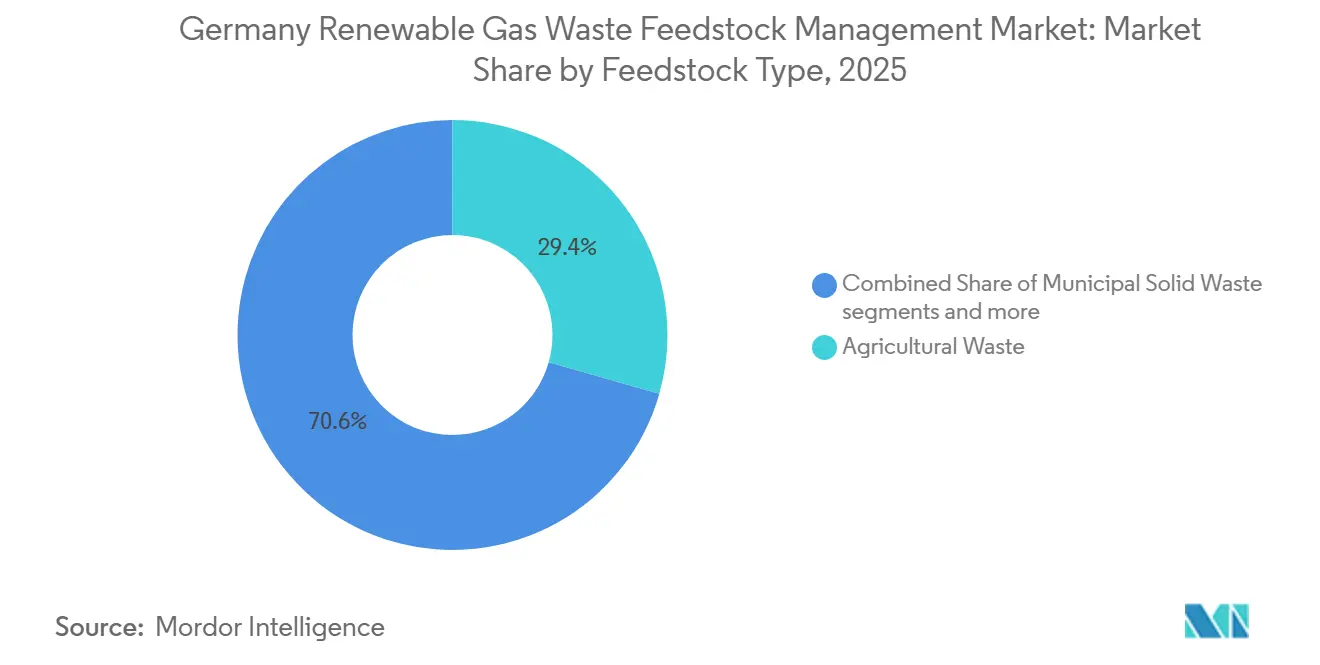
Agricultural waste accounted for 29.4% of the Germany renewable gas waste feedstock market share in 2025. The segment includes manure, slurry, and crop residues and reflects the farm-based structure of Germany’s anaerobic digestion fleet. Food and beverage processing waste is the fastest-growing feedstock type, with a forecast CAGR of 7.2% through 2031. Food-industry effluents, fats, oils, greases, spent grains, and off-specification products can offer concentrated organic content and regular supply schedules. Municipal solid waste, especially its organic fraction, is becoming more important as separate bio-waste collection expands. Germany collected 10.7 million tonnes of bio-waste in 2024, creating a larger input stream for centralized anaerobic digestion facilities near urban centers. The Germany renewable gas waste feedstock management market is moving toward greater reliance on waste-based inputs as support for maize silage and other first-generation energy crops tightens.
Sewage sludge and biosolids provide a stable feedstock source because wastewater treatment plants operate continuously. German municipal wastewater treatment plants disposed of 1.67 million tonnes of sewage sludge in 2024, and agricultural use fell to 12% from 30% in 2009. The reduction in land application directs more sludge toward thermal treatment and other valorization routes. Industrial organic waste from breweries, paper mills, and pharmaceutical facilities has a smaller role but can be commercially attractive because supply volumes and organic loading are more consistent. RED III sustainability criteria act as an eligibility filter for biomethane support and favor documented waste-derived feedstocks over crop-based alternatives. The change increases the importance of collection contracts, material testing, and feedstock traceability. It also gives processors with reliable pre-treatment systems an advantage when handling mixed or contaminated waste streams.

By End-Use Facility Type: Anaerobic Digestion Plants Lead as Co-Digestion Expands
Anaerobic digestion plants accounted for 46.3% of the Germany renewable gas waste feedstock market share for waste feedstock in 2025. Germany’s network of farm digesters and centralized waste-to-gas facilities supports this position. Wastewater treatment plants using co-digestion are the fastest-growing end-use configuration, with a forecast CAGR of 8.1% through 2031. Co-digestion processes sewage sludge alongside high-calorific food waste or fats, oils, and greases at existing wastewater assets. The approach improves the utilization of sewage sludge and food waste feedstocks by diverting more organic material into anaerobic digestion, supporting higher feedstock recovery and reducing reliance on landfill disposal. Landfill gas recovery sites and thermal treatment facilities still handle material that does not meet the specifications for anaerobic digestion. Germany’s landfill restrictions, however, limit the long-term expansion of landfill gas recovery.
Anaerobic digestion (AD) plants are the second-fastest-growing end-use segment as they increasingly integrate biogas upgrading systems to produce biomethane for grid injection and transport applications. This trend increases the importance of consistent feedstock quality, traceability, and contamination control to meet biomethane quality specifications and sustainability requirements. The others category includes pyrolysis, hydrothermal liquefaction, and thermochemical gasification. These technologies remain at an early stage but provide alternative processing pathways for feedstocks that are unsuitable for conventional anaerobic digestion because of variable composition or contamination.
By Service Type: Collection Leads While Digital Monitoring Grows Fastest
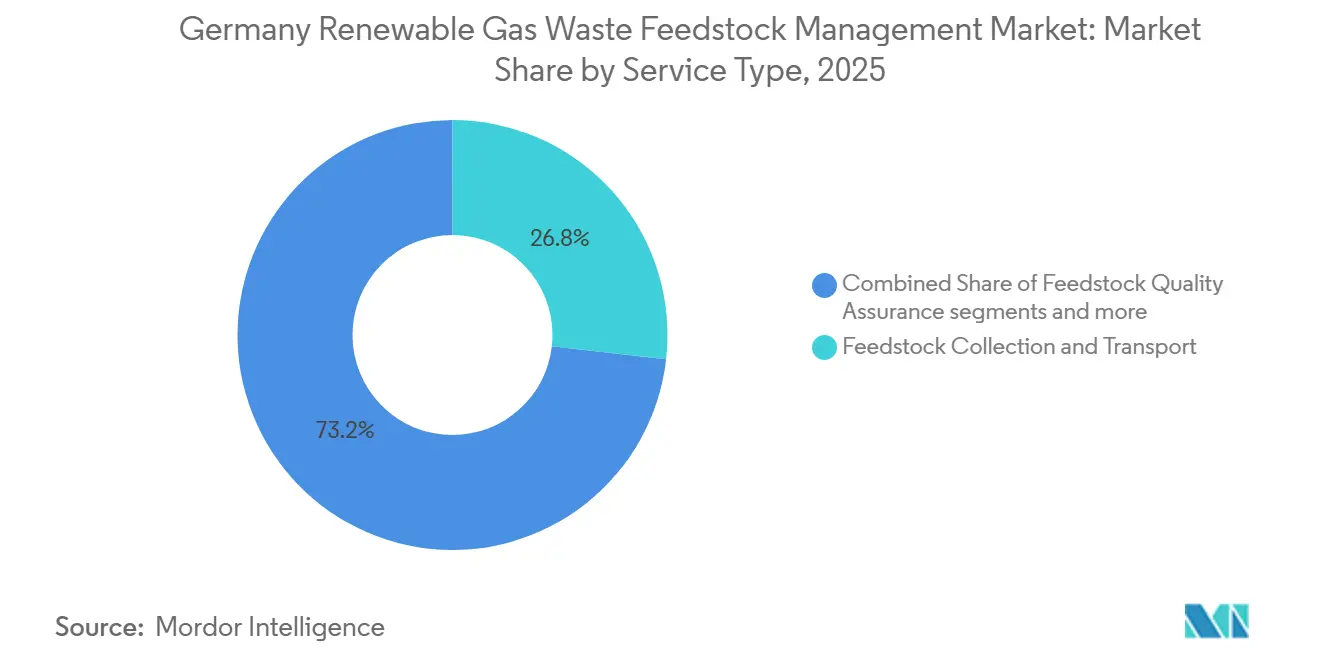
Feedstock collection and transport held 26.8% of the Germany renewable gas waste feedstock management market share in 2025. Collection is essential because plants cannot maintain output without dependable movement of material from farms, municipalities, food processors, and other sources. Germany’s road network and established municipal waste contracts support the segment, but dispersed agricultural waste continues to raise route costs. Manure collection is generally viable within a 10 km radius of a centralized digester. Testing, laboratory services, and quality assurance support the collection function through biochemical methane potential testing, contamination screening, and sensor-based checks. Supply chain management and consultancy are also gaining relevance as waste generators seek structured contracts and compliance documentation.
Digital feedstock monitoring platforms are the fastest-growing service type and are forecast to grow at an 11.3% CAGR through 2031. These platforms use sensors, cloud-based systems, and digital tracking tools to monitor feedstock quality, detect contamination, maintain traceability, and improve inventory management across collection and pre-treatment networks. The commercial value lies in providing evidence of feedstock condition to municipal suppliers and biomethane buyers. The EU Biomethane Mechanism, which began operating in June 2026, makes verified provenance and gas quality more relevant to transactions between market participants. The Germany renewable gas waste feedstock management market can use these systems to reduce uncertainty around contamination and variable inputs. Wider adoption may also help operators manage seasonal agricultural supply while maintaining a stable process mix.
Geography Analysis
The Germany renewable gas waste feedstock management market spans the entire country, with feedstock availability, waste generation patterns, and service demand varying significantly across regions. Bavaria and Baden-Württemberg generate large volumes of agricultural feedstocks from livestock farming and crop production, supporting strong demand for manure, slurry, and crop residue collection and handling services. North Rhine-Westphalia and Lower Saxony combine extensive food-processing industries with dense urban populations that generate significant volumes of bio-waste, creating opportunities for centralized feedstock collection and pre-treatment. In Mecklenburg-Vorpommern and Brandenburg, large agricultural operations and expanding biomethane infrastructure supported the commissioning of three upgrading facilities during the fourth quarter of 2025, increasing demand for consistent, traceable organic feedstocks.
Germany's 329 PJ of combined biogas and biomethane production in 2024 reflects a mature renewable gas sector with established feedstock collection and processing infrastructure. As production capacity has stabilized, market participants are increasingly prioritizing feedstock quality, traceability, logistical efficiency, and reliable organic waste supplies over large-scale capacity expansion. The German regulatory framework combines EU legislation with national requirements for waste and renewable gas. The Circular Economy Act requires source separation and recovery of bio-waste, while the Biogas Regulation establishes technical and quality requirements for biomethane. The implementation of RED III will introduce stricter sustainability requirements for eligible feedstocks, increasing the importance of feedstock traceability, characterization, and proof-of-sustainability systems.
Regional demand for feedstock management services continues to depend on waste generation density, transport costs, and proximity to collection, pre-treatment, and anaerobic digestion facilities. Operators that invest in efficient logistics, feedstock quality assurance, and traceability systems are expected to strengthen their competitive position as sustainability requirements become more stringent. Across Europe, expanding biomethane production and renewable gas policies are also expected to increase competition for high-quality organic feedstocks that meet sustainability and traceability requirements. Although Germany has a well-established feedstock management network, this broader European demand may influence the availability and pricing of industrial organic waste and food waste feedstocks in the coming years.
Competitive Landscape
The Germany renewable gas waste feedstock management market exhibits a medium level of market concentration, as no single operator serves all feedstock categories, end-use facilities, and service types across the country. Waste management companies such as REMONDIS SE & Co. KG and Veolia Umweltservice GmbH leverage municipal collection contracts and established logistics networks to secure organic waste feedstocks. Technology providers, including EnviTec Biogas AG, WELTEC BIOPOWER GmbH, and PlanET Biogas Group GmbH, compete through feedstock pre-treatment, anaerobic digestion, biogas upgrading, and biomethane production technologies. Biomethane developers and traders, including VNG Handel & Vertrieb GmbH through bmp greengas GmbH and RWE Supply & Trading GmbH, are expanding upstream to secure reliable biomethane supplies by strengthening relationships with feedstock and production partners. Geographic dispersion of organic waste and the cost of local collection and transport continue to limit market concentration.
EnviTec Biogas completed the acquisition of LIQVIS GmbH, a former Uniper subsidiary operating 18 LNG filling stations in Germany and France, in February 2025. The transaction expanded the company's downstream distribution network for bio-LNG produced from upgraded biogas. EnviTec also invested EUR 50 million (USD 56.4 million) in plant conversion projects in Brandenburg and Mecklenburg, focusing on upgrades to existing facilities, and reached its 100th EnviThan biogas upgrading plant in operation during 2025. These investments strengthen integrated biomethane value chains and increase demand for consistent, traceable organic feedstocks.
Veolia BioCycling invested EUR 1.5 million (USD 1.7 million) in three depackaging facilities at Gröden, Alteno, and Geislingen in June 2026. The facilities can process up to 120,000 tonnes of food waste annually, improving feedstock recovery before anaerobic digestion. Digital feedstock monitoring platforms and small- and medium-scale pre-treatment service providers remain less consolidated than collection and processing activities. RED III sustainability requirements continue to strengthen the competitive position of companies that combine feedstock collection, pre-treatment, quality assurance, and traceability capabilities.
Germany Renewable Gas Waste Feedstock Management Industry Leaders
-
REMONDIS SE & Co. KG
-
Veolia Umweltservice GmbH
-
EnviTec Biogas AG
-
WELTEC BIOPOWER GmbH
-
PlanET Biogas Group GmbH
- *Disclaimer: Major Players sorted in no particular order
Recent Industry Developments
- June 2026: The European Commission officially launched the Biomethane Mechanism under the EU Energy and Raw Materials Platform, connecting buyers, sellers, investors, and project developers in the biomethane market; the tool is designed to accelerate Germany's and Europe's transition away from imported fossil gas by facilitating feedstock-to-biomethane project matchmaking.
- October 2025: BALANCE Erneuerbare Energien GmbH, VNG AG's biogas subsidiary, acquired a portfolio of five biogas sites in Eastern Germany, increasing BALANCE's operational capacity by approximately 25% and establishing VNG as a vertically integrated biomethane producer with direct control over feedstock-to-grid-injection operations.
- August 2025: VNG AG and infrastructure investor CVC DIF sealed their partnership for BALANCE Erneuerbare Energien following competition authority approval, with CVC DIF acquiring a 49% stake in VNG's biogas subsidiary, marking one of the largest private equity entries into Germany's biogas feedstock sector.
- February 2025: EnviTec Biogas AG acquired LIQVIS GmbH, a former Uniper subsidiary operating 18 LNG filling stations across Germany and France, to integrate bio-LNG distribution as a direct transport fuel sales channel downstream of its feedstock processing and biogas upgrading operations.
Germany Renewable Gas Waste Feedstock Management Market Report Scope
The Germany Renewable Gas Waste Feedstock Management Market Report is Segmented by Feedstock Type (Municipal Solid Waste, Agricultural Waste, and more), by End-Use Facility Type (Anaerobic Digestion (AD) Plants, Landfill Gas Recovery Sites, and more), and Service Type (Feedstock Collection & Transport, Feedstock Testing & Laboratory Services, and more). The Market Forecasts are Provided in Terms of Value (USD).
| Municipal Solid Waste (Organic Fraction / Source-Separated) |
| Agricultural Waste (Manure, Slurry, Crop Residues) |
| Sewage Sludge / Biosolids |
| Food & Beverage Processing Waste (FOG, Spent Grains, Off-Spec Product) |
| Industrial Organic Waste (Breweries, Paper Mills, Pharma Effluent) |
| Others |
| Anaerobic Digestion (AD) Plants |
| Landfill Gas Recovery Sites |
| Gasification / Thermal Treatment Facilities |
| Wastewater Treatment Plants (Co-Digestion) |
| Others (Pyrolysis, Hydrothermal) |
| Feedstock Collection & Transport |
| Feedstock Testing & Laboratory Services |
| Feedstock Quality Assurance |
| Digital Feedstock Monitoring Platforms |
| Feedstock Supply Chain Management & Consultancy |
| By Feedstock Type | Municipal Solid Waste (Organic Fraction / Source-Separated) |
| Agricultural Waste (Manure, Slurry, Crop Residues) | |
| Sewage Sludge / Biosolids | |
| Food & Beverage Processing Waste (FOG, Spent Grains, Off-Spec Product) | |
| Industrial Organic Waste (Breweries, Paper Mills, Pharma Effluent) | |
| Others | |
| By End-Use Facility Type | Anaerobic Digestion (AD) Plants |
| Landfill Gas Recovery Sites | |
| Gasification / Thermal Treatment Facilities | |
| Wastewater Treatment Plants (Co-Digestion) | |
| Others (Pyrolysis, Hydrothermal) | |
| By Service Type | Feedstock Collection & Transport |
| Feedstock Testing & Laboratory Services | |
| Feedstock Quality Assurance | |
| Digital Feedstock Monitoring Platforms | |
| Feedstock Supply Chain Management & Consultancy |
Key Questions Answered in the Report
What is the forecast for Germany renewable gas waste feedstock management?
The Germany renewable gas waste feedstock management market is forecast to increase from USD 1.73 billion in 2025 to USD 2.58 billion by 2031 at a 7.0% CAGR.
Which feedstock type had the largest share in 2025?
Agricultural waste led with 29.4% share in 2025, supported by Germany’s established farm-based anaerobic digestion base.
Which service is growing fastest in Germany’s renewable gas supply chain?
Digital feedstock monitoring platforms are forecast to grow at an 11.3% CAGR through 2031.
Why is food and beverage processing waste becoming more important?
Food and beverage processing waste is the fastest-growing feedstock type at a 7.2% CAGR through 2031 and can provide concentrated organic material with regular supply schedules.
What is the largest end-use facility type for managed feedstock?
Anaerobic digestion plants held 46.3% share in 2025, while wastewater treatment plants using co-digestion are the fastest-growing configuration at an 8.1% CAGR.
What are the main constraints on feedstock operations in Germany?
Transport costs, pre-treatment capital needs, compliance requirements, and seasonal supply changes can limit project economics, especially for smaller rural operators.