
Denmark Renewable Gas Waste Feedstock Management Market Size and Share
Market Overview
| Study Period | 2020 - 2031 |
|---|---|
| Forecast Data Period | 2026 - 2031 |
| Base Year Market Size (2025) | USD 0.47 Billion |
| Market Size (2026) | USD 0.51 Billion |
| Market Size (2031) | USD 0.82 Billion |
| Growth Rate (2026 - 2031) | 9.96 % |
| Market Concentration | Medium |
Major Players *Disclaimer: Major Players sorted in no particular order Image © Mordor Intelligence. Reuse requires attribution under CC BY 4.0. | |
Denmark Renewable Gas Waste Feedstock Management Market Analysis by Mordor Intelligence
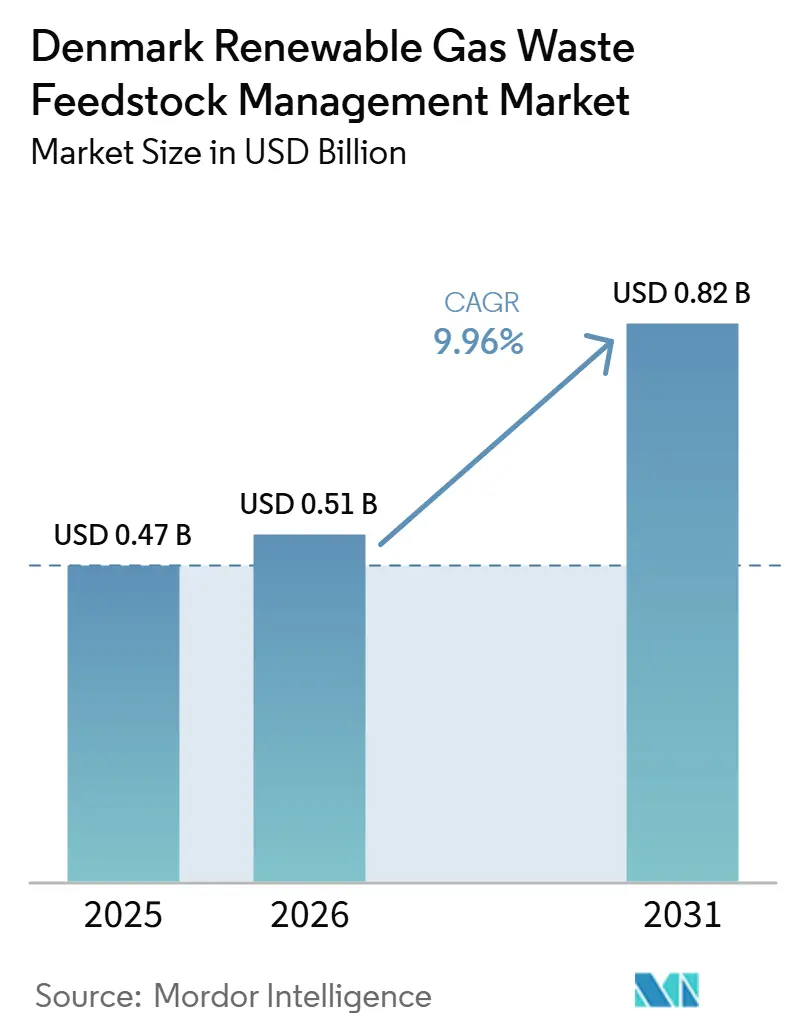
The Denmark Renewable Gas Waste Feedstock Management Market size is expected to grow from USD 0.47 billion in 2025 to USD 0.51 billion in 2026 and is forecast to reach USD 0.82 billion by 2031 at 9.96% CAGR over 2026-2031.
Denmark’s 70% greenhouse gas reduction target for 2030 supports investment in renewable gas infrastructure and related feedstock services. Biogas supplied more than 40% of national gas consumption in 2025, which makes reliable waste collection and preparation important to the national gas system. The August 2025 phaseout of maize silage and the 4% energy crop cap are redirecting procurement toward manure, straw, municipal organics, and food residues. This change increases the need for collection, pre-treatment, quality assurance, and digital documentation.The expansion of biomethane upgrading capacity and grid injection projects is increasing demand for standardized feedstock with consistent quality, lower contamination levels, documented traceability, and reliable pre-treatment across the supply chain. As a result, feedstock service providers are investing in logistics optimization, contamination control, and long-term supply agreements to improve feedstock security and supply reliability.
Key Report Takeaways
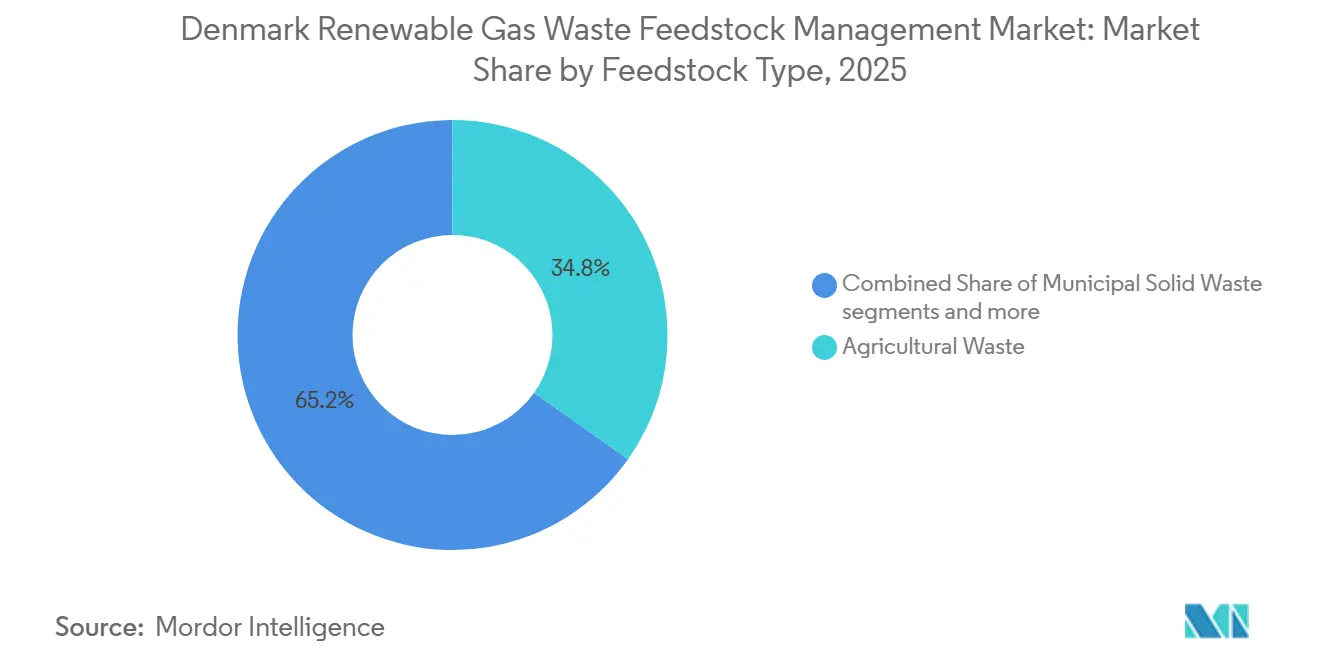
- By feedstock type, agricultural waste held 34.8% of the Denmark renewable gas waste feedstock management market share in 2025, while food and beverage processing waste is forecast to grow at a 10.7% CAGR through 2031.
- By end-use facility type, anaerobic digestion plants held 49.2% of the Denmark renewable gas waste feedstock management market size in 2025, while wastewater treatment plants using co-digestion are forecast to grow at an 11.8% CAGR through 2031.
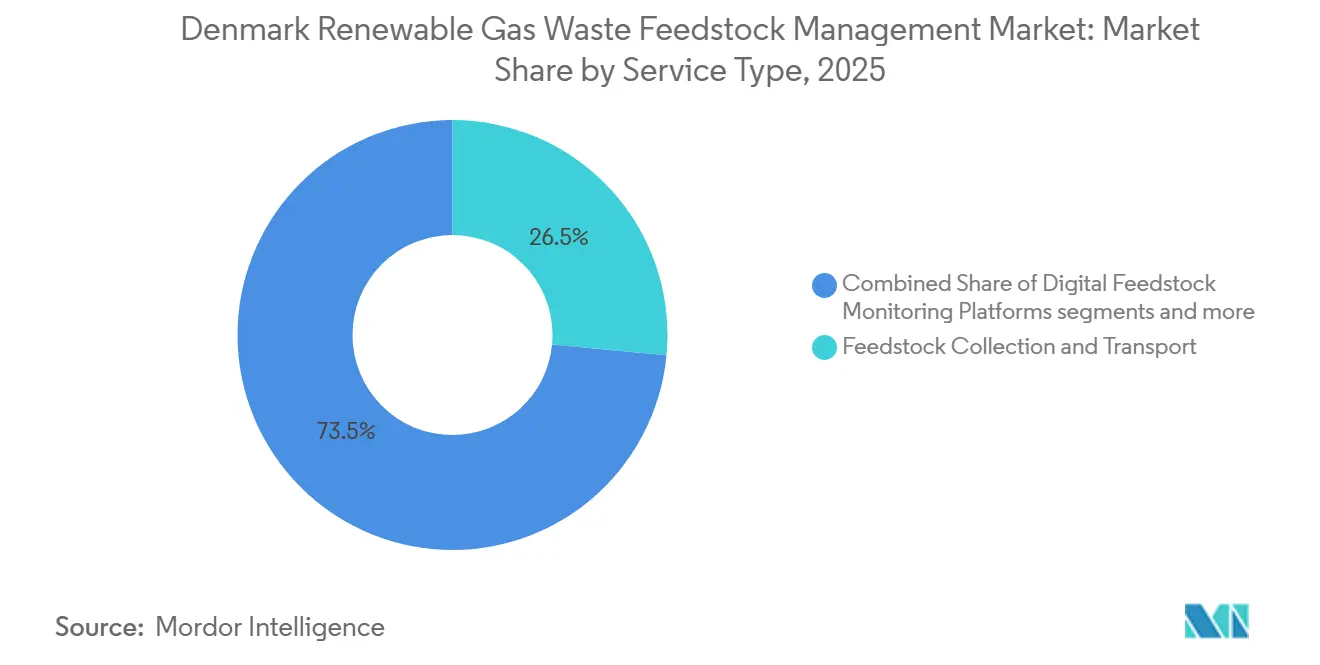
- By service type, feedstock collection and transport led with 26.5% in 2025, while digital feedstock monitoring platforms are forecast to grow at a 14.8% CAGR through 2031.
Note: Market size and forecast figures in this report are generated using Mordor Intelligence’s proprietary estimation framework, updated with the latest available data and insights as of January 2026.
Denmark Renewable Gas Waste Feedstock Management Market Trends and Insights
Drivers Impact Analysis*
| Driver | (~) % Impact on CAGR Forecast | Geographic Relevance | Impact Timeline |
|---|---|---|---|
| Denmark's Green Transition Strategy Accelerating Biomethane Feedstock Utilization | +2.5% | National | Medium term (2-4 years) |
| Extensive Livestock Manure Resources Strengthening Anaerobic Digestion Feedstock Supply | +2.0% | National, concentrated in Western Jutland | Long term (≥ 4 years) |
| Rapid Expansion of Biomethane Injection into the National Gas Grid | +1.8% | National, with Jutland and Zealand grid hubs | Medium term (2-4 years) |
| Strong Agricultural Cooperative Model Enhancing Feedstock Collection Efficiency | +1.2% | National, with clusters in Mid-Jutland and Funen | Long term (≥ 4 years) |
| Municipal Organic Waste Collection Programs Increasing Biodegradable Feedstock Availability | +1.0% | National, concentrated in Copenhagen, Aarhus, and Odense | Short term (≤ 2 years) |
| Rising Industrial and District Heating Demand for Renewable Gas | +0.8% | National, primarily Jutland and Zealand industrial zones | Medium term (2-4 years) |
| Source: Mordor Intelligence | |||
Denmark's Green Transition Strategy Accelerating Biomethane Feedstock Utilization
Denmark’s 2025 implementation of RED III established greenhouse gas savings and methane monitoring requirements for eligible biogas installations.[1] Denmark was the only EU Member State to transpose the directive by the May 2025 deadline, according to the European Parliament Research Service. The requirements make traceable feedstock sourcing essential for operators that need to document compliance. August 2025 maize silage phaseout and the 4% energy crop cap increase the role of manure, straw, municipal organics, and food residues. This raises demand across the Denmark Renewable Gas Waste Feedstock Management Market for collection, pre-treatment, and testing services that can manage material quality. Municipal sorting programs and renewable gas demand from industrial and district heating users reinforce the need for reliable supplies of these organic materials.
Extensive Livestock Manure Resources Strengthening Anaerobic Digestion Feedstock Supply
Livestock manure accounted for 75% of biomass volume supplied to Danish biogas plants by weight. However, it generated only around one-third of the biogas output because its degradable organic content is lower than that of food waste and industrial residues.[2] This large volume makes manure the core supply base for the Denmark Renewable Gas Waste Feedstock Management Market. Denmark’s Climate Status and Outlook 2025 indicated that half of the national livestock manure could be directed to biogas plants by 2030. The 2025 outlook also supports operational measures such as rapid slurry extraction from livestock buildings. This is increasing demand for organized manure collection, storage, transport, and traceability services capable of handling large and geographically dispersed volumes. Co-digestion with complementary organic feedstocks is becoming more important to improve feedstock utilization and increase the commercial value of agricultural residues. Farmers can reduce emissions from untreated manure and receive digestate that can partly substitute for fertilizer. These linked benefits can support longer supply agreements than arrangements based only on a feedstock price.
Rapid Expansion of Biomethane Injection into the National Gas Grid
The latest gas year ending in September 2025 recorded 8.3 TWh of biomethane injection into Denmark’s gas grid.[3] Biogas supplied more than 40% of Denmark’s gas consumption in 2025. Around 80% of biogas is upgraded and injected into the gas grid, rather than being used mainly for electricity and heat. This gives the Denmark Renewable Gas Waste Feedstock Management Market a more structured commercial setting because plants need consistent feedstock volumes and documented gas quality. The growing share of grid-injected biomethane is increasing demand for feedstock standardization, contamination control, and continuous quality monitoring across the supply chain. This trend is encouraging investment in digital traceability platforms and long-term procurement networks that improve supply reliability while supporting renewable gas certification. Known grid access can help operators sign longer supply contracts for complex waste streams. Grid injection also increases the value of systems that verify feedstock origin, batch quality, and greenhouse gas performance.
Strong Agricultural Cooperative Model Enhancing Feedstock Collection Efficiency
Agricultural cooperatives help member farms move slurry and other inputs to central biogas plants with less contract complexity. Vestjyllands Andel a.m.b.a. is an example of a cooperative structure that can coordinate feedstock flows among farms and facilities. Denmark’s biogas plants are predominantly large-scale operations that support high-throughput collection routes, with farms located close together. This supports collection efficiency in the Denmark Renewable Gas Waste Feedstock Management Market, especially in Mid-Jutland and Western Jutland. The cooperative model also lowers feedstock procurement costs by aggregating volumes from multiple farms under standardized collection schedules. This improves plant utilization rates and creates opportunities for specialized logistics providers offering manure transport, storage, and feedstock quality management services. Cooperative networks can also share information on slurry quality and seasonal availability. This reduces uncertainty for collection planning, but the strength of those monitoring capabilities differs across older and newer operators.
Restraints Impact Analysis*
| Restraint | (~) % Impact on CAGR Forecast | Geographic Relevance | Impact Timeline |
|---|---|---|---|
| Strict Sustainability and Nutrient Management Regulations Limiting Feedstock Utilization | -1.5% | National, EU-wide under RED III | Short term (≤ 2 years) |
| Rising Costs of Feedstock Pre-Treatment and Contamination Removal | -1.0% | National | Medium term (2-4 years) |
| Seasonal Variability in Agricultural Waste Generation Affecting Feedstock Supply | -0.8% | National, particularly Western and Northern Denmark | Long term (≥ 4 years) |
| Limited Availability of Additional High-Quality Organic Waste for Future Capacity Expansion | -0.7% | National | Long term (≥ 4 years) |
| Source: Mordor Intelligence | |||
Strict Sustainability and Nutrient Management Regulations Limiting Feedstock Utilization
Denmark implemented RED III through Executive Order No. 482 of 2025, which requires eligible biogas installations to meet greenhouse gas savings criteria with deadlines that extend through 2030. Feedstock operators must document the sustainability of inputs under RED III Annex VI. Digestate use is also subject to nitrogen and phosphorus application limits under Denmark’s aquatic environment action plans. This creates a dual compliance burden because operators must document incoming material and manage the nutrient use of the output. These regulatory requirements are increasing demand for digital compliance systems, feedstock certification, and lifecycle emissions verification across the supply chain. As sustainability reporting becomes more stringent, service providers with robust traceability and documentation capabilities are gaining a competitive advantage in securing long-term contracts with biogas producers. A batch containing multiple inputs must carry a single averaged greenhouse gas value under the Annex VI approach. The European Biogas Association, ERGaR, and Eurogas challenged that method in January 2026 because it can limit flexible accounting for co-digestion plants.
Rising Costs of Feedstock Pre-Treatment and Contamination Removal
The move away from energy crops has made pre-treatment a more significant cost item in the Denmark Renewable Gas Waste Feedstock Management Market. Source-separated household organics and roadside biomass can contain plastic, metals, and litter that require rejection or additional processing. A 2025 study found that contamination in roadside grass can make the material unsuitable without quality controls and mechanical pre-treatment. Food waste and animal by-products entering biogas systems must meet particle-size and heat-treatment requirements under EU rules. The material must be reduced to a maximum particle size of 12 mm and held at 70°C for at least 1 hour. These processing requirements are increasing demand for specialized pre-treatment facilities and automated sorting technologies that can improve feedstock quality while reducing material losses. As lower-quality waste streams make up a larger share of supply, operators with integrated collection and pre-processing capabilities are better positioned to control costs and maintain stable biomethane yields. These requirements add equipment and energy costs, while dispersed urban and industrial sources also raise collection costs.
*Our forecasts treat driver/restraint impacts as directional, not additive. The impact forecasts reflect baseline growth, mix effects, and variable interactions.
Segment Analysis
By Feedstock Type: Agricultural Waste Dominates Supply While Food and Beverage Processing Waste Records Fastest Growth
Agricultural waste held 34.8% of the Denmark Renewable Gas Waste Feedstock Management Market share in 2025. Manure, slurry, and crop residues support this position because high-density livestock farms in Western Jutland are close to large anaerobic digestion facilities. Around 35% of all livestock manure in Denmark was directed to biogas plants in 2025. The government expects that share to reach 50% by 2030. Food and beverage processing waste has the highest forecast growth rate at a 10.7% CAGR through 2031. Its growth reflects wider municipal sorting systems and more developed routes for managing industrial food residues. Bigadan’s Solrød Bioenergi plant processes up to 200,000 tonnes of sorted food waste each year from Copenhagen, Frederiksberg, Næstved, and Lolland-Falster municipalities. It also processes 50,000 tonnes of expired food products annually, showing how aggregation from several sources can support plant-scale operations.
Municipal solid waste has a smaller position but is becoming more important as cities improve sorting systems. Ringkøbing-Skjern Municipality collects 5,400 tonnes of food waste each year through its program. The municipality's collection program demonstrates how source-separated organic waste can provide a reliable feedstock stream for centralized renewable gas facilities. Sewage sludge and biosolids provide a regular feedstock for co-digestion at Denmark’s 48 wastewater treatment plants with digestion capacity. Industrial organic waste from breweries, paper mills, and pharmaceutical effluent can add gate fee revenue that manure arrangements often do not provide. Gate fees improve the commercial value of clean, source-separated organic waste that requires less preprocessing and contamination removal. Annual Danish Energy Agency reporting on feedstock volumes, types, and origins creates a common traceability expectation across these categories.

By End-Use Facility Type: Anaerobic Digestion Plants Lead by Share While Wastewater Treatment Plant Co-Digestion Records Fastest Growth
Anaerobic digestion plants accounted for 49.2% of the Denmark Renewable Gas Waste Feedstock Management Market by end-use facility in 2025. Agricultural plants accounted for around 85% of national biogas production in the most recent reporting period. Centralized plants remain important because Denmark has dense livestock regions, established gas grid access, and ongoing capacity upgrades. Wastewater treatment plants using co-digestion are the fastest-growing facility type, with a forecast CAGR of 11.8% through 2031. A wastewater treatment plant can accept food waste along with sewage sludge and earn gate-fee income from municipal contracts. This approach enables wastewater treatment plants to make better use of sewage sludge together with separately collected organic waste within existing treatment infrastructure. This dual revenue logic can support renewable energy income while serving water treatment operations. The Denmark Renewable Gas Waste Feedstock Management Market therefore benefits where wastewater utilities can combine stable sludge supplies with local organic waste collection.
Billund Biorefinery in Grindsted shows this model in operation. The municipal utility Billund Vand og Energi A/S processes household food waste collected in paper bags, industrial bio-waste, and municipal sludge. Landfill gas recovery is declining in importance because EU landfill diversion rules reduce the amount of biodegradable material sent to disposal sites. Gasification and thermal treatment facilities remain a smaller part of the current facility mix. GreenLab Skive is developing a microwave-based pyrolysis facility for sewage sludge and organic waste, with operations expected to begin in 2027. The development shows growing interest in thermochemical routes for difficult materials. Pyrolysis and hydrothermal processing remain early-stage applications during the forecast period.
By Service Type: Feedstock Collection and Transport Leads by Revenue Share While Digital Monitoring Platforms Record Fastest Growth
Feedstock collection and transport held the largest service share at 26.5% in 2025. This reflects the logistics required to combine agricultural, municipal, and industrial waste at central plants. Collection costs can be high because supplies originate in farming areas in Western Jutland and are delivered to coastal cities and industrial facilities. Route optimization and cooperative aggregation are important for maintaining service margins. Feedstock testing and laboratory services are also growing as RED III requires auditable emissions values for co-digestion batches. Operators increasingly require feedstock characterization, contamination testing, quality assurance, traceability, and sustainability certification to support procurement and regulatory compliance. ISCC and REDcert provide certification systems that support these documentation needs.
Digital feedstock monitoring platforms are forecast to grow at a 14.8% CAGR through 2031, the fastest rate among service types. Batch-level tracking is becoming necessary as operators seek feedstock-specific greenhouse gas values and more complete traceability. The European Biogas Association and ERGaR stated in January 2026 that this tracking is central to greenhouse gas allocation for co-digestion. Biogas Danmark’s Biogas Data Online platform provides a broad overview of the sector by reporting on production, grid injection, storage, and market value. Supply chain management and advisory services are gaining relevance for plants that use 5 or more waste types. These operators need support with contracts, seasonal volumes, and sustainability documentation. Digital service providers can differentiate themselves more easily than transport providers because their work links operational data with regulatory compliance.
Geography Analysis
Western Jutland is a major supply area because its dense cattle and pig farming base provides slurry and manure close to centralized plants. This proximity supports the Denmark Renewable Gas Waste Feedstock Management Market by reducing per-tonne aggregation costs and making long-term manure contracts more practical. Northern Denmark has additional agricultural supply potential through Sindal Biogas, which Copenhagen Infrastructure Partners included in its May 2026 Advanced Bioenergy Fund II investment program. The project is designed to process 500,000 tonnes of biomass each year and produce up to 34 million cubic meters of upgraded biogas. Tønder Biogas in Southern Denmark reached full operational status in 2025, with a capacity of 930,000 tonnes of sustainable organic material per year.
Copenhagen, Aarhus, and Odense are important centers for municipal organic waste collection. Their sorting programs create supplies of source-separated food waste that need depackaging, contamination removal, and hygienization. Solrød Bioenergi receives waste streams from Copenhagen and Frederiksberg, as well as Næstved and Lolland-Falster. This arrangement demonstrates the value of consolidating urban waste volumes into a single treatment system. Zealand’s grid hubs and industrial activity also link waste management services with grid injection and industrial offtake.
Funen and Mid-Jutland benefit from cooperative farming structures that support collection planning. Shared data on slurry quality and seasonal supply can help facilities organize transport routes and reduce disruption. Billund Biorefinery in Grindsted combines municipal wastewater management and organic waste co-digestion. Across the Denmark Renewable Gas Waste Feedstock Management Market, geographic advantage depends on proximity to supply sources, transport networks, grid access, and facilities capable of managing material quality.
Competitive Landscape
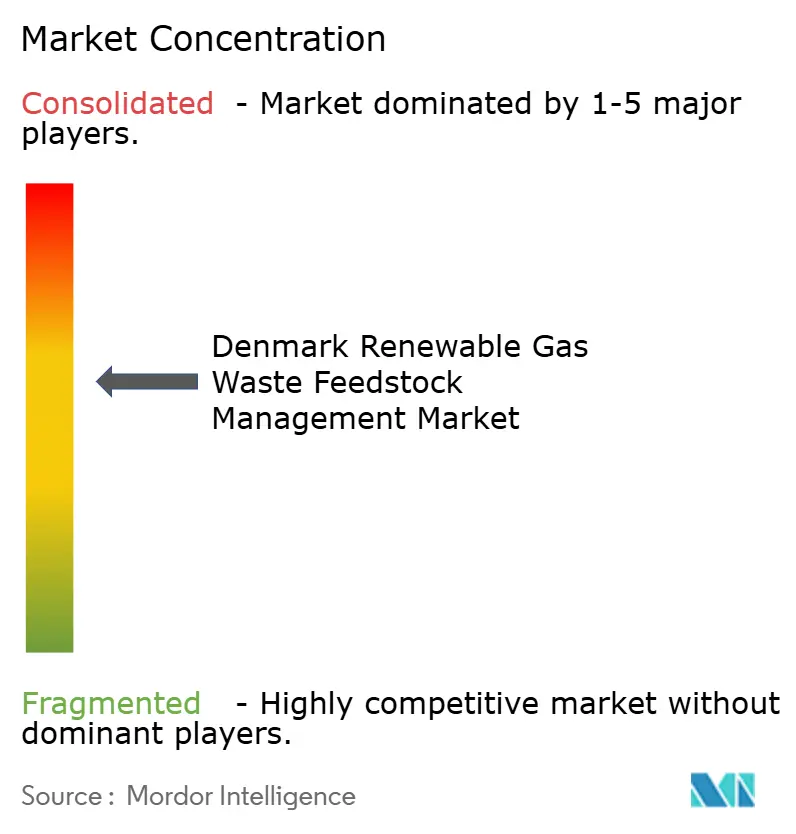
The Denmark renewable gas waste feedstock management market exhibits a medium level of market concentration, with a limited number of integrated operators holding strong market positions, while specialist logistics and feedstock pre-treatment providers remain more fragmented. Shell Biogas A/S operates 13 biogas plants acquired through Shell's Nature Energy acquisition and integrated under the Shell brand in 2025. Bigadan A/S is another leading integrated operator, combining feedstock collection, pre-treatment, biomethane production, and grid injection within its operating model. Arjun Infrastructure Partners increased its stake in Bigadan to majority ownership in October 2025, reflecting continued investment in integrated renewable gas platforms. Competitive positioning among market operators depends on securing long-term feedstock supply agreements, maintaining extensive collection networks, and managing feedstock quality and regulatory compliance across large processing volumes.
Competition is increasingly shaped by feedstock quality, traceability, and sustainability documentation rather than feedstock volumes alone. Manure-based feedstocks can qualify for favorable greenhouse gas accounting under RED III, increasing the importance of feedstock traceability and Guarantee of Origin documentation. Bigadan co-authored a January 2026 paper with the EBA, ERGaR, and Eurogas proposing more flexible greenhouse gas allocation methods for co-digestion, reflecting the industry's growing focus on sustainability documentation and certified feedstock supply chains.
Technology providers such as Xergi A/S, Ammongas A/S, and Lundsby Renewable Solutions A/S compete by supplying biogas upgrading systems, feedstock pre-treatment technologies, engineering expertise, and related technical solutions rather than directly participating in feedstock collection or aggregation. Their role is to support renewable gas developers through technology, engineering, and process solutions that strengthen feedstock handling, quality assurance, and regulatory compliance.
Denmark Renewable Gas Waste Feedstock Management Industry Leaders
-
Shell Biogas A/S
-
Bigadan A/S
-
Xergi A/S
-
Ammongas A/S
-
Lundsby Renewable Solutions A/S
- *Disclaimer: Major Players sorted in no particular order
Recent Industry Developments
- May 2026: The European Investment Fund committed EUR 200 million (USD 225.7 million) to Copenhagen Infrastructure Partners’ Advanced Bioenergy Fund II. The fund targets EUR 1.5 billion (USD 1.7 billion) and is investing in Danish and European biomethane feedstock infrastructure, including Sindal Biogas in Northern Jutland. The project is designed to process 500,000 tonnes of biomass annually and produce up to 34 million cubic meters of upgraded biogas. This investment supports large-scale aggregation of agricultural biomass in Northern Jutland.
- May 2026: Shell Biogas A/S disclosed cumulative losses of EUR 268 million (USD 302.5 million) from Danish biogas operations since Shell acquired Nature Energy. The company recorded a 2025 net loss of DKK 697 million (USD 105.3 million), on revenue of DKK 830 million (USD 125.4 million). It cited low gas and certificate prices, as well as high biomass procurement costs. The result highlights the importance of secure feedstock contracts and disciplined cost management.
- April 2026: Bigadan A/S and Kanadevia Inova AG extended their collaboration through engineering contracts for a biogenic CO₂ liquefaction plant in Kalundborg and a membrane biogas upgrading plant near Nysted on Lolland. Both facilities are scheduled to begin operations in 2026. The projects add carbon-handling and gas-upgrading capacity to Bigadan’s feedstock operations.
- February 2026: Shell Biogas A/S shelved the planned liquefied biogas facility at the Port of Frederikshavn. Shell cited unfavorable economics for the project. The decision shows that available feedstock alone does not ensure returns from downstream renewable gas infrastructure.
Denmark Renewable Gas Waste Feedstock Management Market Report Scope
The Denmark Renewable Gas Waste Feedstock Management Market Report is Segmented by Feedstock Type (Municipal Solid Waste, Agricultural Waste, and more), by End-Use Facility Type (Anaerobic Digestion (AD) Plants, Landfill Gas Recovery Sites, and more), and Service Type (Feedstock Collection & Transport, Feedstock Testing & Laboratory Services, and more). The Market Forecasts are Provided in Terms of Value (USD).
| Municipal Solid Waste (Organic Fraction / Source-Separated) |
| Agricultural Waste (Manure, Slurry, Crop Residues) |
| Sewage Sludge / Biosolids |
| Food & Beverage Processing Waste (FOG, Spent Grains, Off-Spec Product) |
| Industrial Organic Waste (Breweries, Paper Mills, Pharma Effluent) |
| Others |
| Anaerobic Digestion (AD) Plants |
| Landfill Gas Recovery Sites |
| Gasification / Thermal Treatment Facilities |
| Wastewater Treatment Plants (Co-Digestion) |
| Others (Pyrolysis, Hydrothermal) |
| Feedstock Collection & Transport |
| Feedstock Testing & Laboratory Services |
| Feedstock Quality Assurance |
| Digital Feedstock Monitoring Platforms |
| Feedstock Supply Chain Management & Consultancy |
| By Feedstock Type | Municipal Solid Waste (Organic Fraction / Source-Separated) |
| Agricultural Waste (Manure, Slurry, Crop Residues) | |
| Sewage Sludge / Biosolids | |
| Food & Beverage Processing Waste (FOG, Spent Grains, Off-Spec Product) | |
| Industrial Organic Waste (Breweries, Paper Mills, Pharma Effluent) | |
| Others | |
| By End-Use Facility Type | Anaerobic Digestion (AD) Plants |
| Landfill Gas Recovery Sites | |
| Gasification / Thermal Treatment Facilities | |
| Wastewater Treatment Plants (Co-Digestion) | |
| Others (Pyrolysis, Hydrothermal) | |
| By Service Type | Feedstock Collection & Transport |
| Feedstock Testing & Laboratory Services | |
| Feedstock Quality Assurance | |
| Digital Feedstock Monitoring Platforms | |
| Feedstock Supply Chain Management & Consultancy |
Key Questions Answered in the Report
How large is Denmark’s renewable gas waste feedstock management market?
The market was valued at USD 0.51 billion in 2026 and is forecast to reach USD 0.82 billion by 2031 at a 9.9% CAGR.
What is driving renewable gas feedstock management in Denmark?
The sector is supported by Denmark’s 70% emissions-reduction target for 2030, the phaseout of maize silage, and the need to manage greater volumes of manure, food residues, and municipal organics.
Which feedstock type holds the largest share in Denmark?
Agricultural waste held 34.8% in 2025, supported by manure and slurry from Denmark’s livestock regions.
Which facility type is growing fastest for waste feedstock management?
Wastewater treatment plants using co-digestion are forecast to grow at an 11.8% CAGR through 2031.
Why are digital feedstock monitoring platforms expanding?
Digital platforms are forecast to grow at a 14.8% CAGR, driven by the need for batch-level documentation for greenhouse gas calculations and sustainability traceability.
What are the main challenges for Denmark biogas feedstock operators?
Key challenges include RED III documentation, nutrient limits, contamination removal, seasonal supply variation, and the cost of pre-treatment.