
United States Renewable Gas Waste Feedstock Management Market Size and Share
Market Overview
| Study Period | 2020 - 2031 |
|---|---|
| Forecast Data Period | 2026 - 2031 |
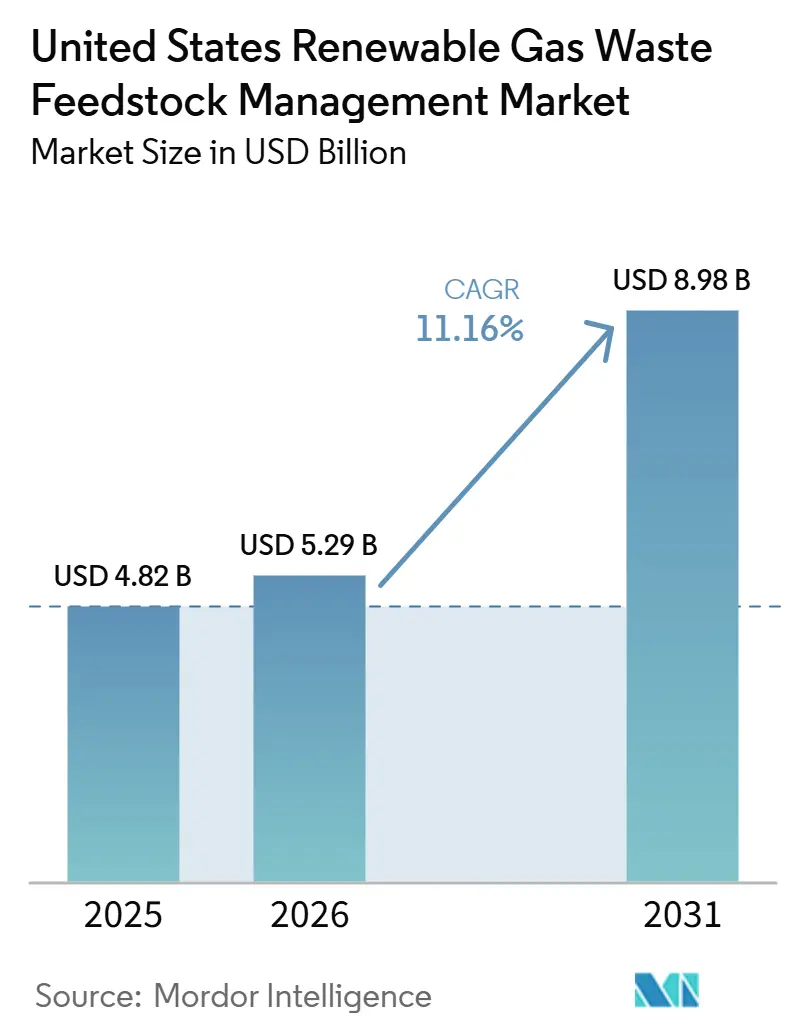
| Base Year Market Size (2025) | USD 4.82 Billion |
| Market Size (2026) | USD 5.29 Billion |
| Market Size (2031) | USD 8.98 Billion |
| Growth Rate (2026 - 2031) | 11.16 % |
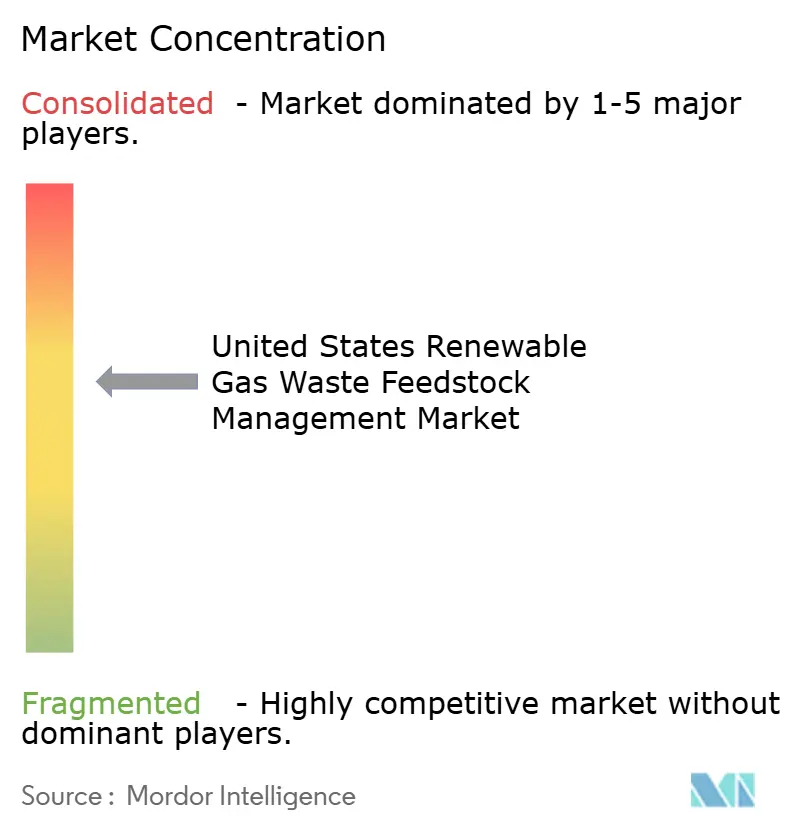
| Market Concentration | Medium |
Major Players *Disclaimer: Major Players sorted in no particular order Image © Mordor Intelligence. Reuse requires attribution under CC BY 4.0. | |
United States Renewable Gas Waste Feedstock Management Market Analysis by Mordor Intelligence
The United States Renewable Gas Waste Feedstock Management Market size is projected to expand from USD 4.82 billion in 2025 and USD 5.29 billion in 2026 to USD 8.98 billion by 2031, registering a CAGR of 11.16% between 2026 to 2031.
The United States renewable gas waste feedstock management market is expanding as renewable natural gas capacity requires a consistent, traceable supply of organic material rather than occasional waste deliveries. The American Biogas Council reported USD 2.1 billion in new biogas infrastructure investment during 2025, taking cumulative United States biogas-sector capital deployment to USD 39.9 billion, while 659 of 2,585 operating facilities were upgrading biogas to pipeline-quality RNG. Federal renewable fuel requirements, state low-carbon fuel programs, and landfill-diversion rules are increasing the value of collection, contamination control, and pre-treatment in the United States renewable gas waste feedstock management market. Larger waste companies are expanding their roles beyond collection to include pre-treatment and RNG production, while specialist providers are seeking opportunities in laboratory testing, digital monitoring, and verified material records. Feedstock contamination, fragmented rural supply, seasonal farm output, and competition from other uses remain practical limits on growth, even as utility and industrial buyers create new demand for pipeline-quality gas.
Key Report Takeaways
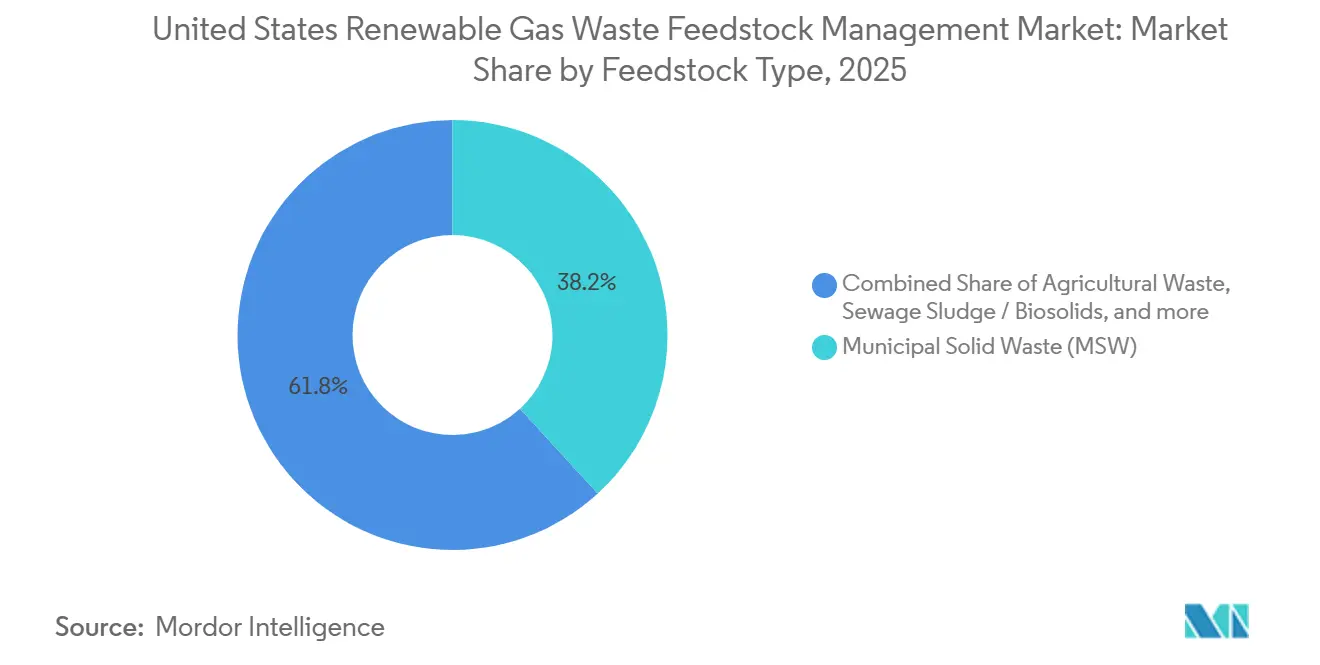
- By feedstock type, municipal solid waste held 38.2% of the United States renewable gas waste feedstock management market share in 2025, while food & beverage processing waste is forecast to expand at a 11.4% CAGR through 2031.
- By end-use facility type, landfill gas recovery sites accounted for 38.6% of the United States renewable gas waste feedstock management market size in 2025, while anaerobic digestion (AD) plants are projected to grow at a 12.8% CAGR through 2031.
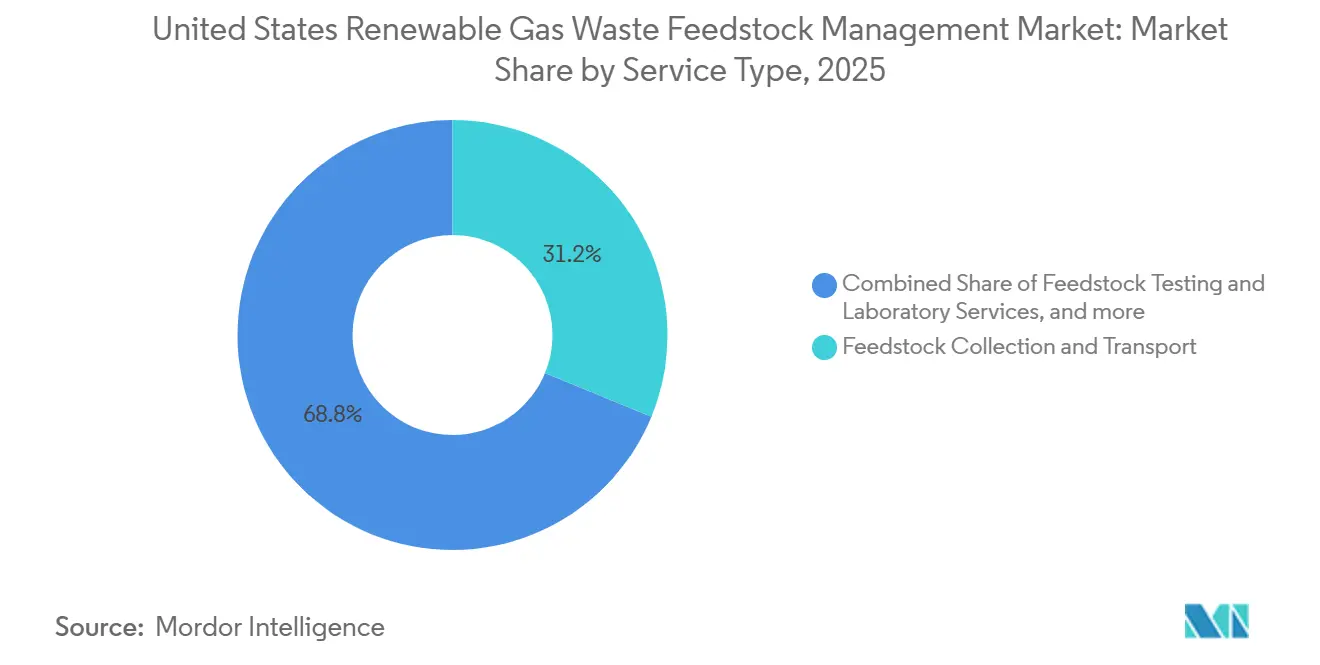
- By service type, feedstock collection & transport accounted for 31.2% in 2025, while digital feedstock monitoring platforms are forecast to grow at a 15.2% CAGR through 2031.
Note: Market size and forecast figures in this report are generated using Mordor Intelligence’s proprietary estimation framework, updated with the latest available data and insights as of January 2026.
United States Renewable Gas Waste Feedstock Management Market Trends and Insights
Drivers Impact Analysis*
| Driver | (~) % Impact on CAGR Forecast | Geographic Relevance | Impact Timeline |
|---|---|---|---|
| State Low-Carbon Fuel Programs Improving Organic Waste Economics | +3.2% | California, Oregon, Washington, with spillover to the Northeast states | Medium term (2-4 years) |
| Infrastructure Investment Expanding Collection and Pre-Treatment Capacity | +2.5% | National, with early gains in Texas, California, and the Midwest | Long term (≥ 4 years) |
| Low-Carbon Fuel Demand Raising Renewable Feedstock Procurement | +2.1% | National, concentrated in California and the Northeast corridor | Medium term (2-4 years) |
| Landfill Diversion Policies Expanding Organic Waste Recovery | +1.8% | California, Washington, New York, and Massachusetts | Medium term (2-4 years) |
| Source-Separated Organics Collection Strengthening Feedstock Quality | +1.5% | California and the Northeast corridor | Short term (≤ 2 years) |
| Industrial Organic Waste Generation Supporting Supply Growth | +1% | National, led by the Midwest and Southeast | Long term (≥ 4 years) |
| Source: Mordor Intelligence | |||
State Low-Carbon Fuel Programs Enhancing Organic Waste Feedstock Economics
California’s Low Carbon Fuel Standard remains a major price signal for the United States renewable gas waste feedstock management market. Amendments effective July 1, 2025, introduced updated Tier 1 carbon-intensity calculators for organic-waste biomethane pathways. The changes support operators that document source separation and pre-treatment, because those practices help establish the carbon profile of a pathway. California AB-70 requires that, starting January 1, 2027, certain pipeline biomethane made exclusively from organic waste qualify as a recovered organic waste product. This connection between fuel-credit eligibility and waste procurement is moving contracts toward documented quality tiers. Similar programs in other states could create comparable demand for certified organic streams.
Infrastructure Investment Accelerating Feedstock Collection and Pre-Treatment Capacity
United States biogas infrastructure investment exceeded USD 2.1 billion in 2025, when 70 facilities were commissioned, and industry capture capacity grew 7.5%. [1]Investment is increasingly shifting toward collection and pre-treatment equipment, not just gas-upgrading systems. Section 48E applies to qualified biogas property for projects beginning construction on or after January 1, 2025, while Section 45Z remains available through December 31, 2029. These provisions improve visibility for projects that require several years of supply-contract and infrastructure planning. Depackaging, mechanical separation, and thermal-hydrolysis systems are becoming more important because their performance affects usable gas yield and compliance records. The United States renewable gas waste feedstock management market, therefore, gives greater commercial weight to providers that can validate the condition of incoming material.
Low-Carbon Fuel Demand Raising Renewable Feedstock Procurement
RNG accounted for 94% of the United States natural-gas motor fuel consumption in 2025, up from 86% in 2024, and volumes reached 755 million gasoline-gallon equivalents. The EPA set the 2026 cellulosic biofuel renewable volume obligation at 1.36 billion ethanol-gallon equivalents, with RNG accounting for 91% of that volume. The requirement creates a federal baseline for renewable fuel production and upstream feedstock procurement. Transportation demand is already mature in some high-penetration states, which shifts attention toward utility injection and industrial offtake. Those outlets require different gas-quality specifications and contract structures. Operators in the United States renewable gas waste feedstock management market are therefore placing greater emphasis on feedstock quality that supports pipeline-quality RNG.
Landfill Diversion Policies Expanding Organic Waste Recovery
State diversion rules are increasing the organic material available to the United States renewable gas waste feedstock management market. California requires jurisdictions to provide organic-waste collection for residents and businesses under SB 1383. Washington requires covered businesses that generate at least 96 gallons of organic material weekly to comply with collection requirements from January 1, 2026, and residential requirements will begin in April 2027. The same programs make source-separated collection more important because it can improve the quality of material delivered to processors. An EPA paper has also considered organic-waste diversion as an alternative landfill compliance mechanism, which could encourage landfill owners to secure diversion contracts and support co-digestion blends when industrial material is documented. Industrial organic waste adds another supply source, especially in the Midwest and Southeast, where food processing, breweries, paper mills, pharmaceutical facilities, and related operations can provide more consistent material streams.
Restraints Impact Analysis*
| Restraint | (~) % Impact on CAGR Forecast | Geographic Relevance | Impact Timeline |
|---|---|---|---|
| Municipal Organic Waste Contamination Raising Pre-Treatment Costs | -2% | National | Short term (≤ 2 years) |
| Fragmented Feedstock Supply Chains Limiting Reliable Availability | -1.5% | National, most acute in rural Southeast and Plains states | Medium term (2-4 years) |
| Competition for Organic Waste Feedstocks Across End Uses | -1% | National, particularly California and the Midwest | Medium term (2-4 years) |
| Seasonal Variability Affecting Agricultural Feedstock Supply | -0.6% | Midwest, Great Plains, and Southeast | Short term (≤ 2 years) |
| Source: Mordor Intelligence | |||
Municipal Organic Waste Contamination Increasing Pre-Treatment Costs
Plastics and packaging in curbside organics are a near-term operating constraint for the United States renewable gas waste feedstock management market. Washington’s June 2026 draft rules raised the allowable incoming contamination threshold from 2% to 5% by volume, reflecting the difficulty of reaching lower rates within current collection systems. The change does not eliminate the need for depackaging and mechanical separation at facilities that accept post-consumer food waste. Contamination can reduce the usable share of collected material and add labor, equipment, and disposal costs. These costs are often carried by collection, testing, and quality-assurance providers before material reaches an anaerobic digester. As a result, smaller independent operators need sufficient throughput to support the required pre-treatment equipment.
Fragmented Feedstock Supply Chains Limiting Reliable Feedstock Availability
The United States renewable gas waste feedstock management market remains fragmented outside dense urban collection areas. The American Biogas Council identified 470 United States landfills that still flare biogas, while only 16% of dairy farms with herds above 500 head operated digesters, leaving more than 2,500 qualifying dairy farms without capture infrastructure. Long-haul distances, low material density, and limited pretreatment capacity reduce returns in rural regions. Seasonal changes in agricultural materials make supply planning more difficult in the Midwest, the Great Plains, and the Southeast. Organic waste also competes with composting, animal feed, and other end uses in California and the Midwest. These conditions support demand for supply-chain management and consultancy services that coordinate smaller and less predictable sources.
*Our forecasts treat driver/restraint impacts as directional, not additive. The impact forecasts reflect baseline growth, mix effects, and variable interactions.
Segment Analysis
By Feedstock Type: Food and Beverage Waste Leads Growth While Municipal Solid Waste Anchors the Base
Municipal solid waste accounted for 38.2% of the market. This growth reflects source-separated organics mandates and gate-fee economics that support food waste as an input for anaerobic digestion. The American Biogas Council counted 124 stand-alone food-waste biogas facilities in operation in December 2025, with 27.6 billion cubic feet of annual capture capacity compared with a potential 192 billion cubic feet if all United States food waste were processed. Municipal solid waste, particularly its organic fraction, remained the largest feedstock base by volume because landfill infrastructure and integrated haulers already operate at scale.
Food and beverage waste is forecast to expand at a CAGR of 11.4% from 2026 to 2031. Food and beverage processors also provide commercially attractive inputs because their waste can yield high methane and have a more consistent composition. Agricultural waste, led by dairy manure and swine slurry, has a large operating-facility base but remains limited by low digester adoption. Sewage sludge and biosolids can serve as co-digestion inputs as land-application restrictions increase concern about PFAS. Breweries, paper mills, and pharmaceutical effluent provide stable industrial organic inputs for blending. Other emerging streams, including pharmaceutical organics and textile effluent, remain early-stage opportunities, and the United States renewable gas waste feedstock management industry must balance the benefits of diverse feedstocks with the added difficulty of consistently handling them.

By End-Use Facility Type: Anaerobic Digestion Plants Drive Growth While Landfill Sites Define Scale
Landfill gas recovery accounted for 38.6% of the market. The expansion reflects new food-waste digestion facilities and wastewater plants moving toward co-digestion. At the same time, EPA survey data showed 19,711 SCFM of biogas at food waste processing digestion facilities in 2023, up from 18,926 SCFM in 2022.[2] Thermal-alkaline pre-treatment at 80°C improved solubilization and methane productivity in food-waste digestion tests, while landfill gas recovery held the largest installed base, with 1,048,000 SCFM in 2025.
Anaerobic digestion plants are forecast to grow at a CAGR of 12.8% through 2031. The United States renewable gas waste feedstock management market for landfill gas recovery also has room to expand, as an additional 1,322,000 SCFM was identified at facilities under construction, in planning, or listed by the Landfill Methane Outreach Program. Gasification and thermal-treatment facilities accept contaminated organics and mixed refuse that are not economical to process by conventional digestion. Wastewater treatment plants can gain tipping-fee revenue by accepting third-party organics under co-digestion arrangements. Pyrolysis and hydrothermal-liquefaction facilities remain early-stage categories but can access the same Section 48E support. At the same time, multi-feedstock digesters need closer monitoring of material quality and dosing than single-feedstock landfill operations. This need creates a larger role for real-time quality assurance in the United States renewable gas waste feedstock management market.
By Service Type: Digital Platforms Redefine Value Capture While Collection Commands the Revenue Base
Collection and transport held the largest service share by revenue, accounting for 31.2%. Feedstock collection and transport remained the largest service category because organic-waste logistics require vehicles, routes, transfer points, and dependable schedules. The United States renewable gas waste feedstock management market relies on these services to move material from dispersed generators to processing sites.[3]
Digital feedstock monitoring platforms are forecast to grow at a 15.2% CAGR from 2026 to 2031. Their growth is linked to sensor networks, yield prediction, and blending tools, while research on commercial anaerobic digestion found that optimization can improve biogas output and reduce operating costs. Digital records can help show feedstock provenance and support pathway audits. In future certified digital monitoring will become a visible contract item as audit requirements and utility gas specifications become more standardized, and providers that establish verified records early may be better positioned as procurement terms evolve. Testing, laboratory services, and quality assurance are growing alongside contamination limits and recordkeeping requirements under low-carbon and renewable-fuel programs. Supply-chain management and consultancy have become distinct services in regions where plant operators cannot secure enough material on their own. This service layer is a key area of competition in the United States renewable gas waste feedstock management market.
Geography Analysis
California and the Northeast corridor remain the most active areas for the United States renewable gas waste feedstock management market because they combine dense waste generation with mature organics programs. California’s statewide collection requirement provides operators with more consistent, documented material volumes, while LCFS amendments reward supply chains that document carbon intensity through collection and pre-treatment. This framework favors operators with established quality-management systems. Massachusetts, New York, and Connecticut form a secondary cluster with food-waste requirements and dense residential collection networks.
Texas and the Southeast are emerging feedstock investment areas within the United States renewable gas waste feedstock management market. Texas generated the largest volume of industrial organic waste among states and was among the leaders in 2025 biogas capital spending. Montauk Renewables commissioned its Ag Renewables project in Turkey, North Carolina, in early 2026, with a Phase 1 capital investment of USD 200 million. The facility’s output ramp depends on additional feedstock collection agreements. Poultry and swine waste in North Carolina offers an underdeveloped supply base for aggregation projects.
The Midwest remains the agricultural feedstock center, supported by dairy manure in Wisconsin, Minnesota, and Michigan, and processing residues in Iowa and Indiana. Low digester penetration and seasonal variation continue to limit the United States renewable gas waste feedstock management market in these areas. Washington’s collection requirements began for covered businesses in January 2026, creating another material pool in the Pacific Northwest. Year-round local-government collection services will be required from April 2027, and the state’s draft 5% contamination threshold will affect pre-treatment investment decisions for new operators. These geographic differences make local collection rules and material quality central to project planning.
Competitive Landscape
The United States renewable gas waste feedstock management market exhibits a medium level of market concentration, with competition among integrated waste management companies, renewable natural gas (RNG) developers, and specialised feedstock technology providers. Collection and aggregation services are relatively more consolidated, supported by established municipal contracts, extensive collection networks, and landfill infrastructure. In contrast, pre-treatment technologies, feedstock quality assurance, laboratory testing, and digital feedstock management remain fragmented, with specialised providers competing through technical expertise and service differentiation rather than scale.
Integrated waste management companies, including WM, Republic Services, and GFL Environmental, are strengthening their competitive position by expanding beyond waste collection into feedstock processing and RNG production. Their established waste management infrastructure enables secure feedstock sourcing while creating additional value through gate fees, renewable fuel credits, and biomethane production. Recent investments by WM, GFL Environmental, OPAL Fuels, Ameresco, and Montauk Renewables demonstrate the increasing focus on expanding RNG capacity through new facilities, joint ventures, and long-term feedstock supply partnerships, reinforcing vertical integration across the value chain.
Patent activity in AI-supported blending and real-time compositional analysis has increased since 2024, signaling efforts to establish technology positions before standardized procurement requirements become widespread. Compliance records are likely to matter more as LCFS and RFS audits become more exacting and utility injection standards become more consistent, allowing smaller specialists to compete where large haulers lack dedicated technical capability. Larger integrated groups can leverage their existing feedstock access to quickly adopt successful technologies, thereby keeping the United States renewable gas waste feedstock management market competitive across different parts of the value chain.
United States Renewable Gas Waste Feedstock Management Industry Leaders
-
Archaea Energy Inc.
-
Waste Management, Inc.
-
Republic Services, Inc.
-
Clean Energy Fuels Corp.
-
OPAL Fuels Inc.
- *Disclaimer: Major Players sorted in no particular order
Recent Industry Developments
- June 2026: GFL Environmental and OPAL Fuels announced the commencement of construction on 2 jointly owned RNG facilities at the Stones Throw Landfill in Tallapoosa County, Alabama, and the Grady Road Landfill in Polk County, Georgia. The projects together represent 2 million MMBTU of combined plant design capacity and expand GFL’s broader target of developing 15 additional RNG facilities across its North American landfill portfolio.
- May 2026: Montauk Renewables reported the commissioning of its Montauk Ag Renewables project in Turkey, North Carolina, with RNG production volumes expected to ramp throughout 2026, tied to additional feedstock collection agreements. The company guided full-year 2026 RNG revenue of USD 175 million to USD 190 million and total RNG production of 5.8 million to 6 million MMBTU, with Phase 1 capital investment remaining at USD 200 million.
- January 2026: : Ameresco and Republic Services achieved commercial operation of a 5.2 MWe RNG facility at the Upper Rock Island County Landfill in East Moline, Illinois. The Ameresco-owned asset is designed to process 2,000 SCFM of landfill gas and produce more than 500,000 dekatherms of pipeline-quality RNG annually, extending the companies’ joint renewable-energy development partnership to 15 completed facilities.
United States Renewable Gas Waste Feedstock Management Market Report Scope
The United States Renewable Gas Waste Feedstock Management Market Report is Segmented by Feedstock Type (Municipal Solid Waste, Agricultural Waste, and More), by End-Use Facility Type (Anaerobic Digestion (AD) Plants, Landfill Gas Recovery Sites, and More), and by Service Type (Feedstock Collection & Transport, Feedstock Testing & Laboratory Services, and More). The Market Forecasts are Provided in Terms of Value (USD).
| Municipal Solid Waste (Organic Fraction / Source-Separated) |
| Agricultural Waste (Manure, Slurry, Crop Residues) |
| Sewage Sludge / Biosolids |
| Food & Beverage Processing Waste (FOG, Spent Grains, Off-Spec Product) |
| Industrial Organic Waste (Breweries, Paper Mills, Pharma Effluent) |
| Others |
| Anaerobic Digestion (AD) Plants |
| Landfill Gas Recovery Sites |
| Gasification / Thermal Treatment Facilities |
| Wastewater Treatment Plants (Co-Digestion) |
| Others (Pyrolysis, Hydrothermal) |
| Feedstock Collection & Transport |
| Feedstock Testing & Laboratory Services |
| Feedstock Quality Assurance |
| Digital Feedstock Monitoring Platforms |
| Feedstock Supply Chain Management & Consultancy |
| By Feedstock Type | Municipal Solid Waste (Organic Fraction / Source-Separated) |
| Agricultural Waste (Manure, Slurry, Crop Residues) | |
| Sewage Sludge / Biosolids | |
| Food & Beverage Processing Waste (FOG, Spent Grains, Off-Spec Product) | |
| Industrial Organic Waste (Breweries, Paper Mills, Pharma Effluent) | |
| Others | |
| By End-Use Facility Type | Anaerobic Digestion (AD) Plants |
| Landfill Gas Recovery Sites | |
| Gasification / Thermal Treatment Facilities | |
| Wastewater Treatment Plants (Co-Digestion) | |
| Others (Pyrolysis, Hydrothermal) | |
| By Service Type | Feedstock Collection & Transport |
| Feedstock Testing & Laboratory Services | |
| Feedstock Quality Assurance | |
| Digital Feedstock Monitoring Platforms | |
| Feedstock Supply Chain Management & Consultancy |
Key Questions Answered in the Report
What is driving growth in the United States renewable gas waste feedstock management?
Federal renewable-fuel requirements, state organics rules, and investment in collection and pre-treatment are supporting growth. The United States renewable gas waste feedstock management market is forecast to grow at a CAGR of 11.1% from 2026 to 2031, as suppliers seek reliable organic material, traceability, lower contamination, and pipeline-quality output for transport, utility, and industrial customers.
Which feedstock is growing fastest for renewable gas production?
Food and beverage waste is the fastest-growing feedstock category, with a projected CAGR of 11.4% through 2031. It benefits from source-separated collection and can provide a more consistent input for digestion when contamination is controlled.
Why is feedstock quality important for RNG projects?
Contamination affects usable material, processing costs, gas yield, and the records needed for low-carbon fuel and renewable-fuel pathways. In the United States, the renewable gas waste feedstock management market, quality also affects whether a facility can meet pipeline injection specifications or support a documented fuel pathway.
Which facilities are expanding fastest for organic waste processing?
Anaerobic digestion plants are forecast to grow at a CAGR of 12.8% through 2031 as food-waste digestion and co-digestion capacity expand. Their growth depends on dependable collection, pre-treatment, and blending of food waste, biosolids, and industrial organics.
What role do digital platforms play in renewable gas operations?
Digital monitoring platforms help track material quality, blending, and provenance. This service type is forecast to grow at a CAGR of 15.2% through 2031. They can help the United States renewable gas waste feedstock management market document incoming material, flag contamination, support audit records, improve dosing decisions, and manage variable feedstock mixtures at multi-input facilities.
How concentrated is the United States renewable gas waste feedstock management market?
Large haulers are influential in collection and aggregation, while pre-treatment and digital services remain fragmented. The United States renewable gas waste feedstock management market includes both integrated national operators and specialized service providers.