
China Renewable Gas Waste Feedstock Management Market Size and Share
Market Overview
| Study Period | 2020 - 2031 |
|---|---|
| Forecast Data Period | 2026 - 2031 |
| Base Year Market Size (2025) | USD 2.12 Billion |
| Market Size (2026) | USD 2.36 Billion |
| Market Size (2031) | USD 4.63 Billion |
| Growth Rate (2026 - 2031) | 14.43 % |
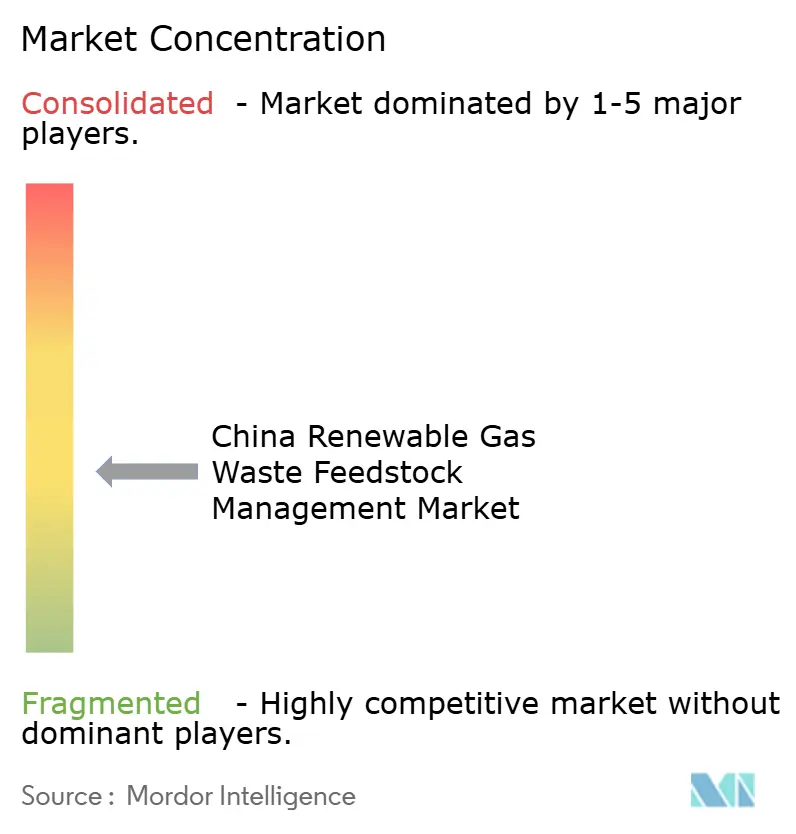
| Market Concentration | Medium |
Major Players *Disclaimer: Major Players sorted in no particular order Image © Mordor Intelligence. Reuse requires attribution under CC BY 4.0. | |
China Renewable Gas Waste Feedstock Management Market Analysis by Mordor Intelligence
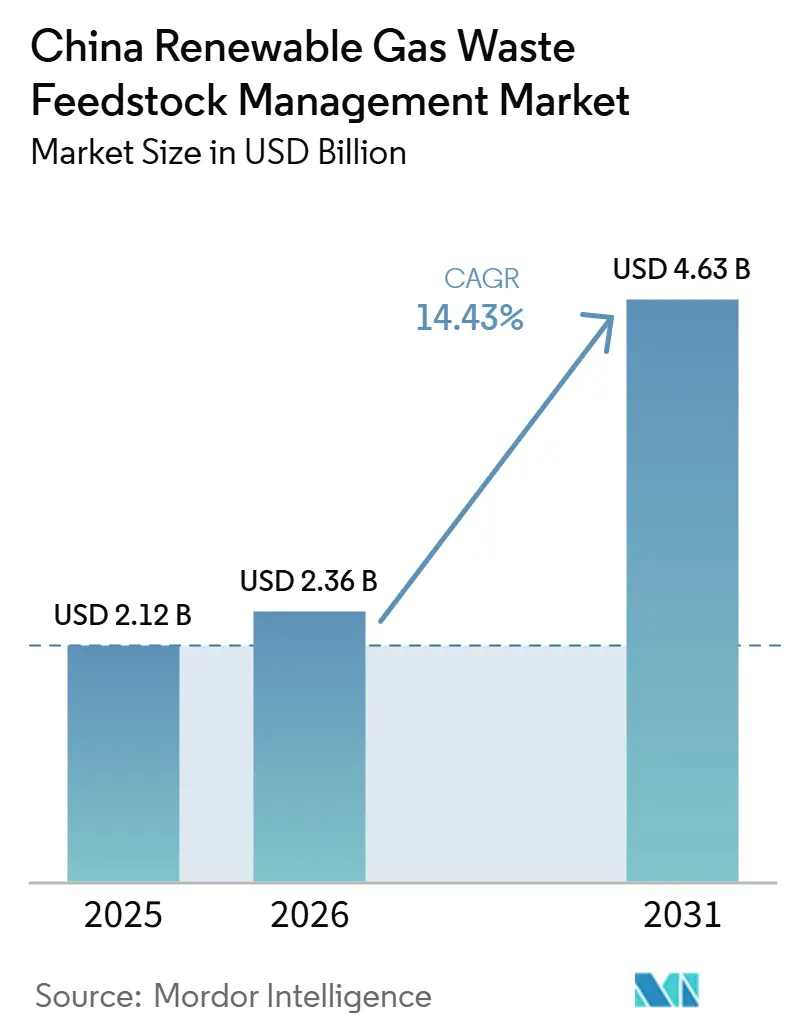
The China Renewable Gas Waste Feedstock Management Market size is expected to grow from USD 2.12 billion in 2025 to USD 2.36 billion in 2026 and is forecast to reach USD 4.63 billion by 2031 at 14.43% CAGR over 2026-2031.
The China renewable gas waste feedstock management market is moving from waste disposal toward organized feedstock supply chains that support bio-natural gas production. The International Energy Agency expects China’s combined biogas and biomethane output to increase 23% between 2025 and 2030, while medium- and large-scale bio-natural gas projects are expected to grow by 80%, making reliable feedstock supply a central operating issue. National biomethane ambitions, waste sorting requirements, and provincial demonstration projects support collection, quality control, and traceability services across the China renewable gas waste feedstock management market. The commercial value of these services depends on regular deliveries, lower contamination, and a clear record of how material moves from its source to a processing site. Eastern provinces remain the main processing and infrastructure centers, while livestock-producing provinces provide a large share of the underlying agricultural feedstock.
Key Report Takeaways
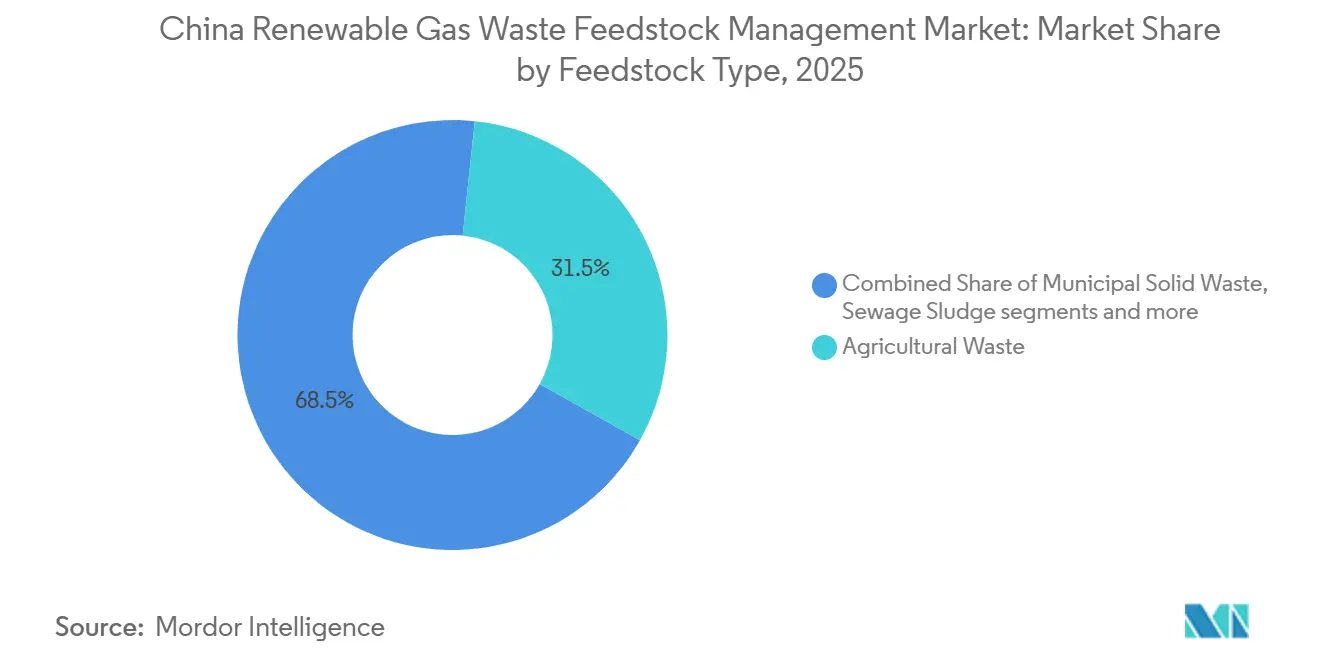
- By feedstock type, agricultural waste held 31.5% of the China renewable gas waste feedstock management market share in 2025, while food & beverage processing waste is forecast to expand at a 14.3% CAGR through 2031.
- By end-use facility type, anaerobic digestion (AD) plants accounted for 43.6% of the China renewable gas waste feedstock management market size in 2025, while gasification / thermal treatment facilities are projected to grow at a 15.1% CAGR through 2031.
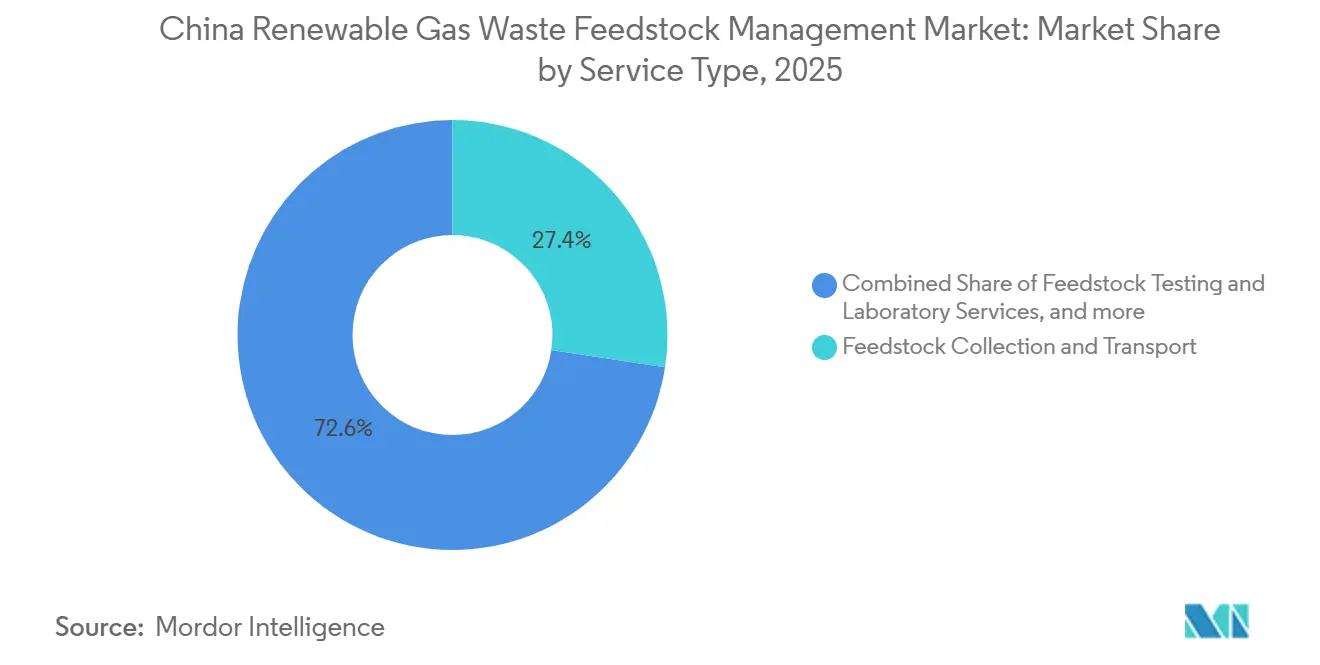
- By service type, feedstock collection & transport accounted for 27.4% in 2025, while digital feedstock monitoring platforms are forecast to grow at a 16.1% CAGR through 2031.
Note: Market size and forecast figures in this report are generated using Mordor Intelligence’s proprietary estimation framework, updated with the latest available data and insights as of January 2026.
China Renewable Gas Waste Feedstock Management Market Trends and Insights
Drivers Impact Analysis*
| Driver | (~) % Impact on CAGR Forecast | Geographic Relevance | Impact Timeline |
|---|---|---|---|
| National Rural Biogas and Biomethane Programs Supporting Agricultural Collection | +3.5% | North and Central China, including Hebei, Shandong, Henan, Inner Mongolia, Jilin, and Xinjiang | Long term (≥ 4 years) |
| Mandatory Municipal Waste Segregation Expanding Organic Feedstock Availability | +2.8% | Eastern and Central Chinese cities, with national urban enforcement | Medium term (2-4 years) |
| Rapid Urbanization Increasing Municipal Organic Waste Generation | +2.3% | Eastern megacities and second- and third-tier inland urban centers | Medium term (2-4 years) |
| Livestock Industry Modernization: Strengthening Manure Supply Chains | +2.0% | Inner Mongolia, Sichuan, Henan, and Hebei | Medium term (2-4 years) |
| Food Waste Recycling Regulations Boosting Commercial Feedstock Recovery | +1.8% | First-tier and second-tier cities, including coastal food-service hubs | Short term (≤ 2 years) |
| Digital Waste Collection and Smart Feedstock Management Improving Supply Chain Efficiency | +1.5% | Shanghai, Guangdong, Zhejiang, and expanding the national pilot activity | Short term (≤ 2 years) |
| Source: Mordor Intelligence | |||
National Rural Biogas and Biomethane Programs Driving Agricultural Feedstock Collection
The 14th Five-Year Plan for Renewable Energy Development identified Hebei, Shandong, Henan, Anhui, Inner Mongolia, Jilin, and Xinjiang as priority areas for bio-natural gas demonstration activity.[1]Projects in these areas combine feedstock collection, organic fertilizer production, and gas distribution rather than relying only on standalone digesters. The State Council’s January 2026 action plan set a 2030 target of 4.5 billion tons of bulk solid waste recycled each year, supporting the broader need for organized resource-use systems. Agricultural networks are therefore moving from smallholder collection toward defined logistics, testing, quality assurance, and traceability arrangements. This change increases the role of specialized providers in the China renewable gas waste feedstock management market.
Manure and slurry collection is especially important in intensive livestock areas, where consistent volumes can support larger renewable gas projects. Integrated project designs also connect feedstock handling with fertilizer and gas revenue, which improves the value of coordinated collection. The policy direction makes agricultural feedstock a long-term foundation for the China renewable gas waste feedstock management market. It also raises the importance of service providers that can verify input quality before delivery. The resulting supply chains are more complex than the farm-level biogas model that was common before 2018.
Mandatory Municipal Waste Segregation Expanding Organic Feedstock Availability
China’s domestic waste classification program requires household food waste to be separated from general refuse. A 2025 study cited Ministry of Housing and Urban-Rural Development data showing that classification rates in pilot cities rose from 15% to 82.5% over the subsequent years. Shanghai’s Zero Waste City Regulations, effective June 2024, established a traceable recycling system that covers solid waste categories and collection stages. Better separation reduces contamination that would otherwise require more de-packaging and screening at treatment facilities. It expands the usable municipal organic stream for the China renewable gas waste feedstock management market.
Sorting also makes community-scale composting and biological treatment more feasible, where contamination previously limited their use. These segregation initiatives improve feedstock quality and expand the supply of source-separated organic waste, strengthening the availability of reliable feedstock for renewable gas production as adoption increases across additional municipalities. The rollout into second-tier cities is likely to extend the regulated organic feedstock pool over several years. Licensed collection and transport providers benefit because municipalities need documented handling from source to facility. The effect is strongest where local enforcement and resident compliance are consistent.
Rapid Urbanization Increasing Municipal Organic Waste Generation
Urbanization expands the amount of organic waste available to formal collection systems, particularly as inland cities develop more structured waste services. Zhengzhou, Wuhan, Hefei, and Changsha have reached waste volumes that can support dedicated collection infrastructure. Restaurants, catering businesses, central kitchens, and food processors create concentrated food waste streams that provide consistent, high-quality feedstock for biomethane production. The China renewable gas waste feedstock management market therefore extends beyond household waste into commercial recovery systems.
The growth of urban food consumption supports a continuing flow of recoverable material independent of individual project incentives. The State Council’s January 2026 action plan broadened formal waste management responsibilities across county-level governments. This expands the institutional basis for collection in interior provinces. Municipal operators will need vehicles, sorting systems, and transfer systems that can handle an increasing number of sources. The result is a wider operational footprint for organic feedstock services.
Livestock Industry Modernization: Strengthening Manure Feedstock Supply Chains
China’s livestock sector is moving from dispersed smallholder activity toward larger intensive farms. This creates more consistent and accessible manure volumes for collection and treatment. Larger operations can use closed-loop treatment systems that combine manure handling, anaerobic fermentation, biogas storage, and operating controls. A 2025 Waste Management study found that intensive swine operations are the leading source of methane emissions and that earlier deployment of anaerobic digestion offers better near-term cost-effectiveness. These conditions support the agricultural base of the China renewable gas waste feedstock management market.
The T/WEA 028-2026 standard, effective in April 2026, formalized digital control requirements for the use of high-value manure on large livestock farms. It covers IoT-based monitoring, cloud data uploads, and remote operating controls. These requirements bring data management closer to daily manure collection and processing decisions. The broader bio-natural gas policy direction supports a more organized approach to handling livestock waste across dense producing provinces. This policy mix supports investment in aggregation logistics across livestock-dense provinces.
Restraints Impact Analysis*
| Restraint | (~) % Impact on CAGR Forecast | Geographic Relevance | Impact Timeline |
|---|---|---|---|
| Inconsistent Source Separation Reducing Feedstock Quality | -1.8% | National, with stronger effects in rural areas and inland cities | Short term (≤ 2 years) |
| Regional Disparities in Organic Waste Collection Infrastructure | -1.4% | Western provinces and mountainous rural areas | Long term (≥ 4 years) |
| High Moisture Content and Feedstock Variability Increasing Pre-Treatment Requirements | -1.0% | National, especially mixed-input urban streams | Medium term (2-4 years) |
| Limited Commercial Biomethane Offtake Infrastructure | -0.8% | National, particularly outside tier-1 cities and gas-grid corridors | Long term (≥ 4 years) |
| Source: Mordor Intelligence | |||
Inconsistent Source Separation Reducing Feedstock Quality
Source separation remains uneven between urban and rural areas, which reduces the consistency of organic feedstock delivered to facilities. A 2026 Frontiers in Sustainability study found that mandatory sorting policies produced less consistent behavioral outcomes in rural settings than in urban areas. Plastic film, packaging residue, and heavy metals in food waste require added de-packaging and screening. These requirements raise the operating burden on the China renewable gas waste feedstock management market. Quality variability also makes reliable blending more difficult for anaerobic digestion facilities.
The 2020 Solid Waste Law assigns county-level governments the responsibility for classified collection, transport, and treatment systems. Its practical effect differs because enforcement capacity and fiscal resources differ across regions. Major cities generally achieve higher sorting quality than rural areas and smaller inland cities. Digital monitoring can improve visibility, but it cannot fully replace consistent separation at the source. Without targeted county-level capacity building, this restraint will persist in the short term.
Regional Disparities in Organic Waste Collection Infrastructure
The main infrastructure gap lies between the eastern processing centers and the central and western areas where much of the agricultural feedstock originates. A 2025 Land study covering 98 counties found that separation-bin coverage in poor central and western counties reached 12% of villages, while coverage was close to universal in eastern coastal administrative villages.[2]Mountainous communities face additional transfer barriers due to narrow roads that limit access by large vehicles. This weakens collection frequency and raises logistics costs. The China renewable gas waste feedstock management market needs locally suitable transport and transfer arrangements in these locations.
Solid Waste Law requires county-level local governments to accelerate the implementation of household waste management systems. Fiscal limits in western provinces slow construction even where the policy obligation is clear. The January 2026 State Council action plan recognizes the need to expand the use of solid waste resources, but achieving its 2030 objectives will require continued capital and operating capacity. High moisture content and mixed feedstock streams add pre-treatment requirements across the country. Commercial biomethane offtake infrastructure also remains limited outside tier-1 cities and major gas-grid corridors, reducing the incentive for upstream investment.
*Our forecasts treat driver/restraint impacts as directional, not additive. The impact forecasts reflect baseline growth, mix effects, and variable interactions.
Segment Analysis
By Feedstock Type: Agricultural Waste Provides the Main Supply Base
Agricultural waste accounted for 31.5% of the China renewable gas waste feedstock management market in 2025. Operators can use these feedstocks to increase biogas yield from lower-energy feedstocks. Manure, slurry, and crop residues are central to the China renewable gas waste feedstock management market because of the national program’s rural focus. Inner Mongolia, Sichuan, and Henan have high livestock density, generating significant manure volumes. The policy target for manure use across 95% of husbandry operations reinforces this dependence.
Food and beverage processing waste is forecast to expand at a 14.3% CAGR between 2026 and 2031. This material includes fats, oils, grease, spent grains, and off-specification food products from commercial manufacturing. Its high calorific content and lower contamination make it useful for co-digestion. Municipal organic waste has expanded under mandatory classification, but variable contamination continues to undermine its economic competitiveness. Sewage sludge provides stable volumes but requires technically managed co-digestion, while industrial organic waste remains a smaller, higher-value stream in major manufacturing clusters.

By End-Use Facility Type: Anaerobic Digestion Leads While Gasification Expands
Anaerobic digestion plants represent the leading destination for managed waste feedstocks in China, accounting for 43.6% of the market share in 2025. Their position reflects operating maturity and compatibility with a broad range of organic inputs. The first biomethane purchase agreements involving Chinese bio-natural gas operators were signed in 2024, shifting more anaerobic digestion projects toward commercial gas supply.
Gasification and thermal treatment facilities are forecast to grow at a 15.1% CAGR between 2026 and 2031. These facilities can process heterogeneous, low-purity materials that anaerobic digestion plants may reject. This relationship makes gasification a complement to anaerobic digestion because it can absorb residual or contaminated fractions. Landfill gas recovery sites are expected to decline as organic diversion reduces the amount of biodegradable waste entering landfills. Wastewater treatment plants can use existing sludge as base-load input, lowering feedstock acquisition costs. A 2025 study found that anaerobic digestion accounted for 70% of technology deployments in centralized food-waste processing, although facility utilization remained constrained in some regions due to inconsistent feedstock availability and variable collection efficiency. Pyrolysis and hydrothermal treatment can also convert biogas residue into biochar or hydrochar, providing an additional downstream route for integrated operators.
By Service Type: Collection Supports Revenue While Digital Monitoring Grows Fastest
Feedstock collection and transport services hold the largest share of revenue in the China renewable gas waste feedstock management market, accounting for 27.4% in 2025. Sealed vehicles, cold-chain requirements for food waste, and compliance-certified weighing systems make this service capital-intensive. These requirements create barriers that favor established licensed operators. Testing and quality assurance services become more important as operators combine multiple feedstock types. They help facilities manage composition and improve processing performance.
The China renewable gas waste feedstock management market size for digital feedstock monitoring platforms is forecast to expand at a 16.1% CAGR between 2026 and 2031. A 2025 peer-reviewed study described a system that uses IoT, AI, and life-cycle assessment to match waste data with treatment paths at 15-minute intervals. Supply chain management and consultancy are also gaining use as projects coordinate multiple inputs and collection locations. Digital records can support feedstock traceability and future carbon certification for biomethane. These capabilities make data services important to the China renewable gas waste feedstock management market as large projects seek more reliable blending and operating control.
Geography Analysis
The eastern coastal provinces were the main processing and infrastructure concentration zone in 2025. Jiangsu, Zhejiang, Guangdong, and Shandong benefit from dense urban activity, food-service demand, and greater fiscal capacity for waste classification and biogas infrastructure. Shanghai’s regulations created a traceable system for all waste categories and collection stages, including organic fraction handling. [3]The China renewable gas waste feedstock management market benefits from this policy density because it supports a more predictable collection system. Eastern provinces also have a large concentration of food and beverage manufacturing, which provides higher-value organic processing waste.
Inner Mongolia, Henan, Sichuan, and Anhui are the principal feedstock origination areas by volume. Henan, Anhui, Inner Mongolia, and Xinjiang were included in the bio-natural gas demonstration county priorities. The China renewable gas waste feedstock management market in these regions centers on aggregation and pre-treatment near agricultural supply. PetroChina is commissioning bio-natural gas plants in provinces with abundant agricultural waste, increasing the need for professional upstream services. These provinces must connect dispersed supply areas to processing plants with dependable local logistics.
Western provinces face slower infrastructure rollout because of terrain, lower population density, and limited local fiscal capacity. The 12% village bin coverage recorded in poor central and western counties highlights this geographic gap. The 2026 action plan supports broader recycling and resource use, but it does not eliminate near-term delivery constraints. The China renewable gas waste feedstock management market therefore has different needs across regions. Eastern areas need improvements in quality and traceability, while western areas need suitable collection infrastructure and transport capacity.
Competitive Landscape
The China renewable gas waste feedstock management market exhibits a medium level of market concentration, with competition across municipal collection operators, specialist feedstock processing providers, and integrated renewable gas developers. Companies differentiate themselves through collection coverage, feedstock quality management, pretreatment capabilities, regulatory compliance, and digital traceability.
State-owned environmental service groups, including China Everbright Environment Group, maintain strong positions through long-term municipal collection contracts, established transportation fleets, and extensive experience with local waste management regulations. Their broad collection networks provide access to large volumes of municipal organic waste, although inconsistent source segregation practices continue to make feedstock quality management challenging. China Everbright's commercialization of biomethane technology, disclosed in its 2025 annual results, further strengthens its integrated feedstock management capabilities and renewable gas value chain.
Specialist technology providers, such as BTA International and Eggersmann, compete through advanced wet mechanical-biological pretreatment, contamination removal, laboratory testing, and quality assurance systems. Their expertise helps operators deliver more consistent feedstock specifications for downstream biomethane production, particularly when mixed municipal waste requires extensive conditioning.
Integrated energy developers, including PetroChina, strengthen the market by connecting feedstock sourcing with biomethane production and gas distribution. PetroChina's agricultural-waste biomethane project in Dayi County achieved Class I gas quality for urban grid injection, demonstrating the growing importance of integrated feedstock management, upgrading, and distribution capabilities.
Overall, the China renewable gas waste feedstock management market remains attractive for companies that can combine strong local collection networks with advanced feedstock conditioning, digital traceability, quality control, and cross-provincial supply chain coordination.
China Renewable Gas Waste Feedstock Management Industry Leaders
-
China Everbright Environment Group Limited
-
Beijing Enterprises Environment Group Limited
-
China Tianying Inc.
-
Shanghai WELLE Environmental Technology Co., Ltd.
-
Veolia Environnement S.A.
- *Disclaimer: Major Players sorted in no particular order
Recent Industry Developments
- April 2026: China Everbright Environment Group disclosed its 2025 annual results on HKEX in March 2026, confirming the Group's first commercialization of biomethane technology, with its inaugural BNG project supplying Jingjiang Special Steel Co. Ltd. Two additional projects were secured, totaling RMB 72 million (USD 10.3 million) in investment with a designed annual biomethane supply capacity of 10 million Nm³/year, marking the Group's strategic entry into integrated feedstock-to-BNG production.
- April 2026: Beijing Enterprises Holdings Limited released its 2025 annual results on HKEX, reporting combined natural gas sales volume of 25.2 billion cubic meters in 2025, a 5.9% year-on-year increase, and confirming accelerated investment in green energy and organic waste feedstock integration opportunities as part of its 15th Five-Year Plan growth strategy under the Four Strongholds framework.
China Renewable Gas Waste Feedstock Management Market Report Scope
The China Renewable Gas Waste Feedstock Management Market Report is Segmented by Feedstock Type (Municipal Solid Waste, Agricultural Waste, Sewage Sludge, and More), by End-Use Facility Type (Anaerobic Digestion (AD) Plants, Landfill Gas Recovery Sites, and More), and by Service Type (Feedstock Collection & Transport, Feedstock Testing & Laboratory Services, and More). The Market Forecasts are Provided in Terms of Value (USD).
| Municipal Solid Waste (Organic Fraction / Source-Separated) |
| Agricultural Waste (Manure, Slurry, Crop Residues) |
| Sewage Sludge / Biosolids |
| Food & Beverage Processing Waste (FOG, Spent Grains, Off-Spec Product) |
| Industrial Organic Waste (Breweries, Paper Mills, Pharma Effluent) |
| Others |
| Anaerobic Digestion (AD) Plants |
| Landfill Gas Recovery Sites |
| Gasification / Thermal Treatment Facilities |
| Wastewater Treatment Plants (Co-Digestion) |
| Others (Pyrolysis, Hydrothermal) |
| Feedstock Collection & Transport |
| Feedstock Testing & Laboratory Services |
| Feedstock Quality Assurance |
| Digital Feedstock Monitoring Platforms |
| Feedstock Supply Chain Management & Consultancy |
| By Feedstock Type | Municipal Solid Waste (Organic Fraction / Source-Separated) |
| Agricultural Waste (Manure, Slurry, Crop Residues) | |
| Sewage Sludge / Biosolids | |
| Food & Beverage Processing Waste (FOG, Spent Grains, Off-Spec Product) | |
| Industrial Organic Waste (Breweries, Paper Mills, Pharma Effluent) | |
| Others | |
| By End-Use Facility Type | Anaerobic Digestion (AD) Plants |
| Landfill Gas Recovery Sites | |
| Gasification / Thermal Treatment Facilities | |
| Wastewater Treatment Plants (Co-Digestion) | |
| Others (Pyrolysis, Hydrothermal) | |
| By Service Type | Feedstock Collection & Transport |
| Feedstock Testing & Laboratory Services | |
| Feedstock Quality Assurance | |
| Digital Feedstock Monitoring Platforms | |
| Feedstock Supply Chain Management & Consultancy |
Key Questions Answered in the Report
What is driving renewable gas waste feedstock management in China?
Waste sorting rules, rural bio-natural gas programs, livestock consolidation, and stronger organic waste collection systems are supporting growth.
How large is China’s renewable gas waste feedstock management sector?
The sector was valued at USD 2.12 billion in 2025 and is forecast to reach USD 4.63 billion by 2031, with 14.4% CAGR.
Which feedstock is expected to grow fastest for renewable gas projects in China?
Food and beverage processing waste is forecast to expand at a 14.3% CAGR through 2031, driven by its high calorific value and relatively low contamination.
Which facilities use managed renewable gas feedstocks most widely in China?
Anaerobic digestion plants lead with 43.6% market share, while gasification and thermal treatment facilities are forecast to grow at a 15.1% CAGR through 2031.
What limits the expansion of China’s feedstock supply chains?
Inconsistent source separation, infrastructure gaps in western provinces, variable moisture levels, and limited biomethane offtake routes remain important constraints.
Which services have the strongest growth potential in this sector?
Digital feedstock monitoring platforms are forecast to grow at a 16.1% CAGR through 2031, supported by traceability and blending requirements.